

Evolution of Electronic Procurement: Contemporary Review of Adoption and Implementation Strategies
Open accessThe DOI matches its Crossref record; 87 of the 87 references it cites were found in a registry or an index.
Abstract
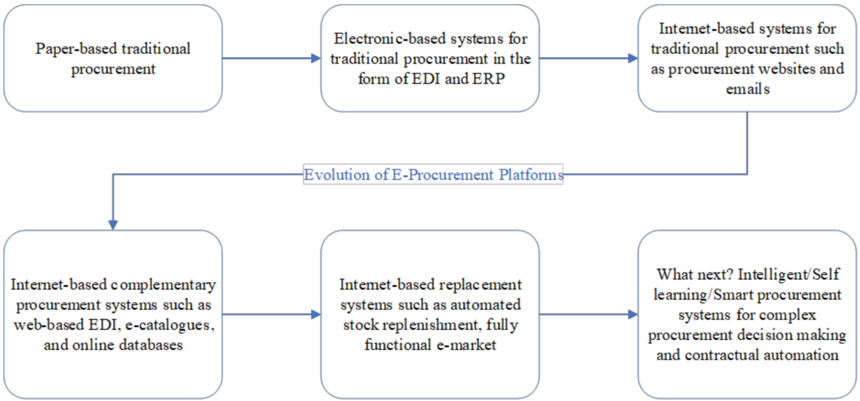
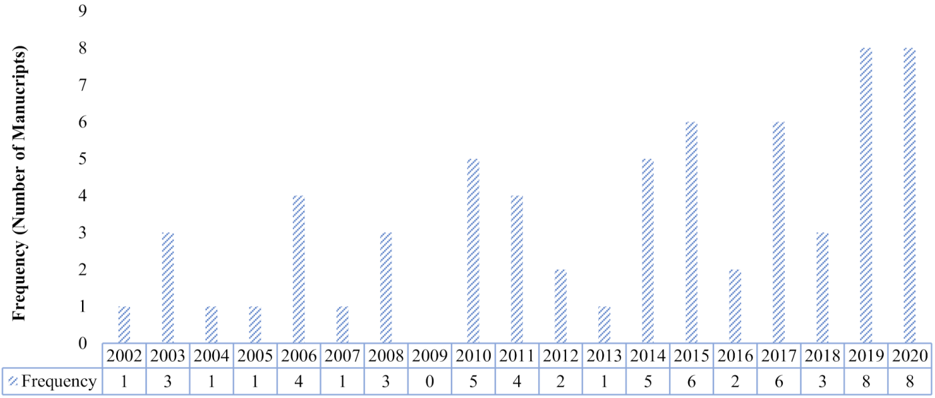
Since the advent of the first form of electronic procurement (EP), the procurement process (i.e., the stages and underlying activities) has evolved to transform the world of commerce significantly. In the construction industry, EP has revolutionized the operational schema of traditional procurement and has paved the way for the development, advancement, and application of more intelligent tools for handling and executing procurement activities of infrastructure-related works. Although the development or adoption of EP-related tools has not been encouraging due to the industry’s conservative nature, in this study, we review the evolution and developments of EP to date. It explores the adoption and implementation strategies of extant and projected EP developments and develops a conceptual framework to explicate the developmental transitions of EP. While there are many studies on EP, there is still a long way to transition into a more intelligent execution of EP-related activities. A total of 64 EP-related manuscripts and other valuable studies were examined to realize the stipulated objective as well as identify the thematic constructs developed under the subject matter. The explorations conducted in this study are intended to contribute to the understanding of the extant discussion on both EP and smart procurement (SP), their adoption strategies, implementation, and applications in infrastructure projects. It elucidates the significant constructs that define and underpin the theoretical implications of EP and SP adoption and implementation. Lastly, the framework highlights the projected developments and transition phases of EP to intelligent procurement (IP).
Overview
The claims and statistics of this paper haven’t been checked yet.
Free: it reads the open-access text and checks the first 5 claims that cite a source we can check. Create a free account to check every claim.
Integrity signals
Registry
Cites
Statistics
Figures
Verification
Claims the paper makes
The claims and statistics of this paper haven’t been checked yet.
Free: it reads the open-access text and checks the first 5 claims that cite a source we can check. Create a free account to check every claim.
Claims other papers make about this one
Each is checked against this paper’s own text: does it say what the citing paper says it does?
The cited source says what the claim attributes to it.
In the citing paper
“Chan et al. [84] provide a comprehensive overview of the evolution and development of e-procurement, highlighting its significance in optimizing the supply chain by reducing costs and improving efficiency.”
From Transformative Procurement Trends: Integrating Industry 4.0 Technologies for Enhanced Procurement Processes (2023) · cites this paper as [84]
Experimental — accuracy not yet measured
Self-check
Percentages, sums and reported differences re-computed from the paper’s own numbers.
The self-check needs the paper’s full text.
Citations
Cites
Personal Computing: Toward a Conceptual Model of Utilization1
Thompson, R. L., Higgins, C. A., & Howell, J. M. (1991) · MIS Quarterly · doi:10.2307/249443 · Cited by 3,814
Understanding Technology Adoption: Theory and Future Directions for Informal Learning
Straub, E. T. (2009) · Review of Educational Research · doi:10.3102/0034654308325896 · Cited by 1,265
A motivational model of microcomputer usage
Igbaria, M., Parasuraman, S., & Baroudi, J. J. (1996) · Journal of Management Information Systems · doi:10.1080/07421222.1996.11518115 · Cited by 915
Osei-Kyei, R., & Chan, A. P. C. (2015) · International Journal of Project Management · doi:10.1016/j.ijproman.2015.02.008 · Cited by 803 · cited 1×
“Prior to the commencement of any research project, it is necessary for researchers to acquaint themselves with the extant theories surrounding the subject matter to be ex‐ plored and critical to identifying relevant gaps highlighted or missing in the literature [48,49].”
BackgroundSelf-citationEriksson, P. E., & Westerberg, M. (2011) · International Journal of Project Management · doi:10.1016/j.ijproman.2010.01.003 · Cited by 363 · cited 1×
“tems or methods have been developed to suit the specific needs and demands of a project [28,32,33].”
MethodTsai, C., & Lydia Wen, M. (2005) · International Journal of Science Education · doi:10.1080/0950069042000243727 · Cited by 307 · cited 1×
“Prior to the commencement of any research project, it is necessary for researchers to acquaint themselves with the extant theories surrounding the subject matter to be ex‐ plored and critical to identifying relevant gaps highlighted or missing in the literature [48,49].”
BackgroundCritical factors that influence e-procurement implementation success in the public sector
Vaidya, K., Sajeev, A. S. M., & Callender, G. (2006) · Journal of Public Procurement · doi:10.1108/jopp-06-01-02-2006-b004 · Cited by 293
Professional ethics in the construction industry
Vee, C., & Skitmore, C. (2003) · Engineering, Construction and Architectural Management · doi:10.1108/09699980310466596 · Cited by 239
A service oriented framework for construction supply chain integration
Cheng, J. C. P., Law, K. H., Bjornsson, H., Jones, A., & Sriram, R. (2010) · Automation in Construction · doi:10.1016/j.autcon.2009.10.003 · Cited by 227
Sustainable procurement: Past, present and future
Walker, H., Miemczyk, J., Johnsen, T., & Spencer, R. (2012) · Journal of Purchasing and Supply Management · doi:10.1016/j.pursup.2012.11.003 · Cited by 202
Research works printed but not linked: 7
- Sutt, J. Manual of Construction Project Management: For Owners and Clients; Wiley: Chichester, UK, 2011.
- Egbu, C.; Vines, M.; Tookey, J. The Role of Knowledge Management in e-Procurement Initiatives for Construction Organisations. In Proceedings of the 19th Annual ARCOM Conference, Brighton, UK, 3-5 September 2003; pp. 661-671.
- Hanák, T.; Šelih, J. Online reverse auctions in construction industry. Gra devinar 2017, 69, 821-830.
- Hackett, M.; Robinson, I.; Statham, G. (Eds.) The Aqua Group Guide to Procurement, Tendering and Contract Administration; Blackwell Publishing: Oxford, UK, 2007.
- Issa, R.R.; Flood, I.; Caglasin, G. A survey of e-business implementation in the US construction industry. J. Inf. Technol. Constr. ITcon 2003, 8, 15-28.
- Rogers, E.M. Diffusion of Innovations; Free Press: New York, NY, USA, 1983.
- Tran, Q.D.; Nguyen, T.Q.T.; Nazir, S. Initial Adoption vs Institutionalization of e-Procurement in Construction Firms: The Role of Government in Developing Countries. In Web Design and Development: Concepts, Methodologies, Tools, and Applications; IGI Global: Hershey, PA, USA, 2016; pp. 1417-1437.
Cited by
Althabatah, A., Yaqot, M., Menezes, B., & Kerbache, L. (2023) · Logistics · doi:10.3390/logistics7030063 · Cited by 108
“Chan et al. [84] provide a comprehensive overview of the evolution and development of e-procurement, highlighting its significance in optimizing the supply chain by reducing costs and improving efficiency.”
BackgroundDeveloping legal frameworks for successful engineering, procurement, and construction projects
Latilo, A., Uzougbo, N. S., Ugwu, M. C., Oduro, P., & Aziza, O. R. (2024) · International Journal of Applied Research in Social Sciences · doi:10.51594/ijarss.v6i8.1430 · Cited by 83
WELL Building: Key Design Features for Office Environments
Tan, C. Y. M., & Rahman, R. A. (2023) · Journal of Architectural Engineering · doi:10.1061/jaeied.aeeng-1544 · Cited by 12
Addy, M. N., Addo, E. T., Abdulai, S. F., Kwofie, T. E., Aigbavboa, C. O., & Adade-Boateng, A. O. (2024) · Journal of Engineering Design and Technology · doi:10.1108/jedt-08-2023-0373 · Cited by 25
Advanced Analytics and Data Management in the Procurement Function: An Aviation Industry Case Study
Altundag, A., & Wynn, M. G. (2024) · Electronics · doi:10.3390/electronics13081554 · Cited by 20
Inusah, Y., Kazaz, A., & Ulubeyli, S. (2025) · Sustainability · doi:10.3390/su17052052 · Cited by 27
Revolution of South African public procurement in the Industry 4.0 era
Mojaki, L. M., Tuyikeze, T., & Ndlovu, N. K. (2024) · Journal of Transport and Supply Chain Management · doi:10.4102/jtscm.v18i0.1079 · Cited by 6
E-Procurement in the Australian Construction Industry: Benefits, Barriers, and Adoption
Hayden, E., Chan, M., van Kan, D., Arowoiya, V. A., & Arifin, M. A. M. (2023) · Proceedings e report · doi:10.36253/10.36253/979-12-215-0289-3.47 · Cited by 4
Alshehhi, K., Cheaitou, A., & Rashid, H. S. (2024) · International Journal of Systems Assurance Engineering and Management · doi:10.1007/s13198-024-02653-9 · Cited by 8
“Other studies have likewise used it in their investigation of AI e.g. (Attard-Frost et al. 2022; Carvalho and Kazim 2022; Chan and Owusu 2022).”
Ntshingila, M. L. (2025) · EUREKA Social and Humanities · doi:10.21303/2504-5571.2025.003703 · Cited by 6
Nchabeleng, L. S., & Ncube, E. D. (2025) · Journal of Transport and Supply Chain Management · doi:10.4102/jtscm.v19i0.1199 · Cited by 8
Fernando, M. H., Hulathdoowage, N. D., & Perera, B. A. K. S. (2026) · Journal of Legal Affairs and Dispute Resolution in Engineering and Construction · doi:10.1061/jladah.ladr-1449 · Cited by 5
Arthur, B., Mwaseba, N. K., & Mnasi, H. M. (2023) · Global Journal of Purchasing and Procurement Management · doi:10.47604/gjppm.2203 · Cited by 4
TOWARDS DIGITAL FUTURE: UNLOCKING STRATEGIES TO INTEGRATE E-TENDERING IN THE CONSTRUCTION LANDSCAPE
Aziz, N. M. (2024) · PLANNING MALAYSIA · doi:10.21837/pm.v22i32.1500 · Cited by 5
“Nevertheless, several issues occur during its enforcement (Mehdipoor et al., 2022; Chan, & Owusu, 2022).”
BackgroundMethodElectronic Sourcing as an E-Procurement Practice and Its Role on Organizational Performance
Murithi, L. N., Ngugi, P. K., & Kiarie, D. (2024) · Journal Integration of Social Studies and Business Development · doi:10.58229/jissbd.v2i2.258 · Cited by 3
Putra, A. M. P., & Biantoro, A. W. (2025) · ASTONJADRO · doi:10.32832/astonjadro.v14i1.16391 · Cited by 2
Jama, E. M., Mwanza, B. G., & Mwanaumo, E. (2024) · African Journal of Commercial Studies · doi:10.59413/ajocs/v4.i3.5 · Cited by 2
“These theories not only shed light on the drivers and barriers to e-procurement adoption but also provide a basis for formulating strategies to enhance the adoption process (Chan & Owusu, 2022).”
BackgroundSultan, B., Al-Hammad, I., Alothman, A., & AlSehli, G. (2025) · Sustainability · doi:10.3390/su17083429 · Cited by 7
Myneni, K. K., & Santheya, A. (2025) · International Journal of Management and Humanities · doi:10.35940/ijmh.g1805.11100625 · Cited by 1
Synergy Between BIM and e-Procurement: A New Paradigm for Digital Procurement Management
Zitiello, E. P., Porcellini, F., Basile, E., Salzano, A., & Nicolella, M. (2025) · Lecture notes in computer science · doi:10.1007/978-3-031-97617-9_5 · Cited by 2
Kanyepe, J., & Alfaneta, M. (2025) · SN Business & Economics · doi:10.1007/s43546-025-00952-2 · Cited by 3
“It also involves the use of digital tools and platforms to manage the procurement lifecycle, including sourcing, purchasing, payment, and contract management, moving away from traditional paper-based or manual methods (Chan and Owusu 2022).”
Digitisation of Procurement and Information Modelling—Literature Review on e-Procurement
Basile, E., Porcellini, F., Zitiello, E. P., Spagnolo, S. L., Salzano, A., & Biancardo, S. A. (2026) · Buildings · doi:10.3390/buildings16101969 · Cited by 2
Bolívar, M. P. R., & Prados, M. P. (2022) · Lecture notes in computer science · doi:10.1007/978-3-031-15086-9_13 · Cited by 3
Baruti, S. P., Lwoga, E. T., & Komba, M. M. (2024) · Huria Journal of the Open University of Tanzania · doi:10.61538/huria.v30i1.1498 · Cited by 7
Asif, M., Siddiqui, M. S., & Sharma, H. P. (2024) · Journal of Science and Technology Policy Management · doi:10.1108/jstpm-03-2024-0100 · Cited by 6
Nchabeleng, L. S. (2023) · ResearchSpace (University of KwaZulu-Natal) · doi:10.29086/10413/23074 · Cited by 1
Dereje, H. M., & Habete, G. A. (2025) · African Journal of Science Technology Innovation and Development · doi:10.1080/20421338.2025.2542592 · Cited by 1
“Still, a designed system evolves through time, use, and testing (Chan and Owusu 2022).”
Okinyi, J. O., & Muli, S. (2025) · International Journal of Social Science and Humanities Research (IJSSHR) · doi:10.61108/ijsshr.v3i3.237
“The Procurement Module highlights the shift from traditional purchasing to integrated e-procurement systems encompassing e-sourcing, e-tendering, e-informing, and ERP-enabled collaboration (Chan & Owusu, 2022).”
Ashiqussalehin, M., Rahaman, M. A., & Sanaullah, M. (2025) · Journal of Computer Science and Technological Enquiry · doi:10.65496/jcste.2025.48 · Cited by 1
Effects of Implementing E-Procurement on Organizational Performance: The Case of African Union
Shewangzaw, B., Omer, A., & Aydagn, A. (2026) · Innovation Business · doi:10.11648/j.ib.20260101.15
Mittal, S., & Jha, K. N. (2026) · Journal of Legal Affairs and Dispute Resolution in Engineering and Construction · doi:10.1061/jladah.ladr-1533
Software Procurement Duplicate Detection Using Fuzzy Matching and LLM Verification
Liao, C.-E., Wu, K.-D., Wang, L.-Y., Wang, S.-C., Chen, Y.-H., Lee, C.-P., & Peng, Y.-H. (2026) · IEEE International Conference on Consumer Technology (ICCT-Pacific) · doi:10.1109/icct-pacific69083.2026.11518888
“More broadly, e-procurement studies [2-7] highlight challenges such as integration complexity, inconsistent data, and limited visibility across catalogs, which in turn increase the risk of duplicate or near-duplicate orders and redundant payments.”
Mohamed, M. M., Ewusi, S. K., Ali, A. F., & Farah, M. A. (2026) · African Journal of Science Technology Innovation and Development · doi:10.1080/20421338.2026.2659628
“The inception of e-procurement dates to the early 1990s, when companies acknowledged the advantages of utilizing electronic technologies to enhance their pro-curement processes (Chan and Owusu 2022).”
Cerezo-Narváez, A., Delgado, M. G., Ramírez-Peña, M., Sánchez-García, D., & Ramos, J. S. (2026) · Frontiers in Artificial Intelligence · doi:10.3389/frai.2026.1962132
Metadata
- Authors
- Chan, A. P. C., & Owusu, E. K.
- Affiliations
- Hong Kong Polytechnic University (HK)
- Corresponding author
- Chan, Albert P. C.
- Venue
- Buildings
- Publisher
- MDPI AG
- Published
- 2022-02-09
- Volume
- 12
- Issue
- 2
- Pages
- 198
- ISSN
- 2075-5309 (ISSN-L)
- OpenAlex
- W4211076466
- Cited by
- 34
- References
- 87
- Citations by year
- 2026: 7 · 2025: 11 · 2024: 10 · 2023: 5 · 2022: 1
- FWCI
- 5.04
- Type
- journal article
- Language
- en
- Open access
- gold
- doi.org
- Licence
- Locations
- Buildings (publishedVersion, cc-by)
- DOAJ (DOAJ: Directory of Open Access Journals) (submittedVersion, cc-by-sa)
- PolyU Institutional Research Archive (Hong Kong Polytechnic University) (submittedVersion, cc-by)
- Funders
- Hong Kong Polytechnic University
- Topics
- Social Sciences › Business, Management and Accounting › Strategy and Management › Public Procurement and Policy
- Physical Sciences › Engineering › Building and Construction › BIM and Construction Integration
- Social Sciences › Decision Sciences › Management Science and Operations Research › Construction Project Management and Performance
- Keywords
- e-procurement, technology adoption strategies, implementation strategies, construction industry, infrastructure projects, conceptual framework
About these checks
Registry, retraction, Cites and statistics results are computed, not judged, with one exception: a printed reference that no index lists is read once by a model before it counts as a citation error. Claims are extracted by a model and kept only when their quote appears verbatim in the text; each cited source is then checked, with a model’s help, for whether it says what the claim relies on. Those verdicts can be wrong — read the claim’s quote and the cited source before relying on one.
Statistics and arithmetic are recomputed, not judged.
Confidence bands are shown only for fields calibrated on our annotated test set. None is calibrated yet, so no band is shown.
What counts as a claim ›How we measure confidence ›How we check this ›
Are you an author, or do you see a problem with this page? Request a review
Data sources
Bibliographic data: Semantic Scholar, OpenAlex, Crossref.
Contains information from the Semantic Scholar Academic Graph Datasets, made available under the ODC Attribution License (ODC-BY 1.0).
Semantic Scholar’s data is described in: Kinney, R., et al. (2023). The Semantic Scholar Open Data Platform. arXiv:2301.10140.
