

The DOI matches its Crossref record; 202 of the 202 references it cites were found in a registry or an index.
Regulation of TNF-Induced Osteoclast Differentiation
Open accessAbstract
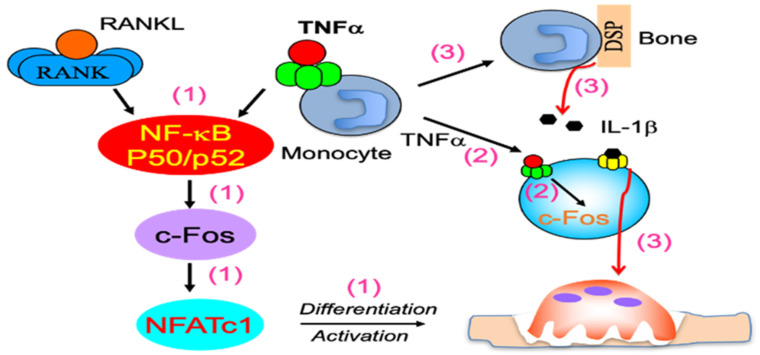
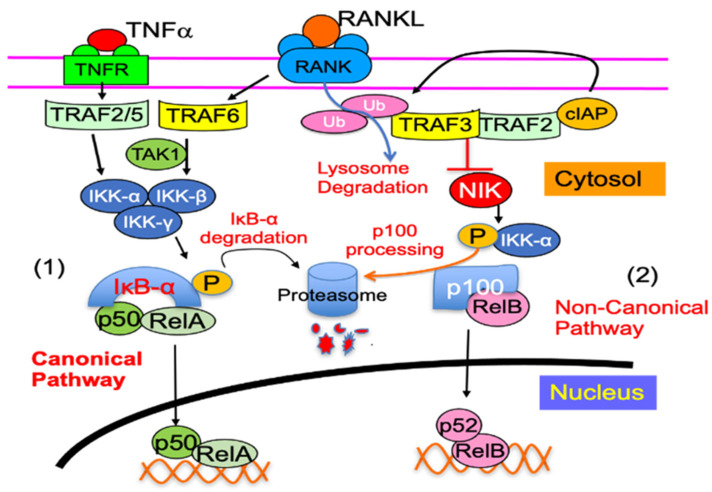
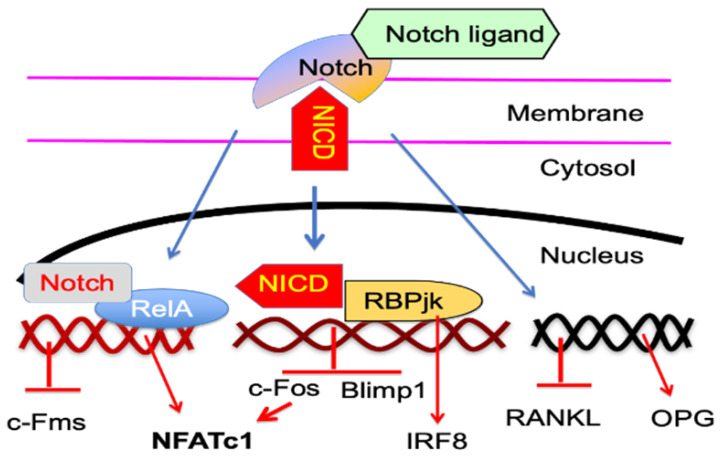
Increased osteoclast (OC) differentiation and activity is the critical event that results in bone loss and joint destruction in common pathological bone conditions, such as osteoporosis and rheumatoid arthritis (RA). RANKL and its decoy receptor, osteoprotegerin (OPG), control OC differentiation and activity. However, there is a specific concern of a rebound effect of denosumab discontinuation in treating osteoporosis. TNFα can induce OC differentiation that is independent of the RANKL/RANK system. In this review, we discuss the factors that negatively and positively regulate TNFα induction of OC formation, and the mechanisms involved to inform the design of new anti-resorptive agents for the treatment of bone conditions with enhanced OC formation. Similar to, and being independent of, RANKL, TNFα recruits TNF receptor-associated factors (TRAFs) to sequentially activate transcriptional factors NF-κB p50 and p52, followed by c-Fos, and then NFATc1 to induce OC differentiation. However, induction of OC formation by TNFα alone is very limited, since it also induces many inhibitory proteins, such as TRAF3, p100, IRF8, and RBP-j. TNFα induction of OC differentiation is, however, versatile, and Interleukin-1 or TGFβ1 can enhance TNFα-induced OC formation through a mechanism which is independent of RANKL, TRAF6, and/or NF-κB. However, TNFα polarized macrophages also produce anabolic factors, including insulin such as 6 peptide and Jagged1, to slow down bone loss in the pathological conditions. Thus, the development of novel approaches targeting TNFα signaling should focus on its downstream molecules that do not affect its anabolic effect.
Overview
The claims and statistics of this paper haven’t been checked yet.
Run the check — free, no account needed. It reads the open-access text and checks the sources it cites.
Integrity signals
Registry
Cites
Statistics
Figures
Verification
Claims the paper makes
The claims and statistics of this paper haven’t been checked yet.
Run the check — free, no account needed. It reads the open-access text and checks the sources it cites.
Claims other papers make about this one
Each is checked against this paper’s own text: does it say what the citing paper says it does?
The cited source says what the claim attributes to it.
In the citing paper
“Different concentrations of TGF-β have different effects on the RANKL/OPG ratio and ultimately on osteoclast differentiation (low concentrations of TGF-β increase the stimulation of osteoclast differentiation, while high concentrations of TGF-β have the opposite effect) [98, 99].”
From Modulation of fracture healing by senescence-associated secretory phenotype (SASP): a narrative review of the current literature (2024) · cites this paper as [99]
Self-check
Percentages, sums and reported differences re-computed from the paper’s own numbers.
The self-check needs the paper’s full text.
Citations
Cites
Exploring the full spectrum of macrophage activation
Mosser, D. M., & Edwards, J. P. (2008) · Nature Reviews Immunology · doi:10.1038/nri2448 · Cited by 9,144
Osteoprotegerin ligand is a cytokine that regulates osteoclast differentiation and activation.
Lacey, D. L., Timms, E., Tan, H.-L., Kelley, M. J., Dunstan, C. R., Burgess, T., Elliott, R., Colombero, A., Elliott, G., Scully, S., et al. (1998) · Cell · doi:10.1016/s0092-8674(00)81569-x · Cited by 5,439 · cited 2×
“In the late 1990s, two independent groups discovered that the receptor activator of nuclear factor-kappa B (NF-κB) ligand (RANKL), also named osteoprotegerin (OPG) ligand or osteoclast differentiation factor (ODF), is the additional factor that drives the terminal OC differentiation [67,68].”
BackgroundMonocyte and macrophage heterogeneity
Gordon, S., & Taylor, P. R. (2005) · Nature Reviews Immunology · doi:10.1038/nri1733 · Cited by 5,190
Osteoprotegerin: a novel secreted protein involved in the regulation of bone density.
Simonet, W. S., Lacey, D. L., Dunstan, C. R., Kelley, M., Chang, M.-S., Lüthy, R., Nguyen, H. Q., Wooden, S., Bennett, L., Boone, T., et al. (1997) · Cell · doi:10.1016/s0092-8674(00)80209-3 · Cited by 5,130 · cited 1×
“Thus, genetic deletion of OPG leads to osteoporosis in mice [77,78], and homozygous deletion of 100 kilobases of OPG gene in human results in juvenile Paget’s disease, characterized by osteopenia and fractures [79].”
BackgroundShared Principles in NF-κB Signaling
Hayden, M. S., & Ghosh, S. (2008) · Cell · doi:10.1016/j.cell.2008.01.020 · Cited by 4,945
The M1 and M2 paradigm of macrophage activation: Time for reassessment
Martinez, F. O., & Gordon, S. (2014) · F1000Prime Reports · doi:10.12703/p6-13 · Cited by 4,689
Macrophage biology in development, homeostasis and disease
Wynn, T. A., Chawla, A., & Pollard, J. W. (2013) · Nature · doi:10.1038/nature12034 · Cited by 4,684 · cited 3×
“Macrophages are classified as classically activated (inflammatory, M1) macrophages or alternatively activated (resident, M2) macrophages [57,136], which are linked to T helper 1 (Th1)- and Th2-type immune responses, respectively [137].”
BackgroundInfluentialYasuda, H., Shima, N., Nakagawa, N., Yamaguchi, K., Kinosaki, M., Mochizuki, S.-I., Tomoyasu, A., Yano, K., Goto, M., Murakami, A., et al. (1998) · Proceedings of the National Academy of Sciences · doi:10.1073/pnas.95.7.3597 · Cited by 4,224 · cited 1×
“In the late 1990s, two independent groups discovered that the receptor activator of nuclear factor-kappa B (NF-κB) ligand (RANKL), also named osteoprotegerin (OPG) ligand or osteoclast differentiation factor (ODF), is the additional factor that drives the terminal OC differentiation [67,68].”
BackgroundDevelopment of Monocytes, Macrophages, and Dendritic Cells
Geissmann, F., Manz, M. G., Jung, S., Sieweke, M. H., Merad, M., & Ley, K. (2010) · Science · doi:10.1126/science.1178331 · Cited by 3,049 · cited 1×
“It has long been known that OCs originate from mononuclear phagocytes [52–55], which comprise monocytes/macrophages and dendritic cells (DC) originated from the common macrophage/DC progenitors (MDPs) [56].”
BackgroundTakayanagi, H., Kim, S., Koga, T., Nishina, H., Isshiki, M., Yoshida, H., Saiura, A., Isobe, M., Yokochi, T., Inoue, J.-I., et al. (2002) · Developmental Cell · doi:10.1016/s1534-5807(02)00369-6 · Cited by 2,701 · cited 1×
“NFATc1 is the master transcription factor regulating OC differentiation [73,74], and thus, over-expression of NFATc1 results in the terminal differentiation and fusion of OCPs without adding RANKL [73,74], and can rescue the defect of RANKL- and TNF-induced OC formation caused by the deletion of NF-κB p50/p52 or c-Fos…”
Background
Cited by
Sorted by citations
Systemic complications of rheumatoid arthritis: Focus on pathogenesis and treatment
Wu, D., Luo, Y., Li, T., Zhao, X., Lv, T., Fang, G., Ou, P., Li, H., Luo, X., Huang, A., et al. (2022) · Frontiers in Immunology · doi:10.3389/fimmu.2022.1051082 · Cited by 295
“Inflammatory cytokines induce osteoclast maturation and inhibit osteoblast activation to perturb bone homeostasis, thus, anti-TNF therapy can improve bone homeostasis in RA patients (143, 144).”
BackgroundInsights and implications of sexual dimorphism in osteoporosis
Zhang, Y., Xie, N., Sun, X., Nice, E. C., Liou, Y., Huang, C., Zhu, H., & Shen, Z. (2024) · Bone Research · doi:10.1038/s41413-023-00306-4 · Cited by 164
“166,167 Estradiol also reduces in fl ammation by downregulating the nuclear factor-κ B (NF-κ B) pathway, Fig.”
BackgroundImpact of the host response and osteoblast lineage cells on periodontal disease
Zhou, M., & Graves, D. T. (2022) · Frontiers in Immunology · doi:10.3389/fimmu.2022.998244 · Cited by 122
The RANK/RANKL/OPG system and tumor bone metastasis: Potential mechanisms and therapeutic strategies
Zhang, Y., Liang, J., Liu, P., Wang, Q., Liu, L., & Zhao, H. (2022) · Frontiers in Endocrinology · doi:10.3389/fendo.2022.1063815 · Cited by 111
Obesity and lipid metabolism in the development of osteoporosis (Review)
Wang, X., Zhang, C., Zhao, G.-T., Yang, K., & Tao, L. (2024) · International Journal of Molecular Medicine · doi:10.3892/ijmm.2024.5385 · Cited by 70
“TNF‑ α slows the differen‑ tiation of osteoblasts and enhances the activity of osteoclasts by recruiting TRAF and activating the NF‑ κ B/c‑Fos/nuclear factor of activated T‑cells cytoplasmic 1 (NFATc1) pathway, which is independent of the RANKL/RANK system (53,54).”
Background
Metadata
- Authors
- Yao, Z., Getting, S. J., & Locke, I. C.
- Affiliations
- University of Rochester Medicine (US)
- University of Westminster (GB)
- Corresponding author
- Yao, Zhenqiang
- Venue
- Cells
- Publisher
- MDPI AG
- Published
- 2021-12-31
- Volume
- 11
- Issue
- 1
- Pages
- 132
- ISSN
- 2073-4409 (ISSN-L)
- PMC
- PMC8750957
- OpenAlex
- W4205952184
- Cited by
- 280
- References
- 201
- Citations by year
- 2026: 45 · 2025: 87 · 2024: 69 · 2023: 54 · 2022: 25
- FWCI
- 3.88
- Type
- journal article
- Language
- en
- Open access
- gold
- doi.org
- Licence
- Locations
- Cells (publishedVersion, cc-by)
- PubMed Central (publishedVersion, cc-by)
- PubMed (publishedVersion)
- WestminsterResearch (University of Westminster) (acceptedVersion, cc-by)
- DOAJ (DOAJ: Directory of Open Access Journals) (submittedVersion, cc-by-sa)
- Funders
- National Institute on Aging (AG049994)
- Topics
- Life Sciences › Biochemistry, Genetics and Molecular Biology › Molecular Biology › Bone Metabolism and Diseases
- Health Sciences › Medicine › Rheumatology › Rheumatoid Arthritis Research and Therapies
- Health Sciences › Medicine › Rheumatology › Osteomyelitis and Bone Disorders Research
- Keywords
- TNF-α, osteoclastogenesis, TNF receptor-associated factors, NF-κB signaling, NFATc1, TRAF3, interleukin-1, TGF-β1, osteoporosis, rheumatoid arthritis, bone loss, antiresorptive agents, Jagged1, macrophages
- MeSH terms
- Animals, Arthritis, Rheumatoid, Cell Differentiation, Humans, Osteoclasts, Osteoporosis, Tumor Necrosis Factor-alpha, Signal Transduction
About these checks
Registry, retraction, Cites and statistics results are computed, not judged, with one exception: a printed reference that no index lists is read once by a model before it counts as a citation error. Claims are extracted by a model and kept only when their quote appears verbatim in the text; each cited source is then checked, with a model’s help, for whether it says what the claim relies on. Those verdicts can be wrong — read the claim’s quote and the cited source before relying on one.
Statistics and arithmetic are recomputed, not judged.
Confidence bands are shown only for fields calibrated on our annotated test set. None is calibrated yet, so no band is shown.
What counts as a claim ›How we measure confidence ›How we check this ›
Are you an author, or do you see a problem with this page? Request a review
