

FGF23 in Chronic Kidney Disease: Bridging the Heart and Anemia
Open accessThe DOI matches its Crossref record; 81 of the 84 references it cites were found in a registry or an index.
Abstract
Fibroblast growth factor 23 (FGF23) is a phosphaturic hormone produced mainly in osteocytes. In chronic kidney disease (CKD) FGF23 levels increase due to higher production, but also as the result of impaired cleavage and reduced excretion from the body. FGF23 has a significant role in disturbed bone and mineral metabolism in CKD, which leads to a higher cardiovascular risk and mortality in these patients. Current research has emphasized the expression of FGF23 in cardiac myocytes, fibroblasts, and endothelial cells, and in addition to the effects on the kidney, its primary role is in cardiac remodeling in CKD patients. Recent discoveries found a significant link between increased FGF23 levels and anemia development in CKD. This review describes the FGF23 role in cardiac hypertrophy and anemia in the setting of CKD and discusses the best therapeutical approach for lowering FGF23 levels.
Overview
The claims and statistics of this paper haven’t been checked yet.
Free: it reads the open-access text and checks the first 5 claims that cite a source we can check. Create a free account to check every claim.
Integrity signals
Registry
Cites
Statistics
Figures
Verification
Claims the paper makes
The claims and statistics of this paper haven’t been checked yet.
Free: it reads the open-access text and checks the first 5 claims that cite a source we can check. Create a free account to check every claim.
Self-check
Percentages, sums and reported differences re-computed from the paper’s own numbers.
The self-check needs the paper’s full text.
Citations
Cites
Ahmed, A., Jorna, T., & Bhandari, S. (2016) · Nephron · doi:10.1159/000447068 · Cited by 11,717
FGF23 induces left ventricular hypertrophy
Faul, C., Amaral, A. P., Oskouei, B., Hu, M.-C., Sloan, A., Isakova, T., Gutiérrez, O. M., Aguillon-Prada, R., Lincoln, J., Hare, J. M., et al. (2011) · Journal of Clinical Investigation · doi:10.1172/jci46122 · Cited by 2,027 · cited 1×
“[13] were the ones who initially identified the detailed mechanism of FGF23-induced LVH which is beyond the canonic way and independent of the klotho mechanism [14].”
BackgroundRegulation of Fibroblast Growth Factor-23 Signaling by Klotho
Kurosu, H., Ogawa, Y., Miyoshi, M., Yamamoto, M., Nandi, A., Rosenblatt, K. P., Baum, M. G., Schiavi, S., Hu, M.-C., Moe, O. W., et al. (2006) · Journal of Biological Chemistry · doi:10.1074/jbc.c500457200 · Cited by 1,366
Calcineurin/NFAT Coupling Participates in Pathological, but not Physiological, Cardiac Hypertrophy
Wilkins, B. J., Dai, Y.-S., Bueno, O. F., Parsons, S. A., Xu, J., Plank, D. M., Jones, F., Kimball, T. R., & Molkentin, J. D. (2004) · Circulation Research · doi:10.1161/01.res.0000109415.17511.18 · Cited by 761
Goetz, R., Beenken, A., Ibrahimi, O. A., Kalinina, J., Olsen, S. K., Eliseenkova, A. V., Xu, C., Neubert, T. A., Zhang, F., Linhardt, R. J., et al. (2007) · Molecular and Cellular Biology · doi:10.1128/mcb.02249-06 · Cited by 544 · cited 1×
“The biologically active form of FGF23 consists of two parts: an N-terminal FGF core homology domain (155 amino acids) that shares homology with other members of the FGF family and a C-terminal domain (72 amino acids) that is important for relations with the FGFR-Klotho complex [2].”
BackgroundActivation of Cardiac Fibroblast Growth Factor Receptor 4 Causes Left Ventricular Hypertrophy
Grabner, A., Amaral, A. P., Schramm, K., Singh, S., Sloan, A., Yanucil, C., Li, J., Shehadeh, L. A., Hare, J. M., David, V., et al. (2015) · Cell Metabolism · doi:10.1016/j.cmet.2015.09.002 · Cited by 541 · cited 4×
“Whereas pro-hypertrophic effects are a result of FGFR4/PLCγ/calcineurin/NFAT signaling activation, the onset of systolic dysfunction is mediated by increased FGFR3 expression and MAPK signaling activation [15,64].”
BackgroundInfluentialPathogenic role of Fgf23 in Hyp mice
Liu, S., Zhou, J., Tang, W., Jiang, X., Rowe, D. W., & Quarles, L. D. (2006) · American Journal of Physiology-Endocrinology and Metabolism · doi:10.1152/ajpendo.00008.2006 · Cited by 495 · cited 1×
“It is interesting to note that administering Ang II to rodents increased the ectopic expression of FGF23 in the heart, a tissue that typically does not express FGF23 or Klotho in physiological amounts [39,40], as well as the expression of the FGF23 in bone, the physiological site of FGF23 production.”
BackgroundInflammation and functional iron deficiency regulate fibroblast growth factor 23 production
David, V., Martin, A., Isakova, T., Spaulding, C., Qi, L., Ramirez, V., Zumbrennen-Bullough, K. B., Sun, C. C., Lin, H. Y., Babitt, J. L., et al. (2016) · Kidney International · doi:10.1038/ki.2015.290 · Cited by 494 · cited 2×
“Thereafter, it has been demonstrated that iron chelators stimulate FGF23 production in isolated bone cell cultures with the transcriptional regulation by hypoxia-inducible factor 1α (HIF 1α) as playing a mechanistical role [57].”
BackgroundGupta, N., & Wish, J. B. (2017) · American Journal of Kidney Diseases · doi:10.1053/j.ajkd.2016.12.011 · Cited by 444 · cited 1×
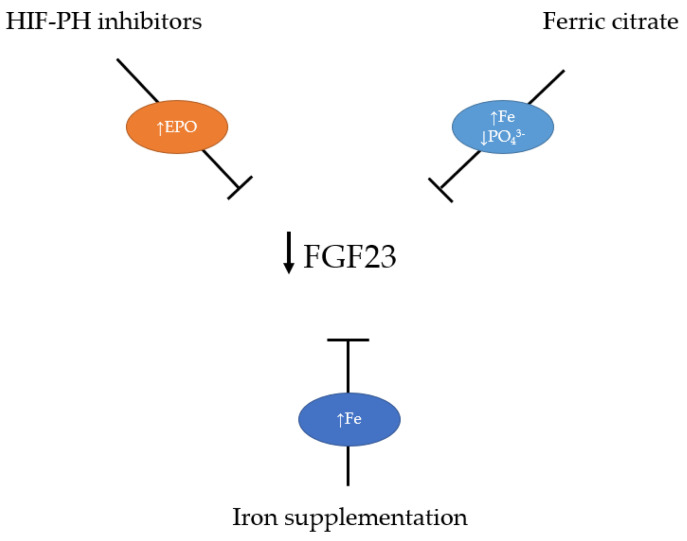
“It has been shown that HIF-PH inhibitors cause more physiological increase in EPO levels compared to ESA, increases serum hemoglobin, decreases hepcidin and ferritin levels, decrease transferrin saturation by increasing total iron-binding capacity, and have a lower risk of major adverse events [76].”
BackgroundSignaling in Fibrosis: TGF-β, WNT, and YAP/TAZ Converge
Piersma, B., Bank, R. A., & Boersema, M. (2015) · Frontiers in Medicine · doi:10.3389/fmed.2015.00059 · Cited by 442 · cited 1×
“provides a nice summary of the detailed crosstalk between TGF, and Wnt/β-catenin, but it is beyond the focus of this review [31].”
Background
Cited by
Fibroblast growth factor signaling in macrophage polarization: impact on health and diseases
Shen, L., Li, Y., & Zhao, H. (2024) · Frontiers in Immunology · doi:10.3389/fimmu.2024.1390453 · Cited by 59
“Elevated serum FGF23 levels in patients with CKD lead to decreased osteotriol, resulting in secondary hyperparathyroidism (60).”
BackgroundRroji, M., Spahia, N., Figurek, A., & Spasovski, G. B. (2025) · Biomedicines · doi:10.3390/biomedicines13030728 · Cited by 35
“These interrelated defects in α -Klotho, FGF23, and phosphate ultimately drive atherogenesis: they accelerate smooth muscle cell migration, calcification, senescence, and leukocyte–endothelial interactions, ultimately destabilizing plaques [95,97–99].”
Abinti, M., Vettoretti, S., Caldiroli, L., Mattinzoli, D., Ikehata, M., Armelloni, S., Molinari, P., Alfieri, C., Castellano, G., & Messa, P. (2024) · Journal of Clinical Medicine · doi:10.3390/jcm13133967 · Cited by 10
Xu, B., Ma, R., Wu, Y., Liu, C., & Song, X. (2025) · Frontiers in Medicine · doi:10.3389/fmed.2025.1678640 · Cited by 11
“FGF-23, a critical regulator of mineral metabolism, also interacts with immune cells, modulating inflammatory responses and highlighting a bidirectional relationship between CKD-MBD and immunity (11).”
Twardawa, M. G., Formanowicz, P., & Formanowicz, D. (2025) · Biomedicines · doi:10.3390/biomedicines13020335 · Cited by 6
“Low klotho levels are associated with increased oxidative stress, inflammation, and accelerated aging-like phenotypes [58], while elevated FGF-23 independently predicts left ventricular hypertrophy and mortality in CKD patients [59,60].”
Metadata
- Authors
- Figurek, A., Rroji, M., & Spasovski, G.
- Affiliations
- University of Zurich (CH)
- University of Medicine Tirana (AL)
- Ss. Cyril and Methodius University in Skopje (MK)
- Corresponding author
- Figurek, Andreja
- Venue
- Cells
- Publisher
- MDPI AG
- Published
- 2023-02-13
- Volume
- 12
- Issue
- 4
- Pages
- 609
- ISSN
- 2073-4409 (ISSN-L)
- PMC
- PMC9954184
- OpenAlex
- W4320729298
- Cited by
- 22
- References
- 84
- Citations by year
- 2026: 6 · 2025: 8 · 2024: 8
- FWCI
- 0.92
- Type
- journal article
- Language
- en
- Open access
- gold
- doi.org
- Licence
- Locations
- Cells (publishedVersion, cc-by)
- PubMed Central (publishedVersion, cc-by)
- PubMed (publishedVersion)
- Zurich Open Repository and Archive (University of Zurich) (acceptedVersion, cc-by)
- DOAJ (DOAJ: Directory of Open Access Journals) (submittedVersion, cc-by-sa)
- Zurich Open Repository and Archive (University of Zurich) (submittedVersion, cc-by)
- Zurich Open Repository and Archive (University of Zurich)
- Topics
- Health Sciences › Medicine › Nephrology › Parathyroid Disorders and Treatments
- Health Sciences › Medicine › Nephrology › Chronic Kidney Disease and Diabetes
- Health Sciences › Medicine › Nephrology › Dialysis and Renal Disease Management
- Keywords
- fibroblast growth factor 23, chronic kidney disease, anemia of chronic kidney disease, cardiac remodeling, cardiac hypertrophy, mineral and bone disorder, cardiovascular risk, FGF23 inhibition, endothelial cells, cardiomyocytes
- MeSH terms
- Fibroblast Growth Factor-23, Anemia, Humans, Myocytes, Cardiac, Endothelial Cells, Renal Insufficiency, Chronic
About these checks
Registry, retraction, Cites and statistics results are computed, not judged, with one exception: a printed reference that no index lists is read once by a model before it counts as a citation error. Claims are extracted by a model and kept only when their quote appears verbatim in the text; each cited source is then checked, with a model’s help, for whether it says what the claim relies on. Those verdicts can be wrong — read the claim’s quote and the cited source before relying on one.
Statistics and arithmetic are recomputed, not judged.
Confidence bands are shown only for fields calibrated on our annotated test set. None is calibrated yet, so no band is shown.
What counts as a claim ›How we measure confidence ›How we check this ›
Are you an author, or do you see a problem with this page? Request a review
How to cite
Cite CoChat for the checks on this page, and the paper for its own findings.
- This page
- CoChat. (2026). Citation check: FGF23 in Chronic Kidney Disease: Bridging the Heart and Anemia. https://app.cochat.ai/papers/10.3390/cells12040609
- The paper
- Figurek, A., Rroji, M., & Spasovski, G. (2023). FGF23 in Chronic Kidney Disease: Bridging the Heart and Anemia. Cells. https://doi.org/10.3390/cells12040609
Data sources
Bibliographic data: Semantic Scholar, OpenAlex, Crossref.
Contains information from the Semantic Scholar Academic Graph Datasets, made available under the ODC Attribution License (ODC-BY 1.0).
Semantic Scholar’s data is described in: Kinney, R., et al. (2023). The Semantic Scholar Open Data Platform. arXiv:2301.10140.
