

Mechanism Integrated Information
Open accessThe DOI matches its Crossref record; 21 of the 21 references it cites were found in a registry or an index.
Abstract
The Integrated Information Theory (IIT) of consciousness starts from essential phenomenological properties, which are then translated into postulates that any physical system must satisfy in order to specify the physical substrate of consciousness. We recently introduced an information measure (Barbosa et al., 2020) that captures three postulates of IIT—existence, intrinsicality and information—and is unique. Here we show that the new measure also satisfies the remaining postulates of IIT—integration and exclusion—and create the framework that identifies maximally irreducible mechanisms. These mechanisms can then form maximally irreducible systems, which in turn will specify the physical substrate of conscious experience.
Overview
The claims and statistics of this paper haven’t been checked yet.
Free: it reads the open-access text and checks the first 5 claims that cite a source we can check. Create a free account to check every claim.
Integrity signals
Registry
Cites
Statistics
Figures




Verification
Claims the paper makes
The claims and statistics of this paper haven’t been checked yet.
Free: it reads the open-access text and checks the first 5 claims that cite a source we can check. Create a free account to check every claim.
Claims other papers make about this one
Each is checked against this paper’s own text: does it say what the citing paper says it does?
The source backs part of the claim, not all of it — or backs it for a different population, condition or comparison.
In the citing paper
“IIT 4.0 presents a more complete, self-consistent formulation and incorporates several recent advances [10–13].”
From Integrated information theory (IIT) 4.0: Formulating the properties of phenomenal existence in physical terms (2023) · cites this paper as [12]
Experimental — accuracy not yet measuredThe cited source says what the claim attributes to it.
In the citing paper
“For example, as shown in [12], if an unconstrained unit is added to a fully specified unit, intrinsic information does not just stay the same, but decreases exponentially.”
From Integrated information theory (IIT) 4.0: Formulating the properties of phenomenal existence in physical terms (2023) · cites this paper as [12]
The cited source says what the claim attributes to it.
In the citing paper
“Because consciousness is the way it is, the formulation of its properties in physical, operational terms should be unique and based on quantities that uniquely satisfy the postulates [12, 32].”
From Integrated information theory (IIT) 4.0: Formulating the properties of phenomenal existence in physical terms (2023) · cites this paper as [12]
Self-check
Percentages, sums and reported differences re-computed from the paper’s own numbers.
The self-check needs the paper’s full text.
Citations
Cites
Causality: Models, Reasoning, and Inference
Pearl, J. (2009) · doi:10.1017/cbo9780511803161 · Cited by 11,653
An information integration theory of consciousness
Tononi, G. (2004) · BMC Neuroscience · doi:10.1186/1471-2202-5-42 · Cited by 1,958 · cited 1×
“Early versions of IIT used the KLD to measure the difference between probability distributions [4,16].”
MethodSelf-citationIntegrated information theory: from consciousness to its physical substrate
Tononi, G., Boly, M., Massimini, M., & Koch, C. (2016) · Nature Reviews Neuroscience · doi:10.1038/nrn.2016.44 · Cited by 1,727 · cited 1×
“For a complete description of the axioms and their motivation, the reader should consult [2,3,6].”
Self-citationConsciousness as integrated information: a provisional manifesto
Tononi, G. (2008) · The Biological Bulletin · doi:10.2307/25470707 · Cited by 1,529 · cited 1×
“Integrated information (Φ) is a measure of the irreducibility of the cause–effect structure specified by a system [8].”
Self-citationFrom the phenomenology to the mechanisms of consciousness: integrated information theory 3.0
Oizumi, M., Albantakis, L., & Tononi, G. (2014) · PLoS Computational Biology · doi:10.1371/journal.pcbi.1003588 · Cited by 1,128 · cited 8×
“So far, the mathematical formulation employed well-established measures of information, such as Kullback–Leibler divergence (KLD) [4] or earth mover’s distance (EMD) [3].”
InfluentialSelf-citationIntegrated information in discrete dynamical systems: motivation and theoretical framework
Balduzzi, D., & Tononi, G. (2008) · PLoS Computational Biology · doi:10.1371/journal.pcbi.1000091 · Cited by 419 · cited 5×
“Importantly, ID is shown to be the unique measure that satisfies the three properties—causality, intrinsicality and specificity—the KLD and EMD measures do not satisfy intrinsicality or specificity.”
InfluentialSelf-citationAxiomatic Characterizations of Information Measures
Csiszár, I. (2008) · Entropy · doi:10.3390/e10030261 · Cited by 282 · cited 2×
“Note that while causality (Equation (5)) and expansion (Equation (6)) properties are traditionally required by information measures (see [15]), here we also require dilution (Equation (7)) and specificity (Equation (8)).”
Janzing, D., Balduzzi, D., Grosse‐Wentrup, M., & Schölkopf, B. (2013) · The Annals of Statistics · doi:10.1214/13-aos1145 · Cited by 216 · cited 1×
“Given the former definitions, the stochastic system S corresponds to a causal network where ppst`1|stq “ ppst`1|dopstqq [12,18,19].”
Why Does Space Feel the Way it Does? Towards a Principled Account of Spatial Experience
Haun, A., & Tononi, G. (2019) · Entropy · doi:10.3390/e21121160 · Cited by 143 · cited 3×
“Moreover, the cause–effect structure specified by the PSC is identical to the subjective quality of the experience [10].”
InfluentialSelf-citationCharacterizations Of Information Measures
Ebanks, B. R., Sahoo, P. K., & Sander, W. (1998) · WORLD SCIENTIFIC eBooks · doi:10.1142/9789812817167 · Cited by 83
Black-boxing and cause-effect power
Marshall, W., Albantakis, L., & Tononi, G. (2018) · PLOS Computational Biology · doi:10.1371/journal.pcbi.1006114 · Cited by 73 · cited 1×
“According to IIT, then, a system is a PSC if it is a maximum of integrated information, meaning that it has higher integrated information than any overlapping systems [3,9].”
Self-citationWhat caused what? A quantitative account of actual causation using dynamical causal networks
Albantakis, L., Marshall, W., Hoel, E., & Tononi, G. (2019) · Entropy · doi:10.3390/e21050459 · Cited by 67 · cited 1×
“To demonstrate that a unit has a potential cause, one can observe whether the unit’s state can be caused by manipulating its input, while to demonstrate that a unit has a potential effect one can manipulate the state of the unit and observe if it causes the state of some other unit [7].”
Self-citationAlbantakis, L., & Tononi, G. (2015) · Entropy · doi:10.3390/e17085472 · Cited by 58 · cited 1×
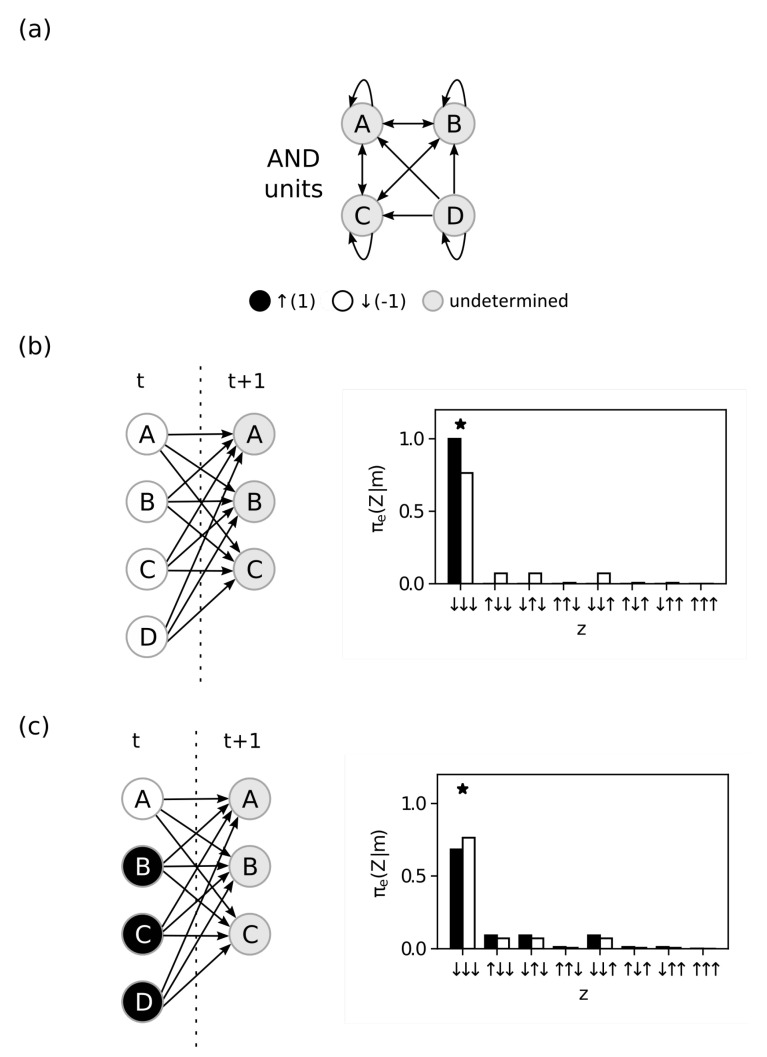
“To evaluate these potential causes and effects, we define the cause repertoire π c p Z | m q (see Equation (A2)) and the effect repertoire π e p Z | m q (see Equation (A1)), which describe how m constrains the potential input or output states of Z Ď S respectively (Figure 1b) [3,11–13].”
Self-citationAn Integrated Information Theory of Consciousness
Tononi, G. (2009) · Elsevier eBooks · doi:10.1002/9781119132363.ch17 · Cited by 47
Self-citationA measure for intrinsic information
Barbosa, L. S., Marshall, W., Streipert, S., Albantakis, L., & Tononi, G. (2020) · Scientific Reports · doi:10.1038/s41598-020-75943-4 · Cited by 42 · cited 4×
“Recently, we introduced an information measure, called intrinsic difference [5], which captures three postulates of IIT—existence, intrinsicality and information—and is unique.”
BackgroundMethodSelf-citationIntegrated information and state differentiation
Marshall, W., Gomez-Ramirez, J., & Tononi, G. (2016) · Frontiers in Psychology · doi:10.3389/fpsyg.2016.00926 · Cited by 36 · cited 1×
“To evaluate these potential causes and effects, we define the cause repertoire π c p Z | m q (see Equation (A2)) and the effect repertoire π e p Z | m q (see Equation (A1)), which describe how m constrains the potential input or output states of Z Ď S respectively (Figure 1b) [3,11–13].”
Self-citationCausal composition: Structural differences among dynamically equivalent systems
Albantakis, L., & Tononi, G. (2019) · Entropy · doi:10.3390/e21100989 · Cited by 30 · cited 1×
“Given the former definitions, the stochastic system S corresponds to a causal network where ppst`1|stq “ ppst`1|dopstqq [12,18,19].”
Self-citationBeyond Neural Correlates of Consciousness
Overgaard, M. S., Mogensen, J., & Kirkeby-Hinrup, A. (2020) · Routledge eBooks · doi:10.4324/9781315205267 · Cited by 27
Albantakis, L. (2020) · Routledge eBooks · doi:10.4324/9781315205267-6 · Cited by 19
Self-citationExclusion and Underdetermined Qualia
Moon, K. (2019) · Entropy · doi:10.3390/e21040405 · Cited by 17 · cited 1×
“As also argued in [17], distinctions that are underdetermined should thus not be included in the cause–effect structure until the tie between purviews or states can be resolved.”
Computing Integrated Information (Φ) in Discrete Dynamical Systems with Multi-Valued Elements
Gomez, J. D., Mayner, W. G. P., Beheler-Amass, M., Tononi, G., & Albantakis, L. (2020) · Entropy · doi:10.3390/e23010006 · Cited by 16 · cited 1×
“The intrinsicality property is defined based on the behavior of the difference measure when distributions are extended by adding units to the purview or increasing the number of possible states of a unit [14].”
Self-citation
Cited by
Albantakis, L., Barbosa, L., Findlay, G., Grasso, M., Haun, A. M., Marshall, W., Mayner, W. G. P., Zaeemzadeh, A., Boly, M., Juel, B. E., et al. (2023) · PLoS Computational Biology · doi:10.1371/journal.pcbi.1011465 · Cited by 292
“A scientific theory of consciousness should account for experience, which is subjective, in objective terms [1].”
InfluentialSelf-citationConsciousness and the Collapse of the Wave Function
Chalmers, D. J., & McQueen, K. J. (2022) · Oxford University Press eBooks · doi:10.1093/oso/9780197501665.003.0002 · Cited by 158
The strength of weak integrated information theory
Mediano, P. A. M., Rosas, F. E., Bor, D., Seth, A. K., & Barrett, A. B. (2022) · Trends in Cognitive Sciences · doi:10.1016/j.tics.2022.04.008 · Cited by 108
A synergistic workspace for human consciousness revealed by Integrated Information Decomposition
Luppi, A. I., Mediano, P. A. M., Rosas, F. E., Allanson, J., Pickard, J. D., Carhart-Harris, R. L., Williams, G. B., Craig, M. M., Finoia, P., Owen, A. M., et al. (2023) · eLife · doi:10.7554/elife.88173 · Cited by 136
Hoffman, D. D., Prakash, C., & Prentner, R. (2023) · Entropy · doi:10.3390/e25010129 · Cited by 38
“If state 2 were transient, then the permutation would be [8, 2, 4, 12, 10, 15, 9, 14, 16].”
Background
Metadata
- Authors
- Barbosa, L. S., Marshall, W., Albantakis, L., & Tononi, G.
- Affiliations
- University of Wisconsin–Madison (US)
- Corresponding author
- Tononi, Giulio
- Venue
- Entropy
- Publisher
- MDPI AG
- Published
- 2021-03-18
- Volume
- 23
- Issue
- 3
- Pages
- 362
- ISSN
- 1099-4300 (ISSN-L)
- PMC
- PMC8003304
- OpenAlex
- W3137983215
- Cited by
- 72
- References
- 21
- Citations by year
- 2026: 9 · 2025: 22 · 2024: 15 · 2023: 13 · 2022: 8 · 2021: 4
- FWCI
- 9.66
- Type
- journal article
- Language
- en
- Open access
- gold
- doi.org
- Licence
- Locations
- Entropy (publishedVersion, cc-by)
- PubMed Central (publishedVersion, cc-by)
- PubMed (publishedVersion)
- DOAJ (DOAJ: Directory of Open Access Journals) (submittedVersion, cc-by-sa)
- Funders
- Tiny Blue Dot Foundation (UW 133AAG3451)
- Templeton World Charity Foundation (TWCF0216)
- Topics
- Social Sciences › Arts and Humanities › Philosophy › Philosophy and Theoretical Science
- Physical Sciences › Physics and Astronomy › Statistical and Nonlinear Physics › Complex Systems and Dynamics
- Social Sciences › Arts and Humanities › History and Philosophy of Science › Philosophy of Biology and Scientific Explanation
- Keywords
- integrated information theory, consciousness, information measures, subjective experience
About these checks
Registry, retraction, Cites and statistics results are computed, not judged, with one exception: a printed reference that no index lists is read once by a model before it counts as a citation error. Claims are extracted by a model and kept only when their quote appears verbatim in the text; each cited source is then checked, with a model’s help, for whether it says what the claim relies on. Those verdicts can be wrong — read the claim’s quote and the cited source before relying on one.
Statistics and arithmetic are recomputed, not judged.
Confidence bands are shown only for fields calibrated on our annotated test set. None is calibrated yet, so no band is shown.
What counts as a claim ›How we measure confidence ›How we check this ›
Are you an author, or do you see a problem with this page? Request a review
Data sources
Bibliographic data: Semantic Scholar, OpenAlex, Crossref.
Contains information from the Semantic Scholar Academic Graph Datasets, made available under the ODC Attribution License (ODC-BY 1.0).
Semantic Scholar’s data is described in: Kinney, R., et al. (2023). The Semantic Scholar Open Data Platform. arXiv:2301.10140.
