

Parametric Study of a Lunar Base Power Systems
Open accessThe DOI matches its Crossref record; 50 of the 52 references it cites were found in a registry or an index; 23 of the 68 sources its claims cite were checked for support.
Abstract
Future lunar base subsystems are required to be rigorously optimized in terms of mass reduction. Nine different power systems were studied as combinations of two power sources and three energy storage technologies.
Overview
CoChat Summary
TL;DR
This paper performs a parametric mass study of nine lunar base power system architectures across more than 200 parameter combinations. Hybrid solar+nuclear systems are generally the most mass-advantageous, except at exceptionally illuminated polar sites where PV-only systems can become lighter.
Key findings
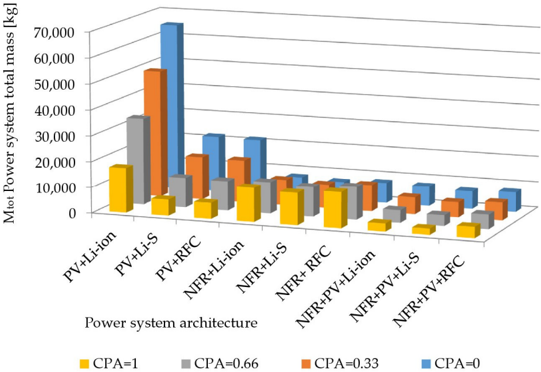
- For the baseline configuration, the lowest total mass was 2220 kg for the hybrid NFR+PV system using Li-S batteries; by comparison, the PV+Li-ion system at 0° latitude was 18,412 kg.
- Selenographic latitude had little effect on most systems, with relative mass differences about 1% or less; RFC-based systems were the exception, with maximum relative differences up to 17.75% (NFR+PV+RFC).
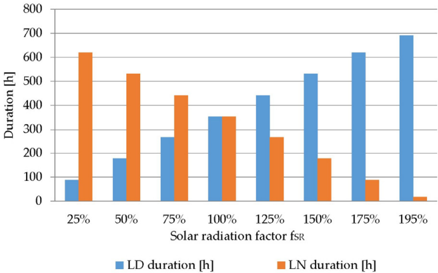
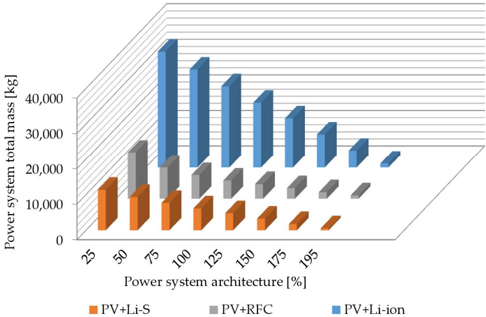
- Nuclear-only systems were unaffected by solar illumination, while PV-only mass depended strongly on it: an fSR of about 150% was needed for a PV-based system to become comparable with nuclear or hybrid solutions; at fSR = 175%, PV+Li-S became lighter than PV+RFC and any NFR or hybrid solution, while PV+Li-ion required fSR = 195%.
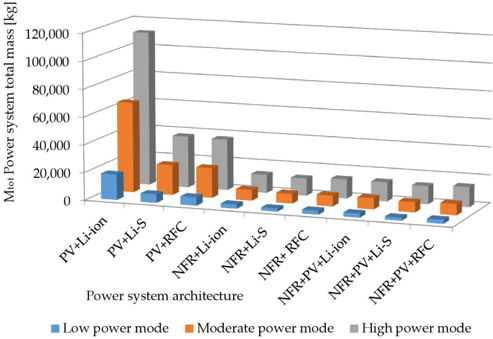
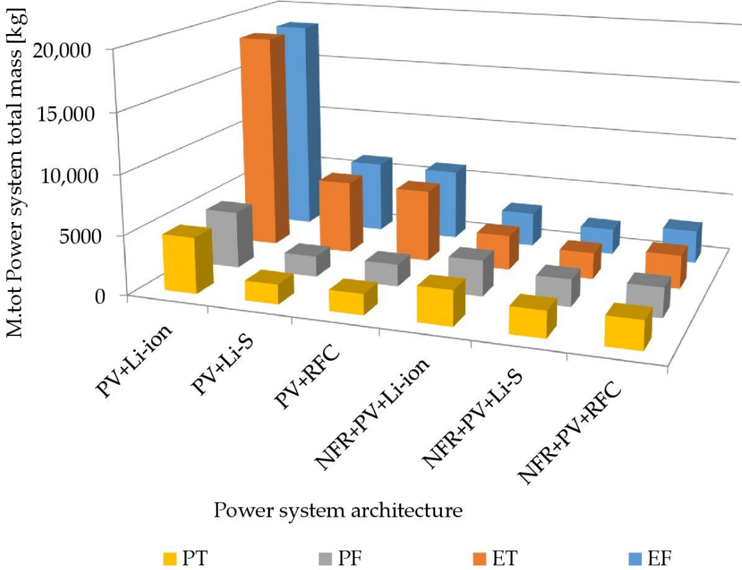
- Scheduling power-demanding operations for lunar days reduced PV and hybrid system mass, whereas nuclear-only systems favored balanced power demand; power system mass scaled almost linearly with maximum power load, with NFR+Li-S versus PV+Li-ion saving about 16 metric tons in low power mode and more than 99 metric tons in high power mode.
Methods
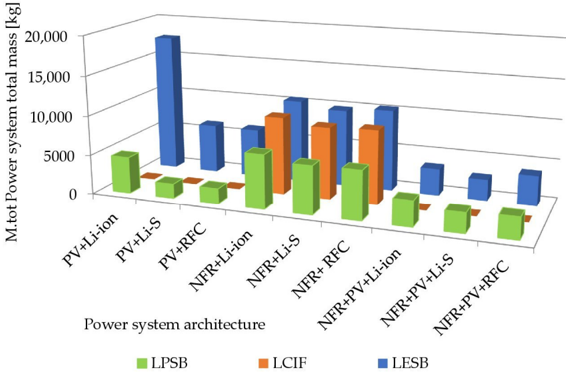
- The study evaluated nine power system architectures combining three power source configurations (PV array, nuclear fission reactor, hybrid PV+NFR) with three energy storage/buffering technologies (Li-ion, Li-S, RFC).
- Seven variable parameters were examined: total power demand, daily power load management strategy, power source type, solar array structure, ESS/EBS type, selenographic latitude, and solar illumination conditions; calculations covered more than 200 parameter combinations, including three case studies.
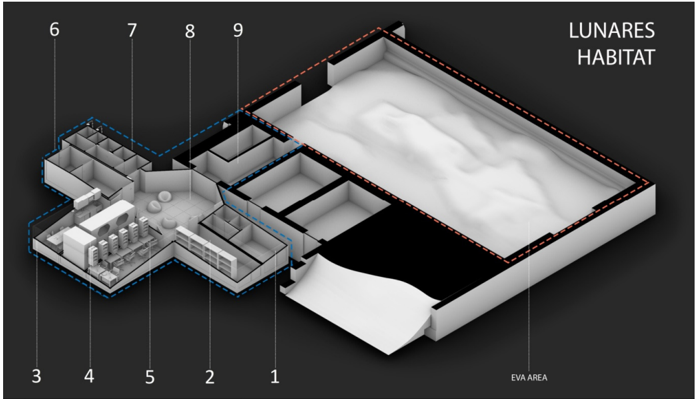
- Total mass calculations included power source, energy storage, temperature control, and balance of system, using a LUNARES habitat-based baseline and prior Kaczmarzyk et al. 2020 assumptions; calculations were conducted in Matlab 2019a and compared across architectures, latitudes, fSR values, power modes, and array structures.
Limitations
- The paper states a simplifying assumption that fSR is similar to the LD/LAD ratio; it estimates the potential error from this assumption cannot be more than ~3% of total power demand for the baseline configuration at 0° latitude, diminishing with increasing latitude and power demand.
- The paper states that Li-S and RFC technologies are not yet sufficiently mature for lunar base applications; RFC-based ESS has never been used in space, and no perfect peaks of eternal light have been positively identified.
- Evident from the text: the results are model-based on the LUNARES habitat and prior assumptions, with many assumed parameters such as efficiencies, specific masses, 10-year operation, and annual PV panel deliveries that are not experimentally validated for an actual lunar base.
Model-written summary. Check it against the paper before relying on it.
Integrity signals
Registry
Cites
Statistics
Figures
Verification
Claims the paper makes
12 Valid · 14 Not valid · 26 Not checked · 103 Own results and interpretations
The cited sources support only part of this claim — read each source’s verdict below.
In the paper
“In most cases, the lifespan of a Li-S cell is limited to few hundred cycles, especially at high discharge currents [45,50].”
§ Parametric Study of a Lunar Base Power Systems > 1.5.3. Lithium-Sulphur Batteries
What the sources say
- Supportedcites [45] 43. Fotouhi, A.; Auger, D.J.; O'Neill, L.; Cleaver, T.; Walus, S. Lithium-Sulfur Battery Technology Readiness and Applications-A Review. Energies 2017, 10, 1937. [CrossRef] source
The Introduction states that Li-S cells have a short cycle life, particularly at high discharge currents. Section 2.2 describes their cycle life under realistic testing conditions as hundreds of cycles, supporting the cited paraphrase. (LLM, conf=0.92)
- Partly supportedcites [50] 48. Wang, Z.; Dong, Y.; Li, H.; Zhao, Z.; Wu, H.B.; Hao, C.; Liu, C.; Qiu, J.; Wen, X. Lou Enhancing lithium-sulphur battery performance by strongly binding the discharge products on amino-functionalized reduced graphene oxide. Nat. Commun. 2014, 5, 5002. [CrossRef] sourceExperimental — accuracy not yet measured
The Abstract describes short lifespan as a barrier to Li–S batteries, and the Synthesis and characterizations section says most reported carbon–sulphur nanocomposites lose almost all capacity when cycled at similarly high rates. It does not establish a general limit of a few hundred cycles for most Li–S cells; its own EFG-S cell retains capacity through 350 cycles. (LLM, conf=0.83)
plainstates an association- Asserted: passes — The authors put it forward as true.
- Checkable: passes — It can be checked against evidence.
- Load-bearing: unclear — It is unclear whether the paper’s conclusions depend on it.
- Based: passes — The paper gives a reason why it holds.
- Supported
The sources with a verdict support this claim; the rest weren’t checked yet, have no full text we could read, or their verdicts aren’t rated yet.
In the paper
“The theoretical gravimetric energy density of a Li-S cell is ~2510 Wh/kg, but the expected practical specific energy density is between 500 and 600 Wh/kg [46,47].”
§ Parametric Study of a Lunar Base Power Systems > 1.5.3. Lithium-Sulphur Batteries
What the sources say
- Supportedcites [46] 44. Zhu, K.; Wang, C.; Chi, Z.; Ke, F.; Yang, Y.; Wang, A.; Wang, W.; Miao, L. How Far Away Are Lithium-Sulfur Batteries From Commercialization? Front. Energy Res. 2019, 15. [CrossRef] source
The Introduction explicitly states that, based on an average discharge voltage of 2.15 V, the theoretical gravimetric energy density of a Li-S cell is approximately 2,510 Wh/kg. This matches the portion of the citing sentence attributed to this source. (LLM, conf=0.95)
- Not checked — no full text of the sourcecites [47] 45. Maurer, C.; Commerell, W.; Hintennach, A.; Jossen, A. Capacity Recovery Effect in Lithium Sulfur Batteries for Electric Vehicles. World Electr. Veh. J. 2018, 9, 34. [CrossRef] source
plain- Asserted: passes — The authors put it forward as true.
- Checkable: passes — It can be checked against evidence.
- Load-bearing: unclear — It is unclear whether the paper’s conclusions depend on it.
- Based: passes — The paper gives a reason why it holds.
- Supported
The cited sources support only part of this claim — read each source’s verdict below.
In the paper
“The total power demand of a lunar facility depends mainly on its inventory and usage profile, along with the round trip efficiency of the applied energy storage system (ESS), as presented in detail by Kaczmarzyk et al., 2020 [33].”
§ Parametric Study of a Lunar Base Power Systems > 1.6. Total Power Demand
What the sources say
- Partly supportedcites Kaczmarzyk et al., 2020 [33] matched to “Internal Heat Gains in a Lunar Base—A Contemporary Case Study” (2020) sourceExperimental — accuracy not yet measured
Section 2.3 calculates device power demand from the equipment used and its daily use time. Sections 2.5 and 3.3 show that storage efficiency affects waste heat and, through the thermal-control system, electrical demand. The paper does not establish that these are the main determinants of a facility’s total power demand; the Conclusions say further study of total power demand is needed. Page numbers are unavailable in our copy. (LLM, conf=0.83)
plainstates a cause- Asserted: passes — The authors put it forward as true.
- Checkable: passes — It can be checked against evidence.
- Load-bearing: unclear — It is unclear whether the paper’s conclusions depend on it.
- Based: passes — The paper gives a reason why it holds.
- Partly supported
The cited sources that could be checked couldn’t confirm or dispute this claim.
In the paper
“The theoretical gravimetric energy density of a Li-S cell is ~2510 Wh/kg, but the expected practical specific energy density is between 500 and 600 Wh/kg [46,47].”
§ Parametric Study of a Lunar Base Power Systems > 1.5.3. Lithium-Sulphur Batteries
What the sources say
- Could not verifycites [46] 44. Zhu, K.; Wang, C.; Chi, Z.; Ke, F.; Yang, Y.; Wang, A.; Wang, W.; Miao, L. How Far Away Are Lithium-Sulfur Batteries From Commercialization? Front. Energy Res. 2019, 15. [CrossRef] sourceExperimental — accuracy not yet measured
The Electrolyte section estimates about 320 Wh/kg for a Li-S pouch-cell design, rising to 459 Wh/kg with less electrolyte. The Conclusion describes an initial battery-pack target of at least 400 Wh/kg. Searches for 500–600 Wh/kg and its endpoints found no passage stating that range as the expected practical specific energy of Li-S cells. (LLM, conf=0.73)
- Not checked — no full text of the sourcecites [47] 45. Maurer, C.; Commerell, W.; Hintennach, A.; Jossen, A. Capacity Recovery Effect in Lithium Sulfur Batteries for Electric Vehicles. World Electr. Veh. J. 2018, 9, 34. [CrossRef] source
plain- Asserted: passes — The authors put it forward as true.
- Checkable: passes — It can be checked against evidence.
- Load-bearing: unclear — It is unclear whether the paper’s conclusions depend on it.
- Based: passes — The paper gives a reason why it holds.
- Could not verify
The cited sources support only part of this claim — read each source’s verdict below.
In the paper
“In the lunar surface environment, waste heat generation by a massive ESS becomes a serious problem due to relatively low radiative heat transfer to outer space, extremely low thermal conductivity of the lunar regolith and the absence of a proper heat sink [33].”
§ Parametric Study of a Lunar Base Power Systems > Energy Storage Temperature Control System
What the sources say
- Partly supportedcites [33] 31. Kaczmarzyk, M.; Starakiewicz, A.; Waśniowski, A. Internal Heat Gains in a Lunar Base-A Contemporary Case Study. Energies 2020, 13, 3213. [CrossRef] sourceExperimental — accuracy not yet measured
Section 2.5 says a solar-powered lunar base needs an ESS of considerable capacity, identifies substantial waste heat from regenerative fuel cells, and treats conductive heat exchange with regolith as negligible. It does not establish that radiative heat transfer to space is relatively low or that there is no proper heat sink; those stated reasons for the heat-dissipation problem are unsupported by the cited passages. (LLM, conf=0.84)
plainstates a cause- Asserted: passes — The authors put it forward as true.
- Checkable: passes — It can be checked against evidence.
- Load-bearing: passes — The paper’s conclusions depend on it.
- Based: passes — The paper gives a reason why it holds.
- Partly supported
92 more claims · 4 with their cited sources checked
Create a free account to see all 155 claims and to verify the 12 references still open.
- Probably not a substantial claim. 22
- It may state two separate claims as one. 40
- Borderline: one of the tests for a substantial claim is unclear. 1
Self-check
Percentages, sums and reported differences re-computed from the paper’s own numbers.
Each contradiction between two passages listed here was confirmed by an independent check.
Rated major: it would touch a result — a value a result rests on, reported and recomputed p-values on opposite sides of the significance level, two passages that conflict with no sign which is right, or a cited work retracted before this paper was published.
In the paper
§ Parametric Study of a Lunar Base Power Systems > RFC-based high-capacity ESS may present up to an about 25% mass advantage over Li-S-based solution, but this advantage decreases with required ESS capacity.
“| NFR+Li-S | 2282 | 2287 | 2262 | 2252 |”
§ Parametric Study of a Lunar Base Power Systems > 3.3. Solar Radiation Factor
“NFR+Li-ion 2915.39 2915.39NFR+Li-S 2195.47 2195.47NFR+ RFC 2388.56 2388.56”
Rated minor: it would not touch a result — a value no result rests on, a p-value that stays on the same side of the significance level, or a conflict that is clerical, resolved elsewhere in the paper, or outside its own findings.
In the paper
“the almost 162 kg polar array is actually 281 kg, to be compared with a single equatorial array weighing 140.6 kg”
§ Parametric Study of a Lunar Base Power Systems > 3.6. Sun Tracking Coefficient and PV Array Structure
Reported 281 · recomputed 324
Citations
Cites
Anti-reflective coatings: A critical, in-depth review
Raut, H. K., Ganesh, V. A., Nair, A. S., & Ramakrishna, S. (2011) · Energy & Environmental Science · doi:10.1039/c1ee01297e · Cited by 1,463
Wang, Z., Dong, Y., Li, H., Zhao, Z., Bin Wu, H., Hao, C., Liu, S., Qiu, J., & Lou, X. W. (2014) · Nature Communications · doi:10.1038/ncomms6002 · Cited by 1,059 · cited 1×
“In most cases, the lifespan of a Li-S cell is limited to few hundred cycles, especially at high discharge currents [45,50].”
Direct evidence of surface exposed water ice in the lunar polar regions
Li, S., Lucey, P. G., Milliken, R. E., Hayne, P. O., Fisher, E., Williams, J.-P., Hurley, D. M., & Elphic, R. C. (2018) · Proceedings of the National Academy of Sciences · doi:10.1073/pnas.1802345115 · Cited by 625
An Inexpensive BRDF Model for Physically‐based Rendering
Schlick, C. (1994) · Computer Graphics Forum · doi:10.1111/1467-8659.1330233 · Cited by 447 · cited 1×
“To account for the reduced light absorption at large incidence angles, the astrometric model was enhanced by incorporating Schlick’s approximation formula for the specular reflection coefficient [74]:”
Vasavada, A. R., Bandfield, J. L., Greenhagen, B. T., Hayne, P. O., Siegler, M. A., Williams, J., & Paige, D. A. (2012) · Journal of Geophysical Research: Planets · doi:10.1029/2011je003987 · Cited by 357 · cited 1×
“At a specified lunar location, any seasonal changes in the Sun’s paths of diurnal motion, diurnal surface temperature distributions or LAD/LAN ratios are so minute, that they are neglected in most practical applications [61,62].”
How Far Away Are Lithium-Sulfur Batteries From Commercialization?
Zhu, K., Wang, C., Chi, Z., Ke, F., Yang, Y., Wang, A., Wang, W., & Miao, L. (2019) · Frontiers in Energy Research · doi:10.3389/fenrg.2019.00123 · Cited by 181
Lithium-Sulfur Battery Technology Readiness and Applications—A Review
Fotouhi, A., Auger, D., O’Neill, L., Cleaver, T., & Walus, S. (2017) · Energies · doi:10.3390/en10121937 · Cited by 180 · cited 4×
“Today Li-S batteries exhibit limited instantaneous power capabilities, high self-discharge and relatively high-capacity decay [45,46].”
InfluentialKilopower Project: The KRUSTY Fission Power Experiment and Potential Missions
McClure, P. R., Poston, D. I., Gibson, M. A., Mason, L. S., & Robinson, R. C. (2020) · Nuclear Technology · doi:10.1080/00295450.2020.1722554 · Cited by 122
Illumination conditions of the south pole of the Moon derived using Kaguya topography
Bussey, D. B. J., McGovern, J. A., Spudis, P. D., Neish, C. D., Noda, H., Ishihara, Y., & Sørensen, S.-A. (2010) · Icarus · doi:10.1016/j.icarus.2010.03.028 · Cited by 121 · cited 4×
“Solar illumination conditions of the selected mountain peaks at the lunar south polar regions [64].”
InfluentialLunar habitats: A brief overview of issues and concepts
Benaroya, H. (2017) · REACH · doi:10.1016/j.reach.2018.08.002 · Cited by 113 · cited 1×
“Li-ion batteries have very high round trip efficiency and more than ten years of successful space application history, which is more than sufficient to consider this technology adequate to use onboard a lunar base [27,34,41].”
Research works printed but not linked: 3
- 41. Bland, J.B.; Abramson, M.; Arnold, R. Powering a Moon Base through the Lunar Night. The Space Review. 2015. Available online: https://www.thespacereview.com/article/2882/1 (accessed on 9 October 2020).
- 52. Waldron, R.D. Lunar Base Power Requirements. Options & Growth. Available online: https://www.semanticscholar.org/ paper/Lunar-Base-Power-Requirements%2C-Options-%26-Growth-Waldron/b7e95959347a17941284d29a74c9ccf9c1717d8e (ac- cessed on 20 January 2021).
- 58. Christie, R.J.; Plachta, D.W.; Hasan, M.M. Transient Thermal Model and Analysis of the Lunar Surface and Regolith for Cryogenic Fluid Storage; NASA/TM-2008-215300; NASA: Cleveland, OH, USA, 2008; pp. 1-13.
Cited by
Space Microgrids for Future Manned Lunar Bases: A Review
Saha, D., Bazmohammadi, N., Raya-Armenta, J. M., Bintoudi, A. D., Lashab, A., Vasquez, J. C., & Guerrero, J. M. (2021) · IEEE Open Access Journal of Power and Energy · doi:10.1109/oajpe.2021.3116674 · Cited by 64
Liu, Z., Wang, Z., Cheng, K., Wang, C., Ha, C., Fei, T., & Qin, J. (2023) · Energy · doi:10.1016/j.energy.2023.127936 · Cited by 38
New Horizons for Microgrids: From Rural Electrification to Space Applications
Micallef, A., Guerrero, J. M., & Vasquez, J. C. (2023) · Energies · doi:10.3390/en16041966 · Cited by 31
Characteristic of thermal energy system self-driven by exhausted heat from equipment in lunar base
Zhang, K., Sun, P., Li, S., Spataru, C., Lv, X., & Weng, Y. (2022) · Applied Thermal Engineering · doi:10.1016/j.applthermaleng.2022.118751 · Cited by 18
Temperature dependence of gas barrier property of clay-polymer composite coatings
Aizawa, T., Kubota, M., & Ebina, T. (2022) · Applied Clay Science · doi:10.1016/j.clay.2022.106571 · Cited by 14
Liu, Z., Cheng, K., Wang, Z., Wang, C., Xu, J., Fei, T., & Qin, J. (2023) · Applied Thermal Engineering · doi:10.1016/j.applthermaleng.2023.121500 · Cited by 12
Hybrid lunar ISRU plant: A comparative analysis with carbothermal reduction and water extraction
Ikeya, K., Guerrero-Gonzalez, F. J., Kiewiet, L., Cardin, M., Cilliers, J. J., Starr, S. O., & Hadler, K. (2025) · Acta Astronautica · doi:10.1016/j.actaastro.2025.02.004 · Cited by 16
Uninterrupted photovoltaic power for lunar colonization without the need for storage
Gordon, J. M. (2022) · Renewable Energy · doi:10.1016/j.renene.2022.02.016 · Cited by 11
Aluminum particle production on alumina rod surface by continuous-wave laser ablation
Tanaka, S., Tanaka, N., Komurasaki, K., Kawashima, R., & Koizumi, H. (2021) · Materials Chemistry and Physics · doi:10.1016/j.matchemphys.2021.125557 · Cited by 10
Lunar Power Sources: An Opportunity to Experiment
Marrone, M., Pasqualin, L., & Ferro, C. G. (2025) · Aerospace · doi:10.3390/aerospace12010058 · Cited by 8
Microgrids for Extraterrestrial Habitats: A Review of Technologies, Needs, and Challenges
Chebbo, L., Gultekin, M. A., Bazzi, A. M., Young, S. A. Q., & Kozak, J. P. (2025) · IEEE Access · doi:10.1109/access.2025.3532163 · Cited by 10
“Fuel cell technologies reach an energy density between 456 and 830 Wh/kg for electric loads between 0.5 kW and 28.03 kW, respectively [112].”
InfluentialDow, A. R. R., Darbali-Zamora, R., Flicker, J., Palacios, F., & Csank, J. (2022) · Conference record of the IEEE Photovoltaic Specialists Conference · doi:10.1109/pvsc48317.2022.9938880 · Cited by 7
“Battery Energy Storage Systems (BESS) can provide auxiliary power when PV is not adequately available [10].”
BackgroundA review of the construction of the supporting energy system for the lunar base
Song, L., Zhang, G., Yaohui, W., Wang, C., & Liu, B. (2025) · Frontiers in Astronomy and Space Sciences · doi:10.3389/fspas.2025.1609140 · Cited by 7
Razeto, C., Visvanathan, R., & Kamel, E. (2025) · Acta Astronautica · doi:10.1016/j.actaastro.2025.10.013 · Cited by 9
Sky lake – Moon environment design
Tol, A. V. L., Lipińska, M. B., Foing, B. H., & Greenwood-George, E. (2022) · Acta Astronautica · doi:10.1016/j.actaastro.2022.07.056 · Cited by 7
Lunar construction: A state-of-the-art survey
Vasudeva, K. S., Emami, M. R., & Dickinson, C. S. (2025) · Progress in Aerospace Sciences · doi:10.1016/j.paerosci.2025.101159 · Cited by 9
Parametric Modeling of a Lunar Base
Mehta, S., Thakar, B., Robertson, B. E., & Mavris, D. N. (2024) · AIAA SciTech Forum · doi:10.2514/6.2024-2546 · Cited by 4
Innovability for a Better World (and a New One?)
Ciorra, E., Polimanti, E., & Canino, A. (2024) · Oxford University Press eBooks · doi:10.1093/oxfordhb/9780192899798.013.49 · Cited by 5
Fault Diagnosis of Power Components with Reliability Assessment in Extraterrestrial Microgrids
Chebbo, L., Nisar, H., & Bazzi, A. M. (2024) · AIAA Journal · doi:10.2514/1.j063874 · Cited by 9
Li, J., Xu, W., Yang, J., Xue, H., Yuan, J., & Wei, T. (2026) · npj Space Exploration · doi:10.1038/s44453-026-00030-3 · Cited by 4
Microgrids space applications: A comprehensive review and future trends
Zdiri, M. A., Khan, B. Z., & Guerrero, J. M. (2025) · Applied Energy · doi:10.1016/j.apenergy.2025.126941 · Cited by 4
Dyer, P., Smith, G., & Nelson, G. J. (2022) · Journal of energy resources technology. · doi:10.1115/1.4072353 · Cited by 3
Solar energy on the Moon for fixed or tracked photovoltaic systems
Weiss, M., Dumais, F., Volatier, M., Aimez, V., Jaouad, A., & Darnon, M. (2024) · EPJ Photovoltaics · doi:10.1051/epjpv/2024021 · Cited by 2
Lunar Robotic Construction System Using Raw Regolith: Design Conceptualization
Vasudeva, K., & Emami, M. R. (2025) · Aerospace · doi:10.3390/aerospace12110947 · Cited by 7
Optimal Sensor Placement for Fault Detection and Isolation in a Lunar DC Microgrid
Heyer, G., Sadabadi, K. K., D’Arpino, M., et al. (2023) · AIAA SciTech Forum · doi:10.2514/6.2023-1392 · Cited by 2
Guadagno, M. C., Wavrunek, T., van Susante, P., et al. (2022) · New Space · doi:10.1089/space.2021.0056 · Cited by 2
SAKATA, I., Chen, Y., & Wajima, T. (2024) · GEOINFORMATICS · doi:10.6010/geoinformatics.35.2_41 · Cited by 3
Simulation of Lunar Soil Excavation and Landfill in the Lunar Power Station Construction
He, Y., Xu, W., Chen, M., et al. (2025) · International Symposium on Computer Technology and Information Science (ISCTIS) · doi:10.1109/isctis65944.2025.11065032 · Cited by 1
“The most recent advancement in space nuclear power is the US Kilopower project[6].”
Integration of space based solar power into a scaling lunar ISRU based infrastructure and economy
MacRobbie, C. J., MacRobbie, M., Sun, M., & Wen, J. Z. (2026) · Energy Conversion and Management X · doi:10.1016/j.ecmx.2026.101692 · Cited by 2
Electrical Load Management and Control in Space Habitat Microgrids
Chebbo, L., Nisar, H., & Bazzi, A. M. (2024) · North American Power Symposium (NAPS) · doi:10.1109/naps61145.2024.10741812 · Cited by 2
“Other literature and technical reports discussed the power generation technologies available and required for long-term space exploration [9]-[12].”
BackgroundAizawa, T., Ebina, T., & Kubota, M. (2021) · Clay science/Clay Science · doi:10.11362/jcssjclayscience.ms-21-3
Reliable 24/7 Megawatt-class Fission Power for Orbital and Lunar Surface Facility Application
Deason, W., Eades, M., Morrison, C., et al. (2022) · ASCEND 2022 · doi:10.2514/6.2022-4269
Control Towers as Multifunctional Structures for Lunar Surface Activity
Muniyasamy, S., Raj, A. T., Kang, M. S., Gross, N., Nelson, C., Villasana, M., Hansen, K., Cler, A. O., & Thangavelautham, J. (2024) · ASCE International Conference on Engineering, Science, Construction, and Operations in Challenging Environments (Earth and Space) · doi:10.1061/9780784485736.065
Infrastructure and Master Planning
Inocente, D. (2025) · Wiley eBooks · doi:10.1002/9781394318131.ch17
Du, X., Ran, X., Huang, X., Tan, N., Lv, Z., Zhang, T., & Chen, K. (2025) · Energy Conversion and Management X · doi:10.1016/j.ecmx.2025.101366 · Cited by 3
Lunar Microgrid Systems Engineering Methodology for Resilient Design
Weitz, N., Vygoder, M., Bendre, S., Bossuyt, D. L. V., & Cuzner, R. M. (2025) · Systems Engineering · doi:10.1002/sys.70021 · Cited by 1
“The larger focus tends to center around the assessment of different technologies required for constructing a lunar microgrid and parametric analyses [30, 36, 54, 55].”
Efe, B. E., Basar, D., Kozluca, A. K., & Toygar, M. T. (2026) · AIAA SciTech Forum · doi:10.2514/6.2026-1907
RetractedLiu, D., Li, L., Wang, P., Lin, L., Tang, J., Rafique, M., Dong, S., Shuai, Y., & (86769), B. W. (2026) · Acta Astronautica · doi:10.1016/j.actaastro.2026.05.063
Xu, X., Zheng, J., Sun, L., et al. (2026) · Aerospace Science and Technology · doi:10.1016/j.ast.2026.112929
Developing a sustainable human lunar presence using space resources
Cernev, T., de Zwart, M., & Hessel, V. (2026) · Space and Planetary Resources · doi:10.1007/s44461-026-00014-x
“For this type of settlement, transportation, energy, shielding, construction, agriculture, manufacturing, and governance must be developed together (Azami et al. 2024; Benaroya 2010, 2018; Ellery 2022; Harper et al. 2016 ; Kaczmarzyk and Musiał 2021; Lei et al. 2025; NASA, 2023).”
Lunar surface energy infrastructure: from in-situ resource utilization to deep space exploration
Gao, Y., Shi, Q., Ding, L., Zhou, Y., Zhou, C., & Han, W. (2026) · npj Space Exploration · doi:10.1038/s44453-026-00053-w · Cited by 1
A lunar regolith circulation system for high efficiency thermal energy storage
Li, M., & Jiang, K. (2026) · Journal of Energy Storage · doi:10.1016/j.est.2026.124542
Metadata
- Authors
- Kaczmarzyk, M., & Musiał, M.
- Affiliations
- Rzeszów University of Technology (PL)
- Corresponding author
- Kaczmarzyk, Marcin
- Venue
- Energies
- Publisher
- MDPI AG
- Published
- 2021-02-21
- Volume
- 14
- Issue
- 4
- Pages
- 1141
- ISSN
- 1996-1073 (ISSN-L)
- OpenAlex
- W3132893368
- Cited by
- 43
- References
- 52
- Citations by year
- 2026: 8 · 2025: 13 · 2024: 7 · 2023: 4 · 2022: 8 · 2021: 3
- FWCI
- 2.84
- Type
- journal article
- Language
- en
- Open access
- gold
- doi.org
- Licence
- Locations
- Energies (publishedVersion, cc-by)
- RePEc: Research Papers in Economics (submittedVersion)
- DOAJ (DOAJ: Directory of Open Access Journals) (submittedVersion, cc-by-sa)
- Topics
- Physical Sciences › Engineering › Aerospace Engineering › Spacecraft Design and Technology
- Physical Sciences › Engineering › Aerospace Engineering › Aerospace Engineering and Energy Systems
- Physical Sciences › Energy › Energy Engineering and Power Technology › Hybrid Renewable Energy Systems
- Keywords
- energy storage systems, energy management strategy, power system architecture, temperature control, balance of system
About these checks
Registry, retraction, Cites and statistics results are computed, not judged, with one exception: a printed reference that no index lists is read once by a model before it counts as a citation error. Claims are extracted by a model and kept only when their quote appears verbatim in the text; each cited source is then checked, with a model’s help, for whether it says what the claim relies on. Those verdicts can be wrong — read the claim’s quote and the cited source before relying on one.
The claim verdicts this report counts are experimental: their accuracy is not yet measured.
A language model drew the claims from the paper on 2026-10-10, under version 3 of the claim definition (model deepseek-v4.1-flash, prompt extract-v3).
A second model labelled each claim on 2026-10-10 (model jev-1.13-20260917, definition revision gold-guideline-v0.2).
Cited sources are checked with a language model’s help (gpt-6-sol).
Statistics and arithmetic are recomputed, not judged.
Confidence bands are shown only for fields calibrated on our annotated test set. None is calibrated yet, so no band is shown.
What counts as a claim ›How we measure confidence ›How we check this ›
Are you an author, or do you see a problem with this page? Request a review
Data sources
Bibliographic data: Semantic Scholar, OpenAlex, Crossref.
Contains information from the Semantic Scholar Academic Graph Datasets, made available under the ODC Attribution License (ODC-BY 1.0).
Semantic Scholar’s data is described in: Kinney, R., et al. (2023). The Semantic Scholar Open Data Platform. arXiv:2301.10140.
