

The DOI matches its Crossref record; 138 of the 139 references it cites were found in a registry or an index.
Secondary Aroma: Influence of Wine Microorganisms in Their Aroma Profile
Open accessAbstract
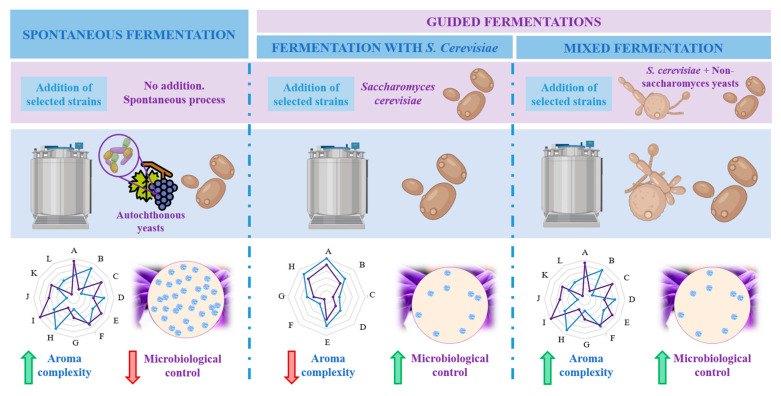
Aroma profile is one of the main features for the acceptance of wine. Yeasts and bacteria are the responsible organisms to carry out both, alcoholic and malolactic fermentation. Alcoholic fermentation is in turn, responsible for transforming grape juice into wine and providing secondary aromas. Secondary aroma can be influenced by different factors; however, the influence of the microorganisms is one of the main agents affecting final wine aroma profile. Saccharomyces cerevisiae has historically been the most used yeast for winemaking process for its specific characteristics: high fermentative metabolism and kinetics, low acetic acid production, resistance to high levels of sugar, ethanol, sulfur dioxide and also, the production of pleasant aromatic compounds. Nevertheless, in the last years, the use of non-saccharomyces yeasts has been progressively growing according to their capacity to enhance aroma complexity and interact with S. cerevisiae, especially in mixed cultures. Hence, this review article is aimed at associating the main secondary aroma compounds present in wine with the microorganisms involved in the spontaneous and guided fermentations, as well as an approach to the strain variability of species, the genetic modifications that can occur and their relevance to wine aroma construction.
Overview
The claims and statistics of this paper haven’t been checked yet.
Run the check — free, no account needed. It reads the open-access text and checks the sources it cites.
Integrity signals
Registry
Cites
Statistics
Figures
Verification
Claims the paper makes
The claims and statistics of this paper haven’t been checked yet.
Run the check — free, no account needed. It reads the open-access text and checks the sources it cites.
Claims other papers make about this one
Each is checked against this paper’s own text: does it say what the citing paper says it does?
The source backs part of the claim, not all of it — or backs it for a different population, condition or comparison.
In the citing paper
“It possesses a sweet, rose-like, and honey-like aroma, which is produced through the deamination, hydroxylation, and reduction of phenylalanine [36,94].”
From The Metabolic Pathways of Yeast and Acetic Acid Bacteria During Fruit Vinegar Fermentation and Their Influence on Flavor Development (2025) · cites this paper as [94]
Experimental — accuracy not yet measuredThe source backs part of the claim, not all of it — or backs it for a different population, condition or comparison.
In the citing paper
“Saccharomyces cerevisiae releases volatile sulfides, such as 3-thiohexanol-1-ol, by cleaving the carbon–sulfur bonds of glutathione and cysteine.”
From The Metabolic Pathways of Yeast and Acetic Acid Bacteria During Fruit Vinegar Fermentation and Their Influence on Flavor Development (2025) · cites this paper as [94]
Experimental — accuracy not yet measuredThe source backs part of the claim, not all of it — or backs it for a different population, condition or comparison.
In the citing paper
“This process imparts a distinctive thiol flavor to wines [94,95].”
From The Metabolic Pathways of Yeast and Acetic Acid Bacteria During Fruit Vinegar Fermentation and Their Influence on Flavor Development (2025) · cites this paper as [94]
Experimental — accuracy not yet measuredThe check wasn’t confident either way, so it gives no verdict — never disputed.
In the citing paper
“Benzyl alcohol typically exhibits the highest odor activity value among the alcohols in vinegar.”
From The Metabolic Pathways of Yeast and Acetic Acid Bacteria During Fruit Vinegar Fermentation and Their Influence on Flavor Development (2025) · cites this paper as [94]
Experimental — accuracy not yet measured
Self-check
Percentages, sums and reported differences re-computed from the paper’s own numbers.
The self-check needs the paper’s full text.
Citations
Cites
Ribéreau‐Gayon, P., Glories, Y., Maujean, A., & Dubourdieu, D. (2006) · Wiley eBooks · doi:10.1002/0470010398 · Cited by 1,385
Not your ordinary yeast: non- Saccharomyces yeasts in wine production uncovered
Jolly, N. P., Varela, C., & Pretorius, I. S. (2014) · FEMS Yeast Research · doi:10.1111/1567-1364.12111 · Cited by 861 · cited 5×
“pulcherrima (telemorphic form of Metschnikowia pulcherrima), among others [21,51].”
BackgroundInfluentialStyger, G., Prior, B. A., & Bauer, F. F. (2011) · Journal of Industrial Microbiology & Biotechnology · doi:10.1007/s10295-011-1018-4 · Cited by 681 · cited 12×
“cerevisiae fermentations and also, different enzymes have demonstrated a key role in their formation, such as alcohol acetyltransferases (Atf1p and Atf2p), isoamyl alcohol acetyltransferase or ethanol acetyltransferase (implied in the formation of acetate esters) or the acyl-CoA:ethanol O-acyltransferase, related with…”
BackgroundInfluentialPadilla, B., Gil, J. V., & Manzanares, P. (2016) · Frontiers in Microbiology · doi:10.3389/fmicb.2016.00411 · Cited by 503
Rapp, A., & Mandery, H. (1986) · Experientia · doi:10.1007/bf01941764 · Cited by 465
Microbial Contribution to Wine Aroma and Its Intended Use for Wine Quality Improvement
Belda, I., Ruíz, J., Esteban‐Fernández, A., Navascués, E., Marquina, D., Santos, A., & Moreno-Arribas, M. V. (2017) · Molecules · doi:10.3390/molecules22020189 · Cited by 350 · cited 12×
“Besides, same species synthesized very low amounts of 1-propanol [3,8,19].”
BackgroundInfluentialKnight, S. J., Klaere, S., Fedrizzi, B., & Goddard, M. R. (2015) · Scientific Reports · doi:10.1038/srep14233 · Cited by 327
Studies on acetate ester production by non-Saccharomyces wine yeasts
Rojas, V., Gil, J. V., Piñaga, F., & Manzanares, P. (2001) · International Journal of Food Microbiology · doi:10.1016/s0168-1605(01)00552-9 · Cited by 320 · cited 4×
“anomala Isoamyl acetate Wine Banana [53]”
BackgroundInfluentialFlavor composition of wines: A review
Schreier, P. H., & JENNINGS, W. G. (1979) · C R C Critical Reviews in Food Science and Nutrition · doi:10.1080/10408397909527273 · Cited by 311 · cited 2×
“Besides, in the group of the unsaturated fatty acids is worthy to mention 9-decenoic acid which possesses preservative properties and is relevant from an aroma point of view when transformed into ethyl ester [31].”
BackgroundAcetic acid bacteria spoilage of bottled red wine—A review
Bartowsky, E. J., & Henschke, P. A. (2007) · International Journal of Food Microbiology · doi:10.1016/j.ijfoodmicro.2007.10.016 · Cited by 304
Research works printed but not linked: 5
- (2020, November 15). National Center for Biotechnology NCBI Taxonomy Browser, Available online: https://www.ncbi.nlm.nih.gov/Taxonomy/Browser/wwwtax.cgi.
- Carrau, F. (2006). Native yeasts for low input winemaking: Searching for wine diversity and increased complexity. Advances in Applied Microbiology V. 111, Academic Press.
- Morata, A. (2018). Malolactic Fermentation. Red Wine Technology, Academic Press.
- Amaresan, N., Annapurna, K., Sankaranarayanan, A.M., and Senthil Kumar, K.K. (2020). Mitesh Dwivedi Gluconobacter. Beneficial Microbes in Agro-Ecology, Academic Press.
- Cifuentes, A. (2021). Microbiomics to Define Wine Terroir. Comprehensive Foodomics, Elsevier.
Cited by
Sorted by citations
Role of Yeasts on the Sensory Component of Wines
Romano, P., Braschi, G., Siesto, G., Patrignani, F., & Lanciotti, R. (2022) · Foods · doi:10.3390/foods11131921 · Cited by 103
“In any case, these are molecules with very low thresholds of perception that, even if present in minimal quantities, can significantly impact the generation of the sensory profile of the final product [20].”
BackgroundAlcoholic Fermentation as a Source of Congeners in Fruit Spirits
Stanzer, D., Čiča, K. H., Blesić, M., Murtić, M. S., Mrvčić, J., & Spaho, N. (2023) · Foods · doi:10.3390/foods12101951 · Cited by 84
“cerevisiae is capable of synthesizing mainly hexanoic and octanoic acids in high amounts but also pentanoic, decanoic, and 3-methylbutanoic acids [81].”
BackgroundInfluentialChanges of lipid oxidation, volatile and taste-active compounds during pan-heating of pork belly
Wang, X., Wang, X., Zhang, X., Liu, S., Yu, J., Cui, H., Xia, S., & Ho, C. (2023) · Food Research International · doi:10.1016/j.foodres.2023.113106 · Cited by 81
Liang, L., Ma, Y., Jiang, Z., Sam, F. E., Peng, S., Li, M., & Wang, J. (2022) · Food Research International · doi:10.1016/j.foodres.2022.112379 · Cited by 74
Wang, F., Zhao, P., Du, G., Zhai, J., Guo, Y., & Wang, X. (2024) · Food Chemistry · doi:10.1016/j.foodchem.2024.139981 · Cited by 66
Metadata
- Authors
- Carpena, M., Fraga-Corral, M., Otero, P., Nogueira, R. A., Garcia-Oliveira, P., Prieto, M. A., & Simal-Gandara, J.
- Affiliations
- Nutrition and Bromatology Group, Analytical and Food Chemistry Department, Faculty of Food Science and Technology, University of Vigo, Ourense Campus, E-32004 Ourense, Spain
- Universidade de Santiago de Compostela (ES)
- Universidade de Vigo (ES)
- Universidade Politécnica de Bragança (PT)
- Corresponding author
- Prieto, Miguel A.
- ORCID
- Venue
- Foods
- Publisher
- MDPI AG
- Published
- 2020-12-27
- Volume
- 10
- Issue
- 1
- Pages
- 51
- ISSN
- 2304-8158 (ISSN-L)
- PMC
- PMC7824511
- OpenAlex
- W3114274140
- Cited by
- 172
- References
- 139
- Citations by year
- 2026: 30 · 2025: 45 · 2024: 38 · 2023: 33 · 2022: 22 · 2021: 4
- FWCI
- 1.25
- Type
- journal article
- Language
- en
- Open access
- gold
- doi.org
- Licence
- Locations
- Foods (publishedVersion, cc-by)
- Europe PMC (PubMed Central) (publishedVersion, other-oa)
- PubMed Central (publishedVersion, cc-by)
- PubMed (publishedVersion)
- Portuguese National Funding Agency for Science, Research and Technology (RCAAP Project by FCT) (submittedVersion, other-oa)
- DOAJ (DOAJ: Directory of Open Access Journals) (submittedVersion, cc-by-sa)
- Investigo repository of University of Vigo (University of Vigo) (submittedVersion, cc-by)
- Investigo Institutional repository of UVigo (Universidade de Vigo) (submittedVersion, cc-by)
- Funders
- European Commission
- Ministerio de Ciencia e Innovación (RYC 2017, RYC‐2017‐22891, IJCI-2016-27774)
- Universidade de Vigo (ED481B-2019/096, ED481A-2019/295)
- Xunta de Galicia (ED481A, ED481A-2019/295, ED481B‐2019‐096, ED481B-)
- Topics
- Life Sciences › Agricultural and Biological Sciences › Food Science › Fermentation and Sensory Analysis
- Life Sciences › Agricultural and Biological Sciences › Plant Science › Horticultural and Viticultural Research
- Life Sciences › Biochemistry, Genetics and Molecular Biology › Biotechnology › Biochemical and biochemical processes
- Keywords
- wine aroma profile, Saccharomyces cerevisiae, non-Saccharomyces yeasts, mixed yeast cultures, malolactic fermentation, alcoholic fermentation, wine spoilage bacteria, aroma compounds, strain differences, spontaneous fermentation
About these checks
Registry, retraction, Cites and statistics results are computed, not judged, with one exception: a printed reference that no index lists is read once by a model before it counts as a citation error. Claims are extracted by a model and kept only when their quote appears verbatim in the text; each cited source is then checked, with a model’s help, for whether it says what the claim relies on. Those verdicts can be wrong — read the claim’s quote and the cited source before relying on one.
Statistics and arithmetic are recomputed, not judged.
Confidence bands are shown only for fields calibrated on our annotated test set. None is calibrated yet, so no band is shown.
What counts as a claim ›How we measure confidence ›How we check this ›
Are you an author, or do you see a problem with this page? Request a review
