

Challenges for Upcycled Foods: Definition, Inclusion in the Food Waste Management Hierarchy and Public Acceptability
Open accessThe DOI matches its Crossref record; 73 of the 76 references it cites were found in a registry or an index, and 1 are not checked yet; 32 of the 108 sources its claims cite were checked for support.
Abstract
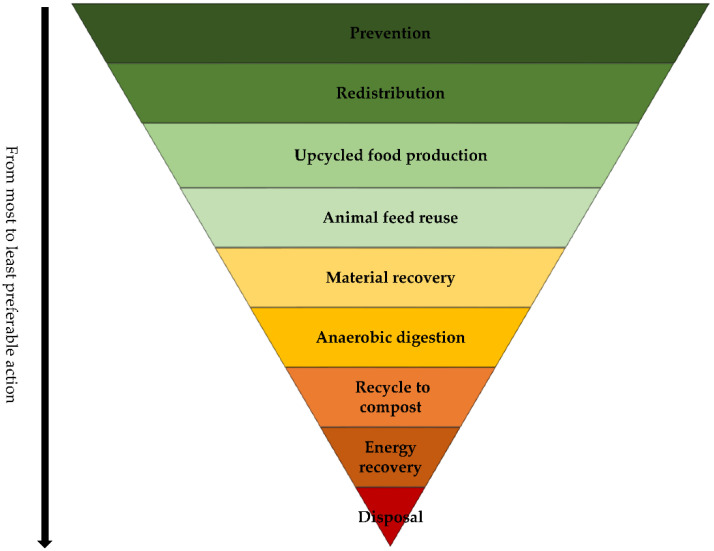
Upcycled foods contain unmarketable ingredients (e.g., damaged food produce, by-products and scraps from food preparation) that otherwise would not be directed for human consumption. Upcycled food is a new food category and thus faces several challenges, such as definition development, inclusion in the food waste management hierarchy and public acceptability. This review provides an overview of these three challenges. The upcycled food definitions have been developed for research, food manufacturers, and multi-stakeholders use. Thus, there is a need for a consumer-friendly definition for the general public. A simplified definition is proposed to introduce these foods as environmentally friendly foods containing safe ingredients that otherwise would not have gone to human consumption such as damaged food produce, by-products and scraps from food preparation. Moreover, an updated version of the food waste management hierarchy has been proposed by including the production of upcycled foods as a separate waste management action that is less preferable than redistribution but more favourable than producing animal feed. Furthermore, consumer sociodemographic characteristics and beliefs, as well as food quality cues and attributes, were identified as crucial factors for the public acceptability of these foods. Future research should address these challenges to facilitate the introduction of upcycled foods.
Verified 2026-11-22 · 1 reference not checked yet
Overview
CoChat Summary
TL;DR
This narrative review examines three challenges for upcycled foods: defining them for consumers, positioning their production in the food waste management hierarchy, and understanding public acceptability. It proposes a simplified consumer-facing definition, places upcycled food production below redistribution and above animal feed, and identifies consumer and food-quality factors affecting acceptance.
Key findings
- Upcycled food definitions exist for research, manufacturers, and multi-stakeholders, but the authors argue a consumer-friendly definition is needed; they propose “environmentally friendly foods containing safe ingredients that otherwise would not have gone to human consumption such as damaged food produce, by-products and scraps from food preparation.”
- The review proposes adding upcycled food production as a separate food waste management action, less preferable than redistribution but more favourable than producing animal feed.
- Upcycled certification requirements are reported as: certified upcycled ingredients must contain at least 95% by weight diverted materials; certified upcycled food products must contain at least 10% upcycled ingredients by weight, with products below 10% certified as having minimal upcycled ingredient content.
- Public acceptability is linked to sociodemographic characteristics and beliefs, plus food quality cues and attributes; the paper notes inconsistent findings for sociodemographic factors and that most acceptability studies used hypothetical upcycled foods rather than actual products.
Methods
- Narrative literature review covering upcycled food definitions, food waste management hierarchies, and public acceptability factors.
- The review synthesizes prior definitions and hierarchies, including research, manufacturer, multi-stakeholder, and certification perspectives, and discusses consumer studies on upcycled or valorised foods.
- No systematic search strategy, database list, inclusion criteria, or formal meta-analysis is stated in the paper.
Limitations
- The paper states that most upcycled food acceptability studies were based on hypothetical products and focused on selected factors, limiting generalisability.
- The paper states that findings for sociodemographic factors are inconsistent across studies and should be interpreted with caution.
- The paper states that the healthfulness of upcycled foods has not been thoroughly investigated; the text also makes evident that no systematic review protocol is reported, so coverage and reproducibility are unclear.
Model-written summary. Check it against the paper before relying on it.
Integrity signals
Registry
Cites
Statistics
Figures
Verification
Claims the paper makes
24 Valid · 1 Not valid · 45 Not checked · 42 Own results and interpretations
The sources with a verdict support this claim; the rest weren’t checked yet, have no full text we could read, or their verdicts aren’t rated yet.
In the paper
“It is worth mentioning that upcycled foods were only produced in a few of the reviewed studies [8,9,56,57,58], and most public acceptability studies were based on hypothetical upcycled foods where people expressed their opinion based on the product descriptions and pictures.”
§ Challenges for Upcycled Foods: Definition, Inclusion in the Food Waste Management Hierarchy and Public Acceptability > 4. Public Acceptability of Upcycled Food
What the sources say
- Supportedcites [8] Grasso S. Omoarukhe E. Wen X. Papoutsis K. Methven L. The Use of Upcycled Defatted Sunflower Seed Flour as a Functional Ingredient in Biscuits Foods 2019 8 305 10.3390/foods8080305 31374886 PMC6722723 source
The citation follows the clause identifying studies that produced upcycled foods. The Materials and Methods (Section 2.7) describe panellists tasting actual biscuits, and the Conclusions (Section 4) describe biscuits made with upcycled defatted sunflower seed flour. This paper therefore supports its role as an example of a production study; the subsequent generalization about most acceptability studies is not attributed to this individual source. (LLM, conf=0.90)
- Supportedcites [9] Alongi M. Melchior S. Anese M. Reducing the glycemic index of short dough biscuits by using apple pomace as a functional ingredient LWT 2019 100 300 305 10.1016/j.lwt.2018.10.068 source
The citation is attached to the statement that this was among the reviewed studies that produced upcycled foods, not to the subsequent generalization about hypothetical products. Section 2.3, “Short dough biscuits preparation,” reports that the researchers prepared and baked biscuits containing 10% or 20% apple pomace. (LLM, conf=0.91)
- Could not verifycites [56] Hellwig C. Gmoser R. Lundin M. Taherzadeh M.J. Rousta K. Fungi Burger from Stale Bread? A Case Study on Perceptions of a Novel Protein-Rich Food Product Made from an Edible Fungus Foods 2020 9 1112 10.3390/foods9081112 PMC7466323 32823542 sourceExperimental — accuracy not yet measured
The paper discusses food-loss estimates and, in its discussion of food-waste recycling and byproduct use, mentions food products made from byproducts. Our copy does not discuss studies of public acceptance of upcycled foods, or whether participants judged hypothetical products from descriptions and pictures. Searches for those terms found no relevant passage. (LLM, conf=0.77)
- Not checked — no full text of the sourcecites [57] de Toledo N.M.V. Nunes L.P. da Silva P.P.M. Spoto M.H.F. Canniatti-Brazaca S.G. Influence of pineapple, apple and melon by-products on cookies: Physicochemical and sensory aspects Int. J. Food Sci. Technol. 2017 52 1185 1192 10.1111/ijfs.13383 source
- Not checked yetcites [58] Stelick A. Sogari G. Rodolfi M. Dando R. Paciulli M. Impact of sustainability and nutritional messaging on Italian consumers’ purchase intent of cereal bars made with brewery spent grains J. Food Sci. 2021 86 531 539 10.1111/1750-3841.15601 33462803 source
plain- Asserted: passes — The authors put it forward as true.
- Checkable: passes — It can be checked against evidence.
- Load-bearing: unclear — It is unclear whether the paper’s conclusions depend on it.
- Based: passes — The paper gives a reason why it holds.
- Supported
The sources with a verdict support this claim; the rest weren’t checked yet, have no full text we could read, or their verdicts aren’t rated yet.
In the paper
“These studies revealed that the sensory characteristics of upcycled foods are conditional and depend on the product formulation and the proportion of upcycled ingredients [8,9,56,57].”
§ Challenges for Upcycled Foods: Definition, Inclusion in the Food Waste Management Hierarchy and Public Acceptability > 4. Public Acceptability of Upcycled Food > 4.2. Upcycled Food Quality Cues and Attributes
What the sources say
- Supportedcites [8] Grasso S. Omoarukhe E. Wen X. Papoutsis K. Methven L. The Use of Upcycled Defatted Sunflower Seed Flour as a Functional Ingredient in Biscuits Foods 2019 8 305 10.3390/foods8080305 31374886 PMC6722723 source
The Results and Discussion (§3.4; page not supplied) report that sensory changes in biscuits were more noticeable at 36% upcycled flour than at 18%. The Conclusions (§4) also propose testing other inclusion levels and reformulating with additional ingredients to optimize the recipe, supporting the claim that sensory characteristics depend on proportion and formulation. (LLM, conf=0.88)
- Supportedcites [9] Alongi M. Melchior S. Anese M. Reducing the glycemic index of short dough biscuits by using apple pomace as a functional ingredient LWT 2019 100 300 305 10.1016/j.lwt.2018.10.068 source
In Results and discussion (§3, p. 179), the paper compares biscuits made with 10% and 20% apple pomace. It reports that some sensory descriptors were unchanged, while fruit flavor was more intense at 20% but not 10%, supporting the claim that sensory effects depend on formulation and ingredient proportion. (LLM, conf=0.88)
- Could not verifycites [56] Hellwig C. Gmoser R. Lundin M. Taherzadeh M.J. Rousta K. Fungi Burger from Stale Bread? A Case Study on Perceptions of a Novel Protein-Rich Food Product Made from an Edible Fungus Foods 2020 9 1112 10.3390/foods9081112 PMC7466323 32823542 sourceExperimental — accuracy not yet measured
The “Food Waste Recycling and Byproduct Use” passage discusses making other products from food byproducts, but not their sensory characteristics. Searches for sensory qualities, formulation, and ingredient proportions found no passage addressing the claim. (LLM, conf=0.75)
- Not checked — no full text of the sourcecites [57] de Toledo N.M.V. Nunes L.P. da Silva P.P.M. Spoto M.H.F. Canniatti-Brazaca S.G. Influence of pineapple, apple and melon by-products on cookies: Physicochemical and sensory aspects Int. J. Food Sci. Technol. 2017 52 1185 1192 10.1111/ijfs.13383 source
plainstates a possible cause- Asserted: passes — The authors put it forward as true.
- Checkable: passes — It can be checked against evidence.
- Load-bearing: passes — The paper’s conclusions depend on it.
- Based: passes — The paper gives a reason why it holds.
- Supported
The cited sources support only part of this claim — read each source’s verdict below.
In the paper
“However, the presence of quality attributes such as nutritional value, healthfulness, and environmental benefits can increase the acceptability of these foods [82,85].”
§ Challenges for Upcycled Foods: Definition, Inclusion in the Food Waste Management Hierarchy and Public Acceptability > 4. Public Acceptability of Upcycled Food > 4.2. Upcycled Food Quality Cues and Attributes
What the sources say
- Partly supportedcites [82] Asioli D. Grasso S. Do consumers value food products containing upcycled ingredients? The effect of nutritional and environmental information Food Qual. Prefer. 2021 91 104194 10.1016/j.foodqual.2021.104194 sourceExperimental — accuracy not yet measured
The Discussion and Conclusions (p. 11) says that communicating nutritional or environmental benefits can increase consumers’ acceptance of upcycled foods, based on willingness to pay for hypothetical upcycled biscuits. The paper does not separately establish that healthfulness increases acceptance. (LLM, conf=0.83)
- Not checked — no full text of the sourcecites [85] Coderoni S. Perito M.A. Approaches for reducing wastes in the agricultural sector. An analysis of Millennials’ willingness to buy food with upcycled ingredients Waste Manag. 2021 126 283 290 10.1016/j.wasman.2021.03.018 33784572 source
plainstates a possible cause- Asserted: passes — The authors put it forward as true.
- Checkable: passes — It can be checked against evidence.
- Load-bearing: passes — The paper’s conclusions depend on it.
- Based: passes — The paper gives a reason why it holds.
- Partly supported
The cited sources that could be checked couldn’t confirm or dispute this claim.
In the paper
“Consumer attention to the food labels, certification, list of ingredients and country of origin affects upcycled food acceptance [60,75].”
§ Challenges for Upcycled Foods: Definition, Inclusion in the Food Waste Management Hierarchy and Public Acceptability > 4. Public Acceptability of Upcycled Food > 4.2. Upcycled Food Quality Cues and Attributes
What the sources say
- Not checked — no full text of the sourcecites [60] Coderoni S. Perito M.A. Sustainable consumption in the circular economy. An analysis of consumers’ purchase intentions for waste-to-value food J. Clean. Prod. 2020 252 119870 10.1016/j.jclepro.2019.119870 source
- Could not verifycites [75] Goodman-Smith F. Bhatt S. Moore R. Mirosa M. Ye H. Deutsch J. Suri R. Retail Potential for Upcycled Foods: Evidence from New Zealand Sustainability 2021 13 2624 10.3390/su13052624 sourceExperimental — accuracy not yet measured
Section 3 (Discussion) mentions packaging and labelling as part of a student product-development assignment, but does not examine whether consumers attend to labels. Section 1.3 discusses sensory qualities and food acceptance; our copy does not address whether labels, certification, ingredient lists, or country of origin affect acceptance of upcycled food (searched: those terms and consumer acceptability). (LLM, conf=0.76)
plainstates a cause- Asserted: passes — The authors put it forward as true.
- Checkable: passes — It can be checked against evidence.
- Load-bearing: passes — The paper’s conclusions depend on it.
- Based: passes — The paper gives a reason why it holds.
The cited sources support only part of this claim — read each source’s verdict below.
In the paper
“Consumers prefer upcycled foods over conventional products when communication emphasizes high protein content (nutritional benefit) and a low carbon footprint (environmental benefit) [82].”
§ Challenges for Upcycled Foods: Definition, Inclusion in the Food Waste Management Hierarchy and Public Acceptability > 4. Public Acceptability of Upcycled Food > 4.2. Upcycled Food Quality Cues and Attributes
What the sources say
- Partly supportedcites [82] Asioli D. Grasso S. Do consumers value food products containing upcycled ingredients? The effect of nutritional and environmental information Food Qual. Prefer. 2021 91 104194 10.1016/j.foodqual.2021.104194 sourceExperimental — accuracy not yet measured
Section 3.1 (p. 7) reports that upcycled sunflower flour was preferred over conventional wheat flour when nutritional and/or environmental information was provided. The study tested messages about higher protein content and a lower carbon footprint (p. 5), but its finding concerns UK consumers’ preferences for hypothetical biscuits, not upcycled foods generally. (LLM, conf=0.86)
plainstates a cause- Asserted: passes — The authors put it forward as true.
- Checkable: passes — It can be checked against evidence.
- Load-bearing: unclear — It is unclear whether the paper’s conclusions depend on it.
- Based: passes — The paper gives a reason why it holds.
- Partly supported
48 more claims · 10 with their cited sources checked
Create a free account to see all 112 claims and to verify the 20 references still open.
- It may state two separate claims as one. 28
- Probably not a substantial claim. 40
Citations
Cites
The theory of planned behavior
Ajzen, I. (1991) · Organizational Behavior and Human Decision Processes · doi:10.1016/0749-5978(91)90020-t · Cited by 134,657
A domain‐specific risk‐attitude scale: measuring risk perceptions and risk behaviors
Weber, E. U., Blais, A., & Betz, N. E. (2002) · Journal of Behavioral Decision Making · doi:10.1002/bdm.414 · Cited by 2,936
The food waste hierarchy as a framework for the management of food surplus and food waste
Papargyropoulou, E., Lozano, R., K. Steinberger, J., Wright, N., & Ujang, Z. B. (2014) · Journal of Cleaner Production · doi:10.1016/j.jclepro.2014.04.020 · Cited by 1,711 · cited 6×
“The food surplus is suitable for human consumption, and when it becomes inedible, it turns into waste [36].”
BackgroundInfluentialLife Cycle Assessment: Theory and Practice
(2018) · doi:10.1007/978-3-319-56475-3 · Cited by 1,073
The Health Benefits of Dietary Fibre
Barber, T. M., Kabisch, S., Pfeiffer, A. F. H., & Weickert, M. O. (2020) · Nutrients · doi:10.3390/nu12103209 · Cited by 892 · cited 1×
“Dietary fibre is associated with cardiovascular and gastrointestinal health [87].”
BackgroundGlycemic index: overview of implications in health and disease,,,
Jenkins, D. J., Kendall, C. W., Augustin, L. S., Franceschi, S., Hamidi, M., Marchie, A., Jenkins, A. L., & Axelsen, M. (2002) · The American Journal of Clinical Nutrition · doi:10.1093/ajcn/76.1.266s · Cited by 827
Quantification of Consumer Attitudes to Health and Hedonic Characteristics of Foods
ROININEN, K., LÄHTEENMÄKI, L., & TUORILA, H. (1999) · Appetite · doi:10.1006/appe.1999.0232 · Cited by 790 · cited 1×
“Taste is one of the major predictors of consumer attitudes towards a food [84].”
BackgroundRauber, F., Da Costa Louzada, M. L., Steele, E., Millett, C., Monteiro, C. A., & Levy, R. B. (2018) · Nutrients · doi:10.3390/nu10050587 · Cited by 628 · cited 1×
“It is worth mentioning that some processed foods, in particular highly processed foods, are high in fat, sugar and salt and are thus considered unhealthy [98].”
BackgroundGender differences in health information behaviour: a Finnish population-based survey
Ek, S. (2015) · Health Promotion International · doi:10.1093/heapro/dat063 · Cited by 559
Estimating and Addressing America's Food Losses
Kantor, L. S., Lipton, K., Manchester, A., Oliveira, V., Kantor, L. S., Lipton, K., Manchester, A., & Oliveira, V. (1997) · Unknown · doi:10.22004/ag.econ.234453 · Cited by 491
Research works printed but not linked: 2
- Sung K. A Review on Upcycling: Current Body of Literature, Knowledge Gaps and a Way Forward World Academy of Science, Engineering and Technology Venice, Italy 2015
- Oladepo O.W. Ilori M.O. Taiwo K.A. Assessment of the waste generation and management practices in Nigerian food industry: Towards a policy for sustainable approaches Am. J. Sci. Ind. Res. 2014 6 12 22
Cited by
Items 101–146 of 146
Hwang, Y., Luo, A., Li, W., & Mattila, A. S. (2026) · Future Foods · doi:10.1016/j.fufo.2026.101107 · Cited by 2
Oliveira, A. C. D. S., Bondam, A. F., Lacerda, L. D., & Ziegler, V. (2026) · Journal of Culinary Science & Technology · doi:10.1080/15428052.2026.2723035 · Cited by 1
“To bear the UFA label, a product must contain at least 10% by weight of upcycled ingredients (Moshtaghian et al., 2021).”
Yang, H. S., Hwang, K., Choi, A., Kim, M. K., Kim, D.-H., & Im, P. (2025) · Journal of the Korean Society of Food Science and Nutrition · doi:10.3746/jkfn.2025.54.2.164 · Cited by 2
Amjad, A., Jameel, Q. Y., Rasheed, M., Riaz, S., Shankar, A., Khare, N., Shan, K. A., Imran, A., Islam, F., Arshad, M. U., et al. (2025) · Waste and Biomass Valorization · doi:10.1007/s12649-025-03219-x · Cited by 6
“This could be a major obstacle to the introduction of this promis-ingly novel approach [79].”
Quality Characteristics of Pan Bread for Food Upcycling of Perilla Seed Meal
Sung, J. Y., & Yoon, H.-H. (2025) · Journal of the East Asian Society of Dietary Life · doi:10.17495/easdl.2025.8.35.4.249 · Cited by 1
Survey Research on the Influencing Factors of Upcycled Food in China
Zhao, B. (2024) · International Journal of Nutrition and Food Sciences · doi:10.11648/j.ijnfs.20241302.14 · Cited by 1
Kajian Literatur : Upcycled Food sebagai Inovasi Zero Waste Untuk Mengurangi Limbah Pangan
Syahbanu, F., & Pawestri, S. (2024) · Rona Teknik Pertanian · doi:10.17969/rtp.v17i1.33102 · Cited by 5
Chung, W. H., Zhong, L., Takechi, R., Coorey, R., & Howieson, J. (2024) · LWT · doi:10.1016/j.lwt.2024.116600
RetractedRetailing Strategies of Imperfect Produce and the Battle Against Food WastePreprint
Kazaz, B., Xu, F., & Yu, H. (2024) · SSRN Electronic Journal · doi:10.2139/ssrn.4951154
İleri Dönüştürülmüş (Upcycled) Gıdalara Yönelik Tüketici Tutumu ve Satın Alma Niyetinin İncelenmesi
Ongun, E., & Atılgan, K. Ö. (2024) · Yeni Fikir Dergisi · doi:10.57205/yenifikirjournal.1587986
Influence of Ethical Consumption Consciousness on Consumers’ Purchase Intentions for Upcycled Foods
Ryu, S.-H. (2024) · Journal of the East Asian Society of Dietary Life · doi:10.17495/easdl.2024.12.34.6.514 · Cited by 2
이, 연., & Yoon, H. H. (2024) · 한국식품조리과학회지 · doi:10.9724/kfcs.2024.40.6.422
Reviving Resources: The Role of Upcycled Foods in the Future of Food
Kataria, P. (2025) · Food Science and Nutrition Cases · doi:10.1079/fsncases.2025.0019 · Cited by 1
Xue-qin, R., Cao, Z., Wang, Z., & Li, Y.-F. (2025) · Journal of Food Quality · doi:10.1155/jfq/5803173 · Cited by 1
Jambrak, A. R., Oey, I., & Tiwari, B. K. (2025) · Trends in Food Science & Technology · doi:10.1016/j.tifs.2025.105189
Beekrum, L. (2025) · De Gruyter eBooks · doi:10.1515/9783111441238-019
Pandey, N., Nath, P., Kale, S., et al. (2025) · Springer eBooks · doi:10.1007/978-981-96-8433-5_12
CARACTERIZAÇÃO FÍSICO-QUÍMICA DA FARINHA DE ANACARDIUM OCCIDENTALE L. PARA APLICAÇÕES EM PANIFICAÇÃO
Rodrigues, R. R. F., Faustino, F. T. M., Machado, A. R., et al. (2025) · Revista Multidisciplinar do Nordeste Mineiro · doi:10.61164/gyr7xc03
Sustainable food production: Recovering plant waste and incorporating it into food products
Navarro-Cruz, A. R., Verá-López, O., Lazcano-Hernández, M., Juárez-Serrano, D., Kammar‐García, A., Arteaga, I. C., Cortés-Lozada, A., Toquero-Franco, A., Quezada-Figueroa, G., & Segura-Badilla, O. (2025) · Agrociencia Uruguay · doi:10.31285/agro.29.1598
Food waste upcycling via livestock to promote sustainability objectives
Dissanayake, K. K., Kurniawan, T. A., Rifky, M., & Samadiy, M. A. (2025) · Elsevier eBooks · doi:10.1016/b978-0-443-22320-4.00001-3
Hwang, S.-H., & Kim, G. (2025) · Journal of the East Asian Society of Dietary Life · doi:10.17495/easdl.2025.10.35.5.398
Ma, S., Xu, Z., Lu, P., Parrella, J. A., & Kogut, A. (2025) · Campbell Systematic Reviews · doi:10.1002/cl2.70075 · Cited by 1
Microplastic content and using food waste-fed insects in fish feed influence appeal of farmed fish
Tan, C. Y. Y., Yan, Y., Puniamoorthy, N., Carrasco, L. R., & Jaung, W. (2026) · Royal Society Open Science · doi:10.1098/rsos.251567
Quality Characteristics of Bagels Added with Rice Bran Powder
Lee, Y. J., & Yoon, H.-H. (2025) · Journal of the East Asian Society of Dietary Life · doi:10.17495/easdl.2025.12.35.6.523
Huh, Y., Xu, Y., & Jeong, E. (2026) · International Journal of Hospitality Management · doi:10.1016/j.ijhm.2026.104592
Case Studies and Real-World Applications
Youssef, I. M., El-Zenary, A. S. A., Zayda, M. G., & El-Hack, M. E. A. (2026) · Springer eBooks · doi:10.1007/978-3-032-15798-0_14
Lu, P., Waldeck, J., Weber, K., & Zhou, H. (2026) · Food and Humanity · doi:10.1016/j.foohum.2026.101135 · Cited by 1
Park, E., Min, A. M. J., & Jin, H.-Y. (2026) · Food Science and Preservation · doi:10.11002/fsp.2026.33.1.83
Fox, S., Kenny, O., Noci, F., & Dermiki, M. (2026) · Food and Humanity · doi:10.1016/j.foohum.2026.101203
Cho, J. (2026) · Cogent Food & Agriculture · doi:10.1080/23311932.2026.2665489
Between sustainability and scepticism: public discourse surrounding upcycled food on social media
Mao, L., Lu, P., Zhuang, M., Jiang, S., & Lamm, A. J. (2026) · Communication Research and Practice · doi:10.1080/22041451.2026.2672874
“Even so, the state-of-the-art iteration of this historic tradition at the industrial level with a certified standard is novel to consumers, which needs a series of educational and communication effort (Moshtaghian, Bolton, & Rousta, 2021).”
Upcycling of tomato by-products in food: quality improvements and life cycle assessment
Lordi, A., Rose, A. L., Caro, D., Conte, A., & Nobile, M. A. D. (2026) · Sustainable Food Technology · doi:10.1039/d5fb00954e · Cited by 1
Lu, P., Borron, A. S., Lamm, A. J., & Gratzek, J. (2026) · Discover Sustainability · doi:10.1007/s43621-026-03682-z
“Although upcycled foods meet safety and quality standards [4, 34], their use of by-products or surplus materials may trigger scepticism among consumers who place heavy weight on quality cues [7].”
Siemiatkowska, M., & Thomsen, M. (2026) · Cleaner Food Systems · doi:10.1016/j.clfs.2026.100048 · Cited by 2
Wang, J., Jiang, N., Li, H., & Jia, S. (2026) · Frontiers in Sustainable Food Systems · doi:10.3389/fsufs.2026.1829877
Akpoghelie, P. O., Nwadiolu, R., Edo, G. I., Iwanegbe, I., Periyasami, K., Oghroro, E. E. A., Jikah, A. N., Yousif, E., Owheruo, J. O., Essaghah, A. E. A., et al. (2026) · Ecological Frontiers · doi:10.3724/j.ecofro-20260072
Upcycled food packaging and consumers: what works and what doesn't?
Nnadiegbulam, J. C., Harbourne, N., & Grasso, S. (2026) · Current Opinion in Food Science · doi:10.1016/j.cofs.2026.101445
Byun, H.-J., & Choi, H.-S. (2026) · Journal of Ethnic Foods · doi:10.1186/s42779-026-00325-6
“Food upcycling, referring to the transformation of underutilized food materials and processing by-products into value-added resources, has emerged as a strategy for sustainable food production [20].”
Browne, G., Glover, L., Brooks, G., Wang, F., Bajka, B. H., Ellis, P. R., Collie, G., Wu, E., Lavelle, F., & Gibson, R. (2026) · International Journal of Gastronomy and Food Science · doi:10.1016/j.ijgfs.2026.101637
Santhanam, M., Somu, G., Piramanayagam, S., Susainathan, A., Jalaludin, N. A., DHANDAPANI, R., Prabhu, D., Damodhar, N., Sugumar, S., Kumaresan, A. P., et al. (2026) · F1000Research · doi:10.12688/f1000research.190217.1
Upcycling of Food Waste in Food Production
Christaki, S., & Mourtzinos, I. (2026) · Elsevier eBooks · doi:10.1016/b978-0-443-40344-6.00278-7
Liang, S., Zhang, Y., Ma, Y., Chen, X., Li, Y., & Tian, J. (2026) · Frontiers in Nutrition · doi:10.3389/fnut.2026.1903565
Dual accounting and decision support for food surplus management in circular food systems
Thomsen, M., Bairaktari, A., Raupach, R. R., Pandey, S., Zhou, X., Siemiatkowska, M., & Budhathoki, M. (2026) · Cleaner Food Systems · doi:10.1016/j.clfs.2026.100065 · Cited by 1
Liu, K., Wu, H., & Liu, F. (2026) · Frontiers in Sustainable Food Systems · doi:10.3389/fsufs.2026.1941442
de Souza, L. D. D., Crepalde, L. T., Sant’Anna, V., & Yi, S. (2026) · International Journal of Gastronomy and Food Science · doi:10.1016/j.ijgfs.2026.101635
Kaur, S., Dhiman, S., Thakur, B., Tripathi, M., & Singh, P. (2026) · Discover Food · doi:10.1007/s44187-026-01164-9
Metadata
- Authors
- Moshtaghian, H., Bolton, K., & Rousta, K.
- Affiliations
- University of Borås (SE)
- Corresponding author
- Moshtaghian, Hanieh
- Venue
- Foods
- Publisher
- MDPI AG
- Published
- 2021-11-20
- Volume
- 10
- Issue
- 11
- Pages
- 2874
- ISSN
- 2304-8158 (ISSN-L)
- PMC
- PMC8621107
- OpenAlex
- W3216622723
- Cited by
- 150
- References
- 76
- Citations by year
- 2026: 37 · 2025: 46 · 2024: 38 · 2023: 22 · 2022: 7
- FWCI
- 1.52
- Type
- journal article
- Language
- en
- Open access
- gold
- doi.org
- Licence
- Locations
- Foods (publishedVersion, cc-by)
- PubMed Central (publishedVersion, cc-by)
- PubMed (publishedVersion)
- DOAJ (DOAJ: Directory of Open Access Journals) (submittedVersion, cc-by-sa)
- Topics
- Life Sciences › Agricultural and Biological Sciences › Food Science › Food Waste Reduction and Sustainability
- Physical Sciences › Environmental Science › Ecology › Agriculture Sustainability and Environmental Impact
- Physical Sciences › Environmental Science › Waste Management and Disposal › Waste Management and Recycling
- Keywords
- upcycled food, public acceptance, food by-products, food scraps, consumer perception, food safety, animal feed
About these checks
Registry, retraction, Cites and statistics results are computed, not judged, with one exception: a printed reference that no index lists is read once by a model before it counts as a citation error. Claims are extracted by a model and kept only when their quote appears verbatim in the text; each cited source is then checked, with a model’s help, for whether it says what the claim relies on. Those verdicts can be wrong — read the claim’s quote and the cited source before relying on one.
The claim verdicts this report counts are experimental: their accuracy is not yet measured.
A language model drew the claims from the paper on 2026-10-10, under version 3 of the claim definition (model deepseek-v4.1-flash, prompt extract-v3).
A second model labelled each claim on 2026-10-10 (model jev-1.13-20260917, definition revision gold-guideline-v0.2).
Cited sources are checked with a language model’s help (gpt-6-sol).
Statistics and arithmetic are recomputed, not judged.
Confidence bands are shown only for fields calibrated on our annotated test set. None is calibrated yet, so no band is shown.
What counts as a claim ›How we measure confidence ›How we check this ›
Are you an author, or do you see a problem with this page? Request a review
Data sources
Bibliographic data: Semantic Scholar, OpenAlex, Crossref.
Contains information from the Semantic Scholar Academic Graph Datasets, made available under the ODC Attribution License (ODC-BY 1.0).
Semantic Scholar’s data is described in: Kinney, R., et al. (2023). The Semantic Scholar Open Data Platform. arXiv:2301.10140.
