

Challenges for Upcycled Foods: Definition, Inclusion in the Food Waste Management Hierarchy and Public Acceptability
Open accessThe DOI matches its Crossref record; 73 of the 76 references it cites were found in a registry or an index, and 1 are not checked yet; 32 of the 108 sources its claims cite were checked for support.
Abstract
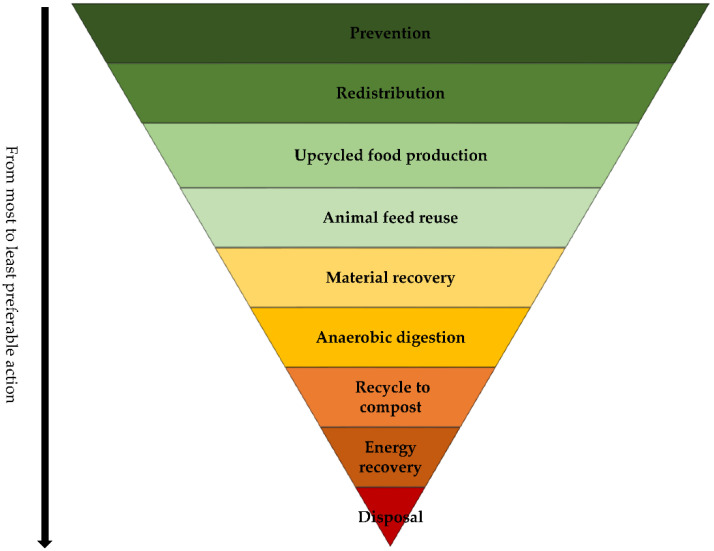
Upcycled foods contain unmarketable ingredients (e.g., damaged food produce, by-products and scraps from food preparation) that otherwise would not be directed for human consumption. Upcycled food is a new food category and thus faces several challenges, such as definition development, inclusion in the food waste management hierarchy and public acceptability. This review provides an overview of these three challenges. The upcycled food definitions have been developed for research, food manufacturers, and multi-stakeholders use. Thus, there is a need for a consumer-friendly definition for the general public. A simplified definition is proposed to introduce these foods as environmentally friendly foods containing safe ingredients that otherwise would not have gone to human consumption such as damaged food produce, by-products and scraps from food preparation. Moreover, an updated version of the food waste management hierarchy has been proposed by including the production of upcycled foods as a separate waste management action that is less preferable than redistribution but more favourable than producing animal feed. Furthermore, consumer sociodemographic characteristics and beliefs, as well as food quality cues and attributes, were identified as crucial factors for the public acceptability of these foods. Future research should address these challenges to facilitate the introduction of upcycled foods.
Verified 2026-11-25 · 1 reference not checked yet
Overview
CoChat Summary
TL;DR
This narrative review examines three challenges for upcycled foods: defining them for consumers, positioning their production in the food waste management hierarchy, and understanding public acceptability. It proposes a simplified consumer-facing definition, places upcycled food production below redistribution and above animal feed, and identifies consumer and food-quality factors affecting acceptance.
Key findings
- Upcycled food definitions exist for research, manufacturers, and multi-stakeholders, but the authors argue a consumer-friendly definition is needed; they propose “environmentally friendly foods containing safe ingredients that otherwise would not have gone to human consumption such as damaged food produce, by-products and scraps from food preparation.”
- The review proposes adding upcycled food production as a separate food waste management action, less preferable than redistribution but more favourable than producing animal feed.
- Upcycled certification requirements are reported as: certified upcycled ingredients must contain at least 95% by weight diverted materials; certified upcycled food products must contain at least 10% upcycled ingredients by weight, with products below 10% certified as having minimal upcycled ingredient content.
- Public acceptability is linked to sociodemographic characteristics and beliefs, plus food quality cues and attributes; the paper notes inconsistent findings for sociodemographic factors and that most acceptability studies used hypothetical upcycled foods rather than actual products.
Methods
- Narrative literature review covering upcycled food definitions, food waste management hierarchies, and public acceptability factors.
- The review synthesizes prior definitions and hierarchies, including research, manufacturer, multi-stakeholder, and certification perspectives, and discusses consumer studies on upcycled or valorised foods.
- No systematic search strategy, database list, inclusion criteria, or formal meta-analysis is stated in the paper.
Limitations
- The paper states that most upcycled food acceptability studies were based on hypothetical products and focused on selected factors, limiting generalisability.
- The paper states that findings for sociodemographic factors are inconsistent across studies and should be interpreted with caution.
- The paper states that the healthfulness of upcycled foods has not been thoroughly investigated; the text also makes evident that no systematic review protocol is reported, so coverage and reproducibility are unclear.
Model-written summary. Check it against the paper before relying on it.
Integrity signals
Registry
Cites
Statistics
Figures
Verification
Claims the paper makes
24 Valid · 1 Not valid · 45 Not checked · 42 Own results and interpretations
The sources with a verdict support this claim; the rest weren’t checked yet, have no full text we could read, or their verdicts aren’t rated yet.
In the paper
“It is worth mentioning that upcycled foods were only produced in a few of the reviewed studies [8,9,56,57,58], and most public acceptability studies were based on hypothetical upcycled foods where people expressed their opinion based on the product descriptions and pictures.”
§ Challenges for Upcycled Foods: Definition, Inclusion in the Food Waste Management Hierarchy and Public Acceptability > 4. Public Acceptability of Upcycled Food
What the sources say
- Supportedcites [8] Grasso S. Omoarukhe E. Wen X. Papoutsis K. Methven L. The Use of Upcycled Defatted Sunflower Seed Flour as a Functional Ingredient in Biscuits Foods 2019 8 305 10.3390/foods8080305 31374886 PMC6722723 source
The citation follows the clause identifying studies that produced upcycled foods. The Materials and Methods (Section 2.7) describe panellists tasting actual biscuits, and the Conclusions (Section 4) describe biscuits made with upcycled defatted sunflower seed flour. This paper therefore supports its role as an example of a production study; the subsequent generalization about most acceptability studies is not attributed to this individual source. (LLM, conf=0.90)
- Supportedcites [9] Alongi M. Melchior S. Anese M. Reducing the glycemic index of short dough biscuits by using apple pomace as a functional ingredient LWT 2019 100 300 305 10.1016/j.lwt.2018.10.068 source
The citation is attached to the statement that this was among the reviewed studies that produced upcycled foods, not to the subsequent generalization about hypothetical products. Section 2.3, “Short dough biscuits preparation,” reports that the researchers prepared and baked biscuits containing 10% or 20% apple pomace. (LLM, conf=0.91)
- Could not verifycites [56] Hellwig C. Gmoser R. Lundin M. Taherzadeh M.J. Rousta K. Fungi Burger from Stale Bread? A Case Study on Perceptions of a Novel Protein-Rich Food Product Made from an Edible Fungus Foods 2020 9 1112 10.3390/foods9081112 PMC7466323 32823542 sourceExperimental — accuracy not yet measured
The paper discusses food-loss estimates and, in its discussion of food-waste recycling and byproduct use, mentions food products made from byproducts. Our copy does not discuss studies of public acceptance of upcycled foods, or whether participants judged hypothetical products from descriptions and pictures. Searches for those terms found no relevant passage. (LLM, conf=0.77)
- Not checked — no full text of the sourcecites [57] de Toledo N.M.V. Nunes L.P. da Silva P.P.M. Spoto M.H.F. Canniatti-Brazaca S.G. Influence of pineapple, apple and melon by-products on cookies: Physicochemical and sensory aspects Int. J. Food Sci. Technol. 2017 52 1185 1192 10.1111/ijfs.13383 source
- Not checked yetcites [58] Stelick A. Sogari G. Rodolfi M. Dando R. Paciulli M. Impact of sustainability and nutritional messaging on Italian consumers’ purchase intent of cereal bars made with brewery spent grains J. Food Sci. 2021 86 531 539 10.1111/1750-3841.15601 33462803 source
plain- Asserted: passes — The authors put it forward as true.
- Checkable: passes — It can be checked against evidence.
- Load-bearing: unclear — It is unclear whether the paper’s conclusions depend on it.
- Based: passes — The paper gives a reason why it holds.
- Supported
The sources with a verdict support this claim; the rest weren’t checked yet, have no full text we could read, or their verdicts aren’t rated yet.
In the paper
“These studies revealed that the sensory characteristics of upcycled foods are conditional and depend on the product formulation and the proportion of upcycled ingredients [8,9,56,57].”
§ Challenges for Upcycled Foods: Definition, Inclusion in the Food Waste Management Hierarchy and Public Acceptability > 4. Public Acceptability of Upcycled Food > 4.2. Upcycled Food Quality Cues and Attributes
What the sources say
- Supportedcites [8] Grasso S. Omoarukhe E. Wen X. Papoutsis K. Methven L. The Use of Upcycled Defatted Sunflower Seed Flour as a Functional Ingredient in Biscuits Foods 2019 8 305 10.3390/foods8080305 31374886 PMC6722723 source
The Results and Discussion (§3.4; page not supplied) report that sensory changes in biscuits were more noticeable at 36% upcycled flour than at 18%. The Conclusions (§4) also propose testing other inclusion levels and reformulating with additional ingredients to optimize the recipe, supporting the claim that sensory characteristics depend on proportion and formulation. (LLM, conf=0.88)
- Supportedcites [9] Alongi M. Melchior S. Anese M. Reducing the glycemic index of short dough biscuits by using apple pomace as a functional ingredient LWT 2019 100 300 305 10.1016/j.lwt.2018.10.068 source
In Results and discussion (§3, p. 179), the paper compares biscuits made with 10% and 20% apple pomace. It reports that some sensory descriptors were unchanged, while fruit flavor was more intense at 20% but not 10%, supporting the claim that sensory effects depend on formulation and ingredient proportion. (LLM, conf=0.88)
- Could not verifycites [56] Hellwig C. Gmoser R. Lundin M. Taherzadeh M.J. Rousta K. Fungi Burger from Stale Bread? A Case Study on Perceptions of a Novel Protein-Rich Food Product Made from an Edible Fungus Foods 2020 9 1112 10.3390/foods9081112 PMC7466323 32823542 sourceExperimental — accuracy not yet measured
The “Food Waste Recycling and Byproduct Use” passage discusses making other products from food byproducts, but not their sensory characteristics. Searches for sensory qualities, formulation, and ingredient proportions found no passage addressing the claim. (LLM, conf=0.75)
- Not checked — no full text of the sourcecites [57] de Toledo N.M.V. Nunes L.P. da Silva P.P.M. Spoto M.H.F. Canniatti-Brazaca S.G. Influence of pineapple, apple and melon by-products on cookies: Physicochemical and sensory aspects Int. J. Food Sci. Technol. 2017 52 1185 1192 10.1111/ijfs.13383 source
plainstates a possible cause- Asserted: passes — The authors put it forward as true.
- Checkable: passes — It can be checked against evidence.
- Load-bearing: passes — The paper’s conclusions depend on it.
- Based: passes — The paper gives a reason why it holds.
- Supported
The cited sources support only part of this claim — read each source’s verdict below.
In the paper
“However, the presence of quality attributes such as nutritional value, healthfulness, and environmental benefits can increase the acceptability of these foods [82,85].”
§ Challenges for Upcycled Foods: Definition, Inclusion in the Food Waste Management Hierarchy and Public Acceptability > 4. Public Acceptability of Upcycled Food > 4.2. Upcycled Food Quality Cues and Attributes
What the sources say
- Partly supportedcites [82] Asioli D. Grasso S. Do consumers value food products containing upcycled ingredients? The effect of nutritional and environmental information Food Qual. Prefer. 2021 91 104194 10.1016/j.foodqual.2021.104194 sourceExperimental — accuracy not yet measured
The Discussion and Conclusions (p. 11) says that communicating nutritional or environmental benefits can increase consumers’ acceptance of upcycled foods, based on willingness to pay for hypothetical upcycled biscuits. The paper does not separately establish that healthfulness increases acceptance. (LLM, conf=0.83)
- Not checked — no full text of the sourcecites [85] Coderoni S. Perito M.A. Approaches for reducing wastes in the agricultural sector. An analysis of Millennials’ willingness to buy food with upcycled ingredients Waste Manag. 2021 126 283 290 10.1016/j.wasman.2021.03.018 33784572 source
plainstates a possible cause- Asserted: passes — The authors put it forward as true.
- Checkable: passes — It can be checked against evidence.
- Load-bearing: passes — The paper’s conclusions depend on it.
- Based: passes — The paper gives a reason why it holds.
- Partly supported
The cited sources that could be checked couldn’t confirm or dispute this claim.
In the paper
“Consumer attention to the food labels, certification, list of ingredients and country of origin affects upcycled food acceptance [60,75].”
§ Challenges for Upcycled Foods: Definition, Inclusion in the Food Waste Management Hierarchy and Public Acceptability > 4. Public Acceptability of Upcycled Food > 4.2. Upcycled Food Quality Cues and Attributes
What the sources say
- Not checked — no full text of the sourcecites [60] Coderoni S. Perito M.A. Sustainable consumption in the circular economy. An analysis of consumers’ purchase intentions for waste-to-value food J. Clean. Prod. 2020 252 119870 10.1016/j.jclepro.2019.119870 source
- Could not verifycites [75] Goodman-Smith F. Bhatt S. Moore R. Mirosa M. Ye H. Deutsch J. Suri R. Retail Potential for Upcycled Foods: Evidence from New Zealand Sustainability 2021 13 2624 10.3390/su13052624 sourceExperimental — accuracy not yet measured
Section 3 (Discussion) mentions packaging and labelling as part of a student product-development assignment, but does not examine whether consumers attend to labels. Section 1.3 discusses sensory qualities and food acceptance; our copy does not address whether labels, certification, ingredient lists, or country of origin affect acceptance of upcycled food (searched: those terms and consumer acceptability). (LLM, conf=0.76)
plainstates a cause- Asserted: passes — The authors put it forward as true.
- Checkable: passes — It can be checked against evidence.
- Load-bearing: passes — The paper’s conclusions depend on it.
- Based: passes — The paper gives a reason why it holds.
The cited sources support only part of this claim — read each source’s verdict below.
In the paper
“Consumers prefer upcycled foods over conventional products when communication emphasizes high protein content (nutritional benefit) and a low carbon footprint (environmental benefit) [82].”
§ Challenges for Upcycled Foods: Definition, Inclusion in the Food Waste Management Hierarchy and Public Acceptability > 4. Public Acceptability of Upcycled Food > 4.2. Upcycled Food Quality Cues and Attributes
What the sources say
- Partly supportedcites [82] Asioli D. Grasso S. Do consumers value food products containing upcycled ingredients? The effect of nutritional and environmental information Food Qual. Prefer. 2021 91 104194 10.1016/j.foodqual.2021.104194 sourceExperimental — accuracy not yet measured
Section 3.1 (p. 7) reports that upcycled sunflower flour was preferred over conventional wheat flour when nutritional and/or environmental information was provided. The study tested messages about higher protein content and a lower carbon footprint (p. 5), but its finding concerns UK consumers’ preferences for hypothetical biscuits, not upcycled foods generally. (LLM, conf=0.86)
plainstates a cause- Asserted: passes — The authors put it forward as true.
- Checkable: passes — It can be checked against evidence.
- Load-bearing: unclear — It is unclear whether the paper’s conclusions depend on it.
- Based: passes — The paper gives a reason why it holds.
- Partly supported
48 more claims · 10 with their cited sources checked
Create a free account to see all 112 claims and to verify the 20 references still open.
- It may state two separate claims as one. 28
- Probably not a substantial claim. 40
Citations
Cites
The theory of planned behavior
Ajzen, I. (1991) · Organizational Behavior and Human Decision Processes · doi:10.1016/0749-5978(91)90020-t · Cited by 134,657
A domain‐specific risk‐attitude scale: measuring risk perceptions and risk behaviors
Weber, E. U., Blais, A., & Betz, N. E. (2002) · Journal of Behavioral Decision Making · doi:10.1002/bdm.414 · Cited by 2,936
The food waste hierarchy as a framework for the management of food surplus and food waste
Papargyropoulou, E., Lozano, R., K. Steinberger, J., Wright, N., & Ujang, Z. B. (2014) · Journal of Cleaner Production · doi:10.1016/j.jclepro.2014.04.020 · Cited by 1,711 · cited 6×
“The food surplus is suitable for human consumption, and when it becomes inedible, it turns into waste [36].”
BackgroundInfluentialLife Cycle Assessment: Theory and Practice
(2018) · doi:10.1007/978-3-319-56475-3 · Cited by 1,073
The Health Benefits of Dietary Fibre
Barber, T. M., Kabisch, S., Pfeiffer, A. F. H., & Weickert, M. O. (2020) · Nutrients · doi:10.3390/nu12103209 · Cited by 892 · cited 1×
“Dietary fibre is associated with cardiovascular and gastrointestinal health [87].”
BackgroundGlycemic index: overview of implications in health and disease,,,
Jenkins, D. J., Kendall, C. W., Augustin, L. S., Franceschi, S., Hamidi, M., Marchie, A., Jenkins, A. L., & Axelsen, M. (2002) · The American Journal of Clinical Nutrition · doi:10.1093/ajcn/76.1.266s · Cited by 827
Quantification of Consumer Attitudes to Health and Hedonic Characteristics of Foods
ROININEN, K., LÄHTEENMÄKI, L., & TUORILA, H. (1999) · Appetite · doi:10.1006/appe.1999.0232 · Cited by 790 · cited 1×
“Taste is one of the major predictors of consumer attitudes towards a food [84].”
BackgroundRauber, F., Da Costa Louzada, M. L., Steele, E., Millett, C., Monteiro, C. A., & Levy, R. B. (2018) · Nutrients · doi:10.3390/nu10050587 · Cited by 628 · cited 1×
“It is worth mentioning that some processed foods, in particular highly processed foods, are high in fat, sugar and salt and are thus considered unhealthy [98].”
BackgroundGender differences in health information behaviour: a Finnish population-based survey
Ek, S. (2015) · Health Promotion International · doi:10.1093/heapro/dat063 · Cited by 559
Estimating and Addressing America's Food Losses
Kantor, L. S., Lipton, K., Manchester, A., Oliveira, V., Kantor, L. S., Lipton, K., Manchester, A., & Oliveira, V. (1997) · Unknown · doi:10.22004/ag.econ.234453 · Cited by 491
(2013) · Cited by 490
Novel antioxidants in food quality preservation and health promotion
Shahidi, F., & Zhong, Y. (2010) · European Journal of Lipid Science and Technology · doi:10.1002/ejlt.201000044 · Cited by 479 · cited 1×
“, Alzheimer’s and Parkinson), diabetes, hypertension and cardiovascular disease [88].”
BackgroundWasted Food: U.S. Consumers' Reported Awareness, Attitudes, and Behaviors
Neff, R. A., Spiker, M. L., & Truant, P. L. (2015) · PLOS ONE · doi:10.1371/journal.pone.0127881 · Cited by 461 · cited 1×
“Wasted food implies the loss of food as a valuable resource, whereas food waste conveys the generation of valueless materials as waste [28,29].”
BackgroundTeigiserova, D. A., Hamelin, L., & Thomsen, M. (2020) · Science of The Total Environment · doi:10.1016/j.scitotenv.2019.136033 · Cited by 461 · cited 5×
“Some hierarchies [30,38,39] provide a general model with a small selection of actions, resulting in different interpretations of each action.”
BackgroundInfluentialBello Acebrón, L., & Calvo Dopico, D. (2000) · Food Quality and Preference · doi:10.1016/s0950-3293(99)00059-2 · Cited by 413
The Role of Price in Multi-Attribute Product Evaluations
Erickson, G. M., & Johansson, J. K. (1985) · Journal of Consumer Research · doi:10.1086/208508 · Cited by 412 · cited 2×
“Another extrinsic cue is price, which plays a dual role in consumer choices [78,79].”
BackgroundCox, D. N., & Evans, G. (2008) · Food Quality and Preference · doi:10.1016/j.foodqual.2008.04.005 · Cited by 397 · cited 1×
“There is a general aversion and neophobia towards novel foods and foods produced by innovative methods [68], and technophobia has been identified as a barrier to consumer acceptance [69].”
BackgroundOpening the black box of food waste reduction
Garrone, P., Melacini, M., & Perego, A. (2014) · Food Policy · doi:10.1016/j.foodpol.2014.03.014 · Cited by 394 · cited 1×
“Surplus food can be generated at any stage of the food supply chain because it comprises edible food that has been produced, manufactured, retailed or served but has not been consumed [26].”
BackgroundGlycemic index: overview of implications in health and disease,,,
Jenkins, D. J., Kendall, C. W., Augustin, L. S., Franceschi, S., Hamidi, M., Marchie, A., Jenkins, A. L., & Axelsen, M. (2002) · The American Journal of Clinical Nutrition · doi:10.1093/ajcn/76/1.266s · Cited by 379 · cited 1×
“Low glycemic index foods decrease the risk of developing diabetes and cardiovascular disease [89].”
BackgroundPerceived quality: A market driven and consumer oriented approach
Oude Ophuis, P. A. M., & Van Trijp, H. C. M. (1995) · Food Quality and Preference · doi:10.1016/0950-3293(94)00028-t · Cited by 375 · cited 3×
“Food intrinsic cues are mostly ingredient-related and thus cannot be easily altered without modifying the physical characteristics of the product [14,71].”
BackgroundProcessed foods: Contributions to nutrition
Weaver, C. M., Dwyer, J., Fulgoni, V. L., King, J. C., Leveille, G. A., MacDonald, R. S., Ordovas, J., & Schnakenberg, D. (2014) · The American Journal of Clinical Nutrition · doi:10.3945/ajcn.114.089284 · Cited by 347
On the measurement of food waste
Bellemare, M. F., Çakir, M., Peterson, H. H., Novak, L., & Rudi, J. (2017) · American Journal of Agricultural Economics · doi:10.1093/ajae/aax034 · Cited by 324
Limitations of the waste hierarchy for achieving absolute reductions in material throughput
Van Ewijk, S., & Stegemann, J. A. (2016) · Journal of Cleaner Production · doi:10.1016/j.jclepro.2014.11.051 · Cited by 304 · cited 2×
“The priority order of actions in the waste management hierarchy is based on “assumed” environmental impacts, and the results from lifecycle assessment (LCA) studies of the actual environmental impact have been inconclusive [46].”
BackgroundCoderoni, S., & Perito, M. A. (2020) · Journal of Cleaner Production · doi:10.1016/j.jclepro.2019.119870 · Cited by 298 · cited 10×
“In terms of product brand, although consumers consider brand as one of the food quality indicators [77], this factor does not appear to act in favour of upcycled foods [25,60].”
BackgroundInfluentialFood quality: Relativity, context and consumer expectations
Cardello, A. V. (1995) · Food Quality and Preference · doi:10.1016/0950-3293(94)00039-x · Cited by 293 · cited 1×
“Food quality affects consumer acceptability [70] and is determined by cues and attributes [71].”
BackgroundAnalysis of waste hierarchy in the European waste directive 2008/98/EC
Gharfalkar, M., Court, R., Campbell, C., Ali, Z., & Hillier, G. (2015) · Waste Management · doi:10.1016/j.wasman.2015.02.007 · Cited by 285
Cue utilisation and quality perception with regard to branded beef
Bredahl, L. (2004) · Food Quality and Preference · doi:10.1016/s0950-3293(03)00024-7 · Cited by 272
Consumer food choices: The role of price and pricing strategies
Steenhuis, I. H., Waterlander, W. E., & de Mul, A. (2011) · Public Health Nutrition · doi:10.1017/s1368980011001637 · Cited by 241 · cited 1×
“The high price of environmentally friendly foods [80] affects their affordability for the public, particularly for low-income consumers [81].”
BackgroundMarian, L., Chrysochou, P., Krystallis, A., & Thøgersen, J. (2014) · Food Quality and Preference · doi:10.1016/j.foodqual.2014.05.001 · Cited by 237 · cited 1×
“The high price of environmentally friendly foods [80] affects their affordability for the public, particularly for low-income consumers [81].”
BackgroundA Methodology for Sustainable Management of Food Waste
Garcia-Garcia, G., Woolley, E., Rahimifard, S., Colwill, J., White, R., & Needham, L. (2017) · Waste and Biomass Valorization · doi:10.1007/s12649-016-9720-0 · Cited by 225
Reducing the land use of EU pork production: Where there’s swill, there’s a way
zu Ermgassen, E. K. H. J., Phalan, B., Green, R. E., & Balmford, A. (2016) · Food Policy · doi:10.1016/j.foodpol.2015.11.001 · Cited by 210 · cited 3×
“For example, in some models, composting is preferred to anaerobic digestion [36,38] and vice versa [37,41].”
BackgroundThe impact of dietary protein intake on longevity and metabolic health
Kitada, M., Ogura, Y., Monno, I., & Koya, D. (2019) · EBioMedicine · doi:10.1016/j.ebiom.2019.04.005 · Cited by 175 · cited 1×
“For example, proteins are protective against sarcopenia (loss of muscle mass) and frailty [86].”
BackgroundAschemann-Witzel, J., & Stangherlin, I. D. C. (2021) · Technological Forecasting and Social Change · doi:10.1016/j.techfore.2021.120749 · Cited by 174 · cited 1×
“To our knowledge, there are a limited number of literature reviews on the nonbiotechnological aspect of upcycled foods [20,21], and none of them addresses all of the challenges mentioned above.”
BackgroundBärebring, L., Palmqvist, M., Winkvist, A., & Augustin, H. (2020) · Nutrition Journal · doi:10.1186/s12937-020-00659-0 · Cited by 167
Reducing the glycemic index of short dough biscuits by using apple pomace as a functional ingredient
Alongi, M., Melchior, S., & Anese, M. (2019) · LWT · doi:10.1016/j.lwt.2018.10.068 · Cited by 166 · cited 4×
“These studies revealed that the sensory characteristics of upcycled foods are conditional and depend on the product formulation and the proportion of upcycled ingredients [8,9,56,57].”
BackgroundInfluentialBhatt, S., Lee, J., Deutsch, J., Ayaz, H., Fulton, B., & Suri, R. (2018) · Journal of Consumer Behaviour · doi:10.1002/cb.1689 · Cited by 162 · cited 10×
“Some research studies refer to upcycled foods as waste-to-value food products [25] or value-added surplus products [14].”
BackgroundInfluentialThe dual role of price: Decomposing consumers’ reactions to price
Völckner, F. (2008) · Journal of the Academy of Marketing Science · doi:10.1007/s11747-007-0076-7 · Cited by 160 · cited 2×
“Another extrinsic cue is price, which plays a dual role in consumer choices [78,79].”
BackgroundSingh-Ackbarali, D., & Maharaj, R. (2014) · Journal of Curriculum and Teaching · doi:10.5430/jct.v3n1p10 · Cited by 157 · cited 1×
“Intrinsic cues are used in food sensory evaluation [74], and some studies have developed an upcycled food product to assess its intrinsic cues such as appearance and colour [8,56–58].”
BackgroundThe effect of the brand on perceived quality of food products
Vraneševic´, T., & Stančec, R. (2003) · British Food Journal · doi:10.1108/00070700310511609 · Cited by 148 · cited 1×
“In terms of product brand, although consumers consider brand as one of the food quality indicators [77], this factor does not appear to act in favour of upcycled foods [25,60].”
BackgroundKim, M.-H., Song, Y.-E., Song, H.-B., Kim, J.-W., & Hwang, S.-J. (2011) · Waste Management · doi:10.1016/j.wasman.2011.04.019 · Cited by 144 · cited 1×
“The dried food waste can be incinerated in mixed solid waste, resulting in energy recovery [51].”
BackgroundAschemann-Witzel, J., & Peschel, A. O. (2019) · Food Quality and Preference · doi:10.1016/j.foodqual.2019.04.012 · Cited by 140 · cited 5×
“For example, the consumer’s low acceptability of protein drinks made from potato by-products or grass as a protein source [25] can be due to the inclusion of unfamiliar ingredients.”
BackgroundInfluentialConsumer preferences for upcycled ingredients: A case study with biscuits
Grasso, S., & Asioli, D. (2020) · Food Quality and Preference · doi:10.1016/j.foodqual.2020.103951 · Cited by 140 · cited 4×
“The certification of upcycled foods with carbon footprint labels such as carbon trust improves their acceptability, particularly among environmentalists [19].”
BackgroundInfluentialConsumers’ willingness to pay for upcycled foods
Bhatt, S., Ye, H., Deutsch, J., Ayaz, H., & Suri, R. (2020) · Food Quality and Preference · doi:10.1016/j.foodqual.2020.104035 · Cited by 112 · cited 2×
“, food waste and sub-optimal ingredients), people expect to pay a discounted price for such foods [15].”
BackgroundCoderoni, S., & Perito, M. A. (2021) · Waste Management · doi:10.1016/j.wasman.2021.03.018 · Cited by 111 · cited 1×
“However, the presence of quality attributes such as nutritional value, healthfulness, and environmental benefits can increase the acceptability of these foods [82,85].”
BackgroundFood waste quantification in primary production—The Nordic countries as a case study
Hartikainen, H., Mogensen, L., Svanes, E., & Franke, U. (2018) · Waste Management · doi:10.1016/j.wasman.2017.10.026 · Cited by 110
Peschel, A. O., & Aschemann-Witzel, J. (2020) · Journal of Cleaner Production · doi:10.1016/j.jclepro.2020.122884 · Cited by 110 · cited 1×
“Therefore, transparency in upcycled food communication does not necessarily convince consumers to buy or pay more, and, in fact, it may negatively affect their choices [83].”
BackgroundThe role of food waste hierarchy in addressing policy and research: A comparative analysis
Giordano, C., Falasconi, L., Cicatiello, C., & Pancino, B. (2019) · Journal of Cleaner Production · doi:10.1016/j.jclepro.2019.119617 · Cited by 107 · cited 1×
“The food waste management hierarchy plays an important role in establishing policies [18]; therefore, the inclusion of upcycled food production in this hierarchy helps to develop policies and regulations.”
BackgroundReynolds, C., Piantadosi, J., & Boland, J. (2015) · Sustainability · doi:10.3390/su7044707 · Cited by 103 · cited 1×
“Thus, decreasing food waste provides an opportunity to feed people in need and reduce food insecurity [4].”
BackgroundAddressing food waste: How to position upcycled foods to different generations
Zhang, J., Ye, H., Bhatt, S., Jeong, H., Deutsch, J., Ayaz, H., & Suri, R. (2021) · Journal of Consumer Behaviour · doi:10.1002/cb.1844 · Cited by 101 · cited 4×
“One of the advantages of upcycled food production is its contribution to food security [16].”
BackgroundInfluential2016 Global Food Policy Report
Research Institute (IFPRI), I. F. P. (2016) · doi:10.2499/9780896295827 · Cited by 101
Influence of pineapple, apple and melon by-products on cookies: physicochemical and sensory aspects
de Toledo, N. M. V., Nunes, L. P., da Silva, P. P. M., Spoto, M. H. F., & Canniatti-Brazaca, S. G. (2017) · International Journal of Food Science and Technology · doi:10.1111/ijfs.13383 · Cited by 91 · cited 4×
“These studies revealed that the sensory characteristics of upcycled foods are conditional and depend on the product formulation and the proportion of upcycled ingredients [8,9,56,57].”
BackgroundInfluentialMcCarthy, B., Kapetanaki, A. B., & Wang, P. (2020) · Journal of Cleaner Production · doi:10.1016/j.jclepro.2020.120435 · Cited by 91 · cited 3×
“Consumers with a high level of education [61] and a high income level [65] are inclined to choose upcycled foods.”
BackgroundAsioli, D., & Grasso, S. (2021) · Food Quality and Preference · doi:10.1016/j.foodqual.2021.104194 · Cited by 86 · cited 6×
“Similarly, consumers are willing to pay a premium price when the upcycled food is introduced as a food with nutritional and environmental benefits [82].”
BackgroundInfluentialThe Use of Upcycled Defatted Sunflower Seed Flour as a Functional Ingredient in Biscuits
Grasso, S., Omoarukhe, E., Wen, X., Papoutsis, K., & Methven, L. (2019) · Foods · doi:10.3390/foods8080305 · Cited by 85
Transforming Beef By-products into Valuable Ingredients: Which Spell/Recipe to Use?
Henchion, M., McCarthy, M., & O’Callaghan, J. (2016) · Frontiers in Nutrition · doi:10.3389/fnut.2016.00053 · Cited by 83
Defining Upcycled Food Products
Spratt, O., Suri, R., & Deutsch, J. (2021) · Journal of Culinary Science & Technology · doi:10.1080/15428052.2020.1790074 · Cited by 83 · cited 10×
“Foods made from such ingredients are value-added products and are classified as “upcycled foods” [10], a term that has been recently introduced.”
BackgroundInfluentialFood Waste and Upcycled Foods: Can a Logo Increase Acceptance of Upcycled Foods?
Bhatt, S., Ye, H., Deutsch, J. M., Jeong, H., Zhang, J., & Suri, R. (2021) · Journal of Food Products Marketing · doi:10.1080/10454446.2021.1955798 · Cited by 71
Consumer acceptance of food obtained from olive by-products: A survey of Italian consumers
Perito, M. A., Di Fonzo, A., Sansone, M., & Russo, C. (2019) · British Food Journal · doi:10.1108/bfj-03-2019-0197 · Cited by 70 · cited 1×
“There is a general aversion and neophobia towards novel foods and foods produced by innovative methods [68], and technophobia has been identified as a barrier to consumer acceptance [69].”
BackgroundRetail Potential for Upcycled Foods: Evidence from New Zealand
Goodman-Smith, F., Bhatt, S., Moore, R., Mirosa, M., Ye, H., Deutsch, J., & Suri, R. (2021) · Sustainability · doi:10.3390/su13052624 · Cited by 68 · cited 2×
“Since upcycled food intrinsic cues are difficult to modify, marketing activities mainly focus on extrinsic cues [14] such as labels, certification, country of origin and price [60,61,75].”
BackgroundA Framework for a More Efficient Approach to Food Waste Management
Garcia‐Garcia, G., Woolley, E., & Rahimifard, S. (2015) · ETP International Journal of Food Engineering · doi:10.18178/ijfe.1.1.65-72 · Cited by 66 · cited 2×
“This might be due to the intended use of the hierarchy, because composting is applicable at both industrial and household levels, whereas anaerobic digestion appears to have more environmental benefits [50].”
BackgroundHellwig, C., Gmoser, R., Lundin, M., Taherzadeh, M. J., & Rousta, K. (2020) · Foods · doi:10.3390/foods9081112 · Cited by 63 · cited 3×
“These studies revealed that the sensory characteristics of upcycled foods are conditional and depend on the product formulation and the proportion of upcycled ingredients [8,9,56,57].”
BackgroundSelf-citationStelick, A., Sogari, G., Rodolfi, M., Dando, R., & Paciulli, M. (2021) · Journal of Food Science · doi:10.1111/1750-3841.15601 · Cited by 62 · cited 2×
“The taste and texture of an upcycled food may differ from conventional products, and thus these foods appear more [57] or less favourable [8,56,58] than their conventional alternatives.”
BackgroundPublic understanding of climate change terminology
Bruine de Bruin, W., Rabinovich, L., Weber, K., Babboni, M., Dean, M., & Ignon, L. (2021) · Climatic Change · doi:10.1007/s10584-021-03183-0 · Cited by 62 · cited 3×
“Thus, a definition that contains simple words and avoids complex language can be more effective for communication and comprehension by the general public [17].”
BackgroundInfluentialMicronutrient fortification of foods — rationale, application and impact
Mannar, M. G. V., & Sankar, R. (2004) · The Indian Journal of Pediatrics · doi:10.1007/bf02828115 · Cited by 48 · cited 1×
“Nutrient fortification is a strategy used to improve food quality [90], and upcycled foods can take advantage of this approach to improve their acceptability.”
BackgroundAli, S., Akter, S., & Fogarassy, C. (2021) · Sustainability · doi:10.3390/su13105390 · Cited by 39 · cited 1×
“It is worth mentioning that findings for sociodemographic factors are not consistent in all studies [22,60,66] and thus should be interpreted with caution, as the context of each study and the type of upcycled food under investigation were different.”
BackgroundAschemann-Witzel, J., Bizzo, H. R., Doria Chaves, A. C. S., Faria-Machado, A. F., Gomes Soares, A., de Oliveira Fonseca, M. J., Kidmose, U., & Rosenthal, A. (2023) · Critical Reviews in Food Science and Nutrition · doi:10.1080/10408398.2021.1963665 · Cited by 38 · cited 1×
“To our knowledge, there are a limited number of literature reviews on the nonbiotechnological aspect of upcycled foods [20,21], and none of them addresses all of the challenges mentioned above.”
BackgroundNew Sustainable Market Opportunities for Surplus Food: A Food System-Sensitive Methodology (FSSM)
O’Donnell, T. H., Deutsch, J., Yungmann, C., Zeitz, A., & Katz, S. H. (2015) · Food and Nutrition Sciences · doi:10.4236/fns.2015.610093 · Cited by 35 · cited 1×
“Taking leftovers and converting them to foods, and recycling ingredients from surplus foods to produce another type of food are some examples [22,23].”
BackgroundReducing food waste; Obstacles experienced in legislation and regulations
Waarts, Y. R., Eppink, M. M., Oosterkamp, E. B., Hiller, S. R. C. H., van der Sluis, A. A., & Timmermans, T. (2011) · Socio-Environmental Systems Modeling · Cited by 28
Calculating the energy and water use in food processing and assessing the resulting impacts
Walker, C., Beretta, C., Sanjuán, N., & Hellweg, S. (2018) · The International Journal of Life Cycle Assessment · doi:10.1007/s11367-017-1327-6 · Cited by 24 · cited 2×
“Some environmental issues related to food manufacturing include waste generation, excessive use of resources (energy and water) and a high carbon footprint [53,91].”
BackgroundA Hierarchical Pyramid for Food Waste Based on a Social Innovation Perspective
Lombardi, M., & Costantino, M. (2021) · Sustainability · doi:10.3390/su13094661 · Cited by 22 · cited 2×
“It has been suggested that value-added food production could be considered within the human reuse stage [52], however, producing upcycled food differs from redistribution.”
Background(2020) · Cited by 9
Valorisation of food surpluses and side-flows and citizens' understanding
Rahmani, D., & Roig, J. M. G. (2018) · RECERCAT (Consorci de Serveis Universitaris de Catalunya) · Cited by 8
Price (2000) · doi:10.1002/(sici)1099-1719(200005)8:2<96::aid-sd133>3.0.co;2-j
The State of Food and Agriculture 2019: Moving Forward on Food Loss and Waste Reduction
(2019) · The State of Food and Agriculture · doi:10.18356/32f21f8c-en
Research works printed but not linked: 2
- Sung K. A Review on Upcycling: Current Body of Literature, Knowledge Gaps and a Way Forward World Academy of Science, Engineering and Technology Venice, Italy 2015
- Oladepo O.W. Ilori M.O. Taiwo K.A. Assessment of the waste generation and management practices in Nigerian food industry: Towards a policy for sustainable approaches Am. J. Sci. Ind. Res. 2014 6 12 22
Cited by
Nyhan, L., Sahin, A. W., Schmitz, H. H., Siegel, J. B., & Arendt, E. K. (2023) · Journal of Agricultural and Food Chemistry · doi:10.1021/acs.jafc.3c02489 · Cited by 153
Consumer attitudes to upcycled foods in US and China
Grasso, S., Fu, R., Goodman-Smith, F., Lalor, F., & Crofton, E. C. (2023) · Journal of Cleaner Production · doi:10.1016/j.jclepro.2023.135919 · Cited by 107
The high-value and sustainable utilization of grape pomace: A review
Wang, C., You, Y., Huang, W., & Zhan, J. (2024) · Food Chemistry: X · doi:10.1016/j.fochx.2024.101845 · Cited by 85
“’ Considering its popularity, it is also referred to as ‘value-added surplus products ’ or ‘waste-to-value foods ’ (Moshtaghian et al., 2021).”
BackgroundLigarda-Samanez, C. A., Huamán-Carrión, M. L., Ponce, W. C. C., la Cruz, G. D., Huamaní, D. F. C., Moscoso, D. J. C., García-Espinoza, A. J., León, R. S., Durán, Y. A., Muñoz-Saenz, J. C., et al. (2025) · Foods · doi:10.3390/foods14111950 · Cited by 110
“In this context, several substances must hold the Generally Recognized as Safe (GRAS) status in the United States or equivalent approvals in other jurisdictions, ensuring their safe incorporation into functional food systems [7,28,40].”
InfluentialA scoping review of the literature examining consumer acceptance of upcycled foods
Lu, P., Parrella, J. A., Xu, Z., & Kogut, A. (2024) · Food Quality and Preference · doi:10.1016/j.foodqual.2023.105098 · Cited by 99
Metadata
- Authors
- Moshtaghian, H., Bolton, K., & Rousta, K.
- Affiliations
- University of Borås (SE)
- Corresponding author
- Moshtaghian, Hanieh
- Venue
- Foods
- Publisher
- MDPI AG
- Published
- 2021-11-20
- Volume
- 10
- Issue
- 11
- Pages
- 2874
- ISSN
- 2304-8158 (ISSN-L)
- PMC
- PMC8621107
- OpenAlex
- W3216622723
- Cited by
- 150
- References
- 76
- Citations by year
- 2026: 37 · 2025: 46 · 2024: 38 · 2023: 22 · 2022: 7
- FWCI
- 1.52
- Type
- journal article
- Language
- en
- Open access
- gold
- doi.org
- Licence
- Locations
- Foods (publishedVersion, cc-by)
- PubMed Central (publishedVersion, cc-by)
- PubMed (publishedVersion)
- DOAJ (DOAJ: Directory of Open Access Journals) (submittedVersion, cc-by-sa)
- Topics
- Life Sciences › Agricultural and Biological Sciences › Food Science › Food Waste Reduction and Sustainability
- Physical Sciences › Environmental Science › Ecology › Agriculture Sustainability and Environmental Impact
- Physical Sciences › Environmental Science › Waste Management and Disposal › Waste Management and Recycling
- Keywords
- upcycled food, public acceptance, food by-products, food scraps, consumer perception, food safety, animal feed
About these checks
Registry, retraction, Cites and statistics results are computed, not judged, with one exception: a printed reference that no index lists is read once by a model before it counts as a citation error. Claims are extracted by a model and kept only when their quote appears verbatim in the text; each cited source is then checked, with a model’s help, for whether it says what the claim relies on. Those verdicts can be wrong — read the claim’s quote and the cited source before relying on one.
The claim verdicts this report counts are experimental: their accuracy is not yet measured.
A language model drew the claims from the paper on 2026-10-10, under version 3 of the claim definition (model deepseek-v4.1-flash, prompt extract-v3).
A second model labelled each claim on 2026-10-10 (model jev-1.13-20260917, definition revision gold-guideline-v0.2).
Cited sources are checked with a language model’s help (gpt-6-sol).
Statistics and arithmetic are recomputed, not judged.
Confidence bands are shown only for fields calibrated on our annotated test set. None is calibrated yet, so no band is shown.
What counts as a claim ›How we measure confidence ›How we check this ›
Are you an author, or do you see a problem with this page? Request a review
Data sources
Bibliographic data: Semantic Scholar, OpenAlex, Crossref.
Contains information from the Semantic Scholar Academic Graph Datasets, made available under the ODC Attribution License (ODC-BY 1.0).
Semantic Scholar’s data is described in: Kinney, R., et al. (2023). The Semantic Scholar Open Data Platform. arXiv:2301.10140.
