

Plant Milk-Clotting Enzymes for Cheesemaking
Open accessThe DOI matches its Crossref record; 116 of the 121 references it cites were found in a registry or an index; 6 of the 27 sources its claims cite were checked for support.
Abstract
Nowadays, several plant-derived milk-clotting enzymes are available for cheesemaking technology.
Overview
CoChat Summary
## TL;DR
This review surveys plant-derived milk-clotting enzymes used in cheesemaking and argues that they are promising rennet substitutes, but their widespread use is limited mainly by high proteolytic activity and resulting bitterness. It also summarizes strategies to improve performance, including standardization of extracts, recombinant enzymes, adjunct cultures, milk ultrafiltration, and post-coagulation inactivation.
## Key findings
- Calf rennet now covers only 20–30% of the world demand for milk coagulants, which helps explain the search for plant-based alternatives.
- Most plant-derived clotting enzymes have high proteolytic activity (PA), which can generate bitter peptides and reduce suitability for many cheeses; the review states they are still mainly suitable for soft and creamy unripened cheese types.
- The paper highlights several promising plant enzymes and reports specific examples: actinidin had the highest MCA/PA ratio among ginger, melon, and kiwifruit proteases, and kiwi coagulant produced mozzarella with cheese properties similar to calf-rennet cheese without bitter flavors.
- The review reports quantitative cheese effects from plant coagulants, including 0.3–0.7% lower curd yield after long protease exposure, 86.45 U/mL caseinolytic activity and 450 U/mL MCA for Calotropis procera latex, and a 20.71% yield for cheese made with kiwi extract in camel milk.
## Methods
- This is a literature review of plant milk-clotting enzymes used in cheese technology, organized by protease class and by their effects on cheesemaking.
- It synthesizes prior studies on enzyme properties, including milk-clotting activity (MCA), proteolytic activity (PA), pH/temperature optima, cleavage specificity, and cheese outcomes such as texture, yield, and sensory quality.
- The main analysis is comparative narrative synthesis across plant coagulants, cheese types, and mitigation strategies; no new experimental sample or original dataset is reported in the text provided.
## Limitations
- The paper states that vegetable clotting enzymes are only partially suitable for cheesemaking because of excessive proteolytic activity, which can cause bitter flavor development.
- It also notes that extract variability in composition makes standardization difficult and limits industrial implementation.
- Evident from the text: as a review, it depends on previously published studies, so the conclusions are only as strong as the underlying heterogeneous literature; the paper itself does not report a uniform experimental design or pooled quantitative meta-analysis.
Model-written summary. Check it against the paper before relying on it.
Integrity signals
Registry
Cites
Statistics
Figures
Verification
Claims the paper makes
5 Valid · 0 Not valid · 20 Not checked · 3 Own results and interpretations
Every source the paper cites for this claim was checked and supports it.
In the paper
“The data reported that kiwi extract determined the highest yield (20.71%).”
§ Plant Milk-Clotting Enzymes for Cheesemaking > 2. Types and Characteristics of Vegetable Proteases > 2.2. Cysteine Proteases
What the sources say
- Supportedcites [59] Fguiri I. Atigui M. Sboui A. Samira A. Marzougui C. Dbara M. Khorchani T. Camel Milk-Clotting Using Plant Extracts as a Substitute to Commercial Rennet J. Chem. 2021 2021 6680246 10.1155/2021/6680246 source
Section 3.4, “Cheese Curd Yield,” reports that kiwifruit produced the highest curd yield, 20.71%, compared with chymosin and the other plant coagulants in camel milk. (LLM, conf=0.95)
plainstates a cause- Asserted: passes — The authors put it forward as true.
- Checkable: passes — It can be checked against evidence.
- Load-bearing: unclear — It is unclear whether the paper’s conclusions depend on it.
- Based: passes — The paper gives a reason why it holds.
- Supported
The cited sources support only part of this claim — read each source’s verdict below.
In the paper
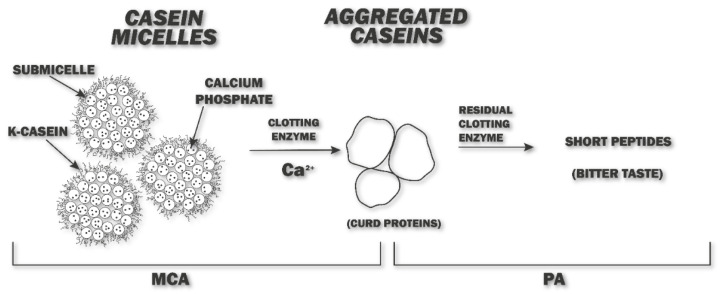
“The high PA characterizes most of the vegetable proteases, which, especially during beginning of cheeses ripening, continue to hydrolyze the caseins causing the appearance of short peptides, which can have a bitter taste [80].”
- Also stated in: § 6. Conclusions and Future Perspective · plain
“Based on the literature, most plant-derived clotting enzymes showed high PA, resulting in bitter compounds in the final products.”
§ Plant Milk-Clotting Enzymes for Cheesemaking > 3. Proteolytic Activity and Bitter Taste by Plant Derived Coagulant in Cheese
What the sources say
- Partly supportedcites [80] Visser S. Proteolytic Enzymes and Their Relation to Cheese Ripening and Flavor: An Overview J. Dairy Sci. 1993 76 329 350 10.3168/jds.S0022-0302(93)77354-3 sourceExperimental — accuracy not yet measured
The Introduction (page unavailable) says residual clotting enzyme contributes to casein breakdown during initial ripening, and the ‘Bitter Flavor Formation and Debittering’ section (page unavailable) links bitter peptides to residual clotting enzyme and bacterial proteinases. The passages do not establish that most plant-derived clotting enzymes have high proteolytic activity or specifically cause this effect. (LLM, conf=0.84)
plainstates a cause- Asserted: passes — The authors put it forward as true.
- Checkable: passes — It can be checked against evidence.
- Load-bearing: passes — The paper’s conclusions depend on it.
- Based: passes — The paper gives a reason why it holds.
- Also stated in: § 6. Conclusions and Future Perspective · plain
The cited sources support only part of this claim — read each source’s verdict below.
In the paper
“In particular, low molecular weight peptides can have hydrophobic groups at C-terminal end, which give them a high Q value and therefore bitterness [24,91].”
§ Plant Milk-Clotting Enzymes for Cheesemaking > 4. Effect of Plant Coagulants on Cheeses
What the sources say
- Not checked — no full text of the sourcecites [24] Mazorra-Manzano M.A. Moreno-Hernández J.M. Ramírez-Suarez J.C. Milk-clotting plant proteases for cheesemaking Biotechnological Applications of Plant Proteolytic Enzymes Springer International Publishing Cham, Switzerland 2018 21 41 9783319971322 source
- Partly supportedcites [91] Lemieux L. Simard R.E. Bitter flavour in dairy products. I. A Review of the Factors Likely to Influence its Development, Mainly in Cheese Manufacture Le Lait 1991 71 599 636 10.1051/lait:1991647 sourceExperimental — accuracy not yet measured
The BITTERNESS-HYDROPHOBICITY section describes the Q-hypothesis as a relationship between peptide amino-acid composition and bitterness, and says terminal amino acids can affect bitter-taste intensity. The BITTER FLAVOUR DEVELOPMENT IN CHEESE section also notes that reducing peptides initially too large to taste bitter may produce bitter peptides. Neither passage establishes the specific chain that hydrophobic groups at a low-molecular-weight peptide’s C-terminal end give it a high Q value and therefore bitterness; page numbers are unavailable in our copy. (LLM, conf=0.84)
plainstates a cause- Asserted: passes — The authors put it forward as true.
- Checkable: passes — It can be checked against evidence.
- Load-bearing: unclear — It is unclear whether the paper’s conclusions depend on it.
- Based: passes — The paper gives a reason why it holds.
In the paper
“A ratio similar to chymosin (that is considered as a reference) corresponds to a high-quality coagulant, reflecting a high curd yield and low cheese defects, such as bitter flavors and an excellent final product with desirable firmness [7].”
§ Plant Milk-Clotting Enzymes for Cheesemaking > 1. Introduction
What the sources say
- Not matchedcites [7] Nitu S. Geicu-Cristea M. Matei F. Milk-Clotting Enzymes Obtained from Plants in Cheesemaking—A Review Sci. Bull. Ser. F Biotechnol. 2021 25 66 75
We searched by its title and found no matching paper.
plainstates a cause- Asserted: passes — The authors put it forward as true.
- Checkable: passes — It can be checked against evidence.
- Load-bearing: passes — The paper’s conclusions depend on it.
- Based: passes — The paper gives a reason why it holds.
- Not matched
In the paper
“Moreover, Puglisi et al. [54] showed that actinidin has an excellent MCA/PA ratio in production of mozzarella with kiwi juice as a coagulant without the onset of bitter flavors.”
§ Plant Milk-Clotting Enzymes for Cheesemaking > 2. Types and Characteristics of Vegetable Proteases > 2.2. Cysteine Proteases
What the sources say
- Not checked — no full text of the sourcecites [54] Puglisi I. Petrone G. Piero A.R.L. A Kiwi Juice Aqueous Solution as Coagulant of Bovine Milk and Its Potential in Mozzarella Cheese Manufacture Food Bioprod. Process. 2014 92 67 72 10.1016/j.fbp.2013.07.011 source
boostedstates a cause- Asserted: passes — The authors put it forward as true.
- Checkable: passes — It can be checked against evidence.
- Load-bearing: passes — The paper’s conclusions depend on it.
- Based: passes — The paper gives a reason why it holds.
12 more claims
Create a free account to see all 28 claims and every source verdict.
- It may state two separate claims as one. 10
- Probably not a substantial claim. 1
Self-check
Percentages, sums and reported differences re-computed from the paper’s own numbers.
Rated major: it would touch a result — a value a result rests on, reported and recomputed p-values on opposite sides of the significance level, two passages that conflict with no sign which is right, or a cited work retracted before this paper was published.
In the paper
“the protease obtained from R. pusillus consists of 437 amino acids, 22 of which are signal peptides; the following 44 amino acids are propeptide, and 361 amino acids constitute a mature protease.”
§ Plant Milk-Clotting Enzymes for Cheesemaking > 1. Introduction
Reported 437 · recomputed 427
Citations
Cites
The Structure and Function of the Aspartic Proteinases
Davies, D. R. (1990) · Annual Review of Biophysics and Biophysical Chemistry · doi:10.1146/annurev.bb.19.060190.001201 · Cited by 658 · cited 1×
“Most aspartic proteases consist of single-chain enzymes with a molecular weight of about 35 kDa and a length of about 330 amino acids [35,36].”
BackgroundPeptidases and amino acid catabolism in lactic acid bacteria
Christensen, J. E., Dudley, E. G., Pederson, J. A., & Steele, J. L. (1999) · Antonie van Leeuwenhoek · doi:10.1023/a:1002001919720 · Cited by 630
[2] Families of serine peptidases
Rawlings, N. D., & Barrett, A. J. (1994) · Methods in Enzymology · doi:10.1016/0076-6879(94)44004-2 · Cited by 629 · cited 1×
“They are present in many plant tissues, but more abundantly in fruits, and take part in many metabolic pathways of the plant [61].”
BackgroundImportance of Calcium and Phosphate in Cheese Manufacture: A Review
Lucey, J. A., & Fox, P. F. (1993) · Journal of Dairy Science · doi:10.3168/jds.s0022-0302(93)77504-9 · Cited by 454
Structure of human procathepsin L reveals the molecular basis of inhibition by the prosegment.
Coulombe, R., Grochulski, P., Sivaraman, J., Ménard, R., Mort, J. S., & Cygler, M. (1996) · The EMBO Journal · doi:10.1002/j.1460-2075.1996.tb00934.x · Cited by 388
A cut above the rest: the regulatory function of plant proteases
Schaller, A. (2004) · Planta · doi:10.1007/s00425-004-1407-2 · Cited by 384 · cited 1×
“Proteases are enzymes present uniformly in the tissues of plants; they take on various functions from germination to senescence processes [23].”
BackgroundPapain protects papaya trees from herbivorous insects: role of cysteine proteases in latex
Konno, K., Hirayama, C., Nakamura, M., Tateishi, K., Tamura, Y., Hattori, M., & Kohno, K. (2004) · The Plant Journal · doi:10.1046/j.1365-313x.2003.01968.x · Cited by 376 · cited 1×
“One of the most studied cysteine proteases is papain from Carica papaya [51], but other cysteine proteases have been extracted from ginger rhizomes [52], from the root latex of Jacaratia corumbensis [53], and from Actinidia chinensis [54].”
BackgroundProteolytic Enzymes and Their Relation to Cheese Ripening and Flavor: An Overview
Visser, S. (1993) · Journal of Dairy Science · doi:10.3168/jds.s0022-0302(93)77354-3 · Cited by 305 · cited 1×
“The high PA characterizes most of the vegetable proteases, which, especially during beginning of cheeses ripening, continue to hydrolyze the caseins causing the appearance of short peptides, which can have a bitter taste [80].”
BackgroundRecent Advances in Milk Clotting Enzymes
JACOB, M., JAROS, D., & ROHM, H. (2011) · International Journal of Dairy Technology · doi:10.1111/j.1471-0307.2010.00633.x · Cited by 295 · cited 2×
“a reverse transcriptase process, the mRNA of chymosin from the animal abomasum is transferred to cDNA and subsequently grafted into the DNA of a Generally recognized as safe (GRAS) microorganism that will be able to produce chymosin through fermentation [8].”
Background[33] Catalytic mechanism in papain family of cysteine peptidases
Cstorer, A., & Ménard, R. (1994) · Methods in Enzymology · doi:10.1016/0076-6879(94)44035-2 · Cited by 265 · cited 1×
“The active catalytic domain contains three catalytic residues (Cys-His-Asn) that have specific functions: the Cys residue acts as a nucleophile while the His residue acts as a general base for proton shuttling [49].”
Background
Research works printed but not linked: 3
- Nitu S. Geicu-Cristea M. Matei F. Milk-Clotting Enzymes Obtained from Plants in Cheesemaking—A Review Sci. Bull. Ser. F Biotechnol. 2021 25 66 75
- Hussein J.B. Suleiman A. Ilesanmi J.Y.O. Sanusi S.A. Chemical Composition and Sensory Qualities of West African Soft Cheese (Warankashi) Produced from Blends of Cow Milk and Soy Milk Niger. J. Trop. Agric. 2016 16 79 89
- Agboola S. Cheesmaking from Ultrafiltered Milk Using Plant Rennet Aust. J. Dairy Technol. 2002 57 143
Cited by
Bioengineered Enzymes and Precision Fermentation in the Food Industry
Boukid, F., Ganeshan, S., Wang, Y., Tulbek, M. C., & Nickerson, M. T. (2023) · International Journal of Molecular Sciences · doi:10.3390/ijms241210156 · Cited by 132
Ayuso, P., Quizhpe, J., Rosell, M. D. L. Á., Peñalver, R., & Nieto, G. (2024) · Applied Sciences · doi:10.3390/app14114940 · Cited by 68
Nicosia, F. D., Pino, A., Maciel, G. L. R., Sanfilippo, R. R., Caggia, C., de Carvalho, A. F., & Randazzo, C. L. (2023) · Foods · doi:10.3390/foods12061154 · Cited by 44
“Moreover, X-prolyl-dipeptidyl aminopeptidase (PepX) is an additional peptidase with the ability to hydrolyze proline in specific peptide sites mitigating the bitter taste of the cheese [14].”
BackgroundSelf-citationExploring the applications of plant-based coagulants in cheese production: A review
Mohsin, A. Z., Norsah, E., Marzlan, A. A., Rahim, M. H. A., & Hussin, A. S. M. (2023) · International Dairy Journal · doi:10.1016/j.idairyj.2023.105792 · Cited by 54
Choudhary, R., Kaushik, R., Chawla, P., et al. (2024) · Journal of the Science of Food and Agriculture · doi:10.1002/jsfa.13776 · Cited by 34
Biological functions of compounds from Bacillus subtilis and its subspecies, Bacillus subtilis natto
Miyazawa, T., Abe, C., Bhaswant, M., Ikeda, R., Higuchi, O., & Miyazawa, T. (2022) · Food Bioengineering · doi:10.1002/fbe2.12036 · Cited by 19
Nicosia, F. D., Puglisi, I., Pino, A., Baglieri, A., Cava, R. L., Caggia, C., de Carvalho, A. F., & Randazzo, C. L. (2022) · Foods · doi:10.3390/foods11152255 · Cited by 20
“However, technologies involving recombinant DNA are the subject of great debate for ethical reasons, and many countries, such as France, Germany and the Netherlands, have restricted the use of FPC [7,8].”
BackgroundSelf-citationFatima, H., Hussain, A., Ambreen, A., Kabir, K., Arshad, F., Ayesha, A., Bibi, B., Ahmed, A., Najam, A., Firdous, N., et al. (2024) · Journal of Food Composition and Analysis · doi:10.1016/j.jfca.2024.106954 · Cited by 21
Galli, B. D., Hamed, A. M., Sheehan, J. J., King, N., Abdelhamid, M., & Romeih, E. (2023) · International Journal of Dairy Technology · doi:10.1111/1471-0307.12951 · Cited by 20
Benito‐Vázquez, I., Garrido‐Romero, M., Díez‐Municio, M., & Moreno, F. J. (2024) · Applied Food Research · doi:10.1016/j.afres.2024.100491 · Cited by 17
Zhang, L., Wu, G., Li, D., Huang, A., & Wang, X. (2024) · Food Research International · doi:10.1016/j.foodres.2024.114225 · Cited by 16
Zhang, X., Tao, L., Wei, G., Yang, M., Wang, Z., Shi, C., Shi, Y., & Huang, A. (2023) · Critical Reviews in Food Science and Nutrition · doi:10.1080/10408398.2023.2275295 · Cited by 19
“For example, the low cheese yield, high acidity, texture defects and bitter taste of cheese are all due to the high hydrolytic activity of plant proteases (Ben Amira et al. 2018; El-Salam et al. 2019; Murlidhar, Anusha, and Bindhu 2017; Nicosia et al. 2022; Mohsin et al. 2024).”
Production of a novel milk‐clotting enzyme from solid‐substrate Mucor spp. culture
Qasim, F., Diercks‐Horn, S., Gerlach, D., Schneider, A., & Fernández‐Lahore, M. (2022) · Journal of Food Science · doi:10.1111/1750-3841.16307 · Cited by 16
Exploring New Fruit- and Vegetable-Derived Rennet for Cheese Making
Pacifico, S., Caputo, E., Piccolella, S., & Mandrich, L. (2024) · Applied Sciences · doi:10.3390/app14062257 · Cited by 17
Milk clotting enzymes from marine resources and their role in cheese-making: A mini review
Arbita, A. A., & Zhao, J. J. (2023) · Critical Reviews in Food Science and Nutrition · doi:10.1080/10408398.2023.2220030 · Cited by 12
“A number of reviews have discussed various sources of rennet substitutes derived from plant (Gutiérrez-Méndez et al. 2020; Nicosia et al. 2022; Nitu, Geicu-Cristea, and Matei 2021), animal (Liu et al. 2021), recombinant and microbial enzymes (Liu et al. 2021; Neelakantan, Mohanty, and Kaushik 1999;…”
Amino acid sequence of two new milk-clotting proteases from the macroalga Gracilaria edulis
Arbita, A. A., Paul, N. A., Cox, J. M., & Zhao, J. J. (2022) · International Journal of Biological Macromolecules · doi:10.1016/j.ijbiomac.2022.05.038 · Cited by 12
Di Rosa, A. R., Accetta, F., Nicosia, F. D., Litrenta, F., Pino, A., Lopreiato, V., Caggia, C., & Randazzo, C. L. (2024) · Food Bioscience · doi:10.1016/j.fbio.2024.103917 · Cited by 9
Self-citationBolívar, M. S. B., Pasini, F., Marzocchi, S., Ravagli, C., & Tedeschi, P. (2023) · Foods · doi:10.3390/foods12163032 · Cited by 15
Invited review: Milk-clotting enzymes of microbial origin and their role in cheesemaking-A review.
Wiśniewski, P., Małkowska-Kowalczyk, M., Łobacz, A., Zadernowska, A., & Żulewska, J. (2025) · Journal of dairy science · doi:10.3168/jds.2025-26973 · Cited by 10
Nicosia, F. D., Pino, A., Vaccalluzzo, A., Pinto, V. R. A., Fusieger, A., Cava, R. L., Caggia, C., Randazzo, C. L., & de Carvalho, A. F. (2023) · Food Bioscience · doi:10.1016/j.fbio.2023.103284 · Cited by 5
Self-citationBioprocess Considerations and Enabling Technologies for High-Efficiency Precision Fermentation
Robertson, S., Ponrajan, H., Sharma, M., Lim, L., & Kaur, G. (2026) · Food Reviews International · doi:10.1080/87559129.2026.2651257 · Cited by 5
“[113] These latter examples highlight the potential of precision fermentation to improve the landscape of vegan products.”
Zhang, T., Yang, Z., Zhang, Y., Yi, L., Duan, F., Zhao, Q., Gu, Y., & Wang, S. (2024) · Food Chemistry · doi:10.1016/j.foodchem.2024.141956 · Cited by 5
Industrial scope of cysteine protease and its anti-gluten property: A review
Shukla, M., Gharote, A. S., & Muchahary, S. (2025) · Food Nutrition · doi:10.1016/j.fnutr.2025.100006 · Cited by 7
Akbar, A., Siddiqui, A. J., Raza, A., Zia, A., Nakyinsige, K., Hakiimu, K., & Musharraf, S. G. (2024) · Food Control · doi:10.1016/j.foodcont.2024.111113 · Cited by 11
Sasaki, Y., Matsuo, T., Watanabe, Y., Iwatsuki, M., Inahashi, Y., Nishida, S., Naito, M., & Shoji, M. (2024) · The Journal of Antibiotics · doi:10.1038/s41429-024-00790-8 · Cited by 5
“The cloudiness of mC medium is thought to be caused by the insolubility of small peptides produced by Kgp-and Rgp-degrading casein proteins, although the exact process is unknown [30, 43, 44].”
Exploring cheese production enzymes from various plants as an alternative to Calf rennet
Tebeje, A., Mengesha, Y., Tegegne, A. T., Alemu, G. B., Mersha, N. T., Yohannes, T. G., Negash, A. W., & Jiru, T. M. (2024) · Discover Food · doi:10.1007/s44187-024-00226-0 · Cited by 11
Omrani, A., Sboui, A., Hannachi, H., Hamouda, M., Dbara, M., Hammadi, M., Khorchani, T., & Maqsood, S. (2024) · International Journal of Dairy Technology · doi:10.1111/1471-0307.13118 · Cited by 5
Kouki, R., Essaidi, I., Annabi, K., Dhen, N., Haouala, F., Alhudhaibi, A. M., Rudayni, H. A., Bziouech, S. A., Ayari, O., & Dridi, B. A. M. (2024) · Agronomy · doi:10.3390/agronomy14050987 · Cited by 4
In vitro assessment of thrombolytic potential of red and white ginger (Zingiber officinale)
Pinontoan, R., Leke, P. A. I., Lesmana, J. A., Purnomo, J. S., Dikson, D., & Samantha, A. (2024) · Functional Foods in Health and Disease · doi:10.31989/ffhd.v14i1.1245 · Cited by 4
“…and is believed to confer a wide variety of health benefits via oral tradition. protease, identified as Zingibain, has been used in various applications such as meat tenderization [19], milk curdling in cheese production [20], and as a potential bioinsecticide for controlling armyworm pests [12].”
BackgroundRole of Clay Substrate Molecular Interactions in Some Dairy Technology Applications
Azzouz, A., Aruş, V. A., & Platon, N. (2024) · International Journal of Molecular Sciences · doi:10.3390/ijms25020808 · Cited by 4
“The high demand–supply ratio for calf rennet stimulated the search for viable and profitable sources of surrogates for traditional MCE [35,36].”
BackgroundAluru, V., & Sukumaran, B. O. (2023) · Process Biochemistry · doi:10.1016/j.procbio.2023.11.024 · Cited by 5
Invited review. Milk clotting enzymes: A transcendental decision in goat´s milk cheese quality
Fresno, M., Henríquez, A. A., Torres, A., Castro, N., Álvarez, S., & Sepe, L. (2023) · Small Ruminant Research · doi:10.1016/j.smallrumres.2023.107147 · Cited by 8
Lomolino, G., Zannoni, S., Vegro, M., & Iseppi, A. D. (2025) · Dairy · doi:10.3390/dairy6040043 · Cited by 4
Ritota, M., Costanzo, M. G. D., Rampanti, G., Aquilanti, L., León, C. B.-D., Tejada, L. C., Psomas, A., Dridi, B. A. M., & Manzi, P. (2025) · Journal of Dairy Research · doi:10.1017/s0022029925100903 · Cited by 5
“Aspartic, serine or cysteine proteases, able to hydrolyse k-casein, have been reported in cardoon flowers such as Cynara scolymus, Cynara cardunculus or Onopordum tauricum (Nicosia et al. , 2022).”
Comparative Study of Coagulation Dynamics: Cardoon Flower Extract vs. Chymosin
Gomes, S., Pina, I., Fernandes, J., Dias, J. M., REBOREDO, F. H., Martins, A. P. L., & de Alvarenga, N. B. (2024) · Dairy · doi:10.3390/dairy5040059 · Cited by 7
Kaur, M., Khan, U. M., Bayram, I., Bhatia, S., & Gupta, U. (2024) · Future Foods · doi:10.1016/j.fufo.2024.100486 · Cited by 5
Sturova, Y. G., Гришкова, А. В., Коньшин, В. В., et al. (2024) · Proceedings of universities Applied chemistry and biotechnology · doi:10.21285/achb.935 · Cited by 3
Sudirman, S., Hardianti, B. D., & Safitri, T. A. (2024) · Jurnal Ilmiah Profesi Pendidikan · doi:10.29303/jipp.v9i3.2422 · Cited by 20
“Sumber daya lokal yang melimpah di Nusa Tenggara Barat (NTB), seperti tumbuhan biduri dan terong liar, dapat menjadi alternatif yang efektif untuk menggumpalkan protein susu dalam pembuatan keju, menggantikan rennet yang mahal dan sering kali diimpor (Auldist et al., 2010; Nicosia et al., 2022).”
BackgroundExtraction, catalytic study and milk-clotting properties of proteases from Brassica oleracea
Fabrizi, C., Liburdi, K., & Esti, M. (2024) · Food Bioscience · doi:10.1016/j.fbio.2024.104396 · Cited by 3
Evaluation Dangke Cheese Processing by Edible Film Coating Made from Whey Combined with Konjac Flour
Malaka, R., Maruddin, F., Arief, F. A., et al. (2024) · Journal of Food Processing and Preservation · doi:10.1155/2024/4676923 · Cited by 3
“Based on the texture, cheese can be divided into three parts: hard cheese, semihard cheese, and soft cheese [31].”
BackgroundProteolytic enzymes for production of functional protein hydrolysates and bioactive peptides
Mazorra-Manzano, M. A., & Ramírez‐Suárez, J. C. (2024) · Elsevier eBooks · doi:10.1016/b978-0-443-15437-9.00013-6 · Cited by 6
Plant-based coagulants for halal cheese production
Rahma, A. A., & Issustiarani, A. (2024) · Halal Studies and Society · doi:10.29244/hass.2.1.14-17 · Cited by 3
Ungaro, V. A., Fairbanks, J. P. A., Rossi, L. M., & de Miranda, M. T. M. (2024) · International Journal of Biological Macromolecules · doi:10.1016/j.ijbiomac.2024.134503 · Cited by 2
Casavecchia, S., Giannelli, F., Giovannotti, M., Trucchi, E., Carducci, F., Quattrini, G., Lucchetti, L., Barucca, M., Canapa, A., Biscotti, M. A., et al. (2024) · Plants · doi:10.3390/plants13050654 · Cited by 2
Innovative Approach of Cheese Making from Camel Milk: A Review
Bekele, B. (2023) · Food science and nutrition · doi:10.5772/intechopen.108700 · Cited by 3
Ali, T. H., Mohamed, L. A., Abdellah, E. M., Farouk, S., & El-Ghonemy, D. H. (2025) · World Academy of Sciences Journal · doi:10.3892/wasj.2025.399 · Cited by 3
“Aspergillus oryzae under shaking conditions in PDA medium (Materials and methods) also exhibited notable activity (102±3.4 MCA/ml), indicating that cultivation conditions significantly influence enzyme produc‑ tion (9,21).”
InfluentialMuthusamy, S., Vetukuri, R. R., Lundgren, A., Kim, S., Kalyandurg, P. B., Strid, Å., Zhu, L., Kanagarajan, S., & Brodelius, P. E. (2025) · Plant Biotechnology Journal · doi:10.1111/pbi.70339 · Cited by 2
Zhang, T., Bao, X., Yang, S., Lu, C., Zhao, Q., Gu, Y., & Wang, S. (2025) · Journal of Agricultural and Food Chemistry · doi:10.1021/acs.jafc.5c04993 · Cited by 1
Jaros, D., Nachtigall, C., & Rohm, H. (2025) · Elsevier eBooks · doi:10.1016/b978-0-443-15956-5.00043-9 · Cited by 1
Uniacke‐Lowe, T., & Fox, P. F. (2025) · Elsevier eBooks · doi:10.1016/b978-0-443-15956-5.00027-0 · Cited by 3
Malaka, R., Prahesti, K. I., Mahendradatta, M., et al. (2024) · Indian Journal of Agricultural Research · doi:10.18805/ijare.af-882 · Cited by 1
Kahlouche, A. (2024) · Azerbaijan Chemical Journal · doi:10.32737/0005-2531-2024-29-43 · Cited by 2
A novel cheese made of Gracilaria edulis proteases and its characterisation
Arbita, A. A., Paul, N. A., Cox, J. M., & Zhao, J. J. (2024) · International Dairy Journal · doi:10.1016/j.idairyj.2024.105906 · Cited by 4
Tito, F. R., Pepe, A., Tonón, C. V., Daleo, G. R., & Guevara, M. G. (2023) · Journal of the Science of Food and Agriculture · doi:10.1002/jsfa.12780 · Cited by 1
Liburdi, K., Cucci, S., & Esti, M. (2022) · Foods · doi:10.3390/foods11142137 · Cited by 2
“Extensive casein hydrolysis during cheese production may be associated with low cheese yield and flavor and texture defects [6,7].”
BackgroundErk, G., & Akpınar, A. (2026) · European Food Research and Technology · doi:10.1007/s00217-026-05315-1
“Actinidin has been used as a coagulant in the production of various cheeses and has been reported to exhibit properties similar to those of calf rennet [52].”
Microplate Turbidimetric Assay in Determining Milk-Clotting Activity of Enzyme Preparations
Berdyshev, I., & Demidyuk, I. (2026) · Cheesemaking and buttermaking · doi:10.21603/2073-4018-2026-3-67
Fan, Y., Li, Y., Deng, Y., Zhang, L., Wei, G., Shi, L., Fan, J., & Wang, X. (2026) · Journal of Agricultural and Food Chemistry · doi:10.1021/acs.jafc.6c09729
A COMPARATIVE ANALYSIS OF MILK-CLOTTING COAGULANTS IN CAMEL MILK CHEESEMAKING
Gabrilyants, E., Alibekov, R. S., & Utebaeva, A. (2026) · Bulletin of Shakarim University Technical Sciences · doi:10.53360/2788-7995-2026-2(22)-37
González-Pérez, P., Gutiérrez‐Méndez, N., Olivas, G. I., Acosta‐Muñiz, C. H., & Sepulveda, D. R. (2026) · Food and Humanity · doi:10.1016/j.foohum.2026.101388 · Cited by 1
Pereira, C., Campos, L., Veiga, A., Pereira-Dias, S., & Henriques, M. (2026) · Foods · doi:10.3390/foods15132359
“…capillary electrophoresis to predict rennet impact on creaminess [10] to excitation–emission fluorescence matrices for the botanical and origin-based differentiation of cheeses [56], these tools provide a framework to enhance the consistency of cardoon in the production of these artisanal products.”
Khirzin, M. H., Laksanawati, T. A., Prastika, N. P., et al. (2026) · Revista Facultad Nacional de Agronomía Medellín · doi:10.15446/rfnam.v79.123114
Thistle-curdled cheeses: exploring consumer acceptance and willingness to pay in the Mediterranean
Mandolesi, S., Öztürk, E., Naspetti, S., & Zanoli, R. (2026) · Journal of Dairy Research · doi:10.1017/s0022029926102398
Santamarina-García, G., Yap, M., Crispie, F., Amores, G., Lordan, C., Virto, M., & Cotter, P. D. (2026) · Dairy · doi:10.3390/dairy7030036
León, C. B.-D., Delgado, D., Fernández, D., Mozzon, M., Abellán, A., Aquilanti, L., & Tejada, L. C. (2026) · Dairy · doi:10.3390/dairy7030034
Lai, G., Pes, M., Piga, C., Caredda, M., Fiori, M., Furesi, S., Caboni, P., & Addis, M. (2026) · Small Ruminant Research · doi:10.1016/j.smallrumres.2026.107771
Pacifico, S., Caputo, E., Piccolella, S., Diglio, C., Zenone, T., Bertolini, T., & Mandrich, L. (2026) · Future Foods · doi:10.1016/j.fufo.2026.100981 · Cited by 1
da Silva, E. C., Santos, M. P. F., Teixeira, J. M., Costa, F. S., Fontan, R. D. C. I., Veloso, C. M., Franco, M., & Bonomo, R. C. F. (2026) · Bioresource Technology Reports · doi:10.1016/j.biteb.2026.102663
Saleem, S. S., Rahman, M. B. A., Leow, T. C., Noor, N. D. M., Salleh, A. B., & Oslan, S. N. (2026) · International Journal of Biological Macromolecules · doi:10.1016/j.ijbiomac.2026.150240
Enzymes and Probiotics Encapsulation by Microfluidization
Thakur, P., Sharma, S., Suthar, P., et al. (2026) · doi:10.1007/978-3-032-12323-7_9
Harnessing the Potential of Microbial Proteases for Sustainable Biorefinery Applications
Ghosal, R. K., Mandal, S., Vyas, A., Jana, A., Vasundhara, Goverdhini, Animish, A., & Suthindhiran, K. (2026) · Interdisciplinary biotechnological advances · doi:10.1007/978-981-95-9011-7_11
Comparative Mass Spectrometric Analysis of Proteolytic Activity in Wine and Wine Vinegars
Rašková, M., Zlatohlávková, E., & Šebela, M. (2025) · Journal of Mass Spectrometry · doi:10.1002/jms.70003
Prado, M. D. C. B., Vilcanqui-Pérez, F., & Falcón, L. F. P. (2025) · C&T Riqchary Revista de investigación en ciencia y tecnología · doi:10.57166/riqchary.v7.n2.2025.12
An Overview of West African Traditional Soft Cheese: Processing, Safety, and Quality Characteristics
Tossou, M. W., Achaglinkame, M. A., Dari, L., Sossa-Vihotogbé, C., Bodor, Z., & Mörlein, D. (2025) · Comprehensive Reviews in Food Science and Food Safety · doi:10.1111/1541-4337.70301
“Excessive proteolysis over-hydrolyzes caseins, generating hydrophobic peptides that, when not adequately degraded, accumulate and give a bitter or undesirable taste (Fallico et al. 2005; Liburdi et al. 2019; Nicosia et al. 2022).”
Nugrahani, I., Muharrifani, Y., Iman, A. A., & Tursino, T. (2025) · International Journal of Biological Macromolecules · doi:10.1016/j.ijbiomac.2025.144622
Use of Plant Peptidases for the Production of Therapeutic Peptides
Freitas, C. D. T., & de Oliveira, J. S. (2025) · Protein and Peptide Letters · doi:10.2174/0109298665373399250319082357
Milk-clotting activity of Withania coagulans hairy root extracts
Mikhaylova, E. V., Palkina, I. M., & Слинкин, А. А. (2025) · Proceedings of universities Applied chemistry and biotechnology · doi:10.21285/achb.957
Omar, M. M. (2025) · IOP Conference Series Earth and Environmental Science · doi:10.1088/1755-1315/1449/1/012155
Nugraha, W. T., Murti, T. W., Erwanto, Y., Nurliyani, N., Suranindyah, Y. Y., Muhlisin, M., & Fibri, D. L. N. (2025) · BIO Web of Conferences · doi:10.1051/bioconf/202516704001 · Cited by 1
Manik, S., Ramani, A., Saji, R., Sen, C., & Majumder, R. (2025) · Springer eBooks · doi:10.1007/978-3-031-94476-5_5
Denaturation kinetics and processing of cream cheese substitute coagulated with lemon juice
Castro, R., Barriga, R. E. O., Choque, E. C., & Prieto, J. M. (2025) · Brazilian journal of food technology/Brazilian Journal of Food Technology · doi:10.1590/1981-6723.2725
Gadein, K. A., Mustafa, S. E., Babiker, W. A. M., & Abuagla, M. A. A. (2025) · Journal of Food Quality · doi:10.1155/jfq/7868250
Guimarães, O. L., QUIRINO, V. M. D. S., de Moura, A. S., Correia, J. O., Furtado, J. R., Florêncio, I. M., da Silva, M. M. C., Salles, H. O., dos Santos, K. M. O., do Egito, A. S., et al. (2024) · Foods · doi:10.3390/foods13182905
Montone, A. M. I., Aita, S. E., Capuano, F., Citro, A., Esposito, A., Gallo, A., Nappa, M., Taglioni, E., & Montone, C. M. (2024) · International Dairy Journal · doi:10.1016/j.idairyj.2024.106074
Muthusamy, S., Vetukuri, R. R., Lundgren, A., Kim, S., Kalyandurg, P. B., Strid, Å., Zhu, L., Kanagarajan, S., & Brodelius, P. E. (2024) · bioRxiv (Cold Spring Harbor Laboratory) · doi:10.1101/2024.08.27.609932
Nicosia, F. D. (2024) · doi:10.47328/ufvbbt.2024.152 · Cited by 1
Self-citationEvaluation of rheological properties of plant extracts from Mediterranean flora in goat milk
Lovallo, C., Feo, V. D., Claps, S., & Sepe, L. (2024) · Small Ruminant Research · doi:10.1016/j.smallrumres.2024.107250
Application of Enzymes as Food Additives in Food Industries
Mehmood, T., Waseem, M., Ahmad, Z., Hafeez, H. T., Ahmad, B., & Khan, M. A. (2024) · Springer eBooks · doi:10.1007/978-3-031-71131-2_9 · Cited by 1
Public Health Perspectives of Genetically Modified Food: A Comprehensive Review
Ilyas, M., Ali, M., Aslam, M., et al. (2022) · Pakistan Journal of Health Sciences · doi:10.54393/pjhs.v3i06.165
Metadata
- Authors
- Nicosia, F. D., Puglisi, I., Pino, A., Caggia, C., & Randazzo, C. L.
- Affiliations
- University of Catania (IT)
- Corresponding author
- Randazzo, Cinzia Lucia
- Venue
- Foods
- Publisher
- MDPI AG
- Published
- 2022-03-18
- Volume
- 11
- Issue
- 6
- Pages
- 871
- ISSN
- 2304-8158 (ISSN-L)
- PMC
- PMC8949083
- OpenAlex
- W4221134610
- Semantic Scholar
- 5284536562209107c46dd5efa65aa2bb0c65ceae
- Cited by
- 95
- References
- 121
- Citations by year
- 2026: 19 · 2025: 21 · 2024: 36 · 2023: 13 · 2022: 6
- FWCI
- 2.24
- Type
- journal article
- Language
- en
- Open access
- gold
- doi.org
- Licence
- Locations
- Foods (publishedVersion, cc-by)
- PubMed Central (publishedVersion, cc-by)
- PubMed (publishedVersion)
- DOAJ (DOAJ: Directory of Open Access Journals) (submittedVersion, cc-by-sa)
- Topics
- Life Sciences › Biochemistry, Genetics and Molecular Biology › Biotechnology › Enzyme Production and Characterization
- Life Sciences › Agricultural and Biological Sciences › Food Science › Proteins in Food Systems
- Life Sciences › Agricultural and Biological Sciences › Food Science › Advanced Scientific Research Methods
- Keywords
- cheese production, protease classification, proteolytic activity, cheese rheology, cheese sensory properties
About these checks
Registry, retraction, Cites and statistics results are computed, not judged, with one exception: a printed reference that no index lists is read once by a model before it counts as a citation error. Claims are extracted by a model and kept only when their quote appears verbatim in the text; each cited source is then checked, with a model’s help, for whether it says what the claim relies on. Those verdicts can be wrong — read the claim’s quote and the cited source before relying on one.
The claim verdicts this report counts are experimental: their accuracy is not yet measured.
A language model drew the claims from the paper on 2026-10-11, under version 3 of the claim definition (model deepseek-v4.1-flash, prompt extract-v3).
A second model labelled each claim on 2026-10-11 (model jev-1.13-20260917, definition revision gold-guideline-v0.2).
Cited sources are checked with a language model’s help (gpt-6-sol).
Statistics and arithmetic are recomputed, not judged.
Confidence bands are shown only for fields calibrated on our annotated test set. None is calibrated yet, so no band is shown.
What counts as a claim ›How we measure confidence ›How we check this ›
Are you an author, or do you see a problem with this page? Request a review
Data sources
Bibliographic data: Semantic Scholar, OpenAlex, Crossref.
Contains information from the Semantic Scholar Academic Graph Datasets, made available under the ODC Attribution License (ODC-BY 1.0).
Semantic Scholar’s data is described in: Kinney, R., et al. (2023). The Semantic Scholar Open Data Platform. arXiv:2301.10140.
