

The DOI matches its Crossref record; 45 of the 45 references it cites were found in a registry or an index.
Ultrasound-Assisted Extraction of Polyphenols from Maritime Pine Residues with Deep Eutectic Solvents
Open accessAbstract
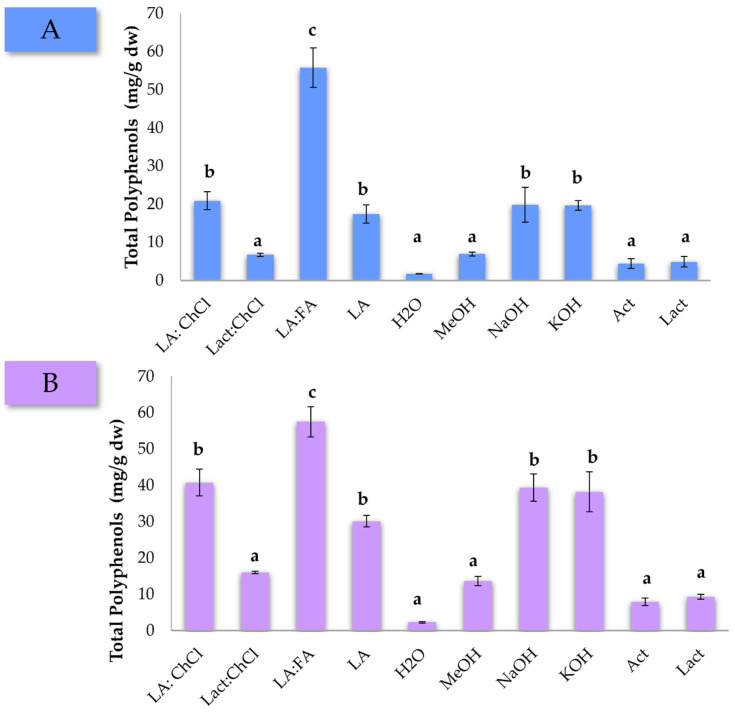
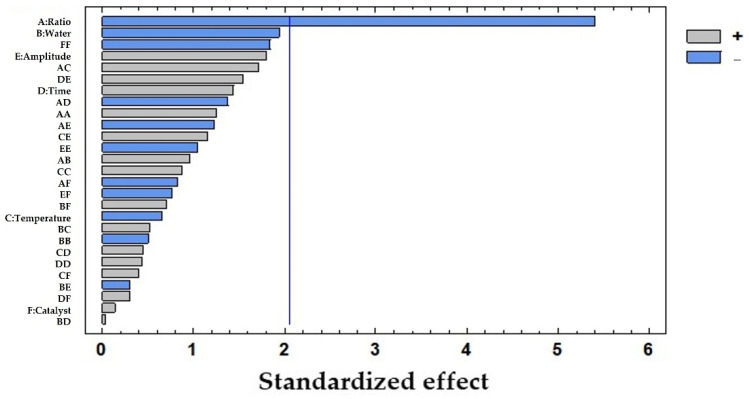
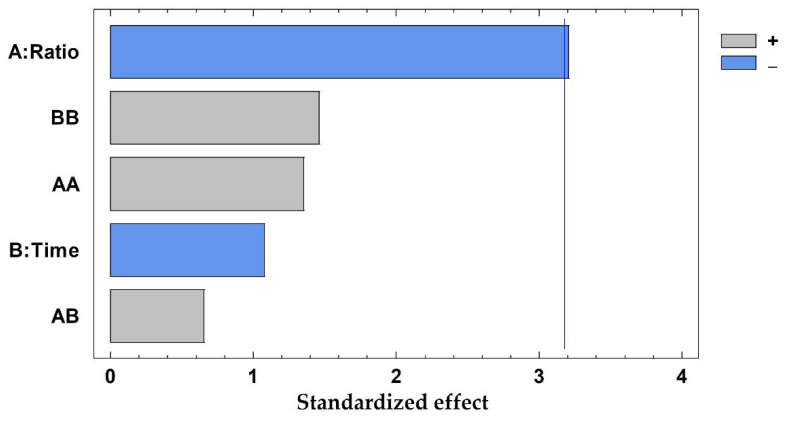
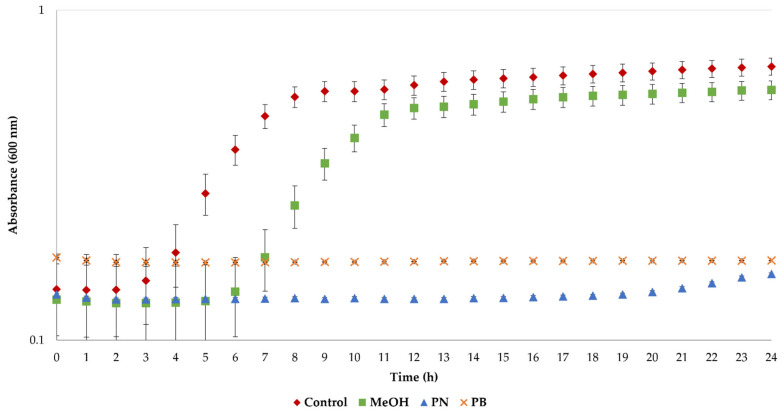
Deep eutectic solvents represent an important alternative in the field of green solvents due to their low volatility, non-toxicity, and low synthesis cost. In the present investigation, we propose the production of enriched polyphenolic extracts from maritime pine forest residues via an ultrasound-assisted approach. A Box–Behnken experimental design with a response surface methodology was used with six variables to be optimized: solid-to-solvent ratio, water percentage, temperature and time of extraction, amplitude, and catalyst concentration. The mixture of levulinic and formic acids achieved the highest extraction yield of polyphenols from pine needle and bark biomass. In addition, the solid-to-solvent ratio was found to be the only influential variable in the extraction (p-value: 0.0000). The optimal conditions were established as: 0.1 g of sample in 10 mL of LA:FA (70:30%, v/v) with 0% water and 0 M H2SO4 heated to 30 °C and extracted during 40 min with an ultrasound amplitude of 80% at 37 kHz. The bioactive properties of polyphenol-enriched extracts have been proven with significant antioxidant (45.90 ± 2.10 and 66.96 ± 2.75 mg Trolox equivalents/g dw) and antimicrobial activities. The possibility to recycle and reuse the solvent was also demonstrated; levulinic acid was successfully recovered from the extracts and reused in novel extractions on pine residues. This research shows an important alternative to obtaining polyphenol-enriched extracts from forest residues that are commonly discarded without any clear application, thus opening an important window toward the valorization of such residues.
Overview
The claims and statistics of this paper haven’t been checked yet.
Run the check — free, no account needed. It reads the open-access text and checks the sources it cites.
Integrity signals
Registry
Cites
Statistics
Figures
Verification
Claims the paper makes
The claims and statistics of this paper haven’t been checked yet.
Run the check — free, no account needed. It reads the open-access text and checks the sources it cites.
Claims other papers make about this one
Each is checked against this paper’s own text: does it say what the citing paper says it does?
In the citing paper
“In addition, the combined effect of ultrasonic energy and the unique solvent properties of DESs enables faster and more efficient extraction compared with conventional extraction methods [32,33].”
From Eco-Friendly Deep Eutectic Solvent-Based Extraction Technologies: A Comprehensive Review of Principles, Applications, and Comparative Insights (2026) · cites this paper as [33]
Self-check
Percentages, sums and reported differences re-computed from the paper’s own numbers.
The self-check needs the paper’s full text.
Citations
Cites
Use of a Free Radical Method to Evaluate Antioxidant Activity
Brand-Williams, W., Cuvelier, M. E., & Berset, C. (1995) · LWT - Food Science and Technology · doi:10.1016/s0023-6438(95)80008-5 · Cited by 25,994
Abbott, A. P., Boothby, D., Capper, G., Davies, D. L., & Rasheed, R. K. (2004) · Journal of the American Chemical Society · doi:10.1021/ja048266j · Cited by 4,340
Box-Behnken design: An alternative for the optimization of analytical methods
Ferreira, S. L. C., Bruns, R. E., Ferreira, H. S., Matos, G. D., David, J. M., Brandão, G. C., da Silva, E. G. P., Portugal, L. A., dos Reis, P. S., Souza, A. S., et al. (2007) · Analytica Chimica Acta · doi:10.1016/j.aca.2007.07.011 · Cited by 3,214
Natural deep eutectic solvents as new potential media for green technology
Dai, Y., van Spronsen, J., Witkamp, G.-J., Verpoorte, R., & Choi, Y. H. (2013) · Analytica Chimica Acta · doi:10.1016/j.aca.2012.12.019 · Cited by 2,694
Screening of radical scavenging activity of some medicinal and aromatic plant extracts
Miliauskas, G., Venskutonis, P. R., & van Beek, T. A. (2004) · Food Chemistry · doi:10.1016/j.foodchem.2003.05.007 · Cited by 2,114
Tailoring properties of natural deep eutectic solvents with water to facilitate their applications
Dai, Y., Witkamp, G.-J., Verpoorte, R., & Choi, Y. H. (2015) · Food Chemistry · doi:10.1016/j.foodchem.2015.03.123 · Cited by 1,367
Hammond, O. S., Bowron, D. T., & Edler, K. J. (2017) · Angewandte Chemie International Edition · doi:10.1002/anie.201702486 · Cited by 823
Satlewal, A., Agrawal, R., Bhagia, S., Sangoro, J., & Ragauskas, A. J. (2018) · Biotechnology Advances · doi:10.1016/j.biotechadv.2018.08.009 · Cited by 552
Extraction of polyphenolic antioxidants from orange peel waste using deep eutectic solvents
Ozturk, B., Parkinson, C., & Gonzalez-Miquel, M. (2018) · Separation and Purification Technology · doi:10.1016/j.seppur.2018.05.052 · Cited by 542
Chanioti, S., & Tzia, C. (2018) · Innovative Food Science & Emerging Technologies · doi:10.1016/j.ifset.2018.07.001 · Cited by 339
Research works printed but not linked: 1
- Boddula, R., Ahamed, M.I., and Asiri, A.M. (2021). Chapter 14—Green Approaches for the Extraction of Bioactive from Natural Sources for Pharmaceutical Applications. Green Sustainable Process for Chemical and Environmental Engineering and Science, Elsevier.
Cited by
Siddiqui, S. A., Ali Redha, A., Salauddin, M., Harahap, I. A., & Rupasinghe, H. P. V. (2025) · Critical Reviews in Analytical Chemistry · doi:10.1080/10408347.2023.2266846 · Cited by 110
“[84] Three DES combinations that were used in this study were Lev-Fa (formic acids ¼ Fa), Lev-ChCl, and La-ChCl.”
MethodXu, R. D., Chaudhary, K., Altemimi, A. B., Khalid, S., Ansar, S., Abid, N., Abdi, G., & Aadil, R. M. (2025) · Ultrasonics Sonochemistry · doi:10.1016/j.ultsonch.2025.107500 · Cited by 89
“Frequencies be-tween 20 and 50 kHz are considered optimal, as multiple processes, including cavitation, shear stress, and fragmentation, work synergistically to maximize yield and extraction efficiency [58,73].”
InfluentialSzopa, D., Wróbel, P., & Witek‐Krowiak, A. (2024) · Journal of Molecular Liquids · doi:10.1016/j.molliq.2024.124902 · Cited by 50
Geană, E., Ciucure, C. T., Tamaian, R., Marinaș, I. C., Gaboreanu, D. M., Stan, M. S., & Chițescu, C. L. (2023) · Antioxidants · doi:10.3390/antiox12071383 · Cited by 39
“Therefore, various extraction methods have been applied to increase phenolic extraction yield from wood bark, such as ultrasound-assisted extraction (UAE) [54,55], microwave-assisted extraction (MAE) [56], Antioxidants 2023, 12, 1383 3 of 38 pressurized liquid extraction (PLE), supercritical fluid extraction [57,58],…”
MethodDuarte, H., Aliaño–González, M. J., Cantos‐Villar, E., Faleiro, M. L., Romano, A., & Medronho, B. (2023) · Talanta · doi:10.1016/j.talanta.2023.125135 · Cited by 30
Self-citation
Metadata
- Authors
- Duarte, H., Gomes, V., Aliaño-González, M. J., Faleiro, L., Romano, A., & Medronho, B.
- Affiliations
- University of Algarve (PT)
- MED—Mediterranean Institute for Agriculture, Environment and Development, Faculdade de Ciências e Tecnologia, Campus de Gambelas, Universidade do Algarve, Ed. 8, 8005-139 Faro, Portugal
- Champalimaud Research Program, Champalimaud Centre for the Unknown, 1400-038 Lisbon, Portugal
- Mid Sweden University (SE)
- Corresponding author
- Medronho, Bruno
- Venue
- Foods
- Publisher
- MDPI AG
- Published
- 2022-11-22
- Volume
- 11
- Issue
- 23
- Pages
- 3754
- ISSN
- 2304-8158 (ISSN-L)
- PMC
- PMC9738461
- OpenAlex
- W4309592940
- Cited by
- 31
- References
- 44
- Citations by year
- 2026: 8 · 2025: 10 · 2024: 5 · 2023: 8
- FWCI
- 3.01
- Type
- journal article
- Language
- en
- Open access
- gold
- doi.org
- Licence
- Locations
- Foods (publishedVersion, cc-by)
- PubMed Central (publishedVersion, cc-by)
- PubMed (publishedVersion)
- RODIN (Universidad de Cádiz) (publishedVersion, cc-by)
- DOAJ (DOAJ: Directory of Open Access Journals) (submittedVersion, cc-by-sa)
- Portuguese National Funding Agency for Science, Research and Technology (RCAAP Project by FCT) (submittedVersion, cc-by)
- Funders
- National Funds (UIDB/05183/2020, PTDC/ASP-SIL/30619/2017, CEECIND/01014/2018)
- FCT—Foundation for Science and Technology (UIDB/05183/2020, PTDC/ASP-SIL/30619/2017, CEECIND/01014/2018)
- researcher (UIDB/05183/2020, PTDC/ASP-SIL/30619/2017, CEECIND/01014/2018)
- Topics
- Health Sciences › Medicine › Biochemistry (medical) › Phytochemicals and Antioxidant Activities
- Physical Sciences › Chemistry › Physical and Theoretical Chemistry › Ionic liquids properties and applications
- Life Sciences › Agricultural and Biological Sciences › Food Science › Agricultural and Biological Research
- Keywords
- ultrasound-assisted extraction, polyphenols, deep eutectic solvents, levulinic acid, formic acid, pine needles, pine bark, biomass valorization, antioxidant activity, antimicrobial activity, solvent recovery, extraction optimization
About these checks
Registry, retraction, Cites and statistics results are computed, not judged, with one exception: a printed reference that no index lists is read once by a model before it counts as a citation error. Claims are extracted by a model and kept only when their quote appears verbatim in the text; each cited source is then checked, with a model’s help, for whether it says what the claim relies on. Those verdicts can be wrong — read the claim’s quote and the cited source before relying on one.
Statistics and arithmetic are recomputed, not judged.
Confidence bands are shown only for fields calibrated on our annotated test set. None is calibrated yet, so no band is shown.
What counts as a claim ›How we measure confidence ›How we check this ›
Are you an author, or do you see a problem with this page? Request a review
Data sources
Bibliographic data: Semantic Scholar, OpenAlex, Crossref.
Contains information from the Semantic Scholar Academic Graph Datasets, made available under the ODC Attribution License (ODC-BY 1.0).
Semantic Scholar’s data is described in: Kinney, R., et al. (2023). The Semantic Scholar Open Data Platform. arXiv:2301.10140.
