

Valorization of Fruit Waste for Bioactive Compounds and Their Applications in the Food Industry
Open accessThe DOI matches its Crossref record; 211 of the 225 references it cites were found in a registry or an index; 28 of the 143 sources its claims cite were checked for support.
Abstract
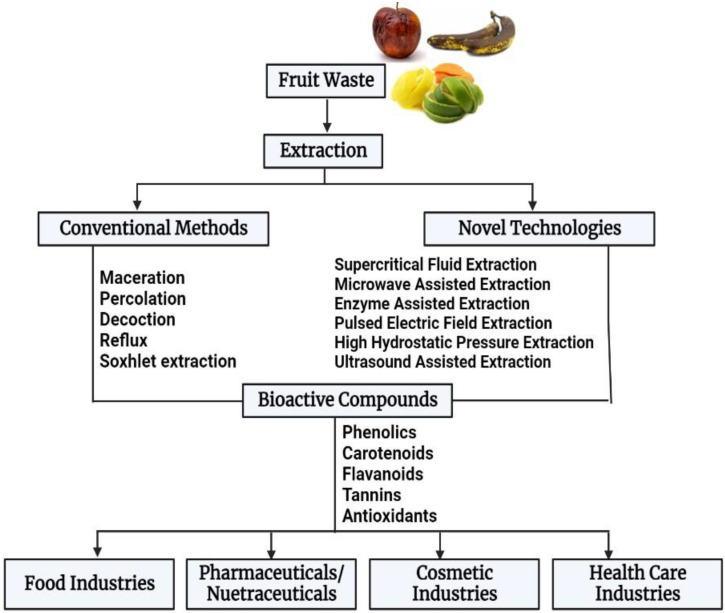
The fruit production and processing sectors produce tremendous amounts of by-products and waste that cause significant economic losses and an undesirable impact on the environment. The effective utilization of these fruit wastes can help to reduce the carbon footprint and greenhouse gas emissions, thereby achieving sustainable development goals. These by-products contain a variety of bioactive compounds, such as dietary fiber, flavonoids, phenolic compounds, antioxidants, polysaccharides, and several other health-promoting nutrients and phytochemicals. These bioactive compounds can be extracted and used as value-added products in different industrial applications. The bioactive components extracted can be used in developing nutraceutical products, functional foods, or food additives. This review provides a comprehensive review of the recent developments in fruit waste valorization techniques and their application in food industries. The various extraction techniques, including conventional and emerging methods, have been discussed. The antioxidant and antimicrobial activities of the active compounds extracted and isolated from fruit waste have been described. The most important food industrial application of bioactive compounds extracted from fruit waste (FW) has been provided. Finally, challenges, future direction, and concluding remarks on the topic are summarized.
Overview
CoChat Summary
TL;DR
This review summarizes valorization of fruit waste as a source of bioactive compounds and their food-industry applications, covering conventional and emerging extraction methods. It reports that fruit and vegetable waste is substantial and that peels, seeds, pomace, and other by-products contain phenolic compounds, dietary fiber, carotenoids, and antimicrobial/antioxidant constituents useful for fortification and preservation.
Key findings
- Fruit and vegetable waste is large: about 46% of produced fruits and vegetables (1400 million tons) are wasted; fruit peel waste accounts for 15–60% of fruit waste; mango and orange 30–50%, pineapple 40–50%, and banana 20%; common fruits account for 25–57 million tons of waste annually.
- By-products are rich in bioactives: apple peels can contain up to 3300 mg/100 g dry matter phenolics; mango peels have total phenolics roughly 13–47% higher than flesh and 32% higher than seeds; papaya peels about 1.2 times higher than seeds; apple pomace has 15% soluble and 36% insoluble dietary fiber; grape pomace total dietary fiber is around 78% (9.5% soluble, 68% insoluble); mango peels total dietary fiber is 40–72%.
- Extraction techniques discussed include Soxhlet, maceration, supercritical fluid extraction, microwave-assisted extraction, enzyme-assisted extraction, pulsed electric field extraction, high-pressure/pressurized liquid extraction, and ultrasound-assisted extraction; novel methods are described as faster, more selective, and less solvent-intensive, but with higher cost and scale-up challenges.
- Food applications include apple pomace up to 30% in baked/extruded snacks; mango peel powder up to 20% in biscuits and up to 30% in cookies; apple pomace 2–8% in beef patties (up to 6% acceptable); 1% apple pomace in yogurt; lemon fiber 2–6% lowered cholesterol and saturated fatty acids in low-fat beef burgers; orange peel as a fat replacer reduced peroxide levels by >90%; grape seed extracts at 40 and 60 mg delayed lipid oxidation in cooked chicken for 14 days. Antimicrobial examples: elderberry skin/seed extracts gave an inhibition zone of almost 20 mm against *Bacillus cereus*; mandarin by-product extracts gave zones of 16.1 and 17 mm; muscadine grape polyphenols reduced *Staphylococcus aureus* viability by nearly 5 log10 CFU/mL over 6 h.
Methods
- This is a review; electronic searches were conducted mainly in PubMed, Google Scholar, Scopus, and ScienceDirect using broad terms such as valorization, fruit waste utilization, fruit by-products, extraction techniques, and bioactive components.
- The search returned 300 scholarly items, including research articles, reviews, books, patents, and other publicly accessible internet sources; about 200 items published after 2000 were shortlisted, and articles published before 2015 were also chosen due to scarcity of contemporary studies; selected articles were thoroughly studied and critically analyzed, and the review was written based on PRISMA guidelines.
- No primary experimental design or new data are reported; the paper synthesizes existing literature.
Limitations
- Stated: bioactive components can degrade quickly, and extraction parameters such as pressure, temperature, light, and pH can cause losses (e.g., a 22% reduction in phenolic content was reported in strawberries); extraction and isolation methods remain lab-intensive and lengthy; novel technologies have higher cost and difficulties in scaling up to industrial standards; fruit and vegetable waste is perishable, dispersed, and often a complex mixture that increases extraction cost; in vivo analysis is needed to validate bioactivity, stability, safety, and bioavailability; further research is needed to determine best extraction procedures for food fortification and other applications.
- Evident: as a narrative review, the findings depend on the selected literature and no systematic meta-analysis or primary validation is reported; the paper also notes that in many antimicrobial studies the principal components responsible for activity have not been evaluated.
Model-written summary. Check it against the paper before relying on it.
Integrity signals
Registry
Cites
Statistics
Figures
Verification
Claims the paper makes
24 Valid · 6 Not valid · 83 Not checked · 21 Own results and interpretations
The cited sources support only part of this claim — read each source’s verdict below.
In the paper
“The polarity/ionic strength of various solvents in use, along with the usage of heat and/or mixing, are the key factors influencing the effectiveness of conventional extraction processes [87].”
§ Valorization of Fruit Waste for Bioactive Compounds and Their Applications in the Food Industry > 5. Extraction Techniques > 5.1. Conventional Methods
What the sources say
- Partly supportedcites [87] Zhang Q.-W. Lin L.-G. Ye W.-C. Techniques for extraction and isolation of natural products: A comprehensive review Chin. Med. 2018 13 1 26 10.1186/s13020-018-0177-x 29692864 PMC5905184 sourceExperimental — accuracy not yet measured
The Extraction section (page not provided) identifies solvent polarity and temperature as factors affecting extraction efficiency. It does not identify mixing as a key factor in conventional extraction, and its discussion of ionic strength concerns ion-exchange chromatography under Separation methods, not extraction. (LLM, conf=0.88)
plainstates a cause- Asserted: passes — The authors put it forward as true.
- Checkable: passes — It can be checked against evidence.
- Load-bearing: unclear — It is unclear whether the paper’s conclusions depend on it.
- Based: passes — The paper gives a reason why it holds.
- Partly supported
The cited sources support only part of this claim — read each source’s verdict below.
In the paper
“According to reports, tomato seeds contain a variety of bioactive substances, including bioactive peptides, flavonoids, carotenoids, pectin, and vitamins (tocopherol) [36].”
§ Valorization of Fruit Waste for Bioactive Compounds and Their Applications in the Food Industry > 4. Bioactive Compounds from Fruit Waste
What the sources say
- Partly supportedcites [36] Kumar M. Tomar M. Bhuyan D.J. Punia S. Grasso S. Sa A.G.A. Carciofi B.A.M. Arrutia F. Changan S. Radha Tomato (Solanum lycopersicum L.) seed: A review on bioactives and biomedical activities Biomed Pharm. 2021 142 112018 10.1016/j.biopha.2021.112018 34449317 sourceExperimental — accuracy not yet measured
Section 2 identifies flavonoids and carotenoids in tomato seeds, and the Introduction identifies α- and γ-tocopherols. The review also discusses bioactive peptides produced from tomato seed proteins, but the passages do not establish that unprocessed seeds contain those peptides. No passage found supports pectin as a tomato-seed constituent. (LLM, conf=0.86)
plain- Asserted: passes — The authors put it forward as true.
- Checkable: passes — It can be checked against evidence.
- Load-bearing: unclear — It is unclear whether the paper’s conclusions depend on it.
- Based: passes — The paper gives a reason why it holds.
- Partly supported
The cited sources that could be checked couldn’t confirm or dispute this claim.
In the paper
“Several studies have also reported the antibacterial effectiveness of grape extracts against lactic acid bacteria, foodborne pathogens, and wine-rotting yeasts [202,203,204,205,206,207].”
§ Valorization of Fruit Waste for Bioactive Compounds and Their Applications in the Food Industry > 7. Application of Bioactive Compounds in the Food Industry > 7.2. Food Preservation
What the sources say
- Could not verifycites [202] Brown J.C. Huang G. Haley-Zitlin V. Jiang X. Antibacterial effects of grape extracts on Helicobacter pylori Appl. Environ. Microbiol. 2009 75 848 852 10.1128/AEM.01595-08 19047390 PMC2632137 sourceExperimental — accuracy not yet measured
The paper’s results (p. 848–852) report inhibition of Helicobacter pylori by grape extracts, but do not address the organisms named in the citing sentence. Searches for lactic acid bacteria, foodborne pathogens, and wine-spoilage yeasts found no passage establishing effectiveness against those groups. (LLM, conf=0.78)
- Not checked — no full text of the sourcecites [203] Baydar N.G. Özkan G. Sağdiç O. Total phenolic contents and antibacterial activities of grape (Vitis vinifera L.) extracts Food Control 2004 15 335 339 10.1016/S0956-7135(03)00083-5 source
- Not checked — no full text of the sourcecites [204] Jayaprakash G. Selvi T. Sakariah K. Antibacterial and antioxidant activities of grape (Vitis vinifera) seed extract Food Res. Int. 2003 36 117 122 10.1016/S0963-9969(02)00116-3 source
- Not checked — no full text of the sourcecites [205] Pastorkova E. Zakova T. Landa P. Novakova J. Vadlejch J. Kokoska Growth inhibitory effect of grape phenolics against wine spoilage yeasts and acetic acid bacteria Int. J. Food Microbiol. 2013 161 209 213 10.1016/j.ijfoodmicro.2012.12.018 23334100 source
- Not checked — no full text of the sourcecites [206] Perumalla A. Hettiarachchy N.S. Green tea and grape seed extracts—Potential applications in food safety and quality Food Res. Int. 2011 44 827 839 10.1016/j.foodres.2011.01.022 source
- Not checked — no full text of the sourcecites [207] Katalinić V. Možina S.S. Skroza D. Generalić I. Abramovič H. Miloš M. Ljubenkov I. Piskernik S. Pezo I. Terpinc P. Polyphenolic profile, antioxidant properties and antimicrobial activity of grape skin extracts of 14 Vitis vinifera varieties grown in Dalmatia (Croatia) Food Chem. 2010 119 715 723 10.1016/j.foodchem.2009.07.019 source
plainstates a cause- Asserted: passes — The authors put it forward as true.
- Checkable: passes — It can be checked against evidence.
- Load-bearing: passes — The paper’s conclusions depend on it.
- Based: passes — The paper gives a reason why it holds.
- Could not verify
The cited sources support only part of this claim — read each source’s verdict below.
In the paper
“These fruit wastes can pose major environmental challenges, such as water and soil pollution, the greenhouse effect, eutrophication, global warming, and other health problems if not effectively handled due to their high biodegradability and fermentability [17].”
§ Valorization of Fruit Waste for Bioactive Compounds and Their Applications in the Food Industry > 3. Fruit Loss and Processing Waste
What the sources say
- Partly supportedcites [17] de Medeiros V.P.B. Pimentel T.C. Varandas R.C.R. Dos Santos S.A. de Souza Pedrosa G.T. da Costa Sassi C.F. da Conceicao M.M. Magnani M. Exploiting the use of agro-industrial residues from fruit and vegetables as alternative microalgae culture medium Food Res. Int. 2020 137 109722 10.1016/j.foodres.2020.109722 33233291 sourceExperimental — accuracy not yet measured
The Introduction says fruit and vegetable residues are an environmental problem because of their high fermentability and biodegradability, and that they can contribute to greenhouse-gas emissions and landfill discharge contamination. It also mentions reducing soil contaminants through composting. It does not specifically link these wastes to water pollution, eutrophication, or health problems; global warming is implied by greenhouse-gas emissions rather than stated separately. (LLM, conf=0.87)
plainstates a cause- Asserted: passes — The authors put it forward as true.
- Checkable: passes — It can be checked against evidence.
- Load-bearing: passes — The paper’s conclusions depend on it.
- Based: passes — The paper gives a reason why it holds.
- Partly supported
Every source the paper cites for this claim was checked and supports it.
In the paper
“Onion peel is reported to be rich source of flavonoids, including athocyanins, kaempferol, and quercetin derivatives (quercetin diglucoside, quercetin aglycone, and quercetin 4-O-glucoside) [23,24].”
§ Valorization of Fruit Waste for Bioactive Compounds and Their Applications in the Food Industry > 4. Bioactive Compounds from Fruit Waste
What the sources say
- Supportedcites [23] Shabir I. Pandey V.K. Dar A.H. Pandiselvam R. Manzoor S. Mir S.A. Shams R. Dash K.K. Fayaz U. Khan S.A. Nutritional Profile, Phytochemical Compounds, Biological Activities, and Utilisation of Onion Peel for Food Applications: A Review Sustainability 2022 14 11958 10.3390/su141911958 source
The Composition/Nutritional Profile section (p. 2) describes onion peel as a rich source of flavonoids. The Plant secondary metabolites section (p. 2) names anthocyanins, kaempferol, quercetin diglucoside, quercetin aglycone, and quercetin 4-O-glucoside among onion flavonoids, noting that the latter compounds are abundant in the outer layer. (LLM, conf=0.94)
- Supportedcites [24] Kumar M. Barbhai M.D. Hasan M. Punia S. Dhumal S. Rais N. Chandran D. Pandiselvam R. Kothakota A. Tomar M. Onion (Allium cepa L.) peels: A review on bioactive compounds and biomedical activities Biomed. Pharmacother. 2022 146 112498 10.1016/j.biopha.2021.112498 34953395 source
Section 2 describes onion peel as rich in flavonoids and identifies anthocyanins in onion skins. It also lists kaempferol, quercetin 3,4′-diglucoside, quercetin aglycone, and quercetin 4′-O-glucoside. The reported concentrations vary by onion variety, but the claim does not assert that all varieties contain equal amounts. (LLM, conf=0.93)
plain- Asserted: passes — The authors put it forward as true.
- Checkable: passes — It can be checked against evidence.
- Load-bearing: unclear — It is unclear whether the paper’s conclusions depend on it.
- Based: passes — The paper gives a reason why it holds.
- Supported
51 more claims · 8 with their cited sources checked
Create a free account to see all 134 claims and to verify the 8 references still open.
- Probably not a substantial claim. 35
- It may state two separate claims as one. 53
- The quote only partly states this claim. 1
Self-check
Percentages, sums and reported differences re-computed from the paper’s own numbers.
Each contradiction between two passages listed here was confirmed by an independent check.
Rated minor: it would not touch a result — a value no result rests on, a p-value that stays on the same side of the significance level, or a conflict that is clerical, resolved elsewhere in the paper, or outside its own findings.
In the paper
§ Valorization of Fruit Waste for Bioactive Compounds and Their Applications in the Food Industry > 7. Application of Bioactive Compounds in the Food Industry > 7.1. Food Fortification
“A study developed beef patties with 2–8% apple pomace as a beef substitute [175].”
§ Valorization of Fruit Waste for Bioactive Compounds and Their Applications in the Food Industry > References
“175. Younis K. Ahmad S. Quality evaluation of buffalo meat patties incorporated with apple pomace powder Buffalo Bull. 2018 37 389 401”
Rated minor: it would not touch a result — a value no result rests on, a p-value that stays on the same side of the significance level, or a conflict that is clerical, resolved elsewhere in the paper, or outside its own findings.
In the paper
§ Valorization of Fruit Waste for Bioactive Compounds and Their Applications in the Food Industry > 7. Application of Bioactive Compounds in the Food Industry > 7.1. Food Fortification
“Similarly, the addition of 3% pomace to stirred yogurt caused a noticeably lower level of syneresis and an increase in the matrix’s stiffness, cohesion, and viscosity [178].”
§ Valorization of Fruit Waste for Bioactive Compounds and Their Applications in the Food Industry > References
“178. Wang J. Mukhtar H. Ma L. Pang Q. Wang X. VHH Antibodies: Reagents for Mycotoxin Detection in Food Products Sensor 2018 18 485 10.3390/s18020485 29415506 PMC5855929”
Rated minor: it would not touch a result — a value no result rests on, a p-value that stays on the same side of the significance level, or a conflict that is clerical, resolved elsewhere in the paper, or outside its own findings.
In the paper
§ Valorization of Fruit Waste for Bioactive Compounds and Their Applications in the Food Industry > 7. Application of Bioactive Compounds in the Food Industry > 7.1. Food Fortification
“Similarly, it was reported that red grape pomace could enhance the color stability and acceptability of pork burgers by reducing lipid oxidation. When the percentage of fruit pomace replacement exceeded 6%, a decrease in hardness and cohesiveness was found [176].”
§ Valorization of Fruit Waste for Bioactive Compounds and Their Applications in the Food Industry > References
“176. Younis K. Ahmad S. Ahmad S. Waste utilization of apple pomace as a source of functional ingredient in buffalo meat sausage Cogent Food Agric. 2015 1 1119397 10.1080/23311932.2015.1119397”
Citations
Cites
Essential oils: Their antibacterial properties and potential applications in foods—A review
Burt, S. (2004) · International Journal of Food Microbiology · doi:10.1016/j.ijfoodmicro.2004.03.022 · Cited by 10,488
Techniques for extraction of bioactive compounds from plant materials: A review
Azmir, J., Zaidul, I. S. M., Rahman, M. M., Sharif, K. M., Mohamed, A., Sahena, F., Jahurul, M. H. A., Ghafoor, K., Norulaini, N. A. N., & Omar, A. K. M. (2013) · Journal of Food Engineering · doi:10.1016/j.jfoodeng.2013.01.014 · Cited by 2,870 · cited 2×
“An efficient extraction approach should be able to target bioactive compounds from the plant matrix, have high selectivity towards analytical procedures and bioassays, and provide a robust and reproducible method that is free of fluctuations in the sample matrix [58].”
Techniques for extraction and isolation of natural products: A comprehensive review
Zhang, Q.-W., Lin, L.-G., & Ye, W.-C. (2018) · Chinese Medicine · doi:10.1186/s13020-018-0177-x · Cited by 2,321 · cited 2×
“The polarity/ionic strength of various solvents in use, along with the usage of heat and/or mixing, are the key factors influencing the effectiveness of conventional extraction processes [87].”
Quercetin, Inflammation and Immunity
Li, Y., Yao, J., Han, C., Yang, J., Chaudhry, M., Wang, S., Liu, H., & Yin, Y. (2016) · Nutrients · doi:10.3390/nu8030167 · Cited by 1,999
Antioxidant activity of apple peels
Wolfe, K., Wu, X., & Liu, R. H. (2003) · Journal of Agricultural and Food Chemistry · doi:10.1021/jf020782a · Cited by 1,873
Anthocyanins: Natural Colorants with Health-Promoting Properties
He, J., & Giusti, M. M. (2010) · Annual Review of Food Science and Technology · doi:10.1146/annurev.food.080708.100754 · Cited by 1,637
Dietary polyphenols, oxidative stress and antioxidant and anti-inflammatory effects
Zhang, H., & Tsao, R. (2016) · Current Opinion in Food Science · doi:10.1016/j.cofs.2016.02.002 · Cited by 1,519
Applications and opportunities for ultrasound assisted extraction in the food industry — A review
Vilkhu, K., Mawson, R., Simons, L., & Bates, D. (2008) · Innovative Food Science & Emerging Technologies · doi:10.1016/j.ifset.2007.04.014 · Cited by 1,394 · cited 1×
“This event releases a significant amount of energy, which causes cell rupture [86].”
Microalgae biorefinery: High value products perspectives
Chew, K. W., Yap, J. Y., Show, P. L., Suan, N. H., Juan, J. C., Ling, T. C., Lee, D.-J., & Chang, J.-S. (2017) · Bioresource Technology · doi:10.1016/j.biortech.2017.01.006 · Cited by 1,336 · cited 1×
“Additionally, these wastes are renewable and viable resources that could be valorized to create commodities with a high market value following the “circular economy” concept [19].”
A review on the extraction methods use in medicinal plants, principle, strength and limitation
(2015) · Medicinal & Aromatic Plants · doi:10.4172/2167-0412.1000196 · Cited by 1,325
Research works printed but not linked: 9
- Caipang C.M.A. Mabuhay-Omar J. Gonzales-Plasus M.M. Plant and fruit waste products as phytogenic feed additives in aquaculture Aquac. Aquar. Conserv. Legis. 2019 12 261 268
- Rathore S.K. Bhatt S. Dhyani S. Jain A. Preliminary phytochemical screening of medicinal plant Ziziphus mauritiana Lam. fruits Int. J. Curr. Pharm. Res. 2012 4 160 162
- Leela C. Shashank B. Suresh D. Phytochemical screening of secondary metabolites of euphorbia Neriifolia linn Glob. J. Res. Med. Plants Indig. Med. 2013 2 292
- Kumar P. Effect of temperature and time intervals on the solvent extraction of essential oil from azadirachta indica (neem) leaf powder by using soxhlet extraction method World J. Pharm. Res. 2018 8 939 946
- Danalache F. Mata P. Alves V.D. Moldão-Martins M. Enzyme-assisted extraction of fruit juices Fruit Juices Elsevier Amsterdam, The Netherlands 2018 183 200
- del Castillo M.D. Iriondo-DeHond A. Martinez-Saez N. Fernandez-Gomez B. Iriondo-DeHond M. Zhou J.-R. Applications of recovered compounds in food products Handbook of Coffee Processing By-Products Elsevier Amsterdam, The Netherlands 2017 171 194
- Fakhlaei R. Khoo H.E. Chiaw Mei Sia W. Yim H.S. Extraction And Evaluation of Antioxidant Potential in Rambutan Rind as Food Waste Carpathian J. Food Sci. Technol. 2015 7 35 44
- Younis K. Ahmad S. Quality evaluation of buffalo meat patties incorporated with apple pomace powder Buffalo Bull. 2018 37 389 401
- Anna B. Vizma N. Dmitry B. Anti-Helicobacter activity of certain food plant extracts and juices and their composition in vitro Food Nutr. Sci. 2011 2011 868 877
Cited by
Items 201–298 of 298
Constantin, O. E., Oncică, G.-F., Stoica, F., Rațu, R. N., Stănciuc, N., Banožić, M., Nikolić, N. Ć., Muresan, C., & Râpeanu, G. (2026) · Applied Sciences · doi:10.3390/app16031472 · Cited by 3
Cao, Z., Liu, X., Xie, C., & Meng, X. (2026) · LWT · doi:10.1016/j.lwt.2026.119171 · Cited by 1
Valorizing food waste to wellness: conventional vs. green extraction of food by-products
Jyoti, A., Rasane, P., Kaur, S., Kaur, J., Erċışlı, S., & Singh, J. (2026) · 3 Biotech · doi:10.1007/s13205-026-04752-9 · Cited by 1
Viet, N. T., Khang, V. C., Quy, N. N., Tien, N. M., & Nhu, H. T. Y. (2026) · Applied Food Research · doi:10.1016/j.afres.2026.101911 · Cited by 1
A study on the products from co-pyrolysis of fruit waste with high density polyethylene
Nooh, A., Gautam, R., Giri, S., Guevara, E., & Sarathy, S. M. (2026) · Applications in Energy and Combustion Science · doi:10.1016/j.jaecs.2026.100489 · Cited by 2
Mamayabay, M. A. B. (2026) · Sustainable Food Technology · doi:10.1039/d5fb00643k · Cited by 1
Zeng, L., Shen, H., Huang, H., & Zhang, W. (2026) · Waste Management · doi:10.1016/j.wasman.2026.115571 · Cited by 2
Sharma, D., Kaur, P., Bhasin, A., et al. (2026) · Food Science & Nutrition · doi:10.1002/fsn3.71818 · Cited by 1
Im, S. T., Kim, W.-C., Kim, Y. J., Kim, J., Lee, S., Chun, J., Choi, Y., & Kang, M. (2026) · Journal of the Science of Food and Agriculture · doi:10.1002/jsfa.70769 · Cited by 1
Ismail, N. A., & Zain, M. S. C. (2026) · Waste and Biomass Valorization · doi:10.1007/s12649-026-03720-x · Cited by 1
Kumar, A., Maheshwari, V., Gautam, Y. K., & Singh, N. (2026) · Industrial Crops and Products · doi:10.1016/j.indcrop.2026.123653 · Cited by 2
Avalos-Ramírez, Y., Grados-Poémape, M., Curibanco-Chinchihuara, S., et al. (2024) · Revista de Investigaciones de la Universidad Le Cordon Bleu · doi:10.36955/riulcb.2024v11n1.001 · Cited by 1
Antimicrobial and antioxidant properties of peel and seed extract of Carica papaya L.
Vasundra, & Dutta, U. (2024) · Indian Journal of Experimental Biology · doi:10.56042/ijeb.v62i08.5178 · Cited by 1
Batista, G. A., Pereira, M. D. A., Oliveira, D. C. F., Miranda, A. L. D. S., Bueno, L. O., da Silva, L. G. M., Pio, L. A. S., Gomes, M. E. D. S., & Ramos, A. D. L. S. (2025) · OBSERVATÓRIO DE LA ECONOMÍA LATINOAMERICANA · doi:10.55905/oelv23n4-124 · Cited by 3
Phytochemical extraction methods: from traditional to modern techniques
Chaari, M., Elhadef, K., Akermi, S., Ali, D. S., D’Amore, T., Meghwar, P., Mellouli, L., Smaoui, S., & Elfalleh, W. (2025) · Elsevier eBooks · doi:10.1016/b978-0-443-26494-8.00012-4 · Cited by 2
Agüero, C. D. P. M., Palacios, G. A., Ruíz, L. A. T., et al. (2023) · Hatun Yachay Wasi · doi:10.57107/hyw.v2i1.42
Magnetic treatment of microorganisms in the food industry
Torres, L. M., Cayamo, A. A. B., Mariño, Y. M., et al. (2024) · Physics & Astronomy International Journal · doi:10.15406/paij.2024.08.00342
Behera, J., & Sarkar, A. (2024) · Research Journal of Pharmaceutical Dosage Forms and Technology · doi:10.52711/0975-4377.2024.00051
AgroHighTech – needs and solutions for biodiversity
Samuolienė, G., Sutulienė, R., Laužikė, K., & Viršilė, A. (2025) · Acta Horticulturae · doi:10.17660/actahortic.2025.1422.25
Bioflavonoid: Extraction Method, Stability, and Biological Activities
Ghosal, S. (2025) · Springer eBooks · doi:10.1007/978-981-96-3663-1_4
Saimen, E., Benedict, M. M., Rahman, N. A., Marbawi, H., Gansau, J. A., Sabullah, M. K., & Jawan, R. (2025) · Journal of Physics Conference Series · doi:10.1088/1742-6596/3003/1/012028
“…components have been identified in both fruit peels and vegetable waste, including polysaccharides, polyphenols, and flavor components that contribute to antimicrobial, antifungal, anticancer, antioxidant, and IOP Publishing doi:10.1088/1742-6596/3003/1/012028 2 antidiabetic activity [5, 6].”
InfluentialContact Toxicity of Cashew Nut Shell Liquid Extract on Adult Bactrocera dorsalis (Hendel)
Keita, S., & Zuharah, W. F. (2025) · Indian Journal of Entomology · doi:10.55446/ije.2025.3059
“Soxhlet exactor (Nirmal et al., 2023) was used to extract CNSL from the ground powder using two different solvents, dichloromethane and hexane.”
Food By-Products: The Recovery of Bioactive Molecules
Polanía, A. M., Figueroa, A. G., & Hernandez, L. L. (2025) · Springer eBooks · doi:10.1007/978-3-031-91693-9_10
Temesgen, A. G., Kaufmann, J., & Cebulla, H. (2026) · Discover Applied Sciences · doi:10.1007/s42452-026-08759-y
Valorization of Fruit Waste to Biofuels and Chemicals
Dwivedi, S. P., Dwivedi, N., & Singh, S. (2025) · Springer eBooks · doi:10.1007/978-981-96-8594-3_2
Beyond the harvest: The origins and diversity of crop residues and byproducts
Singh, S., Yadav, R., & Singh, A. N. (2025) · Elsevier eBooks · doi:10.1016/b978-0-443-30246-6.00001-0 · Cited by 1
Residue to rations: Enhancing livestock nutrition with agricultural byproducts
Papageorgiou, M., Karageorgou, A., Goliomytis, M., Tzamaloukas, O., & Simitzis, P. (2025) · Elsevier eBooks · doi:10.1016/b978-0-443-30246-6.00022-8
Wandhekar, S. S., Kshirsagar, R. B., SADAWARTE, S. K., Gosavi, R. A., Gabor, V., Shaikh, A. M., & Kovács, B. (2025) · Macromol—A Journal of Macromolecular Research · doi:10.3390/macromol5040053 · Cited by 3
“Fruit processing waste is a good source of bioactive components, antioxidants, dietary fibre, vitamins, minerals, and enzymes [18].”
Rajath, M., Remesh, A. V., Mokshith, D. G., et al. (2025) · Food and Humanity · doi:10.1016/j.foohum.2025.100909
Batta, S., Sharma, V., Thakur, P., et al. (2025) · doi:10.1002/9781394301256.ch12
Chamorro, F., Nogueira‐Marques, R., Barciela, P., Perez-Vazquez, A., Jorge, A. O. S., Donn, P., Seyyedi-Mansour, S., Pereira, A. G., & Prieto, M. A. (2025) · Wiley eBooks · doi:10.1002/9781394301256.ch19
Determination of the total polyphenol content and antioxidant activity in banana and oranges waste
Dumitru, M., & Gănescu, A. (2025) · Annals of the University of Craiova Series Chemistry · doi:10.52846/aucchem.2025.1.06
Muliarta, I. N., & Rahayu, N. K. S. (2025) · Industrial and Domestic Waste Management · doi:10.53623/idwm.v5i2.872 · Cited by 1
“By utilizing this waste to extract bioactive molecules, industries could produce nutraceuticals, functional foods, and food additives while reducing environmental impacts [38].”
Pelaje, R. M., Velasco, J. O., Elizon, J., Henson, O. N., Abay, I., Comendador, H., Cruz, P. E. D., Divina, A. J., Junsay, M., Pallada, C. A. K., et al. (2025) · Journal of interdisciplinary perspectives · doi:10.69569/jip.2025.733
Costa, N. A., Chiocchetti, G. D. M. E., de Godoy, M. C. X., Gambero, A., Macêdo, G. A., & Macedo, J. A. (2025) · Molecular Nutrition & Food Research · doi:10.1002/mnfr.70353 · Cited by 3
Seftia, A., Suprianto, Putra, E. D. L., Samran, & Nurbaya, S. (2025) · Jurnal Indah Sains dan Klinis · doi:10.52622/jisk.v6i3.02
Cruz, R. S., do Prado, G. M., de Sousa, P. H. M., Ricardo, N. M. P. S., de Brito, D. H. A., Magalhães, F. E. A., Furtado, J. A., & da Silva, L. M. R. (2026) · Food Technology and Biotechnology · doi:10.17113/ftb.64.02.26.8999
A study on the products from co-pyrolysis of fruit waste with high density polyethylenePreprint
Nooh, A., Gautam, R., Giri, S., Guevara, E., & Sarathy, S. M. (2026) · SSRN Electronic Journal · doi:10.2139/ssrn.6016660
Tumilap, K., Ranario, L. M. D., Guno, F. D., Galeon, P. L., Aguilar, E. G. P., Zacal, V. P. Z., & Pérez, J. H. (2025) · Food Bioengineering · doi:10.1002/fbe2.70041
Muhammed, Y. M. R., Cavoski, I., Apa, C. A., Celano, G., Spagnuolo, M., Minervini, F., & Angelis, M. D. (2026) · Foods · doi:10.3390/foods15020238
“Food waste is a global challenge, with roughly one-third of all food produced—around 1.3 to 1.6 billion tons—being lost or wasted annually [1].”
InfluentialLima, S. K. R., Filho, L. B. D. S., de Almeida, J. O. C. S., et al. (2026) · Food Chemistry · doi:10.1016/j.foodchem.2026.147891
Getahun, A., Kechero, Y., Yemane, N., Tadelle, D., & Esatu, W. (2026) · Veterinary Medicine and Science · doi:10.1002/vms3.70791 · Cited by 2
Abdulsalam, R. A., Olaseni, A. J., Yusuf, B. O., Ijabadeniyi, O. A., & Sabiu, S. (2026) · Scientific African · doi:10.1016/j.sciaf.2026.e03214
Obtaining Electricity in an Alternative and Sustainable Way Using Granadilla Waste Through MFCs
Segundo, R.-F., Moisés, G.-C., Magaly, D. L. C. N., et al. (2026) · Green energy and technology · doi:10.1007/978-3-031-98997-1_49
Functional and Statistical Assessment of Cakes Enriched With Pomegranate Peel and Flower Powders
Acun, S., & Kıran, F. (2026) · Journal of Food Process Engineering · doi:10.1111/jfpe.70363
Singh, D. K., Chudasama, M. H., & Pradhan, R. C. (2026) · Food and Bioprocess Technology · doi:10.1007/s11947-026-04237-w
“This variability is strongly influenced by genetic background, cultivation environment, and seed maturity stage (Basri et al., 2021; Nirmal et al., 2023).”
Research on the Production Process of Fresh Rabat Fruit Soaked in Canned Syrup
Pham, V. T., Pham, B. A., Pham, T. Y. L., Vo, T. K. N., & Nguyen, T. T. N. H. (2026) · International Journal of Food Science · doi:10.1155/ijfo/4300051
Bettadaiah, B. K., Mohan, R., R., A. V., et al. (2025) · SSRN Electronic Journal · doi:10.2139/ssrn.5391528
Performance Evaluation of Orange Seeds and Peels as Natural Coagulants for Surface Water Treatment
Ojo, O. M., & Abayomi, O. F. (2026) · Engineering innovations · doi:10.4028/p-2hpaeg
Márquez‐Rangel, I., Cruz, M., Ruíz, H. A., Rodríguez‐Jasso, R. M., Loredo‐Treviño, A., Castillo-Olvera, G., & Belmares, R. E. (2026) · Food Research International · doi:10.1016/j.foodres.2026.118782 · Cited by 3
Debnath, C. (2026) · Waste and Biomass Valorization · doi:10.1007/s12649-026-03527-w
Design and Fabrication of Fruit Peel Fertilizer Maker
Arunkumar, P. M., Sathiyavathi, S., Nakul, S. A., Nandhaa, S. V., Ramdeepak, R., & Mahendran, S. S. (2025) · IEEE International Conference on Innovations in Engineering and Next-Generation Technologies for Sustainability (ICINVENTS) · doi:10.1109/icinvents64613.2025.11402178
“[13] Also , the presence of a grinding mechanism at the base compartment help to transform the dried peel to powder form effortlessly.”
1757 Green extraction strategies: minimizing environmental impact while maximizing yield
Narsinghani, T., Singh, P., Singh, A., Tuteja, J. S., & Sindhu, R. K. (2026) · De Gruyter eBooks · doi:10.1515/9783111628240-009
Davu, G., Ayar, A., & Ay, E. B. (2026) · Journal of Food Measurement & Characterization · doi:10.1007/s11694-026-04238-5
“Furthermore, the development of standardized extraction processes and functional formulations may offer opportunities for intellectual property protection and industrial applications in food, nutraceutical, and pharmaceutical sectors [73, 74].”
Subramaniam, D., Pham, T. H., Manful, C. F., Galagedara, L., & Krishnapillai, M. (2026) · Bioresource Technology Reports · doi:10.1016/j.biteb.2026.102735
КОМПЛЕКСНА УТИЛІЗАЦІЯ ВІДХОДІВ ПЛОДООВОЧЕВОГО ВИРОБНИЦТВА ІЗ ВИКОРИСТАННЯМ МЕТАНОВОЇ ФЕРМЕНТАЦІЇ
Бублієнко, Н. О., Салавор, О., Ничик, О. В., & Тогачинська, О. В. (2026) · Biota Human Technology · doi:10.58407/bht.1.26.12
Main Cactaceae of the Canary Islands: an untapped source of bioactive compounds
Díaz-Delgado, G. L., Dorta, E., Díaz-Marrero, I., et al. (2026) · Acta Horticulturae · doi:10.17660/actahortic.2026.1452.54
Fan, X., Xian, Y., Yang, T., et al. (2026) · Food Bioscience · doi:10.1016/j.fbio.2026.108908
Utilization of Biomass Waste from Citrus Fruits for the Production of Essential Oils
Catucuamba, E. Q., Lechón, J. A., Bayas-Morejón, F., Quelal, O. M., & Gaibor‐Chávez, J. (2026) · Foods · doi:10.3390/foods15081446 · Cited by 2
“In this context, ongoing research in this field is crucial not only to improve the extraction and valorization processes of these compounds but also for better understanding their environmental and economic impact throughout the entire citrus supply chain [9].”
Renuka, P., Sukantha, T. A., Senthamaraikannan, P., & S., S. S. (2026) · Renewable and Sustainable Energy Reviews · doi:10.1016/j.rser.2026.117016
Valorization of Subtropical Fruit Wastes as Sources of Bioactive Compounds
Chamorro, F., Álvarez, J. E., Pereira, A. G., Silva, A., Seyyedi-Mansour, S., Donn, P., Perez-Vazquez, A., Barciela, P., Carpena, M., & Prieto, M. A. (2026) · Springer eBooks · doi:10.1007/978-3-642-36202-6_286-1
Lachowicz, S., Bieniek, A., Stinco, C. M., Martínez, A. J. M., Kapusta, I. T., Wiśniewski, R., & OCHMIAN, I. D. (2026) · Food Chemistry · doi:10.1016/j.foodchem.2026.149515
Asif, R., Riaz, T., Sheikh, H. A. U. R., et al. (2026) · Journal of Stored Products Research · doi:10.1016/j.jspr.2026.103064
Citrus Peel Flours: From Residues to Bioactive Ingredients for Food Applications
Sales, D., Finimundy, T. C., Ribeiro, J., Heleno, S. A., Mandim, F., Kostić, M., Soković, M., Barros, L., Caleja, C., & Pereira, E. C. (2026) · Molecules · doi:10.3390/molecules31101673
“Similar trends have been consistently reported for fruit by-products, reinforcing their relevance as alternative food matrices with enhanced nutritional value [11].”
Ingredients for the Design and Development of Meat Analogs
Ismail, I., Ho, L., & Hamdan, M. A. (2026) · Springer eBooks · doi:10.1007/978-3-032-19713-9_3
Sharaf, N. S., Shetta, A., Farrag, R., Salakawy, N. E., & Mamdouh, W. (2026) · Cancer Nanotechnology · doi:10.1186/s12645-026-00387-w
From Food Waste to Bioactive Compounds: Unveiling the Molecular Mechanism Against Metabolic Diseases
Doke, R. R., Vinchurkar, K., Jalindar, A. S., Shafi, S., Kausar, N., Singh, A. K., & Singh, S. A. (2026) · Waste and Biomass Valorization · doi:10.1007/s12649-026-03658-0 · Cited by 1
Extraction and characterization of biomaterials from fruit seeds and peels
Rai, R., & Yu, J. Y. (2026) · Elsevier eBooks · doi:10.1016/b978-0-443-38329-8.00015-3
Timilsena, Y. P., Agarwal, D., Majzoobi, M., Farahnaky, A., & Buckow, R. (2026) · Critical Reviews in Food Science and Nutrition · doi:10.1080/10408398.2026.2690035
“Innovative research has explored the conversion of stone fruit pulp into bioplastics, presenting an eco-friendly alternative to conventional petroleum-based plastics (Nirmal et al. 2023).”
Nogueira, B. A., Torres, M. D., Díaz-Reinoso, B., Flórez-Fernández, N., Santos, A. S., Domínguez, H., & Chisté, R. C. (2026) · The Journal of Supercritical Fluids · doi:10.1016/j.supflu.2026.107075
Valorisation of dragon fruit peel in functional squash
ALIM, M. A., Hossain, I., Yesmin, T., et al. (2026) · Foods and raw materials · doi:10.21603/2308-4057-2027-2-712
Future Directions and Emerging Trends
Bhaduri, A., Dulta, K., Das, A., & Ghosh, S. (2026) · Springer eBooks · doi:10.1007/978-3-032-22472-9_15 · Cited by 1
Ang, W. L., Zhan, N., Jiang, X., Toy, J. Y. H., & Huang, D. (2026) · ACS Food Science & Technology · doi:10.1021/acsfoodscitech.5c01012
Emerging Application of Pluot in Nutraceutical and Cosmetic Formulation
Bagul, R. D., Ahire, S. M., Sonwane, D. D., & Mahajan, S. K. (2026) · Research Journal of Pharmacognosy and Phytochemistry · doi:10.52711/0975-4385.2026.00038
Sabaghi, M., Güneşer, O., Tetik, G. D., Çoban, F. K., Çolak, A. M., & Tarhan, Ö. (2026) · Food Bioscience · doi:10.1016/j.fbio.2026.109627 · Cited by 1
Waste Management in Horticulture: A Remunerative Approach
Das, A., Das, P., & Sharangi, A. B. (2026) · Springer eBooks · doi:10.1007/978-981-92-1007-7_20
Ashique, S., Garg, A., Hussain, M. S., Yasmin, S., Kaushik, M., Mukherjee, T., Mohanty, S., Islam, A., Dar, A. H., & Ansari, M. Y. (2026) · Preparative Biochemistry & Biotechnology · doi:10.1080/10826068.2026.2710763
Agrowastes as Valuable Sources of Nutraceuticals and Bioactive Compounds
Pal, A. D. (2026) · IGI Global eBooks · doi:10.4018/979-8-3373-5911-3.ch001
Royal Jelly Unveiled: Composition, Biological Functions, and Emerging Health Applications
Chalapathy, C. V., Ghanta, M. K., Sheikh, S. N. A., Khandelwal, L., Awasthi, S., Shubhashree, M., Seetharam, D. S., & Patil, S. J. (2026) · Bee World · doi:10.1080/0005772x.2025.2542040
Chen, W., Zhao, Z., Li, H., et al. (2026) · Computers · doi:10.3390/computers15080549
Boudad, H., Haddioui, A., Elfazazi, K., Mentag, R., Ouardi, L., Fallah, K. E., Kadi, M. E., & Charafi, J. (2026) · Applied Fruit Science · doi:10.1007/s10341-026-01987-x
“This could be in the form of the development of natural preservatives, antioxidant food ingredients, and the use of bioactive formulations that can be used in cosmetic applications or pharmaceutical applications (Awad et al. 2001; Sharifi-Rad et al. 2020; Nirmal et al. 2023).”
Kavindya, K. K. G. M., Dias, P., Kananke, T. C., Dalukdeniya, D. A. C. K., & Lekamge, L. D. (2026) · Food Wellness · doi:10.1016/j.foodw.2026.100064
From fruit waste to foods via fermentation
Calvete‐Torre, I., Breselge, S., Leech, J., Mathur, H., & Cotter, P. D. (2026) · Current Research in Food Science · doi:10.1016/j.crfs.2026.101549
Lee, D.-Y., Bok, C. H., Shin, Y. W., Lee, S., Ha, J. M., Mariano, E., Choi, S. Y., Lee, W. J., Kim, N., del Mundo, D. Z., et al. (2026) · Critical Reviews in Food Science and Nutrition · doi:10.1080/10408398.2026.2728303
An Overview on Food Waste Conversion Technologies for Biofuel Production
Atchaya, P. T., Youseph, A. S. K., & Joseph, S. (2026) · IGI Global eBooks · doi:10.4018/979-8-3373-3780-7.ch001
Wang, L., Min, Y., Gou, M., Yuan, S., Xu, R., & 裴燕芳 (2026) · Food Chemistry Molecular Sciences · doi:10.1016/j.fochms.2026.100454 · Cited by 2
Chiș, M. S., Fărcaș, A. C., Martău, G. A., Vodnar, D. C., Anamaria, P. O. P., Păucean, A., Simona, M. A. N., & Paul, A. (2026) · Foods · doi:10.3390/foods15183244
Portela, D. H. M., Viana, J. D. D. R., Holanda, D. K. R., Costa, A. M., Pereira, R. D. C. A., Ribeiro, P. R. V., Silva, L. M. A., Canuto, K. M., & Wurlitzer, N. J. (2026) · Food Research International · doi:10.1016/j.foodres.2026.120856 · Cited by 1
戴方霞, Yu, S., Cao, Y., et al. (2026) · ACS Sustainable Chemistry & Engineering · doi:10.1021/acssuschemeng.6c07482
Kaur, S., Dhiman, S., Thakur, B., Tripathi, M., & Singh, P. (2026) · Discover Food · doi:10.1007/s44187-026-01164-9
Costa, J. M., Ampese, L. C., Ziero, H. D. D., et al. (2026) · ACS Engineering Au · doi:10.1021/acsengineeringau.6c00063
Functional potential of fruits and vegetables: From peels to pits
Siddiqui, H., & Sajid, M. (2026) · Elsevier eBooks · doi:10.1016/b978-0-443-34071-0.00003-8
Calleja-Gómez, M., Martínez-Terol, S., Sebastià, A., Rico, H., Berrada, H., & Barba, F. J. (2026) · Innovative Food Science & Emerging Technologies · doi:10.1016/j.ifset.2026.104823
Advances in Extraction, Purification, and Detection of Ergothioneine from Edible Fungi
Li, H., Chen, Z., Chen, X., Xu, D., Huang, X., Wen, Q., Li, W., Xiong, Y., Xie, Z., Xu, D., et al. (2026) · Journal of Analysis and Testing · doi:10.1007/s41664-026-00497-9
Bioactive compounds of pomegranate and selected tropical fruits: A comparative review
Kaluarachchi, A. K., Uthpala, T. G. G., Dhanapala, D., Kasturiarachchi, J. C., Jayasinghe, M. A., & Vidanage, P. W. (2026) · Food and Humanity · doi:10.1016/j.foohum.2026.101529
Manousi, N., Kalogiouri, N. P., Zachariadis, G. A., et al. (2026) · Analytical Letters · doi:10.1080/00032719.2026.2737814
Discharge printing on cotton fabric using fruit peel extracts as natural reducing agents
Raafi, S. M., Islam, Z., & Kumar, D. (2026) · Discover Chemistry. · doi:10.1007/s44371-026-01019-3
“Peels from oranges and pineapples account for 30–50% and 40–50%, respectively, and are often discarded as waste [14].”
Metadata
- Authors
- Nirmal, N., Khanashyam, A., Mundanat, A., Shah, K., Babu, K., Thorakkattu, P., Al-Asmari, F., & Pandiselvam, R.
- Affiliations
- Mahidol University (TH)
- Central Coastal Agricultural Research Institute (IN)
- National Institute of Food Technology Entrepreneurship and Management (IN)
- Sargento Foods, 305 Pine Street, Elkhart Lake, WI 53020, USA
- Kansas State University (US)
- Department of Food Science and Nutrition, College of Agriculture and Food Sciences, King Faisal University, P.O. Box 400, Al-Ahsa 31982, Saudi Arabia
- Central Plantation Crops Research Institute (IN)
- Corresponding author
- Nirmal, Nilesh
- Pandiselvam, Ravi
- Venue
- Foods
- Publisher
- MDPI AG
- Published
- 2023-01-27
- Volume
- 12
- Issue
- 3
- Pages
- 556
- ISSN
- 2304-8158 (ISSN-L)
- PMC
- PMC9914274
- OpenAlex
- W4318485290
- Semantic Scholar
- bc641512fdf2663faade0ba81041803b8a55198a
- Cited by
- 305
- References
- 225
- Citations by year
- 2026: 96 · 2025: 115 · 2024: 73 · 2023: 21
- FWCI
- 6.04
- Type
- journal article
- Language
- en
- Open access
- gold
- doi.org
- Licence
- Locations
- Foods (publishedVersion, cc-by)
- PubMed Central (publishedVersion, cc-by)
- PubMed (publishedVersion)
- DOAJ (DOAJ: Directory of Open Access Journals) (submittedVersion, cc-by-sa)
- Funders
- Mahidol University (MRC-IM-06/2565)
- Topics
- Health Sciences › Medicine › Biochemistry (medical) › Phytochemicals and Antioxidant Activities
- Life Sciences › Agricultural and Biological Sciences › Food Science › Agricultural and Biological Research
- Health Sciences › Nursing › Nutrition and Dietetics › Food Science and Nutritional Studies
- Keywords
- fruit waste valorization, bioactive compounds, fruit by-products, phenolic compounds, flavonoids, dietary fiber, polysaccharides, antioxidant activity, antimicrobial activity, extraction methods, nutraceuticals, functional foods, food additives, sustainable food production
About these checks
Registry, retraction, Cites and statistics results are computed, not judged, with one exception: a printed reference that no index lists is read once by a model before it counts as a citation error. Claims are extracted by a model and kept only when their quote appears verbatim in the text; each cited source is then checked, with a model’s help, for whether it says what the claim relies on. Those verdicts can be wrong — read the claim’s quote and the cited source before relying on one.
The claim verdicts this report counts are experimental: their accuracy is not yet measured.
A language model drew the claims from the paper on 2026-10-10, under version 3 of the claim definition (model deepseek-v4.1-flash, prompt extract-v3).
A second model labelled each claim on 2026-10-10 (model jev-1.13-20260917, definition revision gold-guideline-v0.2).
Cited sources are checked with a language model’s help (gpt-6-sol).
Statistics and arithmetic are recomputed, not judged.
Confidence bands are shown only for fields calibrated on our annotated test set. None is calibrated yet, so no band is shown.
What counts as a claim ›How we measure confidence ›How we check this ›
Are you an author, or do you see a problem with this page? Request a review
Data sources
Bibliographic data: Semantic Scholar, OpenAlex, Crossref.
Contains information from the Semantic Scholar Academic Graph Datasets, made available under the ODC Attribution License (ODC-BY 1.0).
Semantic Scholar’s data is described in: Kinney, R., et al. (2023). The Semantic Scholar Open Data Platform. arXiv:2301.10140.
