

The DOI matches its Crossref record; 82 of the 84 references it cites were found in a registry or an index, and 2 are not checked yet.
Health Consciousness and Its Effect on Perceived Knowledge, and Belief in the Purchase Intent of Liquid Milk: Consumer Insights from an Emerging Market
Open accessAbstract
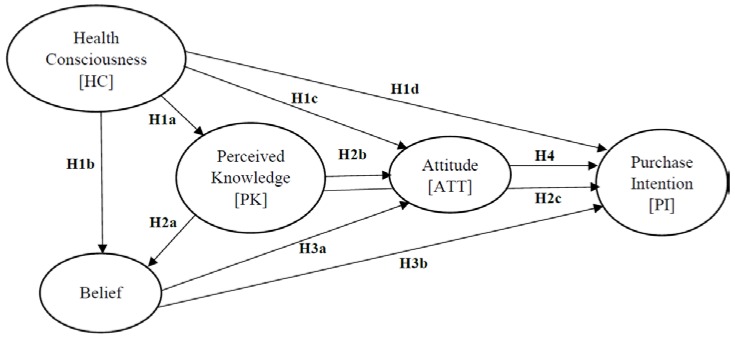
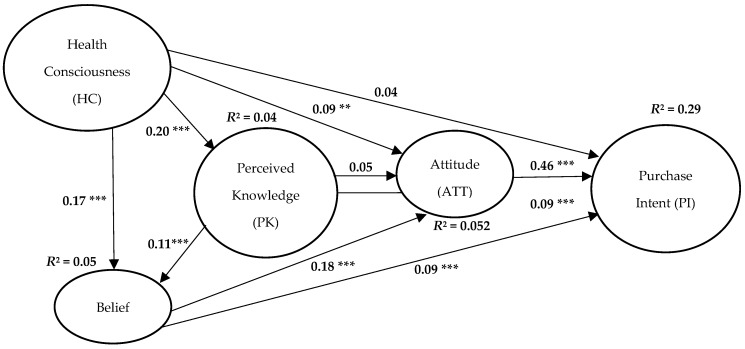
This study is based on the influence of consumers’ health consciousness (HC), perceived knowledge (PK) and beliefs affecting the attitude and purchase intent (PI) of the consumers. The outcome of this study is obtained through an exclusive survey conducted on a randomly selected sample of 712 households who purchase liquid milk (LM) in the cities of Dhaka and Chittagong in Bangladesh. A structured questionnaire is used to interview these participants to obtain data which are analysed employing descriptive statistics, Confirmatory Factor Analysis, and Structural Equation Modelling. The results of the analyses corroborate that consumers’ health consciousness has a positive impact on perceived knowledge, belief, and attitude, but not on purchase intent. In addition, belief affects both the attitude and PI positively. Although consumers’ perceived knowledge is too low to constitute their attitude towards LM, it has a positive, significant impact on the PI. The results also reveal that more than a third of the respondents consume LM several times per month, followed by more than a quarter of the sampled respondents who consume LM several times per week, and these consumption patterns have a positive and significant influence on the PI. Moreover, the monthly income of the family, age, and labelling preference are significantly correlated with PI.
Overview
The claims and statistics of this paper haven’t been checked yet.
Run the check — free, no account needed. It reads the open-access text and checks the sources it cites.
Integrity signals
Registry
Cites
Statistics
Figures
Verification
Claims the paper makes
The claims and statistics of this paper haven’t been checked yet.
Run the check — free, no account needed. It reads the open-access text and checks the sources it cites.
Claims other papers make about this one
Each is checked against this paper’s own text: does it say what the citing paper says it does?
The check wasn’t confident either way, so it gives no verdict — never disputed.
In the citing paper
“Studies show that consumers with higher health consciousness have greater perceived control over avoiding unhealthy food choices and opting for healthier alternatives [10,35,63].”
From Psychological Determinants of Healthy Food Purchase Intention: An Integrative Model Based on Health Consciousness (2025) · cites this paper as [10]
Experimental — accuracy not yet measured
Self-check
Percentages, sums and reported differences re-computed from the paper’s own numbers.
The self-check needs the paper’s full text.
Citations
Cites
Evaluating Structural Equation Models with Unobservable Variables and Measurement Error
Fornell, C., & Larcker, D. F. (1981) · Journal of Marketing Research · doi:10.2307/3151312 · Cited by 109,314 · cited 2×
“6 (see Table 3), thus ensuring adequate convergent validity of the constructs [86].”
BackgroundEvaluating structural equation models with unobservable variables and measurement error
Fornell, C., & Larcker, D. F. (1981) · Journal of Marketing Research · doi:10.1177/002224378101800104 · Cited by 109,190
Baron, R. M., & Kenny, D. A. (1986) · Journal of Personality and Social Psychology · doi:10.1037/0022-3514.51.6.1173 · Cited by 91,532 · cited 1×
“An indirect effect implies the effect of an independent variable on a dependent variable through a mediating variable [66].”
BackgroundThe theory of planned behavior
Ajzen, I. (1991) · Organizational Behavior and Human Decision Processes · doi:10.1016/0749-5978(91)90020-t · Cited by 90,587
Structural Equations with Latent Variables
Bollen, K. A. (1989) · Wiley series in probability and statistics · doi:10.1002/9781118619179 · Cited by 17,944 · cited 1×
“For confirmatory factor analysis (CFA), a minimum sample size of 100 is recommended [70].”
MethodAsymptotic Confidence Intervals for Indirect Effects in Structural Equation Models
Sobel, M. E. (1982) · Sociological Methodology · doi:10.2307/270723 · Cited by 12,810 · cited 1×
“In this test, the influence of a third variable was investigated; whether it had any mediating role in explaining the hypothesized relationship between the given independent variable (IV) and dependent variable (DV) [96].”
BackgroundEfficacy of the Theory of Planned Behaviour: A meta‐analytic review
Armitage, C. J., & Conner, M. (2001) · British Journal of Social Psychology · doi:10.1348/014466601164939 · Cited by 9,970 · cited 1×
“Finally, H4 reports that the attitude is a good predictor of purchase intent, which also corroborates the basic attitudinal research that attitude is the precedent of purchase intent [107,108].”
ResultReporting Structural Equation Modeling and Confirmatory Factor Analysis Results: A Review
Schreiber, J. B., Nora, A., Stage, F. K., Barlow, E. A., & King, J. (2006) · The Journal of Educational Research · doi:10.3200/joer.99.6.323-338 · Cited by 6,937
Relation of sample size to the stability of component patterns.
Guadagnoli, E., & Velicer, W. F. (1988) · Psychological Bulletin · doi:10.1037/0033-2909.103.2.265 · Cited by 2,880 · cited 8×
“As EFA helps in summarizing the information received from a dataset, it is extremely useful to conduct EFA [72].”
MethodInfluentialOn the Exact Variance of Products
Goodman, L. A. (1960) · Journal of the American Statistical Association · doi:10.1080/01621459.1960.10483369 · Cited by 1,467 · cited 1×
“In addition, the values for two other tests, namely the Aroian test [97] and the Goodman test [98], were also provided in Table 7.”
Method
Research works printed but not linked: 16
- Divya, 2018, The Mediating Effect of Perceived Knowledge, Subjective Norms, Health Consciousness on Willingness to consume Functional Foods in India, Taga J., 14, 1101
- Food and Agriculture Organization of the United Nations (2018, July 15). IFCN Dairy Report. Chapter 2.2, Global Dairy Sector: Status and Trends 2008. Available online: http://www.fao.org/docrep/012/i1522e/i1522e02.pdf.
- Hemme, T., Garcia, O., and Khan, A.R. (2004). A Review of Milk Production in Bangladesh with Particular Emphasis on Small Scale Producers, Food and Agriculture Organization of the United Nations, Pro-Poor Livestock Policy Initiative.
- Sikora, T., Niewczas, M., and Prusak, A. (2013, January 17–20). Ethics and trust in quality assurance. Proceedings of the 57th EOQ Congress, Tallinn, Estonia.
- Fishbein, M., and Azjen, I. (1975). Belief, Attitude, Intention and Behavior: An Introduction to Theory and Research, Addison-Wesley.
- Smith, M.C., Walker, D.A., and Hamidova, N. (2012, January 12). A Structural analysis of the attitudes toward science scale: Attitudes and beliefs about science as a multi-dimensional composition. Proceedings of the Annual Meeting of the American Educational Research Association, Vancouver, BC, Canada.
- Underwood, 2002, Belief and attitude change in the context of human development, Sustain. Hum. Dev. Twenty First Century, 2, 103
- Sekaran, U. (2003). Research Methods for Business: A Skill Building Approach, John Wiley & Sons. [4th ed.].
- Hair, J.F., Black, W.C., Babin, B.J., Anderson, R.E., and Tatham, R.L. (2009). Multivariate Data Analysis, Pearson Education Limited. [7th ed.].
- Pallant, J. (2007). SPSS Survival Manual: A Step by Step Guide to Data Analysis Using SPSS, Open University Press. [3rd ed.].
- Hair, J.F., Black, W.C., Babin, B.J., Anderson, R.E., and Tatham, R.L. (2006). Multivariate Data Analysis, Pearson Prentice Hall. [6th ed.].
- Hair, J.F., Black, W.C., Babin, B.J., and Anderson, R.E. (2010). Multivariate Data Analysis, Pearson Education Limited.
- Field, A. (2000). Discovering Statistics Using SPSS for Windows, Sage Publications.
- Brown, T.A. (2006). Confirmatory Factor Analysis for Applied Research, The Guilford Press.
- Hooper, 2008, Structural Equation Modelling: Guidelines for Determining Model Fit. Electron, J. Bus. Res. Methods, 6, 53
- Judd, C.M., and Kenny, D.A. (1960). Estimating the Effects of Social Interventions, Cambridge University Press.
Cited by
Sorted by citations
Nagaraj, S. (2021) · Journal of Retailing and Consumer Services · doi:10.1016/j.jretconser.2020.102423 · Cited by 199
Food Sustainability Knowledge and Attitudes in the Spanish Adult Population: A Cross-Sectional Study
García‐González, Á., Achón, M., Carretero-Krug, A., Varela‐Moreiras, G., & Alonso-Aperte, E. (2020) · Nutrients · doi:10.3390/nu12103154 · Cited by 84
Chakraborty, D., Singu, H. B., & Patre, S. (2022) · Journal of Retailing and Consumer Services · doi:10.1016/j.jretconser.2022.103033 · Cited by 77
Consumers’ Preferences for the Traceability Information of Seafood Safety
Hoque, M. Z., Akhter, N., & Chowdhury, M. S. R. (2022) · Foods · doi:10.3390/foods11121675 · Cited by 58
Self-citationYang, M., Mamun, A. A., Gao, J., Rahman, M. K., Salameh, A. A. M., & Alam, S. S. (2024) · Scientific Reports · doi:10.1038/s41598-023-50436-2 · Cited by 60
“Meanwhile, Hoque et al. 45 observed the positive perception of healthy lifestyle among health-conscious individuals.”
Background
Metadata
- Authors
- Hoque, M. Z., Alam, M. N., & Nahid, K. A.
- Affiliations
- UiT The Arctic University of Norway (NO)
- Coats Bangladesh Limited, Sagorika Road, Chittagong 4219, Bangladesh
- International Islamic University Chittagong (BD)
- Corresponding author
- Hoque, Mohammed Ziaul
- Venue
- Foods
- Publisher
- MDPI AG
- Published
- 2018-09-07
- Volume
- 7
- Issue
- 9
- Pages
- 150
- ISSN
- 2304-8158 (ISSN-L)
- PMC
- PMC6164144
- OpenAlex
- W2890747719
- Cited by
- 112
- References
- 83
- Citations by year
- 2026: 8 · 2025: 10 · 2024: 27 · 2023: 19 · 2022: 18 · 2021: 15 · 2020: 10 · 2019: 3 · 2018: 2
- FWCI
- 7.15
- Type
- journal article
- Language
- en
- Open access
- gold
- dx.doi.org
- Licence
- Locations
- Foods (publishedVersion, cc-by)
- Europe PMC (PubMed Central) (publishedVersion, cc-by)
- PubMed Central (publishedVersion, cc-by)
- PubMed (publishedVersion)
- DOAJ (DOAJ: Directory of Open Access Journals) (submittedVersion)
- NORA - Norwegian Open Research Archives (submittedVersion, other-oa)
- Topics
- Health Sciences › Medicine › Public Health, Environmental and Occupational Health › Consumer Attitudes and Food Labeling
- Social Sciences › Business, Management and Accounting › Marketing › Consumer Behavior and Marketing Influence
- Health Sciences › Nursing › Nutrition and Dietetics › Nutrition, Health and Food Behavior
- Keywords
- health consciousness, perceived knowledge, consumer beliefs, consumer attitudes, purchase intention, fluid milk, dairy consumption, consumption patterns, household income, Bangladesh
About these checks
Registry, retraction, Cites and statistics results are computed, not judged, with one exception: a printed reference that no index lists is read once by a model before it counts as a citation error. Claims are extracted by a model and kept only when their quote appears verbatim in the text; each cited source is then checked, with a model’s help, for whether it says what the claim relies on. Those verdicts can be wrong — read the claim’s quote and the cited source before relying on one.
Statistics and arithmetic are recomputed, not judged.
Confidence bands are shown only for fields calibrated on our annotated test set. None is calibrated yet, so no band is shown.
What counts as a claim ›How we measure confidence ›How we check this ›
Are you an author, or do you see a problem with this page? Request a review
