

The DOI matches its Crossref record; 82 of the 84 references it cites were found in a registry or an index, and 2 are not checked yet.
Health Consciousness and Its Effect on Perceived Knowledge, and Belief in the Purchase Intent of Liquid Milk: Consumer Insights from an Emerging Market
Open accessAbstract
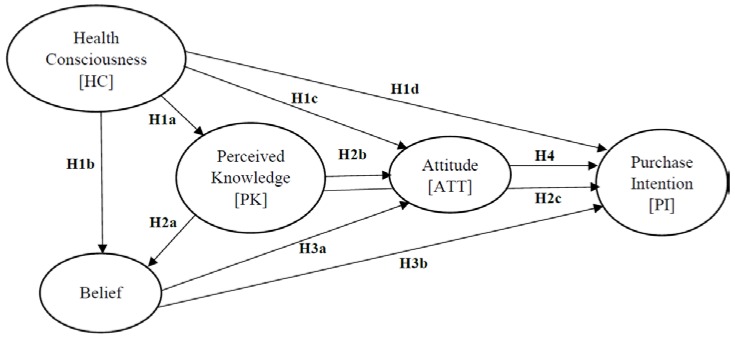
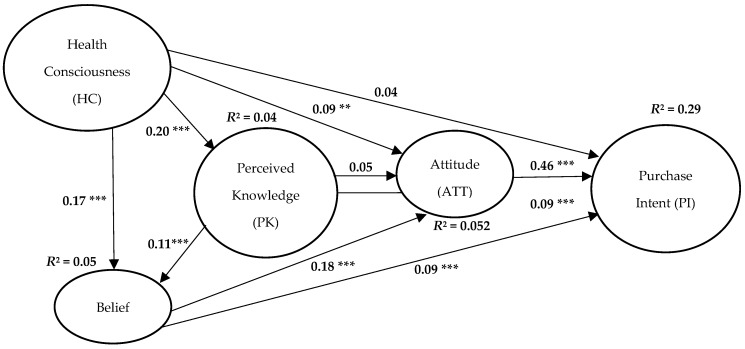
This study is based on the influence of consumers’ health consciousness (HC), perceived knowledge (PK) and beliefs affecting the attitude and purchase intent (PI) of the consumers. The outcome of this study is obtained through an exclusive survey conducted on a randomly selected sample of 712 households who purchase liquid milk (LM) in the cities of Dhaka and Chittagong in Bangladesh. A structured questionnaire is used to interview these participants to obtain data which are analysed employing descriptive statistics, Confirmatory Factor Analysis, and Structural Equation Modelling. The results of the analyses corroborate that consumers’ health consciousness has a positive impact on perceived knowledge, belief, and attitude, but not on purchase intent. In addition, belief affects both the attitude and PI positively. Although consumers’ perceived knowledge is too low to constitute their attitude towards LM, it has a positive, significant impact on the PI. The results also reveal that more than a third of the respondents consume LM several times per month, followed by more than a quarter of the sampled respondents who consume LM several times per week, and these consumption patterns have a positive and significant influence on the PI. Moreover, the monthly income of the family, age, and labelling preference are significantly correlated with PI.
Overview
The claims and statistics of this paper haven’t been checked yet.
Run the check — free, no account needed. It reads the open-access text and checks the sources it cites.
Integrity signals
Registry
Cites
Statistics
Figures
Verification
Claims the paper makes
The claims and statistics of this paper haven’t been checked yet.
Run the check — free, no account needed. It reads the open-access text and checks the sources it cites.
Claims other papers make about this one
Each is checked against this paper’s own text: does it say what the citing paper says it does?
The check wasn’t confident either way, so it gives no verdict — never disputed.
In the citing paper
“Studies show that consumers with higher health consciousness have greater perceived control over avoiding unhealthy food choices and opting for healthier alternatives [10,35,63].”
From Psychological Determinants of Healthy Food Purchase Intention: An Integrative Model Based on Health Consciousness (2025) · cites this paper as [10]
Experimental — accuracy not yet measured
Self-check
Percentages, sums and reported differences re-computed from the paper’s own numbers.
The self-check needs the paper’s full text.
Citations
Cites
Evaluating Structural Equation Models with Unobservable Variables and Measurement Error
Fornell, C., & Larcker, D. F. (1981) · Journal of Marketing Research · doi:10.2307/3151312 · Cited by 109,314 · cited 2×
“6 (see Table 3), thus ensuring adequate convergent validity of the constructs [86].”
BackgroundEvaluating structural equation models with unobservable variables and measurement error
Fornell, C., & Larcker, D. F. (1981) · Journal of Marketing Research · doi:10.1177/002224378101800104 · Cited by 109,190
Baron, R. M., & Kenny, D. A. (1986) · Journal of Personality and Social Psychology · doi:10.1037/0022-3514.51.6.1173 · Cited by 91,532 · cited 1×
“An indirect effect implies the effect of an independent variable on a dependent variable through a mediating variable [66].”
BackgroundThe theory of planned behavior
Ajzen, I. (1991) · Organizational Behavior and Human Decision Processes · doi:10.1016/0749-5978(91)90020-t · Cited by 90,587
Structural Equations with Latent Variables
Bollen, K. A. (1989) · Wiley series in probability and statistics · doi:10.1002/9781118619179 · Cited by 17,944 · cited 1×
“For confirmatory factor analysis (CFA), a minimum sample size of 100 is recommended [70].”
MethodAsymptotic Confidence Intervals for Indirect Effects in Structural Equation Models
Sobel, M. E. (1982) · Sociological Methodology · doi:10.2307/270723 · Cited by 12,810 · cited 1×
“In this test, the influence of a third variable was investigated; whether it had any mediating role in explaining the hypothesized relationship between the given independent variable (IV) and dependent variable (DV) [96].”
BackgroundEfficacy of the Theory of Planned Behaviour: A meta‐analytic review
Armitage, C. J., & Conner, M. (2001) · British Journal of Social Psychology · doi:10.1348/014466601164939 · Cited by 9,970 · cited 1×
“Finally, H4 reports that the attitude is a good predictor of purchase intent, which also corroborates the basic attitudinal research that attitude is the precedent of purchase intent [107,108].”
ResultReporting Structural Equation Modeling and Confirmatory Factor Analysis Results: A Review
Schreiber, J. B., Nora, A., Stage, F. K., Barlow, E. A., & King, J. (2006) · The Journal of Educational Research · doi:10.3200/joer.99.6.323-338 · Cited by 6,937
Relation of sample size to the stability of component patterns.
Guadagnoli, E., & Velicer, W. F. (1988) · Psychological Bulletin · doi:10.1037/0033-2909.103.2.265 · Cited by 2,880 · cited 8×
“As EFA helps in summarizing the information received from a dataset, it is extremely useful to conduct EFA [72].”
MethodInfluentialOn the Exact Variance of Products
Goodman, L. A. (1960) · Journal of the American Statistical Association · doi:10.1080/01621459.1960.10483369 · Cited by 1,467 · cited 1×
“In addition, the values for two other tests, namely the Aroian test [97] and the Goodman test [98], were also provided in Table 7.”
MethodPromoting sustainable consumption: Determinants of green purchases by Swiss consumers
Tanner, C., & Kast, S. W. (2003) · Psychology and Marketing · doi:10.1002/mar.10101 · Cited by 1,177 · cited 1×
“The respondents were primary household shoppers defined as ‘the people who make purchasing decisions and regulate what the other members of the household eat’ [68], thus the credibility of the source was ensured.”
BackgroundSubjective norms, attitudes and intentions of Finnish consumers in buying organic food
Tarkiainen, A., & Sundqvist, S. (2005) · British Food Journal · doi:10.1108/00070700510629760 · Cited by 1,054 · cited 1×
“The Health Consciousness scale considered the consciousness regarding respondents’ own health, family health, nutritional information, health related literature, and additive chemicals [27,48,74].”
BackgroundMichaelidou, N., & Hassan, L. M. (2008) · International Journal of Consumer Studies · doi:10.1111/j.1470-6431.2007.00619.x · Cited by 989
The Health Belief Model and Prediction of Dietary Compliance: A Field Experiment
Becker, M. H., Maiman, L. A., Kirscht, J. P., Haefner, D. P., & Drachman, R. H. (1977) · Journal of Health and Social Behavior · doi:10.2307/2955344 · Cited by 808 · cited 1×
“Health consciousness refers to the extent to which an individual tends to undertake health actions [41].”
BackgroundMarket and marketing of functional food in Europe
Menrad, K. (2002) · Journal of Food Engineering · doi:10.1016/s0260-8774(02)00247-9 · Cited by 786 · cited 1×
“On the other hand, LM is considered to be the key functional dairy product for sale [36], thus, to know to what extent they are health conscious in drinking LM and how this consciousness is linked”
BackgroundConsumer motivations in the purchase of organic food
Zanoli, R., & Naspetti, S. (2002) · British Food Journal · doi:10.1108/00070700210425930 · Cited by 780
Rising consumption of meat and milk in developing countries has created a new food revolution
Delgado, C. L. (2003) · The Journal of Nutrition · doi:10.1093/jn/133.11.3907s · Cited by 717 · cited 5×
“However, in the context of Bangladesh, a promising market for dairy business development in south Asia, the influence of Health Consciousness, Perceived Knowledge and Belief in determining consumer attitude and purchase intent is yet to be discovered.”
BackgroundInfluentialNanoliposomes and Their Applications in Food Nanotechnology
Mozafari, M. R., Johnson, C. J., Hatziantoniou, S., & Demetzos, C. (2008) · Journal of Liposome Research · doi:10.1080/08982100802465941 · Cited by 687
TQM impact on quality conformance and customer satisfaction: A causal model
Forza, C., & Filippini, R. (1998) · International Journal of Production Economics · doi:10.1016/s0925-5273(98)00007-3 · Cited by 627
Aertsens, J., Mondelaers, K., Verbeke, W., Buysse, J., & Huylenbroeck, G. V. (2011) · British Food Journal · doi:10.1108/00070701111179988 · Cited by 561 · cited 1×
“Thus, perceived barriers influence consumers’ attitude negatively [110].”
BackgroundVITAMIN B12 DEFICIENCY AS A WORLDWIDE PROBLEM
Stabler, S. P., & Allen, R. H. (2004) · Annual Review of Nutrition · doi:10.1146/annurev.nutr.24.012003.132440 · Cited by 539 · cited 1×
“Numerous studies [43] have found that LM is a source of vitamins and nutrition that helps in maintaining good health.”
BackgroundThe Probability Function of the Product of Two Normally Distributed Variables
Aroian, L. A. (1947) · The Annals of Mathematical Statistics · doi:10.1214/aoms/1177730442 · Cited by 535 · cited 1×
“In addition, the values for two other tests, namely the Aroian test [97] and the Goodman test [98], were also provided in Table 7.”
MethodThe Antecedents of Preventive Health Care Behavior: An Empirical Study
Jayanti, R. K., & Burns, A. C. (1998) · Journal of the Academy of Marketing Science · doi:10.1177/0092070398261002 · Cited by 524 · cited 1×
“Jayanti & Burns [100] suggest that consumers with greater health knowledge displayed significant preventative health behavior, meaning that the purchase intent of liquid milk as a functional food was predicted by health consciousness.”
BackgroundContextual Influences on Perceptions of Merchant-Supplied Reference Prices
Lichtenstein, D. R., & Bearden, W. O. (1989) · Journal of Consumer Research · doi:10.1086/209193 · Cited by 364 · cited 1×
“General attitude has been constructed with six Five-Point bi-polar scale items, such as bad to good, negative to positive, unfavourable to favourable, dull to exciting, terrible to great, and unsatisfied to satisfied [79,80].”
Consumer Attitudes Toward Health and Health Care: A Differential Perspective
GOULD, S. J. (1988) · Journal of Consumer Affairs · doi:10.1111/j.1745-6606.1988.tb00215.x · Cited by 356 · cited 2×
“Gould [42] framed health consciousness into four dimensions: greater concerns to health, caring about health, engaging in searching for health information, and valuing healthy conditions.”
BackgroundConsumer Perceptions Towards Organic Food
Shafie, F. A., & Rennie, D. M. (2012) · Procedia - Social and Behavioral Sciences · doi:10.1016/j.sbspro.2012.07.034 · Cited by 318 · cited 1×
“Moreover, belief regarding nutritional value, taste, freshness and appearance influenced organic food consumers’ attitudes and preferences [106].”
BackgroundLoose, S. M., & Szolnoki, G. (2010) · Food Quality and Preference · doi:10.1016/j.foodqual.2010.07.011 · Cited by 317 · cited 1×
“In food products, informed liking, such as consumers’ evaluation of packaging, brand, product variety, region, consumers’ blind liking, and so on, can mediate the relationship between cues and purchase intent [67].”
BackgroundLeveraging Urbanization in South Asia: Managing Spatial Transformation for Prosperity and Livability
Ellis, P., & Roberts, M. (2016) · doi:10.1596/978-1-4648-0662-9 · Cited by 292 · cited 1×
“Side by side, as disposable income [5] and organizations grow here [6], health consciousness among people and the demand for functional foods are growing up in this country [7].”
BackgroundThree issues in consumer quality perception and acceptance of dairy products
Grunert, K. G., Bech-Larsen, T., & Bredahl, L. (2000) · International Dairy Journal · doi:10.1016/s0958-6946(00)00085-6 · Cited by 289 · cited 1×
“That is the reason why manufacturers and marketers should know consumers’ perception toward the quality of a dairy product [114] because consumers who perceive dairy products as a nice source of nutrients consume more dairy products than do others.”
BackgroundThe consumer’s attitude toward genetically modified foods in Taiwan
Chen, M., & Li, H.-L. (2006) · Food Quality and Preference · doi:10.1016/j.foodqual.2006.10.002 · Cited by 280 · cited 1×
“The more knowledge consumers perceive about the product, the less risk they are deemed to bear on [50].”
BackgroundImpacts of Milk Fraud on Food Safety and Nutrition with Special Emphasis on Developing Countries
Handford, C. E., Campbell, K., & Elliott, C. T. (2015) · Comprehensive Reviews in Food Science and Food Safety · doi:10.1111/1541-4337.12181 · Cited by 267 · cited 1×
“On the other hand, demand for liquid milk, according to the different reports in the literature, is affected negatively because the availability of pure and safe liquid milk (LM) from a reliable source is low in developing countries like Bangladesh [12].”
BackgroundThe effect of knowledge types on consumer‐perceived risk and adoption of genetically modified foods
Klerck, D., & Sweeney, J. (2007) · Psychology and Marketing · doi:10.1002/mar.20157 · Cited by 266 · cited 3×
“Consumer’s knowledge of food they purchase is crucial to explain consumer behaviour [19].”
BackgroundInfluentialImpact of nutrition environmental interventions on point-of-purchase behavior in adults: a review
SEYMOUR, J. (2004) · Preventive Medicine · doi:10.1016/j.ypmed.2004.04.002 · Cited by 254 · cited 2×
“For this reason, providing information regarding nutritional value is important [48] and vendors are increasingly becoming aware, and providing quality food that has high nutritional value [27].”
BackgroundFood Acceptance: The Role of Consumer Perception and Attitudes
Costell, E., Tárrega, A., & BAYARRI, S. (2009) · Chemosensory Perception · doi:10.1007/s12078-009-9057-1 · Cited by 254 · cited 1×
“That how consumers perceive a product or, how they react in the acceptance or rejection of a product is shaped by multidimensional factors [58].”
BackgroundPerceived barriers in trying to eat healthier – results of a pan-EU consumer attitudinal survey
Kearney, J. M., & McElhone, S. (1999) · British Journal Of Nutrition · doi:10.1017/s0007114599000987 · Cited by 239 · cited 1×
“Because, the availability of information on personal attitude and belief and the cultural context in which this information is derived can also facilitate comprehension of the relative importance of factors that influence food choice [111].”
BackgroundMcIntosh, C. N. (2006) · Personality and Individual Differences · doi:10.1016/j.paid.2006.09.020 · Cited by 217
Beliefs, attitude and behaviour towards fresh meat revisited after the Belgian dioxin crisis
Verbeke, W. (2001) · Food Quality and Preference · doi:10.1016/s0950-3293(01)00042-8 · Cited by 182
Confirmatory factor analysis of the multidimensional Students’ Life Satisfaction Scale
Greenspoon, P. J., & Saklofske, D. H. (1998) · Personality and Individual Differences · doi:10.1016/s0191-8869(98)00115-9 · Cited by 177
Consumer Attitudes and Behaviour to Organic Foods in Ireland
Roddy, G., Cowan, C. A., & Hutchinson, G. (1996) · Journal of International Consumer Marketing · doi:10.1300/j046v09n02_03 · Cited by 161
Antecedents of Seafood Consumption Behavior
Olsen, S. O. (2004) · Journal of Aquatic Food Product Technology · doi:10.1300/j030v13n03_08 · Cited by 145 · cited 3×
“), quality, preservation status and so on is included in product knowledge [56].”
BackgroundMethodMotivating recycling behavior: A quasiexperimental investigation of message and source strategies
Lord, K. R. (1994) · Psychology and Marketing · doi:10.1002/mar.4220110404 · Cited by 122
Effects of Product Beliefs on Product Perception and Liking
Schifferstein, H. N. J. (2001) · Springer eBooks · doi:10.1007/978-3-662-04601-2_6 · Cited by 120 · cited 1×
“These factors include both sensory attributes and prepossessed thoughts, such as belief about the products [59].”
BackgroundKraus, S., & Lehmann, D. J. (1988) · Theoretical Computer Science · doi:10.1016/0304-3975(88)90024-2 · Cited by 117 · cited 1×
“Many researchers studied the interaction between knowledge and belief extensively [51,52].”
BackgroundAsakura, K., Todoriki, H., & Sasaki, S. (2017) · Journal of Epidemiology · doi:10.1016/j.je.2016.09.014 · Cited by 117
The formation of beliefs at the interface of affective and cognitive processes
Fiedler, K., & Bless, H. (2000) · Cambridge University Press eBooks · doi:10.1017/cbo9780511659904.006 · Cited by 112
Dutta, M. J. (2004) · Health Communication · doi:10.1207/s15327027hc1604_1 · Cited by 104 · cited 1×
“People who use media such as the internet, mass media, and interpersonal communication to gather health related information have proper health orientation, suggesting that the attitudes and behaviours [45] are linked with pursuing a healthy life [46].”
BackgroundThe social being in social psychology.
Taylor, S. E. (1998) · Cited by 100
Functional food awareness and perceptions in relation to information sources in older adults
Vella, M. N., Stratton, L. M., Sheeshka, J. D., & Duncan, A. M. (2014) · Nutrition Journal · doi:10.1186/1475-2891-13-44 · Cited by 92
Purchase Intention of Foreign Products
Haque, A., Anwar, N., Yasmin, F., Sarwar, A., ., Z. I., & Momen, A. (2015) · SAGE Open · doi:10.1177/2158244015592680 · Cited by 73
Radam, A., Yacob, M. R., Bee, T. S., & Selamat, J. (2010) · International Journal of Marketing Studies · doi:10.5539/ijms.v2n1p65 · Cited by 67
Steadman, L., & Rutter, D. R. (2004) · British Journal of Health Psychology · doi:10.1348/1359107042304579 · Cited by 61 · cited 1×
“Purchase intent scale has considered five various types of intentions to purchase LM, when one buys milk next time, namely, she/he intends to buy, plans to buy, would like to buy, wants to buy, likely to buy LM [78].”
BackgroundBioavailability of vitamin B12 in cows' milk
Matte, J. J., Guay, F., & Girard, C. L. (2011) · British Journal Of Nutrition · doi:10.1017/s0007114511002364 · Cited by 58
The effect of brand names on flavor perception and consumption in restrained and unrestrained eaters
Cavanagh, K. V., & Forestell, C. A. (2013) · Food Quality and Preference · doi:10.1016/j.foodqual.2012.12.004 · Cited by 57 · cited 1×
“The literature has also revealed that the product knowledge has impacts on consumers’ taste perceptions [54].”
BackgroundChanges in food consumption expenditure in Malaysia
Ishida, A., Law, S. H., & Aita, Y. (2003) · Agribusiness · doi:10.1002/agr.10038 · Cited by 57 · cited 2×
“Moreover, people with high concerns about health benefits consider LM as a source of diet and nutrition [24].”
BackgroundConsumer perceptions of food safety education sources
Redmond, E. C., & Griffith, C. J. (2005) · British Food Journal · doi:10.1108/00070700510606882 · Cited by 54
Factors Influencing Milk Consumption and Purchase Behavior – Evidence from Slovakia
Kurajdová, K., Táborecká‐Petrovičová, J., & Kaščáková, A. (2015) · Procedia Economics and Finance · doi:10.1016/s2212-5671(15)01670-6 · Cited by 50
The Effects of Health Consciousness and Familiarity with DTCA on Perceptions of Dietary Supplements
Stafford, M. R., Fox, A. K., Deitz, G. D., & Gibson, T. (2014) · Journal of Consumer Affairs · doi:10.1111/joca.12051 · Cited by 49 · cited 1×
“Numerous studies illustrate that health consciousness influences consumption [2,28,29], attitude and behavior [28,30], and word of mouth (WOM) [22].”
BackgroundGámbaro, A., Ellis, A. C., & Prieto, V. (2013) · Food and Nutrition Sciences · doi:10.4236/fns.2013.44057 · Cited by 48 · cited 2×
“For the functional foods, consumers’ knowledge and their consumption frequency are significantly and positively correlated [29], and the consumers who have higher knowledge buy and consume more functional foods than others do [3].”
BackgroundDong, Z. (2015) · Asian Journal of Communication · doi:10.1080/01292986.2014.989241 · Cited by 45 · cited 2×
“Literature revealed that health consciousness and information sources have an interacting effect on perceived knowledge in the use of nutrition labels [21].”
BackgroundMilk Production Trends and Dairy Development in Bangladesh
Uddın, M. M., Sultana, M., Ndambi, A., Alqaisi, O., Hemme, T., & Peters, K. J. (2011) · Outlook on Agriculture · doi:10.5367/oa.2011.0056 · Cited by 39 · cited 2×
“Furthermore, the knowledge on the dairy field is scanty in this regard [40].”
BackgroundDiPietro, R. B., Remar, D., & Parsa, H. G. (2016) · Journal of Foodservice Business Research · doi:10.1080/15378020.2016.1189744 · Cited by 38 · cited 3×
“Numerous studies illustrate that health consciousness influences consumption [2,28,29], attitude and behavior [28,30], and word of mouth (WOM) [22].”
BackgroundIslam, M. A., Roy, S., Nabi, A., Solaiman, S., Rahman, M., Huq, M. I., Siddiquee, N. A., & Ahmed, N. (2018) · International Journal of Food Microbiology · doi:10.1016/j.ijfoodmicro.2018.04.028 · Cited by 38 · cited 2×
“However, almost all sampled fresh milk traded on the Bangladeshi local market is adulterated [15].”
BackgroundAdulteration of raw milk in the rural areas of Barisal district of Bangladesh
Chanda, T., Debnath, G. K., Hossain, M., Islam, M., & Begum, M. (2013) · Bangladesh Journal of Animal Science · doi:10.3329/bjas.v41i2.14126 · Cited by 37 · cited 1×
“Research shows that although households are less price sensitive in purchasing functional foods, in this case, quality and safe LM, they cannot avail themselves of their desired milk [13], since almost all of the milk samples, both raw and processed (both pasteurized and Ultra High Temperature (UHT)), are adulterated…”
BackgroundMilk and Linear Growth: Programming of the IGF-I Axis and Implication for Health in Adulthood
Martin, R. M., Holly, J. M. P., & Gunnell, D. (2011) · Nestlé Nutrition Institute Workshop series · doi:10.1159/000325577 · Cited by 37 · cited 1×
“By 2020, developing countries are expected to consume 177 million metric tonnes more milk than they did in 1996–1998, and the success of the dairy industry presumably will depend on the protection of liquid milk [37].”
BackgroundLino, S. G., Marshak, H. H., Herring, R. P., Belliard, J. C., Hilliard, C. L., Campbell, D., & Montgomery, S. (2014) · Complementary Therapies in Medicine · doi:10.1016/j.ctim.2014.03.002 · Cited by 31 · cited 1×
“[105] reported that underlying belief about dietary supplements significantly predicted the intention towards dietary supplement use.”
BackgroundCazacu, S., Rotsios, K. P., & Moshonas, G. (2014) · Procedia Economics and Finance · doi:10.1016/s2212-5671(14)00042-2 · Cited by 28
Chae, J., & Quick, B. L. (2014) · Journal of Health Communication · doi:10.1080/10810730.2014.925016 · Cited by 28 · cited 2×
“and thus, in turn, belief [45] regarding consuming fresh food, in this case LM, is linked with health consciousness that they perceive.”
BackgroundFactors influencing Malaysian consumers’ consumption of dairy productsPreprint
Boniface, B., & Umberger, W. J. (2012) · RePEc: Research Papers in Economics · doi:10.22004/ag.econ.124243 · Cited by 28 · cited 1×
“Again, the study by Boniface and Umberger [113] found that over hedonist consumers consider information regarding health, product, process, and convenience when they form certain perceptions regarding dairy product quality.”
BackgroundPek, J. H., Chan, Y.-H., Yeoh, A. E. J., Quah, T. C., Tan, P. L., & Aung, L. (2010) · Annals of the Academy of Medicine Singapore · doi:10.47102/annals-acadmedsg.v39n1p43 · Cited by 24 · cited 1×
“Consumers are becoming more educated, health conscious, and thus have begun to consider food attributes more carefully when choosing food items [112].”
BackgroundInsights into Health Consciousness in Bosnia and Herzegovina
Mesanovic, E., Kadić‐Maglajlić, S., & Čičić, M. (2013) · Procedia - Social and Behavioral Sciences · doi:10.1016/j.sbspro.2013.06.478 · Cited by 20
Functional Foods: The New Secret of the Health Conscious Indian Women!!
Kapoor, D., & Munjal, A. (2017) · Global Business Review · doi:10.1177/0972150917692196 · Cited by 20 · cited 3×
“Global consumption and the market for functional foods pertain to, in large, consumers’ health consciousness [1] and their awareness, as well as knowledge [2].”
BackgroundThe Logic of Belief Persistence
Battigalli, P., & Bonanno, G. F. (1997) · Economics and Philosophy · doi:10.1017/s0266267100004296 · Cited by 20
Effect of labelled information and sensory attributes on consumers’ intention to purchase milk
Hoque, M. Z., Xie, J., & Nazneen, S. (2018) · South Asian Journal of Business Studies · doi:10.1108/sajbs-02-2018-0021 · Cited by 17 · cited 6×
“Because the perceived knowledge of milk, like ‘taking responsibility for one’s health’, is the key to liquid milk commercialization [109].”
BackgroundInfluentialSelf-citationInformation, Knowledge and Belief
Bonanno, G. F. (2002) · Bulletin of Economic Research · doi:10.1111/1467-8586.00139 · Cited by 14 · cited 2×
“Individuals’ knowledge about a certain event is shaped by the information they gain, while beliefs are based on knowledge an individual perceives [53].”
BackgroundNutritional products for specific health benefits— Foods, pharmaceuticals, or something in between?
Hunt, J. R. (1994) · Journal of the American Dietetic Association · doi:10.1016/0002-8223(94)90238-0 · Cited by 12 · cited 1×
“This might be caused by the search for information relating to health and nutritional benefits of liquid milk, because of its features as a functional product, which is defined as foods sold for health benefits and is characterized by functional ingredients deemed to help prevent various diseases, and dietary suppleme…”
BackgroundThe Importance of Consumers’ Knowledge About Food Quality, Labeling and Safety in Food Choice
Grujić, S., Grujić, R., Petrović, Đ., & Gajic, J. (2013) · Journal of Food Research · doi:10.5539/jfr.v2n5p57 · Cited by 11 · cited 1×
“The perceived knowledge scale has been constructed with the subjective judgement of respondents’ quality evaluation, level of knowledge about LM, expertise about the processing of LM, and information gathering [56,73].”
MethodDean, K. J. (1991) · Journal of Aging and Health · doi:10.1177/089826439100300305 · Cited by 11
Consumers’ preferences for processed milk – A study in Mymensingh town
Mila, F. A., & Raha, S. (2013) · Journal of the Bangladesh Agricultural University · doi:10.3329/jbau.v10i2.14918 · Cited by 10
Consumer Beliefs, Attitudes, and Brand Preferences
Lessig, V. P., & Copley, T. P. (1974) · Journal of the Academy of Marketing Science · doi:10.1007/bf02722339 · Cited by 10 · cited 1×
“In line with this, the literature reports that an individual’s response toward a particular idea or object, predisposed by an organization of belief, can be defined as attitude [103], which, in turn, is hypothesized reflect on his behavior [104].”
BackgroundPieniak, Z., Verbeke, W., Scholderer, J., Brunsø, K., & Olsen, S. O. (2008) · RePEc: Research Papers in Economics · doi:10.22004/ag.econ.44326 · Cited by 9
Rajagopal, N. A. (2014) · Journal of Transnational Management · doi:10.1080/15475778.2014.869465 · Cited by 7 · cited 1×
“Again, knowledge acquired on the products and values perceived by the consumers play a key role in determining the intent to purchase [20].”
BackgroundMilk and Milk Products in Bangladesh
Parvin, S., Shimazaki, K., & Kato, I. (2004) · Institutional Repositories DataBase (IRDB) · Cited by 5
Greek Consumers’ Purchase Intentions towards Dairy Functional Foods
Cazacu, S. (2015) · Cited by 4
Research works printed but not linked: 16
- Divya, 2018, The Mediating Effect of Perceived Knowledge, Subjective Norms, Health Consciousness on Willingness to consume Functional Foods in India, Taga J., 14, 1101
- Food and Agriculture Organization of the United Nations (2018, July 15). IFCN Dairy Report. Chapter 2.2, Global Dairy Sector: Status and Trends 2008. Available online: http://www.fao.org/docrep/012/i1522e/i1522e02.pdf.
- Hemme, T., Garcia, O., and Khan, A.R. (2004). A Review of Milk Production in Bangladesh with Particular Emphasis on Small Scale Producers, Food and Agriculture Organization of the United Nations, Pro-Poor Livestock Policy Initiative.
- Sikora, T., Niewczas, M., and Prusak, A. (2013, January 17–20). Ethics and trust in quality assurance. Proceedings of the 57th EOQ Congress, Tallinn, Estonia.
- Fishbein, M., and Azjen, I. (1975). Belief, Attitude, Intention and Behavior: An Introduction to Theory and Research, Addison-Wesley.
- Smith, M.C., Walker, D.A., and Hamidova, N. (2012, January 12). A Structural analysis of the attitudes toward science scale: Attitudes and beliefs about science as a multi-dimensional composition. Proceedings of the Annual Meeting of the American Educational Research Association, Vancouver, BC, Canada.
- Underwood, 2002, Belief and attitude change in the context of human development, Sustain. Hum. Dev. Twenty First Century, 2, 103
- Sekaran, U. (2003). Research Methods for Business: A Skill Building Approach, John Wiley & Sons. [4th ed.].
- Hair, J.F., Black, W.C., Babin, B.J., Anderson, R.E., and Tatham, R.L. (2009). Multivariate Data Analysis, Pearson Education Limited. [7th ed.].
- Pallant, J. (2007). SPSS Survival Manual: A Step by Step Guide to Data Analysis Using SPSS, Open University Press. [3rd ed.].
- Hair, J.F., Black, W.C., Babin, B.J., Anderson, R.E., and Tatham, R.L. (2006). Multivariate Data Analysis, Pearson Prentice Hall. [6th ed.].
- Hair, J.F., Black, W.C., Babin, B.J., and Anderson, R.E. (2010). Multivariate Data Analysis, Pearson Education Limited.
- Field, A. (2000). Discovering Statistics Using SPSS for Windows, Sage Publications.
- Brown, T.A. (2006). Confirmatory Factor Analysis for Applied Research, The Guilford Press.
- Hooper, 2008, Structural Equation Modelling: Guidelines for Determining Model Fit. Electron, J. Bus. Res. Methods, 6, 53
- Judd, C.M., and Kenny, D.A. (1960). Estimating the Effects of Social Interventions, Cambridge University Press.
Cited by
Sorted by citations
Nagaraj, S. (2021) · Journal of Retailing and Consumer Services · doi:10.1016/j.jretconser.2020.102423 · Cited by 199
Food Sustainability Knowledge and Attitudes in the Spanish Adult Population: A Cross-Sectional Study
García‐González, Á., Achón, M., Carretero-Krug, A., Varela‐Moreiras, G., & Alonso-Aperte, E. (2020) · Nutrients · doi:10.3390/nu12103154 · Cited by 84
Chakraborty, D., Singu, H. B., & Patre, S. (2022) · Journal of Retailing and Consumer Services · doi:10.1016/j.jretconser.2022.103033 · Cited by 77
Consumers’ Preferences for the Traceability Information of Seafood Safety
Hoque, M. Z., Akhter, N., & Chowdhury, M. S. R. (2022) · Foods · doi:10.3390/foods11121675 · Cited by 58
Self-citationYang, M., Mamun, A. A., Gao, J., Rahman, M. K., Salameh, A. A. M., & Alam, S. S. (2024) · Scientific Reports · doi:10.1038/s41598-023-50436-2 · Cited by 60
“Meanwhile, Hoque et al. 45 observed the positive perception of healthy lifestyle among health-conscious individuals.”
Background
Metadata
- Authors
- Hoque, M. Z., Alam, M. N., & Nahid, K. A.
- Affiliations
- UiT The Arctic University of Norway (NO)
- Coats Bangladesh Limited, Sagorika Road, Chittagong 4219, Bangladesh
- International Islamic University Chittagong (BD)
- Corresponding author
- Hoque, Mohammed Ziaul
- Venue
- Foods
- Publisher
- MDPI AG
- Published
- 2018-09-07
- Volume
- 7
- Issue
- 9
- Pages
- 150
- ISSN
- 2304-8158 (ISSN-L)
- PMC
- PMC6164144
- OpenAlex
- W2890747719
- Cited by
- 112
- References
- 83
- Citations by year
- 2026: 8 · 2025: 10 · 2024: 27 · 2023: 19 · 2022: 18 · 2021: 15 · 2020: 10 · 2019: 3 · 2018: 2
- FWCI
- 7.15
- Type
- journal article
- Language
- en
- Open access
- gold
- dx.doi.org
- Licence
- Locations
- Foods (publishedVersion, cc-by)
- Europe PMC (PubMed Central) (publishedVersion, cc-by)
- PubMed Central (publishedVersion, cc-by)
- PubMed (publishedVersion)
- DOAJ (DOAJ: Directory of Open Access Journals) (submittedVersion)
- NORA - Norwegian Open Research Archives (submittedVersion, other-oa)
- Topics
- Health Sciences › Medicine › Public Health, Environmental and Occupational Health › Consumer Attitudes and Food Labeling
- Social Sciences › Business, Management and Accounting › Marketing › Consumer Behavior and Marketing Influence
- Health Sciences › Nursing › Nutrition and Dietetics › Nutrition, Health and Food Behavior
- Keywords
- health consciousness, perceived knowledge, consumer beliefs, consumer attitudes, purchase intention, fluid milk, dairy consumption, consumption patterns, household income, Bangladesh
About these checks
Registry, retraction, Cites and statistics results are computed, not judged, with one exception: a printed reference that no index lists is read once by a model before it counts as a citation error. Claims are extracted by a model and kept only when their quote appears verbatim in the text; each cited source is then checked, with a model’s help, for whether it says what the claim relies on. Those verdicts can be wrong — read the claim’s quote and the cited source before relying on one.
Statistics and arithmetic are recomputed, not judged.
Confidence bands are shown only for fields calibrated on our annotated test set. None is calibrated yet, so no band is shown.
What counts as a claim ›How we measure confidence ›How we check this ›
Are you an author, or do you see a problem with this page? Request a review
