

Fungi Burger from Stale Bread? A Case Study on Perceptions of a Novel Protein-Rich Food Product Made from an Edible Fungus
Open accessThe DOI matches its Crossref record; 49 of the 50 references it cites were found in a registry or an index.
Abstract
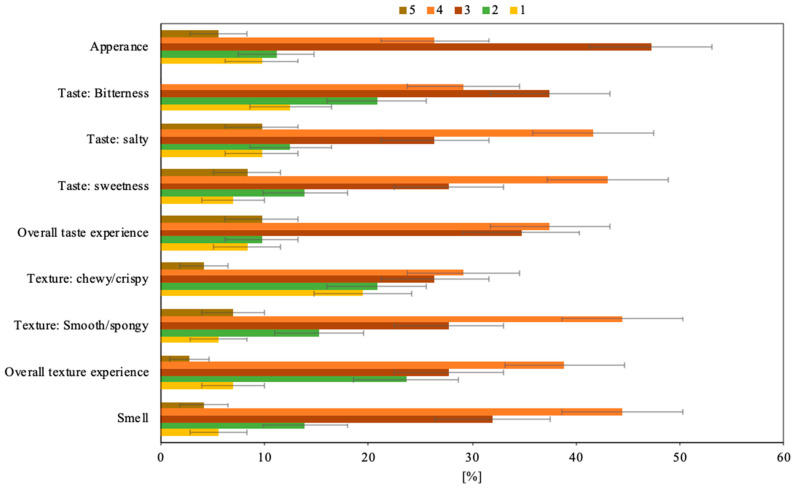
The current study aims to assess how a novel fungi product made from the filamentous fungus Neurospora intermedia, cultivated on bread residuals, is perceived using questionnaires. Participants were asked to rate characteristic attributes of a fungi burger patty and state their preference when comparing it to Quorn and hamburger patties. The data were analyzed to assess whether gender or age was statistically associated with preference profiles. Neither age nor gender was associated with the preference profiles regarding the comparison of burger patties. Except for age and bitterness, age and gender were also not associated with the preference profiles regarding the sensory characteristics of the fungi burger patty. Most of the participants liked the characteristics of the fungi burger patty. The results indicate that fungi products from waste can become accepted products when information dissemination targets environmental benefits. Moreover, to be commercially accepted, the chewiness and bitterness of the product should be improved. Other improvements should target the overall taste in order to cater to people who prefer meat-based protein sources.
Overview
The claims and statistics of this paper haven’t been checked yet.
Free: it reads the open-access text and checks the first 5 claims that cite a source we can check. Create a free account to check every claim.
Integrity signals
Registry
Cites
Statistics
Figures
Verification
Claims the paper makes
The claims and statistics of this paper haven’t been checked yet.
Free: it reads the open-access text and checks the first 5 claims that cite a source we can check. Create a free account to check every claim.
Claims other papers make about this one
Each is checked against this paper’s own text: does it say what the citing paper says it does?
The cited source says what the claim attributes to it.
In the citing paper
“The taste and texture of an upcycled food may differ from conventional products, and thus these foods appear more [57] or less favourable [8,56,58] than their conventional alternatives.”
From Challenges for Upcycled Foods: Definition, Inclusion in the Food Waste Management Hierarchy and Public Acceptability (2021) · cites this paper as [56]
Self-check
Percentages, sums and reported differences re-computed from the paper’s own numbers.
The self-check needs the paper’s full text.
Citations
Cites
Food Security: The Challenge of Feeding 9 Billion People
Godfray, H. C. J., Beddington, J. R., Crute, I. R., Haddad, L., Lawrence, D., Muir, J. F., Pretty, J., Robinson, S., Thomas, S. M., & Toulmin, C. (2010) · Science · doi:10.1126/science.1185383 · Cited by 11,943
Sensory Evaluation of Food: Principles and Practices
Lawless, H. T., & Heymann, H. (2010) · Food Science Text Series · doi:10.1007/978-1-4419-6488-5 · Cited by 4,815
Meilgaard, M. C., Carr, B. T., & Carr, B. T. (2006) · CRC Press eBooks · doi:10.1201/b16452 · Cited by 4,373
The chi-square test of independence
McHugh, M. L. (2013) · Biochemia Medica · doi:10.11613/bm.2013.018 · Cited by 2,828 · cited 1×
“While a chi-square test cannot prove that two samples of groups are the same, it will prove whether or not the hypothesis can be rejected [39].”
BackgroundFood Texture and Viscosity: Concept and Measurement
Bourne, M. C. (2002) · Cited by 1,416
McGuire, S. (2015) · Advances in Nutrition · doi:10.3945/an.115.009936 · Cited by 1,094
Sjöberg, L. (2000) · Risk Analysis · doi:10.1111/0272-4332.00001 · Cited by 1,082 · cited 2×
“ti f nat r l i l i fl i technologies [44] because so e peo le i f r ris [45].”
BackgroundConsumer perception and behaviour regarding sustainable protein consumption: A systematic review
Hartmann, C., & Siegrist, M. (2017) · Trends in Food Science & Technology · doi:10.1016/j.tifs.2016.12.006 · Cited by 880 · cited 2×
“The limited amount of protein-rich food available in parts of the world [8] contributes to more than one billion people worldwide being unable to meet daily protein requirements [9,10].”
BackgroundNutritional quality of important food legumes
Iqbal, A., Khalil, I. A., Ateeq, N., & Sayyar Khan, M. (2006) · Food Chemistry · doi:10.1016/j.foodchem.2005.05.011 · Cited by 771 · cited 1×
“amounts of proteins from animal origin is both expensive and challenging [11].”
Background
Research works printed but not linked: 1
- Soetan K.O. Oyewole O.E. The need for adequate processing to reduce the antinutritional factors in plants used as human foods and animal feeds: A review Afr. J. Food Sci. 2009 3 223 232
Cited by
Current challenges of alternative proteins as future foods
Malila, Y., Owolabi, I. O., Chotanaphuti, T., Sakdibhornssup, N., Elliott, C. T., Visessanguan, W., Karoonuthaisiri, N., & Petchkongkaew, A. (2024) · npj Science of Food · doi:10.1038/s41538-024-00291-w · Cited by 210
“Fungi-based patties were described as salty, sour, bitter, astringent, and umami with a wide range of smells (e.g., nutty, fruity, and moldy) 52,61,62 .”
BackgroundFungal Cell Factories for Efficient and Sustainable Production of Proteins and Peptides
Lübeck, M., & Lübeck, P. S. (2022) · Microorganisms · doi:10.3390/microorganisms10040753 · Cited by 158
“They can provide new food properties, in terms of texture, flavor, and increased solubility [70,81].”
BackgroundMoshtaghian, H., Bolton, K., & Rousta, K. (2021) · Foods · doi:10.3390/foods10112874 · Cited by 150
“These studies revealed that the sensory characteristics of upcycled foods are conditional and depend on the product formulation and the proportion of upcycled ingredients [8,9,56,57].”
BackgroundSelf-citationProtein Sources Alternative to Meat: State of the Art and Involvement of Fermentation
Molfetta, M., de Morais, E. G., Barreira, L. A., Bruno, G. L., Porcelli, F., Dugat‐Bony, É., Bonnarme, P., & Minervini, F. (2022) · Foods · doi:10.3390/foods11142065 · Cited by 152
“For instance, fungi-burgers obtained from stale bread fermented by N. intermedia are proposed in Sweden [82].”
BackgroundInfluentialDerbyshire, E. J., & Delange, J. (2021) · Frontiers in Sustainable Food Systems · doi:10.3389/fsufs.2021.581682 · Cited by 149
“Elsewhere, a novel fungi product has been produced from the filamentous fungus Neurospora intermedia, grown on widely available bread waste (Hellwig et al., 2020).”
BackgroundRousta, N., Hellwig, C., Wainaina, S., Lukitawesa, L., Agnihotri, S., Rousta, K., & Taherzadeh, M. J. (2021) · Foods · doi:10.3390/foods10112774 · Cited by 97
“Solid-state fermentation (SSF) is applied in the production of many traditional fermented food products.”
BackgroundResultSelf-citationNeurospora intermedia from a traditional fermented food enables waste-to-food conversion
Rekdal, V. M., Villalobos‐Escobedo, J. M., Valerón, N. R., García, M. O., Vásquez, D. P., Rosales, A., Sörensen, P. M., Baidoo, E. E. K., de Carvalho, A. C., Riley, R. W., et al. (2024) · Nature Microbiology · doi:10.1038/s41564-024-01799-3 · Cited by 92
“Despite the promises of SSF for transforming by-products into human foods with improved nutrition and sensory appeal 15,16 , engineering by-product–strain combinations in SSF for desired outcomes remains challenging.”
BackgroundEffects of fungal based bioactive compounds on human health: Review paper
Rousta, N., Aslan, M., Akbaş, M. Y., Özcan, F., Şar, T., & Taherzadeh, M. J. (2023) · Critical Reviews in Food Science and Nutrition · doi:10.1080/10408398.2023.2178379 · Cited by 81
“Moreover, the biomass obtained from oat flour and bread left over from the market has become an alternative food product such as hamburger (Hellwig et al. 2020; Rousta, Hellwig, et al. 2021; Rousta et al. 2022).”
Self-citationCianni, R. D., Pippinato, L., & Mancuso, T. (2023) · Appetite · doi:10.1016/j.appet.2023.106454 · Cited by 70
Potential Protein Production from Lignocellulosic Materials Using Edible Mushroom Forming Fungi
Scholtmeijer, K., van den Broek, L. A. M., Fischer, A. R. H., & van Peer, A. F. (2023) · Journal of Agricultural and Food Chemistry · doi:10.1021/acs.jafc.2c08828 · Cited by 58
Awasthi, M. K., Kumar, V., Hellwig, C., Wikandari, R., Harirchi, S., Şar, T., Wainaina, S., Sindhu, R., Binod, P., Zhang, Z., et al. (2022) · Food Research International · doi:10.1016/j.foodres.2022.112318 · Cited by 61
Self-citationMoshtaghian, H., Bolton, K., & Rousta, K. (2023) · British Food Journal · doi:10.1108/bfj-09-2022-0757 · Cited by 59
Self-citationBarrón, S. E. G., Carmona-Escutia, R. P., Herrera-López, E. J., Trinidad, D. A. L., & Gschaedler, A. (2025) · Foods · doi:10.3390/foods14050713 · Cited by 55
“This would allow the development of new products that meet the needs of consumers and, in addition, enable the development of thoughtful markets.”
Gökşen, G., Karabulut, G., Keklik, M., & Martínez‐Sanz, M. (2025) · Food Chemistry · doi:10.1016/j.foodchem.2025.145013 · Cited by 46
Mycoproteins and their health‐promoting properties: Fusarium species and beyond
Lee, D., Pan, J. H., Kim, D., Heo, W., Shin, E., Kim, Y. J., Shim, Y. Y., Reaney, M. J. T., Ko, S., Hong, S., et al. (2024) · Comprehensive Reviews in Food Science and Food Safety · doi:10.1111/1541-4337.13365 · Cited by 42
Resource recovery and treatment of wastewaters using filamentous fungi
Sar, T., Marchlewicz, A., Harirchi, S., Mantzouridou, F. T., Hosoglu, M. I., Akbas, M. Y., Hellwig, C., & Taherzadeh, M. J. (2024) · Science of The Total Environment · doi:10.1016/j.scitotenv.2024.175752 · Cited by 38
Self-citationMyco-biorefinery approaches for food waste valorization: Present status and future prospects
Awasthi, M. K., Harirchi, S., Şar, T., Vigneswaran, V. S., Rajendran, K., Gómez‐García, R., Hellwig, C., Binod, P., Sindhu, R., Madhavan, A., et al. (2022) · Bioresource Technology · doi:10.1016/j.biortech.2022.127592 · Cited by 40
Self-citationEffect of Labelling and Information on Consumer Perception of Foods Presented as 3D Printed
Feng, X., Khemacheevakul, K., Siller, S. D. L., Wolodko, J., & Wismer, W. V. (2022) · Foods · doi:10.3390/foods11060809 · Cited by 38
“Greater acceptance of novel technologies is characteristic of younger consumers [44,45].”
BackgroundMeat alternatives: A proofed commodity?
Boukid, F., & Gagaoua, M. (2022) · Advances in food and nutrition research · doi:10.1016/bs.afnr.2022.02.003 · Cited by 36
Dean, D., Rombach, M., Vriesekoop, F., de Koning, W., de Aguiar, L. K., Anderson, M. J., Mongondry, P., Urbano, B., Luciano, C. A. G., Jiang, B., et al. (2023) · Journal of International Food & Agribusiness Marketing · doi:10.1080/08974438.2023.2169428 · Cited by 34
“The process to produce fungal-based proteins is very similar to beer brewing, where relatively simple sugars and other nutrients are fermented by a fungal culture (Hellwig et al., 2020).”
BackgroundMoshtaghian, H., Bolton, K., & Rousta, K. (2023) · International Journal of Food Science & Technology · doi:10.1111/ijfs.16588 · Cited by 36
Self-citationHousehold fermentation of leftover bread to nutritious food
Hellwig, C., Rousta, N., Wikandari, R., Taherzadeh, M. J., Häggblom‐Kronlöf, G., Bolton, K., & Rousta, K. (2022) · Waste Management · doi:10.1016/j.wasman.2022.06.038 · Cited by 32
Self-citationMohtar, W. H. M. W., Wan‐Mohtar, W. A. A. Q. I., Zahuri, A. A., Ibrahim, M. F., Show, P.-L., Ilham, Z., Jamaludin, A. A., Patah, M. F. A., Usuldin, S. R. A., & Rowan, N. J. (2022) · Bioengineered · doi:10.1080/21655979.2023.2184785 · Cited by 31
“Additionally, this edible fungal biomass’ organoleptic properties [119], such as flavor and texture, make them suitable meat alternatives [120,121].”
BackgroundAspects that affect tasting studies of emerging food – a review
Hellwig, C., Taherzadeh, M. J., Bolton, K., Lundin, M., Häggblom‐Kronlöf, G., & Rousta, K. (2021) · Future Foods · doi:10.1016/j.fufo.2021.100109 · Cited by 27
Self-citationRekdal, V. M., Valerón, N. R., García, M. O., Vásquez, D. P., Sörensen, P. M., Munk, R., & Keasling, J. D. (2023) · International Journal of Gastronomy and Food Science · doi:10.1016/j.ijgfs.2023.100826 · Cited by 24
Consumer acceptance of mycelium as protein source
Fischer, A. R. H., & Hilboesen, O. (2024) · Food Quality and Preference · doi:10.1016/j.foodqual.2024.105304 · Cited by 25
“However, to date research on mycelium remains scarce with some notable exceptions like consumer testing of mycelium cake harvested from stale bread which showed cautiously positive consumer opinions, particularly because of environmental benefits (Hellwig et al., 2020).”
Zięba, P., Sękara, A., Bernaś, E., Krakowska, A., Sułkowska‐Ziaja, K., Kunicki, E., Suchanek, M., & Muszyńska, B. (2021) · Molecules · doi:10.3390/molecules26113273 · Cited by 25
Potential of utilizing almond hull extract for filamentous fungi production by submerged cultivation
Cao, L., Barzee, T. J., El‐Mashad, H. M., Pan, Z., & Zhang, R. (2024) · Food Bioengineering · doi:10.1002/fbe2.12079 · Cited by 21
Bulkan, G., Ferreira, J., Rajendran, K., & Taherzadeh, M. (2020) · Fermentation · doi:10.3390/fermentation6040099 · Cited by 14
“intermedia, a GRAS (generally regarded as safe) microorganism, can be used for the production of nutritious food products from stale bread and brewers spent grains [17,18].”
BackgroundSelf-citationMontebello, R., Derossi, A., Caporizzi, R., Taherzadeh, M. J., Rousta, N., & Severini, C. (2025) · Food Bioscience · doi:10.1016/j.fbio.2025.106882 · Cited by 16
Self-citationIsmail, I., & Huda, N. (2022) · Elsevier eBooks · doi:10.1016/b978-0-323-91001-9.00004-9 · Cited by 15
Filho, P. F. S. (2022) · Advances in food and nutrition research · doi:10.1016/bs.afnr.2022.04.003 · Cited by 13
New food ingredient via acid-tolerant Rhizopus oligosporus growth
Massa, A., Baiget, M., Rothschild, L. J., Axpe, E., & Carrero-Carralero, C. (2024) · Applied Food Research · doi:10.1016/j.afres.2024.100583 · Cited by 14
From surplus bread to burger using filamentous fungi at bakeries: Techno-economical evaluation
Gmoser, R., Lennartsson, P. R., & Taherzadeh, M. J. (2021) · Cleaner Environmental Systems · doi:10.1016/j.cesys.2021.100020 · Cited by 13
Self-citationDonzella, S., Capusoni, C., Pellegrino, L., & Compagno, C. (2021) · Journal of Fungi · doi:10.3390/jof7121028 · Cited by 12
“tablished meat alternatives such as Quorn by Fusarium venenatum [38] and oncom by Neurospora intermedia [39].”
BackgroundEvaluation of crises suitability of food systems: a comparison of alternative protein sources
Boccardo, A., Hagelaar, G. J. L. F., & Lakemond, C. M. M. (2023) · Food Security · doi:10.1007/s12571-023-01390-4 · Cited by 11
“Opposingly, pulses (Calles et al., 2019; Day, 2013; Van der Weele et al., 2019; Xipsiti et al., 2017) and myco-proteins (Finnigan et al., 2017; Hellwig et al., 2020) were widely accepted by the consumers.”
BackgroundMethodPlant-based fermented foods and microbial ingredients in meat analogs
Boukid, F., Fanari, F., & Mefleh, M. (2024) · Elsevier eBooks · doi:10.1016/b978-0-443-21846-0.00015-0 · Cited by 12
Nutritional and sensory parameters of amazake from the recycling of stale bread
Starzyńska‐Janiszewska, A., Stodolak, B., Štefániková, J., Joanidis, P., Mickowska, B., & Šnirc, M. (2024) · Waste Management · doi:10.1016/j.wasman.2024.06.028 · Cited by 9
Hellwig, C., Bolton, K., Häggblom‐Kronlöf, G., & Rousta, K. (2022) · Sustainability · doi:10.3390/su15010317 · Cited by 8
Self-citationBarbon, A. P. A. D. C., Pérez, I. M. N., Barbon, S., Máquina, A. D. V., Su, W.-H., & Barbin, D. F. (2026) · Journal of Pharmaceutical and Biomedical Analysis Open · doi:10.1016/j.jpbao.2026.100105 · Cited by 6
Hoxha, L., Sucic, I., Taherzadeh, M. J., & Marangon, M. (2025) · Innovative Food Science & Emerging Technologies · doi:10.1016/j.ifset.2025.104409 · Cited by 5
Self-citationEnvironmental, Nutritional, and Cultural Sustainability of Novel Food Protein Sources
Nitride, C., D’Auria, G., Ferrara, A., & Ferranti, P. (2022) · Elsevier eBooks · doi:10.1016/b978-0-12-823960-5.00056-1 · Cited by 6
Glocal and ecoethical perceptions of engagement with fungi-based food
Hellwig, C., Moshtaghian, H., Persson, D., Bolton, K., Rousta, K., & Häggblom‐Kronlöf, G. (2024) · Journal of Cleaner Production · doi:10.1016/j.jclepro.2024.140898 · Cited by 5
Self-citationStodolak, B., Starzyńska‐Janiszewska, A., & Poniewska, D. (2024) · Applied Sciences · doi:10.3390/app14114879 · Cited by 5
Bread Staling Measurement Techniques: A Review
(2024) · Journal of Food Chemistry and Nanotechnology · doi:10.17756/jfcn.2024-178 · Cited by 5
“…products and bread will also increase annually, with food demand projected to increase by 70% by 2050, reaching almost ten billion tons [2, 13, 14] Two viable solutions to meet the increasing demand for bakery 40 products are 1) improving the wheat grain yield using classic and molecular…”
BackgroundHoxha, L., Battisti, I., Arrigoni, G., Taherzadeh, M. J., & Marangon, M. (2025) · Food Bioscience · doi:10.1016/j.fbio.2025.108142 · Cited by 4
Self-citationCâmara, A. K. F. I., Ozaki, M. M., Paglarini, C. D. S., dos Santos, M., & Pollonio, M. A. R. (2024) · Springer eBooks · doi:10.1007/978-3-031-69872-9_10 · Cited by 7
Perspective and Emerging Sources Novel Foods and Ingredients From Fungi
Ferrara, A., Velotto, S., & Ferranti, P. (2022) · Elsevier eBooks · doi:10.1016/b978-0-12-823960-5.00046-9 · Cited by 5
Yu, R., Rathnayake, P. Y., Nam, C., Yeo, S. E., Kim, T.-K., Lee, H. J., & Yong, H. I. (2025) · Food Science and Biotechnology · doi:10.1007/s10068-025-02059-8 · Cited by 4
“Similarly, to achieve commercial acceptance, improvements must be made to existing N. intermedia hamburger patties as regards their chewiness and bitterness (Hellwig et al., 2020).”
An Analysis of Key Attributes of Upcycled Food using a Best-Worst Scaling Approach
Jennifer, Y. (2023) · GLOBAL BUSINESS & FINANCE REVIEW · doi:10.17549/gbfr.2023.28.5.1 · Cited by 4
Culinary science and skills of plant-based meat alternatives
Huang, Y., Benimana, F., & Mohan, A. (2024) · Elsevier eBooks · doi:10.1016/b978-0-443-21846-0.00005-8 · Cited by 3
Hava Bazlı Proteinin Alternatif Bir Protein Kaynağı Olarak Kullanım Olanaklarının İncelenmesi
Erdoğan, E., Orhan, K. A. Y. A., Derin, E., & Çakaloğlu, B. (2022) · International Journal of Life Sciences and Biotechnology · doi:10.38001/ijlsb.1096533 · Cited by 2
Digital Evaluation of Growth and Lipid Production in Lipomyces starkeyi from a Single Cell
Tanaka, Y., Minamiki, T., & Kurita, R. (2024) · ACS Food Science & Technology · doi:10.1021/acsfoodscitech.4c00164 · Cited by 2
The Fungal Edible Proteins’ Industrial Biotechnology: Where Are We?
Amara, A. A. A. F., & Gupta, A. R. (2025) · Fungal biology · doi:10.1007/978-3-032-06478-3_11 · Cited by 1
European perspectives on fungi-based food: Appeal and concerns
Hellwig, C., & Taherzadeh, M. J. (2026) · Food and Humanity · doi:10.1016/j.foohum.2026.101025 · Cited by 1
Self-citationHarnessing fungal fermentation for waste-to-food conversion
Black, B., Massa, A., Lurie, F., Preidl, A.-K., & Rekdal, V. M. (2026) · Trends in biotechnology · doi:10.1016/j.tibtech.2026.02.018 · Cited by 1
Filamentous fungal synthetic biology: Current applications and ongoing developments
Hill, R. A. (2026) · Biotechnology Advances · doi:10.1016/j.biotechadv.2026.108912 · Cited by 1
Environmental Aspects of Plant Protein Foods
Roy, P., Orikiasa, T., & Shiina, T. (2022) · Springer eBooks · doi:10.1007/978-3-030-91206-2_16 · Cited by 1
An overview of novel proteins in reformulated food
Vargas‐Ramella, M., Franco, D., Moreira, R., & López‐Pedrouso, M. (2023) · Elsevier eBooks · doi:10.1016/b978-0-443-15346-4.00012-4 · Cited by 1
Filamentous fungi as cell factories for heterogeneous protein production
Meshram, P., Murmu, M., Barage, S. H., & Singh, R. (2024) · Elsevier eBooks · doi:10.1016/b978-0-323-98388-4.00004-6 · Cited by 2
Mikoproteinler: Geleneksel Et ve Et Ürünlerine Bir Alternatif
Orhan, K. A. Y. A., Kozlu, A., & Esen, Ö. B. (2022) · Akademik Gıda · doi:10.24323/akademik-gida.1224821
Dahunsi, O. S. (2024) · Elsevier eBooks · doi:10.1016/b978-0-443-24129-1.00006-5
Economic utilization of xylotrophic basidiomycetes: a review
Zlobina, Y. A., Широких, А. А., & Ashikhmina, T. Y. (2025) · Theoretical and Applied Ecology · doi:10.25750/1995-4301-2025-3-006-018
Massa, A., Placeres, M. D., Axpe, E., Rothschild, L. J., & Carrero-Carralero, C. (2026) · International Journal of Gastronomy and Food Science · doi:10.1016/j.ijgfs.2026.101410
Nitride, C., D’Onofrio, F., Varriale, S., Mariniello, L., Gallo, M., Ferranti, P., Pezzella, C., & Giosafatto, C. V. L. (2026) · Elsevier eBooks · doi:10.1016/b978-0-443-40334-7.00091-5
Varis, J. J., Lehto, E., Saalo, H.-M., Svartström, J., Vainio, A., Sandell, M., Mikkonen, K. S., & Seppä, L. (2026) · Future Foods · doi:10.1016/j.fufo.2026.101191
Metadata
- Authors
- Hellwig, C., Gmoser, R., Lundin, M., Taherzadeh, M. J., & Rousta, K.
- Affiliations
- University of Borås (SE)
- Corresponding author
- Hellwig, Coralie
- Venue
- Foods
- Publisher
- MDPI AG
- Published
- 2020-08-13
- Volume
- 9
- Issue
- 8
- Pages
- 1112
- ISSN
- 2304-8158 (ISSN-L)
- PMC
- PMC7466323
- OpenAlex
- W3048730654
- Cited by
- 63
- References
- 50
- Citations by year
- 2026: 6 · 2025: 7 · 2024: 17 · 2023: 9 · 2022: 16 · 2021: 7 · 2020: 1
- FWCI
- 5.35
- Type
- journal article
- Language
- en
- Open access
- gold
- doi.org
- Licence
- Locations
- Foods (publishedVersion, cc-by)
- PubMed Central (publishedVersion, cc-by)
- PubMed (publishedVersion)
- Diva portal (Dalarna University Library) (submittedVersion, other-oa)
- DOAJ (DOAJ: Directory of Open Access Journals) (submittedVersion, cc-by-sa)
- Funders
- This research was funded by the Swedish Agency for Economic and Regional Growth (Tillväxtverket) via the European Union European Regional Development Fun (Ways2Taste)
- Topics
- Life Sciences › Agricultural and Biological Sciences › Food Science › Sensory Analysis and Statistical Methods
- Health Sciences › Medicine › Public Health, Environmental and Occupational Health › Consumer Attitudes and Food Labeling
- Physical Sciences › Environmental Science › Ecology › Agriculture Sustainability and Environmental Impact
- Keywords
- edible mushrooms, food waste valorization, consumer perception, sensory properties, food preferences, gender differences, age differences, bitterness, chewiness, meat substitutes
About these checks
Registry, retraction, Cites and statistics results are computed, not judged, with one exception: a printed reference that no index lists is read once by a model before it counts as a citation error. Claims are extracted by a model and kept only when their quote appears verbatim in the text; each cited source is then checked, with a model’s help, for whether it says what the claim relies on. Those verdicts can be wrong — read the claim’s quote and the cited source before relying on one.
Statistics and arithmetic are recomputed, not judged.
Confidence bands are shown only for fields calibrated on our annotated test set. None is calibrated yet, so no band is shown.
What counts as a claim ›How we measure confidence ›How we check this ›
Are you an author, or do you see a problem with this page? Request a review
Data sources
Bibliographic data: Semantic Scholar, OpenAlex, Crossref.
Contains information from the Semantic Scholar Academic Graph Datasets, made available under the ODC Attribution License (ODC-BY 1.0).
Semantic Scholar’s data is described in: Kinney, R., et al. (2023). The Semantic Scholar Open Data Platform. arXiv:2301.10140.
