

Fungi Burger from Stale Bread? A Case Study on Perceptions of a Novel Protein-Rich Food Product Made from an Edible Fungus
Open accessThe DOI matches its Crossref record; 49 of the 50 references it cites were found in a registry or an index.
Abstract
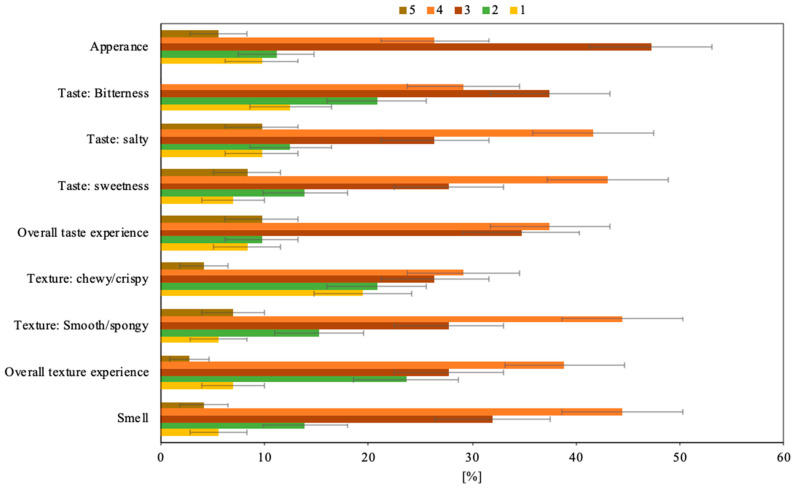
The current study aims to assess how a novel fungi product made from the filamentous fungus Neurospora intermedia, cultivated on bread residuals, is perceived using questionnaires. Participants were asked to rate characteristic attributes of a fungi burger patty and state their preference when comparing it to Quorn and hamburger patties. The data were analyzed to assess whether gender or age was statistically associated with preference profiles. Neither age nor gender was associated with the preference profiles regarding the comparison of burger patties. Except for age and bitterness, age and gender were also not associated with the preference profiles regarding the sensory characteristics of the fungi burger patty. Most of the participants liked the characteristics of the fungi burger patty. The results indicate that fungi products from waste can become accepted products when information dissemination targets environmental benefits. Moreover, to be commercially accepted, the chewiness and bitterness of the product should be improved. Other improvements should target the overall taste in order to cater to people who prefer meat-based protein sources.
Overview
The claims and statistics of this paper haven’t been checked yet.
Free: it reads the open-access text and checks the first 5 claims that cite a source we can check. Create a free account to check every claim.
Integrity signals
Registry
Cites
Statistics
Figures
Verification
Claims the paper makes
The claims and statistics of this paper haven’t been checked yet.
Free: it reads the open-access text and checks the first 5 claims that cite a source we can check. Create a free account to check every claim.
Claims other papers make about this one
Each is checked against this paper’s own text: does it say what the citing paper says it does?
The cited source says what the claim attributes to it.
In the citing paper
“The taste and texture of an upcycled food may differ from conventional products, and thus these foods appear more [57] or less favourable [8,56,58] than their conventional alternatives.”
From Challenges for Upcycled Foods: Definition, Inclusion in the Food Waste Management Hierarchy and Public Acceptability (2021) · cites this paper as [56]
Self-check
Percentages, sums and reported differences re-computed from the paper’s own numbers.
The self-check needs the paper’s full text.
Citations
Cites
Food Security: The Challenge of Feeding 9 Billion People
Godfray, H. C. J., Beddington, J. R., Crute, I. R., Haddad, L., Lawrence, D., Muir, J. F., Pretty, J., Robinson, S., Thomas, S. M., & Toulmin, C. (2010) · Science · doi:10.1126/science.1185383 · Cited by 11,943
Sensory Evaluation of Food: Principles and Practices
Lawless, H. T., & Heymann, H. (2010) · Food Science Text Series · doi:10.1007/978-1-4419-6488-5 · Cited by 4,815
Meilgaard, M. C., Carr, B. T., & Carr, B. T. (2006) · CRC Press eBooks · doi:10.1201/b16452 · Cited by 4,373
The chi-square test of independence
McHugh, M. L. (2013) · Biochemia Medica · doi:10.11613/bm.2013.018 · Cited by 2,828 · cited 1×
“While a chi-square test cannot prove that two samples of groups are the same, it will prove whether or not the hypothesis can be rejected [39].”
BackgroundFood Texture and Viscosity: Concept and Measurement
Bourne, M. C. (2002) · Cited by 1,416
McGuire, S. (2015) · Advances in Nutrition · doi:10.3945/an.115.009936 · Cited by 1,094
Sjöberg, L. (2000) · Risk Analysis · doi:10.1111/0272-4332.00001 · Cited by 1,082 · cited 2×
“ti f nat r l i l i fl i technologies [44] because so e peo le i f r ris [45].”
BackgroundConsumer perception and behaviour regarding sustainable protein consumption: A systematic review
Hartmann, C., & Siegrist, M. (2017) · Trends in Food Science & Technology · doi:10.1016/j.tifs.2016.12.006 · Cited by 880 · cited 2×
“The limited amount of protein-rich food available in parts of the world [8] contributes to more than one billion people worldwide being unable to meet daily protein requirements [9,10].”
BackgroundNutritional quality of important food legumes
Iqbal, A., Khalil, I. A., Ateeq, N., & Sayyar Khan, M. (2006) · Food Chemistry · doi:10.1016/j.foodchem.2005.05.011 · Cited by 771 · cited 1×
“amounts of proteins from animal origin is both expensive and challenging [11].”
BackgroundPublic acceptance of nanotechnology foods and food packaging: The influence of affect and trust
Siegrist, M., Cousin, M.-E., Kastenholz, H., & Wiek, A. (2007) · Appetite · doi:10.1016/j.appet.2007.03.002 · Cited by 545 · cited 1×
“However, perceived risk, such as the risk posed by additional financial strain, is negatively correlated with people’s willingness to purchase a product [47].”
BackgroundFactors influencing public acceptance of innovative food technologies and products
SIEGRIST, M. (2008) · Trends in Food Science & Technology · doi:10.1016/j.tifs.2008.01.017 · Cited by 536 · cited 5×
“ti f nat r l i l i fl i technologies [44] because so e peo le i f r ris [45].”
BackgroundInfluentialNonmeat Protein Alternatives as Meat Extenders and Meat Analogs
Asgar, M. A., Fazilah, A., Huda, N., Bhat, R., & Karim, A. A. (2010) · Comprehensive Reviews in Food Science and Food Safety · doi:10.1111/j.1541-4337.2010.00124.x · Cited by 505 · cited 1×
“This is especially important for meat alternatives, like the fungi burger patty, because texture is the most challenging obstacle in growing wide acceptance [53].”
BackgroundMeat alternatives: an integrative comparison
van der Weele, C., Feindt, P., Jan van der Goot, A., van Mierlo, B., & van Boekel, M. (2019) · Trends in Food Science & Technology · doi:10.1016/j.tifs.2019.04.018 · Cited by 430 · cited 2×
“Even thoug peo l are ofte a r t t t r environment [43], as much as 14 of the rtici t f reasons.”
BackgroundSustainability of plant-based diets: back to the future
Sabaté, J., & Soret, S. (2014) · The American Journal of Clinical Nutrition · doi:10.3945/ajcn.113.071522 · Cited by 426 · cited 1×
“Reasons for this can be that the production and consumption of plant-based products are thought to contribute to sustainable food supply, health (both individual and global health), and social justice, and to mediate negative environmental consequences because fewer natural resources are needed in their production [24…”
BackgroundTempe fermentation, innovation and functionality: update into the third millenium
Nout, M. J. R., & Kiers, J. L. (2005) · Journal of Applied Microbiology · doi:10.1111/j.1365-2672.2004.02471.x · Cited by 399 · cited 1×
“Fungi improve nutritive values by producing enzymes that degrade the cell walls of the plant they are cultivated on and so improve the digestibility of available proteins [18].”
BackgroundWu, G., Fanzo, J., Miller, D. D., Pingali, P., Post, M., Steiner, J. L., & Thalacker‐Mercer, A. E. (2014) · Annals of the New York Academy of Sciences · doi:10.1111/nyas.12500 · Cited by 339
Footprints of water and energy inputs in food production – Global perspectives
Khan, S., & Hanjra, M. A. (2009) · Food Policy · doi:10.1016/j.foodpol.2008.09.001 · Cited by 334 · cited 1×
“The status quo of food production, however, often depletes resources [3] at a time when managing the planet’s resources has never been as important as it currently is [4].”
BackgroundClimate change and sustainable food production
Smith, P., & Gregory, P. J. (2013) · Proceedings of the Nutrition Society · doi:10.1017/s0029665112002832 · Cited by 323 · cited 1×
“This issue goes hand in hand with challenges to provide nutritious food to everyone [2] in sustainable ways that are affordable as well as gentle on the environment and life on earth.”
BackgroundVan Loo, E. J., Hoefkens, C., & Verbeke, W. (2017) · Food Policy · doi:10.1016/j.foodpol.2017.03.001 · Cited by 292 · cited 1×
“For some, this change may manifest in the preference of plant-based products over meat-based ones [23].”
BackgroundSensory Methods of Texture and Viscosity Measurement
Bourne, M. C. (2002) · Food Texture and Viscosity · doi:10.1016/b978-012119062-0/50007-3 · Cited by 278
Glutamate: from discovery as a food flavor to role as a basic taste (umami)
Kurihara, K. (2009) · The American Journal of Clinical Nutrition · doi:10.3945/ajcn.2009.27462d · Cited by 247
Life cycle assessment of supermarket food waste
Brancoli, P., Rousta, K., & Bolton, K. (2017) · Resources, Conservation and Recycling · doi:10.1016/j.resconrec.2016.11.024 · Cited by 247 · cited 6×
“Many examples of fermented food products are closely linked to contexts of sociocultural patterns of food preferences, such as fungal fermented soybeans in Indonesia or fermented herring in Sweden.”
BackgroundInfluentialSelf-citationProduction of microbial pigments utilizing agro-industrial waste: a review
Panesar, R., Kaur, S., & Panesar, P. S. (2015) · Current Opinion in Food Science · doi:10.1016/j.cofs.2014.12.002 · Cited by 243 · cited 2×
“Moreover, using bread residuals as a source for fermentation can also eliminate disposal problems associated with waste, lower environmental pollution from waste, and introduce potentially cost-effective processes for the production of valuable compounds due to the low or negative cost of the raw materials [27].”
BackgroundInfluence of information about manufacturing process on beer acceptability
Caporale, G., & Monteleone, E. (2004) · Food Quality and Preference · doi:10.1016/s0950-3293(03)00067-3 · Cited by 213 · cited 1×
“Interestingly, providing information on how a food product is manufactured may influence how the taste of that product is evaluated [41].”
BackgroundMICROBIOLOGY OF ORIENTAL FERMENTED FOODS
Hesseltine, C. W. (1983) · Annual Review of Microbiology · doi:10.1146/annurev.mi.37.100183.003043 · Cited by 164 · cited 1×
“[25] have taken this one step further and demonstrated an innovative way to produce a protein-rich food product, with good nutritional value, made from bread residuals through solid-state fermentation using the edible and generally regarded as safe to eat [26] filamentous fungus Neurospora intermedia.”
BackgroundVegan-mycoprotein concentrate from pea-processing industry byproduct using edible filamentous fungi
Filho, P. F. S., Nair, R. B., Andersson, D., Lennartsson, P. R., & Taherzadeh, M. J. (2018) · Fungal Biology and Biotechnology · doi:10.1186/s40694-018-0050-9 · Cited by 159 · cited 1×
“Efforts to improve the nutritive value of plants often focus on chemical, physical, and enzymatic treatments, but biological treatments may offer an approach that is gentler to the environment [16].”
BackgroundSelf-citationMicrobial production of food ingredients, enzymes and nutraceuticals
McNeil, B., Archer, D., Giavasis, I., & Harvey, L. (2013) · Woodhead Publishing Limited eBooks · doi:10.1533/9780857093547 · Cited by 153
Profiling European traditional food consumers
Vanhonacker, F., Lengard, V., Hersleth, M., & Verbeke, W. (2010) · British Food Journal · doi:10.1108/00070701011067479 · Cited by 148 · cited 3×
“Traditional food consumers who are less open to innovations in the food sector are commonly native and older conservative females, with below-average incomes [35].”
BackgroundInfluentialVong, W. C., Hua, X. Y., & Liu, S. (2017) · LWT · doi:10.1016/j.lwt.2017.12.050 · Cited by 137 · cited 1×
“The taste of filamentous fungi fermented food can be influenced by several amino acids [49].”
BackgroundStephenson, L. S., Latham, M. C., & Ottesen, E. A. (2000) · Parasitology · doi:10.1017/s0031182000006478 · Cited by 128
Brancoli, P., Lundin, M., Bolton, K., & Eriksson, M. (2019) · Resources Conservation and Recycling · doi:10.1016/j.resconrec.2019.04.027 · Cited by 121 · cited 1×
“The amount of bread waste generated by retailers alone in Sweden is estimated to be roughly 29,870 tons per year [29].”
BackgroundSelf-citationSjoberg (2000) · PubMed · Cited by 109
From stale bread and brewers spent grain to a new food source using edible filamentous fungi
Gmoser, R., Fristedt, R., Larsson, K., Undeland, I., Taherzadeh, M., & Lennartsson, P. R. (2020) · Bioengineered · doi:10.1080/21655979.2020.1768694 · Cited by 107 · cited 5×
“The fungi burger patty has a similar texture to that of soybean burger patties, but the final texture can be improved to meet the expectations of the people it caters to through the addition of minor ingredients [34].”
BackgroundInfluentialSelf-citationGmoser, R., Sintca, C., Taherzadeh, M. J., & Lennartsson, P. R. (2019) · Waste Management · doi:10.1016/j.wasman.2019.07.039 · Cited by 106
Self-citationBelief in gene technology: The influence of environmental attitudes and gender
Siegrist, M. (1998) · Personality and Individual Differences · doi:10.1016/s0191-8869(98)00021-x · Cited by 88 · cited 2×
“Environmental attitudes can moderately influence the acceptance of innovative food technologies [42].”
BackgroundUse of Waste Bread to Produce Fermentation Products
Melikoğlu, M., & Webb, C. (2013) · Elsevier eBooks · doi:10.1016/b978-0-12-391921-2.00004-4 · Cited by 83 · cited 2×
“Through the fermentation of bread, most of the carbohydrates can be converted into fungal protein, and the nutrients in the bread are concentrated in the final product [21].”
Background(2000) · doi:10.1002/9780470290217 · Cited by 73
Takahashi, T., Hayakawa, F., Kumagai, M., Akiyama, Y., & Kohyama, K. (2009) · Journal of Food Engineering · doi:10.1016/j.jfoodeng.2009.05.023 · Cited by 39 · cited 1×
“Moreover, the texture of a food product is also generally recognized as an important factor influencing whether or not a food product will be accepted [52].”
Backgroundde Souza, T. D., Massarolo, K. C., Tralamazza, S. M., & Badiale–Furlong, E. (2017) · CyTA - Journal of Food · doi:10.1080/19476337.2017.1359676 · Cited by 38
Resource Recovery to Approach Zero Municipal Waste
Taherzadeh, M. J., & Richards, T. (2015) · CRC Press eBooks · doi:10.1201/b18680 · Cited by 34
Self-citationDesign and performance of Small scale sensory consumer tests
Svensson, L. (2012) · Epsilon Archive for Student Projects (Swedish University of Agricultural Sciences) · Cited by 33
Processing of agricultural wastes in solid state fermentation for microbial protein production
Nigam, P. S. N., & Singh, D. N. (1996) · Journal of Scientific & Industrial Research · Cited by 28
Blakeman, J. P., McCracken, A. R., & Seaby, D. A. (1988) · Journal of the Science of Food and Agriculture · doi:10.1002/jsfa.2740450203 · Cited by 20
The thermal stability of Quorntm pieces
Knight, N., Roberts, G., & Shelton, D. (2001) · International Journal of Food Science & Technology · doi:10.1046/j.1365-2621.2001.00424.x · Cited by 15 · cited 1×
“This is because such fungi produce filaments that are much like those in meat, with a texture similar to that of lean meat [54].”
BackgroundThe thermal stability of Quorntm pieces
Knight, N., Roberts, G., & Shelton, D. (2001) · International Journal of Food Science & Technology · doi:10.1111/j.1365-2621.2001.00424.x · Cited by 15
Joyce, A., Dixon, S., Comfort, J., & Hallett, J. (2008) · Environmental Health Insights · doi:10.4137/ehi.s914 · Cited by 14 · cited 1×
“People are currently striving towards behavioral patterns that lower the negative consequences of human activity on the environment, and many have found meaningful ways to answer these calls by changing their dietary habits [22].”
BackgroundJin, B., Yu, Q., van Leeuwen, J. H., & Hung, Y. (2010) · Humana Press eBooks · doi:10.1007/978-1-60327-031-1_20 · Cited by 10 · cited 2×
“intermedia, to be generally pleasant [51].”
A model for consumers' preferences for Novel Protein Foods and environmental quality
Zhu, X., & Ierland, E. C. V. (2005) · Economic Modelling · doi:10.1016/j.econmod.2005.05.004 · Cited by 6 · cited 5×
“This is in line with Zhu and van Ierland [46], who found that the substitution effect of novel protein food products depends on their price relationship to alternative products and that lowering their price aids their replacement of meat-based protein sources.”
BackgroundResultInfluential
Research works printed but not linked: 1
- Soetan K.O. Oyewole O.E. The need for adequate processing to reduce the antinutritional factors in plants used as human foods and animal feeds: A review Afr. J. Food Sci. 2009 3 223 232
Cited by
Current challenges of alternative proteins as future foods
Malila, Y., Owolabi, I. O., Chotanaphuti, T., Sakdibhornssup, N., Elliott, C. T., Visessanguan, W., Karoonuthaisiri, N., & Petchkongkaew, A. (2024) · npj Science of Food · doi:10.1038/s41538-024-00291-w · Cited by 210
“Fungi-based patties were described as salty, sour, bitter, astringent, and umami with a wide range of smells (e.g., nutty, fruity, and moldy) 52,61,62 .”
BackgroundFungal Cell Factories for Efficient and Sustainable Production of Proteins and Peptides
Lübeck, M., & Lübeck, P. S. (2022) · Microorganisms · doi:10.3390/microorganisms10040753 · Cited by 158
“They can provide new food properties, in terms of texture, flavor, and increased solubility [70,81].”
BackgroundMoshtaghian, H., Bolton, K., & Rousta, K. (2021) · Foods · doi:10.3390/foods10112874 · Cited by 150
“These studies revealed that the sensory characteristics of upcycled foods are conditional and depend on the product formulation and the proportion of upcycled ingredients [8,9,56,57].”
BackgroundSelf-citationProtein Sources Alternative to Meat: State of the Art and Involvement of Fermentation
Molfetta, M., de Morais, E. G., Barreira, L. A., Bruno, G. L., Porcelli, F., Dugat‐Bony, É., Bonnarme, P., & Minervini, F. (2022) · Foods · doi:10.3390/foods11142065 · Cited by 152
“For instance, fungi-burgers obtained from stale bread fermented by N. intermedia are proposed in Sweden [82].”
BackgroundInfluentialDerbyshire, E. J., & Delange, J. (2021) · Frontiers in Sustainable Food Systems · doi:10.3389/fsufs.2021.581682 · Cited by 149
“Elsewhere, a novel fungi product has been produced from the filamentous fungus Neurospora intermedia, grown on widely available bread waste (Hellwig et al., 2020).”
Background
Metadata
- Authors
- Hellwig, C., Gmoser, R., Lundin, M., Taherzadeh, M. J., & Rousta, K.
- Affiliations
- University of Borås (SE)
- Corresponding author
- Hellwig, Coralie
- Venue
- Foods
- Publisher
- MDPI AG
- Published
- 2020-08-13
- Volume
- 9
- Issue
- 8
- Pages
- 1112
- ISSN
- 2304-8158 (ISSN-L)
- PMC
- PMC7466323
- OpenAlex
- W3048730654
- Cited by
- 63
- References
- 50
- Citations by year
- 2026: 6 · 2025: 7 · 2024: 17 · 2023: 9 · 2022: 16 · 2021: 7 · 2020: 1
- FWCI
- 5.35
- Type
- journal article
- Language
- en
- Open access
- gold
- doi.org
- Licence
- Locations
- Foods (publishedVersion, cc-by)
- PubMed Central (publishedVersion, cc-by)
- PubMed (publishedVersion)
- Diva portal (Dalarna University Library) (submittedVersion, other-oa)
- DOAJ (DOAJ: Directory of Open Access Journals) (submittedVersion, cc-by-sa)
- Funders
- This research was funded by the Swedish Agency for Economic and Regional Growth (Tillväxtverket) via the European Union European Regional Development Fun (Ways2Taste)
- Topics
- Life Sciences › Agricultural and Biological Sciences › Food Science › Sensory Analysis and Statistical Methods
- Health Sciences › Medicine › Public Health, Environmental and Occupational Health › Consumer Attitudes and Food Labeling
- Physical Sciences › Environmental Science › Ecology › Agriculture Sustainability and Environmental Impact
- Keywords
- edible mushrooms, food waste valorization, consumer perception, sensory properties, food preferences, gender differences, age differences, bitterness, chewiness, meat substitutes
About these checks
Registry, retraction, Cites and statistics results are computed, not judged, with one exception: a printed reference that no index lists is read once by a model before it counts as a citation error. Claims are extracted by a model and kept only when their quote appears verbatim in the text; each cited source is then checked, with a model’s help, for whether it says what the claim relies on. Those verdicts can be wrong — read the claim’s quote and the cited source before relying on one.
Statistics and arithmetic are recomputed, not judged.
Confidence bands are shown only for fields calibrated on our annotated test set. None is calibrated yet, so no band is shown.
What counts as a claim ›How we measure confidence ›How we check this ›
Are you an author, or do you see a problem with this page? Request a review
Data sources
Bibliographic data: Semantic Scholar, OpenAlex, Crossref.
Contains information from the Semantic Scholar Academic Graph Datasets, made available under the ODC Attribution License (ODC-BY 1.0).
Semantic Scholar’s data is described in: Kinney, R., et al. (2023). The Semantic Scholar Open Data Platform. arXiv:2301.10140.
