

The Role of Emotion Dysregulation in Understanding Suicide Risk: A Systematic Review of the Literature
Open accessThe DOI matches its Crossref record; 84 of the 89 references it cites were found in a registry or an index; 20 of the 41 sources its claims cite were checked for support.
Abstract
Suicide prevention represents a global imperative, and efforts to identify potential risk factors are intensifying. Among these, emotional regulation abilities represent a transdiagnostic component that may have an impactful influence on suicidal ideation and behavior. Therefore, the present systematic review aimed to investigate the association between emotion dysregulation and suicidal ideation and/or behavior in adult participants. The review followed PRISMA guidelines, and the research was performed through four major electronic databases (PubMed/MEDLINE, Scopus, PsycInfo, and Web of Science) for relevant titles/abstracts published from January 2013 to September 2023. The review included original studies published in peer-reviewed journals and in English that assessed the relationship between emotional regulation, as measured by the Difficulties in Emotional Regulation Scale (DERS), and suicidal ideation and/or behavior. In total, 44 studies were considered eligible, and the results mostly revealed significant positive associations between emotion dysregulation and suicidal ideation, while the findings on suicide attempts were more inconsistent. Furthermore, the findings also confirmed the role of emotion dysregulation as a mediator between suicide and other variables. Given these results, it is important to continue investigating these constructs and conduct accurate assessments to implement effective person-centered interventions.
Overview
CoChat Summary
## TL;DR
This PRISMA systematic review examined 44 adult studies linking emotion dysregulation, measured by the DERS, with suicidal ideation and/or suicide attempts. The review found mostly positive associations with suicidal ideation, more inconsistent findings for suicide attempts, and recurring evidence that emotion dysregulation can function as a mediator.
## Key findings
- The review included 44 studies published from January 2013 to September 2023; 26/44 (59.1%) were from the USA, and study samples ranged from 60 to 2693 participants.
- For suicidal ideation, the authors report mostly positive associations with emotion dysregulation across both clinical and nonclinical samples; one nonclinical study found emotion dysregulation accounted for 36.7% of the variance in suicidal ideation, and another found the DERS score accounted for 11% of the variance.
- For suicide attempts, findings were more mixed: some studies found positive associations, while others found no significant relationship or that the association disappeared when other variables were added.
- Emotion dysregulation was reported to mediate relationships between suicidal ideation/attempts and several variables, including NSSI, childhood trauma, psychopathy, cannabis-use problems, perfectionistic concerns and strivings, depressive symptoms, PTSD, avoidant/anxious attachment, and sleep disturbances.
## Methods
- Design: Systematic literature review conducted according to PRISMA guidelines.
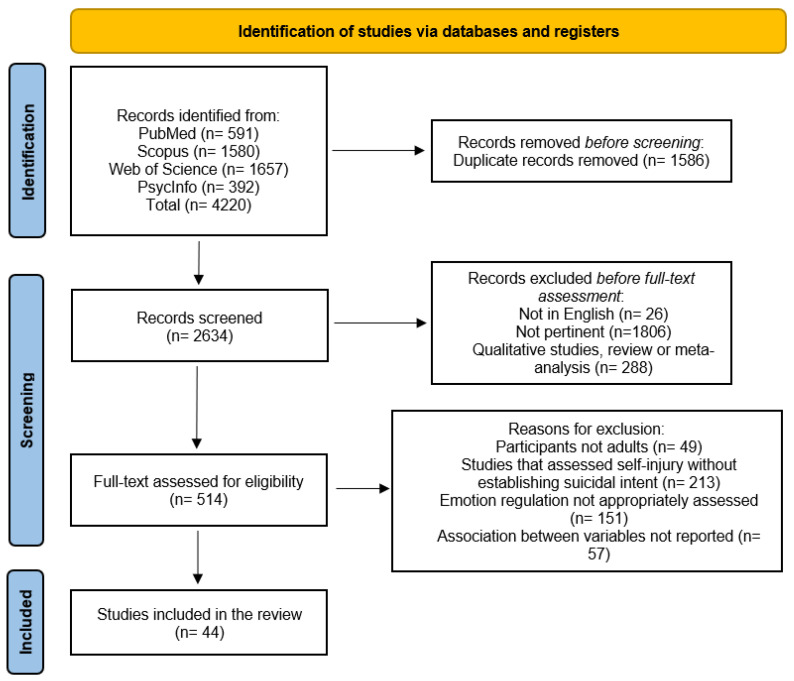
- Data/sample: Searched PubMed/MEDLINE, Scopus, PsycINFO, and Web of Science for English-language studies published 2013–September 2023; included adult (18+) quantitative case-control, cohort, or cross-sectional studies using the DERS and measuring suicidal ideation and/or behavior.
- Analysis: Two-step screening (title/abstract, then full text), independent data extraction, consensus resolution for disagreements, and a quality assessment based on adapted NIH tools with scores from 0 to 7.
## Limitations
- The paper states that study quality was relatively low overall, with a mean quality score of 3.47, and that several studies showed selection bias and weak-to-moderate quality.
- The review notes that only four studies used a longitudinal design, limiting conclusions about directionality/causality.
- Most studies relied on self-report measures, which the authors say exposes results to recall bias and social desirability.
- Evident from the text: the review included only studies using the DERS and only English-language papers, which may narrow generalizability and exclude relevant evidence.
Model-written summary. Check it against the paper before relying on it.
Integrity signals
Registry
Cites
Statistics
Figures
Verification
Claims the paper makes
11 Valid · 1 Not valid · 28 Not checked · 31 Own results and interpretations
At least one cited source doesn’t support this claim or points to a different paper, and none confirmed it — see the verdicts below.
In the paper
“For example, a study by Clapham and colleagues [32] showed that the predictive value of emotional dysregulation on suicidal ideation becomes nonsignificant when introducing depressive symptoms and gender in regression.”
§ The Role of Emotion Dysregulation in Understanding Suicide Risk: A Systematic Review of the Literature > 4. Discussion
What the sources say
- Disputedcites [32] Clapham R. Brausch A. Emotion regulation deficits across the spectrum of self-harm Death Stud. 2022 46 2477 2484 10.1080/07481187.2021.1972366 34486924 PMC9554899 sourceExperimental — accuracy not yet measured
The Results (page unavailable) report that, after controlling for depression and gender, one emotion-regulation deficit—lack of access to strategies—remained significantly associated with suicidal ideation. Other subscales were nonsignificant, but the unqualified claim that emotional dysregulation became nonsignificant contradicts that finding. (LLM, conf=0.90)
Checked by a reasoning model — may be wrong.
plain- Asserted: passes — The authors put it forward as true.
- Checkable: passes — It can be checked against evidence.
- Load-bearing: passes — The paper’s conclusions depend on it.
- Based: passes — The paper gives a reason why it holds.
- Disputed
Every source the paper cites for this claim was checked and supports it.
In the paper
“For example, borderline personality disorder or posttraumatic stress disorder, which are strongly characterized by disrupted emotions, may represent more powerful predictors of suicide attempt [24].”
§ The Role of Emotion Dysregulation in Understanding Suicide Risk: A Systematic Review of the Literature > 4. Discussion
What the sources say
- Supportedcites [24] Turton H. Berry K. Danquah A. Pratt D. The relationship between emotion dysregulation and suicide ideation and behavior: A systematic review J. Affect. Disord. Rep. 2021 5 100136 10.1016/j.jadr.2021.100136 source
Section 3.4 reports that BPD and PTSD diagnoses remained significant predictors of suicide-attempt history after controlling for emotion-regulation difficulties, which did not remain predictive. Section 4.1 likewise suggests that variables associated with those diagnoses might better explain suicide attempts. The cited finding concerns suicide-attempt history in the studied clinical sample, not a general causal effect. (LLM, conf=0.88)
hedgedstates a possible cause- Asserted: passes — The authors put it forward as true.
- Checkable: passes — It can be checked against evidence.
- Load-bearing: unclear — It is unclear whether the paper’s conclusions depend on it.
- Based: passes — The paper gives a reason why it holds.
- Supported
The cited sources support only part of this claim — read each source’s verdict below.
In the paper
“Accordingly, studies have shown that emotion dysregulation eases the development of suicidal ideation and behavior [15,16,17,18].”
§ The Role of Emotion Dysregulation in Understanding Suicide Risk: A Systematic Review of the Literature > 1. Introduction
What the sources say
- Partly supportedcites [15] Mayorga N.A. Jardin C. Bakhshaie J. Garey L. Viana A.G. Cardoso J.B. Zvolensky M. Acculturative stress, emotion regulation, and affective symptomology among Latino/a college students J. Couns. Psychol. 2018 65 247 258 10.1037/cou0000263 29543479 PMC11846055 sourceExperimental — accuracy not yet measured
The Results (Suicidality; page unavailable) report an indirect association between acculturative stress and suicidality symptoms through difficulties in emotion regulation among Latino/a college students. The paper does not establish that emotion dysregulation causes suicidal ideation or behavior to develop, or that the finding applies beyond this population. (LLM, conf=0.85)
- Partly supportedcites [16] Miller A.B. McLaughlin K.A. Busso D.S. Brueck S. Peverill M. Sheridan M.A. Neural Correlates of Emotion Regulation and Adolescent Suicidal Ideation Biol. Psychiatry Cogn. Neurosci. Neuroimaging 2018 3 125 132 10.1016/j.bpsc.2017.08.008 29529407 PMC5851479 sourceExperimental — accuracy not yet measured
The paper states that emotion-regulation difficulties are associated with increased risk for suicidal ideation in youth (section labeled Abstract > Conclusions; page unavailable). Its Discussion links disrupted emotion regulation to adolescent ideation, but only suggests that improving regulation could help prevent suicidal behavior. It does not establish that dysregulation causes the development of ideation or behavior. (LLM, conf=0.84)
- Not checked — no full text of the sourcecites [17] Eaddy M. Zullo L. Horton S.E. Hughes J.L. Kennard B. Diederich A. Emslie G.J. Schuster L. Stewart S.M. A Theory-Driven Investigation of the Association Between Emotion Dysregulation and Suicide Risk in a Clinical Adolescent Sample Suicide Life Threat. Behav. 2019 49 928 940 10.1111/sltb.12472 29745436 source
- Partly supportedcites [18] Gratz K.L. Spitzen T.L. Tull M.T. Expanding our understanding of the relationship between nonsuicidal self-injury and suicide attempts: The roles of emotion regulation self-efficacy and the acquired capability for suicide J. Clin. Psychol. 2020 76 1653 1667 10.1002/jclp.22950 32227691 PMC7723229 sourceExperimental — accuracy not yet measured
The General Discussion reports that lower emotion-regulation self-efficacy was indirectly associated with suicide attempts among people who engage in nonsuicidal self-injury. It suggests that repeated failures to regulate emotions may increase the likelihood of a transition from suicidal ideation to an attempt. It does not establish that emotion dysregulation causes the development of suicidal ideation, and its findings are narrower than the claim’s general statement about suicidal behavior. Page numbers are unavailable in our copy. (LLM, conf=0.84)
plainstates a cause- Asserted: passes — The authors put it forward as true.
- Checkable: passes — It can be checked against evidence.
- Load-bearing: passes — The paper’s conclusions depend on it.
- Based: passes — The paper gives a reason why it holds.
- Partly supported
A result the paper reports from its own data — it cites no other source for it, so there is none to check. The quote shows it is in the paper.
In the paper
“Furthermore, the findings also confirmed the role of emotion dysregulation as a mediator between suicide and other variables.”
§ The Role of Emotion Dysregulation in Understanding Suicide Risk: A Systematic Review of the Literature > Abstract
boostedstates a cause- Asserted: passes — The authors put it forward as true.
- Checkable: passes — It can be checked against evidence.
- Load-bearing: passes — The paper’s conclusions depend on it.
- Based: passes — The paper gives a reason why it holds.
A result the paper states — it cites no source for it, so there is none to check. The quote shows it is in the paper.
In the paper
“In contrast, after controlling for depression and sex, only the dimension of flexible use of emotional regulation strategies remained significantly associated with suicidal ideation.”
§ The Role of Emotion Dysregulation in Understanding Suicide Risk: A Systematic Review of the Literature > 3. Results > 3.3. Emotional Regulation and Suicidal Ideation
plainstates an association- Asserted: passes — The authors put it forward as true.
- Checkable: passes — It can be checked against evidence.
- Load-bearing: unclear — It is unclear whether the paper’s conclusions depend on it.
- Based: passes — The paper gives a reason why it holds.
26 more claims
Create a free account to see all 71 claims and every source verdict.
- Probably not a substantial claim. 21
- It may state two separate claims as one. 24
Citations
Cites
The PRISMA 2020 statement: An updated guideline for reporting systematic reviews
Page, M. J., McKenzie, J. E., Bossuyt, P. M., Boutron, I., Hoffmann, T. C., Mulrow, C. D., Shamseer, L., Tetzlaff, J. M., Akl, E. A., Brennan, S. E., et al. (2021) · BMJ · doi:10.1136/bmj.n71 · Cited by 108,283
An inventory for measuring depression
BECK, A. T. (1961) · Archives of General Psychiatry · doi:10.1001/archpsyc.1961.01710120031004 · Cited by 38,032
Gratz, K. L., & Roemer, L. (2004) · Journal of Psychopathology and Behavioral Assessment · doi:10.1023/b:joba.0000007455.08539.94 · Cited by 8,942 · cited 6×
“An individual experiences difficulties in emotional regulation when one or more of these skills are absent [2], as measured by the Difficulties in Emotional Regulation Scale (DERS) [2].”
BackgroundMethodInfluentialEmotion-regulation strategies across psychopathology: A meta-analytic review
Aldao, A., Nolen-Hoeksema, S., & Schweizer, S. (2010) · Clinical Psychology Review · doi:10.1016/j.cpr.2009.11.004 · Cited by 6,686 · cited 1×
“They are involved in suicide risk through various pathways [3,4].”
BackgroundPosner, K., Brown, G. K., Stanley, B., Brent, D. A., Yershova, K. V., Oquendo, M. A., Currier, G. W., Melvin, G. A., Greenhill, L., Shen, S., et al. (2011) · American Journal of Psychiatry · doi:10.1176/appi.ajp.2011.10111704 · Cited by 5,157
Assessment of suicidal intention: The Scale for Suicide Ideation.
Beck, A. T., Kovacs, M., & Weissman, A. (1979) · Journal of Consulting and Clinical Psychology · doi:10.1037//0022-006x.47.2.343 · Cited by 3,419
Porges, S. W. (2007) · Biological Psychology · doi:10.1016/j.biopsycho.2006.06.009 · Cited by 3,415 · cited 1×
“Therefore, the nervous system seems to determine the range of emotional expression and the ability to regulate affective states, providing a plausible explanation of several social, emotional, and communication behaviors and disorders [84].”
BackgroundOsman, A., Bagge, C. L., Gutierrez, P. M., Konick, L. C., Kopper, B. A., & Barrios, F. X. (2001) · Assessment · doi:10.1177/107319110100800409 · Cited by 2,276
The Three-Step Theory (3ST): A New Theory of Suicide Rooted in the “Ideation-to-Action” Framework
Klonsky, E. D., & May, A. M. (2015) · International Journal of Cognitive Therapy · doi:10.1521/ijct.2015.8.2.114 · Cited by 1,799 · cited 2×
“Therefore, perceiving oneself as a burden, being disconnected from the social environment, and experiencing a high degree of psychological pain are associated with unsuccessful emotional coping and are elements implicated in the theories mentioned above [5,6,12,13].”
BackgroundPORGES, S. W. (1995) · Psychophysiology · doi:10.1111/j.1469-8986.1995.tb01213.x · Cited by 1,624 · cited 1×
“Finally, the role of the autonomic nervous system should not be omitted, as conceptualized by Porges [82] in the Polyvagal theory.”
Research works printed but not linked: 2
- Joiner T.E. Why People Die by Suicide Harvard University Press Cambridge, MA, USA 2005
- Linehan M.M. DBT Skills Training Manual 2nd ed. Guilford Press New York, NY, USA 2015
Cited by
Associations of adverse childhood experiences with mental health and behaviors among adolescents
Al‐Mamun, F., Habib, A. A., Abedin, M. J., ALmerab, M. M., Atroszko, P. A., & Mamun, M. A. (2025) · BMC Public Health · doi:10.1186/s12889-025-25246-y · Cited by 8
“Unlike physical abuse, which may draw more attention due to visible signs, psychological abuse often remains unrecognized and unaddressed; yet can be linked to chronic emotional dysregulation, diminished self-worth, and feelings of hopelessness, which are key factors of suicidal ideation [42].”
Camp, J., Blundell, E., Smith, P. A., & Rimes, K. A. (2025) · Archives of Sexual Behavior · doi:10.1007/s10508-025-03276-2 · Cited by 10
“…(Bud et al., 2023; Hu et al., 2014; Joormann & Stanton, 2016; Kraiss et al., 2020; Leppanen et al., 2022; Visted et al., 2018) and suicidal and non-suicidal self-injurious behaviors (Brereton & McGlinchey, 2020; Colmenero-Navarrete et al., 2022; Rogante et al., 2024; Wolff et al., 2019).”
Arqueros, M., Pérez-Díez, I., García-Ramos, A., Ayad‐Ahmed, W., Sánchez, A., & de la Torre‐Luque, A. (2025) · European Child & Adolescent Psychiatry · doi:10.1007/s00787-025-02712-x · Cited by 12
“Emotional dysregulation also significantly contributes to risk, as adolescents struggling with emotional instability are particularly vulnerable [85].”
Sarfika, R., Malini, H., Wenny, B. P., Kustanti, C. Y., Saifudin, I. M. M. Y., Putri, D. E., Wijaya, N. E., & Efendi, F. (2025) · International Journal of Mental Health Nursing · doi:10.1111/inm.70092 · Cited by 4
Furente, F., Annecchini, F., Matera, E., Serafino, S., Frigeri, G., Gabellone, A., Margari, L., & Petruzzelli, M. G. (2024) · European Journal of Investigation in Health Psychology and Education · doi:10.3390/ejihpe14120202 · Cited by 3
“…examined the associations be-tween suicide and specific emotional difficulties and maladaptive strategies in their regulation [58–63]; a recent systematic review by Rogante et al. (2024), focusing on adults, found significant positive associations between ED and SI, with less evidence for SA [64].”
Vatandoost, S., Heel, M. V., Azadfar, Z., den Bossche, S. V., Baetens, I., & Meybodi, F. A. (2025) · Social Development · doi:10.1111/sode.70000 · Cited by 4
Tonaydin, S., & Polat, S. (2025) · Journal of Psychiatric and Mental Health Nursing · doi:10.1111/jpm.70034 · Cited by 4
Identity Pathology and Emptiness as Novel Predictors of Suicidal Ideation
Meddaoui, B., Stewart, J. G., & Kaufman, E. A. (2025) · Suicide and Life-Threatening Behavior · doi:10.1111/sltb.13164 · Cited by 2
“…have been consistently linked to suicidal thoughts (albeit less robustly with behaviors), and deficits in this skillset are thought to explain why psychological pain sometimes leads to suicide and self-injury (McHugh et al. 2019; Rogante et al. 2024; Shelef et al. 2015; Turton et al. 2021).”
Nightmares and Capability for Suicide: Implications in Adolescents at High‐Risk for Suicide
Amadasu, E. E., Valenga, G. L., Dieste, S., Gazor, A., Wolfe, K. L., Brown, W. D., & Stewart, S. M. (2025) · Suicide and Life-Threatening Behavior · doi:10.1111/sltb.70061 · Cited by 3
Psychometric examination of the Japanese version of Perth Emotion Regulation Competency Inventory
Kashimura, M., 石津, 憲., Preece, D. A., & Becerra, R. (2024) · Australian Psychologist · doi:10.1080/00050067.2024.2374920 · Cited by 2
“In particular, the suicide rate in Japan is high compared to the rest of the world, and since significant associations between emotion dysregulation and suicide have been reported (Rogante et al., 2024), ensuring appropriate assessment procedures for ER in Japan is an urgent issue.”
Wen, C., Wei, Z., Chalghaf, N., Woldegerima, W. A., Wu, J., Bragazzi, N. L., & Garbarino, S. (2025) · Annals of General Psychiatry · doi:10.1186/s12991-025-00576-8 · Cited by 1
“Poor sleep quality has been linked to increased emotional reactivity and impaired emotion regulation, which may increase vulnerability to suicidal thoughts [31, 32].”
Liu, Y. H., Wang, X., Chen, M., Li, W., Li, W., Gao, L., & Lin, L. (2025) · Psychology Health & Medicine · doi:10.1080/13548506.2025.2536870 · Cited by 1
“Conversely, low levels of emotional regulation self-efficacy are significantly positively correlated with suicide attempts within a year (Rogante et al., 2024).”
Yirdong, F., Benau, E. M., Segura, P., & Polanco-Roman, L. A. (2025) · Crisis · doi:10.1027/0227-5910/a001020 · Cited by 1
Ekici, F., Güler, H. A., Bayırlı, Ö., Gümüşoluk, T. B., & Kandeğer, A. (2025) · Journal of Interpersonal Violence · doi:10.1177/08862605251375358 · Cited by 2
“Additionally, difficulties in emotion regulation may impair an individual’s ability to manage emerging problems, intensifying psychological and emotional distress (Klonsky & May, 2015; Rogante et al., 2024; Shneidman, 1993).”
Hall, K. E., Tull, M. T., & Gratz, K. L. (2025) · Journal of Clinical Psychology · doi:10.1002/jclp.70046 · Cited by 2
“These heightened difficulties with emotion regulation may also place individuals with PTSD symptoms at elevated risk for STB (Rogante et al. 2024; Turton et al. 2021).”
Yao, K., Huang, X., Kuang, J., & Xu, M. (2025) · BMC Psychiatry · doi:10.1186/s12888-025-07598-2 · Cited by 2
“These cognitive processes include negative cognitive biases, maladaptive emotion regulation strategies, and emotion regulation abilities [10, 23].”
Olibamoyo, O., Adewuya, A. O., Atilola, O., Fatusi, A. O., Akeju, K. F., Abodunrin, I., & Oladipo, O. E. (2026) · BMC Psychiatry · doi:10.1186/s12888-026-07833-4 · Cited by 1
“Within this framework, expressive suppression represents a maladaptive emotion regulation strategy that may intensify vulnerability to suicidal ideation [30].”
Suicide and suicidal behaviors: insight into clinical challenges and preventive measures
Pompili, M., Berardis, D. D., Dell’Osso, B. M., Forte, A. M., Innamorati, M., Rogante, E., Sarli, G., Serafini, G., & Amore, M. (2025) · Expert Review of Neurotherapeutics · doi:10.1080/14737175.2025.2542764 · Cited by 5
Self-citationEmotion Dysregulation, Mindfulness, Self-Compassion, and Values Engagement in US Post-9/11 Veterans
Metts, A. V., Wild, M. G., Pearson, R., Krauss, A., Mendoza, C., O’Brien, S. F., & Creech, S. K. (2025) · Mindfulness · doi:10.1007/s12671-025-02578-9
“The impact of mindfulness on emotion dysregulation more broadly in veterans also deserves more attention given the negative impact of emotion dysregulation on mental health outcomes in this population (Raudales et al., 2021; Rogante et al., 2024).”
Gökkaya, S. C. (2025) · Current Psychology · doi:10.1007/s12144-025-08471-x · Cited by 1
“Theoretical studies from recent years (Korkmaz, 2023; Raudales et al., 2020; Rogante et al., 2024 ) show that many individuals who commit self-harm also have difficulty regulating intense negative emotional states.”
Knorr, A. C., Wallace, G. T., Schatten, H. T., Prince, M. A., Boudreaux, E. D., Miller, I. W., Camargo, C. A., Conner, B. T., & Arias, S. A. (2025) · Journal of Psychiatric Research · doi:10.1016/j.jpsychires.2025.10.007
“Research underscores the role of emotion dysregulation in depression (Joormann and Stanton, 2016; Visted et al., 2018), NSSI (Knorr et al., 2019; Wolff et al., 2019; Zielinski et al., 2018), and suicide risk (Rogante et al., 2024; Turton et al., 2021).”
Lei, J., Sanders, A., & Camp, J. (2025) · The Cognitive Behaviour Therapist · doi:10.1017/s1754470x25100305 · Cited by 2
“Emotion regulation difficulties are implicated in the development and maintenance of a wide variety of mental health difficulties, self-harm, and suicidal behaviours (Hu et al ., 2014; Kraiss et al ., 2020; Rogante et al ., 2024; Sloan et al ., 2017; Weissman et al ., 2019; Wolff et al ., 2019).”
Anxiety symptoms as a hub-mediation nexus in suicidal ideation among depressed patients
Zhan, G., Cai, H., Ren, R., Ni, H., Qin, J., Bao, L., Li, C.-M., Lyu, Z., Song, L., Huang, T., et al. (2025) · BMC Psychiatry · doi:10.1186/s12888-025-07552-2 · Cited by 3
“The emergence of ‘anxiety and panic’ as a central component in the network suggests that emotional dysregulation may play a critical role in driving aberrant motivational dynamics [42, 43].”
Yeskaliyeva, A. T., Абетова, А. А., Zhamaliyeva, L. M., Yessimov, N., Музафаров, Р., Tleubayeva, S., Abetova, D. A., Abenova, N. A., Zhakieva, S. S., Kudaibergenova, S. K., et al. (2025) · Ġylym men densaulyķ saķtau. · doi:10.34689/sh.2025.27.5.018
Trauma-Informed, Equity-Focused, and Community-Led Suicide Prevention and Healing
Busby, D. R., Tunno, A. M., Brownlow, B. N., Hargrove, S., & Maxie-Cole, R. (2026) · Child and Adolescent Psychiatric Clinics of North America · doi:10.1016/j.chc.2025.11.015
Efinger, L., Lozada, S., Daau, S., Leon, I. D., Bolen, E., Blessing, A., DeBeer, B. B., & Morissette, S. B. (2026) · Journal of College Student Mental Health · doi:10.1080/28367138.2026.2637868
McDonald, S. E., Tomlinson, C. A., Freedenthal, S. L., Bright, C. L., Malone, A., Nicotera, N., Kogan, L. R., Buiten, H. V., & Ford, J. D. (2026) · Frontiers in Psychiatry · doi:10.3389/fpsyt.2026.1771930
“Fifth, we did not assess several constructs that may mediate or confound associations between adversity pro fi les and suicidality, including substance use disorders, emotion regulation dif fi culties, or related mental health diagnoses (94 – 96).”
Rucker, J., Ray, A., & Rufino, K. A. (2026) · Bulletin of the Menninger Clinic · doi:10.1521/bumc.2026.90.1.42
Shahine, M., Malestroit, M., Courtet, P., & Olié, É. (2026) · BMC Psychiatry · doi:10.1186/s12888-026-08068-z
“Negatively regulating one’s emotions may lead to interpersonal difficulties, increasing interpersonal rejection, social isolation, and perceived inability to overcome emotional distress [45, 48].”
Benau, E. M., Vaughan, C. R., Yirdong, F., & Polanco-Roman, L. A. (2026) · Death Studies · doi:10.1080/07481187.2026.2668351
Apicella, M., Pontillo, M., Maglio, G., Minutolo, A., Serra, G., Santa, G. D., Andracchio, E., D’Amario, G., Labonia, M., Averna, R., et al. (2026) · Scientific Reports · doi:10.1038/s41598-026-57386-5
“Findings from adult studies consistently link DERS-measured ED to suicidal ideation 50 .”
Suicide and Sleep Disorders: The Role of Insomnia, Nightmares, and Circadian Disruption
Debellotte, O., Shetty, A. R., Wang, Y., Amin, A., Mann, V., Fadayomi, M., Gudipati, P., Hanna, H., Karippaparambil, L., & Rai, M. (2026) · Cureus · doi:10.7759/cureus.112319
“REM fragmentation impairs affective regulation, increasing vulnerability to maladaptive emotional responses [22].”
Heydari, M., Ranjbar, H. A., Modjtahedi, S. H., Hassanian‐Moghaddam, H., & Habibi, M. (2026) · International Journal of Mental Health and Addiction · doi:10.1007/s11469-026-01704-5
Spoken Response-Based Automatic Screening of Suicidal Risk Among Adolescents
Gupta, R. (2026) · International Conference on Signal Processing and Communications (SPCOM) · doi:10.1109/spcom71105.2026.11622980
“Difficulty in emotion regulation contributes to the development of mental health conditions, with suicide being the most severe consequence of impaired emotion regulation ability [2].”
An, C., Dhaher, S., Kilicoglu, M. F. V., Turner, J. A., Schreiner, M. W., & Moe, A. (2026) · bioRxiv (Cold Spring Harbor Laboratory) · doi:10.64898/2026.08.05.743099
Xu, M., Wu, J., Liu, M., Duan, X., Sheng, E., Gu, L., & Liu, L. (2026) · Frontiers in Psychiatry · doi:10.3389/fpsyt.2026.1895657
Adolescent emotional dysregulation and suicide: A review
Xu, F., & Xu, S. (2026) · Medicine · doi:10.1097/md.0000000000043127
“[37] Whereas, when strong negative emotions are experienced as intolerable (denial of commitment), individuals engage in suicidal behavior when they lack perceived strategies to appropriately regulate their emotions and resolve distressing situations (strategies; goals).”
Sandhu, S., Bagul, K. R., Gulani, M., Mudgal, V., & Jain, P. (2026) · Indian Journal of Psychiatry · doi:10.4103/indianjpsychiatry_699_26
“[6] Importantly, the persistence of this association during remission supports the conceptualization of emotional dysregulation as a trait-like deficit rather than merely a consequence of acute mood episodes.”
Knorr, A. C., Wang, L., Valentino, K., & Ammerman, B. A. (2026) · Journal of Affective Disorders · doi:10.1016/j.jad.2026.122522
Metadata
- Authors
- Rogante, E., Cifrodelli, M., Sarubbi, S., Costanza, A., Erbuto, D., Berardelli, I., & Pompili, M.
- Affiliations
- Sapienza University of Rome (IT)
- Azienda Ospedaliera Sant'Andrea (IT)
- University of Geneva (CH)
- Corresponding author
- Pompili, Maurizio
- ORCID
- Venue
- Healthcare
- Publisher
- MDPI AG
- Published
- 2024-01-10
- Volume
- 12
- Issue
- 2
- Pages
- 169
- ISSN
- 2227-9032 (ISSN-L)
- PMC
- PMC10815449
- OpenAlex
- W4390703384
- Semantic Scholar
- 82075e755f35ca2d14f235e264d6dd98d02bae77
- Cited by
- 39
- References
- 89
- Citations by year
- 2026: 16 · 2025: 21 · 2024: 2
- FWCI
- 4.62
- Type
- journal article
- Language
- en
- Open access
- gold
- doi.org
- Licence
- Locations
- Healthcare (publishedVersion, cc-by)
- PubMed (publishedVersion)
- IRIS Research product catalog (Sapienza University of Rome) (submittedVersion, cc-by)
- PubMed Central (submittedVersion, cc-by)
- Topics
- Social Sciences › Psychology › Clinical Psychology › Suicide and Self-Harm Studies
- Health Sciences › Medicine › Psychiatry and Mental health › Mental Health Treatment and Access
- Social Sciences › Psychology › Clinical Psychology › Child and Adolescent Psychosocial and Emotional Development
- Keywords
- emotional dysregulation, suicide risk, suicidal ideation, suicide attempts, emotion regulation, suicide prevention, transdiagnostic factors, mediation
About these checks
Registry, retraction, Cites and statistics results are computed, not judged, with one exception: a printed reference that no index lists is read once by a model before it counts as a citation error. Claims are extracted by a model and kept only when their quote appears verbatim in the text; each cited source is then checked, with a model’s help, for whether it says what the claim relies on. Those verdicts can be wrong — read the claim’s quote and the cited source before relying on one.
The claim verdicts this report counts are experimental: their accuracy is not yet measured.
A language model drew the claims from the paper on 2026-10-09, under version 3 of the claim definition (model deepseek-v4.1-flash, prompt extract-v3).
A second model labelled each claim on 2026-10-09 (model jev-1.13-20260917, definition revision gold-guideline-v0.2).
Cited sources are checked with a language model’s help (gpt-6-sol).
Statistics and arithmetic are recomputed, not judged.
Confidence bands are shown only for fields calibrated on our annotated test set. None is calibrated yet, so no band is shown.
What counts as a claim ›How we measure confidence ›How we check this ›
Are you an author, or do you see a problem with this page? Request a review
Data sources
Bibliographic data: Semantic Scholar, OpenAlex, Crossref.
Contains information from the Semantic Scholar Academic Graph Datasets, made available under the ODC Attribution License (ODC-BY 1.0).
Semantic Scholar’s data is described in: Kinney, R., et al. (2023). The Semantic Scholar Open Data Platform. arXiv:2301.10140.
