

The Role of Emotion Dysregulation in Understanding Suicide Risk: A Systematic Review of the Literature
Open accessThe DOI matches its Crossref record; 84 of the 89 references it cites were found in a registry or an index; 20 of the 41 sources its claims cite were checked for support.
Abstract
Suicide prevention represents a global imperative, and efforts to identify potential risk factors are intensifying. Among these, emotional regulation abilities represent a transdiagnostic component that may have an impactful influence on suicidal ideation and behavior. Therefore, the present systematic review aimed to investigate the association between emotion dysregulation and suicidal ideation and/or behavior in adult participants. The review followed PRISMA guidelines, and the research was performed through four major electronic databases (PubMed/MEDLINE, Scopus, PsycInfo, and Web of Science) for relevant titles/abstracts published from January 2013 to September 2023. The review included original studies published in peer-reviewed journals and in English that assessed the relationship between emotional regulation, as measured by the Difficulties in Emotional Regulation Scale (DERS), and suicidal ideation and/or behavior. In total, 44 studies were considered eligible, and the results mostly revealed significant positive associations between emotion dysregulation and suicidal ideation, while the findings on suicide attempts were more inconsistent. Furthermore, the findings also confirmed the role of emotion dysregulation as a mediator between suicide and other variables. Given these results, it is important to continue investigating these constructs and conduct accurate assessments to implement effective person-centered interventions.
Overview
CoChat Summary
## TL;DR
This PRISMA systematic review examined 44 adult studies linking emotion dysregulation, measured by the DERS, with suicidal ideation and/or suicide attempts. The review found mostly positive associations with suicidal ideation, more inconsistent findings for suicide attempts, and recurring evidence that emotion dysregulation can function as a mediator.
## Key findings
- The review included 44 studies published from January 2013 to September 2023; 26/44 (59.1%) were from the USA, and study samples ranged from 60 to 2693 participants.
- For suicidal ideation, the authors report mostly positive associations with emotion dysregulation across both clinical and nonclinical samples; one nonclinical study found emotion dysregulation accounted for 36.7% of the variance in suicidal ideation, and another found the DERS score accounted for 11% of the variance.
- For suicide attempts, findings were more mixed: some studies found positive associations, while others found no significant relationship or that the association disappeared when other variables were added.
- Emotion dysregulation was reported to mediate relationships between suicidal ideation/attempts and several variables, including NSSI, childhood trauma, psychopathy, cannabis-use problems, perfectionistic concerns and strivings, depressive symptoms, PTSD, avoidant/anxious attachment, and sleep disturbances.
## Methods
- Design: Systematic literature review conducted according to PRISMA guidelines.
- Data/sample: Searched PubMed/MEDLINE, Scopus, PsycINFO, and Web of Science for English-language studies published 2013–September 2023; included adult (18+) quantitative case-control, cohort, or cross-sectional studies using the DERS and measuring suicidal ideation and/or behavior.
- Analysis: Two-step screening (title/abstract, then full text), independent data extraction, consensus resolution for disagreements, and a quality assessment based on adapted NIH tools with scores from 0 to 7.
## Limitations
- The paper states that study quality was relatively low overall, with a mean quality score of 3.47, and that several studies showed selection bias and weak-to-moderate quality.
- The review notes that only four studies used a longitudinal design, limiting conclusions about directionality/causality.
- Most studies relied on self-report measures, which the authors say exposes results to recall bias and social desirability.
- Evident from the text: the review included only studies using the DERS and only English-language papers, which may narrow generalizability and exclude relevant evidence.
Model-written summary. Check it against the paper before relying on it.
Integrity signals
Registry
Cites
Statistics
Figures
Verification
Claims the paper makes
11 Valid · 1 Not valid · 28 Not checked · 31 Own results and interpretations
At least one cited source doesn’t support this claim or points to a different paper, and none confirmed it — see the verdicts below.
In the paper
“For example, a study by Clapham and colleagues [32] showed that the predictive value of emotional dysregulation on suicidal ideation becomes nonsignificant when introducing depressive symptoms and gender in regression.”
§ The Role of Emotion Dysregulation in Understanding Suicide Risk: A Systematic Review of the Literature > 4. Discussion
What the sources say
- Disputedcites [32] Clapham R. Brausch A. Emotion regulation deficits across the spectrum of self-harm Death Stud. 2022 46 2477 2484 10.1080/07481187.2021.1972366 34486924 PMC9554899 sourceExperimental — accuracy not yet measured
The Results (page unavailable) report that, after controlling for depression and gender, one emotion-regulation deficit—lack of access to strategies—remained significantly associated with suicidal ideation. Other subscales were nonsignificant, but the unqualified claim that emotional dysregulation became nonsignificant contradicts that finding. (LLM, conf=0.90)
Checked by a reasoning model — may be wrong.
plain- Asserted: passes — The authors put it forward as true.
- Checkable: passes — It can be checked against evidence.
- Load-bearing: passes — The paper’s conclusions depend on it.
- Based: passes — The paper gives a reason why it holds.
- Disputed
Every source the paper cites for this claim was checked and supports it.
In the paper
“For example, borderline personality disorder or posttraumatic stress disorder, which are strongly characterized by disrupted emotions, may represent more powerful predictors of suicide attempt [24].”
§ The Role of Emotion Dysregulation in Understanding Suicide Risk: A Systematic Review of the Literature > 4. Discussion
What the sources say
- Supportedcites [24] Turton H. Berry K. Danquah A. Pratt D. The relationship between emotion dysregulation and suicide ideation and behavior: A systematic review J. Affect. Disord. Rep. 2021 5 100136 10.1016/j.jadr.2021.100136 source
Section 3.4 reports that BPD and PTSD diagnoses remained significant predictors of suicide-attempt history after controlling for emotion-regulation difficulties, which did not remain predictive. Section 4.1 likewise suggests that variables associated with those diagnoses might better explain suicide attempts. The cited finding concerns suicide-attempt history in the studied clinical sample, not a general causal effect. (LLM, conf=0.88)
hedgedstates a possible cause- Asserted: passes — The authors put it forward as true.
- Checkable: passes — It can be checked against evidence.
- Load-bearing: unclear — It is unclear whether the paper’s conclusions depend on it.
- Based: passes — The paper gives a reason why it holds.
- Supported
The cited sources support only part of this claim — read each source’s verdict below.
In the paper
“Accordingly, studies have shown that emotion dysregulation eases the development of suicidal ideation and behavior [15,16,17,18].”
§ The Role of Emotion Dysregulation in Understanding Suicide Risk: A Systematic Review of the Literature > 1. Introduction
What the sources say
- Partly supportedcites [15] Mayorga N.A. Jardin C. Bakhshaie J. Garey L. Viana A.G. Cardoso J.B. Zvolensky M. Acculturative stress, emotion regulation, and affective symptomology among Latino/a college students J. Couns. Psychol. 2018 65 247 258 10.1037/cou0000263 29543479 PMC11846055 sourceExperimental — accuracy not yet measured
The Results (Suicidality; page unavailable) report an indirect association between acculturative stress and suicidality symptoms through difficulties in emotion regulation among Latino/a college students. The paper does not establish that emotion dysregulation causes suicidal ideation or behavior to develop, or that the finding applies beyond this population. (LLM, conf=0.85)
- Partly supportedcites [16] Miller A.B. McLaughlin K.A. Busso D.S. Brueck S. Peverill M. Sheridan M.A. Neural Correlates of Emotion Regulation and Adolescent Suicidal Ideation Biol. Psychiatry Cogn. Neurosci. Neuroimaging 2018 3 125 132 10.1016/j.bpsc.2017.08.008 29529407 PMC5851479 sourceExperimental — accuracy not yet measured
The paper states that emotion-regulation difficulties are associated with increased risk for suicidal ideation in youth (section labeled Abstract > Conclusions; page unavailable). Its Discussion links disrupted emotion regulation to adolescent ideation, but only suggests that improving regulation could help prevent suicidal behavior. It does not establish that dysregulation causes the development of ideation or behavior. (LLM, conf=0.84)
- Not checked — no full text of the sourcecites [17] Eaddy M. Zullo L. Horton S.E. Hughes J.L. Kennard B. Diederich A. Emslie G.J. Schuster L. Stewart S.M. A Theory-Driven Investigation of the Association Between Emotion Dysregulation and Suicide Risk in a Clinical Adolescent Sample Suicide Life Threat. Behav. 2019 49 928 940 10.1111/sltb.12472 29745436 source
- Partly supportedcites [18] Gratz K.L. Spitzen T.L. Tull M.T. Expanding our understanding of the relationship between nonsuicidal self-injury and suicide attempts: The roles of emotion regulation self-efficacy and the acquired capability for suicide J. Clin. Psychol. 2020 76 1653 1667 10.1002/jclp.22950 32227691 PMC7723229 sourceExperimental — accuracy not yet measured
The General Discussion reports that lower emotion-regulation self-efficacy was indirectly associated with suicide attempts among people who engage in nonsuicidal self-injury. It suggests that repeated failures to regulate emotions may increase the likelihood of a transition from suicidal ideation to an attempt. It does not establish that emotion dysregulation causes the development of suicidal ideation, and its findings are narrower than the claim’s general statement about suicidal behavior. Page numbers are unavailable in our copy. (LLM, conf=0.84)
plainstates a cause- Asserted: passes — The authors put it forward as true.
- Checkable: passes — It can be checked against evidence.
- Load-bearing: passes — The paper’s conclusions depend on it.
- Based: passes — The paper gives a reason why it holds.
- Partly supported
A result the paper reports from its own data — it cites no other source for it, so there is none to check. The quote shows it is in the paper.
In the paper
“Furthermore, the findings also confirmed the role of emotion dysregulation as a mediator between suicide and other variables.”
§ The Role of Emotion Dysregulation in Understanding Suicide Risk: A Systematic Review of the Literature > Abstract
boostedstates a cause- Asserted: passes — The authors put it forward as true.
- Checkable: passes — It can be checked against evidence.
- Load-bearing: passes — The paper’s conclusions depend on it.
- Based: passes — The paper gives a reason why it holds.
A result the paper states — it cites no source for it, so there is none to check. The quote shows it is in the paper.
In the paper
“In contrast, after controlling for depression and sex, only the dimension of flexible use of emotional regulation strategies remained significantly associated with suicidal ideation.”
§ The Role of Emotion Dysregulation in Understanding Suicide Risk: A Systematic Review of the Literature > 3. Results > 3.3. Emotional Regulation and Suicidal Ideation
plainstates an association- Asserted: passes — The authors put it forward as true.
- Checkable: passes — It can be checked against evidence.
- Load-bearing: unclear — It is unclear whether the paper’s conclusions depend on it.
- Based: passes — The paper gives a reason why it holds.
26 more claims
Create a free account to see all 71 claims and every source verdict.
- Probably not a substantial claim. 21
- It may state two separate claims as one. 24
Citations
Cites
The PRISMA 2020 statement: An updated guideline for reporting systematic reviews
Page, M. J., McKenzie, J. E., Bossuyt, P. M., Boutron, I., Hoffmann, T. C., Mulrow, C. D., Shamseer, L., Tetzlaff, J. M., Akl, E. A., Brennan, S. E., et al. (2021) · BMJ · doi:10.1136/bmj.n71 · Cited by 108,283
An inventory for measuring depression
BECK, A. T. (1961) · Archives of General Psychiatry · doi:10.1001/archpsyc.1961.01710120031004 · Cited by 38,032
Gratz, K. L., & Roemer, L. (2004) · Journal of Psychopathology and Behavioral Assessment · doi:10.1023/b:joba.0000007455.08539.94 · Cited by 8,942 · cited 6×
“An individual experiences difficulties in emotional regulation when one or more of these skills are absent [2], as measured by the Difficulties in Emotional Regulation Scale (DERS) [2].”
BackgroundMethodInfluentialEmotion-regulation strategies across psychopathology: A meta-analytic review
Aldao, A., Nolen-Hoeksema, S., & Schweizer, S. (2010) · Clinical Psychology Review · doi:10.1016/j.cpr.2009.11.004 · Cited by 6,686 · cited 1×
“They are involved in suicide risk through various pathways [3,4].”
BackgroundPosner, K., Brown, G. K., Stanley, B., Brent, D. A., Yershova, K. V., Oquendo, M. A., Currier, G. W., Melvin, G. A., Greenhill, L., Shen, S., et al. (2011) · American Journal of Psychiatry · doi:10.1176/appi.ajp.2011.10111704 · Cited by 5,157
Assessment of suicidal intention: The Scale for Suicide Ideation.
Beck, A. T., Kovacs, M., & Weissman, A. (1979) · Journal of Consulting and Clinical Psychology · doi:10.1037//0022-006x.47.2.343 · Cited by 3,419
Porges, S. W. (2007) · Biological Psychology · doi:10.1016/j.biopsycho.2006.06.009 · Cited by 3,415 · cited 1×
“Therefore, the nervous system seems to determine the range of emotional expression and the ability to regulate affective states, providing a plausible explanation of several social, emotional, and communication behaviors and disorders [84].”
BackgroundOsman, A., Bagge, C. L., Gutierrez, P. M., Konick, L. C., Kopper, B. A., & Barrios, F. X. (2001) · Assessment · doi:10.1177/107319110100800409 · Cited by 2,276
The Three-Step Theory (3ST): A New Theory of Suicide Rooted in the “Ideation-to-Action” Framework
Klonsky, E. D., & May, A. M. (2015) · International Journal of Cognitive Therapy · doi:10.1521/ijct.2015.8.2.114 · Cited by 1,799 · cited 2×
“Therefore, perceiving oneself as a burden, being disconnected from the social environment, and experiencing a high degree of psychological pain are associated with unsuccessful emotional coping and are elements implicated in the theories mentioned above [5,6,12,13].”
BackgroundPORGES, S. W. (1995) · Psychophysiology · doi:10.1111/j.1469-8986.1995.tb01213.x · Cited by 1,624 · cited 1×
“Finally, the role of the autonomic nervous system should not be omitted, as conceptualized by Porges [82] in the Polyvagal theory.”
Emotion regulation and mental health
Gross, J. J., & Muñoz, R. F. (1995) · Clinical Psychology: Science and Practice · doi:10.1111/j.1468-2850.1995.tb00036.x · Cited by 1,595 · cited 1×
“In this theoretical framework, emotion dysregulation has been consistently linked with interpersonal difficulties [7,8]; specifically, people with difficulty regulating their emotions could develop interpersonal rejection and experience feelings of social isolation and the perception of being a…”
BackgroundNock, M. K., Holmberg, E. B., Photos, V. I., & Michel, B. D. (2007) · Psychological Assessment · doi:10.1037/1040-3590.19.3.309 · Cited by 1,352
The psychology of suicidal behaviour
O'Connor, R. C., & Nock, M. K. (2014) · The Lancet Psychiatry · doi:10.1016/s2215-0366(14)70222-6 · Cited by 1,193
Turecki, G., Brent, D. A., Gunnell, D., O’Connor, R. C., Oquendo, M. A., Pirkis, J., & Stanley, B. H. (2019) · Nature Reviews Disease Primers · doi:10.1038/s41572-019-0121-0 · Cited by 1,074 · cited 1×
“According to Turecki and colleagues [81], individuals with early adversities, including both internalizing and externalizing behaviors, altered brain structure, and impaired executive function, all of which are traits that overlap with the suicidal phenotype, have a greater risk of developing…”
BackgroundCommentary: Suicide as Psychache
SHNEIDMAN, E. S. (1993) · The Journal of Nervous and Mental Disease · doi:10.1097/00005053-199303000-00001 · Cited by 775 · cited 2×
“Shneidman [5] proposed that suicide is caused by unbearable and intolerable psychological pain, named ‘ psychache ’.”
BackgroundNeurocognitive bases of emotion regulation development in adolescence
Ahmed, S. P., Bittencourt-Hewitt, A., & Sebastian, C. L. (2015) · Developmental Cognitive Neuroscience · doi:10.1016/j.dcn.2015.07.006 · Cited by 621
Polyvagal Theory: A Science of Safety
Porges, S. W. (2022) · Frontiers in Integrative Neuroscience · doi:10.3389/fnint.2022.871227 · Cited by 399 · cited 1×
“On the contrary, when the perceived feelings are positive and are associated with tranquillity, access to interpersonal availability and co-regulation, and experiencing feelings of trust, love, and intimacy [83].”
BackgroundEmotion regulation: a transdiagnostic perspective on a new RDoC domain
Fernandez, K. C., Jazaieri, H., & Gross, J. J. (2016) · Cognitive Therapy and Research · doi:10.1007/s10608-016-9772-2 · Cited by 329 · cited 1×
“They are involved in suicide risk through various pathways [3,4].”
BackgroundAdrian, M., Zeman, J., Erdley, C., Lisa, L., & Sim, L. (2011) · Journal of Abnormal Child Psychology · doi:10.1007/s10802-010-9465-3 · Cited by 301 · cited 1×
“In this theoretical framework, emotion dysregulation has been consistently linked with interpersonal difficulties [7,8]; specifically, people with difficulty regulating their emotions could develop interpersonal rejection and experience feelings of social isolation and the perception of being a…”
BackgroundThe neurodevelopmental origins of suicidal behavior
Turecki, G., Ernst, C., Jollant, F., Labonté, B., & Mechawar, N. (2012) · Trends in Neurosciences · doi:10.1016/j.tins.2011.11.008 · Cited by 299 · cited 1×
“This finding suggests the crucial role of early experiences in shaping the development of adaptive emotional, behavioral, and cognitive phenotypes [79].”
BackgroundThe molecular bases of the suicidal brain
Turecki, G. (2014) · Nature Reviews Neuroscience · doi:10.1038/nrn3839 · Cited by 281 · cited 1×
“Specifically, it has been argued that HPA axis dysfunction and DNA methylation subsequent to genetic and familial predisposition and to the presence of early life adversities may be responsible for stable modifications in the expression of genes associated with emotional regulation strategies [80].”
BackgroundAnestis, M. D., Bagge, C. L., Tull, M. T., & Joiner, T. E. (2011) · Journal of Psychiatric Research · doi:10.1016/j.jpsychires.2010.10.013 · Cited by 271 · cited 3×
“Previous studies and systematic reviews have already examined the associations between suicide and specific emotional regulation difficulties and maladaptive strategies [21–26] in adult and adolescent populations.”
ResultEmotion dysregulation and vulnerability to suicidal ideation and attempts
Rajappa, K., Gallagher, M., & Miranda, R. (2012) · Cognitive Therapy and Research · doi:10.1007/s10608-011-9419-2 · Cited by 251 · cited 1×
“These findings may indicate that the perceived inability to overcome emotional demands may represent a salient factor that leads to suicidal ideation and it is seen as an alternative strategy for managing intolerable emotions [77,78].”
BackgroundPisani, A. R., Wyman, P. A., Petrova, M., Schmeelk-Cone, K., Goldston, D. B., Xia, Y., & Gould, M. S. (2013) · Journal of Youth and Adolescence · doi:10.1007/s10964-012-9884-2 · Cited by 183 · cited 1×
“Pisani et al. [22] reported that emotion dysregulation was associated with increased risk for previous suicide attempts, above and beyond the effects of depressive symptoms and demographic factors.”
BackgroundInternational Handbook of Suicide Prevention: Research, Policy and Practice
(2011) · Wiley eBooks · doi:10.1002/9781119998556 · Cited by 183
Pope, A. W., & Bierman, K. L. (1999) · Developmental Psychology · doi:10.1037//0012-1649.35.2.335 · Cited by 173 · cited 1×
“…with interpersonal difficulties [7,8]; specifically, people with difficulty regulating their emotions could develop interpersonal rejection and experience feelings of social isolation and the perception of being a burden during stressful periods as a consequence of increased suicidal ideation [9].”
BackgroundColmenero-Navarrete, L., García-Sancho, E., & Salguero, J. M. (2022) · Archives of Suicide Research · doi:10.1080/13811118.2021.1999872 · Cited by 155
Suicidal behavior and problems with emotion regulation
Neacsiu, A. D., Fang, C. M., Rodriguez, M., & Rosenthal, M. Z. (2018) · Suicide and Life-Threatening Behavior · doi:10.1111/sltb.12335 · Cited by 139
Difficulties in emotion regulation and suicide ideation and attempt in adolescent inpatients
Hatkevich, C., Penner, F., & Sharp, C. (2019) · Psychiatry Research · doi:10.1016/j.psychres.2018.11.038 · Cited by 139 · cited 2×
“These findings may indicate that the perceived inability to overcome emotional demands may represent a salient factor that leads to suicidal ideation and it is seen as an alternative strategy for managing intolerable emotions [77,78].”
BackgroundResultThe Association Between Emotional Intelligence and Suicidal Behavior: A Systematic Review
Domínguez-García, E., & Fernández-Berrocal, P. (2018) · Frontiers in Psychology · doi:10.3389/fpsyg.2018.02380 · Cited by 137
Ghorbani, F., Khosravani, V., Sharifi Bastan, F., & Jamaati Ardakani, R. (2017) · Psychiatry Research · doi:10.1016/j.psychres.2017.03.005 · Cited by 124 · cited 3×
“Ghorbani et al. [38] showed that all the dimensions were positively associated with suicidal ideation and that impulse control difficulties and reduced goal-directed behavior were significant predictors of suicide risk in treatment-seeking alcohol-dependent outpatients.”
BackgroundResultMiranda, R., Tsypes, A., Gallagher, M., & Rajappa, K. (2013) · Cognitive Therapy and Research · doi:10.1007/s10608-013-9524-5 · Cited by 113 · cited 5×
“All of the studies used a cross-sectional design, except for those of Al-Dajani et al. [28], Mata-Greve et al. [46], Miranda et al. [47], and Raudales et al. [56], who used longitudinal data.”
BackgroundResultInfluentialSuicidal and violent behavior: The role of anger, emotion dysregulation, and impulsivity
Ammerman, B. A., Kleiman, E. M., Uyeji, L. L., Knorr, A. C., & McCloskey, M. S. (2015) · Personality and Individual Differences · doi:10.1016/j.paid.2015.01.044 · Cited by 110 · cited 3×
“Finally, emotional dysregulation acts as a mediator in the association between anger and suicide attempt [29], while the indirect effect of PTSD on suicide attempt through difficulties in emotional regulation is not significant [56].”
BackgroundResultAnestis, M. D., Pennings, S. M., Lavender, J. M., Tull, M. T., & Gratz, K. L. (2013) · Comprehensive Psychiatry · doi:10.1016/j.comppsych.2013.04.005 · Cited by 100 · cited 1×
“Moreover, emotionally dysregulated individuals may also exhibit impulsive and dysregulated behaviors that increase their capability for suicide and increase their likelihood of attempting suicide in the presence of ideation [10,11].”
BackgroundNeural Correlates of Emotion Regulation and Adolescent Suicidal Ideation
Miller, A. B., McLaughlin, K. A., Busso, D. S., Brueck, S., Peverill, M., & Sheridan, M. A. (2018) · Biological Psychiatry: Cognitive Neuroscience and Neuroimaging · doi:10.1016/j.bpsc.2017.08.008 · Cited by 96
Rogers, M. L., & Joiner, T. E. (2018) · Journal of Psychiatric Research · doi:10.1016/j.jpsychires.2017.12.017 · Cited by 86 · cited 5×
“…significant correlations between suicide attempts and emotional dysregulation in both Anestis et al. [11], Miranda et al. [47], and Rogers and Joiner [58]; however, the latter also suggested that the DERS score was unrelated to a lifetime of suicide attempts when included in logistic regression.”
BackgroundInfluentialTurton, H., Berry, K., Danquah, A., & Pratt, D. (2021) · Journal of Affective Disorders Reports · doi:10.1016/j.jadr.2021.100136 · Cited by 80 · cited 3×
“For example, borderline personality disorder or posttraumatic stress disorder, which are strongly characterized by disrupted emotions, may represent more powerful predictors of suicide attempt [24].”
BackgroundInfluentialPalagini, L., Cipollone, G., Masci, I., Caruso, D., Paolilli, F., Perugi, G., & Riemann, D. (2019) · Comprehensive Psychiatry · doi:10.1016/j.comppsych.2018.12.009 · Cited by 70 · cited 3×
“Eighteen studies recruited clinical samples predominantly from mental health inpatient units [30,34,35,39,44,45,51,56,60,61,67].”
BackgroundPisetsky, E. M., Haynos, A. F., Lavender, J. M., Crow, S. J., & Peterson, C. B. (2017) · Comprehensive Psychiatry · doi:10.1016/j.comppsych.2016.11.012 · Cited by 69 · cited 3×
“…a history of suicide attempts, but there was no difference in DERS score between single and multiple attempters or between single and nonattempters; however, in the study by Pisetsky et al. [54], the authors did not detect any differences between individuals with or without suicide attempts.”
BackgroundResultAnestis, M. D., Kleiman, E. M., Lavender, J. M., Tull, M. T., & Gratz, K. L. (2014) · Comprehensive Psychiatry · doi:10.1016/j.comppsych.2014.07.007 · Cited by 64 · cited 6×
“In Anestis et al. [11], a sample of adult inpatients with substance-use disorders showed significant and positive correlations between suicide attempts and DERS scores.”
BackgroundInfluentialVan Eck, K., Ballard, E., Hart, S., Newcomer, A., Musci, R., & Flory, K. (2015) · Journal of Attention Disorders · doi:10.1177/1087054713518238 · Cited by 60
Self-injurious behaviors in posttraumatic stress disorder: An examination of potential moderators
Dixon-Gordon, K. L., Tull, M. T., & Gratz, K. L. (2014) · Journal of Affective Disorders · doi:10.1016/j.jad.2014.05.033 · Cited by 59
Duggan, J. M., Toste, J. R., & Heath, N. L. (2013) · Psychiatry Research · doi:10.1016/j.psychres.2012.11.016 · Cited by 59 · cited 3×
“Duggan et al. [36], who considered suicide-related rumination due to body image experiences, reported a significant association with difficulties in emotional regulation.”
BackgroundAcculturative stress, emotion regulation, and affective symptomology among Latino/a college students
Mayorga, N. A., Jardin, C., Bakhshaie, J., Garey, L., Viana, A. G., Cardoso, J. B., & Zvolensky, M. (2018) · Journal of Counseling Psychology · doi:10.1037/cou0000263 · Cited by 57 · cited 1×
“Accordingly, studies have shown that emotion dysregulation eases the development of suicidal ideation and behavior [15–18].”
BackgroundKhazem, L. R., & Anestis, M. D. (2016) · Psychiatry Research · doi:10.1016/j.psychres.2016.08.038 · Cited by 54 · cited 3×
“According to Khazem and Anestis [42], adults with suicidal ideation reported higher scores in emotional dysregulation than adults without suicidal ideation.”
BackgroundLaghaei, M., Mehrabizadeh Honarmand, M., Jobson, L., Abdollahpour Ranjbar, H., & Habibi Asgarabad, M. (2023) · BMC Psychiatry · doi:10.1186/s12888-023-04699-8 · Cited by 45 · cited 1×
“Previous studies and systematic reviews have already examined the associations between suicide and specific emotional regulation difficulties and maladaptive strategies [21–26] in adult and adolescent populations.”
ResultEmotion dysregulation acts in the relationship between vulnerable narcissism and suicidal ideation
Ponzoni, S., Beomonte Zobel, S., Rogier, G., & Velotti, P. (2021) · Scandinavian Journal of Psychology · doi:10.1111/sjop.12730 · Cited by 44 · cited 5×
“…[43], psychopathy [37], cannabis-use problems [50], perfectionistic concerns and strivings [68], disrythmicity of social aspects [52,53], depressive symptoms [53], vulnerable narcissism [55], posttraumatic stress disorder [56], avoidant and anxious attachment [63], and sleep disturbances [69].”
BackgroundInfluentialPalagini, L., Cipollone, G., Moretto, U., Masci, I., Tripodi, B., Caruso, D., & Perugi, G. (2019) · Psychiatry Research · doi:10.1016/j.psychres.2018.11.056 · Cited by 41 · cited 2×
“…childhood trauma [43], psychopathy [37], cannabis-use problems [50], perfectionistic concerns and strivings [68], disrythmicity of social aspects [52,53], depressive symptoms [53], vulnerable narcissism [55], posttraumatic stress disorder [56], avoidant and anxious attachment [63], and sleep…”
BackgroundMallorquí-Bagué, N., Mena-Moreno, T., Granero, R., Vintró-Alcaraz, C., Sánchez-González, J., Fernández-Aranda, F., Pino-Gutiérrez, A. D., Mestre-Bach, G., Aymamí, N., Gómez-Peña, M., et al. (2018) · Journal of Behavioral Addictions · doi:10.1556/2006.7.2018.132 · Cited by 39
Gratz, K. L., Spitzen, T. L., & Tull, M. T. (2020) · Journal of Clinical Psychology · doi:10.1002/jclp.22950 · Cited by 36 · cited 1×
“Accordingly, studies have shown that emotion dysregulation eases the development of suicidal ideation and behavior [15–18].”
BackgroundBody dissatisfaction and suicidal ideation among psychiatric inpatients with eating disorders
Rufino, K. A., Viswanath, H., Wagner, R., & Patriquin, M. A. (2018) · Comprehensive Psychiatry · doi:10.1016/j.comppsych.2018.03.013 · Cited by 35 · cited 1×
“Eighteen studies recruited clinical samples predominantly from mental health inpatient units [30,34,35,39,44,45,51,56,60,61,67].”
BackgroundMohammadzadeh, A., Ganji, Z., Khosravani, V., Ardakan, A. M., & Amirinezhad, A. (2019) · Addictive Behaviors · doi:10.1016/j.addbeh.2019.05.035 · Cited by 35 · cited 3×
“…dimensions of emotional dysregulation were tested as mediators between suicidal ideation and other variables; for example, in Mohammadzadeh et al. [48], difficulties with emotional awareness, nonaccep-tance of emotional responses, and flexible use of emotional regulation strategies mediated the…”
BackgroundMethodSuicide attempts and emotion regulation in psychiatric outpatients
Harris, L., Chelminski, I., Dalrymple, K., Morgan, T., & Zimmerman, M. (2018) · Journal of Affective Disorders · doi:10.1016/j.jad.2018.02.054 · Cited by 34 · cited 2×
“Moreover, in some of those studies [41,58] in which a significant association was detected, the introduction of other variables overcame the role of emotional dysregulation, suggesting that suicide attempt may be dependent on other aspects.”
BackgroundCorrelates of Non-suicidal Self-Injury and Suicide Attempts in Bulimic Spectrum Disorders
Gómez-Expósito, A., Wolz, I., Fagundo, A. B., Granero, R., Steward, T., Jiménez-Murcia, S., Agüera, Z., & Fernández-Aranda, F. (2016) · Frontiers in Psychology · doi:10.3389/fpsyg.2016.01244 · Cited by 32
Eaddy, M., Zullo, L., Horton, S. E., Hughes, J. L., Kennard, B., Diederich, A., Emslie, G. J., Schuster, L., & Stewart, S. M. (2019) · Suicide and Life-Threatening Behavior · doi:10.1111/sltb.12472 · Cited by 32
Palagini, L., Miniati, M., Marazziti, D., Massa, L., Grassi, L. G., & Geoffroy, P. A. (2022) · PubMed Central · doi:10.36131/cnfioritieditore20220306 · Cited by 32 · cited 6×
“…[43], psychopathy [37], cannabis-use problems [50], perfectionistic concerns and strivings [68], disrythmicity of social aspects [52,53], depressive symptoms [53], vulnerable narcissism [55], posttraumatic stress disorder [56], avoidant and anxious attachment [63], and sleep disturbances [69].”
BackgroundInfluentialRogers, M. L., Hom, M. A., Dougherty, S. P., Gallyer, A. J., & Joiner, T. E. (2020) · Archives of Suicide Research · doi:10.1080/13811118.2018.1522283 · Cited by 31 · cited 2×
“Furthermore, the DERS mean score differed significantly among students with multiple attempts, one attempt, and no attempt [47], and among those who reported aborted, interrupted, or actual attempts, with actual attempts showing higher mean scores [59].”
BackgroundSilvers, J. A., Hubbard, A. D., Chaudhury, S., Biggs, E., Shu, J., Grunebaum, M. F., Fertuck, E., Weber, J., Kober, H., Carson-Wong, A., et al. (2016) · Journal of Psychiatric Research · doi:10.1016/j.jpsychires.2016.06.020 · Cited by 30
Bentley, K. H., Sauer-Zavala, S., Stevens, K. T., & Washburn, J. J. (2020) · General Hospital Psychiatry · doi:10.1016/j.genhosppsych.2018.09.012 · Cited by 28 · cited 2×
“Specifically, 12 studies [28,31,36, 50–53 ,55, 57, 64, 68,”
BackgroundRufino, K. A., Ward‐Ciesielski, E. F., Webb, C. A., & Nadorff, M. R. (2020) · Psychiatry Research · doi:10.1016/j.psychres.2020.113437 · Cited by 27 · cited 3×
“Eighteen studies recruited clinical samples predominantly from mental health inpatient units [30,34,35,39,44,45,51,56,60,61,67].”
BackgroundResultEmotion regulation deficits across the spectrum of self-harm
Clapham, R., & Brausch, A. (2022) · Death Studies · doi:10.1080/07481187.2021.1972366 · Cited by 26 · cited 5×
“According to Clapham and colleagues [32], emotional dysregulation accounted for 36.7% of the variance in suicidal ideation.”
BackgroundInfluentialRigucci, S., Sarubbi, S., Erbuto, D., Rogante, E., Hantouche, E. G., Innamorati, M., Lester, D., & Pompili, M. (2020) · Journal of Affective Disorders · doi:10.1016/j.jad.2020.11.108 · Cited by 25
Self-citationLemaigre, C., & Taylor, E. P. (2019) · Child Abuse & Neglect · doi:10.1016/j.chiabu.2018.11.013 · Cited by 24 · cited 3×
“…in emotional regula-Healthcare tion were found to mediate the relationships between suicidal ideation and NSSI [36,70], childhood trauma [43], psychopathy [37], cannabis-use problems [50], perfectionistic concerns and strivings [68], disrythmicity of social aspects [52,53], depressive…”
BackgroundYang, C., Wang, J., Shao, Y., Liu, M., & Geng, F. (2022) · Child Abuse & Neglect · doi:10.1016/j.chiabu.2022.105822 · Cited by 23 · cited 3×
“Twenty-one studies assessed nonclinical samples; eleven studies involved undergraduate students [29,32,40,47, 58,59,64,65,68,69], two studies involved community participants [28,70], and two involved prisoners [37,66].”
BackgroundResultPsychopathy and suicide: The mediating effects of emotional and behavioral dysregulation
Fadoir, N. A., Lutz-Zois, C. J., & Goodnight, J. A. (2019) · Personality and Individual Differences · doi:10.1016/j.paid.2019.01.021 · Cited by 21 · cited 3×
“Twenty-one studies assessed nonclinical samples; eleven studies involved undergraduate students [29,32,40,47, 58,59,64,65,68,69], two studies involved community participants [28,70], and two involved prisoners [37,66].”
BackgroundTurton, H., Berry, K., Danquah, A., Green, J., & Pratt, D. (2022) · Clinical Psychology & Psychotherapy · doi:10.1002/cpp.2735 · Cited by 20 · cited 5×
“…[43], psychopathy [37], cannabis-use problems [50], perfectionistic concerns and strivings [68], disrythmicity of social aspects [52,53], depressive symptoms [53], vulnerable narcissism [55], posttraumatic stress disorder [56], avoidant and anxious attachment [63], and sleep disturbances [69].”
BackgroundInfluentialYoon, S. H., Shim, S.-H., & Kim, J. S. (2022) · Frontiers in Psychiatry · doi:10.3389/fpsyt.2022.900724 · Cited by 20 · cited 3×
“Eighteen studies recruited clinical samples predominantly from mental health inpatient units [30,34,35,39,44,45,51,56,60,61,67].”
BackgroundResultBaer, M. M., LaCroix, J. M., Browne, J. C., Hassen, H. O., Perera, K. U., Soumoff, A., Weaver, J., & Ghahramanlou-Holloway, M. (2018) · Psychiatry Research · doi:10.1016/j.psychres.2018.08.082 · Cited by 18 · cited 4×
“Eighteen studies recruited clinical samples predominantly from mental health inpatient units [30,34,35,39,44,45,51,56,60,61,67].”
BackgroundResultInfluentialOrr, M. F., Rogers, A. H., Shepherd, J. M., Buckner, J. D., Ditre, J. W., Bakhshaie, J., & Zvolensky, M. J. (2019) · Psychology Health & Medicine · doi:10.1080/13548506.2019.1653485 · Cited by 18
Zeifman, R. J., Antony, M. M., & Kuo, J. R. (2020) · Personality and Individual Differences · doi:10.1016/j.paid.2019.109612 · Cited by 18 · cited 4×
“Specifically, 12 studies [28,31,36, 50–53 ,55, 57, 64, 68,”
BackgroundInfluentialAl-Dajani, N., Uliaszek, A. A., & Hamdullahpur, K. (2019) · Borderline Personality Disorder and Emotion Dysregulation · doi:10.1186/s40479-019-0112-5 · Cited by 18
Martin, C., Vujanovic, A., & Day, S. X. (2017) · Journal of Aggression, Maltreatment & Trauma · doi:10.1080/10926771.2017.1341443 · Cited by 17
Is Emotion Dysregulation Associated with Suicidal Ideation in Post 9/11 Veterans?
Decker, S. E., Hoff, R., Martino, S., Mazure, C. M., Park, C. L., Porter, E., & Kraus, S. W. (2021) · Archives of Suicide Research · doi:10.1080/13811118.2019.1661895 · Cited by 15 · cited 3×
“Weak, but significant positive correlations between DERS scores and suicide attempts were found in a sample of veterans [33], and emotional dysregulation remained a significant predictor of suicide attempts when controlling for other possible confounders, except depression and PTSD.”
BackgroundYang, L., Zhang, S., Liu, X., Hou, J., & Hou, X. (2023) · Current Psychology · doi:10.1007/s12144-021-01666-y · Cited by 14
Denning, D. M., Perry, T. R., Reilly, E. E., Berner, L. A., Velkoff, E. A., Kaye, W. H., Wierenga, C. E., & Brown, T. A. (2022) · Suicide and Life-Threatening Behavior · doi:10.1111/sltb.12907 · Cited by 14
Zemestani, M., Abdolmaleki, S., McGrew, S. J., & Vujanovic, A. A. (2023) · Archives of Suicide Research · doi:10.1080/13811118.2023.2190366 · Cited by 13 · cited 3×
“…[43], psychopathy [37], cannabis-use problems [50], perfectionistic concerns and strivings [68], disrythmicity of social aspects [52,53], depressive symptoms [53], vulnerable narcissism [55], posttraumatic stress disorder [56], avoidant and anxious attachment [63], and sleep disturbances [69].”
BackgroundZobel, S. B., Bruno, S., Torru, P., Rogier, G., & Velotti, P. (2023) · Psychiatry Investigation · doi:10.30773/pi.2022.0338 · Cited by 13 · cited 4×
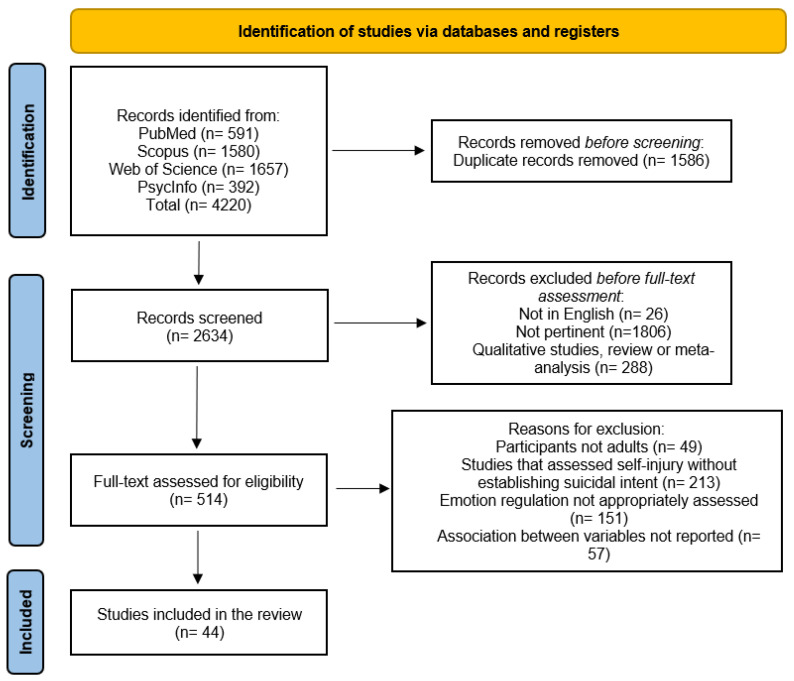
“The systematic search identified 44 original research articles [11, 28– 70 ] that assessed the relationship between emotional regulation and suicidal”
BackgroundInfluentialHaliczer, L. A., Harnedy, L. E., Oakley, M., & Dixon–Gordon, K. L. (2021) · The Journal of Primary Prevention · doi:10.1007/s10935-021-00639-y · Cited by 13 · cited 2×
“Twenty-one studies assessed nonclinical samples; eleven studies involved undergraduate students [29,32,40,47, 58,59,64,65,68,69], two studies involved community participants [28,70], and two involved prisoners [37,66].”
BackgroundA longitudinal examination of cultural risk factors of suicide and emotion regulation.
Mata-Greve, F., Johnson, M., & Blanchard, B. E. (2022) · American Journal of Orthopsychiatry · doi:10.1037/ort0000629 · Cited by 13
Childhood emotional dysregulation paths for suicide-related behaviour engagement in adolescence
de la Torre-Luque, A., Essau, C. A., Lara, E., Leal-Leturia, I., & Borges, G. (2023) · European Child & Adolescent Psychiatry · doi:10.1007/s00787-022-02111-6 · Cited by 11
Rodríguez‐Cano, R., Paulus, D. J., Derrick, J. L., Blalock, J. A., & Zvolensky, M. J. (2021) · Journal of Substance Abuse Treatment · doi:10.1016/j.jsat.2021.108508 · Cited by 7
Raudales, A. M., Carosa, C. L., Weiss, N. H., Schatten, H. T., & Armey, M. F. (2023) · Journal of Psychiatric Research · doi:10.1016/j.jpsychires.2023.03.002 · Cited by 7 · cited 7×
“…[43], psychopathy [37], cannabis-use problems [50], perfectionistic concerns and strivings [68], disrythmicity of social aspects [52,53], depressive symptoms [53], vulnerable narcissism [55], posttraumatic stress disorder [56], avoidant and anxious attachment [63], and sleep disturbances [69].”
BackgroundResultInfluentialChild abuse as a risk factor for suicide in life: a selective overview
Gianluca, S., Innamorati, M., Venturini, P., Serafini, G., Lester, D., & Girardi, P. (2011) · CINECA IRIS Institutial Research Information System (University of Genoa) · Cited by 5
Self-citationScale for Suicide Ideation: Psychometric properties of a self-report version
Beck, A. T., Steer, R. A., & Ranieri, W. F. (1988) · Journal of Clinical Psychology · doi:10.1002/1097-4679(198807)44:4<499::aid-jclp2270440404>3.0.co;2-6
Research works printed but not linked: 2
- Joiner T.E. Why People Die by Suicide Harvard University Press Cambridge, MA, USA 2005
- Linehan M.M. DBT Skills Training Manual 2nd ed. Guilford Press New York, NY, USA 2015
Cited by
Associations of adverse childhood experiences with mental health and behaviors among adolescents
Al‐Mamun, F., Habib, A. A., Abedin, M. J., ALmerab, M. M., Atroszko, P. A., & Mamun, M. A. (2025) · BMC Public Health · doi:10.1186/s12889-025-25246-y · Cited by 8
“Unlike physical abuse, which may draw more attention due to visible signs, psychological abuse often remains unrecognized and unaddressed; yet can be linked to chronic emotional dysregulation, diminished self-worth, and feelings of hopelessness, which are key factors of suicidal ideation [42].”
Camp, J., Blundell, E., Smith, P. A., & Rimes, K. A. (2025) · Archives of Sexual Behavior · doi:10.1007/s10508-025-03276-2 · Cited by 10
“…(Bud et al., 2023; Hu et al., 2014; Joormann & Stanton, 2016; Kraiss et al., 2020; Leppanen et al., 2022; Visted et al., 2018) and suicidal and non-suicidal self-injurious behaviors (Brereton & McGlinchey, 2020; Colmenero-Navarrete et al., 2022; Rogante et al., 2024; Wolff et al., 2019).”
Arqueros, M., Pérez-Díez, I., García-Ramos, A., Ayad‐Ahmed, W., Sánchez, A., & de la Torre‐Luque, A. (2025) · European Child & Adolescent Psychiatry · doi:10.1007/s00787-025-02712-x · Cited by 12
“Emotional dysregulation also significantly contributes to risk, as adolescents struggling with emotional instability are particularly vulnerable [85].”
Sarfika, R., Malini, H., Wenny, B. P., Kustanti, C. Y., Saifudin, I. M. M. Y., Putri, D. E., Wijaya, N. E., & Efendi, F. (2025) · International Journal of Mental Health Nursing · doi:10.1111/inm.70092 · Cited by 4
Furente, F., Annecchini, F., Matera, E., Serafino, S., Frigeri, G., Gabellone, A., Margari, L., & Petruzzelli, M. G. (2024) · European Journal of Investigation in Health Psychology and Education · doi:10.3390/ejihpe14120202 · Cited by 3
“…examined the associations be-tween suicide and specific emotional difficulties and maladaptive strategies in their regulation [58–63]; a recent systematic review by Rogante et al. (2024), focusing on adults, found significant positive associations between ED and SI, with less evidence for SA [64].”
Metadata
- Authors
- Rogante, E., Cifrodelli, M., Sarubbi, S., Costanza, A., Erbuto, D., Berardelli, I., & Pompili, M.
- Affiliations
- Sapienza University of Rome (IT)
- Azienda Ospedaliera Sant'Andrea (IT)
- University of Geneva (CH)
- Corresponding author
- Pompili, Maurizio
- ORCID
- Venue
- Healthcare
- Publisher
- MDPI AG
- Published
- 2024-01-10
- Volume
- 12
- Issue
- 2
- Pages
- 169
- ISSN
- 2227-9032 (ISSN-L)
- PMC
- PMC10815449
- OpenAlex
- W4390703384
- Semantic Scholar
- 82075e755f35ca2d14f235e264d6dd98d02bae77
- Cited by
- 39
- References
- 89
- Citations by year
- 2026: 16 · 2025: 21 · 2024: 2
- FWCI
- 4.62
- Type
- journal article
- Language
- en
- Open access
- gold
- doi.org
- Licence
- Locations
- Healthcare (publishedVersion, cc-by)
- PubMed (publishedVersion)
- IRIS Research product catalog (Sapienza University of Rome) (submittedVersion, cc-by)
- PubMed Central (submittedVersion, cc-by)
- Topics
- Social Sciences › Psychology › Clinical Psychology › Suicide and Self-Harm Studies
- Health Sciences › Medicine › Psychiatry and Mental health › Mental Health Treatment and Access
- Social Sciences › Psychology › Clinical Psychology › Child and Adolescent Psychosocial and Emotional Development
- Keywords
- emotional dysregulation, suicide risk, suicidal ideation, suicide attempts, emotion regulation, suicide prevention, transdiagnostic factors, mediation
About these checks
Registry, retraction, Cites and statistics results are computed, not judged, with one exception: a printed reference that no index lists is read once by a model before it counts as a citation error. Claims are extracted by a model and kept only when their quote appears verbatim in the text; each cited source is then checked, with a model’s help, for whether it says what the claim relies on. Those verdicts can be wrong — read the claim’s quote and the cited source before relying on one.
The claim verdicts this report counts are experimental: their accuracy is not yet measured.
A language model drew the claims from the paper on 2026-10-09, under version 3 of the claim definition (model deepseek-v4.1-flash, prompt extract-v3).
A second model labelled each claim on 2026-10-09 (model jev-1.13-20260917, definition revision gold-guideline-v0.2).
Cited sources are checked with a language model’s help (gpt-6-sol).
Statistics and arithmetic are recomputed, not judged.
Confidence bands are shown only for fields calibrated on our annotated test set. None is calibrated yet, so no band is shown.
What counts as a claim ›How we measure confidence ›How we check this ›
Are you an author, or do you see a problem with this page? Request a review
Data sources
Bibliographic data: Semantic Scholar, OpenAlex, Crossref.
Contains information from the Semantic Scholar Academic Graph Datasets, made available under the ODC Attribution License (ODC-BY 1.0).
Semantic Scholar’s data is described in: Kinney, R., et al. (2023). The Semantic Scholar Open Data Platform. arXiv:2301.10140.
