

Effects of Third-Wave Cognitive Behavioral Therapy for Healthcare Professionals’ Burnout: A Systematic Review and Meta-Analysis
Open accessThe DOI matches its Crossref record; 65 of the 72 references it cites were found in a registry or an index, and 2 are not checked yet; 22 of the 32 sources its claims cite were checked for support.
Abstract
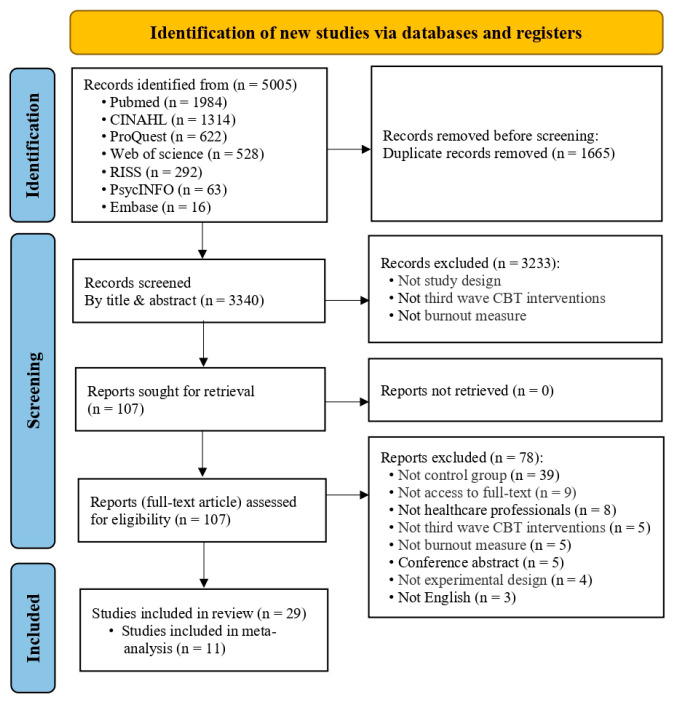
Background/Objectives: Burnout, caused by chronic workplace stress, encompasses emotional exhaustion, depersonalization, and low personal accomplishment. Over half of healthcare professionals experience burnout, leading to increased turnover. Third-wave cognitive behavioral therapies are effective in managing burnout. This study aimed to synthesize existing evidence on third-wave cognitive behavioral therapies and evaluate its effectiveness in reducing burnout among healthcare professionals. Methods: We systematically searched eight databases for studies published through May 2024. The eligible studies included randomized controlled trials and quasi-experimental designs evaluating third-wave cognitive behavioral therapies on burnout in healthcare professionals. A meta-analysis was conducted by applying fixed- and random-effects models. Results: A total of 5005 records were identified, of which 29 were reviewed and summarized, and 11 were included in the meta-analysis. Most interventions utilized mindfulness-based techniques (n = 26) with delivery methods including on-site (n = 16), online (n = 12), and hybrid (n = 1) formats. Third-wave cognitive behavioral therapies significantly reduced emotional exhaustion (standardized mean difference [SMD] = −0.686, confidence interval [CI] = −1.237, −0.136, p = 0.0145, I2 = 92.5%) and depersonalization (SMD = −0.529, CI = −0.975, −0.083, p = 0.0202, I2 = 89.3%), but the effect on low personal accomplishment was not statistically significant (SMD = 0.311, 95% CI = −0.319 to 0.941, p = 0.3338, I2 = 89.4%). Conclusions: Third-wave cognitive behavioral therapies should be implemented to reduce emotional exhaustion and depersonalization; future research should target low personal accomplishment and explore approaches beyond mindfulness.
Verified 2026-11-25 · 2 references not checked yet
Overview
CoChat Summary
## TL;DR
This systematic review and meta-analysis found that third-wave cognitive behavioral therapies, mostly mindfulness-based, significantly reduced emotional exhaustion and depersonalization in healthcare professionals. The effect on low personal accomplishment was not significant, suggesting that organizational factors likely matter for that burnout dimension.
## Key findings
- The search identified 5005 records; after screening, 29 studies were included in the review and 11 studies in the meta-analysis.
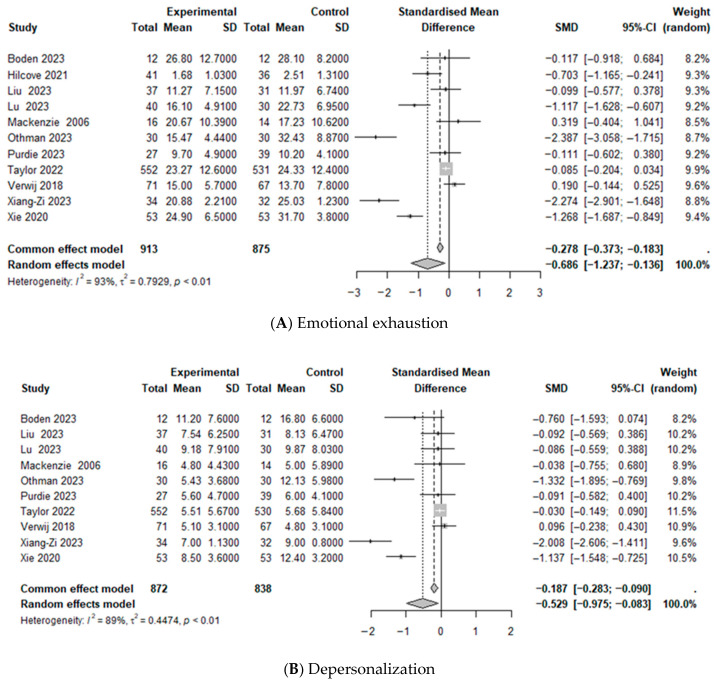
- Third-wave CBTs significantly reduced emotional exhaustion: SMD = −0.686 (95% CI −1.237 to −0.136; p = 0.0145; I² = 92.5%).
- Third-wave CBTs significantly reduced depersonalization: SMD = −0.529 (95% CI −0.975 to −0.083; p = 0.0202; I² = 89.3%).
- The effect on low personal accomplishment was not statistically significant: SMD = 0.311 (95% CI −0.319 to 0.941; p = 0.3338; I² = 89.4%).
- Most interventions were mindfulness-based: 26 of 29 studies; delivery was on-site (n = 16), online (n = 12), or hybrid (n = 1).
## Methods
- Systematic review and meta-analysis conducted according to PRISMA and registered in PROSPERO (CRD42024571625).
- Included RCTs and quasi-experimental studies of healthcare professionals in hospitals; burnout outcomes were eligible for the review, but the meta-analysis included only studies using the Maslach Burnout Inventory (MBI) for EE, DP, or PA.
- Searched eight databases through August 2024; used fixed- and random-effects models in R 4.1.1, with heterogeneity assessed using I² and risk of bias assessed with RoB 2.0 and ROBINS-I.
## Limitations
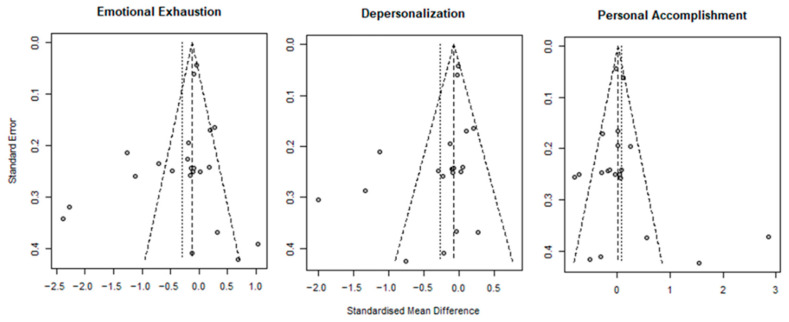
- The paper states that heterogeneity was substantial because interventions differed in duration, delivery mode, and outcome measures, and that this variability limits robustness of the pooled estimates.
- The paper states that subgroup and sensitivity analyses were not feasible because there were too few studies per subgroup to produce stable estimates.
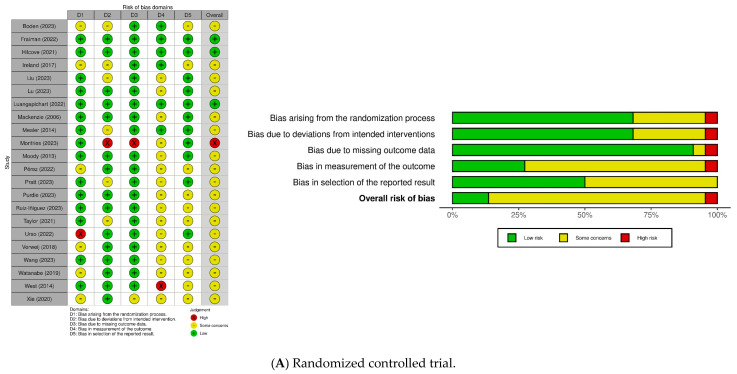
- The paper states that some included studies had risk-of-bias concerns, including moderate risk in quasi-experimental studies and issues related to blinding/allocation procedures.
- Evident from the text: the evidence base was heavily dominated by mindfulness interventions (26/29 studies), so findings for other third-wave CBT approaches are limited.
Model-written summary. Check it against the paper before relying on it.
Integrity signals
Registry
Cites
Statistics
Figures
Verification
Claims the paper makes
11 Valid · 3 Not valid · 6 Not checked · 32 Own results and interpretations
The cited sources support only part of this claim — read each source’s verdict below.
In the paper
“The COVID-19 pandemic also accelerated the adoption of digital interventions such as mindfulness-based and acceptance-based therapies [12,13], highlighting the need to evaluate these approaches specifically in HP-centered contexts.”
§ Effects of Third-Wave Cognitive Behavioral Therapy for Healthcare Professionals’ Burnout: A Systematic Review and Meta-Analysis > 1. Introduction
What the sources say
- Partly supportedcites [12] Othman S.Y. Hassan N.I. Mohamed A.M. Effectiveness of mindfulness-based interventions on burnout and self-compassion among critical care nurses caring for patients with COVID-19: A quasi-experimental study BMC Nurs. 2023 22 305 10.1186/s12912-023-01466-8 37674145 PMC10481566 sourceExperimental — accuracy not yet measured
The Discussion (page unavailable) says the study delivered mindfulness training online because classroom training was difficult for critical care nurses during COVID-19. This supports a pandemic-related move to digital delivery in this study, but not a broader acceleration in adoption or the adoption of acceptance-based therapies; teaching an attitude of acceptance is not evidence of a separate acceptance-based therapy. (LLM, conf=0.86)
- Partly supportedcites [13] Pratt E.H. Hall L. Jennings C. Olsen M.K. Jan A. Parish A. Porter L.S. Cox C.E. Mobile mindfulness for psychological distress and burnout among frontline COVID-19 nurses: A pilot randomized trial Ann. Am. Thorac. Soc. 2023 20 1475 1482 10.1513/AnnalsATS.202301-025OC 37289650 PMC10559143 sourceExperimental — accuracy not yet measured
The Methods and Discussion describe an app-delivered mindfulness intervention for frontline COVID-19 nurses. They do not establish that the pandemic accelerated adoption of digital interventions, and the paper does not address acceptance-based therapies. (LLM, conf=0.83)
plainstates a cause- Asserted: passes — The authors put it forward as true.
- Checkable: passes — It can be checked against evidence.
- Load-bearing: unclear — It is unclear whether the paper’s conclusions depend on it.
- Based: passes — The paper gives a reason why it holds.
- Partly supported
The cited sources support only part of this claim — read each source’s verdict below.
In the paper
“Despite the growing body of research on third-wave CBTs, there is a paucity of comprehensive analyses of their effectiveness, specifically for HPs experiencing burnout.”
§ Effects of Third-Wave Cognitive Behavioral Therapy for Healthcare Professionals’ Burnout: A Systematic Review and Meta-Analysis > 1. Introduction
What the sources say
- Partly supportedcites [24] Lee M. Cha C. Interventions to reduce burnout among clinical nurses: Systematic review and meta-analysis Sci. Rep. 2023 13 10971 10.1038/s41598-023-38169-8 37414811 PMC10325963 sourceExperimental — accuracy not yet measured
The Introduction says earlier reviews of burnout interventions for nurses were limited to mindfulness training and coping strategies, supporting a gap in comprehensive analyses for nurses. It does not identify a gap specifically for third-wave CBTs or for healthcare professionals generally; it notes that reviews covering healthcare professionals had already been conducted. (LLM, conf=0.85)
- Partly supportedcites [25] Wang Q. Wang F. Zhang S. Liu C. Feng Y. Chen J. Effects of a mindfulness-based interventions on stress, burnout in nurses: A systematic review and meta-analysis Front. Psychiatry 2023 14 1218340 10.3389/fpsyt.2023.1218340 37599884 PMC10434780 sourceExperimental — accuracy not yet measured
The Introduction (page unavailable) says prior reviews of mindfulness-based interventions for nurses had limited samples and did not adequately distinguish short- from long-term effects, motivating a more comprehensive review. The Discussion (page unavailable) also acknowledges existing reviews involving other healthcare professionals. These passages support a narrower gap in the evidence, but not a general paucity of comprehensive analyses of all third-wave CBTs for healthcare professionals experiencing burnout. (LLM, conf=0.84)
- Partly supportedcites [26] Selič-Zupančič P. Klemenc-Ketiš Z. Onuk Tement S. The impact of psychological interventions with elements of mindfulness on burnout and well-being in healthcare professionals: A systematic review J. Multidiscip. Healthc. 2023 16 1821 1831 10.2147/JMDH.S398552 37404957 PMC10317529 sourceExperimental — accuracy not yet measured
The Strengths and Limitations section says that, unlike reviews focused on a single profession, this review covers a heterogeneous group of healthcare professionals. That supports a gap in broad analyses of mindfulness-based interventions, but the paper does not establish a paucity of analyses of third-wave CBTs as a whole. It also notes that included studies generally did not assess participants’ baseline sensitivity to burnout, so their participants cannot all be described as experiencing burnout. (LLM, conf=0.82)
plain- Asserted: passes — The authors put it forward as true.
- Checkable: passes — It can be checked against evidence.
- Load-bearing: passes — The paper’s conclusions depend on it.
- Based: passes — The paper gives a reason why it holds.
- Partly supported
The cited sources support only part of this claim — read each source’s verdict below.
In the paper
“Third-wave cognitive behavioral therapies are effective in managing burnout.”
- Also stated in: § 1. Introduction · boosted
“Recent studies have demonstrated the positive effects of third-wave CBTs on individuals experiencing burnout or depression [20,21].”
§ Effects of Third-Wave Cognitive Behavioral Therapy for Healthcare Professionals’ Burnout: A Systematic Review and Meta-Analysis > Abstract > Abstract Background/Objectives: Burnout, caused by chronic workplace stress, encompasses emotional exhaustion, depersonalization, and low personal accomplishment. Over half of healthcare professionals experience burnout, leading to increased turnover. Third-wave cognitive behavioral therapies are effective in managing burnout. This study aimed to synthesize existing evidence on third-wave cognitive behavioral therapies and evaluate its effectiveness in reducing burnout among healthcare professionals. Methods: We systematically searched eight databases for studies published through May 2024. The eligible studies included randomized controlled trials and quasi-experimental designs evaluating third-wave cognitive behavioral therapies on burnout in healthcare professionals. A meta-analysis was conducted by applying fixed- and random-effects models. Results: A total of 5005 records were identified, of which 29 were reviewed and summarized, and 11 were included in the meta-analysis. Most interventions utilized mindfulness-based techniques (n = 26) with delivery methods including on-site (n = 16), online (n = 12), and hybrid (n = 1) formats. Third-wave cognitive behavioral therapies significantly reduced emotional exhaustion (standardized mean difference [SMD] = −0.686, confidence interval [CI] = −1.237, −0.136, p = 0.0145, I2 = 92.5%) and depersonalization (SMD = −0.529, CI = −0.975, −0.083, p = 0.0202, I2 = 89.3%), but the effect on low personal accomplishment was not statistically significant (SMD = 0.311, 95% CI = −0.319 to 0.941, p = 0.3338, I2 = 89.4%). Conclusions: Third-wave cognitive behavioral therapies should be implemented to reduce emotional exhaustion and depersonalization; future research should target low personal accomplishment and explore approaches beyond mindfulness.
What the sources say
- Could not verifycites [20] Hayes S.C. Hofmann S.G. ‘Third-wave’ cognitive and behavioral therapies and the emergence of a process-based approach to intervention in psychiatry World Psychiatry 2021 20 363 375 10.1002/wps.20884 34505370 PMC8429332 sourceExperimental — accuracy not yet measured
The “Third Wave” of CBT section discusses research on acceptance and commitment therapy and outcomes for depression and chronic pain, but does not report whether third-wave therapies manage burnout. A search for burnout and work-related stress found no passage addressing that outcome. (LLM, conf=0.76)
- Partly supportedcites [21] Towey-Swift K.D. Lauvrud C. Whittington R. Acceptance and commitment therapy (ACT) for professional staff burnout: A systematic review and narrative synthesis of controlled trials J. Ment. Health 2023 32 452 464 10.1080/09638237.2021.2022628 35105253 sourceExperimental — accuracy not yet measured
The Discussion reports moderate support for ACT reducing burnout in professional staff, and the Acceptance and commitment therapy section identifies ACT as a third-wave cognitive behavioural therapy. The claim extends that finding to third-wave therapies generally and states effectiveness more firmly than the Conclusion, which expresses cautious optimism and says evidence is insufficient to identify ACT as a treatment of choice. Page numbers were not supplied in our copy. (LLM, conf=0.90)
boostedstates a cause- Asserted: passes — The authors put it forward as true.
- Checkable: passes — It can be checked against evidence.
- Load-bearing: passes — The paper’s conclusions depend on it.
- Based: passes — The paper gives a reason why it holds.
- Also stated in: § 1. Introduction · boosted
The cited sources support only part of this claim — read each source’s verdict below.
In the paper
“Previous systematic reviews and meta-analyses have frequently focused on specific CBTs or subsets of HPs.”
§ Effects of Third-Wave Cognitive Behavioral Therapy for Healthcare Professionals’ Burnout: A Systematic Review and Meta-Analysis > 1. Introduction
What the sources say
- Partly supportedcites [24] Lee M. Cha C. Interventions to reduce burnout among clinical nurses: Systematic review and meta-analysis Sci. Rep. 2023 13 10971 10.1038/s41598-023-38169-8 37414811 PMC10325963 sourceExperimental — accuracy not yet measured
The Introduction says earlier reviews of burnout interventions were limited to mindfulness training or coping strategies, supporting the point that some focused on specific approaches. It lists cognitive behavioral therapy separately rather than identifying those approaches as CBTs. It also says some earlier reviews covered nurses specifically, while reviews of interventions included both nurses and medical doctors; the claim's generalization about subsets of healthcare professionals is therefore only partly supported. (LLM, conf=0.84)
- Partly supportedcites [25] Wang Q. Wang F. Zhang S. Liu C. Feng Y. Chen J. Effects of a mindfulness-based interventions on stress, burnout in nurses: A systematic review and meta-analysis Front. Psychiatry 2023 14 1218340 10.3389/fpsyt.2023.1218340 37599884 PMC10434780 sourceExperimental — accuracy not yet measured
The Discussion (page unavailable) describes earlier systematic reviews focused on nurses or other healthcare professionals, supporting the claim about subsets of healthcare professionals. It also describes reviews of mindfulness-based interventions, but does not characterize those reviews as focusing on specific cognitive behavioral therapies (CBTs). (LLM, conf=0.84)
- Partly supportedcites [26] Selič-Zupančič P. Klemenc-Ketiš Z. Onuk Tement S. The impact of psychological interventions with elements of mindfulness on burnout and well-being in healthcare professionals: A systematic review J. Multidiscip. Healthc. 2023 16 1821 1831 10.2147/JMDH.S398552 37404957 PMC10317529 sourceExperimental — accuracy not yet measured
The Discussion’s “Comparison to Other Studies” section (page not provided) says other reviews focused mostly on one healthcare profession, supporting the claim about subsets of healthcare professionals. The passages do not establish that previous reviews and meta-analyses frequently focused on specific CBTs. (LLM, conf=0.85)
plain- Asserted: passes — The authors put it forward as true.
- Checkable: passes — It can be checked against evidence.
- Load-bearing: passes — The paper’s conclusions depend on it.
- Based: passes — The paper gives a reason why it holds.
- Partly supported
The cited sources that could be checked couldn’t confirm or dispute this claim.
In the paper
“The Healthcare Labor Practice Framework also highlights that PA is closely tied to conditions such as workload, staffing adequacy, emotional labor demands, and autonomy [63].”
§ Effects of Third-Wave Cognitive Behavioral Therapy for Healthcare Professionals’ Burnout: A Systematic Review and Meta-Analysis > 4. Discussion
What the sources say
- Could not verifycites [63] Moldovan F. Moldovan L. Bataga T. Assessment of labor practices in healthcare using an innovatory framework for sustainability Medicina 2023 59 796 10.3390/medicina59040796 37109755 PMC10143905 sourceExperimental — accuracy not yet measured
The Materials and Methods section (2.2) discusses burnout risk and factors affecting medical staff satisfaction, but does not link personal accomplishment to workload, staffing adequacy, emotional labor demands, or autonomy. Searches for “personal accomplishment” with those conditions and with burnout and autonomy found no passage making the claimed connection. (LLM, conf=0.72)
plainstates an association- Asserted: passes — The authors put it forward as true.
- Checkable: passes — It can be checked against evidence.
- Load-bearing: passes — The paper’s conclusions depend on it.
- Based: passes — The paper gives a reason why it holds.
- Could not verify
20 more claims · 1 with their cited sources checked
Create a free account to see all 52 claims and to verify the 1 reference still open.
- Probably not a substantial claim. 19
- It may state two separate claims as one. 16
Self-check
Percentages, sums and reported differences re-computed from the paper’s own numbers.
Each contradiction between two passages listed here was confirmed by an independent check.
Rated minor: it would not touch a result — a value no result rests on, a p-value that stays on the same side of the significance level, or a conflict that is clerical, resolved elsewhere in the paper, or outside its own findings.
In the paper
§ Effects of Third-Wave Cognitive Behavioral Therapy for Healthcare Professionals’ Burnout: A Systematic Review and Meta-Analysis > 3. Results > 3.2. Intervention Characteristics
“The duration of the interventions varied between 4 weeks and 6 months”
§ Effects of Third-Wave Cognitive Behavioral Therapy for Healthcare Professionals’ Burnout: A Systematic Review and Meta-Analysis > 4. Discussion > Strengths and Limitations
“The intervention duration ranged from a minimum of 4 weeks to a maximum of 12 weeks.”
Citations
Cites
The PRISMA 2020 statement: An updated guideline for reporting systematic reviews
Page, M. J., McKenzie, J. E., Bossuyt, P. M., Boutron, I., Hoffmann, T. C., Mulrow, C. D., Shamseer, L., Tetzlaff, J. M., Akl, E. A., Brennan, S. E., et al. (2021) · BMJ · doi:10.1136/bmj.n71 · Cited by 108,283
Maslach, C., Schaufeli, W. B., & Leiter, M. P. (2001) · Annual Review of Psychology · doi:10.1146/annurev.psych.52.1.397 · Cited by 12,852 · cited 1×
“These dimensions can manifest differently with distinct antecedents and consequences [3].”
Understanding the burnout experience: Recent research and its implications for psychiatry
Maslach, C., & Leiter, M. P. (2016) · World Psychiatry · doi:10.1002/wps.20311 · Cited by 4,200 · cited 2×
“Three burnout dimensions have been identified: emotional exhaustion (EE), depersonalization (DP), and low personal accomplishment (PA) [2].”
Physician burnout: contributors, consequences and solutions
West, C. P., Dyrbye, L. N., & Shanafelt, T. D. (2018) · Journal of Internal Medicine · doi:10.1111/joim.12752 · Cited by 2,768 · cited 1×
“This results in a decline in job satisfaction, an increase in workplace turnover, and a deterioration in the quality of patient care [5,6].”
Hayes, S. C. (2004) · Behavior Therapy · doi:10.1016/s0005-7894(04)80013-3 · Cited by 2,493 · cited 2×
“A notable shift in the focus of cognitive behavior therapy (CBT) has resulted in third-wave CBT approaches, which prioritize altering psychological contexts and cognitive attitudes that precipitate psychosocial health issue development [14].”
Interventions to prevent and reduce physician burnout: a systematic review and meta-analysis
West, C. P., Dyrbye, L. N., Erwin, P. J., & Shanafelt, T. D. (2016) · The Lancet · doi:10.1016/s0140-6736(16)31279-x · Cited by 2,362
Burnout in nursing: a theoretical review.
Dall’Ora, C., Ball, J., Reinius, M., & Griffiths, P. (2020) · Human Resources for Health · doi:10.1186/s12960-020-00469-9 · Cited by 1,181 · cited 2×
“Reducing EE and DP may also contribute to improved workforce retention and lower absenteeism, ultimately benefiting healthcare providers and enhancing patient safety and care quality [9–11].”
A systematic review including meta-analysis of work environment and burnout symptoms
Aronsson, G., Theorell, T., Grape, T., Hammarström, A., Hogstedt, C., Marteinsdottir, I., Skoog, I., Träskman-Bendz, L., & Hall, C. (2017) · BMC Public Health · doi:10.1186/s12889-017-4153-7 · Cited by 789 · cited 1×
“Unlike EE or DP, PA is more strongly influenced by structural and environmental factors, including work autonomy, recognition, opportunities for professional development, and organizational culture [60,61].”
Product review: Covidence (systematic review software)
Babineau, J. (2014) · Journal of the Canadian Health Libraries Association / Journal de l'Association des bibliothèques de la santé du Canada · doi:10.5596/c14-016 · Cited by 721 · cited 2×
“Throughout the review process, two researchers independently screened the records and extracted data using Covidence (https://covidence.org) [31], which automatically flagged any conflicts between reviewers.”
West, C. P., Dyrbye, L. N., Rabatin, J. T., Call, T. G., Davidson, J. H., Multari, A., Romanski, S. A., Hellyer, J. M. H., Sloan, J. A., & Shanafelt, T. D. (2014) · JAMA Internal Medicine · doi:10.1001/jamainternmed.2013.14387 · Cited by 695 · cited 1×
“Fourteen studies were published in North America [13,33–35, 40–45 ,47 ,51 ,55 ,57], nine in Asia [37–39,49 ,50,52, 54 ,”
Prevalence of and Factors Associated With Nurse Burnout in the US
Shah, M. K., Gandrakota, N., Cimiotti, J. P., Ghose, N., Moore, M., & Ali, M. K. (2021) · JAMA Network Open · doi:10.1001/jamanetworkopen.2020.36469 · Cited by 671 · cited 2×
“Reducing EE and DP may also contribute to improved workforce retention and lower absenteeism, ultimately benefiting healthcare providers and enhancing patient safety and care quality [9–11].”
Boot, W. R., Simons, D. J., Stothart, C., & Stutts, C. (2013) · Perspectives on Psychological Science · doi:10.1177/1745691613491271 · Cited by 670 · cited 1×
“However, the limited use of active control groups may compromise the rigor of comparisons as these groups better account for placebo effects and participant expectations [65].”
A brief mindfulness-based stress reduction intervention for nurses and nurse aides
Mackenzie, C. S., Poulin, P. A., & Seidman-Carlson, R. (2006) · Applied Nursing Research · doi:10.1016/j.apnr.2005.08.002 · Cited by 448 · cited 4×
“A meta-analysis of 11 studies that evaluated EE [12,33,35,37,38,40,44,46,48,52,58] and 10 studies that measured DP and low PA [12,33,37,38,40,44,46,48,52,58] [12,33,35,37,38,40,44,46,48,52,58]; ( B ): [12,33,37,38,40,44,46,48,52,58].”
InfluentialFeasibility and Acceptability of a Resilience Training Program for Intensive Care Unit Nurses
Mealer, M., Conrad, D., Evans, J., Jooste, K., Solyntjes, J., Rothbaum, B., & Moss, M. (2014) · American Journal of Critical Care · doi:10.4037/ajcc2014747 · Cited by 316 · cited 1×
“Among the 22 RCTs, the risk of bias was rated as “some concerns” in 17 studies [13,29,36–38, 40, 41 , 43– 52”
The 2017 National Nursing Workforce Survey
Smiley, R. A., Lauer, P., Bienemy, C., Berg, J. G., Shireman, E., Reneau, K. A., & Alexander, M. (2018) · Journal of Nursing Regulation · doi:10.1016/s2155-8256(18)30131-5 · Cited by 303 · cited 1×
“This results in a decline in job satisfaction, an increase in workplace turnover, and a deterioration in the quality of patient care [5,6].”
A Systematic Review and Meta-Analysis of Burnout Among Healthcare Workers During COVID-19
Ghahramani, S., Lankarani, K. B., Yousefi, M., Heydari, K., Shahabi, S., & Azmand, S. (2021) · Frontiers in Psychiatry · doi:10.3389/fpsyt.2021.758849 · Cited by 293 · cited 1×
“Recent meta-analyses have reported that more than half of the healthcare professionals (HPs) worldwide experience burnout, with particularly high rates of EE and DP [4].”
Hayes, S. C., & Hofmann, S. G. (2021) · World Psychiatry · doi:10.1002/wps.20884 · Cited by 260 · cited 1×
“Recent studies have demonstrated the positive effects of third-wave CBTs on individuals experiencing burnout or depression [20,21].”
Lomas, T., Medina, J. C., Ivtzan, I., Rupprecht, S., & Eiroa-Orosa, F. J. (2017) · Teaching and Teacher Education · doi:10.1016/j.tate.2016.10.008 · Cited by 258 · cited 1×
“This finding aligns with previous research demonstrating the effectiveness of mindfulness interventions in HPs [59,64].”
Burnout in healthcare: the case for organisational change
Montgomery, A., Panagopoulou, E., Esmail, A., Richards, T., & Maslach, C. (2019) · BMJ · doi:10.1136/bmj.l4774 · Cited by 231 · cited 1×
“Furthermore, HPs typically work in collaboration with client care, which means that they may collectively experience burnout [28].”
Duarte, J., & Pinto-Gouveia, J. (2016) · International Journal of Nursing Studies · doi:10.1016/j.ijnurstu.2016.10.002 · Cited by 225 · cited 1×
“Of the 29 retrieved studies, 22 adopted an RCT design [13,27,33–52], whereas seven employed quasi-experimental designs [12,53–58].”
Organizational strategies to reduce physician burnout: a systematic review and meta-analysis
De Simone, S., Vargas, M., & Servillo, G. (2021) · Aging Clinical and Experimental Research · doi:10.1007/s40520-019-01368-3 · Cited by 202
Changing rational-emotive therapy (RET) to rational emotive behavior therapy (REBT)
Ellis, A. (1995) · Journal of Rational-Emotive & Cognitive-Behavior Therapy · doi:10.1007/bf02354453 · Cited by 193 · cited 1×
“These include mindfulness-based cognitive [8], acceptance and commitment (ACT) [15], rational emotional behavior [16], and dialectical behavior [17] therapies.”
Saaiq, M., & Ashraf, B. (2017) · PubMed Central · Cited by 158
Helping the Helpers: Mindfulness Training for Burnout in Pediatric Oncology—A Pilot Program
Moody, K., Kramer, D., Santizo, R. O., Magro, L., Wyshogrod, D., Ambrosio, J., Castillo, C., Lieberman, R., & Stein, J. (2013) · Journal of Pediatric Oncology Nursing · doi:10.1177/1043454213504497 · Cited by 154
Ireland, M. J., Clough, B., Gill, K., Langan, F., O'Connor, A., & Spencer, L. (2017) · Medical Teacher · doi:10.1080/0142159x.2017.1294749 · Cited by 138 · cited 1×
“Among the 22 RCTs, the risk of bias was rated as “some concerns” in 17 studies [13,29,36–38, 40, 41 , 43– 52”
Mindfulness-based stress reduction for residents: A randomized controlled trial
Verweij, H., van Ravesteijn, H., van Hooff, M. L. M., Lagro-Janssen, A. L. M., & Speckens, A. E. M. (2018) · Journal of General Internal Medicine · doi:10.1007/s11606-017-4249-x · Cited by 122 · cited 1×
“A meta-analysis of 11 studies that evaluated EE [12,33,35,37,38,40,44,46,48,52,58] and 10 studies that measured DP and low PA [12,33,37,38,40,44,46,48,52,58] [12,33,35,37,38,40,44,46,48,52,58]; ( B ): [12,33,37,38,40,44,46,48,52,58].”
Taylor, H., Cavanagh, K., Field, A. P., & Strauss, C. (2022) · JMIR mHealth and uHealth · doi:10.2196/31744 · Cited by 94 · cited 2×
“Among these, 13 studies included follow-up assessments [12,27,34,39,45,46,49–54 , 56] with”
Ong, N. Y., Teo, F. J. J., Ee, J. Z. Y., Yau, C. E., Thumboo, J., Tan, H. K., & Ng, Q. X. (2024) · General Psychiatry · doi:10.1136/gpsych-2023-101115 · Cited by 93 · cited 2×
“This finding aligns with previous research demonstrating the effectiveness of mindfulness interventions in HPs [59,64].”
Holistic nursing in practice: Mindfulness-based yoga as an intervention to manage stress and burnout
Hilcove, K., Marceau, C., Thekdi, P., Larkey, L., Brewer, M. A., & Jones, K. (2021) · Journal of Holistic Nursing · doi:10.1177/0898010120921587 · Cited by 92 · cited 2×
“A meta-analysis of 11 studies that evaluated EE [12,33,35,37,38,40,44,46,48,52,58] and 10 studies that measured DP and low PA [12,33,37,38,40,44,46,48,52,58] [12,33,35,37,38,40,44,46,48,52,58]; ( B ): [12,33,37,38,40,44,46,48,52,58].”
Wang, Q., Wang, F., Zhang, S., Liu, C., Feng, Y., & Chen, J. (2023) · Frontiers in Psychiatry · doi:10.3389/fpsyt.2023.1218340 · Cited by 89 · cited 1×
“For example, meta-analysis studies on mindfulness-based interventions for nurses [24,25] and a systematic review of mindfulness [26] were conducted to retrieve evidence for CBT for HP burnout.”
Strauss, C., Gu, J., Montero-Marin, J., Whittington, A., Chapman, C., & Kuyken, W. (2021) · International Journal of Clinical and Health Psychology · doi:10.1016/j.ijchp.2021.100227 · Cited by 88 · cited 2×
“These include mindfulness-based cognitive [8], acceptance and commitment (ACT) [15], rational emotional behavior [16], and dialectical behavior [17] therapies.”
Interventions to reduce burnout among clinical nurses: systematic review and meta-analysis
Lee, M., & Cha, C. (2023) · Scientific Reports · doi:10.1038/s41598-023-38169-8 · Cited by 84 · cited 2×
“For example, meta-analysis studies on mindfulness-based interventions for nurses [24,25] and a systematic review of mindfulness [26] were conducted to retrieve evidence for CBT for HP burnout.”
Self-citationPérez, V., Menéndez-Crispín, E. J., Sarabia-Cobo, C., de Lorena, P., Fernández-Rodríguez, A., & González-Vaca, J. (2022) · International Journal of Environmental Research and Public Health · doi:10.3390/ijerph191811441 · Cited by 77 · cited 3×
“Among these, 13 studies included follow-up assessments [12,27,34,39,45,46,49–54 , 56] with”
Are cognitive–behavioral interventions effective in reducing occupational stress among nurses?
Orly, S., Rivka, B., Rivka, E., & Dorit, S.-E. (2012) · Applied Nursing Research · doi:10.1016/j.apnr.2011.01.004 · Cited by 67 · cited 1×
“Burnout among HPs is significantly associated with suicidal ideation [7], decreased job satisfaction [8], and increased turnover intention, ultimately resulting in a loss of HPs and deterioration in the quality of care, which is also negatively affected, as is patient safety and health status…”
Kelsey, E. A., West, C. P., Cipriano, P. F., Peterson, C., Satele, D., Shanafelt, T., & Dyrbye, L. N. (2021) · AJN, American Journal of Nursing · doi:10.1097/01.naj.0000798056.73563.fa · Cited by 65
Watanabe, N., Horikoshi, M., Shinmei, I., Oe, Y., Narisawa, T., Kumachi, M., Matsuoka, Y., Hamazaki, K., & Furukawa, T. A. (2019) · Journal of Affective Disorders · doi:10.1016/j.jad.2019.03.067 · Cited by 61 · cited 1×
“Fourteen studies were published in North America [13,33–35, 40–45 ,47 ,51 ,55 ,57], nine in Asia [37–39,49 ,50,52, 54 ,”
Towey-Swift, K. D., Lauvrud, C., & Whittington, R. (2023) · Journal of Mental Health · doi:10.1080/09638237.2021.2022628 · Cited by 60
Alrashdi, D. H., Chen, K. K., Meyer, C., & Gould, R. L. (2023) · Journal of Technology in Behavioral Science · doi:10.1007/s41347-023-00321-6 · Cited by 50
Xie, C., Zeng, Y., Lv, Y., Li, X., Xiao, J., & Hu, X. (2020) · Complementary Therapies in Medicine · doi:10.1016/j.ctim.2020.102485 · Cited by 48 · cited 4×
“A meta-analysis of 11 studies that evaluated EE [12,33,35,37,38,40,44,46,48,52,58] and 10 studies that measured DP and low PA [12,33,37,38,40,44,46,48,52,58] [12,33,35,37,38,40,44,46,48,52,58]; ( B ): [12,33,37,38,40,44,46,48,52,58].”
InfluentialTransfer Learning for Facial Expression Recognition
Kumar, R., Corvisieri, G., Fici, T. F., Hussain, S. I., Tegolo, D., & Valenti, C. F. (2025) · Information · doi:10.3390/info16040320 · Cited by 46 · cited 1×
“…shown that transfer-learning approaches can substantially enhance facial-expression recognition performance, illustrating how AI-driven methods may support future advancements in detecting emotional strain and developing more tailored psychological interventions for healthcare professionals [68].”
Maas genannt Bermpohl, F., Hülsmann, L., & Martin, A. (2023) · Frontiers in Psychiatry · doi:10.3389/fpsyt.2023.1160908 · Cited by 44 · cited 1×
“The efficacy of mindfulness-based methods and ACT is well established, with significant reductions in depression and anxiety symptoms [22,23].”
Othman, S. Y., Hassan, N. I., & Mohamed, A. M. (2023) · BMC Nursing · doi:10.1186/s12912-023-01466-8 · Cited by 40 · cited 5×
“Among these, 13 studies included follow-up assessments [12,27,34,39,45,46,49–54 , 56] with”
InfluentialSelič-Zupančič, P., Klemenc-Ketiš, Z., & Onuk Tement, S. (2023) · Journal of Multidisciplinary Healthcare · doi:10.2147/jmdh.s398552 · Cited by 39
Lippke, S., Gao, L., Keller, F. M., Becker, P., & Dahmen, A. (2021) · doi:10.2196/preprints.31274 · Cited by 36
Lippke, S., Gao, L., Keller, F. M., Becker, P., & Dahmen, A. (2021) · Journal of Medical Internet Research · doi:10.2196/31274 · Cited by 36 · cited 1×
“Consistent with our findings, previous studies investigating adherence to on-site versus online interventions reported no significant differences in dropout rates [66,67].”
Effective interventions to reduce burnout in nurses: A meta-analysis
Musker, M., & Othman, S. (2024) · Complementary Therapies in Clinical Practice · doi:10.1016/j.ctcp.2023.101827 · Cited by 35
Assessment of Labor Practices in Healthcare Using an Innovatory Framework for Sustainability
Moldovan, F., Moldovan, L., & Bataga, T. (2023) · Medicina · doi:10.3390/medicina59040796 · Cited by 35 · cited 1×
“The Healthcare Labor Practice Framework also highlights that PA is closely tied to conditions such as workload, staffing adequacy, emotional labor demands, and autonomy [63].”
Fraiman, Y. S., Cheston, C. C., Cabral, H., Allen, C., Asnes, A. G., Barrett, J. T., Batra, M., Bernstein, W., Bleeker, T., Dietz, P. M., et al. (2022) · Archives of Pediatrics and Adolescent Medicine · doi:10.1001/jamapediatrics.2021.5740 · Cited by 31 · cited 1×
“Among these, 13 studies included follow-up assessments [12,27,34,39,45,46,49–54 , 56] with”
Urso, C., Laserna, A., Feng, L., Agnite, A., Jawe, N., Magoun, C., Layton, L. S., Nates, J. L., & Gutiérrez, C. (2022) · Holistic Nursing Practice · doi:10.1097/hnp.0000000000000544 · Cited by 30 · cited 1×
“Fourteen studies were published in North America [13,33–35, 40–45 ,47 ,51 ,55 ,57], nine in Asia [37–39,49 ,50,52, 54 ,”
Schefft, C., Heinitz, C., Guhn, A., Brakemeier, E., Sterzer, P., & Köhler, S. (2023) · Frontiers in Psychiatry · doi:10.3389/fpsyt.2023.1189970 · Cited by 28 · cited 1×
“The efficacy of mindfulness-based methods and ACT is well established, with significant reductions in depression and anxiety symptoms [22,23].”
Ruiz‐Íñiguez, R., Montero, A. C., Burgos-Julián, F. A., Roche, J. R. F., & Germán, M. Á. S. (2023) · Frontiers in Psychology · doi:10.3389/fpsyg.2023.1160714 · Cited by 26
Wang, Q., Luan, Y., Liu, D., Dai, J., Wang, H., Zhang, Y., Wang, S., Dong, X., & Bi, H. (2024) · International Journal of Nursing Practice · doi:10.1111/ijn.13204 · Cited by 26 · cited 2×
“Among these, 13 studies included follow-up assessments [12,27,34,39,45,46,49–54 , 56] with”
Pratt, E. H., Hall, L., Jennings, C., Olsen, M. K., Jan, A., Parish, A., Porter, L. S., & Cox, C. E. (2023) · Annals of the American Thoracic Society · doi:10.1513/annalsats.202301-025oc · Cited by 26
McNulty, D. S., LaMonica-Way, C., & Senneff, J.-A. (2022) · JONA: The Journal of Nursing Administration · doi:10.1097/nna.0000000000001137 · Cited by 22 · cited 1×
“Fourteen studies were published in North America [13,33–35, 40–45 ,47 ,51 ,55 ,57], nine in Asia [37–39,49 ,50,52, 54 ,”
FU, C.-Y., KAO, C.-C., & WANG, R.-H. (2021) · Journal of Nursing Research · doi:10.1097/jnr.0000000000000426 · Cited by 21 · cited 2×
“Among these, 13 studies included follow-up assessments [12,27,34,39,45,46,49–54 , 56] with”
Liu, L., Tian, L., Jiang, J., Zhang, Y., Chi, X., Liu, W., Zhao, Y.-H., & Sun, P. (2023) · Holistic Nursing Practice · doi:10.1097/hnp.0000000000000603 · Cited by 21 · cited 2×
“A meta-analysis of 11 studies that evaluated EE [12,33,35,37,38,40,44,46,48,52,58] and 10 studies that measured DP and low PA [12,33,37,38,40,44,46,48,52,58] [12,33,35,37,38,40,44,46,48,52,58]; ( B ): [12,33,37,38,40,44,46,48,52,58].”
A Smartphone App to Reduce Burnout in the Emergency Department: A Pilot Randomized Controlled Trial
Monfries, N., Sandhu, N., & Millar, K. R. (2022) · Workplace Health & Safety · doi:10.1177/21650799221123261 · Cited by 21
Purdie, D. R., Federman, M., Chin, A., Winston, D., Bursch, B., Olmstead, R., Bulut, Y., & Irwin, M. R. (2023) · Journal of Clinical Psychology in Medical Settings · doi:10.1007/s10880-022-09896-3 · Cited by 19 · cited 1×
“A meta-analysis of 11 studies that evaluated EE [12,33,35,37,38,40,44,46,48,52,58] and 10 studies that measured DP and low PA [12,33,37,38,40,44,46,48,52,58] [12,33,35,37,38,40,44,46,48,52,58]; ( B ): [12,33,37,38,40,44,46,48,52,58].”
Mindfulness exercises reduce death anxiety and burnout in intensive care nurses
Xiang-Zi, J., & Jia-yuan, Z. (2023) · Death Studies · doi:10.1080/07481187.2022.2113480 · Cited by 17
Lu, F., Xu, Y., Yu, Y., Zhao, R., Peng, L., Liu, B., & Li, M. (2023) · Nurse Education in Practice · doi:10.1016/j.nepr.2023.103640 · Cited by 17 · cited 3×
“A meta-analysis of 11 studies that evaluated EE [12,33,35,37,38,40,44,46,48,52,58] and 10 studies that measured DP and low PA [12,33,37,38,40,44,46,48,52,58] [12,33,35,37,38,40,44,46,48,52,58]; ( B ): [12,33,37,38,40,44,46,48,52,58].”
Boden, L. M., Rodriguez, C., Kelly, J. D., Khalsa, A. S., & Casper, D. S. (2023) · JBJS Open Access · doi:10.2106/jbjs.oa.22.00114 · Cited by 16
Luangapichart, P., Saisavoey, N., & Viravan, N. (2022) · doi:10.1101/2022.08.09.22278601 · Cited by 14
Luangapichart, P., Saisavoey, N., & Viravan, N. (2022) · Healthcare · doi:10.3390/healthcare10122532 · Cited by 14 · cited 2×
“Among these, 13 studies included follow-up assessments [12,27,34,39,45,46,49–54 , 56] with”
Beanlands, H. J., McCay, E. A., Wang, A. H., Aiello, A., Schwind, J., Martin, L. S., Mina, E. S., Rose, D. N., Fredericks, S., & Newman, K. (2020) · Canadian Journal of Nursing Research · doi:10.1177/0844562119896487 · Cited by 12 · cited 1×
“These include mindfulness-based cognitive [8], acceptance and commitment (ACT) [15], rational emotional behavior [16], and dialectical behavior [17] therapies.”
Safaeian, M., Kakavand, A., Bahrami Hidaji, M., Mohammadi Shirmahaleh, F., & Ranjbaripour, T. (2023) · Archives of Hygiene Sciences · doi:10.34172/ahs.12.2.1.417 · Cited by 2 · cited 1×
“Among these, 13 studies included follow-up assessments [12,27,34,39,45,46,49–54 , 56] with”
World Health Organization (2025, January 23). International Classification of Diseases, 11th Revision, 2024; (ICD-11): The Global Standard for Diagnostic Health Information. Available online: https://icd.who.int/browse/2024-01/mms/en#129180281.
(n.d.)
UnresolvedHayes, S.C., Strosahl, K.D., and Wilson, K.G. (2011). Acceptance and Commitment Therapy: The Process and Practice of Mindful Change, Guilford Press.
(n.d.)
UnresolvedSkinner, B.F. (1953). Science and Human Behavior, MacMillan.
(n.d.)
UnresolvedBeck, A.T. (1979). Cognitive Therapy and the Emotional Disorders, International Universities Press.
(n.d.)
UnresolvedModifying “pico” question into “picos” model for more robust and reproducible presentation of the methodology employed in a scientific study
Saaiq (2017) · World J. Plast. Surg.
UnresolvedNational Evidence-Based Healthcare Collaborating Agency (NECA) (2021). NECA Risk of Bias Assessment Tool Manual: AMSTAR 2, ROBIS, RoB 2, ROBINS-I, NECA.
(n.d.)
UnresolvedWood-Johnson, S. (2021). Does a Six-Week Online Mindfulness Intervention Affect Burnout in Registered Nurses Working in an Adult Inpatient Rehabilitation Setting During the COVID-19 Pandemic? Doctor of Nursing Practice Scholarly Project. [Ph.D. Thesis, DeSales University].
(n.d.)
Unresolved
Cited by
Mazur, J., Kosowski, M., Marciniak, J., Chołuj, D., Zarówna, K., Pura, W., Matecka, D., & Śliwiński, W. (2026) · International Journal of Innovative Technologies in Social Science · doi:10.31435/ijitss.3(51).2026.6238
Kim, Y., Cha, C., & Baek, G. (2026) · JMIR mhealth and uhealth · doi:10.2196/85986
“Beyond traditional protocol-based CBT, an expanding body of research has applied CBT-based or CBT-informed psychological interventions, including mindfulness-based approaches [11], laughter therapy [12], storytelling [13], and reflective writing [14], to address burnout-related symptoms.”
Self-citationSwain, J., Carter, D., Vando, L., & Reardon, I. (2026) · Research Square · doi:10.21203/rs.3.rs-10020276/v1
Metadata
- Authors
- Han, J.-H., Lee, M., Cha, C., & Baek, G.
- Affiliations
- Ewha Womans University (KR)
- College of Nursing, Ewha Womans University, Seoul 03760, Republic of Korea
- Corresponding author
- Baek, Gumhee
- Venue
- Healthcare
- Publisher
- MDPI AG
- Published
- 2025-12-11
- Volume
- 13
- Issue
- 24
- Pages
- 3253
- ISSN
- 2227-9032 (ISSN-L)
- PMC
- PMC12733128
- OpenAlex
- W4417244493
- Semantic Scholar
- cccdbaae236fc6c36b67c56edcbdb2fb0ecb376f
- Cited by
- 3
- References
- 69
- Citations by year
- 2026: 3
- FWCI
- 0.60
- Type
- journal article
- Language
- en
- Open access
- gold
- doi.org
- Licence
- Locations
- Healthcare (publishedVersion, cc-by)
- PubMed (publishedVersion)
- PubMed Central (publishedVersion, cc-by)
- Funders
- National Research Foundation of Korea (RS-2024-00351194)
- Topics
- Health Sciences › Health Professions › General Health Professions › Healthcare professionals’ stress and burnout
- Social Sciences › Psychology › Social Psychology › Stress and Burnout Research
- Health Sciences › Medicine › Public Health, Environmental and Occupational Health › Occupational Health and Burnout
- Keywords
- burnout, third-wave cognitive behavioral therapy, healthcare workers, emotional exhaustion, depersonalization, low personal accomplishment, mindfulness-based interventions, occupational stress
About these checks
Registry, retraction, Cites and statistics results are computed, not judged, with one exception: a printed reference that no index lists is read once by a model before it counts as a citation error. Claims are extracted by a model and kept only when their quote appears verbatim in the text; each cited source is then checked, with a model’s help, for whether it says what the claim relies on. Those verdicts can be wrong — read the claim’s quote and the cited source before relying on one.
The claim verdicts this report counts are experimental: their accuracy is not yet measured.
A language model drew the claims from the paper on 2026-10-10, under version 3 of the claim definition (model deepseek-v4.1-flash, prompt extract-v3).
A second model labelled each claim on 2026-10-10 (model jev-1.13-20260917, definition revision gold-guideline-v0.2).
Cited sources are checked with a language model’s help (gpt-6-sol).
Statistics and arithmetic are recomputed, not judged.
Confidence bands are shown only for fields calibrated on our annotated test set. None is calibrated yet, so no band is shown.
What counts as a claim ›How we measure confidence ›How we check this ›
Are you an author, or do you see a problem with this page? Request a review
Data sources
Bibliographic data: Semantic Scholar, OpenAlex, Crossref.
Contains information from the Semantic Scholar Academic Graph Datasets, made available under the ODC Attribution License (ODC-BY 1.0).
Semantic Scholar’s data is described in: Kinney, R., et al. (2023). The Semantic Scholar Open Data Platform. arXiv:2301.10140.
