

Flood Risk in Urban Areas: Modelling, Management and Adaptation to Climate Change. A Review
Open accessThe DOI matches its Crossref record; 357 of the 357 references it cites were found in a registry or an index.
Abstract
The modelling and management of flood risk in urban areas are increasingly recognized as global challenges. The complexity of these issues is a consequence of the existence of several distinct sources of risk, including not only fluvial, tidal and coastal flooding, but also exposure to urban runoff and local drainage failure, and the various management strategies that can be proposed. The high degree of vulnerability that characterizes such areas is expected to increase in the future due to the effects of climate change, the growth of the population living in cities, and urban densification. An increasing awareness of the socio-economic losses and environmental impact of urban flooding is clearly reflected in the recent expansion of the number of studies related to the modelling and management of urban flooding, sometimes within the framework of adaptation to climate change. The goal of the current paper is to provide a general review of the recent advances in flood-risk modelling and management, while also exploring future perspectives in these fields of research.
Overview
The claims and statistics of this paper haven’t been checked yet.
Free: it reads the open-access text and checks the first 5 claims that cite a source we can check. Create a free account to check every claim.
Integrity signals
Registry
Cites
Statistics
Figures
Verification
Claims the paper makes
The claims and statistics of this paper haven’t been checked yet.
Free: it reads the open-access text and checks the first 5 claims that cite a source we can check. Create a free account to check every claim.
Claims other papers make about this one
Each is checked against this paper’s own text: does it say what the citing paper says it does?
The source backs part of the claim, not all of it — or backs it for a different population, condition or comparison.
In the citing paper
“In recent years, advancements in flood vulnerability assessments have stressed the need for robust methodologies that account for non-stationary approaches and real-time data sources to address climate change and increasing extreme weather events [7].”
From Urban Flood Vulnerability Assessment in Freetown, Sierra Leone: AHP Approach (2024) · cites this paper as [7]
Experimental — accuracy not yet measured
Self-check
Percentages, sums and reported differences re-computed from the paper’s own numbers.
The self-check needs the paper’s full text.
Citations
Cites
Transforming Our World: The 2030 Agenda for Sustainable Development
(2018) · A New Era in Global Health · doi:10.1891/9780826190123.ap02 · Cited by 19,351 · cited 2×
“…legislation and global agendas, such as the Sendai Framework for Disaster Risk Reduction (2015–2030) [229], the Sustainable Development Goals [230], the Paris Climate Agreement [231], and the EU Strategy on Adaptation to Climate Change. natives originate in different regions with their own…”
Social Vulnerability to Environmental Hazards*
Cutter, S. L., Boruff, B. J., & Shirley, W. L. (2003) · Social Science Quarterly · doi:10.1111/1540-6237.8402002 · Cited by 5,702 · cited 2×
“The methodology proposed by [178] to build a social vulnerability index (SoVI) has been one of the most frequently used in the literature to quantify social vulnerability, yet there is presently a large variety of other methods and variables in use to quantify vulnerability, and some recent studies…”
MethodSendai Framework for Disaster Risk Reduction 2015-2030
(2018) · Human Rights Documents Online · doi:10.1163/2210-7975_hrd-9813-2015016 · Cited by 3,392
Future flood losses in major coastal cities
Hallegatte, S., Green, C., Nicholls, R. J., & Corfee-Morlot, J. (2013) · Nature Climate Change · doi:10.1038/nclimate1979 · Cited by 2,503
Nature-based solutions to address global societal challenges
(2016) · doi:10.2305/iucn.ch.2016.13.en · Cited by 2,064 · cited 2×
“Performance-based metrics are often based on the results of hydrological or hydraulic models and are, therefore, considered to be more precise and objective than multi-criteria index-based metrics [212].”
BackgroundKabisch, N., Frantzeskaki, N., Pauleit, S., Naumann, S., Davis, M., Artmann, M., Haase, D., Knapp, S., Korn, H., Stadler, J., et al. (2016) · Ecology and Society · doi:10.5751/es-08373-210239 · Cited by 1,490 · cited 1×
“Flood resilience is increasingly seen as a complement to existing flood ‐ risk ‐ manage ‐ ment approaches, being as it is a promising concept for dealing with the increasingly se ‐ vere consequences of climate change in general, and with increasing flood risk in particu ‐ lar [196].”
BackgroundThe science, policy and practice of nature-based solutions: An interdisciplinary perspective
Nesshöver, C., Assmuth, T., Irvine, K. N., Rusch, G. M., Waylen, K. A., Delbaere, B., Haase, D., Jones-Walters, L., Keune, H., Kovacs, E., et al. (2017) · Science of The Total Environment · doi:10.1016/j.scitotenv.2016.11.106 · Cited by 1,342 · cited 2×
“In this context, some authors argue for a deeper understanding of the hydro-ecological effects of NBSs on different scales and within a diversity of environmental conditions [235,254].”
BackgroundResilience and disaster risk reduction: an etymological journey
Alexander, D. E. (2013) · Natural Hazards and Earth System Sciences · doi:10.5194/nhess-13-2707-2013 · Cited by 1,293 · cited 1×
“Much work in the literature has been dedicated to defining resilience as a concept to use in flood management [197–200].”
BackgroundBates, P. D., Horritt, M. S., & Fewtrell, T. J. (2010) · Journal of Hydrology · doi:10.1016/j.jhydrol.2010.03.027 · Cited by 1,273
A Review of Risk Perceptions and Other Factors that Influence Flood Mitigation Behavior
Bubeck, P., Botzen, W. J. W., & Aerts, J. C. J. H. (2012) · Risk Analysis · doi:10.1111/j.1539-6924.2011.01783.x · Cited by 1,201 · cited 1×
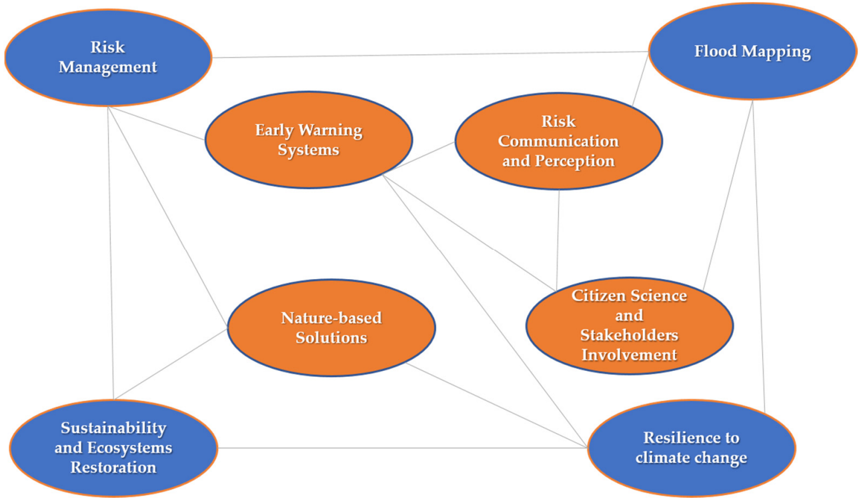
“…and the environment Natural flood management is part of this new philosophy, embracing related terms such as “making space for the river”, “ecosystem ‐ following sections, the progress in the above-mentioned trends are discussed, highlighting all potential interconnections between them (Figure 7).”
Background
Research works printed but not linked: 3
- 19. IPCC Summary for policymakers. In Climate Change 2014: Impacts, Adaptation, and Vulnerability. Part A: Global and Sectoral Aspects ; Contribution of Working Group II to the Fifth Assessment Report of the Intergovernmental Panel on Climate Change; Cambridge University Press: Cambridge, UK; New York, NY, USA, 2014.
- 54. Blad é , E.; Cea, L.; Corestein, G.; Escolano, E.; Puertas, J.; V á zquez-Cend ó n, E.; Dolz, J.; Coll, A. Iber: Herramienta de simulaci ó n num é rica del flujo en r í os. Rev. Int. Metod. Numer. Calc. Disen. Ing. 2014 , 30 , 1-10. [CrossRef]
- 19. based solutions. Sustainability 2019 , 11 , 6788. [CrossRef]
Cited by
Items 101–200 of 379
Clemens, C. R., Jobst, A. E., Radschun, M., Himmel, J., & Kanoun, O. (2024) · Measurement · doi:10.1016/j.measurement.2024.114286 · Cited by 9
Gündel, H., & Önaç, A. K. (2024) · Natural Hazards · doi:10.1007/s11069-024-06868-8 · Cited by 8
“In many practices, the flood risk approach is defined as three combinations created by hazard, vulnerability, and exposure (Cea and Costabile 2022).”
Valera, K., & Sharifi, A. (2025) · International Journal of Disaster Risk Reduction · doi:10.1016/j.ijdrr.2025.105362 · Cited by 8
Dynamic flood risk prediction in Houston: a multi-model machine learning approach
Mishra, S., Bajpai, A., Mohanta, A., Banerjee, B., Rajput, S., & Kundu, S. (2024) · Geocarto International · doi:10.1080/10106049.2024.2432866 · Cited by 8
“These geographical characteristics necessitate robust flood risk management strategies tailored to the city’s specific challenges (Cea and Costabile 2022).”
Flood Risk in Char Community: An Evidence‐Based Study in Bangladesh
Rahman, M. M., Suchi, M. N. J., Shahide, A. M. S., Hossain, M. T., Alam, E., & Islam, M. K. (2025) · Journal of Flood Risk Management · doi:10.1111/jfr3.70084 · Cited by 7
Li, S., Tang, Y., Zhao, Y., Ning, X., Zhang, Y., Lv, S., & Liu, C. (2025) · Remote Sensing Applications Society and Environment · doi:10.1016/j.rsase.2025.101742 · Cited by 7
Meliani, F., Sulistyowati, R., Sapan, E. G. A., Sumargana, L., Lestari, S., Suryanta, J., Rudiastuti, A. W., Cahyaningtiyas, I. F., Pianto, T. A., Akbar, H. I., et al. (2025) · Resources · doi:10.3390/resources14110169 · Cited by 8
Schiefer, E., & Schenk, E. R. (2024) · Hydrology · doi:10.3390/hydrology11080115 · Cited by 7
“Flood variability due to environmental and climate change is a major economic and social concern globally [41].”
BackgroundGovender, I. H., Reddy, M., & Pillay, R. P. (2025) · Sustainable development · doi:10.5772/intechopen.1008977 · Cited by 7
Ullah, I., Kovács, G., Lenner, T., & Góczán, P. (2025) · Geographies · doi:10.3390/geographies5020016 · Cited by 7
“Consequently, they can have catastrophic effects on communities, leading to loss of life and injuries while adversely affecting the economy and overall quality of life [4,5].”
Tzanou, E. A., & Skoulikaris, C. (2024) · Hydrology · doi:10.3390/hydrology11090136 · Cited by 8
Qin, H., Liang, Q., Chen, H., & Silva, D. (2024) · Journal of Hydrology · doi:10.1016/j.jhydrol.2024.131918 · Cited by 7
Halecki, W. (2024) · Forests · doi:10.3390/f15122194 · Cited by 7
Haou, M. E., Ourribane, M., Ismaili, M., Krimissa, S., & Namous, M. (2025) · Ecological Engineering & Environmental Technology · doi:10.12912/27197050/200141 · Cited by 7
Setianto, H., Utaya, S., Bachri, S., Utomo, D. H., & Taryana, D. (2025) · International Journal of Sustainable Development and Planning · doi:10.18280/ijsdp.200330 · Cited by 8
“These findings support research on the role of communities in protecting the environment at risk of flooding [6, 15, 31, 76].”
Xu, Z. Q., Xia, J., Li, Q., Feng, J., & Dong, B. (2025) · Journal of Hydrology · doi:10.1016/j.jhydrol.2025.133386 · Cited by 7
Associating reservoir operations with 2D inundation risk and climate uncertainty
Feng, Y., Zheng, R., Ma, D., & Huang, X. T. (2024) · Water Science & Technology Water Supply · doi:10.2166/ws.2024.162 · Cited by 6
Nkonu, R. S., & Antwi, M. (2024) · Environmental Development · doi:10.1016/j.envdev.2024.101061 · Cited by 6
A parallel porosity model for large-scale modelling of river floods in urban areas
Ferrari, A. (2024) · Journal of Hydrology · doi:10.1016/j.jhydrol.2024.131232 · Cited by 5
Haou, M. E., Ourribane, M., Keshavarzi, A., Ismaili, M., Eloudi, H., Hajji, S., Bouzkraoui, M. E., Namous, M., & Krimissa, S. (2025) · Modeling Earth Systems and Environment · doi:10.1007/s40808-025-02584-9 · Cited by 5
“This factors have increased both the occurrence and magnitude of flood - ing events, impacting daily life and straining municipal sanitation and stormwater drainage systems (Cea and Costabile 2022).”
Nasrollahi, F. S. F., Orton, P. M., & Montalto, F. A. (2025) · Land · doi:10.3390/land14091832 · Cited by 5
Urban flood disaster risk management using multi-criteria decision-making methods: A scoping review
Piaseckienė, G., & Antuchevičienė, J. (2025) · International Journal of Strategic Property Management · doi:10.3846/ijspm.2025.25478 · Cited by 5
“Floods driven by climate change and urbanization cause both direct and indirect impacts — from infrastructure damage and economic disruptions to negative effects on public health, education, and emergency services (Barredo et al., 2012; Cea & Costabile, 2022).”
A sustainable solution for flood and rain hazard using remote sensing & GIS: New Cairo
Abdel-Wahab, A. M., Shahin, D. S., & Ezz, H. (2023) · The Egyptian Journal of Remote Sensing and Space Science · doi:10.1016/j.ejrs.2023.10.002 · Cited by 5
Urban water management in Milan metropolitan area, a review
Sartirana, D., Zanotti, C., Rotiroti, M., Caschetto, M., Redaelli, A., Bruno, S., Fumagalli, L., Amicis, M. D., & Bonomi, T. (2024) · Acque Sotterranee-Italian Journal of Groundwater · doi:10.7343/as-2024-763 · Cited by 5
“Surface flood risk and groundwater management have been analysed globally but also at city scale (Mudd et al., 2004; Vázquez-Suñé et al., 2005; Schirmer et al., 2013; Nkwunonwo et al., 2020; Guo et al., 2021; Cea and Costabile, 2022; La Vigna, 2022).”
BackgroundNarrativas de desastres en Instagram: Cómo el foco editorial conecta con las audiencias en Chile
Ortega‐Gunckel, C., Grassau, D., & Puente, S. (2024) · Comunicación y Medios · doi:10.5354/0719-1529.2024.74294 · Cited by 5
“En un mundo cada vez más asolado por desastres socio-naturales de distintos tipos (Wamsler & Jo-hannessen, 2020), las inundaciones ilustran nues-tra vulnerabilidad ante fenómenos que trascienden fronteras y desafían nuestra cotidianidad y resi-liencia (Cea & Costabile, 2022).”
Flood inundation and hazard mapping using the HEC-RAS 2D model: a case study of Adoori River, Iran
Darijani, Z., Ghaeini‐Hessaroeyeh, M., & Fadaei-Kermani, E. (2025) · Modeling Earth Systems and Environment · doi:10.1007/s40808-024-02280-0 · Cited by 5
“(Cea and Costabile 2022; Naghibi et al. 2020).”
Besarra, I., Opdyke, A., Mendoza, J. E., Delmendo, P. A., Santiago, J. T., Evangelista, D. J., & Lagmay, A. M. F. (2025) · Journal of Environmental Management · doi:10.1016/j.jenvman.2025.124966 · Cited by 5
Hu, G., Zhang, Y., Chen, C., Shen, Z., Hu, Y., Yin, H., Shao, Z., Zheng, H. Q., & Chen, F. (2025) · Landscape and Ecological Engineering · doi:10.1007/s11355-025-00670-9 · Cited by 5
“The combined effects of climate change, such as rising sea levels, increased frequency of extreme rainfall events, and storm surges, exacerbate flood risk in coastal cities, where populations and assets are heavily concentrated (Cea and Costabile 2022; Laino and Iglesias 2023).”
Yoon, K. S., Rehman, K., Yoo, H. J., Lee, S. O., & Hong, S.-H. (2022) · Water · doi:10.3390/w14091446 · Cited by 5
Yang, S.-Y., Hsu, S. M., Hsiao, C., & Chang, C.-H. (2022) · Natural Hazards · doi:10.1007/s11069-022-05784-z · Cited by 5
“Considering the availability and spatial resolution of topographic data currently obtained using light detection and ranging (LiDAR) and the computational performance of most 2D overland flow solvers, the 1D–2D model can be applied to many practical fields (Cea and Costabile 2022).”
BackgroundInfluentialGIS AND AHP-BASED FLOOD ZONING AND CONSERVATION STRATEGIES IN THE TARUSAN WATERSHED, INDONESIA
Barlian, E., Umar, I., Dewata, I., Triyatno, T., Putra, A., Mustikasari, E., Purnamaningtyas, S. E., Hendrajat, E. A., Sari, S. M., Yulius, Y., et al. (2025) · Geographia Technica · doi:10.21163/gt_2025.202.08 · Cited by 4
Impact of Different Building Roof Types on Hydrological Processes at the Urban Community Scale
Chen, C., Hou, H., Shi, Y., Zhao, P., Li, Y., Wang, Y., Zhang, Y., & Hu, T. (2025) · Hydrology · doi:10.3390/hydrology12060154 · Cited by 4
Khaldi, L., Elabed, A., & Khanchoufi, A. E. (2025) · Scientific African · doi:10.1016/j.sciaf.2025.e02834 · Cited by 6
Haghshenas, S. S., Astarita, V., Haghshenas, S. S., Guido, G., & Martino, G. (2025) · International Conference on Control, Decision and Information Technologies (CoDIT) · doi:10.1109/codit66093.2025.11321672 · Cited by 4
“Moreover, the integration of climate risk assessments in urban planning documents can prevent buildings from being constructed in high-risk areas and promote sustainable land use practices [10], [11].”
امانی, خ., & Hosseini, S. M. (2026) · International Journal of Disaster Risk Reduction · doi:10.1016/j.ijdrr.2026.106019 · Cited by 4
Puspitasari, D., Hizbaron, D. R., & Mei, E. T. W. (2026) · Jàmbá Journal of Disaster Risk Studies · doi:10.4102/jamba.v18i1.1873 · Cited by 4
“…are employed, but these methods entail comprehensive and detailed information, such as river cross sections, soil infiltration rates and meteorological records, which creates problems in meeting data requirements for the modelling (Cea & Costabile 2022; Costabile & Macchione 2015; Dewan 2013).”
Comprehensive Framework for the Assessment of Multi‐Level Pluvial Flood Risk
Truu, M., Annus, I., & Kändler, N. (2026) · Journal of Flood Risk Management · doi:10.1111/jfr3.70193 · Cited by 4
“Urban areas worldwide are faced with increasing threats from pluvial flooding, which are exacerbated by climate change and rapid urbanisation (Cea and Costabile 2022; Dordi et al. 2022; Executive Office of Energy and Environmental Affairs 2024).”
InfluentialFrimpong, R. A., Adjei-Yeboah, S., Bohat, N., Sunkari, E. D., Hemans, I. A., & Afandi, G. E. (2026) · Journal of African Earth Sciences · doi:10.1016/j.jafrearsci.2026.106148 · Cited by 4
Nature-Based Solutions for Sustainable Flood Management: A Comprehensive Analysis
Murtaza, N., Rezzoug, A., Pasha, G. A., Almutairi, O. E., & Akbar, Z. (2026) · Water Resources Management · doi:10.1007/s11269-026-04649-5 · Cited by 5
Innovative steel modular housing system for multiple natural hazard mitigation
Sarno, L. D., & Forgione, R. (2024) · International Journal of Disaster Risk Reduction · doi:10.1016/j.ijdrr.2024.104734 · Cited by 5
Design and optimisation of automated hydraulic gate control systems for flood control
Lako, A., & Barko, O. (2024) · Naukovij žurnal «Tehnìka ta energetika» · doi:10.31548/machinery/4.2024.58 · Cited by 4
The Impact of a Clay-Core Embankment Dam Break on the Flood Wave Characteristics
Ionescu, C. S., Nistoran, D. E. G., Baciu, C. A., Cozma, A., Motovilnic, I., & Brașovanu, L. (2025) · Hydrology · doi:10.3390/hydrology12030056 · Cited by 4
Cao, S., Ji, W., & Dongping, F. (2025) · Journal of Management in Engineering · doi:10.1061/jmenea.meeng-6618 · Cited by 4
Kim, S., Sung, K., Shin, J., & Heo, J. (2025) · Water · doi:10.3390/w17152213 · Cited by 4
DEM Generation Incorporating River Channels in Data-Scarce Contexts: The “Fluvial Domain Method”
Villanueva, J. R. E., Pérez, J., & Nardini, A. (2025) · Hydrology · doi:10.3390/hydrology12020033 · Cited by 5
Modelling and Mapping Rapid-Onset Coastal Flooding: A Systematic Literature Review
Re, A., Minola, L., & Pezzoli, A. (2025) · Water · doi:10.3390/w17040599 · Cited by 4
Semi-probabilistic methods for existing concrete structures under climate change: Review
Casti, L., Schmidt, F., Biondini, F., & Makhoul, N. (2025) · Structure and Infrastructure Engineering · doi:10.1080/15732479.2025.2474691 · Cited by 4
“…adaptation strategies with respect to extreme events, e.g. hurricanes (Bjarnadottir et al., 2011; Lee & Ellingwood, 2017; Li et al., 2016), tsunamis (Alhamid et al., 2022; Nazarnia et al., 2020; Sep � ulveda et al., 2021), and floods (Bhatkoti et al., 2016; Cea & Costabile, 2022; Kim et al., 2017).”
Adeyemi, A. B., Komolafe, A. A., Nakalembe, C., Ismaila, R. O., Adebayo, A. D., & Babayemi, O. E. (2024) · Research Square · doi:10.21203/rs.3.rs-4863685/v1 · Cited by 5
Lambu, P., & Duvvuru, R. (2024) · IEEE International Conference on Green Industrial Electronics and Sustainable Technologies (GIEST) · doi:10.1109/giest62955.2024.10959940 · Cited by 3
“Current technologies are limited in flood situations, highlighting the need for offline, durable systems that can deliver accurate location information even in severe conditions [3].”
InfluentialFarkoushi, M. G., Lee, J., Hong, S., & Sohn, H. (2025) · International Journal of Disaster Risk Reduction · doi:10.1016/j.ijdrr.2025.105655 · Cited by 3
Abass, K., Dumedah, G., Dramani, A., Ofosu, A., Guodaar, L., Nyaaba, E., Segbefia, A. Y., Afriyie, K., Asiedu, H. B., Appiah, G., et al. (2025) · Geographical Journal · doi:10.1111/geoj.70036 · Cited by 3
Impact of Grated Inlet Clogging on Urban Pluvial Flooding
Russo, B., Beiró, V., Julián, P. L. L., & Oliete, A. A. (2025) · Hydrology · doi:10.3390/hydrology12090231 · Cited by 3
Lee, Y., & Hong, C. (2025) · Urban Science · doi:10.3390/urbansci9110474 · Cited by 3
Alkaddour, A. M., Shadoud, M. A., Hashemi, M., Mahmoud, F., Hammad, M., Youssef, Y. M., & Mucsi, L. (2026) · DYSONA – Applied Science · doi:10.30493/das.2025.514366 · Cited by 6
Synthetic Sewer Networks for Pluvial Flood Assessment in Urban Areas: A Data Gap Filling Methodology
de la Cruz-Coronas, À., & Russo, B. (2025) · Hydrological Processes · doi:10.1002/hyp.70365 · Cited by 3
“…of this, the field of urban flood modelling has received growing attention over the last decades, to the point that nowadays there is a wide number of reliable methodologies and tools to assess their occurrence and severity (Cea and Costabile 2022; Hammond et al. 2015; Mignot and Dewals 2022).”
Ahmad, A. A., Said, M. Z., Gapor, S. A., Jamru, L. R., Jubit, N. A., Najib, S. A. M., Masron, T., Ariffin, N. A., & Zakaria, Y. S. (2026) · Forum Geografi · doi:10.23917/forgeo.10133 · Cited by 4
Papakonstantinou, G. F. D. (2026) · Geographies · doi:10.3390/geographies6010026 · Cited by 3
Effect of building representation on pluvial flood risk in urban areas: the Podoniftis basin, Greece
Alexopoulos, M. J., Dimitriadis, P., Mitsi, E., Koutsoyiannis, D., Istrati, D., & Iliopoulou, T. (2026) · Frontiers in Built Environment · doi:10.3389/fbuil.2026.1757749 · Cited by 3
Khoso, W. A., Rehman, M. A. U., Waseem, M., Asghar, Z., & Baig, F. (2026) · Applied Water Science · doi:10.1007/s13201-026-02916-9 · Cited by 3
“The high vulnerability that char - acterizes such areas will increase in future because of the effects of climate change (Cea and Costabile 2022).”
A tracer‐aided 2D numerical framework to define fluvial and pluvial hazard mapping
Perrini, P., Iacobellis, V., Gioia, A., & Cea, L. (2024) · Journal of Flood Risk Management · doi:10.1111/jfr3.13039 · Cited by 4
“…using the Rain-On-Grid (RoG) approach (also known as Direct Rainfall Approach) have increasingly been preferred, as noted in the recent literature (Cea et al., 2022; Costabile et al., 2023; David et al., 2023; David & Schmalz, 2020; García-Alén et al., 2022; Godara et al., 2023; Perrini et al.,…”
Self-citationClimate Smart Computing: A Perspective
Yang, M., Jayaprakash, B., Ghosh, S., Jung, H. T., Eagon, M., Northrop, W. F., & Shekhar, S. (2024) · Pervasive and Mobile Computing · doi:10.1016/j.pmcj.2025.102019 · Cited by 6
Yang, J., & Jung, K. (2025) · Environmental Research Communications · doi:10.1088/2515-7620/adca96 · Cited by 3
Roggero, M., Brill, F., & Tügel, F. (2025) · International Journal of Disaster Risk Reduction · doi:10.1016/j.ijdrr.2025.105721 · Cited by 3
Chang, Y.-S., Wu, K.-J., & Ho, H. (2025) · Urban Climate · doi:10.1016/j.uclim.2025.102637 · Cited by 3
Reinforcement Failing guides the discovery of emergent physical dynamics in adaptive tumor therapy
Aif, S., Eiche, M., Appold, N., Fischer, E., Citak, T., & Kayser, J. (2026) · npj Artificial Intelligence · doi:10.1038/s44387-026-00157-4 · Cited by 3
“In climate resilience, for instance, coastal fl ooding management often relies on low-fi delity models to optimize infrastructure planning 60 ; using GRAPE to evaluate these plans against high-fi delity hydrodynamic simulations would identify which speci fi c physical factors, such as local turbulence…”
Debone, D., Tavella, R. A., Colombo, A. L., Gales, A. C., Júnior, F. M. R. D. S., & Miraglia, S. G. E. K. (2025) · Anthropocene Science · doi:10.1007/s44177-025-00099-7 · Cited by 3
“Proactive measures, such as expanding urban drainage capacity, stabilizing slopes prone to landslides, and enforcing land-use plans that prevent settlements in floodplains, are crucial (Cea and Costabile 2022; Wang et al. 2023).”
InfluentialSimulation of flood associated with extreme rainfall events over the urban city, Bengaluru, India
Purwar, S., Mohapatra, G. N., & Rakesh, V. (2026) · Natural Hazards · doi:10.1007/s11069-026-08042-8 · Cited by 3
Near Real-Time Flood Inundation Prediction Using Sentinel-1 Imagery and Deep Learning
Mohamadiazar, N., Ebrahimian, A., & Hosseiny, H. (2024) · World Environmental and Water Resources Congress (EWRI) · doi:10.1061/9780784485477.073 · Cited by 4
A Tale of Two Storms: Inter‐Storm Variability of Stable Water Isotopes in a Solute Transport Model
Grande, E., Moreno, B. K. D., & Moran, J. E. (2024) · Hydrological Processes · doi:10.1002/hyp.15338 · Cited by 2
“Key to flood prediction, adaptation and mitigation under these conditions is knowledge of contributing water sources and timing of flows in streams and areas susceptible to flooding (Cea and Costabile 2022).”
A High-Resolution DEM-Based Method for Tracking Urban Pluvial–Fluvial Floods
Liang, Y., Liao, W., & Wang, H. (2025) · Remote Sensing · doi:10.3390/rs17071225 · Cited by 3
Overview of Flood Concepts: Present Perspective and Future Direction
Pandey, S., & Swarnkar, S. (2025) · Springer eBooks · doi:10.1007/978-3-031-82559-0_18 · Cited by 4
Ramzan, M. A., Alias, N. E., Yusop, Z., & Sai’di, Z. (2025) · IOP Conference Series Earth and Environmental Science · doi:10.1088/1755-1315/1505/1/012017 · Cited by 2
Flood regulation as a multivariate challenge in the Anthropocene: a systematic modeling approach
Zheng, K., & Lin, P. (2025) · Environmental Research Letters · doi:10.1088/1748-9326/ae08ce · Cited by 2
Dale, J. E., Dorosin, S., Constantine, J. A., & Masteller, C. C. (2026) · Hydrology and earth system sciences · doi:10.5194/hess-30-2183-2026 · Cited by 3
Evaluating the combined impact of climate change and urbanization patterns on flood risks
Ali, S. S., Shah, A. A., Ahmed, F., Isha, S., Hussain, Q., Yamoat, N., & Yanghaipol, P. (2025) · Engineering Research Express · doi:10.1088/2631-8695/ae1084 · Cited by 2
Zhang, L., Jiao, S., & Lü, J. (2025) · Environment Development and Sustainability · doi:10.1007/s10668-025-06868-z · Cited by 2
“Traditional flood control and drainage models focus on built-up areas and rely on engineering measures, such as drainage networks and rigid levees, to promote the rapid discharge of accumulated water (Cea & Costabile, 2022).”
Policy framework for water sensitivity in the secondary cities of India: visions and options
Kansal, M. L., & Bose, S. (2025) · Water Policy · doi:10.2166/wp.2025.063 · Cited by 2
Scour evolution for steady and unsteady flow conditions downstream of Type A piano key weirs
Panthi, M., Crookston, B. M., & Palermo, M. (2026) · Journal of Hydrology and Hydromechanics · doi:10.2478/johh-2026-0003 · Cited by 2
“Risks associated with scour are generally increasing in part due to climate shifts evidenced by increasing storm duration and intensities and flood-drought cycles (Bermúdez et al., 2021; Cea and Costabile, 2022; Wasko et al., 2021).”
Evaluación del riesgo de inundación: estado actual y perspectivas futuras en España
López, P. M., de la Cruz-Coronas, À., Russo, B., & Bladé, E. (2026) · Ingeniería del agua · doi:10.4995/ia.24696 · Cited by 2
de la Cruz-Coronas, À., Russo, B., Pacho-Gómez, S., & Yubero, D. (2026) · Sustainability · doi:10.3390/su18094530 · Cited by 2
Nong, M., Konishi, T., Kumagae, T., AMAGUCHI, H., & Imamura, Y. (2026) · Water · doi:10.3390/w18101152 · Cited by 2
A high-resolution framework for urban pluvial flood risk mapping
Vogelbacher, A., von Szombathely, M., Lennartz, M., Poschlod, B., & Sillmann, J. (2026) · Natural hazards and earth system sciences · doi:10.5194/nhess-26-2765-2026 · Cited by 2
“To ensure transparency and facilitate open-source data replication, all models created using the Model Builder were also exported as Python scripts, allowing users to run or modify them outside the ArcGIS environment.”
Uca, U., Lamada, M., Nyompa, S., & Haris, N. A. (2022) · Forum geografic · doi:10.5775/fg.2022.105.d · Cited by 2
Zhang, Y., Tügel, F., Han, H., Hou, J., & Hinkelmann, R. (2023) · Urban Water Journal · doi:10.1080/1573062x.2023.2209061 · Cited by 2
“Therefore, rainfall-runoff simulations are becoming increasingly important not only for flood protection and management (Barbero et al. 2022; Cea and Costabile 2022) but also for urban drainage and the implementation of LID (low impact development) measures (Hua et al. 2020; Rentachintala, Reddy,…”
BackgroundExtending the Design Life of the Palm Jumeirah Revetment Considering Climate Change Effects
Elkersh, K., Atabay, S., Yilmaz, A. G., Morad, Y., & Nouar, N. (2023) · Hydrology · doi:10.3390/hydrology10050111 · Cited by 2
Description of Artificial Intelligence Models in Sustainable Water Resource Management
Guzman, L. A., Ortiz, J. A., & Liceaga-Ortiz-De-La-Peña, J. M. (2023) · Advances in finance, accounting, and economics book series · doi:10.4018/979-8-3693-0373-3.ch012 · Cited by 2
GIS-integrated pluvial flood risk assessment methodology for urban areas
Truu, M., Annus, I., & Kändler, N. (2022) · Water Distribution Systems Analysis Conference (WDSA) · doi:10.4995/wdsa-ccwi2022.2022.14144 · Cited by 2
Molina, J. T., Arantes, C. C., Murry, B. A., Veselka, W., & Anderson, J. T. (2024) · Ecological Indicators · doi:10.1016/j.ecolind.2024.112523 · Cited by 2
Urban Vulnerability Assessment of Sea Level Rise in Singapore through the World Avatar
Phua, S. Z., Lee, K. F., Tsai, Y., Ganguly, S., Yan, J., Mosbach, S., Ng, T., Moise, A. F., Horton, B. P., & Kraft, M. (2024) · Applied Sciences · doi:10.3390/app14177815 · Cited by 3
Aghajanloo, K., & Almalou, H. F. (2024) · Tamāshāgarān. · doi:10.61186/jwmr.15.2.32 · Cited by 2
Worku, G., & Adugna, D. (2025) · American Journal of Applied Scientific Research · doi:10.11648/j.ajasr.20251101.14 · Cited by 2
“…frequently impede the development of comprehensive flood protection measures in urban resilience literature, particularly in Lagos, Nigeria [74-77] conducted comparative studies in New Orleans, USA, demonstrating that the implementation of sturdy flood protection systems, such as levees…”
A Deeper Look into Flood Risk in the City of Bari (Italy)
Totaro, V., Santoro, S., Bruno, M. F., Iacobellis, V., Molfetta, M. G., & Fratino, U. (2025) · Lecture notes in computer science · doi:10.1007/978-3-031-97648-3_8 · Cited by 2
Kapecki, T., Gibała-Kapecka, B., & Ozga, A. (2025) · Sustainability · doi:10.3390/su17209201 · Cited by 4
Flood damage assessment for the Phan-Ca Lo River basin in Vinh Phuc Province, Vietnam
Phan, H. M., Chau, T. K., & Vu, H. T. M. (2024) · Journal of Water and Climate Change · doi:10.2166/wcc.2024.036 · Cited by 2
Yusri, N. A. M., Yogarayan, S., Razak, A., Abdullah, M. F. A., & Azman, A. (2025) · Lecture notes in electrical engineering · doi:10.1007/978-981-97-4780-1_5 · Cited by 1
Geomorphic flood index 2.0: enhanced tools for delineating flood-prone areas in data-scarce regions
Manfreda, S., Navarro, J. S., Albertini, C., Zhuang, R., Pacia, F. D., Chaturvedi, S., & Samela, C. (2026) · CATENA · doi:10.1016/j.catena.2026.110242 · Cited by 1
Leshchenko, N., Dorokhina, H., Busel, A., & Shyrokobokova, M. (2025) · Budownictwo i Architektura · doi:10.35784/bud-arch.6381 · Cited by 1
“Additionally, studies by Spanish and Italian researchers on modelling and managing flood risks in urban areas [20], British researchers on the implementation of Blue-Green flood risk management strategies [21], Chinese researchers on sustainable urban planning for coastal flood risk control [22],…”
Singh, A., Mansfield, H., Pregnolato, M., & Wright, N. (2025) · Journal of Flood Risk Management · doi:10.1111/jfr3.70067 · Cited by 1
Kim, H., & Keum, H.-J. (2025) · Journal of Flood Risk Management · doi:10.1111/jfr3.70092 · Cited by 1
Lee, J., Kim, M., Cho, Y., & Park, J.-B. (2025) · Water · doi:10.3390/w17162455 · Cited by 1
Metadata
- Authors
- Cea, L., & Costabile, P.
- Affiliations
- Universidade da Coruña (ES)
- University of Calabria (IT)
- Corresponding author
- Cea, Luís
- Costabile, Pierfranco
- Venue
- Hydrology
- Publisher
- MDPI AG
- Published
- 2022-03-18
- Volume
- 9
- Issue
- 3
- Pages
- 50
- ISSN
- 2306-5338 (ISSN-L)
- OpenAlex
- W4220807507
- Cited by
- 317
- References
- 357
- Citations by year
- 2026: 101 · 2025: 94 · 2024: 75 · 2023: 33 · 2022: 14
- FWCI
- 21.52
- Type
- journal article
- Language
- en
- Open access
- gold
- doi.org
- Licence
- Locations
- Hydrology (publishedVersion, cc-by)
- DOAJ (DOAJ: Directory of Open Access Journals) (submittedVersion)
- Archive of Doctoral Theses and Digital Collections (University of Calabria) (submittedVersion, cc-by)
- RUC (Universidade Da Coruña) (submittedVersion, cc-by)
- Topics
- Physical Sciences › Environmental Science › Global and Planetary Change › Flood Risk Assessment and Management
- Physical Sciences › Environmental Science › Environmental Engineering › Urban Stormwater Management Solutions
- Physical Sciences › Environmental Science › Water Science and Technology › Hydrology and Watershed Management Studies
- Keywords
- urban flooding, flood risk modelling, flood risk management, climate change adaptation, urban runoff, drainage failure, coastal flooding, tidal flooding, urban densification, socio-economic losses
About these checks
Registry, retraction, Cites and statistics results are computed, not judged, with one exception: a printed reference that no index lists is read once by a model before it counts as a citation error. Claims are extracted by a model and kept only when their quote appears verbatim in the text; each cited source is then checked, with a model’s help, for whether it says what the claim relies on. Those verdicts can be wrong — read the claim’s quote and the cited source before relying on one.
Statistics and arithmetic are recomputed, not judged.
Confidence bands are shown only for fields calibrated on our annotated test set. None is calibrated yet, so no band is shown.
What counts as a claim ›How we measure confidence ›How we check this ›
Are you an author, or do you see a problem with this page? Request a review
Data sources
Bibliographic data: Semantic Scholar, OpenAlex, Crossref.
Contains information from the Semantic Scholar Academic Graph Datasets, made available under the ODC Attribution License (ODC-BY 1.0).
Semantic Scholar’s data is described in: Kinney, R., et al. (2023). The Semantic Scholar Open Data Platform. arXiv:2301.10140.
