

Flood Risk in Urban Areas: Modelling, Management and Adaptation to Climate Change. A Review
Open accessThe DOI matches its Crossref record; 357 of the 357 references it cites were found in a registry or an index.
Abstract
The modelling and management of flood risk in urban areas are increasingly recognized as global challenges. The complexity of these issues is a consequence of the existence of several distinct sources of risk, including not only fluvial, tidal and coastal flooding, but also exposure to urban runoff and local drainage failure, and the various management strategies that can be proposed. The high degree of vulnerability that characterizes such areas is expected to increase in the future due to the effects of climate change, the growth of the population living in cities, and urban densification. An increasing awareness of the socio-economic losses and environmental impact of urban flooding is clearly reflected in the recent expansion of the number of studies related to the modelling and management of urban flooding, sometimes within the framework of adaptation to climate change. The goal of the current paper is to provide a general review of the recent advances in flood-risk modelling and management, while also exploring future perspectives in these fields of research.
Overview
The claims and statistics of this paper haven’t been checked yet.
Free: it reads the open-access text and checks the first 5 claims that cite a source we can check. Create a free account to check every claim.
Integrity signals
Registry
Cites
Statistics
Figures
Verification
Claims the paper makes
The claims and statistics of this paper haven’t been checked yet.
Free: it reads the open-access text and checks the first 5 claims that cite a source we can check. Create a free account to check every claim.
Claims other papers make about this one
Each is checked against this paper’s own text: does it say what the citing paper says it does?
The source backs part of the claim, not all of it — or backs it for a different population, condition or comparison.
In the citing paper
“In recent years, advancements in flood vulnerability assessments have stressed the need for robust methodologies that account for non-stationary approaches and real-time data sources to address climate change and increasing extreme weather events [7].”
From Urban Flood Vulnerability Assessment in Freetown, Sierra Leone: AHP Approach (2024) · cites this paper as [7]
Experimental — accuracy not yet measured
Self-check
Percentages, sums and reported differences re-computed from the paper’s own numbers.
The self-check needs the paper’s full text.
Citations
Cites
Transforming Our World: The 2030 Agenda for Sustainable Development
(2018) · A New Era in Global Health · doi:10.1891/9780826190123.ap02 · Cited by 19,351 · cited 2×
“…legislation and global agendas, such as the Sendai Framework for Disaster Risk Reduction (2015–2030) [229], the Sustainable Development Goals [230], the Paris Climate Agreement [231], and the EU Strategy on Adaptation to Climate Change. natives originate in different regions with their own…”
Social Vulnerability to Environmental Hazards*
Cutter, S. L., Boruff, B. J., & Shirley, W. L. (2003) · Social Science Quarterly · doi:10.1111/1540-6237.8402002 · Cited by 5,702 · cited 2×
“The methodology proposed by [178] to build a social vulnerability index (SoVI) has been one of the most frequently used in the literature to quantify social vulnerability, yet there is presently a large variety of other methods and variables in use to quantify vulnerability, and some recent studies…”
MethodSendai Framework for Disaster Risk Reduction 2015-2030
(2018) · Human Rights Documents Online · doi:10.1163/2210-7975_hrd-9813-2015016 · Cited by 3,392
Future flood losses in major coastal cities
Hallegatte, S., Green, C., Nicholls, R. J., & Corfee-Morlot, J. (2013) · Nature Climate Change · doi:10.1038/nclimate1979 · Cited by 2,503
Nature-based solutions to address global societal challenges
(2016) · doi:10.2305/iucn.ch.2016.13.en · Cited by 2,064 · cited 2×
“Performance-based metrics are often based on the results of hydrological or hydraulic models and are, therefore, considered to be more precise and objective than multi-criteria index-based metrics [212].”
BackgroundKabisch, N., Frantzeskaki, N., Pauleit, S., Naumann, S., Davis, M., Artmann, M., Haase, D., Knapp, S., Korn, H., Stadler, J., et al. (2016) · Ecology and Society · doi:10.5751/es-08373-210239 · Cited by 1,490 · cited 1×
“Flood resilience is increasingly seen as a complement to existing flood ‐ risk ‐ manage ‐ ment approaches, being as it is a promising concept for dealing with the increasingly se ‐ vere consequences of climate change in general, and with increasing flood risk in particu ‐ lar [196].”
BackgroundThe science, policy and practice of nature-based solutions: An interdisciplinary perspective
Nesshöver, C., Assmuth, T., Irvine, K. N., Rusch, G. M., Waylen, K. A., Delbaere, B., Haase, D., Jones-Walters, L., Keune, H., Kovacs, E., et al. (2017) · Science of The Total Environment · doi:10.1016/j.scitotenv.2016.11.106 · Cited by 1,342 · cited 2×
“In this context, some authors argue for a deeper understanding of the hydro-ecological effects of NBSs on different scales and within a diversity of environmental conditions [235,254].”
BackgroundResilience and disaster risk reduction: an etymological journey
Alexander, D. E. (2013) · Natural Hazards and Earth System Sciences · doi:10.5194/nhess-13-2707-2013 · Cited by 1,293 · cited 1×
“Much work in the literature has been dedicated to defining resilience as a concept to use in flood management [197–200].”
BackgroundBates, P. D., Horritt, M. S., & Fewtrell, T. J. (2010) · Journal of Hydrology · doi:10.1016/j.jhydrol.2010.03.027 · Cited by 1,273
A Review of Risk Perceptions and Other Factors that Influence Flood Mitigation Behavior
Bubeck, P., Botzen, W. J. W., & Aerts, J. C. J. H. (2012) · Risk Analysis · doi:10.1111/j.1539-6924.2011.01783.x · Cited by 1,201 · cited 1×
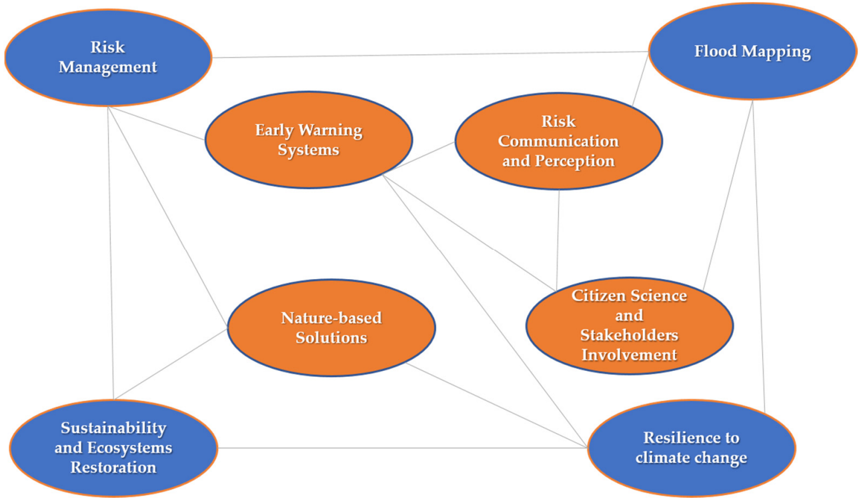
“…and the environment Natural flood management is part of this new philosophy, embracing related terms such as “making space for the river”, “ecosystem ‐ following sections, the progress in the above-mentioned trends are discussed, highlighting all potential interconnections between them (Figure 7).”
Background
Research works printed but not linked: 3
- 19. IPCC Summary for policymakers. In Climate Change 2014: Impacts, Adaptation, and Vulnerability. Part A: Global and Sectoral Aspects ; Contribution of Working Group II to the Fifth Assessment Report of the Intergovernmental Panel on Climate Change; Cambridge University Press: Cambridge, UK; New York, NY, USA, 2014.
- 54. Blad é , E.; Cea, L.; Corestein, G.; Escolano, E.; Puertas, J.; V á zquez-Cend ó n, E.; Dolz, J.; Coll, A. Iber: Herramienta de simulaci ó n num é rica del flujo en r í os. Rev. Int. Metod. Numer. Calc. Disen. Ing. 2014 , 30 , 1-10. [CrossRef]
- 19. based solutions. Sustainability 2019 , 11 , 6788. [CrossRef]
Cited by
Comprehensive Overview of Flood Modeling Approaches: A Review of Recent Advances
Kumar, V., Sharma, K., Caloiero, T., Mehta, D., & Singh, K. (2023) · Hydrology · doi:10.3390/hydrology10070141 · Cited by 251
“Describe the study area—Determine the research area’s borders, taking special note of the river or watershed of interest;”
BackgroundAdapting cities to the surge: A comprehensive review of climate-induced urban flooding
Dharmarathne, G., Waduge, A. O., Bogahawaththa, M., Rathnayake, U., & Meddage, D. P. P. (2024) · Results in Engineering · doi:10.1016/j.rineng.2024.102123 · Cited by 234
Quantitative flood hazard assessment methods: A review
Maranzoni, A., D'Oria, M., & Rizzo, C. (2023) · Journal of Flood Risk Management · doi:10.1111/jfr3.12855 · Cited by 183
“Despite recent valuable efforts to provide critical reviews on various aspects of flood risk modelling (e.g., Cea & Costabile, 2022; Moreira et al., 2021), a comprehensive review on quantitative flood hazard assessment methods is still missing in the literature.”
do Lago, C. A. F., Giacomoni, M. H., Bentivoglio, R., Taormina, R., Júnior, M. N. G., & Mendiondo, E. M. (2023) · Journal of Hydrology · doi:10.1016/j.jhydrol.2023.129276 · Cited by 97
Tabasi, N., Fereshtehpour, M., & Roghani, B. (2025) · Discover Water · doi:10.1007/s43832-025-00193-2 · Cited by 90
“Among various natural hazards, flood hazards are particularly notorious for their devastating effects, and their occurrence has become increasingly frequent in recent decades [1–5].”
Costabile, P., Costanzo, C., Kalogiros, J. A., & Bellos, V. (2023) · Water Resources Research · doi:10.1029/2023wr034599 · Cited by 84
“…F (m/s) represents the hydrologic loss in terms of infiltration rate, D is the term related to the effects of the urban drainage system, that can be modeled in different ways depending on both the availability of detailed data and the specific purposes of the study (Cea & Costabile, 2022).”
BackgroundSelf-citationFlood modeling and fluvial dynamics: A scoping review on the role of sediment transport
Hamidifar, H., Nones, M., & Rowiński, P. M. (2024) · Earth-Science Reviews · doi:10.1016/j.earscirev.2024.104775 · Cited by 92
El-Bagoury, H., & Gad, A. M. (2024) · Water · doi:10.3390/w16020356 · Cited by 80
Coletta, V. R., Pagano, A., Zimmermann, N., Davies, M., Butler, A. P., Fratino, U., Giordano, R., & Pluchinotta, I. (2024) · Journal of Hydrology · doi:10.1016/j.jhydrol.2024.131248 · Cited by 85
Edamo, M. L., Ukumo, T. Y., Lohani, T. K., Ayana, M. T., Ayele, M. A., Mada, Z. M., & Abdi, D. M. (2022) · Environmental Challenges · doi:10.1016/j.envc.2022.100629 · Cited by 75
Zeng, B., Huang, G., & Chen, W. (2024) · Environmental Modelling & Software · doi:10.1016/j.envsoft.2024.106213 · Cited by 76
A new approach for urban flood risk assessment using coupled SWMM–HEC-RAS-2D model
Khatooni, K., Hooshyaripor, F., Malekmohammadi, B., & Noori, R. (2025) · Journal of Environmental Management · doi:10.1016/j.jenvman.2024.123849 · Cited by 56
Asghari, F., Piadeh, F., Egyir, D., Yousefi, H., Rizzuto, J. P., Campos, L. C., & Behzadian, K. (2023) · Sustainability · doi:10.3390/su151411151 · Cited by 55
“These components are then assessed The “S-FRESI” during and after is sensitivity and sensitivity measures the degree of susceptibility of urban systems and populations to flooding, and adaptive capacity assesses the ability of cities to recover from floods and build resilience for the future [29].”
BackgroundGeospatial modelling of floods: a literature review
Avila-Aceves, E., Plata-Rocha, W., Monjardín-Armenta, S. A., & Rangel‐Peraza, J. G. (2023) · Stochastic Environmental Research and Risk Assessment · doi:10.1007/s00477-023-02505-1 · Cited by 47
Sañudo, E., García-Feal, O., Hagen, L., Cea, L., Puertas, J., Montalvo, C., Alvarado-Vicencio, R., & Hofmann, J. (2024) · Journal of Hydrology · doi:10.1016/j.jhydrol.2024.132603 · Cited by 42
Self-citationCea, L., Álvarez, M., & Puertas, J. (2022) · Journal of Hydrology Regional Studies · doi:10.1016/j.ejrh.2022.101247 · Cited by 44
Self-citationNile, B. K., Al-Saadi, R. J. M., Abdulameer, L., Maimuri, N. M. L. A., & Al-Dujaili, A. N. (2025) · Water Conservation Science and Engineering · doi:10.1007/s41101-025-00375-y · Cited by 48
Zha, X., Fang, W., Zhu, W. Y., Wang, S., Mu, Y., Wang, X., Luo, P., Zainol, M. R. R. M. A., Zawawi, M. H., Chong, K. L., et al. (2024) · Journal of Hydrology · doi:10.1016/j.jhydrol.2024.131189 · Cited by 37
Thapa, S., Sinclair, H. D., Creed, M., Borthwick, A. G. L., Watson, C. S., & Muthusamy, M. (2024) · Water Resources Research · doi:10.1029/2024wr037742 · Cited by 40
“In turn, embankments can significantly increase the rate of geomorphic change, with greater local erosion and sediment transport occurring during high flows (Cea & Costabile, 2022; McCann, 2013) and sedimentation at locations with low flow conditions.”
Lisetskii, F., & Buryak, Z. A. (2023) · Water · doi:10.3390/w15132443 · Cited by 36
NPCC4: Climate change and New York City's flood risk
Rosenzweig, B., Montalto, F. A., Orton, P., Kaatz, J., Maher, N., Kleyman, J., Chen, Z., Sanderson, E., Adhikari, N., McPhearson, T., et al. (2024) · Annals of the New York Academy of Sciences · doi:10.1111/nyas.15175 · Cited by 33
Flood susceptibility mapping in the Bilate catchment, Ethiopia
Edamo, M. L., Bushira, K. M., & Ukumo, T. Y. (2022) · H2Open Journal · doi:10.2166/h2oj.2022.128 · Cited by 33
Bagheri, A., & Liu, G.-J. (2024) · Environmental Reviews · doi:10.1139/er-2024-0065 · Cited by 28
Flood Risk Assessment and Mapping: A Case Study from Australia’s Hawkesbury-Nepean Catchment
Kelly, M., Schwarz, I., Ziegelaar, M., Watkins, A., & Kuleshov, Y. (2023) · Hydrology · doi:10.3390/hydrology10020026 · Cited by 33
Deep learning rapid flood risk predictions for climate resilience planning
Yosri, A., Ghaith, M., & El-Dakhakhni, W. W. (2024) · Journal of Hydrology · doi:10.1016/j.jhydrol.2024.130817 · Cited by 31
Lazzarin, T., Defina, A., & Viero, D. P. (2023) · Geosciences · doi:10.3390/geosciences13040112 · Cited by 27
Urban flood dilemmas: How European cities growth shapes flood risk and resilience strategies?
Halecki, W., & Młyński, D. (2025) · Journal of Environmental Management · doi:10.1016/j.jenvman.2025.124161 · Cited by 30
A review of flash‐floods management: From hydrological modeling to crisis management
Sadkou, S., Artigue, G., Frealle, N., Ayral, P.-A., Pistre, S., Sauvagnargues, S., & Johannet, A. (2024) · Journal of Flood Risk Management · doi:10.1111/jfr3.12999 · Cited by 29
Sawaneh, I. A., Fan, L., & Sesay, B. (2024) · Nature-Based Solutions · doi:10.1016/j.nbsj.2024.100143 · Cited by 28
Husein, M., Takele, T., Diriba, D., & Karuppannan, S. (2025) · Environmental and Sustainability Indicators · doi:10.1016/j.indic.2025.100920 · Cited by 31
ADAPTING A DIGITAL TWIN TO ENABLE REAL-TIME WATER SENSITIVE URBAN DESIGN DECISION-MAKING
Langenheim, N., Sabri, S., Chen, Y., Kesmanis, A., Felson, A. J., Mueller, A., Rajabifard, A., & Zhang, Y. (2022) · The international archives of the photogrammetry, remote sensing and spatial information sciences/International archives of the photogrammetry, remote sensing and spatial information sciences · doi:10.5194/isprs-archives-xlviii-4-w4-2022-95-2022 · Cited by 23
Mapping current and future flood exposure using a 5 m flood model and climate change projections
Darlington, C., Raikes, J., Henstra, D., Thistlethwaite, J., & Raven, E. K. (2024) · Natural hazards and earth system sciences · doi:10.5194/nhess-24-699-2024 · Cited by 25
“…flooding under different climate scenarios vary considerably in existing scholarship, and the quality and granularity of local and regional flood maps are also highly variable (Cea & Costabile, 2022; Costabile et al., 2015; de Moel et al., 2009; Henstra et al., 2019; Mudashiru et al., 2021).”
BackgroundInfluentialShu, X., Ye, C., Xu, Z., Liao, R., & Zhang, S. (2025) · International Journal of Disaster Risk Reduction · doi:10.1016/j.ijdrr.2025.105332 · Cited by 21
Urban flood modelling: Challenges and opportunities - A stakeholder-informed analysis
Mahmood, M. Q., Wang, X., Aziz, F., & Doğulu, N. (2025) · Environmental Modelling & Software · doi:10.1016/j.envsoft.2025.106507 · Cited by 26
Flood Modelling and Risk Analysis of Cinan Feizuo Flood Protection Area, Huaihe River Basin
Farooq, U., Taha, A. T. B., Tian, F., Yuan, X., Ajmal, M., Ullah, I., & Ahmad, M. (2023) · Atmosphere · doi:10.3390/atmos14040678 · Cited by 22
Bellos, V., Costanzo, C., Kalogiros, J. A., Ahmadian, R., Rozos, E., & Costabile, P. (2024) · Water Resources Management · doi:10.1007/s11269-024-03988-5 · Cited by 22
“The aforementioned framework is a promising approach for enhancing the accuracy and efficiency of early warning systems (Cea and Costabile 2022 ; Costabile et al. 2023 ; Najafi et al. 2024 ).”
Self-citationGüven, D. S., Yenigün, K., Işınkaralar, Ö., & Işınkaralar, K. (2024) · Natural Hazards · doi:10.1007/s11069-024-06945-y · Cited by 20
“…struggling with extreme events and several disasters, and it has been observed that climate change has steadily increased hazards such as storms, tornadoes, drought, floods, and forest fires in urban areas (Jahangir et al. 2019; Andor et al. 2020 ; Cea and Costabile 2022 ; Isinkaralar et al. 2023).”
Aureli, F., Maranzoni, A., & Petaccia, G. (2024) · Water · doi:10.3390/w16081093 · Cited by 20
Lombardo, M., Totaro, V., Chiaravalloti, F., & Petrucci, O. (2025) · International Journal of Disaster Risk Reduction · doi:10.1016/j.ijdrr.2025.105419 · Cited by 20
Jaimes-Correa, J. C., Muñoz‐Arriola, F., & Bartelt‐Hunt, S. L. (2022) · Hydrology · doi:10.3390/hydrology9050080 · Cited by 19
High-Resolution 2D Modelling for Simulating and Improving the Management of Border Irrigation
Costabile, P., Costanzo, C., Gangi, F., Gaetani, C. I. D., Rossi, L., Gandolfi, C., & Masseroni, D. (2022) · Agricultural Water Management · doi:10.1016/j.agwat.2022.108042 · Cited by 19
Self-citationSaha, G., Kabir, M. N., Islam, M. S., Khandaker, A., & Chowdhury, P. (2024) · Arabian Journal of Geosciences · doi:10.1007/s12517-024-11907-6 · Cited by 19
Ahmad, D., & Afzal, M. (2024) · Environment Development and Sustainability · doi:10.1007/s10668-024-04674-7 · Cited by 23
“…al., 2021; Alcántara-Ayala et al., 2022; Khayyam & Munir, 2022; Yaseen et al., 2023), flood hazards effects on urban region (Bodoque et al., 2016; Cea & Costabile, 2022; Dou et al., 2018; Du et al., 2015; Gigović et al., 2017; Johann & Leismann, 2017; Liu et al., 2021; Matsa & Mupepi, 2022; Park…”
Zwirglmaier, V., & Garschagen, M. (2024) · Urban Climate · doi:10.1016/j.uclim.2024.102034 · Cited by 19
How suitable are current approaches to simulate flood risk under future urbanization trends?
Zwirglmaier, V., Reimuth, A., & Garschagen, M. (2024) · Environmental Research Letters · doi:10.1088/1748-9326/ad536f · Cited by 18
Sofi, M. S., Rautela, K. S., Muslim, M., & Bhat, S. U. (2024) · Frontiers of Urban and Rural Planning · doi:10.1007/s44243-024-00036-z · Cited by 20
“This necessitates regular revaluation of flood risk in these areas (Cea & Costabile, 2022).”
Fathi, M. M., Liu, Z., Fernandes, A. M., Hren, M. T., Terry, D. O., Nataraj, C., & Smith, V. (2024) · Environmental Modelling & Software · doi:10.1016/j.envsoft.2024.106307 · Cited by 19
Ghomash, S. K. B., Apel, H., & Caviedes‐Voullième, D. (2024) · Natural hazards and earth system sciences · doi:10.5194/nhess-24-2857-2024 · Cited by 28
Mondal, K., Ghosh, M., & Karmakar, S. (2025) · Sustainable Cities and Society · doi:10.1016/j.scs.2025.106279 · Cited by 16
Janeka, P., Foellmer, J., Martínez, J. A., Schrammeijer, E. A., Hertig, E., van Rompay, T. J. L., Cerrone, D., Sawungrana, A., & Anthonj, C. (2025) · Wellbeing Space and Society · doi:10.1016/j.wss.2025.100304 · Cited by 16
Bouramdane, A.-A. (2023) · Information System and Smart City · doi:10.59400/issc.v3i1.190 · Cited by 16
“⚫ Water Scarcity or Flooding and Drainage Issues : Changes in precipitation patterns ( Figure 4 ) [1] can lead to water scarcity in some regions [27,28] , or flooding and drainage issues [29,30] in other regions, affecting water supply, sanitation [31,32] , and agriculture [33,34] .”
BackgroundTsujimoto, R., Fukuda, T., & Yabuki, N. (2024) · Environmental Modelling & Software · doi:10.1016/j.envsoft.2024.106054 · Cited by 17
A novel urban flood risk assessment framework based on refined numerical simulation technology
Zhu, W. Y., Cao, Z., Kawaike, K., Luo, P., YAMANOI, K., & Koshiba, T. (2024) · Journal of Hydrology · doi:10.1016/j.jhydrol.2024.132152 · Cited by 17
Social vulnerability correlates of flood risk to crops and buildings
Asl, S. R., Rahman, A., Tate, E. C., Lehman, W. P., & Wing, O. E. J. (2025) · Natural Hazards · doi:10.1007/s11069-025-07137-y · Cited by 18
“However, direct economic loss only partially reflects social vulnerability (Cea & Costabile 2022), given its positive relationship with asset values and the manifestation of social vulnerability and the manifestation of social vulnerability in indirect and intangible impacts (Merz et al. 2010).”
Cartwright, J. H., Shammi, S. A., & Rodgers, J. (2022) · Water · doi:10.3390/w14121923 · Cited by 15
Doulabian, S., Tousi, E. G., Toosi, A. S., & Alaghmand, S. (2023) · Hydrology · doi:10.3390/hydrology10060117 · Cited by 15
Improving pluvial flood mapping resolution of large coarse models with deep learning
do Lago, C. A. F., Brasil, J. A. T., Júnior, M. N. G., Mendiondo, E. M., & Giacomoni, M. H. (2024) · Hydrological Sciences Journal · doi:10.1080/02626667.2024.2329268 · Cited by 16
“Two-dimensional (2D) hydrodynamic models are the most effective tool for predicting urban pluvial flooding (Bulti and Abebe 2020, Cea and Costabile 2022).”
MethodArtificial Intelligence Algorithms in Flood Prediction: A General Overview
Pandey, M. K. (2024) · Springer eBooks · doi:10.1007/978-3-031-51053-3_12 · Cited by 20
Future Climate Extremes in Bangladesh: Insights from a Multi-Model Ensemble of CMIP6 Simulations
Nazrul, F. B., Karim, M. R., Pavan, W., & Kamruzzaman, M. (2025) · Earth Systems and Environment · doi:10.1007/s41748-025-00681-4 · Cited by 17
Zhong, H., Zhang, B., Ma, T., Qi, X., Wang, X., shang, H., Qu, S., & Fang, W. (2022) · Water · doi:10.3390/w14233873 · Cited by 14
Large‐scale physical facility and experimental dataset for the validation of urban drainage models
Sañudo, E., Cea, L., Puertas, J., Naves, J., & Anta, J. (2024) · Hydrological Processes · doi:10.1002/hyp.15068 · Cited by 14
“In many cases the drainage networks of cities are obsolete, deficient, or have low levels of retrofit and maintenance that can lead to human and material losses as a result of urban flooding and environmental pollution (Cea & Costabile, 2022).”
BackgroundSelf-citationGambo, J., Roslan, S. N. A., Shafri, H. Z. M., ́Ya, N. N. C., Yusuf, Y. A., & Ang, Y. (2023) · International Journal of Disaster Risk Reduction · doi:10.1016/j.ijdrr.2024.104400 · Cited by 18
Progress and landscape of disaster science: Insights from computational analyses
Yazdani, M., Loosemore, M., Mojtahedi, M., Sanderson, D., & Haghani, M. (2024) · International Journal of Disaster Risk Reduction · doi:10.1016/j.ijdrr.2024.104536 · Cited by 16
Machine learning-based rainfall forecasting in real-time optimal operation of urban drainage systems
Aderyani, F. R., & Mousavi, S. J. (2024) · Journal of Hydrology · doi:10.1016/j.jhydrol.2024.132118 · Cited by 20
A meta-review of disaster research
Waseem, H. B., & Rana, I. A. (2025) · Natural Hazards · doi:10.1007/s11069-025-07296-y · Cited by 16
“…rapid reviews (Lee et al. 2023; Ullah et al. 2024), policy reviews (Berg 2020; Canosa et al. 2023), critical reviews (Salvador et al. 2023; Salcedo-Sanz et al. 2024), state-of-the-art reviews (Elnagar et al. 2023; Waseem and Rana 2023), and general reviews (Luo et al. 2016; Cea and Costabile 2022).”
Dell’Oca, A., Guadagnini, A., & Riva, M. (2023) · Journal of Environmental Management · doi:10.1016/j.jenvman.2023.118466 · Cited by 14
1D-2D hydrodynamic and sediment transport modelling using MIKE models
Pareta, K. (2024) · Discover Water · doi:10.1007/s43832-024-00130-9 · Cited by 16
Tsikas, P. K., Chassiakos, A. P., & Papadimitropoulos, V. C. (2025) · Sustainability · doi:10.3390/su17177687 · Cited by 13
Huang, C.-C., & Wang, C.-L. (2024) · Journal of Water and Climate Change · doi:10.2166/wcc.2024.125 · Cited by 12
Rasool, U., Yin, X., Xu, Z., Rasool, M. A., Hussain, M., Siddique, J., & Hai, N. T. (2025) · Journal of Hydrology · doi:10.1016/j.jhydrol.2025.132905 · Cited by 12
Mukherjee, S., Kar, S., Bhattacharyya, T., & Feitelson, E. I. (2025) · Frontiers in Water · doi:10.3389/frwa.2025.1574309 · Cited by 13
Alexopoulos, M. J., Iliopoulou, T., Modé, P. D., Istrati, D., Spyrakos, C. C., Soile, S., Verykokou, S., Ioannidis, C., & Koutsoyiannis, D. (2025) · The Science of The Total Environment · doi:10.1016/j.scitotenv.2025.180256 · Cited by 12
Kumar, P., Perez, K. C., Biswal, A., Sun, H., Dwivedi, A. K., Hama, S. M. L., Khalili, S., Ahlawat, A., Andrade, M. D. F., Alves, R. A., et al. (2025) · The Innovation · doi:10.1016/j.xinn.2025.101184 · Cited by 28
“284 Steep walls and high flood defenses designed to reduce risk will also reduce direct accessibility for the public, along with the visual connection of the public with these natural features.”
Mapping the Social, Economic, and Ecological Impact of Floods in Brisbane
Hou, Y., Wei, Y., Wu, S., & Li, J. (2023) · Water · doi:10.3390/w15213842 · Cited by 15
Debnath, J., Sahariah, D., Meraj, G., Chand, K., Singh, S. K., Kanga, S., & Kumar, P. (2024) · Physics and Chemistry of the Earth Parts A/B/C · doi:10.1016/j.pce.2024.103772 · Cited by 12
Pham, V. T., Do, A. N. T., & Do, T. A. T. (2025) · Advances in Space Research · doi:10.1016/j.asr.2025.06.028 · Cited by 11
Artificial intelligence evaluation of nature based flood resilience in hilly terrain
Mabrouk, A., Inam, I., Qureshi, M. Z., Ali, T., Murtaza, N., Ouda, M. M., Al-Naghi, A. A. A., & Cruz, D. M. T. (2025) · Scientific Reports · doi:10.1038/s41598-025-19629-9 · Cited by 13
“The integration of these diverse strategies, supported by dynamic flood modeling and a focus on socio-economic and environmental impacts, is essential for developing effective flood risk management plans in hilly urban areas 34,35 .”
Pirone, D., Padulano, R., & Giudice, G. D. (2026) · Journal of Flood Risk Management · doi:10.1111/jfr3.70184 · Cited by 11
Role of Multifunctional Water Reservoirs in the Upper Vistula Basin in Reducing Flood Risk
Woś, K., Radoń, R., Tekielak, T., Wrzosek, K., Pieron, Ł., & Piorecki, M. (2022) · Water · doi:10.3390/w14244025 · Cited by 11
Urban Flood Vulnerability Assessment in Freetown, Sierra Leone: AHP Approach
Koroma, A. O., Saber, M., & Abdelbaki, C. (2024) · Hydrology · doi:10.3390/hydrology11100158 · Cited by 10
A comprehensive review of flood monitoring and evaluation in Nigeria
Babati, A.-H., Abdussalam, A. F., Baba, S. U., Isa, Z., & Ugya, A. Y. (2025) · International Journal of Energy and Water Resources · doi:10.1007/s42108-025-00356-w · Cited by 10
“There is a lack of comprehensive and centralized flood data repositories, making it difficult to analyze trends over time (Cea & Costabile, 2022; Haltas et al., 2021).”
Multi-fidelity graph neural networks for efficient and accurate flood hazard mapping
Taghizadeh, M., Zandsalimi, Z., Shafiee‐Jood, M., & Alemazkoor, N. (2025) · Environmental Modelling & Software · doi:10.1016/j.envsoft.2025.106654 · Cited by 12
Application of machine learning for coastal flooding
Babati, A.-H., Isa, Z., Abdussalam, A. F., Baba, S. U., Baba, B. M., & Musa, A. S. (2025) · Discover Cities · doi:10.1007/s44327-025-00125-8 · Cited by 12
“…understanding coastal flooding, their limitations relating to data requirements, computational demands, simplifying assumptions, real-time data integration, calibration and validation challenges, as well as scalability issues, make it necessary to embrace advanced integrated approaches [70, 71].”
Hong, C., & Tanaka, K. (2023) · Sustainability · doi:10.3390/su151813587 · Cited by 10
Vatyukova, O. Y., Klikunova, A., Vasilchenko, A. A., Voronin, A., Khoperskov, A. V., & Kharitonov, M. (2023) · Computation · doi:10.3390/computation11080150 · Cited by 10
Gong, Y., Geng, X., Wang, P., Hu, S., & Wang, X. (2024) · Land · doi:10.3390/land13091374 · Cited by 9
Integrating social vulnerability to flood risk assessment in Metro Manila
Dulawan, J. M. T., Imamura, Y., & AMAGUCHI, H. (2024) · River · doi:10.1002/rvr2.108 · Cited by 9
“Despite recent advancements in Flood Risk Assessment (FRA), a recent review indicated that most studies, particularly in rapidly urbanizing areas, have predominantly focused on hazard analysis through hydrological and hydraulic modeling (Cea & Costabile, 2022).”
Jung, K., Yoo, J., Shin, S., Kim, J., & Min, I. (2025) · Journal of Environmental Management · doi:10.1016/j.jenvman.2025.124526 · Cited by 10
Mulu, A., Kassa, S. B., Wossene, M. L., Meshesha, T. M., Fenta, A. A., & Hailu, Y. B. (2025) · Discover Water · doi:10.1007/s43832-025-00216-y · Cited by 10
Bao, Z., Wu, Y., He, W., She, N., & Li, Z. (2025) · Applied Sciences · doi:10.3390/app152111577 · Cited by 9
Gitundu, D. T., Gathenya, J. M., Raude, J. M., Sang, J., & Ngugi, H. N. (2023) · Remote Sensing Applications Society and Environment · doi:10.1016/j.rsase.2023.100977 · Cited by 9
Fatone, F., Szeląg, B., Kowal, P., McGarity, A. E., Kiczko, A., Wałek, G., Wojciechowska, E., Stachura, M., & Caradot, N. (2023) · Hydrology and earth system sciences · doi:10.5194/hess-27-3329-2023 · Cited by 9
Cloud Modelling of Property-Level Flood Exposure in Megacities
Iliadis, C., Glenis, V., & Kilsby, C. G. (2023) · Water · doi:10.3390/w15193395 · Cited by 9
Forti, L., Pelfini, M., Sissakian, V. K., & Zerboni, A. (2023) · Anthropocene · doi:10.1016/j.ancene.2023.100413 · Cited by 9
“(Chin, 2006; Hooke, 2006; Gurnell et al., 2007; Benito and Hudson, 2010; Hunter et al., 2007; Bathrellos et al., 2016; Braud et al., 2016; Link et al., 2019; Bahrawi et al., 2020; Nkwunonwo et al., 2020; Cea and Costabile, 2022).”
BackgroundTran, V. N., & Kim, J. (2024) · Environmental Modelling & Software · doi:10.1016/j.envsoft.2024.106132 · Cited by 10
Multi-GPU parallelization of shallow water modelling on unstructured meshes
Dong, B., Huang, B., Tan, C., Xia, J., Lin, K., Gao, S., & Hu, Y. (2025) · Journal of Hydrology · doi:10.1016/j.jhydrol.2025.133105 · Cited by 10
Ruan, X., Sun, H. X., Yu, Q., Shou, W., & Wang, J. (2025) · Sustainability · doi:10.3390/su17125622 · Cited by 8
Haou, M. E., Ourribane, M., Ismaili, M., Abdelrahman, K. S., Fnais, M. S., Krimissa, S., Eloudi, H., Hajji, S., Bouzkraoui, M. E., Tarchi, F., et al. (2025) · Frontiers in Environmental Science · doi:10.3389/fenvs.2025.1585926 · Cited by 8
Das, A. (2025) · Green Technology Resilience and Sustainability · doi:10.1007/s44173-025-00025-5 · Cited by 8
“The application of the technologies of remote sensing in this study also reflects the contemporarily algorithm of the evaluation of water resources and flood hazard in urban territories [43].”
Integrating remote sensing and machine learning for flood modelling: A systematic literature review
Manyaka, N., Shoko, C., Gxokwe, S., & Dube, T. J. (2026) · Physics and Chemistry of the Earth Parts A/B/C · doi:10.1016/j.pce.2026.104315 · Cited by 11
Metadata
- Authors
- Cea, L., & Costabile, P.
- Affiliations
- Universidade da Coruña (ES)
- University of Calabria (IT)
- Corresponding author
- Cea, Luís
- Costabile, Pierfranco
- Venue
- Hydrology
- Publisher
- MDPI AG
- Published
- 2022-03-18
- Volume
- 9
- Issue
- 3
- Pages
- 50
- ISSN
- 2306-5338 (ISSN-L)
- OpenAlex
- W4220807507
- Cited by
- 317
- References
- 357
- Citations by year
- 2026: 101 · 2025: 94 · 2024: 75 · 2023: 33 · 2022: 14
- FWCI
- 21.52
- Type
- journal article
- Language
- en
- Open access
- gold
- doi.org
- Licence
- Locations
- Hydrology (publishedVersion, cc-by)
- DOAJ (DOAJ: Directory of Open Access Journals) (submittedVersion)
- Archive of Doctoral Theses and Digital Collections (University of Calabria) (submittedVersion, cc-by)
- RUC (Universidade Da Coruña) (submittedVersion, cc-by)
- Topics
- Physical Sciences › Environmental Science › Global and Planetary Change › Flood Risk Assessment and Management
- Physical Sciences › Environmental Science › Environmental Engineering › Urban Stormwater Management Solutions
- Physical Sciences › Environmental Science › Water Science and Technology › Hydrology and Watershed Management Studies
- Keywords
- urban flooding, flood risk modelling, flood risk management, climate change adaptation, urban runoff, drainage failure, coastal flooding, tidal flooding, urban densification, socio-economic losses
About these checks
Registry, retraction, Cites and statistics results are computed, not judged, with one exception: a printed reference that no index lists is read once by a model before it counts as a citation error. Claims are extracted by a model and kept only when their quote appears verbatim in the text; each cited source is then checked, with a model’s help, for whether it says what the claim relies on. Those verdicts can be wrong — read the claim’s quote and the cited source before relying on one.
Statistics and arithmetic are recomputed, not judged.
Confidence bands are shown only for fields calibrated on our annotated test set. None is calibrated yet, so no band is shown.
What counts as a claim ›How we measure confidence ›How we check this ›
Are you an author, or do you see a problem with this page? Request a review
Data sources
Bibliographic data: Semantic Scholar, OpenAlex, Crossref.
Contains information from the Semantic Scholar Academic Graph Datasets, made available under the ODC Attribution License (ODC-BY 1.0).
Semantic Scholar’s data is described in: Kinney, R., et al. (2023). The Semantic Scholar Open Data Platform. arXiv:2301.10140.
