

Flood Risk in Urban Areas: Modelling, Management and Adaptation to Climate Change. A Review
Open accessThe DOI matches its Crossref record; 357 of the 357 references it cites were found in a registry or an index.
Abstract
The modelling and management of flood risk in urban areas are increasingly recognized as global challenges. The complexity of these issues is a consequence of the existence of several distinct sources of risk, including not only fluvial, tidal and coastal flooding, but also exposure to urban runoff and local drainage failure, and the various management strategies that can be proposed. The high degree of vulnerability that characterizes such areas is expected to increase in the future due to the effects of climate change, the growth of the population living in cities, and urban densification. An increasing awareness of the socio-economic losses and environmental impact of urban flooding is clearly reflected in the recent expansion of the number of studies related to the modelling and management of urban flooding, sometimes within the framework of adaptation to climate change. The goal of the current paper is to provide a general review of the recent advances in flood-risk modelling and management, while also exploring future perspectives in these fields of research.
Overview
The claims and statistics of this paper haven’t been checked yet.
Free: it reads the open-access text and checks the first 5 claims that cite a source we can check. Create a free account to check every claim.
Integrity signals
Registry
Cites
Statistics
Figures
Verification
Claims the paper makes
The claims and statistics of this paper haven’t been checked yet.
Free: it reads the open-access text and checks the first 5 claims that cite a source we can check. Create a free account to check every claim.
Claims other papers make about this one
Each is checked against this paper’s own text: does it say what the citing paper says it does?
The source backs part of the claim, not all of it — or backs it for a different population, condition or comparison.
In the citing paper
“In recent years, advancements in flood vulnerability assessments have stressed the need for robust methodologies that account for non-stationary approaches and real-time data sources to address climate change and increasing extreme weather events [7].”
From Urban Flood Vulnerability Assessment in Freetown, Sierra Leone: AHP Approach (2024) · cites this paper as [7]
Experimental — accuracy not yet measured
Self-check
Percentages, sums and reported differences re-computed from the paper’s own numbers.
The self-check needs the paper’s full text.
Citations
Cites
Transforming Our World: The 2030 Agenda for Sustainable Development
(2018) · A New Era in Global Health · doi:10.1891/9780826190123.ap02 · Cited by 19,351 · cited 2×
“…legislation and global agendas, such as the Sendai Framework for Disaster Risk Reduction (2015–2030) [229], the Sustainable Development Goals [230], the Paris Climate Agreement [231], and the EU Strategy on Adaptation to Climate Change. natives originate in different regions with their own…”
Social Vulnerability to Environmental Hazards*
Cutter, S. L., Boruff, B. J., & Shirley, W. L. (2003) · Social Science Quarterly · doi:10.1111/1540-6237.8402002 · Cited by 5,702 · cited 2×
“The methodology proposed by [178] to build a social vulnerability index (SoVI) has been one of the most frequently used in the literature to quantify social vulnerability, yet there is presently a large variety of other methods and variables in use to quantify vulnerability, and some recent studies…”
MethodSendai Framework for Disaster Risk Reduction 2015-2030
(2018) · Human Rights Documents Online · doi:10.1163/2210-7975_hrd-9813-2015016 · Cited by 3,392
Future flood losses in major coastal cities
Hallegatte, S., Green, C., Nicholls, R. J., & Corfee-Morlot, J. (2013) · Nature Climate Change · doi:10.1038/nclimate1979 · Cited by 2,503
Nature-based solutions to address global societal challenges
(2016) · doi:10.2305/iucn.ch.2016.13.en · Cited by 2,064 · cited 2×
“Performance-based metrics are often based on the results of hydrological or hydraulic models and are, therefore, considered to be more precise and objective than multi-criteria index-based metrics [212].”
BackgroundKabisch, N., Frantzeskaki, N., Pauleit, S., Naumann, S., Davis, M., Artmann, M., Haase, D., Knapp, S., Korn, H., Stadler, J., et al. (2016) · Ecology and Society · doi:10.5751/es-08373-210239 · Cited by 1,490 · cited 1×
“Flood resilience is increasingly seen as a complement to existing flood ‐ risk ‐ manage ‐ ment approaches, being as it is a promising concept for dealing with the increasingly se ‐ vere consequences of climate change in general, and with increasing flood risk in particu ‐ lar [196].”
BackgroundThe science, policy and practice of nature-based solutions: An interdisciplinary perspective
Nesshöver, C., Assmuth, T., Irvine, K. N., Rusch, G. M., Waylen, K. A., Delbaere, B., Haase, D., Jones-Walters, L., Keune, H., Kovacs, E., et al. (2017) · Science of The Total Environment · doi:10.1016/j.scitotenv.2016.11.106 · Cited by 1,342 · cited 2×
“In this context, some authors argue for a deeper understanding of the hydro-ecological effects of NBSs on different scales and within a diversity of environmental conditions [235,254].”
BackgroundResilience and disaster risk reduction: an etymological journey
Alexander, D. E. (2013) · Natural Hazards and Earth System Sciences · doi:10.5194/nhess-13-2707-2013 · Cited by 1,293 · cited 1×
“Much work in the literature has been dedicated to defining resilience as a concept to use in flood management [197–200].”
BackgroundBates, P. D., Horritt, M. S., & Fewtrell, T. J. (2010) · Journal of Hydrology · doi:10.1016/j.jhydrol.2010.03.027 · Cited by 1,273
A Review of Risk Perceptions and Other Factors that Influence Flood Mitigation Behavior
Bubeck, P., Botzen, W. J. W., & Aerts, J. C. J. H. (2012) · Risk Analysis · doi:10.1111/j.1539-6924.2011.01783.x · Cited by 1,201 · cited 1×
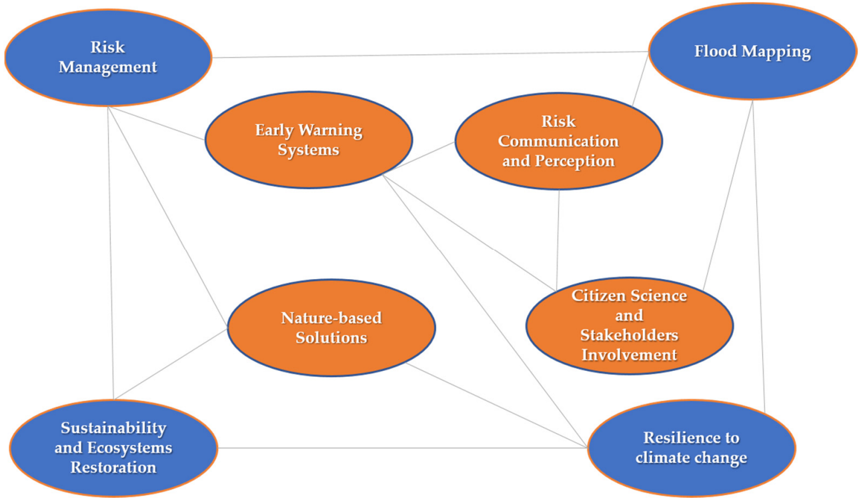
“…and the environment Natural flood management is part of this new philosophy, embracing related terms such as “making space for the river”, “ecosystem ‐ following sections, the progress in the above-mentioned trends are discussed, highlighting all potential interconnections between them (Figure 7).”
Background
Research works printed but not linked: 3
- 19. IPCC Summary for policymakers. In Climate Change 2014: Impacts, Adaptation, and Vulnerability. Part A: Global and Sectoral Aspects ; Contribution of Working Group II to the Fifth Assessment Report of the Intergovernmental Panel on Climate Change; Cambridge University Press: Cambridge, UK; New York, NY, USA, 2014.
- 54. Blad é , E.; Cea, L.; Corestein, G.; Escolano, E.; Puertas, J.; V á zquez-Cend ó n, E.; Dolz, J.; Coll, A. Iber: Herramienta de simulaci ó n num é rica del flujo en r í os. Rev. Int. Metod. Numer. Calc. Disen. Ing. 2014 , 30 , 1-10. [CrossRef]
- 19. based solutions. Sustainability 2019 , 11 , 6788. [CrossRef]
Cited by
Items 201–300 of 379
Huang, J., He, R., Zhang, X., Tan, W., & Zhang, J. (2025) · International Journal of Reliability Quality and Safety Engineering · doi:10.1142/s0218539325500287 · Cited by 1
Omar, S. R., Rahman, N. H. A., Mustaffa, N. E., & Azizul, M. F. (2025) · International Journal of Innovation and Industrial Revolution · doi:10.35631/ijirev.722002 · Cited by 1
Boudaghpour, S. (2025) · Modeling Earth Systems and Environment · doi:10.1007/s40808-025-02700-9 · Cited by 1
“Accordingly, understanding the environment According to Cea and Costabile (2022), flood-related hydrodynamic variables, such as flow depth and velocity, can be computed through numerical flood inundation mod - els to provide an appropriate flood risk analysis for assess - ing potential damage to…”
Albalawi, E. (2026) · Advances in Space Research · doi:10.1016/j.asr.2025.12.108 · Cited by 1
Lu, J., Jiao, S., Guo, Q., & Zhu, X. (2026) · Journal of Hydrology · doi:10.1016/j.jhydrol.2026.135136 · Cited by 2
Merabtene, T., Usman, A. G., Ozsahin, D. U., & Ozsahin, D. U. (2026) · Water Resources Management · doi:10.1007/s11269-025-04362-9 · Cited by 1
“…system to the growing number of droughts, the dramatic events of precipitation, and the change in the hydrological cycle, which makes the prediction a significant instrument of future planning and management of a sustainable supply of water resources (Cea and Costabile 2022; Capoda-glio 2024).”
Harto, A. B., Virtriana, R., Kusuma, R. J., Reynaldi, I. K. C., Karima, A. Q., & Kuntoro, A. A. (2026) · Geomatics Natural Hazards and Risk · doi:10.1080/19475705.2026.2634202 · Cited by 1
Kim, B., Ryu, H., Lee, S., Lee, J., & Noh, S. J. (2026) · Environmental Modelling & Software · doi:10.1016/j.envsoft.2026.106957 · Cited by 1
The Impact of China’s Climate-Adaptive City Pilot Policy on Urban Ecological Resilience
Song, W., Liu, Y., Zhang, Y., Feng, L., & Meng, F. (2026) · Sustainability · doi:10.3390/su18063004 · Cited by 1
Adjei-Yeboah, S., Frimpong, R. A., Ankah, M. L. Y., & Bohat, N. (2026) · Journal of African Earth Sciences · doi:10.1016/j.jafrearsci.2026.106145 · Cited by 1
Bentula, J. M. B., Durano, C. E. A., Vasquez, J. F. P., & Salcedo-Albores, S. M. (2025) · IEEE Asia-Pacific Conference on Geoscience, Electronics and Remote Sensing Technology (AGERS) · doi:10.1109/agers67633.2025.11446386 · Cited by 1
“While the findings are unique to CSU Creek, the general principle—that targeted structural interventions can improve flow conveyance—has relevance for other urban waterways [2][18].”
Chikabvumbwa, S. R., Mwale, F., Mtethiwa, J. T., Fandika, I. R., & Kauma, C. D. (2026) · Environment and Urbanization · doi:10.1177/09562478261423202 · Cited by 1
Flood risk assessment using HEC-RAS model and GIS for the Indus River, Pakistan
Aziz, S. U. R., Arshad, M. I., Shahid, M. A., Waraich, E. A., & Merwade, V. (2026) · Journal of Ecological Engineering · doi:10.12911/22998993/216102 · Cited by 1
“Gauge stations are available at Chashma and Taunsa, Pakistan.”
InfluentialZoghi, A., Cooke, R., Khaliq, M. N., & Drake, J. A. P. (2026) · Journal of Hydrology · doi:10.1016/j.jhydrol.2026.135433 · Cited by 1
Ogunbode, T. O., Opabunmi, B. A., Adeyi, S. T., Akinwale, E. A., & Ayodele, I. M. (2026) · Scientific Reports · doi:10.1038/s41598-026-48954-w · Cited by 1
Fattasse, H., Laaraj, M., Lahrichi, K., & Okacha, A. (2026) · Mediterranean Geoscience Reviews · doi:10.1007/s42990-026-00238-1 · Cited by 1
“Their integration into local risk management policies is also particularly recommended in Mediterranean regions, where interactions among climate hydrology and land use are complex (Cea and Costabile.”
Drivers of basement flooding: Rainfall intensity and infrastructure impacts in Trelleborg, Sweden
Mobini, S., Pirzamanbein, B., Du, Y., & Nyberg, L. (2026) · Journal of Hydrology Regional Studies · doi:10.1016/j.ejrh.2026.103512 · Cited by 1
Enhancing metro system resilience under flood using multi-layer complex networks
Wang, L., He, R., Li, Y., Luo, H., & Zhang, L. (2026) · Tunnelling and Underground Space Technology · doi:10.1016/j.tust.2026.107784 · Cited by 1
Tahmi, S., Rui, X., Benzaoui, S., Khelali, M., Chebika, H., & Guechi, I. (2026) · Environmental Modelling & Software · doi:10.1016/j.envsoft.2026.107039 · Cited by 2
Mohammadi, N., & Mostafazadeh, R. (2026) · Climate · doi:10.3390/cli14060126 · Cited by 1
“Urban flooding exemplifies such hazards, arising from concurrent intense rainfall, river overflow, or sea level rise [136].”
Bernal-Basurco, C., Rodríguez‐Sinobas, L., & Cardozo, D. A. S. (2026) · Journal of Environmental Management · doi:10.1016/j.jenvman.2026.130458 · Cited by 1
Lin, Z. B., Sheng, J., Chen, J. Z., & Du, Z. (2026) · Water · doi:10.3390/w18151822 · Cited by 1
Fardin, S. C. S. G., Zêzere, J. L., Mendes, T. S. G., & Simões, S. J. C. (2026) · GeoHazards · doi:10.3390/geohazards7030094 · Cited by 1
“Several authors have suggested that LULC classification should incorporate runoff characteristics [61,68,74,75] or reflect existing drainage network and hydrographic connectivity [31,61], since anthropogenic alterations can disrupt natural flow paths, change the flow direction, and sometimes…”
GIS-based flood risk assessment in the Zhabay River Basin, Kazakhstan
Mussina, A., Makhmudova, L. K., Medeu, A. R., Ospanova, M., Abdullayeva, A., Tursyngali, M., Zhaksylyk, S., Rodrigo-Ilarri, J., & Rodrigo-Clavero, M.-E. (2026) · Progress in Disaster Science · doi:10.1016/j.pdisas.2026.100694 · Cited by 1
Zhang, H., Dai, P., & Kong, Y. (2026) · Sustainability · doi:10.3390/su18178878 · Cited by 1
Nussbaum, R., Armon, M., & Morin, E. (2026) · Journal of Hydrology · doi:10.1016/j.jhydrol.2026.136438 · Cited by 1
Discharge coefficients to be used in inlet hydraulics
Gómez, M., Alvarez, J. D. T., & Russo, B. (2023) · Proceedings of the Institution of Civil Engineers - Water Management · doi:10.1680/jwama.22.00059 · Cited by 1
Simulation of flood inundation in the Klawing Watershed, Purbalingga, Central Java
Santoso, P. B., Ramanda, M. P., Wariyatno, N. G., Sudibyo, G. H., Pamudji, G., Hardini, P., Indriyati, E. W., Nastain, Nugroho, P. S., Yanto, Y., et al. (2023) · E3S Web of Conferences · doi:10.1051/e3sconf/202346402006 · Cited by 1
Li, X.-J., & Tang, H.-L. (2024) · Journal of Central South University · doi:10.1007/s11771-024-5694-4 · Cited by 1
The Role of Floods in Urban Environments
Sánchez-García, C., & Francos, M. (2024) · The urban book series · doi:10.1007/978-3-031-62641-8_2 · Cited by 1
Picourlat, F., Ler, L. G., Targosz, J., Masselis, G., Dominguez, A. G., Billaud, F., Gourbesville, P., & Roux, P. (2024) · Springer water · doi:10.1007/978-981-97-4072-7_9 · Cited by 1
Mejía‐Morales, M. A. (2022) · theses.fr (ABES) · doi:10.70675/f0140674z0d2bz4379z9bd9z106ee895b7bc · Cited by 3
Rahman, H. U., Ding, H., Wang, G., & Khan, A. (2025) · Springer eBooks · doi:10.1007/978-981-97-4547-0_194-1 · Cited by 1
(2023) · Hydrology and earth system sciences · doi:10.5194/hess-2023-63-rc1
(2023) · Hydrology and earth system sciences · doi:10.5194/hess-2023-63-rc2
Szeląg, B. (2023) · Hydrology and earth system sciences · doi:10.5194/hess-2023-63-ac1
Szeląg, B. (2023) · Hydrology and earth system sciences · doi:10.5194/hess-2023-63-ac4
Szeląg, B. (2023) · Hydrology and earth system sciences · doi:10.5194/hess-2023-63-ac2
Szeląg, B. (2023) · Hydrology and earth system sciences · doi:10.5194/hess-2023-63-ac3
Raikes, J. (2023) · Natural hazards and earth system sciences · doi:10.5194/nhess-2023-87-ac2
Ahmad, D., & Afzal, M. (2024) · Research Square · doi:10.21203/rs.3.rs-3901129/v1
A Simplistic Approach for Evaluating Urban Flood Risk through the Integration of HEC-RAS 2D and GIS
Ojasanya, K. A., & George-Kayode, B. O. (2024) · World Environmental and Water Resources Congress (EWRI) · doi:10.1061/9780784485477.050
(2024) · Natural hazards and earth system sciences · doi:10.5194/nhess-2024-50-rc1
(2024) · Natural hazards and earth system sciences · doi:10.5194/nhess-2024-50-rc2
Caviedes-Voullième, D. (2024) · Natural hazards and earth system sciences · doi:10.5194/nhess-2024-50-ac2
Caviedes‐Voullième, D. (2024) · Natural hazards and earth system sciences · doi:10.5194/nhess-2024-50-ac1
Public policies on sustainable flood risk management: Study cases of the Netherlands and Malawi
Maulana, P. D., Koestoer, R. H. S., & Karuniasa, M. (2024) · ASEAN Natural Disaster Mitigation and Education Journal · doi:10.61511/andmej.v2i1.2024.953
Bacar, A. H., & Rawhoudine, S. C. (2024) · American Journal of Computational Mathematics · doi:10.4236/ajcm.2024.143015
Foster, K., Salehi, P., Aalto, J., Corbett, D. M., & Visetti, P. (2024) · Cities and nature · doi:10.1007/978-3-031-50365-8_21
(2024) · Natural hazards and earth system sciences · doi:10.5194/nhess-2024-139-rc2
Modelagem computacional de barragens móveis de pequeno porte para aplicação em canais urbanos
Cabral, J. J. D. S. P., Neves, Y. T., Rodrigues, A. B., & Cirilo, J. A. (2025) · Revista Brasileira de Geografia Física · doi:10.26848/rbgf.v18.1.p741-755
Wardhani, F. A., Sapan, E. G. A., Widiatmoko, N., Yuvhendmindo, M. R., Santosa, B. H., Susanti, W. D., Pravitasari, A. E., Triwisesa, E., & Ridwansyah, I. (2024) · Bulletin of Geography Physical Geography Series · doi:10.12775/bgeo-2024-0012
Fachri, F. J., Harlan, D., Nugroho, J., Chaidar, A. N., & Kasim, M. R. S. (2025) · Journal of Civil Engineering · doi:10.12962/j20861206.v40i1.22288
Equity in access to ecosystem services among riparian residents in Greater Kumasi, Ghana
Langnel, D., Mensah, H., Amuzu, B. M., & Simpeh, E. K. (2025) · Discover Cities · doi:10.1007/s44327-025-00058-2
“This finding was also realized in a study by Costabile [51] which discussed that the naturally clean state of rivers is very important as it enhances the usage of riverine services while low river quality as a result of extreme pollution especially in urban areas also creates inequitable access to…”
Land-use adaptation in flood risk areas with rain-on-grid modeling
Rocha, C. I. O., & Zambon, R. C. (2025) · Urban Water Journal · doi:10.1080/1573062x.2025.2496956
“In this context, the results obtained corroborate the statement by Cea and Costabile (2022), who emphasize that 2D SWE have become the most efficient tools for flood analysis in urban areas.”
Haque, K. M. S., Haque, M. K., Haque, M. M., Rahman, M. Z., Hossain, M. S., Ahmed, T. U., Hasan, M. M., Rokonuzzaman, M., Sadat, M. N., Khanom, D. A., et al. (2025) · Research Square · doi:10.21203/rs.3.rs-6620655/v1
Enhancing Flood Resilience Through Effective Land Use Planning Policies in New Zealand
Auliagisni, W., Wilkinson, S. J., & Elkharboutly, M. (2025) · Lecture notes in civil engineering · doi:10.1007/978-981-96-2904-6_7
Afolabi, O., Akinsemoyin, Z., Essel, E. K., IGHOFIOMONI, M. O., Thompson, K. E., Basit, K. A., & Chinonyerem, C. A. (2025) · Asian Journal of Advanced Research and Reports · doi:10.9734/ajarr/2025/v19i71083
Jee, H. W., Seo, S. B., Seo, Y.-H., & Park, J. (2025) · Natural Hazards · doi:10.1007/s11069-025-07503-w
“Increasing flood frequency and damage require updated and appropriate flood mitigation policies (Cea and Costabile 2022 ).”
dos Reis, G. D. C., dos Santos, K. A., Basso, R. E., Pereira, T. S. R., Mendes, T. A., de Carvalho, T. P., & Formiga, K. T. M. (2025) · Preprints.org · doi:10.20944/preprints202509.1472.v1
Warasanti, E. S., Nugroho, A. R. B., Maharani, Y. N., & Purwanta, J. (2025) · Sanus Medical Journal · doi:10.22236/sanus.v7i1.20426
Nonlinear behavior of urban flood peaks in the U.S. Mid-Atlantic region
Hua, G., Li, H., & Leung, L. R. (2025) · Journal of Hydroinformatics · doi:10.2166/hydro.2025.005
Lan, B. T. N., Hùng, N. M., Thanh, D. T., & Hai, D. T. (2026) · Humanities and Social Sciences Communications · doi:10.1057/s41599-026-08131-w · Cited by 1
Dynamic Equivalent Drainage Method for Urban Flood Modeling: A Rainfall-adaptive Fusion Approach
Wu, M. F., Gao, Y., Cheng, Y., Chen, X., Zhang, J., & Yi, L. (2026) · Water Resources Management · doi:10.1007/s11269-026-04749-2
Rápalo, L. M. C., Júnior, M. N. G., & Mendiondo, E. M. (2025) · International Journal of Disaster Risk Reduction · doi:10.1016/j.ijdrr.2025.105931 · Cited by 1
Slongo, C., Chungikar, S. A., Niederwieser, E., Siegele, D., & Matt, D. T. (2025) · IOP Conference Series Earth and Environmental Science · doi:10.1088/1755-1315/1546/1/012019
“In parallel, AI and IoT can detect patterns in large sensor datasets, forecasting system behaviour during extreme events, and triggering automated controls, such as reducing outflow to prevent flooding and manage peak runoff [21], [23].”
Estimación de la eficiencia hidráulica de imbornales utilizando su coeficiente de desagüe
Alvarez, J. D. T., & Russo, B. (2023) · UPCommons institutional repository (Universitat Politècnica de Catalunya)
Modélisation des crues en régime nival à l'Est du Canada
Yousfi, N. (2024) · Archipel (Université du Québec à Montréal)
Khan, S. (2024) · Theseus (Ammattikorkeakoulujen) · Cited by 2
Youth on the Frontlines: A Study of Volunteering in Flood Disaster Relief Efforts
Ridzuan, M. R., & Rahman, N. A. S. A. (2025) · IDRiM Journal · doi:10.5595/001c.147512
Adaptation strategies for drainage and flood management Taman Fair Park, Ipoh Perak, Malaysia
Mohd Redzuan Teoh, A. B., & Zakaria, A. Z. (2025) · UiTM Institutional Repositories (Universiti Teknologi MARA)
Pramudi, Y. T. C., Nugroho, R. A., Mulyanto, E., & Muljono, M. (2025) · Green Engineering International Journal of Engineering and Applied Science · doi:10.70062/greenengineering.v2i1.260
Estrategias transdisciplinarias para mitigar riesgos de inundaciones en megaciudades costeras
Montúfar, G. (2025) · Ciencia Ingenierías y Aplicaciones · doi:10.22206/cite.2025.v8.3610
Siemiończyk, E., Skoczko, I., & Szatyłowicz, E. (2026) · Advances in Science and Technology – Research Journal · doi:10.12913/22998624/210710
“In international literature, many studies point to the critical importance of maintaining hydro - logical continuity in urban areas, including avoid - ing excessive concreting of river valleys and pro - tecting natural and semi-natural retention areas [54, 55].”
Mapa de calados máximos de las inundaciones del 29 de octubre de 2024 en l’Horta Sud y la Ribera
Talens, A. R., Pardo-Pascual, J. E., Almonacid-Caballer, J., Sarría, A. F., Palomar-Vázquez, J. M., & Cabezas-Rabadán, C. (2025) · Cuadernos de Geografía de la Universitat de València · doi:10.7203/cguv.114-15.32144
Serious Game-Based Flood Visualization System for Disaster Mitigation Capacity Building
Idris, N. I. F., Yuliana, Y., & Rosmini, R. (2025) · Ceddi Journal of Information System and Technology (JST) · doi:10.56134/jst.v4i2.153
“Rapid urbanization, land-use change, climate variability, and insufficient drainage infrastructure have intensified flood frequency and severity, particularly in coastal and low-lying cities (Cea & Costabile, 2022; Glago, 2021; Tingsanchali, 2012).”
A High-Resolution Framework for Urban Pluvial Flood Risk MappingPreprint
Vogelbacher, A., von Szombathely, M., Lennartz, M., Poschlod, B., & Sillmann, J. (2026) · doi:10.5194/egusphere-2025-6362
Development of a web-based tool for rapid flood inundation modeling
Xiao, D., Yuan, B., Guo, Z., Wz, Y., Jiang, J., Chen, M., Lv, G., & Liu, J. (2026) · Environmental Modelling & Software · doi:10.1016/j.envsoft.2026.106876
Adapting the SWOT matrix as a territorial planning tool for urban flood management
Rezende, O. M., de Magalhães, P. M. C., Gomes, M. V. R., Thomaz, F. R., Lemos, M. F., & Miguez, M. G. (2026) · Scientific Reports · doi:10.1038/s41598-026-79840-0
Ghazali, H., Mohamad, F., & Mohamed, Z. (2025) · CFD letters · doi:10.37934/cfdl.18.3.219230
Kim, T., & Rhee, D.-S. (2025) · Journal of The Korean Society of Water and Wastewater · doi:10.11001/jksww.2025.39.6.515
Flood risk analysis for Culiacan River infrastructure development using HEC-RAS
Rentería-Guevara, S. A., Delgado-Grave, E. M., Monjardín-Armenta, S. A., Rangel‐Peraza, J. G., García-Páez, F., Sanhouse-García, A. J., & Mora-Félix, Z. D. (2026) · Journal of Applied Water Engineering and Research · doi:10.1080/23249676.2026.2619185
Abhishek, S. N., Suraj, P. G., Chetana, G., & Shailesh, J. P. (2025) · i-manager’s Journal on Civil Engineering · doi:10.26634/jce.15.3.22243
Abhishek, S. N., Mohan, B., Rajesh, S. R., & Nivedita, K. D. (2025) · i-manager’s Journal on Structural Engineering · doi:10.26634/jste.14.2.22244
Hill, B., Liang, Q., Chen, H., & Bosher, L. (2026) · Journal of Hydrology Regional Studies · doi:10.1016/j.ejrh.2026.103178 · Cited by 1
Analysis of Sengkarang Watershed Performance with the Addition of River Maintenance Flow Parameters
Sodikin, W., Juwono, P. T., & Sholichin, M. (2025) · Jurnal Teknik Pengairan · doi:10.21776/ub.pengairan.2025.016.02.6
Karakaya, İ., Taşkın, A. G., Ateşoğlu, A., & Karakaya, A. (2026) · Natural Hazards · doi:10.1007/s11069-025-07772-5
“These conditions amplify flood risk, causing significant social, economic, and environmental impacts (Cea and Costabile 2022 ; Ogden et al. 2011 ).”
Angel, R. S., Kalaivani, K. S., Abdul Basith, K., Patil, K. B., Samreen, S., & Hyma Lakshmi, T., V (2025) · International Conference on Science Technology Engineering and Mathematics (ICONSTEM) · doi:10.1109/iconstem65670.2025.11374369
“Such models have been shown to be useful in representation of large magnitude floods under controlled conditions but can be found to lack flexibility and respond slowly to the changing environmental and climatic conditions[10].”
RetractedBarrios, M. A. H. (2024) · Repositorio Institucional Universidad El Bosque
Sehrawat, S., & Shekhar, S. (2026) · Arabian Journal of Geosciences · doi:10.1007/s12517-026-12451-1
Long-term trend quantification of rainfall-induced inundation due to climate change
Wu, S., & Lu, Y.-S. (2026) · Journal of Water and Climate Change · doi:10.2166/wcc.2026.275
Clemens, C. (2026) · Qucosa (Saxon State and University Library Dresden) · doi:10.51382/978-3-96100-301-3
Zeleke, Y. A., Garo, O. O., & Andiye, Y. M. (2026) · River · doi:10.1002/rvr2.70048
“These tools empower urban planners, emergency managers, and the general public with vital insights for preemptive decision ‐ making (Bakhtiari et al., 2023; Cea & Costabile, 2022; Tambal et al., 2024; Tariq et al., 2020).”
Royte, L., & Sanderson, E. W. (2026) · Annals of the New York Academy of Sciences · doi:10.1111/nyas.70248
“Understanding future climate changes, while uncertain, are important to consider when predicting contemporary adaptation strategies [ 52 ].”
Mutmainnah, I., Yusuf, R., Ridha, N. A., Usman, S., Suriyani, & Saprin (2026) · Multidisciplinary Science Journal · doi:10.31893/multiscience.2026567
“Rapid urbanization has led to large-scale land conversion from water catchment zones into residential areas, commercial centers, and transportation infrastructure (Cea & Costabile, 2022).”
Climate change overrides population dynamics in driving flood exposure in the Yangtze River Basin
Qi, W., Lu, L., Cai, Y., & Tan, Q. (2026) · Journal of Hydrology Regional Studies · doi:10.1016/j.ejrh.2026.103418
Climate Change Policy and Local Energy Crisis: Lessons from Flooding Management in Nigeria
Shiyanbade, B. W., Ayanlade, O. S., Hassan, H. B., & ALAKO, L. O. (2026) · Springer eBooks · doi:10.1007/978-3-032-11678-9_28
Metadata
- Authors
- Cea, L., & Costabile, P.
- Affiliations
- Universidade da Coruña (ES)
- University of Calabria (IT)
- Corresponding author
- Cea, Luís
- Costabile, Pierfranco
- Venue
- Hydrology
- Publisher
- MDPI AG
- Published
- 2022-03-18
- Volume
- 9
- Issue
- 3
- Pages
- 50
- ISSN
- 2306-5338 (ISSN-L)
- OpenAlex
- W4220807507
- Cited by
- 317
- References
- 357
- Citations by year
- 2026: 101 · 2025: 94 · 2024: 75 · 2023: 33 · 2022: 14
- FWCI
- 21.52
- Type
- journal article
- Language
- en
- Open access
- gold
- doi.org
- Licence
- Locations
- Hydrology (publishedVersion, cc-by)
- DOAJ (DOAJ: Directory of Open Access Journals) (submittedVersion)
- Archive of Doctoral Theses and Digital Collections (University of Calabria) (submittedVersion, cc-by)
- RUC (Universidade Da Coruña) (submittedVersion, cc-by)
- Topics
- Physical Sciences › Environmental Science › Global and Planetary Change › Flood Risk Assessment and Management
- Physical Sciences › Environmental Science › Environmental Engineering › Urban Stormwater Management Solutions
- Physical Sciences › Environmental Science › Water Science and Technology › Hydrology and Watershed Management Studies
- Keywords
- urban flooding, flood risk modelling, flood risk management, climate change adaptation, urban runoff, drainage failure, coastal flooding, tidal flooding, urban densification, socio-economic losses
About these checks
Registry, retraction, Cites and statistics results are computed, not judged, with one exception: a printed reference that no index lists is read once by a model before it counts as a citation error. Claims are extracted by a model and kept only when their quote appears verbatim in the text; each cited source is then checked, with a model’s help, for whether it says what the claim relies on. Those verdicts can be wrong — read the claim’s quote and the cited source before relying on one.
Statistics and arithmetic are recomputed, not judged.
Confidence bands are shown only for fields calibrated on our annotated test set. None is calibrated yet, so no band is shown.
What counts as a claim ›How we measure confidence ›How we check this ›
Are you an author, or do you see a problem with this page? Request a review
Data sources
Bibliographic data: Semantic Scholar, OpenAlex, Crossref.
Contains information from the Semantic Scholar Academic Graph Datasets, made available under the ODC Attribution License (ODC-BY 1.0).
Semantic Scholar’s data is described in: Kinney, R., et al. (2023). The Semantic Scholar Open Data Platform. arXiv:2301.10140.
