

The DOI matches its Crossref record; 1 of the 1 references it cites were found in a registry or an index.
Environmental Criteria in the Spanish Public Works Procurement Process
Abstract
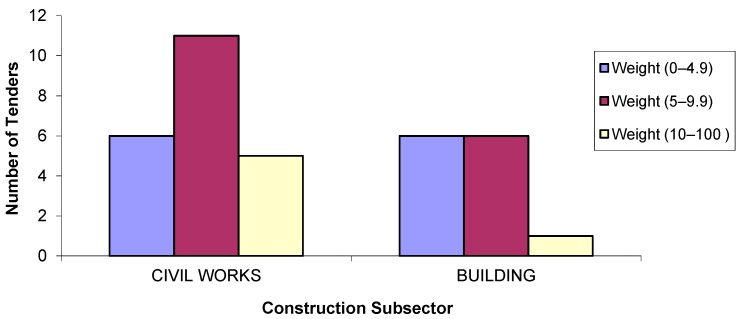
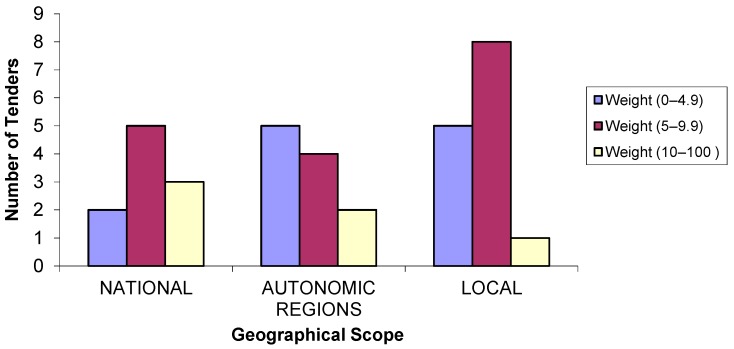
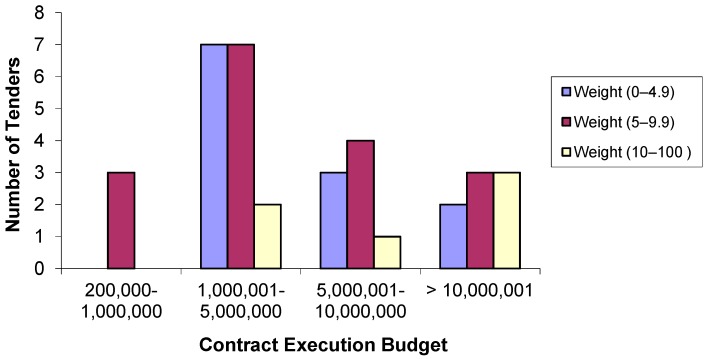
Green Public Procurement (GPP) is defined as a process of contracting products, services, and works with the least possible damage to the environment during their life cycle. In order to improve the knowledge about GPP, a study of the use of environmental tendering criteria in the Spanish public construction sector has been performed. The results of this study show that the use of environmental criteria in Spanish public sector construction procurement is low in comparison to a certain group of countries, known as “Green 7”, in the European Union. Environmental criteria is the fourth criterion in importance, but its weight in the global of the process is much lower than other criteria such as price, memory of the construction process and the delivery time. National administrations use environmental criteria more frequently because they have more resources and staff training about environmental issues. Environmental criteria are more used in the tendering of civil projects and works whose budget exceeds ten million euro due to the environmental impact of these kind and/or size of projects.
Overview
The claims and statistics of this paper haven’t been checked yet.
Run the check — free, no account needed. It reads the open-access text and checks the sources it cites.
Integrity signals
Registry
Cites
Statistics
Figures
Verification
Claims the paper makes
The claims and statistics of this paper haven’t been checked yet.
Run the check — free, no account needed. It reads the open-access text and checks the sources it cites.
Claims other papers make about this one
Each is checked against this paper’s own text: does it say what the citing paper says it does?
In the citing paper
“These studies often focus on tender criteria (Fuentes-Bargues et al., 2017) and implementation in the client organization (Igarashi et al., 2017), while a less common focus is on contracting”
From Rethinking the project life cycle – how circularity challenges processes, roles and governance (2025) · cites this paper as Fuentes-Bargues et al., 2017
Self-check
Percentages, sums and reported differences re-computed from the paper’s own numbers.
The self-check needs the paper’s full text.
Citations
Cites
Motivating green public procurement in China: An individual level perspective
Zhu, Q., Geng, Y., & Sarkis, J. (2013) · Journal of Environmental Management · doi:10.1016/j.jenvman.2013.04.009 · Cited by 209
Research works printed but not linked: 53
- Spence, 1995, Sustainable development and the construction industry, Habitat Int., 19, 279, 10.1016/0197-3975(94)00071-9 · DOI
- Tam, 2004, Green construction assessment for environmental management in the construction industry of Hong Kong, Int. J. Proj, Manag., 22, 563, 10.1016/j.ijproman.2004.03.001 · DOI
- Sev, 2009, How can the construction industry contribute to sustainable development? A conceptual framework, Sustain. Dev., 17, 161, 10.1002/sd.373 · DOI
- Hill, 1997, Sustainable construction: Principles and a framework for attainment, Constr. Manag. Econ., 15, 223, 10.1080/014461997372971 · DOI
- Tan, 1999, ISO 14000: Its relevance to the construction industry of Singapore and its potential as the next industry milestone, Constr. Manag. Econ., 17, 449, 10.1080/014461999371376 · DOI
- Ball, 2002, Can ISO 14000 and eco-labelling turn the construction industry green?, Build. Environ., 37, 421, 10.1016/S0360-1323(01)00031-2 · DOI
- MacDonald, 2005, Strategic sustainable development using the ISO 14001 Standard, J. Clean. Prod., 13, 631, 10.1016/j.jclepro.2003.06.001 · DOI
- Reed, 2009, International Comparison of Sustainable Rating Tools, J. Sustain. Real Estate, 1, 1, 10.1080/10835547.2009.12091787 · DOI
- Lam, 2011, Environmental management system vs. green specifications: How do they complement each other in the construction industry?, J. Environ. Manag., 82, 788, 10.1016/j.jenvman.2010.10.030 · DOI
- Qiao, 2011, Issues and Challenges in Implementing China’s Green Public Procurement Program, J. Environ. Prot., 2, 1034, 10.4236/jep.2011.28119 · DOI
- Berardi, 2012, Sustainability Assessment in the Construction Sector: Rating Systems and Rated Buildings, Sustain. Dev., 20, 411, 10.1002/sd.532 · DOI
- 2010, Metodología y herramientas VERDE para la evaluación de la sostenibilidad en edificios, Inf. Constr., 62, 87, 10.3989/ic.08.056 · DOI
- Plouffe, 2004, The ecolabel and sustainable development, Int. J. Life-Cycle Assess., 9, 349, 10.1007/BF02979076 · DOI
- Domingues, 2015, Defining criteria and indicators for a sustainability label of local public services, Ecol. Indic., 57, 452, 10.1016/j.ecolind.2015.05.016 · DOI
- Iraldo, 2009, Is an environmental management system able to influence environmental and competitive? The case of the eco-management and audit scheme (EMAS) in the European Union, J. Clean. Prod., 82, 88
- Alegre, 2011, Evaluation of environmental management resources (ISO 14001) at civil engineering construction worksites: A case study of the community of Madrid, J. Environ. Manag., 92, 1858, 10.1016/j.jenvman.2011.03.008 · DOI
- Palmujoki, 2010, Green Public Procurement: Analysis on the Use of Environmental Criteria in Contracts, Rev. Eur. Community Int. Environ. Law, 19, 250, 10.1111/j.1467-9388.2010.00681.x · DOI
- Large, 2011, Drivers of green supply management performance: Evidence from Germany, J. Purch. Supply Manag., 17, 176, 10.1016/j.pursup.2011.04.006 · DOI
- Geng, 2008, Greening government procurement in developing countries: Building capacity in China, J. Environ. Manag., 88, 932, 10.1016/j.jenvman.2007.04.016 · DOI
- OECD Observer (Organisation for Economic Co-operation and Development) Bribery in Procurement, Methods, Actors and Counter-Measures. Available online: https://www.oecd.org/investment/anti-bribery/anti-briberyconvention/44956834.pdf.
- Wong, 2008, Construction and economic development: The case of Hong Kong, Constr. Manag. Econ., 26, 813, 10.1080/01446190802189927 · DOI
- Aoyagi, 2009, Collusion as public monitoring becomes noisy: Experimental evidence, J. Econ. Theory, 124, 883
- Uttam, 2012, EIA and green procurement: Opportunities for strengthening their coordination, Environ. Impact Assess. Rev., 33, 73, 10.1016/j.eiar.2011.10.007 · DOI
- Nissinen, 2012, Environmental impacts and the most economically advantageous tender in public procurement, J. Public Procure., 12, 43, 10.1108/JOPP-12-01-2012-B002 · DOI
- Swanson, 2005, Developing priorities for greener stage government purchasing: A California case study, J. Clean. Prod., 13, 669, 10.1016/j.jclepro.2003.12.011 · DOI
- Bolton, 2006, Government procurement as a policy tool in South Africa, J. Public Procure., 6, 193, 10.1108/JOPP-06-03-2006-B001 · DOI
- Bolton, 2008, Protecting the environment through public procurement: The case of South Africa, Nat. Resour. Forum, 32, 1, 10.1111/j.1477-8947.2008.00171.x · DOI
- Ho, 2010, Green Procurement in the Asian Public sector and the Hong-Kong private sector, Nat. Resour. Forum, 34, 24, 10.1111/j.1477-8947.2010.01274.x · DOI
- Thai, K.V., and Piga, G. (2006). Advancing Public Procurement: Practices, Innovation and Knowledge-Sharing, PrAcademic Press.
- Tukker, 2008, Fostering change to sustainable consumption and production: An evidence based view, J. Clean. Prod., 16, 1218, 10.1016/j.jclepro.2007.08.015 · DOI
- Thai, K.V., and Piga, G. (2006). Advancing Public Procurement: Practices, Innovation and Knowledge-Sharing, PrAcademic Press.
- Nissinen, 2009, Environmental criteria in the public purchases above the EU threshold values by three Nordic countries: 2003 and 2005, Ecol. Econ., 68, 1838, 10.1016/j.ecolecon.2008.12.005 · DOI · Paper page
- Bratt, 2013, Assessment of criteria development for public procurement from a strategic sustainability perspective, J. Clean. Prod., 52, 309, 10.1016/j.jclepro.2013.02.007 · DOI
- Li, 2005, Environmentally responsable public procurement (ERPP) and its implications for integrated product policy (IPP), J. Clean. Prod., 13, 705, 10.1016/j.jclepro.2004.01.007 · DOI
- Michelsen, 2009, Green procurement in Norway: A survey of practices at the municipal and county level, J. Environ. Manag., 91, 160, 10.1016/j.jenvman.2009.08.001 · DOI · Paper page
- Testa, 2012, What factors influence the uptake of GPP (green public procurement) practices? New evidence from an Italian survey, Ecol. Econ., 82, 88, 10.1016/j.ecolecon.2012.07.011 · DOI · Paper page
- Igarashi, 2015, Investigating the anatomy of supplier selection in green public procurement, J. Clean. Prod., 108, 442, 10.1016/j.jclepro.2015.08.010 · DOI
- Testa, 2016, Drawbacks and opportunities of green public procurement: An effective tool for sustainable production, J. Clean. Prod., 112, 1893, 10.1016/j.jclepro.2014.09.092 · DOI · Paper page
- Balfors, 2009, Environmental consideration in procurement of construction contracts: Current practice, problems and opportunities in green procurement in the Swedish construction industry, J. Clean. Prod., 17, 1214, 10.1016/j.jclepro.2009.04.001 · DOI
- Sterner, E. (2002). Green Procurement of Buildings. Estimation of Environmental Impact and Life-Cycle Cost. [Ph.D. Thesis, Department of Civil and Mining Engineering, Luleá University of Technology]. Available online: http://epubl.ltu.se/1402-1544/2002/09/LTU-DT-0209-SE.pdf.
- Faith-Ell, C. (2005). The Application of Environmental Requirements in Procurement of Road Maintenance in Sweden. [Ph.D. Thesis, Land and Water Resources Engineering, Royal Institute of Technology]. Available online: http://www.diva-portal.org/smash/get/diva2:7160/FULLTEXT01.pdf.
- 2003, Reflexiones sobre la inclusión de aspectos sociales y medioambientales como criterios de adjudicación de los contratos públicos, Contrat. Adm. Pract., 18, 34
- FueyoBros, 2003, Criterios Objetivos de Adjudicación de Contratos en la Administración Pública, Contrat. Adm. Pract., 23, 45
- 2012, Theiso-Score Curve Graph. A new tool for competitive bidding, Autom. Constr., 22, 481, 10.1016/j.autcon.2011.11.007 · DOI
- 2013, On competitive bidding: Scoring and position probability graphs, Int. J. Proj. Manag., 31, 434, 10.1016/j.ijproman.2012.09.012 · DOI
- 2010, An ANP and AHP based approach for weighting criteria in public works bidding, J. Oper. Res. Soc., 61, 905, 10.1057/jors.2010.13 · DOI
- 2008, Contractor selection: Fuzzy control approach, Can. J. Civ. Eng., 35, 473, 10.1139/L07-127 · DOI
- 2013, Determination of Disproportionate Tenders in Public Procurement, J. Investig. Manag., 2, 1
- 2013, Analysis of the Scoring Formula of Economic Criteria in Public Procurement, Int. J. Econ. Behav. Organ., 1, 1
- 2010, Análisis descriptivo de la Dirección Ambiental de Obra en las Declaraciones de Impacto Ambiental de proyectos de Ingeniería Civil, Ing. Civ., 160, 92
- Fuentes-Bargues, J.L., and Ferrer-Gisbert, P.S. (, 2014). Metodología para la Dirección Ambiental de Obra en Obras de Edificación. Proceedings of XII Spanish National Congress on Environmental, Madrid, Spain. Available online: http://www.conama2012.conama.org/conama10/download/files/conama2014/CT%202014/1896711453.pdf.
- Walter, 2009, Sustainable procurement in the United Kingdom public sector, Supply Chain Manag., 14, 128, 10.1108/13598540910941993 · DOI · Paper page
- Fuentes-Bargues, J.L. (2013). Propuesta Metodológica para la Determinación del Criterio de Adjudicación Económico en los Concursos Públicos. [Ph.D. Thesis, Departamento de Ingeniería de Construcción y Fabricación, Universidad Nacional de Educación a Distancia]. Available online: http://e-spacio.uned.es/fez/eserv/tesisuned:IngInd-Jlfuentes/Documento.pd.
Cited by
Sorted by citations
Getting the green light on green public procurement: Macro and meso determinants
Rosell, J. (2021) · Journal of Cleaner Production · doi:10.1016/j.jclepro.2020.123710 · Cited by 92
Ortega Carrasco, P., Iannone, F., Ferrón Vílchez, V., & Testa, F. (2025) · Sustainable Development · doi:10.1002/sd.3234 · Cited by 41
Key factors hindering sustainable procurement in the Brazilian public sector: A Delphi study
Da Costa, B. B. F., & Da Motta, A. L. T. S. (2019) · International Journal of Sustainable Development and Planning · doi:10.2495/sdp-v14-n2-152-171 · Cited by 39
Rethinking the project life cycle – how circularity challenges processes, roles and governance
Lingegård, S., & Hedborg, S. (2025) · Project Leadership and Society · doi:10.1016/j.plas.2025.100194 · Cited by 10
Metadata
- Authors
- Fuentes-Bargues, J., González-Cruz, M., & González-Gaya, C.
- Affiliations
- Departamento de Proyectos de Ingeniería, Universitat Politècnica de València, Camino de Vera s/n, 46022 Valencia, Spain
- Departamento de Ingeniería de Construcción y Fabricación, ETSII, UNED, C/Ciudad Universitaria S/N, 28040 Madrid, Spain
- Venue
- International Journal of Environmental Research and Public Health
- Publisher
- MDPI AG
- Published
- 2017-02-18
- Volume
- 14
- Issue
- 2
- Pages
- 204
- ISSN
- 1660-4601
- PMC
- PMC5334758
- Cited by
- 48
- References
- 1
- Language
- en
- Funders
- Universitat Politècnica de València
- UNED
About these checks
Registry, retraction, Cites and statistics results are computed, not judged, with one exception: a printed reference that no index lists is read once by a model before it counts as a citation error. Claims are extracted by a model and kept only when their quote appears verbatim in the text; each cited source is then checked, with a model’s help, for whether it says what the claim relies on. Those verdicts can be wrong — read the claim’s quote and the cited source before relying on one.
Statistics and arithmetic are recomputed, not judged.
Confidence bands are shown only for fields calibrated on our annotated test set. None is calibrated yet, so no band is shown.
What counts as a claim ›How we measure confidence ›How we check this ›
Are you an author, or do you see a problem with this page? Request a review
