

The DOI matches its Crossref record; 49 of the 50 references it cites were found in a registry or an index.
The Relationship between Impulsivity and Internet Gaming Disorder in Young Adults: Mediating Effects of Interpersonal Relationships and Depression
Open accessAbstract
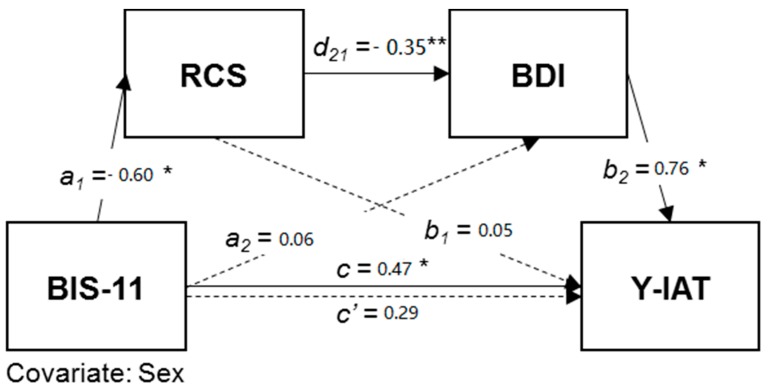
Background: This study aimed to explore relationships between impulsivity, interpersonal relationships, depression, and Internet Gaming Disorder (IGD) symptoms. Methods: A total of 118 young adults participated in this study: 67 IGD patients who met five or more of the DSM-5 diagnostic criteria for IGD and 56 healthy controls. We administered questionnaires to assess IGD symptoms (Young’s Internet Addiction Test; Y-IAT), impulsivity (Barratt Impulsiveness Scale; BIS-11), interpersonal relationship (Relationship Change Scale; RCS), and depression (Beck Depression Inventory; BDI). We used PROCESS macro in SPSS to perform mediation analysis. Results: IGD symptom was positively related to depression and impulsivity, and negatively related to the quality of interpersonal relationships. Mediation analysis revealed full mediation effects of interpersonal relationships and depression on the association between impulsivity and IGD symptoms in the IGD group. Specifically, even after adjusting for gender as a covariate, high impulsivity was associated with greater difficulty with interpersonal relationships; which further affected depression and increased the risk of IGD. Conclusions: These results demonstrate the importance of early intervention in IGD patients, particularly in young adults with high impulsivity. When intervening in adults’ IGD, we should consider not only individual factors (e.g., depression) but also socioenvironmental factors (e.g., interpersonal relationships).
Overview
The claims and statistics of this paper haven’t been checked yet.
Run the check — free, no account needed. It reads the open-access text and checks the sources it cites.
Integrity signals
Registry
Cites
Statistics
Figures
Verification
Claims the paper makes
The claims and statistics of this paper haven’t been checked yet.
Run the check — free, no account needed. It reads the open-access text and checks the sources it cites.
Claims other papers make about this one
Each is checked against this paper’s own text: does it say what the citing paper says it does?
The cited source says what the claim attributes to it.
In the citing paper
“Temperamental features, such as high impulsivity, have also been associated with gambling (Dowling et al., 2017), gaming (Gervasi et al., 2017; Kuss et al., 2018; Ryu et al., 2018)”
Self-check
Percentages, sums and reported differences re-computed from the paper’s own numbers.
The self-check needs the paper’s full text.
Citations
Cites
Diagnostic and Statistical Manual of Mental Disorders
American Psychiatric Association (2013) · doi:10.1176/appi.books.9780890425596 · Cited by 116,369
Beck, A. T., Steer, R. A., & Brown, G. (2011) · PsycTESTS Dataset · doi:10.1037/t00742-000 · Cited by 7,535
MacKinnon, D. P., Fairchild, A. J., & Fritz, M. S. (2007) · Annual Review of Psychology · doi:10.1146/annurev.psych.58.110405.085542 · Cited by 5,688
Internet Addiction: The Emergence of a New Clinical Disorder
YOUNG, K. S. (1998) · CyberPsychology & Behavior · doi:10.1089/cpb.1998.1.237 · Cited by 5,513
A pathways model of problem and pathological gambling
Blaszczynski, A., & Nower, L. (2002) · Addiction · doi:10.1046/j.1360-0443.2002.00015.x · Cited by 2,013
The Relationship Between Depression and Internet Addiction
YOUNG, K. S., & ROGERS, R. C. (1998) · CyberPsychology & Behavior · doi:10.1089/cpb.1998.1.25 · Cited by 1,233
Caplan, S. E. (2003) · Communication Research · doi:10.1177/0093650203257842 · Cited by 1,026
The compulsive internet use scale (CIUS): some psychometric properties
Meerkerk, G.-J., Van Den Eijnden, R. J. J. M., Vermulst, A. A., & Garretsen, H. F. L. (2009) · CyberPsychology & Behavior · doi:10.1089/cpb.2008.0181 · Cited by 989
Psychiatric features of individuals with problematic internet use
Shapira, N. A., Goldsmith, T. D., Keck, P. E., Khosla, U. M., & McElroy, S. L. (2000) · Journal of Affective Disorders · doi:10.1016/s0165-0327(99)00107-x · Cited by 898
The association between Internet addiction and psychiatric disorder: A review of the literature
Ko, C.-H., Yen, J.-Y., Yen, C.-F., Chen, C.-S., & Chen, C.-C. (2012) · European Psychiatry · doi:10.1016/j.eurpsy.2010.04.011 · Cited by 895 · cited 2×
“Similarly, IGD has been found to be associated with many psychiatric disorders and symptoms, including depression, anxiety, ADHD, hostility, interpersonal sensitivity, and paranoid ideation [32,33,41,52,53].”
Background
Research works printed but not linked: 7
- Choi, 2012, Internet addiction: Why we become addicted to the internet?, Asia Pac. J. Clin. Oncol., 4, 12
- Choi, 2013, In the modified integrated pathways model of internet addiction, J. Behav. Addict., 2, 10
- Seifi, 2014, The study of the relationship between internet addiction and depression, anxiety and stress among students of Islamic Azad University of Birjand, Int. J. Econ. Manag. Soc. Sci., 3, 28
- Kim, 2003, The validation of korean adolescent internet addiction scale (K-AIAS), Korean J. Clin. Psychol., 22, 125
- Schlein, S., Guerney, B., and Stover, L. (1971). The Interpersonal Relationship Scale. [Ph.D. Thesis, Pennsylvania State University]. Unpublished work.
- Chun, 1995, The social skills training for social adjustment of the schizophrenic patients, Ment. Health Soc. Work, 2, 33
- Hayes, A. (2016). Process for SPSS (Version 2.16) [Macros], The Guilford Press.
Cited by
Sorted by citations
Brand, M., Wegmann, E., Stark, R., Müller, A., Wölfling, K., Robbins, T. W., & Potenza, M. N. (2019) · Neuroscience & Biobehavioral Reviews · doi:10.1016/j.neubiorev.2019.06.032 · Cited by 2,126
Restrepo, A., Scheininger, T., Clucas, J., Alexander, L., Salum, G. A., Georgiades, K., Paksarian, D., Merikangas, K. R., & Milham, M. P. (2020) · BMC Psychiatry · doi:10.1186/s12888-020-02640-x · Cited by 168
Yuan, G. F., Elhai, J. D., & Hall, B. J. (2020) · Addictive Behaviors · doi:10.1016/j.addbeh.2020.106648 · Cited by 176
Wegmann, E., Müller, S. M., Turel, O., & Brand, M. (2020) · Scientific Reports · doi:10.1038/s41598-020-60819-4 · Cited by 145
The Association Between Internet Gaming Disorder and Impulsivity: A Systematic Review of Literature
Şalvarlı, Ş. İ., & Griffiths, M. D. (2019) · International Journal of Mental Health and Addiction · doi:10.1007/s11469-019-00126-w · Cited by 151
Metadata
- Authors
- Ryu, H., Lee, J.-Y., Choi, A., Park, S., Kim, D.-J., & Choi, J.-S.
- Affiliations
- SNUH SMG-SNU Boramae Medical Center (KR)
- The Catholic University of Korea Seoul St. Mary's Hospital (KR)
- Seoul National University (KR)
- Corresponding author
- Choi, Jung-Seok
- Venue
- International Journal of Environmental Research and Public Health
- Publisher
- MDPI AG
- Published
- 2018-03-06
- Volume
- 15
- Issue
- 3
- Pages
- 458
- ISSN
- 1660-4601 (ISSN-L)
- PMC
- PMC5877003
- OpenAlex
- W2790200283
- Cited by
- 104
- References
- 50
- Citations by year
- 2026: 4 · 2025: 10 · 2024: 12 · 2023: 22 · 2022: 17 · 2021: 12 · 2020: 11 · 2019: 13 · 2018: 3
- FWCI
- 22.14
- Type
- journal article
- Language
- en
- Open access
- gold
- doi.org
- Licence
- Locations
- International Journal of Environmental Research and Public Health (publishedVersion, cc-by)
- Europe PMC (PubMed Central) (publishedVersion, cc-by)
- PubMed Central (publishedVersion, cc-by)
- PubMed (publishedVersion)
- RePEc: Research Papers in Economics (submittedVersion)
- DOAJ (DOAJ: Directory of Open Access Journals) (submittedVersion)
- Funders
- the National Research Foundation of Korea (NRF-2014M3C7A1062894)
- Topics
- Social Sciences › Sociology and Political Science › Impact of Technology on Adolescents
- Social Sciences › Psychology › Clinical Psychology › Gambling Behavior and Treatments
- Social Sciences › Psychology › Clinical Psychology › Sexuality, Behavior, and Technology
- Keywords
- internet gaming disorder, impulsivity, interpersonal relationships, depression, mediation, young adults, internet addiction, relationship quality, early intervention
- MeSH terms
- Adult, Depression, Female, Humans, Impulsive Behavior, Interpersonal Relations, Male, Psychiatric Status Rating Scales, Surveys and Questionnaires, Behavior, Addictive, Video Games, Internet, Young Adult
About these checks
Registry, retraction, Cites and statistics results are computed, not judged, with one exception: a printed reference that no index lists is read once by a model before it counts as a citation error. Claims are extracted by a model and kept only when their quote appears verbatim in the text; each cited source is then checked, with a model’s help, for whether it says what the claim relies on. Those verdicts can be wrong — read the claim’s quote and the cited source before relying on one.
Statistics and arithmetic are recomputed, not judged.
Confidence bands are shown only for fields calibrated on our annotated test set. None is calibrated yet, so no band is shown.
What counts as a claim ›How we measure confidence ›How we check this ›
Are you an author, or do you see a problem with this page? Request a review
