

The DOI matches its Crossref record; 51 of the 52 references it cites were found in a registry or an index, and 1 are not checked yet.
Assessing Vulnerability to Urban Heat: A Study of Disproportionate Heat Exposure and Access to Refuge by Socio-Demographic Status in Portland, Oregon
Open accessAbstract
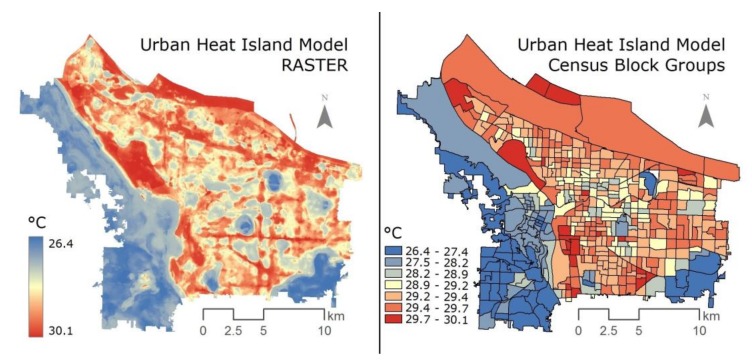
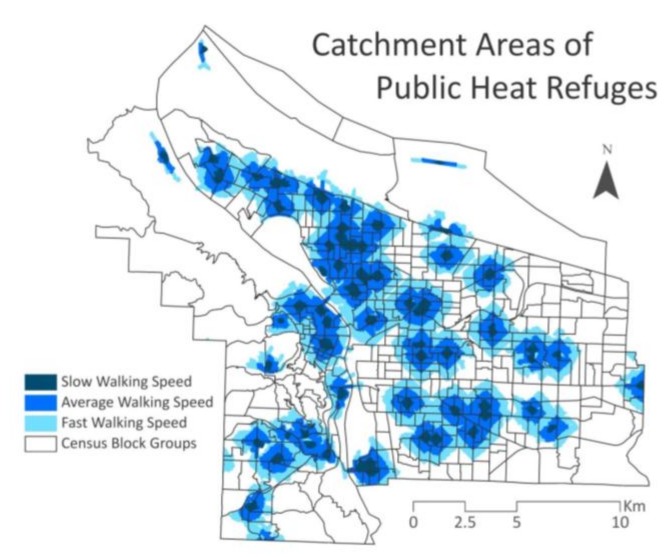
Extreme urban heat is a powerful environmental stressor which poses a significant threat to human health and well-being. Exacerbated by the urban heat island phenomenon, heat events are expected to become more intense and frequent as climate change progresses, though we have limited understanding of the impact of such events on vulnerable populations at a neighborhood or census block group level. Focusing on the City of Portland, Oregon, this study aimed to determine which socio-demographic populations experience disproportionate exposure to extreme heat, as well as the level of access to refuge in the form of public cooling centers or residential central air conditioning. During a 2014 heat wave, temperature data were recorded using a vehicle-traverse collection method, then extrapolated to determine average temperature at the census block group level. Socio-demographic factors including income, race, education, age, and English speaking ability were tested using statistical assessments to identify significant relationships with heat exposure and access to refuge from extreme heat. Results indicate that groups with limited adaptive capacity, including those in poverty and non-white populations, are at higher risk for heat exposure, suggesting an emerging concern of environmental justice as it relates to climate change. The paper concludes by emphasizing the importance of cultural sensitivity and inclusion, in combination with effectively distributing cooling centers in areas where the greatest burden befalls vulnerable populations.
Overview
The claims and statistics of this paper haven’t been checked yet.
Run the check — free, no account needed. It reads the open-access text and checks the sources it cites.
Integrity signals
Registry
Cites
Statistics
Figures
Verification
Claims the paper makes
The claims and statistics of this paper haven’t been checked yet.
Run the check — free, no account needed. It reads the open-access text and checks the sources it cites.
Claims other papers make about this one
Each is checked against this paper’s own text: does it say what the citing paper says it does?
The source backs part of the claim, not all of it — or backs it for a different population, condition or comparison.
In the citing paper
“Instead, research linking intracity differences in heat exposure to sociodemographic factors has typically been done in an ad hoc manner for a small number of individual cities23,29–32.”
From Disproportionate exposure to urban heat island intensity across major US cities (2021) · cites this paper as [23]
Experimental — accuracy not yet measuredThe source backs part of the claim, not all of it — or backs it for a different population, condition or comparison.
In the citing paper
“studies on the city have recently shown that racialized populations experience disproportionate exposure to extreme heat and have less access to refuge from high temperatures, be it green spaces or cooling centers (Nesbitt and Meitner, 2016;Voelkel et al., 2018).”
From Intersectional climate justice: A conceptual pathway for bridging adaptation planning, transformative action, and social equity (2022) · cites this paper as Voelkel et al., 2018
Experimental — accuracy not yet measuredThe source backs part of the claim, not all of it — or backs it for a different population, condition or comparison.
In the citing paper
“Portland has a long history of environmental racism, from redlining policies in the 20th century to the ongoing exclusion of non-white and low-income populations from green amenities, as studies on the city have recently shown that racialized populations experience disproportionate exposure to extreme heat and have less access to refuge from high temperatures, be it green spaces or cooling centers”
From Intersectional climate justice: A conceptual pathway for bridging adaptation planning, transformative action, and social equity (2022) · cites this paper as Voelkel et al., 2018
Experimental — accuracy not yet measuredThe source backs part of the claim, not all of it — or backs it for a different population, condition or comparison.
In the citing paper
“Although this choice does not diminish the environmental value of such initiatives, adaptation projects are shown to have a greater social impact on poorer neighborhoods, where residents are generally more vulnerable to heat (e.g., due to advanced age or pre-existing chronic medical conditions) and have less access to cooling options (Nesbitt and Meitner, 2016;Voelkel et al., 2018).”
From Intersectional climate justice: A conceptual pathway for bridging adaptation planning, transformative action, and social equity (2022) · cites this paper as Voelkel et al., 2018
Experimental — accuracy not yet measuredThe source backs part of the claim, not all of it — or backs it for a different population, condition or comparison.
In the citing paper
“Although this choice does not diminish the environmental value of such initiatives, adaptation projects are shown to have a greater social impact on poorer neighborhoods, where residents are generally more vulnerable to heat (e.g., due to advanced age or pre-existing chronic medical conditions) and have less access to cooling options(Nesbitt and Meitner, 2016;Voelkel et al., 2018).”
From Intersectional climate justice: A conceptual pathway for bridging adaptation planning, transformative action, and social equity (2022) · cites this paper as Voelkel et al., 2018
Experimental — accuracy not yet measured
The source backs part of the claim, not all of it — or backs it for a different population, condition or comparison.
In the citing paper
“In urban heat research, vulnerability is commonly associated with environmental, demographic, social, and urban-form characteristics that increase sensitivity or reduce coping capacity under hot conditions [33-35].”
From GPU-Accelerated Deep Learning for Heatwave Prediction and Urban Heat Risk Assessment (2026) · cites this paper as [34]
Experimental — accuracy not yet measuredThe cited source says what the claim attributes to it.
In the citing paper
“Small-scale case studies have found disparities in the distribution of urban heat island intensity within single cities23 or differences in exposure among population groups within a few cities in different countries24–26.”
From Disproportionate exposure to urban heat island intensity across major US cities (2021) · cites this paper as [23]
The cited source says what the claim attributes to it.
In the citing paper
“These findings provide comprehensive evidence supporting the narrative presented by earlier case studies that minority and low-income communities bear the brunt of the urban heat island effect23,25,26,29–32,35, air temperature23, and heat stress31 in individual or multicity studies.”
From Disproportionate exposure to urban heat island intensity across major US cities (2021) · cites this paper as [23]
The cited source says what the claim attributes to it.
In the citing paper
“Several recent studies have shown that vulnerability-oriented heat assessments benefit from integrating both social indicators and spatial characteristics of the urban fabric [34, 35].”
From GPU-Accelerated Deep Learning for Heatwave Prediction and Urban Heat Risk Assessment (2026) · cites this paper as [34]
Self-check
Percentages, sums and reported differences re-computed from the paper’s own numbers.
The self-check needs the paper’s full text.
Citations
Cites
NOTES ON CONTINUOUS STOCHASTIC PHENOMENA
MORAN, P. A. P. (1950) · Biometrika · doi:10.1093/biomet/37.1-2.17 · Cited by 8,622
World Urbanization Prospects: The 1996 Revision
Brockerhoff, M. P., & Nations, U. (1998) · Population and Development Review · doi:10.2307/2808041 · Cited by 5,900
The energetic basis of the urban heat island
Oke, T. R. (1982) · Quarterly Journal of the Royal Meteorological Society · doi:10.1002/qj.49710845502 · Cited by 4,670
A framework for vulnerability analysis in sustainability science
Turner, B. L., Kasperson, R. E., Matson, P. A., McCarthy, J. J., Corell, R. W., Christensen, L., Selin, N. E., Kasperson, J. X., Luers, A. L., Martello, M. L., et al. (2003) · Proceedings of the National Academy of Sciences · doi:10.1073/pnas.1231335100 · Cited by 4,378
More Intense, More Frequent, and Longer Lasting Heat Waves in the 21st Century
Meehl, G. A., & Tebaldi, C. (2004) · Science · doi:10.1126/science.1098704 · Cited by 4,322
Adaptive capacity and human cognition: The process of individual adaptation to climate change
Grothmann, T., & Patt, A. (2005) · Global Environmental Change · doi:10.1016/j.gloenvcha.2005.01.002 · Cited by 1,661
Yohe, G., & Tol, R. S. J. (2002) · Global Environmental Change · doi:10.1016/s0959-3780(01)00026-7 · Cited by 1,306
Normal walking speed: a descriptive meta-analysis
Bohannon, R. W., & Andrews, A. W. (2011) · Physiotherapy · doi:10.1016/j.physio.2010.12.004 · Cited by 926
Buyantuev, A., & Wu, J. (2009) · Landscape Ecology · doi:10.1007/s10980-009-9402-4 · Cited by 828
Mapping community determinants of heat vulnerability
Reid, C. E., O’Neill, M. S., Gronlund, C. J., Brines, S. J., Brown, D. G., Diez-Roux, A. V., & Schwartz, J. (2009) · Environmental Health Perspectives · doi:10.1289/ehp.0900683 · Cited by 805
The 2006 California Heat Wave: Impacts on Hospitalizations and Emergency Department Visits
Knowlton, K., Rotkin-Ellman, M., King, G., Margolis, H. G., Smıth, D. J., Solomon, G. M., Trent, R. B., & English, P. B. (2008) · Environmental Health Perspectives · doi:10.1289/ehp.11594 · Cited by 762
Estimates of the Damage Costs of Climate Change. Part 1: Benchmark Estimates
Tol, R. S. J. (2002) · Environmental and Resource Economics · doi:10.1023/a:1014500930521 · Cited by 742
The distributional impact of climate change on rich and poor countries
Mendelsohn, R. O., Dinar, A., & WILLIAMS, L. (2006) · Environment and Development Economics · doi:10.1017/s1355770x05002755 · Cited by 708
Future climate in the Pacific Northwest
Mote, P. W., & Salathé, E. P. (2010) · Climatic Change · doi:10.1007/s10584-010-9848-z · Cited by 590
Which Came First? Toxic Facilities, Minority Move-In, and Environmental Justice
Pastor, M., Sadd, J., & Hipp, J. R. (2001) · Journal of Urban Affairs · doi:10.1111/0735-2166.00072 · Cited by 567
The Cost of Racial and Class Exclusion in the Inner City
Wacquant, L. J. D., & Wilson, W. J. (1989) · The Annals of the American Academy of Political and Social Science · doi:10.1177/0002716289501001001 · Cited by 525
Certain Effects of Grouping upon the Size of the Correlation Coefficient in Census Tract Material
Gehlke, C. E., & Biehl, K. (1934) · Journal of the American Statistical Association · doi:10.1080/01621459.1934.10506247 · Cited by 520
Harlan, S. L., Declet-Barreto, J. H., Stefanov, W. L., & Petitti, D. B. (2013) · Environmental Health Perspectives · doi:10.1289/ehp.1104625 · Cited by 507
Study of green areas and urban heat island in a tropical city
Wong, N. H., & Chen, Y. (2004) · Habitat International · doi:10.1016/j.habitatint.2004.04.008 · Cited by 505
Uejio, C. K., Wilhelmi, O. V., Golden, J. S., Mills, D. M., Gulino, S. P., & Samenow, J. P. (2011) · Health & Place · doi:10.1016/j.healthplace.2010.12.005 · Cited by 504
Racial and Socioeconomic Disparities in Heat-Related Health Effects and Their Mechanisms: a Review
Gronlund, C. J. (2014) · Current Epidemiology Reports · doi:10.1007/s40471-014-0014-4 · Cited by 475
Hart, M., & Sailor, D. J. (2008) · Theoretical and Applied Climatology · doi:10.1007/s00704-008-0017-5 · Cited by 452
The urban heat island effect and city contiguity
Debbage, N., & Shepherd, J. M. (2015) · Computers Environment and Urban Systems · doi:10.1016/j.compenvurbsys.2015.08.002 · Cited by 447
The "Environmental Justice" Frame: A Conceptual Discussion and an Application
Čapek, S. M. (1993) · Social Problems · doi:10.1525/sp.1993.40.1.03x0069q · Cited by 361
van Hove, L. W. A., Jacobs, C. M. J., Heusinkveld, B. G., Elbers, J. A., van Driel, B. L., & Holtslag, A. A. M. (2014) · Building and Environment · doi:10.1016/j.buildenv.2014.08.029 · Cited by 327
Huang, G., Zhou, W., & Cadenasso, M. L. (2011) · Journal of Environmental Management · doi:10.1016/j.jenvman.2011.02.006 · Cited by 299
Grover, A., & Singh, R. (2015) · Environments · doi:10.3390/environments2020125 · Cited by 294
Spatial distribution and microscale characteristics of the urban heat island in Tel-Aviv, Israel
Saaroni, H., Ben‐Dor, E., Bitan, A., & Potchter, O. (2000) · Landscape and Urban Planning · doi:10.1016/s0169-2046(99)00075-4 · Cited by 248
Certain Effects of Grouping Upon the Size of the Correlation Coefficient in Census Tract Material
Gehlke, C. E., & Biehl, K. (1934) · Journal of the American Statistical Association · doi:10.2307/2277827 · Cited by 216
Vulnerability to Extreme Heat in Metropolitan Phoenix: Spatial, Temporal, and Demographic Dimensions
Chow, W., Chuang, W.-C., & Gober, P. A. (2011) · The Professional Geographer · doi:10.1080/00330124.2011.600225 · Cited by 210
Poorest countries experience earlier anthropogenic emergence of daily temperature extremes
Harrington, L. J., Frame, D. J., Fischer, E. M., Hawkins, E., Joshi, M., & JONES, C. D. (2016) · Environmental Research Letters · doi:10.1088/1748-9326/11/5/055007 · Cited by 196
Dhainaut, J.-F., Claessens, Y.-É., Ginsburg, C., & Riou, B. (2003) · Critical Care · doi:10.1186/cc2404 · Cited by 185
Johnson, D. P., & Wilson, J. S. (2009) · Applied Geography · doi:10.1016/j.apgeog.2008.11.004 · Cited by 182
Kotharkar, R., & Surawar, M. (2015) · Journal of Urban Planning and Development · doi:10.1061/(asce)up.1943-5444.0000277 · Cited by 158
Knowlton, K., Rotkin-Ellman, M., Geballe, L., Max, W. B., & Solomon, G. M. (2011) · Health Affairs · doi:10.1377/hlthaff.2011.0229 · Cited by 148
Study on the urban heat island mitigation effect achieved by converting to grass-covered parking
Takebayashi, H., & Moriyama, M. (2009) · Solar Energy · doi:10.1016/j.solener.2009.01.019 · Cited by 122
Ethnic Neighborhoods in Multi-Ethnic America, 1990-2000: Resurgent Ethnicity in the Ethnoburbs?
Wen, M., Lauderdale, D. S., & Kandula, N. R. (2009) · Social Forces · doi:10.1353/sof.0.0244 · Cited by 116
Urban Heat and Air Pollution: An Emerging Role for Planners in the Climate Change Debate
Stone, B. (2005) · Journal of the American Planning Association · doi:10.1080/01944360508976402 · Cited by 115
Effect of land cover on air temperatures involved in the development of an intra-urban heat island
Yokobori, T., & Ohta, S. (2009) · Climate Research · doi:10.3354/cr00800 · Cited by 105
The spatial variability of heat-related mortality in Massachusetts
Hattis, D. B., Ogneva-Himmelberger, Y. A., & Ratick, S. J. (2011) · Applied Geography · doi:10.1016/j.apgeog.2011.07.008 · Cited by 97
Impact of the 2011 heat wave on mortality and emergency department visits in Houston, Texas
Zhang, K., Chen, T.-H., & Begley, C. E. (2015) · Environmental Health · doi:10.1186/1476-069x-14-11 · Cited by 90
Voelkel, J. L., & Shandas, V. (2017) · Climate · doi:10.3390/cli5020041 · Cited by 78
Self-citationGraham, J. D., Chang, B., & Evans, J. S. (1992) · Risk Analysis · doi:10.1111/j.1539-6924.1992.tb00684.x · Cited by 77
Sociodemographic aspects of human susceptibility to toxic chemicals:
Sexton, K. (1997) · Environmental Toxicology and Pharmacology · doi:10.1016/s1382-6689(97)10020-5 · Cited by 71
Prioritizing Preferable Locations for Increasing Urban Tree Canopy in New York City
Locke, D. H., Grove, J. M., Lu, J. W. T., Troy, A. R., O'Niel-Dunne, J. P. M., & Beck, B. D. (2010) · Cities and the Environment · doi:10.15365/cate.3142010 · Cited by 61
Effects of the summer heat wave of 1988 on daily mortality in Allegheny County, PA.
Ramlow, J. M., & Kuller, L. H. (1990) · PubMed · Cited by 56
Lee, L., Chen, L., Wang, X., & Zhao, J. (2011) · International Conference on Remote Sensing, Environment and Transportation Engineering · doi:10.1109/rsete.2011.5964429 · Cited by 31
Developing High-Resolution Descriptions of Urban Heat Islands: A Public Health Imperative
Voelkel, J., Shandas, V., & Haggerty, B. (2016) · Preventing Chronic Disease · doi:10.5888/pcd13.160099 · Cited by 31
Self-citationGlobal 3D-Nephanalysis of Total Cloud Amount: Climatology for 1979
Hughes, N. A., & Henderson-Sellers, A. (1985) · Journal of Climate and Applied Meteorology · doi:10.1175/1520-0450(1985)024 · Cited by 27
Baldinelli, G., & Bonafoni, S. (2015) · Lecture notes in computer science · doi:10.1007/978-3-319-23222-5_12 · Cited by 15
Climate Justice: Towards a Proactive Response to Social Inequities
Shandas, V. (2009) · PDXScholar (Portland State University) · Cited by 3
Self-citation4. Urban Growth and Neighborhood Change
Downs, A. J. (2010) · Rowman & Littlefield Publishers eBooks · doi:10.5771/9780815717348-37 · Cited by 1
Research works printed but not linked: 1
- Szasz, A. (1994). Ecopopulism: Toxic Waste and the Movement for Environmental Justice, University of Minnesota Press.
Cited by
Sorted by citations
Hoffman, J. S., Shandas, V., & Pendleton, N. (2020) · Climate · doi:10.3390/cli8010012 · Cited by 842
Self-citationDisproportionate exposure to urban heat island intensity across major US cities
Hsu, A., Sheriff, G., Chakraborty, T., & Manya, D. (2021) · Nature Communications · doi:10.1038/s41467-021-22799-5 · Cited by 846
Qian, Y., Chakraborty, T., Li, J., Li, D., He, C., Sarangi, C., Chen, F., Yang, X., & Leung, L.-Y. R. (2022) · Advances in Atmospheric Sciences · doi:10.1007/s00376-021-1371-9 · Cited by 379
Amorim-Maia, A. T., Anguelovski, I., Chu, E., & Connolly, J. (2022) · Urban Climate · doi:10.1016/j.uclim.2021.101053 · Cited by 328
Envisioning environmental equity: climate change, health, and racial justice
Deivanayagam, T. A., English, S., Hickel, J., Bonifacio, J., Guinto, R., Hill, K. X., Huq, M., Issa, R., Mulindwa, H., Nagginda, H. P., et al. (2023) · The Lancet · doi:10.1016/s0140-6736(23)00919-4 · Cited by 260
Metadata
- Authors
- Voelkel, J., Hellman, D., Sakuma, R., & Shandas, V.
- Affiliations
- Portland State University (US)
- Peace Winds Japan, Tokyo 151-0063, Japan
- Corresponding author
- Shandas, Vivek
- Venue
- International Journal of Environmental Research and Public Health
- Publisher
- MDPI AG
- Published
- 2018-03-30
- Volume
- 15
- Issue
- 4
- Pages
- 640
- ISSN
- 1660-4601 (ISSN-L)
- PMC
- PMC5923682
- OpenAlex
- W2794659326
- Cited by
- 278
- References
- 52
- Citations by year
- 2026: 49 · 2025: 38 · 2024: 44 · 2023: 52 · 2022: 34 · 2021: 33 · 2020: 17 · 2019: 10 · 2018: 1
- FWCI
- 7.53
- Type
- journal article
- Language
- en
- Open access
- gold
- doi.org
- Licence
- Locations
- International Journal of Environmental Research and Public Health (publishedVersion, cc-by)
- Europe PMC (PubMed Central) (publishedVersion, cc-by)
- PubMed Central (publishedVersion, cc-by)
- PubMed (publishedVersion)
- PDXScholar (Portland State University) (submittedVersion, cc-by)
- RePEc: Research Papers in Economics (submittedVersion)
- DOAJ (DOAJ: Directory of Open Access Journals) (submittedVersion, cc-by-sa)
- Funders
- National Science Foundation (1444755)
- Portland State University
- U.S. Forest Service (17-DG-11132544-014)
- Topics
- Physical Sciences › Environmental Science › Health, Toxicology and Mutagenesis › Climate Change and Health Impacts
- Social Sciences › Sociology and Political Science › Environmental Justice and Health Disparities
- Physical Sciences › Environmental Science › Environmental Engineering › Urban Heat Island Mitigation
- Keywords
- urban heat, urban heat island, heat exposure, vulnerable populations, sociodemographic disparities, cooling centers, central air conditioning, environmental justice, climate change, heat waves, poverty, race, Portland, Oregon, census block groups
- MeSH terms
- Adult, Aged, Cities, Environmental Exposure, Hot Temperature, Humans, Middle Aged, Oregon, Residence Characteristics, Socioeconomic Factors, Urban Health, Heat Stress Disorders, Vulnerable Populations, Health Status Disparities, Young Adult, Climate Change
About these checks
Registry, retraction, Cites and statistics results are computed, not judged, with one exception: a printed reference that no index lists is read once by a model before it counts as a citation error. Claims are extracted by a model and kept only when their quote appears verbatim in the text; each cited source is then checked, with a model’s help, for whether it says what the claim relies on. Those verdicts can be wrong — read the claim’s quote and the cited source before relying on one.
Statistics and arithmetic are recomputed, not judged.
Confidence bands are shown only for fields calibrated on our annotated test set. None is calibrated yet, so no band is shown.
What counts as a claim ›How we measure confidence ›How we check this ›
Are you an author, or do you see a problem with this page? Request a review
