

The DOI matches its Crossref record; 18 of the 18 references it cites were found in a registry or an index.
Mental Health Literacy in Young Adults: Adaptation and Psychometric Properties of the Mental Health Literacy Questionnaire
Open accessAbstract
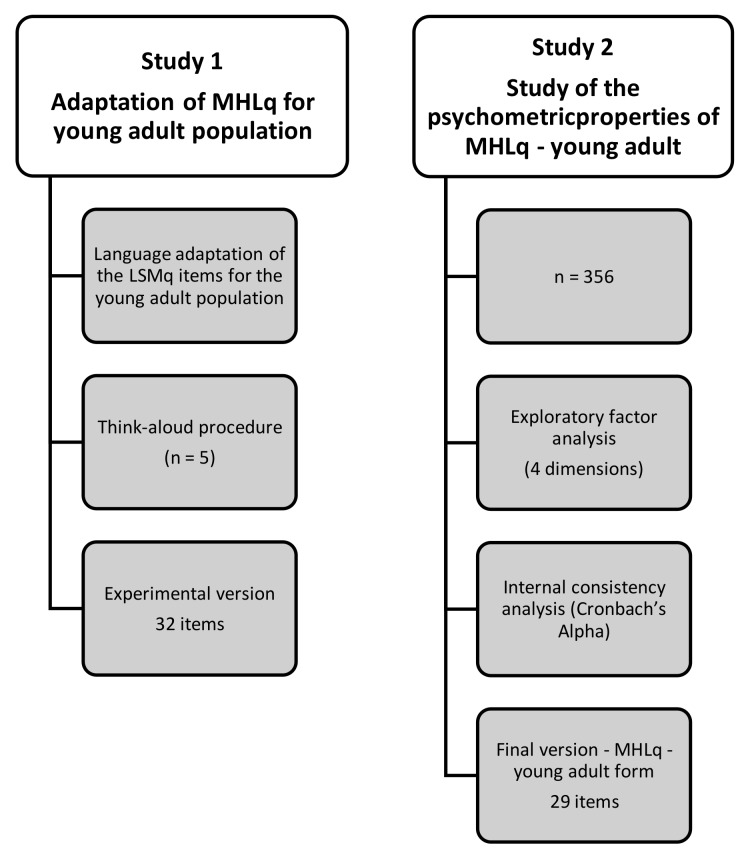
Mental health literacy (MHL) is considered a prerequisite for early recognition and intervention in mental disorders, and for this reason, it has become a focus of research over the past few decades. Assessing this construct is relevant for identifying knowledge gaps and erroneous beliefs concerning mental health issues, to inform the development of interventions aimed at promoting mental health literacy as well as the evaluation of these interventions. Recently, we developed a new self-reporting measure (MHLq) for assessing mental health literacy in young people (12–14 years-old), meeting the need to assess MHL from a comprehensive perspective of the construct instead of focusing on a restricted number of mental disorders or specific dimensions (e.g., knowledge concerning specific disorders; stigma). The present study aimed to adapt the MHLq for the young adult population and to examine its psychometric properties, according to the following steps: (1) item adaptation, using a think aloud procedure (n = 5); (2) data collection (n = 356, aged between 18 and 25 years old; and (3) psychometric analyses (exploratory factor analysis and internal consistency analysis). The final version of the questionnaire included 29 items (total scale α = 0.84), organized by four dimensions: (1) knowledge of mental health problems (α = 0.74); (2) erroneous beliefs/stereotypes (α = 0.72); (3) help-seeking and first aid skills (α = 0.71); and (4) self-help strategies (α = 0.60). The results suggest that the MHLq-adult form is a practical, valid, and reliable screening tool for identifying gaps in knowledge, beliefs, and behavioral intentions related to mental health and mental disorders, planning promotion programs, and evaluating intervention effectiveness.
Overview
The claims and statistics of this paper haven’t been checked yet.
Run the check — free, no account needed. It reads the open-access text and checks the sources it cites.
Integrity signals
Registry
Cites
Statistics
Figures
Verification
Claims the paper makes
The claims and statistics of this paper haven’t been checked yet.
Run the check — free, no account needed. It reads the open-access text and checks the sources it cites.
Claims other papers make about this one
Each is checked against this paper’s own text: does it say what the citing paper says it does?
In the citing paper
“To evaluate MHL, questionnaires were developed for the target population presented above, notably the Mental Health Literacy Scale [53], the Multicomponent Mental Health Literacy Scale [54], and the Mental Health Literacy Questionnaire [55].”
From Mental health literacy intervention on help-seeking in athletes: a systematic review (2020) · cites this paper as [55]
Self-check
Percentages, sums and reported differences re-computed from the paper’s own numbers.
The self-check needs the paper’s full text.
Citations
Cites
What is coefficient alpha? An examination of theory and applications
Cortina, J. M. (1993) · Journal of Applied Psychology · doi:10.1037/0021-9010.78.1.98 · Cited by 8,810
Jorm, A. F., Korten, A. E., Jacomb, P. A., Christensen, H., Rodgers, B., & Pollitt, P. (1997) · Medical Journal of Australia · doi:10.5694/j.1326-5377.1997.tb140071.x · Cited by 2,585
Mental health literacy: Public knowledge and beliefs about mental disorders
Jorm, A. F. (2000) · British Journal of Psychiatry · doi:10.1192/bjp.177.5.396 · Cited by 2,114
Mental health literacy: empowering the community to take action for better mental health
Jorm, A. F. (2012) · American Psychologist · doi:10.1037/a0025957 · Cited by 1,783
Measuring Mental Illness Stigma
Link, B. G., Yang, L. H., Phelan, J. C., & Collins, P. Y. (2004) · Schizophrenia Bulletin · doi:10.1093/oxfordjournals.schbul.a007098 · Cited by 1,474
Mackenzie, C. S., Gekoski, W. L., & Knox, V. J. (2006) · Aging & Mental Health · doi:10.1080/13607860600641200 · Cited by 878
Familiarity With and Social Distance From People Who Have Serious Mental Illness
Corrigan, P. W., Green, A., Lundin, R., Kubiak, M. A., & Penn, D. L. (2001) · Psychiatric Services · doi:10.1176/appi.ps.52.7.953 · Cited by 535
Development and psychometric properties of the Mental Health Knowledge Schedule
Evans-Lacko, S., Little, K., Meltzer, H., Rose, D., Rhydderch, D., Henderson, C., & Thornicroft, G. (2010) · The Canadian Journal of Psychiatry · doi:10.1177/070674371005500707 · Cited by 402
Angermeyer, M. C., Matschinger, H., & Corrigan, P. W. (2004) · Schizophrenia Research · doi:10.1016/s0920-9964(03)00186-5 · Cited by 354
Influence of Gender on Mental Health Literacy in Young Australians
Cotton, S., Wright, A., Harris, M., Jorm, A. F., & McGorry, P. D. (2006) · Australian & New Zealand Journal of Psychiatry · doi:10.1080/j.1440-1614.2006.01885.x · Cited by 352
Research works printed but not linked: 1
- Janda, L. (1998). Psychological Testing: Theory and Applications, Pearson. [1st ed.].
Cited by
Sorted by citations
What is good mental health? A scoping review
Fusar-Poli, P., Salazar de Pablo, G., De Micheli, A., Nieman, D. H., Correll, C. U., Kessing, L. V., Pfennig, A., Bechdolf, A., Borgwardt, S., Arango, C., et al. (2020) · European Neuropsychopharmacology · doi:10.1016/j.euroneuro.2019.12.105 · Cited by 356
Tavousi, M., Mohammadi, S., Sadighi, J., Zarei, F., Kermani, R. M., Rostami, R., & Montazeri, A. (2022) · PLoS ONE · doi:10.1371/journal.pone.0271524 · Cited by 165
Mental Health Literacy in Healthcare Students: An Expansion of the Mental Health Literacy Scale
Chao, H.-J., Lien, Y., Kao, Y., Tasi, I.-C., Lin, H.-S., & Lin, H.-S. (2020) · International Journal of Environmental Research and Public Health · doi:10.3390/ijerph17030948 · Cited by 82
Mental health literacy and quality of life in Iran: a cross-sectional study
Jafari, A., Nejatian, M., Momeniyan, V., Barsalani, F. R., & Tehrani, H. (2021) · BMC Psychiatry · doi:10.1186/s12888-021-03507-5 · Cited by 67
Mental health literacy intervention on help-seeking in athletes: a systematic review
Bu, D., Chung, P.-K., Zhang, C.-Q., Liu, J., & Wang, X. (2020) · International Journal of Environmental Research and Public Health · doi:10.3390/ijerph17197263 · Cited by 61
Metadata
- Authors
- Dias, P., Campos, L., Almeida, H., & Palha, F.
- Affiliations
- Universidade Católica Portuguesa (PT)
- Corresponding author
- Campos, Luísa
- Venue
- International Journal of Environmental Research and Public Health
- Publisher
- MDPI AG
- Published
- 2018-06-23
- Volume
- 15
- Issue
- 7
- Pages
- 1318
- ISSN
- 1660-4601 (ISSN-L)
- PMC
- PMC6068770
- OpenAlex
- W2808937049
- Cited by
- 137
- References
- 18
- Citations by year
- 2026: 21 · 2025: 28 · 2024: 13 · 2023: 22 · 2022: 26 · 2021: 13 · 2020: 8 · 2019: 5 · 2018: 1
- FWCI
- 9.16
- Type
- journal article
- Language
- en
- Open access
- gold
- dx.doi.org
- Licence
- Locations
- International Journal of Environmental Research and Public Health (publishedVersion, cc-by)
- Europe PMC (PubMed Central) (publishedVersion, cc-by)
- PubMed Central (publishedVersion, cc-by)
- PubMed (publishedVersion)
- RePEc: Research Papers in Economics (submittedVersion)
- DOAJ (DOAJ: Directory of Open Access Journals) (submittedVersion)
- Portuguese National Funding Agency for Science, Research and Technology (RCAAP Project by FCT) (submittedVersion, cc-by)
- Funders
- Fundação para a Ciência e a Tecnologia (UID/CED/4872/2016)
- Topics
- Health Sciences › Medicine › Psychiatry and Mental health › Mental Health Treatment and Access
- Health Sciences › Nursing › Research and Theory › Health Education and Validation
- Health Sciences › Health Professions › General Health Professions › Health Literacy and Information Accessibility
- Keywords
- mental health literacy, young adults, questionnaire adaptation, psychometric properties, mental health knowledge, mental illness stereotypes, help-seeking, self-help strategies, mental health screening, mental illness
- MeSH terms
- Adolescent, Adult, Age Factors, Mental Disorders, Child, Female, Humans, Male, Mental Health, Psychometrics, Surveys and Questionnaires, Reproducibility of Results, Young Adult, Health Literacy
About these checks
Registry, retraction, Cites and statistics results are computed, not judged, with one exception: a printed reference that no index lists is read once by a model before it counts as a citation error. Claims are extracted by a model and kept only when their quote appears verbatim in the text; each cited source is then checked, with a model’s help, for whether it says what the claim relies on. Those verdicts can be wrong — read the claim’s quote and the cited source before relying on one.
Statistics and arithmetic are recomputed, not judged.
Confidence bands are shown only for fields calibrated on our annotated test set. None is calibrated yet, so no band is shown.
What counts as a claim ›How we measure confidence ›How we check this ›
Are you an author, or do you see a problem with this page? Request a review
