

The DOI matches its Crossref record; 6 of the 6 references it cites were found in a registry or an index.
An Augmented Risk Information Seeking Model: Perceived Food Safety Risk Related to Food Recalls
Abstract
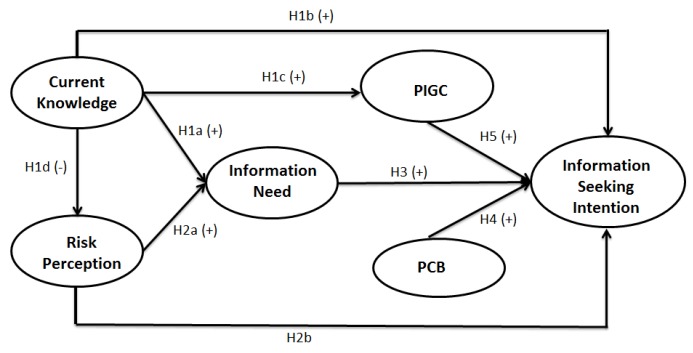
Food safety is of worldwide concern. As an effective mechanism governing food safety, food recalls are widely applied around the world. Though it is well known that food recalls can have substantial, negative impacts on corporate reputation and marketing, we know relatively little related to what factors motivate people to seek related information after the recall announcement. This study attempts to elucidate the determinants of information-seeking intention in the context of food safety in food recalls by using an augmented risk information-seeking model. A survey of 631 Chinese residents was used to explore the proposed framework. The results show that current knowledge, risk perception, perceived channel beliefs, and perceived information-gathering capacity (PIGC) are all significant predictors of information need and information-seeking intention. It was also confirmed that risk perception has a positive correlation with seeking need. These findings are important for policymakers, recalling manufacturers, and retailers to develop strategies for better risk communication in food recall announcements.
Overview
The claims and statistics of this paper haven’t been checked yet.
Run the check — free, no account needed. It reads the open-access text and checks the sources it cites.
Integrity signals
Registry
Cites
Statistics
Figures
Verification
Claims the paper makes
The claims and statistics of this paper haven’t been checked yet.
Run the check — free, no account needed. It reads the open-access text and checks the sources it cites.
Claims other papers make about this one
Each is checked against this paper’s own text: does it say what the citing paper says it does?
The source backs part of the claim, not all of it — or backs it for a different population, condition or comparison.
In the citing paper
“Liao et al. showed that channel beliefs, current knowledge, risk perception, and perceived information-gathering capacity (PIGC) are all significant predictors of information needs [30].”
From Risk Information Seeking Behavior in Disaster Resettlement: A Case Study of Ankang City, China (2020) · cites this paper as [30]
Experimental — accuracy not yet measured
Self-check
Percentages, sums and reported differences re-computed from the paper’s own numbers.
The self-check needs the paper’s full text.
Citations
Cites
The theory of planned behavior
Ajzen, I. (1991) · Organizational Behavior and Human Decision Processes · doi:10.1016/0749-5978(91)90020-t · Cited by 90,587
The Protective Action Decision Model: Theoretical Modifications and Additional Evidence
Lindell, M. K., & Perry, R. W. (2012) · Risk Analysis · doi:10.1111/j.1539-6924.2011.01647.x · Cited by 1,868
Griffin, R. J., Dunwoody, S., & Neuwirth, K. (1999) · Environmental Research · doi:10.1006/enrs.1998.3940 · Cited by 1,187
Understanding Web-based learning continuance intention: The role of subjective task value
Chiu, C.-M., & Wang, E. T. G. (2008) · Information & Management · doi:10.1016/j.im.2008.02.003 · Cited by 869
Toward a Theory of Motivated Information Management
Afifi, W. A., & Weiner, J. L. (2004) · Communication Theory · doi:10.1111/j.1468-2885.2004.tb00310.x · Cited by 683
PRISM: A Planned Risk Information Seeking Model
Kahlor, L. (2010) · Health Communication · doi:10.1080/10410231003775172 · Cited by 531
Research works printed but not linked: 60
- Zhao, 2013, The financial impact of product recall announcements in China, Int. J. Prod. Econ., 142, 115, 10.1016/j.ijpe.2012.10.018 · DOI
- Pozo, 2016, Evaluating the costs of meat and poultry recalls to food firms using stock returns, Food Policy, 59, 66, 10.1016/j.foodpol.2015.12.007 · DOI
- Xu, 2014, Study of traceability system impact on food recall cost based on food recall cost model, J. China Agric. Univ., 2, 035
- Wu, 2013, Public risk perception of food additives and food scares. The case in Suzhou, China, Appetite, 70, 90, 10.1016/j.appet.2013.06.091 · DOI
- Rozin, 1986, Psychological factors influencing food choice, Food Consum., 5, 85
- Griffin, 2008, After the flood: Anger, attribution, and the seeking of information, Sci. Commun., 29, 285, 10.1177/1075547007312309 · DOI · Paper page
- Kellens, 2012, The Informed Society: An analysis of the public’s information-seeking behavior regarding coastal flood risks, Risk Anal., 32, 1369, 10.1111/j.1539-6924.2011.01743.x · DOI · Paper page
- Kahlor, 2007, An augmented risk information seeking model: The case of global warming, Media Psychol., 10, 414, 10.1080/15213260701532971 · DOI
- Griffin, 2004, Information sufficiency and risk communication, Media Psychol., 6, 23, 10.1207/s1532785xmep0601_2 · DOI
- Patrick, 2007, Effectiveness of recall notification: Community response to a nationwide recall of hot dogs and deli meats, J. Food Prot., 70, 2373, 10.4315/0362-028X-70.10.2373 · DOI
- Steelfisher, 2010, Public perceptions of food recalls and production safety: Two surveys of the American public, J. Food Saf., 30, 848, 10.1111/j.1745-4565.2010.00246.x · DOI
- Fleming, 2006, Going beyond exposure to local news media: An information-processing examination of public perceptions of food safety, J. Health Commun., 11, 789, 10.1080/10810730600959705 · DOI
- Wilcock, 2004, Consumer attitudes, knowledge and behaviour: A review of food safety issues, Trends Food Sci. Technol., 15, 56, 10.1016/j.tifs.2003.08.004 · DOI · Paper page
- Vij, 2006, Recalls of spices due to bacterial contamination monitored by the US Food and Drug Administration: The predominance of Salmonellae, J. Food Prot., 69, 233, 10.4315/0362-028X-69.1.233 · DOI
- Qiang, 2011, Application of content analysis in food safety reports on the internet in China, Food Control, 22, 252, 10.1016/j.foodcont.2010.07.005 · DOI
- Li, R., Wu, H.L., Yin, S.J., and Chen, X.J. (2017). Introductiong to 2017 China Developmet Report on Food Safety, Pecking University Press.
- Wilson, 2000, Human information behavior, Inform. Sci., 3, 49
- Johnson, 1983, Affect, generalization, and the perception of risk, J. Personal. Soc. Psychol., 45, 20, 10.1037/0022-3514.45.1.20 · DOI
- Griffin, 2009, Risk information seeking among US and Dutch residents: An application of the model of risk information seeking and processing, Sci. Commun., 31, 215, 10.1177/1075547009332653 · DOI
- Yang, 2014, Risk information seeking and processing model: A meta-analysis, J. Commun., 64, 20, 10.1111/jcom.12071 · DOI
- Johnson, 1993, A comprehensive model of cancer-related information seeking applied to magazines, Hum. Commun. Res., 19, 343, 10.1111/j.1468-2958.1993.tb00305.x · DOI
- Freimuth, V.S., Stein, J.A., and Kean, T.J. (1989). Searching for Health Information: The Cancer Information Service Model, University of Pennsylvania Press. · DOI
- Radecki, 1995, Perceptions of knowledge, actual knowledge, and information search behavior, J. Exp. Soc. Psychol., 31, 107, 10.1006/jesp.1995.1006 · DOI
- Drichoutis, 2005, Nutrition knowledge and consumer use of nutritional food labels, Eur. Rev. Agric. Econ., 32, 93, 10.1093/erae/jbi003 · DOI
- Griffin, 1990, Energy in the eighties: Education, communication, and the knowledge gap, J. Q., 67, 554
- Yeung, 2001, Food safety risk: Consumer perception and purchase behaviour, Br. Food J., 103, 170, 10.1108/00070700110386728 · DOI
- Chen, 2007, The consumer’s attitude toward genetically modified foods in Taiwan, Food Qual. Prefer., 18, 662, 10.1016/j.foodqual.2006.10.002 · DOI
- Verdurme, 2003, Consumer beliefs and attitude towards genetically modified food: Basis for segmentation and implications for communication, Agribusiness, 19, 91, 10.1002/agr.10045 · DOI
- Baird, 1985, Toward a contingency model of strategic risk taking, Acad. Manag. Rev., 10, 230, 10.2307/257965 · DOI
- Bettman, J.R. (1973). Perceived risk and its components: A model and empirical test. J. Mark. Res., 184–190. · DOI
- Alaszewski, A. (2005). A person-centred approach to communicating risk. PLoS Med., 2. · DOI
- Huurne, 2008, Information needs and risk perception as predictors of risk information seeking, J. Risk Res., 11, 847, 10.1080/13669870701875750 · DOI · Paper page
- Feng, 2014, An empirical study of the toxic capsule crisis in China: Risk perceptions and behavioral responses, Risk Anal., 34, 698, 10.1111/risa.12099 · DOI
- Verbeke, 2005, Agriculture and the food industry in the information age, Eur. Rev. Agric. Econ., 32, 347, 10.1093/eurrag/jbi017 · DOI
- Rubin, A.M. (1986). Uses, gratifications, and media effects research. Perspect. Media Effic., 281–301. Available online: https://www.researchgate.net/profile/Thomas_Ruggiero/publication/233138016_Uses_and_Gratifications_Theory_in_the_21st_Century/links/5a119b03458515cc5aa98ba0/Uses-and-Gratifications-Theory-in-the-21st-Century.pdf.
- Kuttschreuter, 2014, Seeking information about food-related risks: The contribution of social media, Food Qual. Prefer., 37, 10, 10.1016/j.foodqual.2014.04.006 · DOI
- Erci, 2018, Reliability and validity of knowledge and behaviours related food additives scale, Adv. Nurs. Midwifery, 27, 8
- Gearhardt, 2009, Preliminary validation of the Yale food addiction scale, Appetite, 52, 430, 10.1016/j.appet.2008.12.003 · DOI · Paper page
- Chen, 2017, Modeling an extended theory of planned behavior model to predict intention to take precautions to avoid consuming food with additives, Food Qual. Prefer., 58, 24, 10.1016/j.foodqual.2017.01.002 · DOI
- Griffin, 2002, Linking the heuristic-systematic model and depth of processing, Commun. Res., 29, 705, 10.1177/009365002237833 · DOI
- Hill, 1997, Non-response bias in a lifestyle survey, J. Public Health, 19, 203, 10.1093/oxfordjournals.pubmed.a024610 · DOI
- Kamakura, W.A. (2010). Common methods bias. Wiley Int. Encycl. Mark. · DOI
- Schwarz, A., Schwarz, C., and Rizzuto, T. (2008, January 7–10). Examining the “Urban Legend” of Common Method Bias: Nine Common Errors and Their Impact. Proceedings of the 41st Annual Hawaii International Conference on System Sciences, Big Island, HI, USA. · DOI
- Harman, H.H. (1976). Modern Factor Analysis, University of Chicago Press.
- Petter, 2007, Specifying formative constructs in information systems research, MIS Q., 31, 623, 10.2307/25148814 · DOI · Paper page
- Barroso, C., Carrión, G.C., and Roldán, J.L. (2010). Applying maximum likelihood and PLS on different sample sizes: Studies on SERVQUAL model and employee behavior model. Handbook of Partial Least Squares, Springer. · DOI
- Anderson, 1988, Structural equation modeling in practice: A review and recommended two-step approach, Psychol. Bull., 103, 411, 10.1037/0033-2909.103.3.411 · DOI · Paper page
- Fornell, 1981, Evaluating structural equation models with unobservable variables and measurement error, J. Mark. Res., 18, 39, 10.1177/002224378101800104 · DOI · Paper page
- Baron, 1986, The moderator–mediator variable distinction in social psychological research: Conceptual, strategic, and statistical considerations, J. Personal. Soc. Psychol., 51, 1173, 10.1037/0022-3514.51.6.1173 · DOI · Paper page
- Hair, J.F., Hult, G.T.M., Ringle, C., and Sarstedt, M. (2016). A Primer on Partial Least Squares Structural Equation Modeling (PLS-SEM), Sage Publications.
- Tenenhaus, 2005, PLS path modeling, Comput. Stat. Data Anal., 48, 159, 10.1016/j.csda.2004.03.005 · DOI · Paper page
- Wetzels, 2009, Using PLS path modeling for assessing hierarchical construct models: Guidelines and empirical illustration, MIS Q., 33, 177, 10.2307/20650284 · DOI · Paper page
- Klerck, 2007, The effect of knowledge types on consumer-perceived risk and adoption of genetically modified foods, Psychol. Mark., 24, 171, 10.1002/mar.20157 · DOI
- He, 2014, Nuclear power in China after Fukushima: Understanding public knowledge, attitudes, and trust, J. Risk Res., 17, 435, 10.1080/13669877.2012.726251 · DOI
- Song, 2009, If it’s difficult to pronounce, it must be risky: Fluency, familiarity, and risk perception, Psychol. Sci., 20, 135, 10.1111/j.1467-9280.2009.02267.x · DOI
- Jepsen, 2007, Factors affecting consumer use of the Internet for information search, J. Int. Mark., 21, 21
- Brucks, 1985, The effects of product class knowledge on information search behavior, J. Consum. Res., 12, 1, 10.1086/209031 · DOI
- Yang, 2010, Motivation for health information seeking and processing about clinical trial enrollment, Health Commun., 25, 423, 10.1080/10410236.2010.483338 · DOI
- Yang, 2013, What, me worry? The role of affect in information seeking and avoidance, Sci. Commun., 35, 189, 10.1177/1075547012441873 · DOI · Paper page
- Carlson, 2012, Rethinking food recall communications for consumers, Iridescent, 2, 11, 10.1080/19235003.2012.11428511 · DOI
Cited by
Sorted by citations
Risk Information Seeking Behavior in Disaster Resettlement: A Case Study of Ankang City, China
Shi, J., Hu, X., Guo, X., & Lian, C. (2020) · International Journal of Environmental Research and Public Health · doi:10.3390/ijerph17197352 · Cited by 17
Metadata
- Authors
- Liao, C., Zhou, X., & Zhao, D.
- Affiliations
- School of Economics and Management, Southwest University of Science and Technology, Mianyang 621010, China
- School of Management, University of Science and Technology of China, Hefei 230026, China
- ORCID
- Liao, Chuanhui
- Venue
- International Journal of Environmental Research and Public Health
- Publisher
- MDPI AG
- Published
- 2018-08-21
- Volume
- 15
- Issue
- 9
- Pages
- 1800
- ISSN
- 1660-4601
- PMC
- PMC6165319
- Cited by
- 31
- References
- 6
- Language
- en
- Funders
- Annual Project of Soft Science of Sichuan Province (18RKX0993)
- High level research team in Sichuan philosophy and Social Sciences (15ss0103)
About these checks
Registry, retraction, Cites and statistics results are computed, not judged, with one exception: a printed reference that no index lists is read once by a model before it counts as a citation error. Claims are extracted by a model and kept only when their quote appears verbatim in the text; each cited source is then checked, with a model’s help, for whether it says what the claim relies on. Those verdicts can be wrong — read the claim’s quote and the cited source before relying on one.
Statistics and arithmetic are recomputed, not judged.
Confidence bands are shown only for fields calibrated on our annotated test set. None is calibrated yet, so no band is shown.
What counts as a claim ›How we measure confidence ›How we check this ›
Are you an author, or do you see a problem with this page? Request a review
