

The DOI matches its Crossref record; 133 of the 136 references it cites were found in a registry or an index.
The Global Prevalence of Anxiety Among Medical Students: A Meta-Analysis
Open accessAbstract
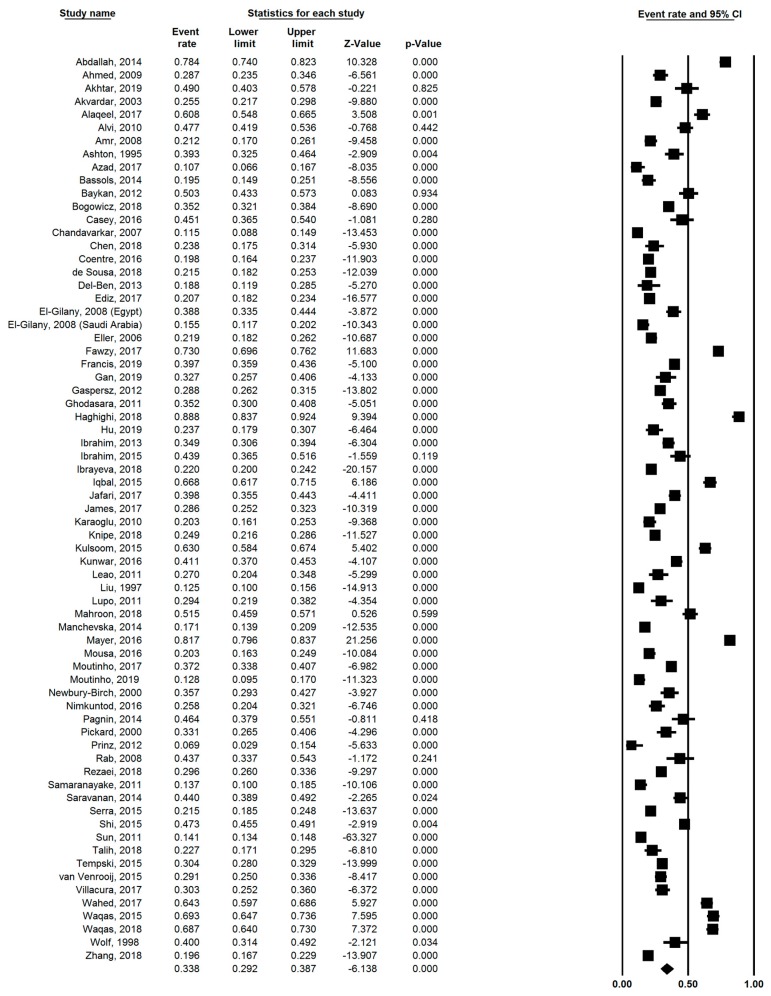
Anxiety, although as common and arguably as debilitating as depression, has garnered less attention, and is often undetected and undertreated in the general population. Similarly, anxiety among medical students warrants greater attention due to its significant implications. We aimed to study the global prevalence of anxiety among medical students and the associated factors predisposing medical students to anxiety. In February 2019, we carried out a systematic search for cross-sectional studies that examined the prevalence of anxiety among medical students. We computed the aggregate prevalence and pooled odds ratio (OR) using the random-effects model and used meta-regression analyses to explore the sources of heterogeneity. We pooled and analyzed data from sixty-nine studies comprising 40,348 medical students. The global prevalence rate of anxiety among medical students was 33.8% (95% Confidence Interval: 29.2–38.7%). Anxiety was most prevalent among medical students from the Middle East and Asia. Subgroup analyses by gender and year of study found no statistically significant differences in the prevalence of anxiety. About one in three medical students globally have anxiety—a prevalence rate which is substantially higher than the general population. Administrators and leaders of medical schools should take the lead in destigmatizing mental illnesses and promoting help-seeking behaviors when students are stressed and anxious. Further research is needed to identify risk factors of anxiety unique to medical students.
Overview
The claims and statistics of this paper haven’t been checked yet.
Run the check — free, no account needed. It reads the open-access text and checks the sources it cites.
Integrity signals
Registry
Cites
Statistics
Figures
Verification
Claims the paper makes
The claims and statistics of this paper haven’t been checked yet.
Run the check — free, no account needed. It reads the open-access text and checks the sources it cites.
Claims other papers make about this one
Each is checked against this paper’s own text: does it say what the citing paper says it does?
The cited source says what the claim attributes to it.
In the citing paper
“a meta-analysis revealed that approximately 1 in 3 medical students worldwide experiences anxiety, a rate significantly exceeding that of the general population [5].”
Self-check
Percentages, sums and reported differences re-computed from the paper’s own numbers.
The self-check needs the paper’s full text.
Citations
Cites
Preferred Reporting Items for Systematic Reviews and Meta-Analyses: the PRISMA statement
Moher, D., Liberati, A., Tetzlaff, J., Altman, D. G., & for the PRISMA Group (2009) · BMJ · doi:10.1136/bmj.b2535 · Cited by 83,823
Preferred Reporting Items for Systematic Reviews and Meta-Analyses: The PRISMA Statement
Moher, D., Liberati, A., Tetzlaff, J., Altman, D. G., & The PRISMA Group (2009) · PLoS Medicine · doi:10.1371/journal.pmed.1000097 · Cited by 64,042 · cited 1×
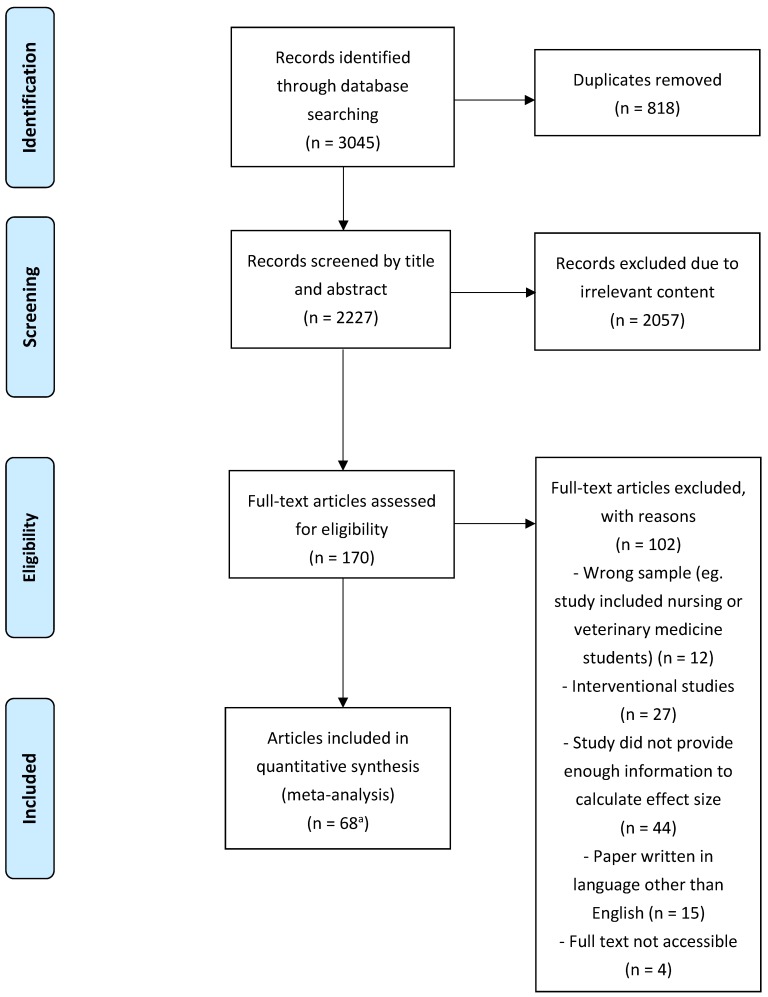
“The selection process, based on the Preferred Reporting Items for Systematic Reviews and Meta-Analyses (PRISMA) guidelines [18], is detailed in Figure 1.”
Bias in meta-analysis detected by a simple, graphical test
Egger, M., Smith, G. D., Schneider, M., & Minder, C. (1997) · BMJ · doi:10.1136/bmj.315.7109.629 · Cited by 56,722 · cited 1×
“We evaluated publication bias using the Egger’s regression method [22].”
MethodThe Hospital Anxiety and Depression Scale
Zigmond, A. S., & Snaith, R. P. (1983) · Acta Psychiatrica Scandinavica · doi:10.1111/j.1600-0447.1983.tb09716.x · Cited by 47,139 · cited 4×
“As a comparison, the prevalence of anxiety among the general population was found to be 3% as screened by the DASS-21 [96], 8.2% as screened by the GAD-7 [97], not more than 10% as screened by the BAI-21 [98] and not more than 25% as screened by the HADS-A [99].”
MethodInfluentialA Brief Measure for Assessing Generalized Anxiety Disorder: The GAD-7
Spitzer, R. L., Kroenke, K., Williams, J. B. W., & Löwe, B. (2006) · Archives of Internal Medicine · doi:10.1001/archinte.166.10.1092 · Cited by 31,765 · cited 4×
“As a comparison, the prevalence of anxiety among the general population was found to be 3% as screened by the DASS-21 [96], 8.2% as screened by the GAD-7 [97], not more than 10% as screened by the BAI-21 [98] and not more than 25% as screened by the HADS-A [99].”
MethodInfluentialWang, G., Ma, R., Qiao, G., Wada, K., Aizawa, Y., & Satoh, T. (2015) · Integrative Medicine International · doi:10.1159/000368408 · Cited by 18,762
An inventory for measuring clinical anxiety: Psychometric properties.
Beck, A. T., Epstein, N., Brown, G., & Steer, R. A. (1988) · Journal of Consulting and Clinical Psychology · doi:10.1037/0022-006x.56.6.893 · Cited by 14,407 · cited 4×
“As a comparison, the prevalence of anxiety among the general population was found to be 3% as screened by the DASS-21 [96], 8.2% as screened by the GAD-7 [97], not more than 10% as screened by the BAI-21 [98] and not more than 25% as screened by the HADS-A [99].”
MethodInfluentialDepression and quality of life in older persons: A review
Sivertsen, H., Bjørkløf, G. H., Engedal, K., Selbæk, G., & Helvik, A.-S. (2015) · Dementia and Geriatric Cognitive Disorders · doi:10.1159/000437299 · Cited by 14,152
Henry, J. D., & Crawford, J. R. (2005) · British Journal of Clinical Psychology · doi:10.1348/014466505x29657 · Cited by 5,801 · cited 4×
“As a comparison, the prevalence of anxiety among the general population was found to be 3% as screened by the DASS-21 [96], 8.2% as screened by the GAD-7 [97], not more than 10% as screened by the BAI-21 [98] and not more than 25% as screened by the HADS-A [99].”
MethodInfluentialAnxiety and cognitive performance: Attentional control theory
Eysenck, M. W., Derakshan, N., Santos, R., & Calvo, M. G. (2007) · Emotion · doi:10.1037/1528-3542.7.2.336 · Cited by 5,289 · cited 1×
“Anxiety can also impair goal-directed attention and concentration [9], working memory [10], and perceptual-motor function [11], all of which are important domains which enable medical students and physicians to provide safe and efficacious medical care to patients.”
Background
Research works printed but not linked: 2
- Prinz, 2012, Burnout, depression and depersonalisation--psychological factors and coping strategies in dental and medical students, GMS Z Med. Ausbild, 29, Doc10
- Lydiard, 2001, Irritable bowel syndrome, anxiety, and depression: What are the links?, J. Clin. Psychiatry, 62, 38
Cited by
Sorted by citations
Anxiety and coping strategies among nursing students during the covid-19 pandemic
Savitsky, B., Findling, Y., Ereli, A., & Hendel, T. (2020) · Nurse Education in Practice · doi:10.1016/j.nepr.2020.102809 · Cited by 812
Alsoufi, A., Alsuyihili, A., Msherghi, A. A. A., Elhadi, A., Atiyah, H., Ashini, A., Ashwieb, A., Ghula, M., Hasan, H. B., Abudabuos, S., et al. (2020) · PLoS ONE · doi:10.1371/journal.pone.0242905 · Cited by 749
“8% of them experienced anxiety symptoms when the results were pooled [24].”
BackgroundSaraswathi, I., Saikarthik, J., Senthil Kumar, K., Madhan Srinivasan, K., Ardhanaari, M., & Gunapriya, R. (2020) · PeerJ · doi:10.7717/peerj.10164 · Cited by 608
Shao, R., He, P., Ling, B., Tan, L., Xu, L., Hou, Y., Kong, L., & Yang, Y. (2020) · BMC Psychology · doi:10.1186/s40359-020-00402-8 · Cited by 422
“8%) estimated by a metaanalysis of 40,348 medical students across 69 studies [57].”
BackgroundEpidemiology of anxiety disorders: global burden and sociodemographic associations
Javaid, S. F., Hashim, I. J., Hashim, M. J., Stip, É., Samad, A., & Ahbabi, A. A. (2023) · Middle East Current Psychiatry · doi:10.1186/s43045-023-00315-3 · Cited by 565
“The finding associated with the relationship between anxiety and urbanization is consistent with recent research evidence [1, 37].”
BackgroundResult
Metadata
- Authors
- Tian-Ci Quek, T., Wai-San Tam, W., X. Tran, B., Zhang, M., Zhang, Z., Su-Hui Ho, C., & Chun-Man Ho, R.
- Affiliations
- Department of Psychological Medicine, Yong Loo Lin School of Medicine, National University of Singapore, Singapore 119007, Singapore
- Alice Lee Centre for Nursing Studies, National University of Singapore, Singapore 119007, Singapore
- Institute for Preventive Medicine and Public Health, Hanoi Medical University, Hanoi 100000, Vietnam
- Huaibei Normal University (CN)
- Department of Psychological Medicine, National University Health System, Singapore 119007, Singapore
- Corresponding author
- Zhang, Zhisong
- ORCID
- Venue
- International Journal of Environmental Research and Public Health
- Publisher
- MDPI AG
- Published
- 2019-07-31
- Volume
- 16
- Issue
- 15
- Pages
- 2735
- ISSN
- 1660-4601 (ISSN-L)
- PMC
- PMC6696211
- OpenAlex
- W2965255255
- Cited by
- 990
- References
- 136
- Citations by year
- 2026: 141 · 2025: 130 · 2024: 186 · 2023: 165 · 2022: 174 · 2021: 124 · 2020: 66 · 2019: 3
- FWCI
- 16.82
- Type
- journal article
- Language
- en
- Open access
- gold
- dx.doi.org
- Licence
- Locations
- International Journal of Environmental Research and Public Health (publishedVersion, cc-by)
- PubMed Central (publishedVersion, cc-by)
- PubMed (publishedVersion)
- Rare & Special e-Zone (The Hong Kong University of Science and Technology) (submittedVersion)
- National University of Singapore (submittedVersion, cc-by)
- RePEc: Research Papers in Economics (submittedVersion)
- DOAJ (DOAJ: Directory of Open Access Journals) (submittedVersion)
- Funders
- This study received funding from the National Social Science Fund (General Project of Education) (BBA170063)
- Topics
- Health Sciences › Health Professions › General Health Professions › Healthcare professionals’ stress and burnout
- Health Sciences › Medicine › Psychiatry and Mental health › Mental Health Treatment and Access
- Social Sciences › Psychology › Clinical Psychology › COVID-19 and Mental Health
- Keywords
- anxiety, medical students, prevalence, risk factors, mental health, medical education, help-seeking, stigma, gender differences, year of study
- MeSH terms
- Anxiety, Humans, Risk Factors, Students, Medical, Global Health, Models, Statistical, Prevalence, Odds Ratio
About these checks
Registry, retraction, Cites and statistics results are computed, not judged, with one exception: a printed reference that no index lists is read once by a model before it counts as a citation error. Claims are extracted by a model and kept only when their quote appears verbatim in the text; each cited source is then checked, with a model’s help, for whether it says what the claim relies on. Those verdicts can be wrong — read the claim’s quote and the cited source before relying on one.
Statistics and arithmetic are recomputed, not judged.
Confidence bands are shown only for fields calibrated on our annotated test set. None is calibrated yet, so no band is shown.
What counts as a claim ›How we measure confidence ›How we check this ›
Are you an author, or do you see a problem with this page? Request a review
