

Work Addiction, Obsessive-Compulsive Personality Disorder, Burn-Out, and Global Burden of Disease: Implications from the ICD-11
Open accessThe DOI matches its Crossref record; 69 of the 70 references it cites were found in a registry or an index.
Abstract
Occupational stress and high workload are being increasingly recognized as significant contributors to the diseases and disorders constituting major components of the global burden of disease. A more detailed definition of burn-out was recently included by the World Health Organization (WHO) in the eleventh revision of the International Classification of Diseases (ICD-11) which reflects a growing acknowledgment of the role of professional work in mental health. One of the symptoms of obsessive-compulsive personality disorder/anankastic personality disorder (OCPD/APD) is an undue preoccupation with productivity to the exclusion of pleasure and interpersonal relationships. This compulsive overworking is closely related to the concept of work addiction, and OCPD/APD was suggested to be its major risk factor. OCPD/APD is the most prevalent personality disorder and one that appears to produce the highest direct and indirect medical costs. At the same time, it is vastly understudied. In recent years, it has been repeatedly emphasized that it requires consistent conceptualization and clarification of its overlapping with similar conditions. Even though the limited existing studies suggest its strong relationship with burn-out and depression among employed individuals, there has been no systematic effort to investigate its role in the consequences of occupational stress and high workload. This paper identifies several substantial gaps in the current understanding of the relationships between work addiction, OCPD/APD, burn-out, and the global burden of disease within the context of the WHO’s plan of developing evidence-based guidelines on mental wellbeing in the workplace.
Overview
The claims and statistics of this paper haven’t been checked yet.
Free: it reads the open-access text and checks the first 5 claims that cite a source we can check. Create a free account to check every claim.
Integrity signals
Registry
Cites
Statistics
Figures
Verification
Claims the paper makes
The claims and statistics of this paper haven’t been checked yet.
Free: it reads the open-access text and checks the first 5 claims that cite a source we can check. Create a free account to check every claim.
Claims other papers make about this one
Each is checked against this paper’s own text: does it say what the citing paper says it does?
The cited source says what the claim attributes to it.
In the citing paper
“Stress has increasingly been recognized as a significant health issue, especially within the working population (Atroszko et al., 2020; Eurofound, 2017).”
From Learning how to recover from stress: Results from an internet-based randomized controlled pilot trial (2023) · cites this paper as Atroszko et al., 2020
Self-check
Percentages, sums and reported differences re-computed from the paper’s own numbers.
The self-check needs the paper’s full text.
Citations
Cites
Diagnostic and Statistical Manual of Mental Disorders
American Psychiatric Association (2013) · doi:10.1176/appi.books.9780890425596 · Cited by 116,369
Vos, T., Allen, C., Arora, M., Barber, R. M., Bhutta, Z. A., Brown, A., Carter, A., Casey, D. C., Charlson, F. J., Chen, A. Z., et al. (2016) · The Lancet · doi:10.1016/s0140-6736(16)31678-6 · Cited by 7,253
No health without mental health
Prince, M., Patel, V., Saxena, S., Maj, M., Maselko, J., Phillips, M. R., & Rahman, A. (2007) · The Lancet · doi:10.1016/s0140-6736(07)61238-0 · Cited by 3,753
Sick individuals and sick populations
Rose, G. (2001) · International Journal of Epidemiology · doi:10.1093/ije/30.3.427 · Cited by 3,736 · cited 1×
“It has been demonstrated that the prevalence of a disease or disorder in a population has a relationship with the average level of behaviors related to that disease/disorder within the population [75].”
BackgroundPsychological Stress and Disease
Cohen, S., Janicki-Deverts, D., & Miller, G. E. (2007) · JAMA · doi:10.1001/jama.298.14.1685 · Cited by 3,168 · cited 1×
“Long working hours and stress (including occupational stress) are among the most well-recognized risk factors for a host of diseases and disorders including CVD [6], cancer [7], depression and anxiety [8], diabetes [9], and substance use and abuse [10].”
BackgroundInterventions to prevent and reduce physician burnout: a systematic review and meta-analysis
West, C. P., Dyrbye, L. N., Erwin, P. J., & Shanafelt, T. D. (2016) · The Lancet · doi:10.1016/s0140-6736(16)31279-x · Cited by 2,362
Depression and cardiovascular disease: a clinical review
Hare, D. L., Toukhsati, S. R., Johansson, P., & Jaarsma, T. (2014) · European Heart Journal · doi:10.1093/eurheartj/eht462 · Cited by 1,362 · cited 8×
“Long working hours and stress (including occupational stress) are among the most well-recognized risk factors for a host of diseases and disorders including CVD [6], cancer [7], depression and anxiety [8], diabetes [9], and substance use and abuse [10].”
BackgroundInfluentialLichtman, J. H., Froelicher, E. S., Blumenthal, J. A., Carney, R. M., Doering, L. V., Frasure-Smith, N., Freedland, K. E., Jaffe, A. S., Leifheit-Limson, E. C., Sheps, D. S., et al. (2014) · Circulation · doi:10.1161/cir.0000000000000019 · Cited by 1,208 · cited 2×
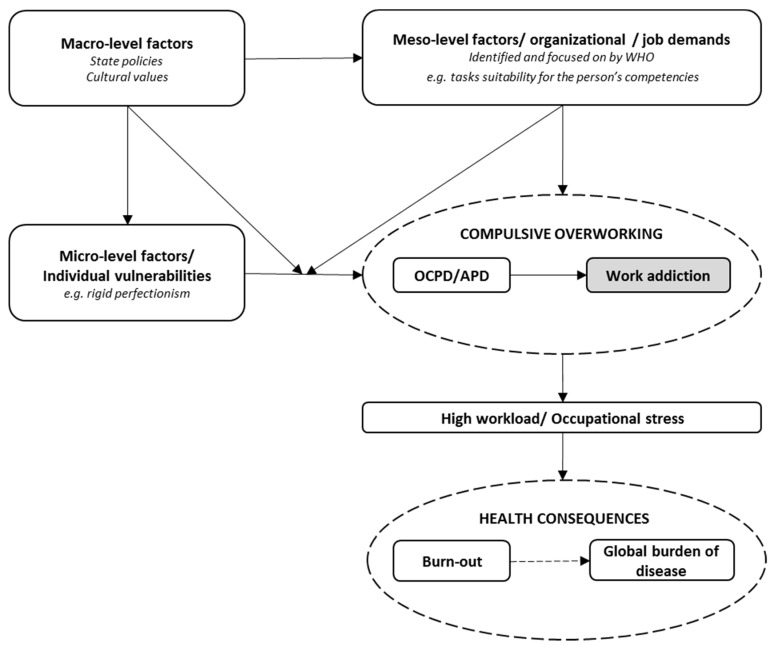
“Moreover, burn-out is a potential mediator between OCPD/APD/work addiction, and other health problems such as CVD or substance abuse—with which burn-out, as well as long working hours, in general—have been previously associated [43–47] (the path between burn-out and other disorders is represented by a dashed line in F…”
BackgroundPerfectionism as a transdiagnostic process: A clinical review
Egan, S. J., Wade, T. D., & Shafran, R. (2011) · Clinical Psychology Review · doi:10.1016/j.cpr.2010.04.009 · Cited by 961
Melamed, S., Shirom, A., Toker, S., Berliner, S., & Shapira, I. (2006) · Psychological Bulletin · doi:10.1037/0033-2909.132.3.327 · Cited by 943 · cited 8×
“Long working hours and stress (including occupational stress) are among the most well-recognized risk factors for a host of diseases and disorders including CVD [6], cancer [7], depression and anxiety [8], diabetes [9], and substance use and abuse [10].”
BackgroundInfluential
Research works printed but not linked: 1
- Robinson B.E. Chained to the Desk: A Guidebook for Workaholics, Their Partners and Children, and the Clinicians Who Treat Them NYU Press New York, NY, USA 2014
Cited by
Items 101–137 of 137
Kohútová, K. (2022) · Pedagogika · doi:10.14712/23362189.2022.2052 · Cited by 1
Stanytė, A., Fineberg, N. A., Podlipskytė, A., Gečaitė-Stončienė, J., & Burkauskas, J. (2024) · Neuroscience Applied · doi:10.1016/j.nsa.2024.104048 · Cited by 5
Managing Workplace Stress in Businesses in the Prishtina Region to Enhance Performance
Sylejmani, M., & Meško, M. (2024) · doi:10.18690/um.fov.3.2024.70 · Cited by 2
Liu, L. (2024) · Personalized Medicine in Psychiatry · doi:10.1016/j.pmip.2024.100127 · Cited by 1
Learning how to recover from stress-related disorders via internet-based interventions
Asplund, R. P. (2021) · Linköping studies in behavioural science · doi:10.3384/diss.diva-172685 · Cited by 3
Magnani, B., & Dimaggio, G. (2023) · QUADERNI DI PSICOTERAPIA COGNITIVA · doi:10.3280/qpc52-2023oa16176 · Cited by 1
Work Addiction and its Risk FactorsPreprint
Mohan, H., & Lone, Z. A. (2021) · SSRN Electronic Journal · doi:10.2139/ssrn.3836618 · Cited by 1
4th Symposium on Occupational Safety and Health Proceedings Book
Pinho, O., Baptista, J. S., Bustos, D., Niquice, F., Branco, J. C., Duarte, J., Fernandes, M., Martins, R., Vasconcelos, S., Teixeira, T., et al. (2021) · doi:10.24840/978-972-752-279-8 · Cited by 1
Korte, M., Cerci, D., Wehry, R., Timmers, R., & Williamson, V. J. (2023) · Health Psychology Research · doi:10.52965/001c.74879 · Cited by 2
Heintz, H., & Haynos, A. F. (2024) · PsyArXiv (OSF Preprints) · doi:10.31234/osf.io/5prej · Cited by 2
Circuitry solution for smart watches using a stationary power supply
Grishin, A., & Alibutaev, A. (2021) · E3S Web of Conferences · doi:10.1051/e3sconf/202127304005
Mentaal welbevinden in Vlaanderen
GYSELAERS, W. (2021) · Tijdschrift voor Geneeskunde · doi:10.47671/tvg.77.21.135
Walking on eggshells: A life defined by obsessive–compulsive personality disorder
Grech, P., & Spiteri, A. (2021) · Journal of Psychiatric and Mental Health Nursing · doi:10.1111/jpm.12805
Alsawah, Z., Amoudi, S. A., & Alfakhri, M. M. (2022) · International Journal of Innovative Research in Medical Science · doi:10.23958/ijirms/vol07-i02/1361
Vasiliu, O. (2022) · Romanian Journal of Military Medicine · doi:10.55453/rjmm.2022.125.3.25
Abdelsater, H., & Hijazi, B. (2023) · Journal of Business Theory and Practice · doi:10.22158/jbtp.v11n1p19
Personality Disorders among Medical Professionals
Fatma, H. (2023) · Journal of Bahria University Medical and Dental College · doi:10.51985/jbumdc2022025
Faurina, R. D., & Sumartik, S. (2024) · Innovative Technologica Methodical Research Journal · doi:10.47134/innovative.v1i2.71
Manifestations of Paranoid Personality in Workaholic Middle Managers
Spytska, L. V. (2024) · The Journal of Nervous and Mental Disease · doi:10.1097/nmd.0000000000001797
Choobsaz, A., Taher, M., Tabatabaee, S. M., & Hosseinkhanzadeh, A. A. (2024) · Alborz University Medical Journal · doi:10.61186/aums.13.2.99
Coste, M., & Ruger, J. P. (2025) · Journal of Epidemiology & Community Health · doi:10.1136/jech-2023-220573 · Cited by 1
“First, we did not feature every pressing epidemiological or public health topic, such as air pollution, climate change-induced health issues 45 46 or occupational stress and burn-out, 47 among others.”
Kunecka, D., Milewska, A. J., Iltchev, P., Kozłowski, R., Marczak, M., & Kilańska, D. M. (2025) · Journal of Nursing Management · doi:10.1155/jonm/6876113
“Te consequence may be burnout [31] and leaving work [32] or profession [33, 34].”
Mena, J. M. M., Silva, A. M., Montero, M. M., Gallegos, J. M., & Vásquez, F. M. (2025) · LATAM Revista Latinoamericana de Ciencias Sociales y Humanidades · doi:10.56712/latam.v6i3.4241 · Cited by 1
Positive Psychotherapy Approach for Patients with Personality Disorders
Hum, G., Bragaru, A. C., Maxim, S., & Pop, D. (2025) · Springer eBooks · doi:10.1007/978-3-031-94645-5_54
Expressions of dysfunction in cluster C personality disorders
Gradinaru, O. (2025) · Studia Universitatis Moldaviae Seria Științe ale Educației · doi:10.59295/sum9(189)2025_45
Balducci, C., Perinelli, E., Avanzi, L., Atroszko, P. A., Charzyńska, E., & Menghini, L. (2026) · Work & Stress · doi:10.1080/02678373.2026.2631986
“…affecting both the frequency of workaholism states and the strength of their relationship with day-to-day situational cues, including anticipated and actual workload, time pressure, and perhaps others (e.g. supervisor and colleagues’ daily expression of workaholism; see Atroszko & Atroszko, 2020).”
Lawendowski, R., Kierzkowski, M., Czerwiński, S. K., Wybrańska, A., & Atroszko, P. A. (2026) · Musicae Scientiae · doi:10.1177/10298649261419817
“…time when no prevention or intervention solutions are applied (Atroszko et al., 2016a), and it may transition into work addiction (Atroszko et al., 2016b), which burdens society with considerable individual, social and economic harm and costs (Atroszko, 2022a, 2022b, 2022c; Atroszko et al., 2020).”
Die perfekte Erschöpfung: Arbeitssucht und Burnout bei zwanghafter Persönlichkeitsstörung
Schreiber, R. (2026) · PTT - Persönlichkeitsstörungen: Theorie und Therapie · doi:10.21706/ptt-30-1-94
Liu, J., Dou, L., Peng, H., Yang, X., Zhang, Z., Luo, J., Xu, M., & WU, M. (2026) · BMC Nursing · doi:10.1186/s12912-026-04681-1 · Cited by 1
“The World Health Organization has included burnout in the International Classification of Diseases, Eleventh Revision (ICD-11) as an occupational phenomenon [3].”
The use of Image and Performance-Enhancing Drugs (IPED) in behavioural addictions
Corazza, O., Burkauskas, J., Luca, I. D., Zandonai, T., Szabó, A., Jiménez‐Múrcia, S., Fernández‐Aranda, F., Kun, B., Jennings, T. L., Gleason, N., et al. (2026) · Journal of Behavioral Addictions · doi:10.1556/2006.2025.00163
“This could suggest a potential link to EDs (Atroszko, Mytlewska, & Atroszko, 2020) or exercise addiction (Demetrovics, van den Brink, Paksi, Horváth, & Maraz, 2022).”
InfluentialMohamed, M. Y., ElGhonemy, S. H., Essawy, H. I., AbouEl-leil, D. H. M., & Kasem, R. E. (2026) · Middle East Current Psychiatry · doi:10.1186/s43045-026-00661-y
“Perfectionism, a key trait of OCPD, involves a rigid insistence on perfection and difficulty in changing perspectives, significantly increasing susceptibility to eating disorders [3, 42].”
Maisonneuve, F., Bujold, A., & Parent‐Rocheleau, X. (2026) · Human Resource Management Journal · doi:10.1111/1748-8583.70058
Evaluation of Burnout Syndrome and Work-Related Psychosocial Factors Among Healthcare Workers
Babiker, M., Roja, Ž., & Kaļķis, H. (2026) · Springer series in design and innovation · doi:10.1007/978-3-032-23073-7_17
Özsoy, E., Griffiths, M. D., Akyiğit, H., Yiğit, B., Çakmak, B. Y., Karaçay, G. T., & Erol, S. (2026) · Acta Psychologica · doi:10.1016/j.actpsy.2026.107596
An Adaptive Network Model of Employee Burnout and Personality: The Role of the Big Five Traits
Bashkirova, A., Compagner, A., Henningsen, D. M., & Treur, J. (2026) · Studies in systems, decision and control · doi:10.1007/978-3-032-16544-2_23
Bochniarz, K. T., Jurek, P., & Atroszko, P. A. (2026) · Campbell Systematic Reviews · doi:10.1177/18911803261489509
“However, findings from occupational burnout research indicate that, for example, disorders such as Obsessive-Compulsive Personality Disorder (OCPD; Atroszko et al., 2020), PTSD (Ham et al., 2022), and other clinically relevant conditions like eating disorders (Medisauskaite & Kamau, 2019; Nevanper…”
Metadata
- Authors
- Atroszko, P. A., Demetrovics, Z., & Griffiths, M. D.
- Affiliations
- University of Gdańsk (PL)
- Eötvös Loránd University (HU)
- Nottingham Trent University (GB)
- Corresponding author
- Atroszko, Paweł A.
- Venue
- International Journal of Environmental Research and Public Health
- Publisher
- MDPI AG
- Published
- 2020-01-20
- Volume
- 17
- Issue
- 2
- Pages
- 660
- ISSN
- 1660-4601 (ISSN-L)
- PMC
- PMC7014139
- OpenAlex
- W2999635410
- Cited by
- 138
- References
- 70
- Citations by year
- 2026: 15 · 2025: 24 · 2024: 21 · 2023: 20 · 2022: 30 · 2021: 18 · 2020: 10
- FWCI
- 21.31
- Type
- journal article
- Language
- en
- Open access
- gold
- doi.org
- Licence
- Locations
- International Journal of Environmental Research and Public Health (publishedVersion, cc-by)
- Europe PMC (PubMed Central) (publishedVersion, cc-by)
- PubMed Central (publishedVersion, cc-by)
- PubMed (publishedVersion)
- Nottingham Trent University's Institutional Repository (Nottingham Trent Repository) (acceptedVersion)
- RePEc: Research Papers in Economics (submittedVersion)
- DOAJ (DOAJ: Directory of Open Access Journals) (submittedVersion)
- Funders
- Hungarian National Research, Development and Innovation Office (K111938, KKP126835)
- Topics
- Social Sciences › Psychology › Social Psychology › Workaholism, burnout, and well-being
- Social Sciences › Psychology › Social Psychology › Stress and Burnout Research
- Health Sciences › Medicine › Public Health, Environmental and Occupational Health › Occupational Health and Burnout
- Keywords
- workaholism, obsessive-compulsive personality disorder, burnout, global burden of disease, ICD-11, occupational stress, workload, depression, health care costs, overwork
- MeSH terms
- Global Burden of Disease, Burnout, Psychological, Compulsive Personality Disorder, Humans, Interpersonal Relations, Obsessive-Compulsive Disorder, Workload, Behavior, Addictive, International Classification of Diseases
About these checks
Registry, retraction, Cites and statistics results are computed, not judged, with one exception: a printed reference that no index lists is read once by a model before it counts as a citation error. Claims are extracted by a model and kept only when their quote appears verbatim in the text; each cited source is then checked, with a model’s help, for whether it says what the claim relies on. Those verdicts can be wrong — read the claim’s quote and the cited source before relying on one.
Statistics and arithmetic are recomputed, not judged.
Confidence bands are shown only for fields calibrated on our annotated test set. None is calibrated yet, so no band is shown.
What counts as a claim ›How we measure confidence ›How we check this ›
Are you an author, or do you see a problem with this page? Request a review
Data sources
Bibliographic data: Semantic Scholar, OpenAlex, Crossref.
Contains information from the Semantic Scholar Academic Graph Datasets, made available under the ODC Attribution License (ODC-BY 1.0).
Semantic Scholar’s data is described in: Kinney, R., et al. (2023). The Semantic Scholar Open Data Platform. arXiv:2301.10140.
