

Work Addiction, Obsessive-Compulsive Personality Disorder, Burn-Out, and Global Burden of Disease: Implications from the ICD-11
Open accessThe DOI matches its Crossref record; 69 of the 70 references it cites were found in a registry or an index.
Abstract
Occupational stress and high workload are being increasingly recognized as significant contributors to the diseases and disorders constituting major components of the global burden of disease. A more detailed definition of burn-out was recently included by the World Health Organization (WHO) in the eleventh revision of the International Classification of Diseases (ICD-11) which reflects a growing acknowledgment of the role of professional work in mental health. One of the symptoms of obsessive-compulsive personality disorder/anankastic personality disorder (OCPD/APD) is an undue preoccupation with productivity to the exclusion of pleasure and interpersonal relationships. This compulsive overworking is closely related to the concept of work addiction, and OCPD/APD was suggested to be its major risk factor. OCPD/APD is the most prevalent personality disorder and one that appears to produce the highest direct and indirect medical costs. At the same time, it is vastly understudied. In recent years, it has been repeatedly emphasized that it requires consistent conceptualization and clarification of its overlapping with similar conditions. Even though the limited existing studies suggest its strong relationship with burn-out and depression among employed individuals, there has been no systematic effort to investigate its role in the consequences of occupational stress and high workload. This paper identifies several substantial gaps in the current understanding of the relationships between work addiction, OCPD/APD, burn-out, and the global burden of disease within the context of the WHO’s plan of developing evidence-based guidelines on mental wellbeing in the workplace.
Overview
The claims and statistics of this paper haven’t been checked yet.
Free: it reads the open-access text and checks the first 5 claims that cite a source we can check. Create a free account to check every claim.
Integrity signals
Registry
Cites
Statistics
Figures
Verification
Claims the paper makes
The claims and statistics of this paper haven’t been checked yet.
Free: it reads the open-access text and checks the first 5 claims that cite a source we can check. Create a free account to check every claim.
Claims other papers make about this one
Each is checked against this paper’s own text: does it say what the citing paper says it does?
The cited source says what the claim attributes to it.
In the citing paper
“Stress has increasingly been recognized as a significant health issue, especially within the working population (Atroszko et al., 2020; Eurofound, 2017).”
From Learning how to recover from stress: Results from an internet-based randomized controlled pilot trial (2023) · cites this paper as Atroszko et al., 2020
Self-check
Percentages, sums and reported differences re-computed from the paper’s own numbers.
The self-check needs the paper’s full text.
Citations
Cites
Diagnostic and Statistical Manual of Mental Disorders
American Psychiatric Association (2013) · doi:10.1176/appi.books.9780890425596 · Cited by 116,369
Vos, T., Allen, C., Arora, M., Barber, R. M., Bhutta, Z. A., Brown, A., Carter, A., Casey, D. C., Charlson, F. J., Chen, A. Z., et al. (2016) · The Lancet · doi:10.1016/s0140-6736(16)31678-6 · Cited by 7,253
No health without mental health
Prince, M., Patel, V., Saxena, S., Maj, M., Maselko, J., Phillips, M. R., & Rahman, A. (2007) · The Lancet · doi:10.1016/s0140-6736(07)61238-0 · Cited by 3,753
Sick individuals and sick populations
Rose, G. (2001) · International Journal of Epidemiology · doi:10.1093/ije/30.3.427 · Cited by 3,736 · cited 1×
“It has been demonstrated that the prevalence of a disease or disorder in a population has a relationship with the average level of behaviors related to that disease/disorder within the population [75].”
BackgroundPsychological Stress and Disease
Cohen, S., Janicki-Deverts, D., & Miller, G. E. (2007) · JAMA · doi:10.1001/jama.298.14.1685 · Cited by 3,168 · cited 1×
“Long working hours and stress (including occupational stress) are among the most well-recognized risk factors for a host of diseases and disorders including CVD [6], cancer [7], depression and anxiety [8], diabetes [9], and substance use and abuse [10].”
BackgroundInterventions to prevent and reduce physician burnout: a systematic review and meta-analysis
West, C. P., Dyrbye, L. N., Erwin, P. J., & Shanafelt, T. D. (2016) · The Lancet · doi:10.1016/s0140-6736(16)31279-x · Cited by 2,362
Depression and cardiovascular disease: a clinical review
Hare, D. L., Toukhsati, S. R., Johansson, P., & Jaarsma, T. (2014) · European Heart Journal · doi:10.1093/eurheartj/eht462 · Cited by 1,362 · cited 8×
“Long working hours and stress (including occupational stress) are among the most well-recognized risk factors for a host of diseases and disorders including CVD [6], cancer [7], depression and anxiety [8], diabetes [9], and substance use and abuse [10].”
BackgroundInfluentialLichtman, J. H., Froelicher, E. S., Blumenthal, J. A., Carney, R. M., Doering, L. V., Frasure-Smith, N., Freedland, K. E., Jaffe, A. S., Leifheit-Limson, E. C., Sheps, D. S., et al. (2014) · Circulation · doi:10.1161/cir.0000000000000019 · Cited by 1,208 · cited 2×
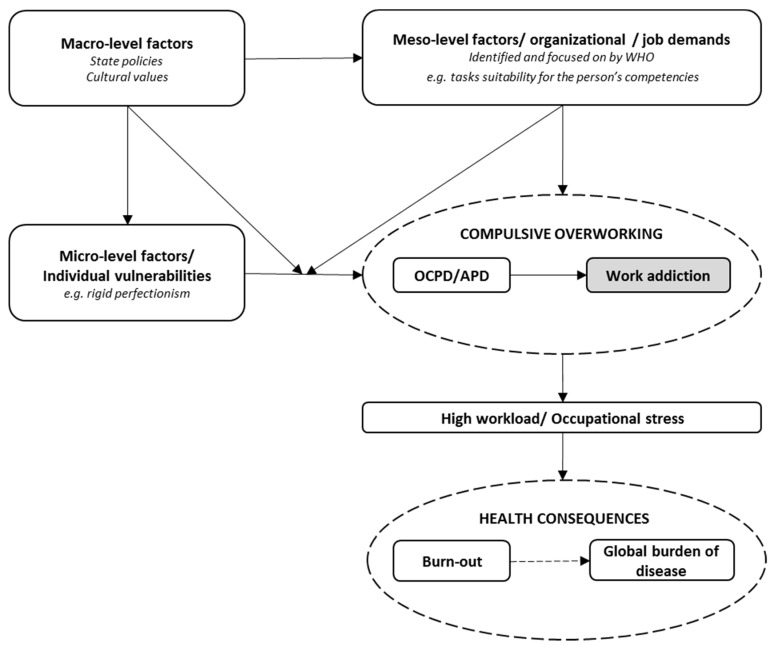
“Moreover, burn-out is a potential mediator between OCPD/APD/work addiction, and other health problems such as CVD or substance abuse—with which burn-out, as well as long working hours, in general—have been previously associated [43–47] (the path between burn-out and other disorders is represented by a dashed line in F…”
BackgroundPerfectionism as a transdiagnostic process: A clinical review
Egan, S. J., Wade, T. D., & Shafran, R. (2011) · Clinical Psychology Review · doi:10.1016/j.cpr.2010.04.009 · Cited by 961
Melamed, S., Shirom, A., Toker, S., Berliner, S., & Shapira, I. (2006) · Psychological Bulletin · doi:10.1037/0033-2909.132.3.327 · Cited by 943 · cited 8×
“Long working hours and stress (including occupational stress) are among the most well-recognized risk factors for a host of diseases and disorders including CVD [6], cancer [7], depression and anxiety [8], diabetes [9], and substance use and abuse [10].”
BackgroundInfluentialBurnout–Depression Overlap: A Review
Bianchi, R., Schonfeld, I. S., & Laurent, E. (2015) · Clinical Psychology Review · doi:10.1016/j.cpr.2015.01.004 · Cited by 868
A systematic review including meta-analysis of work environment and burnout symptoms
Aronsson, G., Theorell, T., Grape, T., Hammarström, A., Hogstedt, C., Marteinsdottir, I., Skoog, I., Träskman-Bendz, L., & Hall, C. (2017) · BMC Public Health · doi:10.1186/s12889-017-4153-7 · Cited by 789
Treatment utilization by patients with personality disorders
Bender, D. S., Dolan, R. T., Skodol, A. E., Sanislow, C. A., Dyck, I. R., McGlashan, T. H., Shea, M. T., Zanarini, M. C., Oldham, J. M., & Gunderson, J. G. (2001) · American Journal of Psychiatry · doi:10.1176/appi.ajp.158.2.295 · Cited by 779 · cited 1×
“Furthermore, patients with personality disorders have more extensive histories of psychiatric outpatient, inpatient, and psychopharmacologic treatment than do comparison patients with a major depressive disorder [16].”
Background(2015) · doi:10.1016/s0140-6736(15)60295-1 · Cited by 732
Tawfik, D. S., Profit, J., Morgenthaler, T. I., Satele, D. V., Sinsky, C. A., Dyrbye, L. N., Tutty, M. A., West, C. P., & Shanafelt, T. D. (2018) · Mayo Clinic Proceedings · doi:10.1016/j.mayocp.2018.05.014 · Cited by 695
(2014) · doi:10.5271/sjweh.3388 · Cited by 648 · cited 1×
“Long working hours and stress (including occupational stress) are among the most well-recognized risk factors for a host of diseases and disorders including CVD [6], cancer [7], depression and anxiety [8], diabetes [9], and substance use and abuse [10].”
BackgroundThe neurocircuitry of impaired insight in drug addiction
Goldstein, R. Z., Craig, A. D. (., Bechara, A., Garavan, H., Childress, A. R., Paulus, M. P., & Volkow, N. D. (2009) · Trends in Cognitive Sciences · doi:10.1016/j.tics.2009.06.004 · Cited by 641 · cited 1×
“It appears to be a very unrealistic assumption that self-employed workers will self-manage their addiction, especially if it is taken into account that more than 90% of addicts never recognize their problem or seek help [59].”
Backgroundvan der Hulst, M. (2003) · Scandinavian Journal of Work, Environment & Health · doi:10.5271/sjweh.720 · Cited by 614
All Work and No Play? A Meta-Analytic Examination of the Correlates and Outcomes of Workaholism
Clark, M. A., Michel, J. S., Zhdanova, L., Pui, S. Y., & Baltes, B. B. (2016) · Journal of Management · doi:10.1177/0149206314522301 · Cited by 561
The Economic Burden of Personality Disorders in Mental Health Care
Soeteman, D. I., Hakkaart-van Roijen, L., Verheul, R., & Busschbach, J. J. V. (2008) · The Journal of Clinical Psychiatry · doi:10.4088/jcp.v69n0212 · Cited by 417 · cited 2×
“OCPD/APD has been identified as producing the highest economic burden among personality disorders in terms of direct medical costs and productivity losses, even exceeding the costs of borderline personality disorder (BPD) [15].”
BackgroundTransdiagnostic psychiatry: a systematic review
Fusar‐Poli, P., Solmi, M., Brondino, N., Davies, C., Chae, C., Politi, P., Borgwardt, S., Lawrie, S. M., Parnas, J., & McGuire, P. (2019) · World Psychiatry · doi:10.1002/wps.20631 · Cited by 409 · cited 1×
“While research on transdiagnostic approaches is still preliminary and does not yet allow for a paradigm shift in classification and clinical care [52,53], it is a promising alternative to the current categorical diagnose-based psychiatric classification.”
BackgroundMultidimensional Perfectionism and Burnout: A Meta-Analysis
Hill, A. P., & Curran, T. (2016) · Personality and Social Psychology Review · doi:10.1177/1088868315596286 · Cited by 389
Burnout and Alcohol Abuse/Dependence Among U.S. Medical Students
Jackson, E. R., Shanafelt, T. D., Hasan, O., Satele, D. V., & Dyrbye, L. N. (2016) · Academic Medicine · doi:10.1097/acm.0000000000001138 · Cited by 341
Transdiagnostic factors of mental disorders.
Krueger, R. F., & Eaton, N. R. (2015) · World Psychiatry · doi:10.1002/wps.20175 · Cited by 330 · cited 1×
“While research on transdiagnostic approaches is still preliminary and does not yet allow for a paradigm shift in classification and clinical care [52,53], it is a promising alternative to the current categorical diagnose-based psychiatric classification.”
BackgroundVirtanen, M., Jokela, M., Nyberg, S. T., Madsen, I. E. H., Lallukka, T., Ahola, K., Alfredsson, L., Batty, G. D., Bjorner, J. B., Borritz, M., et al. (2015) · BMJ · doi:10.1136/bmj.g7772 · Cited by 317 · cited 2×
“For example, high workload and burnout have been found to be associated with substance abuse [10,43,44].”
BackgroundLong Working Hours and Coronary Heart Disease: A Systematic Review and Meta-Analysis
Virtanen, M., Heikkila, K., Jokela, M., Ferrie, J. E., Batty, G. D., Vahtera, J., & Kivimaki, M. (2012) · American Journal of Epidemiology · doi:10.1093/aje/kws139 · Cited by 288
Kivimäki, M., Virtanen, M., Kawachi, I., Nyberg, S. T., Alfredsson, L., Batty, G. D., Bjorner, J. B., Borritz, M., Brunner, E. J., Burr, H., et al. (2015) · The Lancet Diabetes & Endocrinology · doi:10.1016/s2213-8587(14)70178-0 · Cited by 279 · cited 1×
“Long working hours and stress (including occupational stress) are among the most well-recognized risk factors for a host of diseases and disorders including CVD [6], cancer [7], depression and anxiety [8], diabetes [9], and substance use and abuse [10].”
BackgroundImo, U. O. (2017) · BJPsych Bulletin · doi:10.1192/pb.bp.116.054247 · Cited by 268
Burnout and Risk of Coronary Heart Disease: A Prospective Study of 8838 Employees
Toker, S., Melamed, S., Berliner, S., Zeltser, D., & Shapira, I. (2012) · Psychosomatic Medicine · doi:10.1097/psy.0b013e31826c3174 · Cited by 222
Scotland, G., van den Berg, S. M., de Moor, M. H. M., Verweij, K. J. H., Krueger, R. F., Luciano, M., Arias Vasquez, A., Matteson, L. K., Derringer, J., Esko, T., et al. (2016) · Behavior Genetics · doi:10.1007/s10519-015-9735-5 · Cited by 208
Calculating the cost of work-related stress and psychosocial risks
Hassard, J., Teoh, K., Cox, T., Cosmar, M., Gründler, R., Flemming, D., Cosemans, B., & van den Broek, K. (2014) · BIROn (Birkbeck, University of London) · doi:10.2802/20493 · Cited by 204
Ten myths about work addiction
Griffiths, M. D., Demetrovics, Z., & Atroszko, P. A. (2018) · Journal of Behavioral Addictions · doi:10.1556/2006.7.2018.05 · Cited by 204 · cited 1×
“personality and values are well-recognized determinants of work behaviors [25], and they have been associated with OCPD/APD [50] and work addiction [19].”
BackgroundSelf-citationMazzetti, G., Schaufeli, W. B., & Guglielmi, D. (2014) · International Journal of Stress Management · doi:10.1037/a0035700 · Cited by 189
The role of workaholism in the job demands-resources model
Molino, M., Bakker, A. B., & Ghislieri, C. (2016) · Anxiety, Stress, & Coping · doi:10.1080/10615806.2015.1070833 · Cited by 171
Obsessive–Compulsive Personality Disorder: a Current Review
Diedrich, A., & Voderholzer, U. (2015) · Current Psychiatry Reports · doi:10.1007/s11920-014-0547-8 · Cited by 158
Andreassen, C. S., Griffiths, M. D., Sinha, R., Hetland, J., & Pallesen, S. (2016) · PLOS ONE · doi:10.1371/journal.pone.0152978 · Cited by 157
The Individual “Costs” of Workaholism: An Analysis Based on Multisource and Prospective Data
Balducci, C., Avanzi, L., & Fraccaroli, F. (2016) · Journal of Management · doi:10.1177/0149206316658348 · Cited by 152
Work–Family Conflict Among Employees and the Self-Employed Across Europe
Annink, A., den Dulk, L., & Steijn, B. (2015) · Social Indicators Research · doi:10.1007/s11205-015-0899-4 · Cited by 122
Avanzi, L., van Dick, R., Fraccaroli, F., & Sarchielli, G. (2012) · Work & Stress · doi:10.1080/02678373.2012.712291 · Cited by 121
Sussman, S. (2012) · Journal of Addiction Research & Therapy · doi:10.4172/2155-6105.s6-001 · Cited by 121
Workaholism in organizations: the role of organizational values
Burke, R. J. (2001) · Personnel Review · doi:10.1108/eum0000000005977 · Cited by 107
Balducci, C., Cecchin, M., Fraccaroli, F., & Schaufeli, W. B. (2012) · Personality and Individual Differences · doi:10.1016/j.paid.2012.05.004 · Cited by 105
Self‐efficacy and workaholism as initiators of the job demands‐resources model
Guglielmi, D., Simbula, S., Schaufeli, W. B., & Depolo, M. (2012) · Career Development International · doi:10.1108/13620431211255842 · Cited by 96
The relationship between organizational climate, occupational type and workaholism.
Johnstone, A., & Johnston, L. C. (2005) · Murdoch University Research Portal · Cited by 88
Workaholism as a Mediator between Work-Related Stressors and Health Outcomes
Andreassen, C., Pallesen, S., & Torsheim, T. (2018) · International Journal of Environmental Research and Public Health · doi:10.3390/ijerph15010073 · Cited by 87
Predictors of burnout: results from a prospective community study
Rössler, W., Hengartner, M. P., Ajdacic‐Gross, V., & Angst, J. (2014) · European Archives of Psychiatry and Clinical Neuroscience · doi:10.1007/s00406-014-0512-x · Cited by 84
Alcohol dependence in relation to burnout among the Finnish working population
Ahola, K., Honkonen, T., Pirkola, S., Isometsä, E., Kalimo, R., Nykyri, E., Aromaa, A., & Lönnqvist, J. (2006) · Addiction · doi:10.1111/j.1360-0443.2006.01539.x · Cited by 80
Atroszko, P. A., Demetrovics, Z., & Griffiths, M. D. (2019) · Journal of Behavioral Addictions · doi:10.1556/2006.8.2019.11 · Cited by 75
Balducci, C., Avanzi, L., Consiglio, C., Fraccaroli, F., & Schaufeli, W. (2017) · European Journal of Psychological Assessment · doi:10.1027/1015-5759/a000300 · Cited by 69
Obsessive–compulsive personality disorder: a review of current empirical findings
de Reus, R. J. M., & Emmelkamp, P. M. G. (2010) · Personality and Mental Health · doi:10.1002/pmh.144 · Cited by 61
Andreassen, C. S., Bakker, A. B., Bjorvatn, B., Moen, B. E., Magerøy, N., Shimazu, A., Hetland, J., & Pallesen, S. (2017) · Frontiers in Psychology · doi:10.3389/fpsyg.2017.02045 · Cited by 59
Atroszko, P. A., Pallesen, S., Griffiths, M. D., & Andreassen, C. S. (2017) · Health Psychology Report · doi:10.5114/hpr.2017.68759 · Cited by 51
Starčević, V., & Brakoulias, V. (2013) · Current Opinion in Psychiatry · doi:10.1097/yco.0000000000000030 · Cited by 42
Obsessive, compulsive, and conscientious? The relationship between OCPD and personality traits
Mike, A., King, H. R., Oltmanns, T. F., & Jackson, J. J. (2017) · Journal of Personality · doi:10.1111/jopy.12368 · Cited by 39
Problematic overstudying: Studyholism or study addiction?
Loscalzo, Y., & Giannini, M. (2018) · Journal of Behavioral Addictions · doi:10.1556/2006.7.2018.124 · Cited by 38
Myths about “The myths about work addiction”
Andreassen, C. S., Schaufeli, W. B., & Pallesen, S. (2018) · Journal of Behavioral Addictions · doi:10.1556/2006.7.2018.126 · Cited by 36
Asian wellness in decline: a cost of rising prosperity
Tsui, A. H. H. (2008) · International Journal of Workplace Health Management · doi:10.1108/17538350810893919 · Cited by 33
Tóth-Király, I., Bőthe, B., & Orosz, G. (2018) · Journal of Behavioral Addictions · doi:10.1556/2006.7.2018.122 · Cited by 28
Work addiction as a behavioural addiction: Towards a valid identification of problematic behaviour
Atroszko, P. A. (2019) · Australian & New Zealand Journal of Psychiatry · doi:10.1177/0004867419828496 · Cited by 27
Atroszko, P. A. (2018) · Psychiatria i Psychologia Kliniczna · doi:10.15557/pipk.2018.0034 · Cited by 24
Atroszko, P. A. (2019) · Psychiatria i Psychologia Kliniczna · doi:10.15557/pipk.2019.0025 · Cited by 23
Ten myths (or facts?) about workaholism: An appetitive motivation framework
Sussman, S. Y. (2018) · Journal of Behavioral Addictions · doi:10.1556/2006.7.2018.120 · Cited by 17
Raiskila, T., Sequeiros, S. B., Kiuttu, J., Kauhanen, M.-L., Läksy, K., Rissanen, P., Vainiemi, K., Tuulio‐Henriksson, A., Veijola, J., & Joukamaa, M. I. (2013) · Journal of Occupational and Environmental Medicine · doi:10.1097/jom.0b013e3182717e6d · Cited by 16
Ten myths and twenty years: What we know and what we still do not know about work addiction
Kun, B. (2018) · Journal of Behavioral Addictions · doi:10.1556/2006.7.2018.125 · Cited by 14
Work addiction: An organizational behavior as well as an addictive behavior?
Oren, L., Reizer, A., & Weinstein, A. M. (2018) · Journal of Behavioral Addictions · doi:10.1556/2006.7.2018.119 · Cited by 11
Moving from the terminology debate to a transdisciplinary understanding of the problem
Quiñones, C. (2018) · Journal of Behavioral Addictions · doi:10.1556/2006.7.2018.121 · Cited by 11
How to counter the ten myths about work addiction?: Three postulates for future research
Malinowska, D. (2018) · Journal of Behavioral Addictions · doi:10.1556/2006.7.2018.123 · Cited by 9
Drivers of working longer: Results from a large-scale and representative German employee survey
Schulz-Dadaczynski, A., Wendsche, J., Lohmann-Haislah, A., & Stab, N. (2019) · Journal of Management & Organization · doi:10.1017/jmo.2019.34 · Cited by 8
Atroszko, P. A. (2019) · American Journal of Clinical Nutrition · doi:10.1093/ajcn/nqz164 · Cited by 6
Research works printed but not linked: 1
- Robinson B.E. Chained to the Desk: A Guidebook for Workaholics, Their Partners and Children, and the Clinicians Who Treat Them NYU Press New York, NY, USA 2014
Cited by
Bruyneel, A., Bouckaert, N., de Noordhout, C. M., Detollenaere, J., Kohn, L., Pirson, M., Sermeus, W., & den Heede, K. V. (2022) · International Journal of Nursing Studies · doi:10.1016/j.ijnurstu.2022.104385 · Cited by 214
“Burnout is a syndrome that is conceptualized as chronic workplace stress that has not been successfully managed and has resulted in feelings of emotional exhaustion, depersonalization, and a lack of personal accomplishment (Maslach et al., 1996; Atroszko et al., 2020).”
BackgroundWorkload, Workaholism, and Job Performance: Uncovering Their Complex Relationship
Spagnoli, P., Haynes, N. J., Kovalchuk, L. S., Clark, M. A., Buono, C., & Balducci, C. (2020) · International Journal of Environmental Research and Public Health · doi:10.3390/ijerph17186536 · Cited by 147
“This is understandable since workaholism is closely related to obsessive–compulsive personality disorder and a perfectionistic tendency is an important ingredient in such disorder [9].”
BackgroundInfluentialOccupational Burnout and Productivity Loss: A Cross-Sectional Study Among Academic University Staff
Amer, S. A. A. M., Elotla, S. F., Ameen, A. E., Shah, J., & Fouad, A. (2022) · Frontiers in Public Health · doi:10.3389/fpubh.2022.861674 · Cited by 80
Mohammadian, Y., & Nasirzadeh, N. (2021) · Toxicology and Industrial Health · doi:10.1177/07482337211031691 · Cited by 57
“COPD is a progressive disease that could be initiated after exposure to vapors, gases, fumes, and dust (Atroszko et al., 2020).”
BackgroundBruyneel, A., Bouckaert, N., Pirson, M., Sermeus, W., & den Heede, K. V. (2023) · Intensive and Critical Care Nursing · doi:10.1016/j.iccn.2023.103596 · Cited by 64
Metadata
- Authors
- Atroszko, P. A., Demetrovics, Z., & Griffiths, M. D.
- Affiliations
- University of Gdańsk (PL)
- Eötvös Loránd University (HU)
- Nottingham Trent University (GB)
- Corresponding author
- Atroszko, Paweł A.
- Venue
- International Journal of Environmental Research and Public Health
- Publisher
- MDPI AG
- Published
- 2020-01-20
- Volume
- 17
- Issue
- 2
- Pages
- 660
- ISSN
- 1660-4601 (ISSN-L)
- PMC
- PMC7014139
- OpenAlex
- W2999635410
- Cited by
- 138
- References
- 70
- Citations by year
- 2026: 15 · 2025: 24 · 2024: 21 · 2023: 20 · 2022: 30 · 2021: 18 · 2020: 10
- FWCI
- 21.31
- Type
- journal article
- Language
- en
- Open access
- gold
- doi.org
- Licence
- Locations
- International Journal of Environmental Research and Public Health (publishedVersion, cc-by)
- Europe PMC (PubMed Central) (publishedVersion, cc-by)
- PubMed Central (publishedVersion, cc-by)
- PubMed (publishedVersion)
- Nottingham Trent University's Institutional Repository (Nottingham Trent Repository) (acceptedVersion)
- RePEc: Research Papers in Economics (submittedVersion)
- DOAJ (DOAJ: Directory of Open Access Journals) (submittedVersion)
- Funders
- Hungarian National Research, Development and Innovation Office (K111938, KKP126835)
- Topics
- Social Sciences › Psychology › Social Psychology › Workaholism, burnout, and well-being
- Social Sciences › Psychology › Social Psychology › Stress and Burnout Research
- Health Sciences › Medicine › Public Health, Environmental and Occupational Health › Occupational Health and Burnout
- Keywords
- workaholism, obsessive-compulsive personality disorder, burnout, global burden of disease, ICD-11, occupational stress, workload, depression, health care costs, overwork
- MeSH terms
- Global Burden of Disease, Burnout, Psychological, Compulsive Personality Disorder, Humans, Interpersonal Relations, Obsessive-Compulsive Disorder, Workload, Behavior, Addictive, International Classification of Diseases
About these checks
Registry, retraction, Cites and statistics results are computed, not judged, with one exception: a printed reference that no index lists is read once by a model before it counts as a citation error. Claims are extracted by a model and kept only when their quote appears verbatim in the text; each cited source is then checked, with a model’s help, for whether it says what the claim relies on. Those verdicts can be wrong — read the claim’s quote and the cited source before relying on one.
Statistics and arithmetic are recomputed, not judged.
Confidence bands are shown only for fields calibrated on our annotated test set. None is calibrated yet, so no band is shown.
What counts as a claim ›How we measure confidence ›How we check this ›
Are you an author, or do you see a problem with this page? Request a review
Data sources
Bibliographic data: Semantic Scholar, OpenAlex, Crossref.
Contains information from the Semantic Scholar Academic Graph Datasets, made available under the ODC Attribution License (ODC-BY 1.0).
Semantic Scholar’s data is described in: Kinney, R., et al. (2023). The Semantic Scholar Open Data Platform. arXiv:2301.10140.
