

The DOI matches its Crossref record; 55 of the 57 references it cites were found in a registry or an index.
Effect of Inquiry-Based Stress Reduction (IBSR) Intervention on Well-Being, Resilience and Burnout of Teachers during the COVID-19 Pandemic
Open accessAbstract
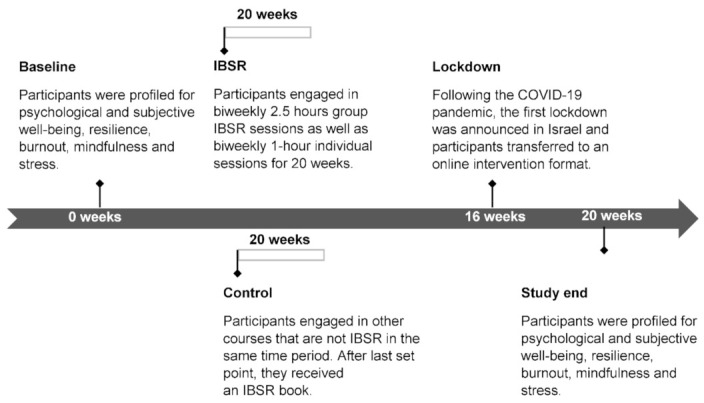
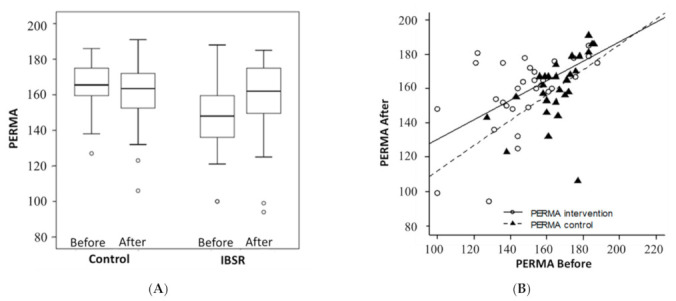
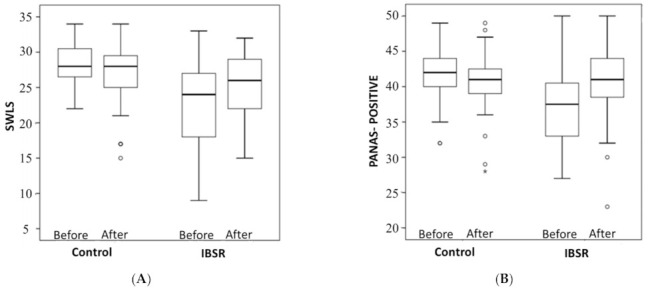
Objective: The COVID-19 pandemic has had a major impact on teachers professional and personal lives. Our primary aim was to assess the effect of a blended Inquiry-Based Stress Reduction (IBSR), an emerging mindfulness and cognitive reframing intervention on teacher’s well-being. Our secondary aims were to assess the effect of IBSR on resilience, burnout, mindfulness, and stress among teachers during the COVID-19 pandemic. Methods: The study was a prospective controlled trial with an intervention group (N = 35) and a comparison control group (N = 32). The intervention took place in the Jerusalem District throughout the school year from November 2019 to May 2020. The sessions were conducted in blended learning that included traditional learning (face-to-face) and online learning. Data was analyzed on an intention-to-treat basis. Results: IBSR blended intervention enhanced the resilience and improved the subjective and psychological well-being of teachers in spite of the breakout of the COVID-19 pandemic and the first lockdown in Israel. Simultaneously the control group suffered from enhanced burnout levels and a decline in psychological and subjective well-being. Conclusions: Implementation of IBSR blended intervention during the school year may benefit teachers’ well-being and ability to flourish, even during stressful events such as the COVID-19 pandemic.
Overview
The claims and statistics of this paper haven’t been checked yet.
Run the check — free, no account needed. It reads the open-access text and checks the sources it cites.
Integrity signals
Registry
Cites
Statistics
Figures
Verification
Claims the paper makes
The claims and statistics of this paper haven’t been checked yet.
Run the check — free, no account needed. It reads the open-access text and checks the sources it cites.
Claims other papers make about this one
Each is checked against this paper’s own text: does it say what the citing paper says it does?
The source backs part of the claim, not all of it — or backs it for a different population, condition or comparison.
In the citing paper
“As a result of this training, it becomes possible to experience situations that were previously perceived as stressful with peace of mind and connectedness [34,41,42].”
From Inquiry based stress reduction (Ibsr) improves overall stuttering experience among adults who stutter: A randomized controlled trial (2021) · cites this paper as [41]
Experimental — accuracy not yet measured
Self-check
Percentages, sums and reported differences re-computed from the paper’s own numbers.
The self-check needs the paper’s full text.
Citations
Cites
Development and validation of brief measures of positive and negative affect: The PANAS scales.
Watson, D., Clark, L. A., & Tellegen, A. (1988) · Journal of Personality and Social Psychology · doi:10.1037/0022-3514.54.6.1063 · Cited by 32,433
The measurement of experienced burnout
Maslach, C., & Jackson, S. E. (1981) · Journal of Organizational Behavior · doi:10.1002/job.4030020205 · Cited by 14,496
Subjective well-being: Three decades of progress.
Diener, E., Suh, E. M., Lucas, R. E., & Smith, H. L. (1999) · Psychological Bulletin · doi:10.1037/0033-2909.125.2.276 · Cited by 12,910
A test of missing completely at random for multivariate data with missing values
Little, R. J. A. (1988) · Journal of the American Statistical Association · doi:10.1080/01621459.1988.10478722 · Cited by 8,963
The brief resilience scale: Assessing the ability to bounce back
Smith, B. W., Dalen, J., Wiggins, K., Tooley, E., Christopher, P., & Bernard, J. (2008) · International Journal of Behavioral Medicine · doi:10.1080/10705500802222972 · Cited by 6,439 · cited 1×
“The Brief Resilience Scale (BRS)—The brief resilience scale was created to assess the ability to bounce back or recover from stress [42].”
MethodFlourish: A Visionary New Understanding of Happiness and Well-Being
(2011) · Choice Reviews Online · doi:10.5860/choice.48-7217 · Cited by 5,543 · cited 11×
“The PERMA Profiler—in the book Flourish (2011), Seligman defined well-being in terms of five pillars: Positive emotion, Engagement, Relationships, Meaning, and Accomplishment, or PERMA [36].”
BackgroundMethodInfluentialResilient Individuals Use Positive Emotions to Bounce Back From Negative Emotional Experiences.
Tugade, M. M., & Fredrickson, B. L. (2004) · Journal of Personality and Social Psychology · doi:10.1037/0022-3514.86.2.320 · Cited by 3,947
Wang, C., Pan, R., Wan, X., Tan, Y., Xu, L., McIntyre, R. S., Choo, F. N., Tran, B., Ho, R., Sharma, V. K., et al. (2020) · Brain, Behavior, and Immunity · doi:10.1016/j.bbi.2020.04.028 · Cited by 2,571 · cited 1×
“It could have been caused by the fact that, despite the increase in the satisfaction and positive emotions in the intervention group, the COVID-19 pandemic and prolonged social distancing had a dramatic negative impact across many domains of the teachers’ personal lives [51,52].”
BackgroundEarly predictors of job burnout and engagement.
Maslach, C., & Leiter, M. P. (2008) · Journal of Applied Psychology · doi:10.1037/0021-9010.93.3.498 · Cited by 2,397 · cited 1×
“Maslach Burnout Inventory (MBI)—the MBI is the most commonly used questionnaire in the field of occupational burnout in the last 30 years [44,45].”
MethodThe satisfaction with life scale and the emerging construct of life satisfaction
Pavot, W., & Diener, E. (2008) · The Journal of Positive Psychology · doi:10.1080/17439760701756946 · Cited by 2,396
Research works printed but not linked: 3
- Maslach, C., Jackson, S.E., and Leiter, M.P. (1996). The Maslach Burnout Inventory Manual, Consulting Psychologists Press. [3rd ed.].
- Gold, Y., and Robert, A.R. (1993). Teachers Managing Stress and Preventing Burnout: The Professional Health Solution, Falmer Press.
- Byron, K., and Stephen, M. (2002). Loving What Is: Four Questions That Can Change Your Life, Three Rivers Press.
Cited by
Sorted by citations
Finstad, G. L., Giorgi, G., Lulli, L. G., Pandolfi, C., Foti, G., León-Perez, J. M., Cantero-Sánchez, F. J., & Mucci, N. (2021) · International Journal of Environmental Research and Public Health · doi:10.3390/ijerph18189453 · Cited by 273
Interventions to Reduce Stress and Burnout among Teachers: A Scoping Review
Agyapong, B., Brett-MacLean, P., Burback, L., Agyapong, V. I. O., & Wei, Y. (2023) · International Journal of Environmental Research and Public Health · doi:10.3390/ijerph20095625 · Cited by 248
Mindfulness-based positive psychology interventions: a systematic review
George, A. J., Romate, J., & Rajkumar, E. (2021) · BMC Psychology · doi:10.1186/s40359-021-00618-2 · Cited by 170
Teachers feeling the burden of COVID-19: Impact on well-being, stress, and burnout
Kotowski, S., Davis, K. G., & Barratt, C. L. (2022) · Work · doi:10.3233/wor-210994 · Cited by 107
K−12 teachers' stress and burnout during the COVID-19 pandemic: A systematic review
Westphal, A., Kalinowski, E., Hoferichter, C. J., & Vock, M. (2022) · Frontiers in Psychology · doi:10.3389/fpsyg.2022.920326 · Cited by 162
Beames, J. R., Spanos, S., Roberts, A., McGillivray, L., Li, S., Newby, J. M., O’Dea, B., & Werner-Seidler, A. (2023) · Educational Psychology Review · doi:10.1007/s10648-023-09720-w · Cited by 109
Liu, Y., Zhao, L., & Su, Y.-S. (2022) · International Journal of Environmental Research and Public Health · doi:10.3390/ijerph19106282 · Cited by 115
Vergara, D., Antón‐Sancho, Á., & Fernández‐Arias, P. (2022) · International Journal of Environmental Research and Public Health · doi:10.3390/ijerph19063732 · Cited by 64
How Much Do We Care about Teacher Burnout during the Pandemic: A Bibliometric Review
Domínguez, V. G., Mateu, D. N., Prado‐Gascó, V., & Gómez-Domínguez, T. (2022) · International Journal of Environmental Research and Public Health · doi:10.3390/ijerph19127134 · Cited by 79
Edara, I. R., Castillo, F. A. D., Ching, G. S., & del Castillo, C. D. (2021) · International Journal of Environmental Research and Public Health · doi:10.3390/ijerph18126381 · Cited by 55
Nabe‐Nielsen, K., Christensen, K. B., Fuglsang, N. V., Larsen, I., & Nilsson, C. J. (2021) · International Archives of Occupational and Environmental Health · doi:10.1007/s00420-021-01806-8 · Cited by 45
Keleynikov, M., Benatov, J., & Berger, R. (2022) · International Journal of Environmental Research and Public Health · doi:10.3390/ijerph19052645 · Cited by 51
Yu, T., Dai, J., Chen, X., & Wang, C. (2024) · Interactive Learning Environments · doi:10.1080/10494820.2024.2370477 · Cited by 40
Soncini, A., Politi, E., & Matteucci, M. C. (2021) · School Psychology · doi:10.1037/spq0000469 · Cited by 48
Waddimba, A. C., Baker, B. M., Pogue, J. R., McAuliffe, M. P., Bennett, M., Baxter, R. D., Mohr, D. C., & Warren, A. M. (2022) · Quality of Life Research · doi:10.1007/s11136-022-03125-y · Cited by 39
The role of hope in language teachers' changing stress, coping, and well-being
MacIntyre, P. D., Mercer, S., Gregersen, T., & Hay, A. (2022) · System · doi:10.1016/j.system.2022.102881 · Cited by 57
Billaudeau, N., Alexander, S., Magnard, L., Temam, S., & Vercambre, M. (2022) · International Journal of Environmental Research and Public Health · doi:10.3390/ijerph19159151 · Cited by 48
Papazis, F., Avramidis, E., & Bacopoulou, F. (2022) · Psychology in the Schools · doi:10.1002/pits.22709 · Cited by 49
Datu, J. A. D., Lee, A., Fung, W. K., Cheung, R. Y. M., & Chung, K. K. H. (2022) · Journal of School Psychology · doi:10.1016/j.jsp.2022.08.003 · Cited by 32
Crompton, H., Chigona, A., & Burke, D. (2023) · TechTrends · doi:10.1007/s11528-022-00826-6 · Cited by 28
Polat, H., Karaköse, T., Özdemir, T. Y., Tülübaş, T., Yirci, R., & Demirkol, M. (2023) · Behavioral Sciences · doi:10.3390/bs13020164 · Cited by 31
Miyoshi, T., Ida, H., Nishimura, Y., Ako, S., & Otsuka, F. (2022) · International Journal of Environmental Research and Public Health · doi:10.3390/ijerph191912523 · Cited by 30
Cho, I., Lee, J., Kim, K., Lee, J., Lee, S., Yoo, S., Suh, S. A., & Chung, S. (2021) · Frontiers in Psychiatry · doi:10.3389/fpsyt.2021.756195 · Cited by 26
A Systematic Review on Teachers’ Well-Being in the COVID-19 Era
Katsarou, E. C., Chatzipanagiotou, P., & Sougari, A.-M. (2023) · Education Sciences · doi:10.3390/educsci13090927 · Cited by 38
Exploring factors affecting English language teacher wellbeing: insights from positive psychology
Sadeghi, K., & Pourbahram, R. (2024) · System · doi:10.1016/j.system.2024.103274 · Cited by 33
Shi, Y., Pyne, K., Kulophas, D., & Bangpan, M. (2021) · International Journal of Educational Research · doi:10.1016/j.ijer.2021.101911 · Cited by 24
Fighting Through COVID-19 for Educational Continuity
Lin, E. C.-P., & Yeh, A. (2022) · Advances in mobile and distance learning book series · doi:10.4018/978-1-6684-4364-4.ch009 · Cited by 24
Multi-omics in stress and health research: study designs that will drive the field forward
Mengelkoch, S., Gassen, J., Lev‐Ari, S., Alley, J. C., Rose, S. M. S., Snyder, M. P., & Slavich, G. M. (2024) · Stress · doi:10.1080/10253890.2024.2321610 · Cited by 26
Self-citationAkgül, G., & Ergin, D. A. (2022) · Psychology in the Schools · doi:10.1002/pits.22716 · Cited by 21
García-Álvarez, D. D. J., Soler, M. J., Cobo-Rendon, R. C., & Hernández-Lalinde, J. (2023) · Sustainability · doi:10.3390/su15139852 · Cited by 21
Influence of Country Digitization Level on Digital Pandemic Stress
Antón‐Sancho, Á., Vergara, D., & Fernández‐Arias, P. (2022) · Behavioral Sciences · doi:10.3390/bs12070203 · Cited by 20
Tsuyuguchi, K. (2023) · Teaching and Teacher Education · doi:10.1016/j.tate.2023.104240 · Cited by 18
Teachers’ Mental Health and Their Involvement in Educational Inclusion
Falquez, S. L. S., Román-Lorente, C., Buzica, M. I., Hernández, J. Á., Ángel, N. G., & Trigueros, R. (2022) · Behavioral Sciences · doi:10.3390/bs12080261 · Cited by 35
Current Foreign Studies of Professional Burnout in Teachers
Kochetkov, N. V., Marinova, T. Y., Orlov, V. A., Raskhodchikova, M. N., & Haymovskaya, N. A. (2023) · Journal of Modern Foreign Psychology · doi:10.17759/jmfp.2023120204 · Cited by 22
Herrera, C., Torres‐Vallejos, J., Martínez-Líbano, J., Rubio, A., Céspedes, C., Oyanedel, J. C., Acuña-Duran, E., & Pedraza, D. (2022) · International Journal of Environmental Research and Public Health · doi:10.3390/ijerph191710963 · Cited by 27
Hoferichter, F., & Jentsch, A. (2024) · British Educational Research Journal · doi:10.1002/berj.4036 · Cited by 27
Padmanabhanunni, A., Pretorius, T. B., Bouchard, J., & Stiegler, N. (2022) · Annales Médico-psychologiques revue psychiatrique · doi:10.1016/j.amp.2022.05.001 · Cited by 20
Chen, X.-M., Liao, X.-L., Chen, I., Gamble, J. H., Jiang, X.-Y., Li, X.-D., & Bo, C.-X. (2024) · PLoS ONE · doi:10.1371/journal.pone.0305494 · Cited by 26
Slaymaker, R. R., O'Byrne, K., & Williams, P. E. (2022) · Journal of Management Development · doi:10.1108/jmd-05-2022-0112 · Cited by 14
Amotz, R. B., Green, G., Joseph, G., Levi, S., Manor, N., Ng, K., Barak, S., Hutzler, Y. S., & Tesler, R. (2022) · Education Sciences · doi:10.3390/educsci12060405 · Cited by 20
Liu, X., Lei, L., Zheng, Y., Deng, Y., & Chen, J. (2023) · Psychology in the Schools · doi:10.1002/pits.23101 · Cited by 17
Khurma, O. A., & Zein, F. E. (2024) · Eurasia Journal of Mathematics Science and Technology Education · doi:10.29333/ejmste/14155 · Cited by 27
The Intervention Effects on Teacher Well-being: A Three-Level Meta-Analysis
Li, Y., Xiang, W., Chen, J., Lee, J. C., Yan, Z., & Li, J. (2024) · Educational Psychology Review · doi:10.1007/s10648-024-09966-y · Cited by 21
Feldman, O., Goldstien, E., Rolnik, B., Ganz, A. B., & Lev-Ari, S. (2021) · Journal of Clinical Medicine · doi:10.3390/jcm10102187 · Cited by 13
“As a result of this training, it becomes possible to experience situations that were previously perceived as stressful with peace of mind and connectedness [34,41,42].”
BackgroundSelf-citationLillelien, K., & Jensen, M. T. (2025) · Education Sciences · doi:10.3390/educsci15070799 · Cited by 20
Sundaram, N., Abramsky, T., Oswald, W. E., Cook, S., Halliday, K. E., Nguipdop‐Djomo, P., Sturgess, J., Ireland, G., Ladhani, S. N., Mangtani, P., et al. (2022) · Journal of School Health · doi:10.1111/josh.13264 · Cited by 13
Tump, D., Narayan, N., Verbiest, V., Hermsen, S., Goris, A. H. C., Chiu, C., & van Stiphout, R. G. P. M. (2022) · JMIR Formative Research · doi:10.2196/38562 · Cited by 14
Li, J., Xue, E., & He, Y. (2023) · Behavioral Sciences · doi:10.3390/bs13100803 · Cited by 17
Colomeischi, A. A., & Ursu, A. (2023) · Social Psychology of Education · doi:10.1007/s11218-023-09874-z · Cited by 14
Padmanabhanunni, A., & Pretorius, T. B. (2023) · International Journal of Environmental Research and Public Health · doi:10.3390/ijerph20043462 · Cited by 11
An Investigation of the Relationship between COVID-19 Anxiety and Burnout among Music Teachers
Sarıkaya, M. (2021) · International Journal on Social and Education Sciences · doi:10.46328/ijonses.274 · Cited by 11
Lin, J., Pol, S. J., Korczak, D. J., Coelho, S. G., Segovia, A., Matava, C. T., Parekh, R. S., Science, M. E., Caldeira‐Kulbakas, M., Crosbie, J., et al. (2022) · PubMed Central · Cited by 10
A pilot study of acceptance and commitment therapy to improve teachers’ psychological well-being
Ghasemi, F., Gholami, J., Issazadegan, A., & Mohammadnia, Z. (2023) · Advances in Mental Health · doi:10.1080/18387357.2023.2200010 · Cited by 10
How did the COVID-19 pandemic affect the anxiety of teachers at work?
Jerrim, J., Allen, R. S., & Sims, S. (2024) · Educational Review · doi:10.1080/00131911.2023.2293455 · Cited by 9
González-Valero, G., Bastida‐Castillo, A., Gómez‐Carmona, C. D., Corral-Pernía, J. A., Melguizo-Ibáñez, E., & Puertas-Molero, P. (2022) · Retos · doi:10.47197/retos.v44i0.91907 · Cited by 12
Universal crisis psychoeducational interventions in schools: A scoping review
Capurso, M., STASIO, S. D., & Ragni, B. (2022) · School Psychology International · doi:10.1177/01430343221104986 · Cited by 10
Liu, C., Li, S., Zhou, J., Zhang, M., & Chen, H. (2024) · Nursing Open · doi:10.1002/nop2.2136 · Cited by 6
Landau, C., Novak, A. M., Ganz, A. B., Rolnik, B. M., Friedman, E., & Lev‐Ari, S. (2021) · JAMA Network Open · doi:10.1001/jamanetworkopen.2021.39670 · Cited by 7
Self-citationYaqian, Z., Chonggao, W., & Fan, Z. (2024) · Work · doi:10.3233/wor-230151 · Cited by 7
Öğretmenlerde Sabır ve Tükenmişlik İlişkisi
Meriç, E., & Erdem, M. (2023) · Mersin Üniversitesi Eğitim Fakültesi Dergisi · doi:10.17860/mersinefd.1204194 · Cited by 9
Kim, J., Kang, Y., & Kim, H. K. (2022) · Korean Journal of Child Studies · doi:10.5723/kjcs.2022.43.3.201 · Cited by 5
Cheng, A. A., Lee, M. H., & Djita, R. R. (2022) · Journal of Religion and Health · doi:10.1007/s10943-022-01647-w · Cited by 5
Ching, G. S., & Gungon, J. L. (2023) · Communications in computer and information science · doi:10.1007/978-3-031-34754-2_27 · Cited by 5
Padmanabhanunni, A., Isaacs, S. A., Pretorius, T. B., & Faroa, B. D. (2022) · OBM Neurobiology · doi:10.21926/obm.neurobiol.2203130 · Cited by 5
Yang, B., Song, S., Zhang, L., & Xu, C. (2025) · BMC Psychology · doi:10.1186/s40359-025-03227-5 · Cited by 4
Kaim, A., Siman‐Tov, M., Adini, B. B., & Lev‐Ari, S. (2023) · Frontiers in Psychology · doi:10.3389/fpsyg.2023.1291621 · Cited by 4
Self-citationPerceived functional resilience in schools according to key stakeholders
Kaim, A., Siman‐Tov, M., Lev‐Ari, S., & Adini, B. B. (2024) · Scientific Reports · doi:10.1038/s41598-023-50892-w · Cited by 4
Self-citationAlshaboul, Y. M. K., Alazaizeh, M., Abu-Tineh, A. M. H., Ghamrawi, N., & Shal, T. (2024) · Frontiers in Education · doi:10.3389/feduc.2024.1374641 · Cited by 10
Graziani, G., Aylward, B. S., Kunkle, S., & Shih, E. (2022) · JMIR Formative Research · doi:10.2196/37169 · Cited by 3
Thuan, N. H. M., Thi, T. H., & Nguyen, Q. N. (2023) · Turkish Online Journal of Distance Education · doi:10.17718/tojde.1020442 · Cited by 4
Kaim, A., Lev‐Ari, S., & Adini, B. B. (2023) · International Journal of Environmental Research and Public Health · doi:10.3390/ijerph20064837 · Cited by 4
Self-citationKeleynikov, M., Benatov, J., & Berger, R. (2021) · Preprints.org · doi:10.20944/preprints202112.0364.v1 · Cited by 3
Ben-Amram, M., & Davidovitch, N. (2023) · International Journal of Higher Education · doi:10.5430/ijhe.v12n2p36 · Cited by 4
A Comprehensive Systematic Review on the Multifaceted Factors Influencing Teacher Flourishing
Yulisinta, F., Setiadi, B. N., & Suci, E. S. T. (2024) · European Journal of Educational Research · doi:10.12973/eu-jer.13.3.1335 · Cited by 6
Anger and Stress Management Techniques for Successful Educational Leadership
Kilag, O. K. T., B.Yamson, J., Bocao, M. T., Cordova, N. A., & Sasan, J. M. (2023) · International Journal of Scientific Multidisciplinary Research · doi:10.55927/ijsmr.v1i9.3578 · Cited by 6
Dunfee, M. N., Bush, H., Leger, K. A., Hilbert, T. J., Brancato, C., & Haynes, E. N. (2024) · TechTrends · doi:10.1007/s11528-024-00957-y · Cited by 3
A pilot study on individual and contextual factors influencing teachers’ digitalisation process
Cataudella, S., Mascia, M. L., Agus, M., Ifenthaler, D., Tomczyk, Ł., & Penna, M. P. (2024) · Contemporary Educational Technology · doi:10.30935/cedtech/15189 · Cited by 3
Soria, W. V. N., & Naparan, G. B. (2022) · International Journal of Social Sciences and Educational Studies · doi:10.23918/ijsses.v9i2p240 · Cited by 3
Domínguez, V. G., Domínguez, M. T. G., Pujalte, L. S., & Mateu, D. N. (2022) · HUMAN REVIEW International Humanities Review / Revista Internacional de Humanidades · doi:10.37467/revhuman.v11.4233 · Cited by 4
Secondary School Teachers’ Resiliency Amidst COVID 19 Pandemic
Dultra, J., Abarca, M., Bulado, A., & Dultra, M. S. (2022) · Journal La Edusci · doi:10.37899/journallaedusci.v3i4.704 · Cited by 2
The Examination of a Teacher Mentorship Intervention on Junior Teachers’ Stress and Self-Efficacy
Cobek, C., Taylor, C. N., LaBrot, Z. C., & DeFouw, E. R. (2025) · Contemporary School Psychology · doi:10.1007/s40688-024-00535-2 · Cited by 2
Graziani, G., Kunkle, S., & Shih, E. (2022) · JMIR Formative Research · doi:10.2196/34283 · Cited by 3
Damghanian, H., Hedayati, S., Farhadinejad, M., & Rastgar, A. A. (2023) · Heliyon · doi:10.1016/j.heliyon.2023.e21445 · Cited by 6
"When Adversity Strikes: Maintaining Student and Teacher Wellbeing During the Covid-19 Pandemic"
Waters, L. E. (2023) · Scholarly Journal of Psychology and Behavioral Sciences · doi:10.32474/sjpbs.2023.07.000258 · Cited by 3
Patangia, B., Sathiyaseelan, A., Balasundaram, S., Ashwini, M., Chaudhury, S., Chaudhry, N., & Jaiprakash, R. (2023) · Business Perspectives and Research · doi:10.1177/22785337231182252 · Cited by 2
Fernández‐Ávalos, M. I., Pérez‐Marfil, M. N., Fernández‐Alcántara, M., Ferrer‐Cascales, R., Cruz‐Quintana, F., & Turnbull, O. H. (2021) · Healthcare · doi:10.3390/healthcare10010048 · Cited by 2
El impacto psicológico de la Pandemia en los docentes. Un enfoque de la enfermera escolar
Toro, J. M. C., Cuenca, P. C., & Cuenca, E. (2023) · Enfermería Global · doi:10.6018/eglobal.567631 · Cited by 1
Sun, Q., Jing, K.-Y., Xu, X., Gao, B., Tan, Y., Yan, X.-F., Wu, L.-K., Ji, Z., Mu, H., & Zhao, M. (2025) · BMC Psychiatry · doi:10.1186/s12888-025-06933-x · Cited by 1
Sterr, K., Bachner, J., Scheller, D. A., Mess, F., Blaschke, S., Mühlberg, T., Butscher, F., & Ellinger, J. (2026) · BMC Public Health · doi:10.1186/s12889-026-26589-w · Cited by 1
Psychosocial and physical activity levels in elementary school education pre-service teachers
Melguizo-Ibáñez, E., Ortega, F. Z., Caracuel-Cáliz, R. F., Alonso-Vargas, J. M., González-Valero, G., & Salazar-Ruiz, M. R. (2023) · Cultura Ciencia y Deporte · doi:10.12800/ccd.v18i58.2057 · Cited by 2
Alsheikh, N. O., Opoku, M. P., Alhosani, N. M., Takriti, R. A., Aljenebi, N., Elhoweris, H., & Garces‐Bacsal, R. M. (2024) · Cogent Education · doi:10.1080/2331186x.2024.2410100 · Cited by 1
Ghiasvand, M., Abbasi, E., Saadvandi, M., & Pariab, J. (2024) · Frontiers in Education · doi:10.3389/feduc.2024.1413657 · Cited by 1
Impact of Inquiry-Based Stress Reduction Intervention on Pharmacy Students’ Test Anxiety
Ndungu, M., Galal, S. M., Tran, E. N., Peng, M., Chang, J., Vyas, D., Mayberry, J. K., & Chima, A. K. (2024) · Trends in Higher Education · doi:10.3390/higheredu3040069 · Cited by 1
Briz, J., & Manalo, L. (2025) · Psychology and Education A Multidisciplinary Journal · doi:10.70838/pemj.380102 · Cited by 1
Jamali, M., Farokhzadian, J., Torkaman, M., & Miri, S. (2025) · BMC Nursing · doi:10.1186/s12912-025-03401-5 · Cited by 1
Psychological Well-Being of Teachers Post Covid-19: Moving Towards A Sustainable Future
Ranjbaran, F. (2023) · Psychology & Psychological Research International Journal · doi:10.23880/pprij-16000342 · Cited by 1
Abstracts of IV International Scientific and Practical Conference
Майданюк, В. П., & Maidaniuk, V. P. (2021) · doi:10.46299/isg.2021.ii.iv · Cited by 2
The Individual Program of Psychological Support for Teaching Staff from Youth Educational Centres
Siemionow, J. (2022) · Lubelski Rocznik Pedagogiczny · doi:10.17951/lrp.2022.41.2.133-144
Fatmawati, L., Suyatno, S., Setiadi, A. N., Ndari, W., & Saifud, A. (2022) · International Journal of Multidisciplinary Research and Growth Evaluation · doi:10.54660/anfo.2022.3.5.10
Le, T. T., Do, T. T. T., & Nguyễn, T. T. L. (2023) · Educational communications and technology yearbook · doi:10.1007/978-981-19-9217-9_17
Metadata
- Authors
- Zadok-Gurman, T., Jakobovich, R., Dvash, E., Zafrani, K., Rolnik, B., Ganz, A. B., & Lev-Ari, S.
- Affiliations
- Tel Aviv University (IL)
- Ministry of Education, Israel (IL)
- Begin High School, John Kennedy Street 8, Rosh Ha’Ayin 4852028, Israel
- Stanford University (US)
- Department of Health Promotion, Sackler Faculty of Medicine, School of Public Health, Tel-Aviv University, Tel-Aviv 69978, Israel
- Venue
- International Journal of Environmental Research and Public Health
- Publisher
- MDPI AG
- Published
- 2021-04-01
- Volume
- 18
- Issue
- 7
- Pages
- 3689
- ISSN
- 1660-4601 (ISSN-L)
- PMC
- PMC8037267
- OpenAlex
- W3143460020
- Cited by
- 128
- References
- 57
- Citations by year
- 2026: 11 · 2025: 7 · 2024: 25 · 2023: 34 · 2022: 37 · 2021: 14
- FWCI
- 18.75
- Type
- journal article
- Language
- en
- Open access
- gold
- doi.org
- Licence
- Locations
- International Journal of Environmental Research and Public Health (publishedVersion, cc-by)
- PubMed Central (publishedVersion, cc-by)
- PubMed (publishedVersion)
- RePEc: Research Papers in Economics (submittedVersion)
- DOAJ (DOAJ: Directory of Open Access Journals) (submittedVersion)
- Topics
- Social Sciences › Psychology › Clinical Psychology › Mindfulness and Compassion Interventions
- Social Sciences › Psychology › Clinical Psychology › COVID-19 and Mental Health
- Social Sciences › Psychology › Social Psychology › Stress and Burnout Research
- Keywords
- teacher well-being, resilience, teacher burnout, mindfulness, cognitive reframing, COVID-19 pandemic, teacher stress, lockdown
- MeSH terms
- School Teachers, COVID-19, SARS-CoV-2, Burnout, Professional, Communicable Disease Control, Humans, Israel, Prospective Studies, Pandemics
About these checks
Registry, retraction, Cites and statistics results are computed, not judged, with one exception: a printed reference that no index lists is read once by a model before it counts as a citation error. Claims are extracted by a model and kept only when their quote appears verbatim in the text; each cited source is then checked, with a model’s help, for whether it says what the claim relies on. Those verdicts can be wrong — read the claim’s quote and the cited source before relying on one.
Statistics and arithmetic are recomputed, not judged.
Confidence bands are shown only for fields calibrated on our annotated test set. None is calibrated yet, so no band is shown.
What counts as a claim ›How we measure confidence ›How we check this ›
Are you an author, or do you see a problem with this page? Request a review
