

Structural Dimension Exploration and Measurement Scale Development of Employee Involution in China’s Workplace Field
Open accessThe DOI matches its Crossref record; 54 of the 61 references it cites were found in a registry or an index; 5 of the 21 sources its claims cite were checked for support.
Abstract
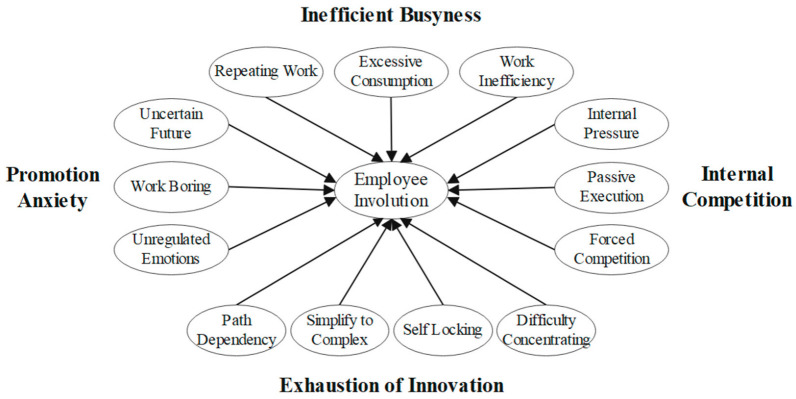
The phenomenon of workplace involution has attracted ample attention. How to make employees treat their work with the correct attitude and behavior and improve their work performance has become a realistic proposition. This study uses a combination of qualitative and quantitative research methods, with the help of grounded theory, to conduct an exploratory study on the structural dimensions of employee involution in the Chinese workplace and, on this basis, to develop and test the measurement scale. The research results show that employee involution is a multi-dimensional construct with rich connotations, including four dimensions: inefficient busyness, exhaustion of innovation, promotion anxiety, and internal competition. The measurement scale consists of four factors and 13 items.
Overview
CoChat Summary
TL;DR
This paper uses grounded theory and scale-development methods to conceptualize employee involution in China’s workplace as a four-dimensional construct: inefficient busyness, exhaustion of innovation, promotion anxiety, and internal competition. It develops and tests a 13-item, 4-factor Likert scale, reporting acceptable reliability and validity.
Key findings
- Employee involution is defined as a state of “voluntary” workplace competition involving internal competitive pressure, tiredness with work tasks, energy and physical consumption, and doubts about self-efficacy and ability improvement.
- The construct has four dimensions: inefficient busyness (behavioral), exhaustion of innovation (cognitive), promotion anxiety (emotional), and internal competition (motivational).
- The final measurement scale has 4 factors and 13 items; exploratory factor analysis retained 13 items with loadings from 0.662 to 0.817, explaining 87.425% of total variance.
- Reliability and validity results: overall Cronbach’s coefficient = 0.943; single-dimension Cronbach’s coefficients = 0.829–0.907; CR values > 0.6; AVE > 0.36; inter-factor correlations = 0.617–0.691.
Methods
- Qualitative grounded theory: open, axial, and selective coding; theoretical sampling; 103 interviewees; 1,652 “involution” expressions collected; more than 900 original sentences/initial concepts; saturation tested with the reserved 1/3 of interview records.
- Scale development: 42 initial items reduced to 21, then to an initial 15-item scale, and finally to 13 items; Likert 5-point scoring.
- Quantitative testing: 587 questionnaires distributed, 549 recovered, 440 valid (74.95% effective recovery rate); sample from employees of 20 small and medium-sized enterprises in manufacturing, construction, service, and education in Anhui Province; 220 cases used for EFA and 220 for CFA; KMO = 0.953, Bartlett sphericity significant (Sig = 0.000).
Limitations
- The paper states that it focused on the structural dimension of involution at the employee level and did not further explore its specific performance at the organizational level.
- Evident from the text: the quantitative sample is drawn from 20 SMEs in Anhui Province, China, so generalizability beyond this context is not established.
- Evident from the text: the scale relies on self-report Likert responses, and the EFA and CFA samples are split from the same 440 valid questionnaires; no longitudinal or multi-source validation is reported.
Model-written summary. Check it against the paper before relying on it.
Integrity signals
Registry
Cites
Statistics
Figures
Verification
Claims the paper makes
4 Valid · 7 Not valid · 9 Not checked · 50 Own results and interpretations
A result the paper reports from its own data — it cites no other source for it, so there is none to check. The quote shows it is in the paper.
In the paper
“The research concluded that the employee involution measurement scale includes 4 factors, which are composed of 13 measurement items.”
§ Structural Dimension Exploration and Measurement Scale Development of Employee Involution in China’s Workplace Field > 7. Discussion
plain- Asserted: passes — The authors put it forward as true.
- Checkable: passes — It can be checked against evidence.
- Load-bearing: passes — The paper’s conclusions depend on it.
- Based: passes — The paper gives a reason why it holds.
A result the paper reports from its own data — it cites no other source for it, so there is none to check. The quote shows it is in the paper.
In the paper
“The measurement scale consists of four factors and 13 items.”
§ Structural Dimension Exploration and Measurement Scale Development of Employee Involution in China’s Workplace Field > Abstract
plain- Asserted: passes — The authors put it forward as true.
- Checkable: passes — It can be checked against evidence.
- Load-bearing: passes — The paper’s conclusions depend on it.
- Based: passes — The paper gives a reason why it holds.
A result the paper reports from its own data — it cites no other source for it, so there is none to check. The quote shows it is in the paper.
In the paper
“The research results show that employee involution is a multi-dimensional construct with rich connotations, including four dimensions: inefficient busyness, exhaustion of innovation, promotion anxiety, and internal competition.”
- Also stated in: § 5. Definition of Involution Concept Structure · plain
“Employee involution includes four dimensions: inefficient busyness, exhaustion of innovation, promotion anxiety, and internal competition.”
§ Structural Dimension Exploration and Measurement Scale Development of Employee Involution in China’s Workplace Field > Abstract
plain- Asserted: passes — The authors put it forward as true.
- Checkable: passes — It can be checked against evidence.
- Load-bearing: passes — The paper’s conclusions depend on it.
- Based: passes — The paper gives a reason why it holds.
- Also stated in: § 5. Definition of Involution Concept Structure · plain
A result the paper reports from its own data — it cites no other source for it, so there is none to check. The quote shows it is in the paper.
In the paper
“Finally, an initial measurement scale with four dimensions and 15 items was formed.”
§ Structural Dimension Exploration and Measurement Scale Development of Employee Involution in China’s Workplace Field > 6. Development and Testing of Involution Measurement Scales > 6.1. Compilation of Scales
plain- Asserted: passes — The authors put it forward as true.
- Checkable: passes — It can be checked against evidence.
- Load-bearing: unclear — It is unclear whether the paper’s conclusions depend on it.
- Based: passes — The paper gives a reason why it holds.
A result the paper states — it cites no source for it, so there is none to check. The quote shows it is in the paper.
In the paper
“reveals how the four dimensions of employee involution are reflected in behavior, cognition, emotion, and motivation”
§ Structural Dimension Exploration and Measurement Scale Development of Employee Involution in China’s Workplace Field > 7. Discussion > 7.1. Theoretical Implications
plain- Asserted: passes — The authors put it forward as true.
- Checkable: passes — It can be checked against evidence.
- Load-bearing: passes — The paper’s conclusions depend on it.
- Based: passes — The paper gives a reason why it holds.
19 more claims
Create a free account to see all 70 claims and every source verdict.
- Probably not a substantial claim. 35
- It may state two separate claims as one. 28
- The quote only partly states this claim. 2
Citations
Cites
The Discovery of Grounded Theory; Strategies for Qualitative Research
Glaser, B. G., Strauss, A. L., & Strutzel, E. (1968) · Nursing Research · doi:10.1097/00006199-196807000-00014 · Cited by 39,449
The Discovery of Grounded Theory: Strategies for Qualitative Research
Glaser, B. G., & Strauss, A. L. (2017) · Aldine (Routledge reprint) · doi:10.4324/9780203793206 · Cited by 25,789
Basics of Qualitative Research (3rd ed.): Techniques and Procedures for Developing Grounded Theory
Corbin, J., & Strauss, A. (2008) · SAGE · doi:10.4135/9781452230153 · Cited by 12,136
PSYCHOLOGICAL CONDITIONS OF PERSONAL ENGAGEMENT AND DISENGAGEMENT AT WORK.
Kahn, W. A. (1990) · Academy of Management Journal · doi:10.2307/256287 · Cited by 10,975 · cited 1×
“Greenhalgh and Rosenblatt [62] pointed out that the sense of team psychological security refers to the subjective perception of employees on the objective environment of the work team, not only the working conditions themselves, but also a judgment that individuals can express their personal beliefs, and that “there i…”
BackgroundSocial Exchange Theory: An Interdisciplinary Review
Cropanzano, R., & Mitchell, M. S. (2005) · Journal of Management · doi:10.1177/0149206305279602 · Cited by 10,068 · cited 1×
“This concept is consistent with the social exchange theory, which is based on the assumption that social exchange involves multiple behaviors that generate obligations and that relationships will increase over time, thus becoming trustworthy, loyal, and mutually committed [60].”
ResultDevelopment of the Job Diagnostic Survey.
Hackman, J. R., & Oldham, G. R. (1975) · Journal of Applied Psychology · doi:10.1037/h0076546 · Cited by 7,246 · cited 1×
“Hackman and Okiham [58], the proponents of the work characteristic model, believe that intrinsic motivation reflects the efficient working state of employees through self-motivation.”
BackgroundAdverse health effects of high-effort/low-reward conditions.
Siegrist, J. (1996) · Journal of Occupational Health Psychology · doi:10.1037/1076-8998.1.1.27 · Cited by 5,713 · cited 1×
“According to the effort-reward imbalance model of Siegrist [23], if an employee’s efforts at work are not reciprocated, they may feel dissatisfied at work, which can manifest as a loss of happiness.”
MethodAnxiety and cognitive performance: Attentional control theory
Eysenck, M. W., Derakshan, N., Santos, R., & Calvo, M. G. (2007) · Emotion · doi:10.1037/1528-3542.7.2.336 · Cited by 5,289 · cited 1×
“Individuals with anxiety and stress tend to interpret the stimuli and events in their environment as excessive threats [17,18].”
BackgroundThe global prevalence of common mental disorders: a systematic review and meta-analysis 1980–2013
Steel, Z., Marnane, C., Iranpour, C., Chey, T., Jackson, J. W., Patel, V., & Silove, D. (2014) · International Journal of Epidemiology · doi:10.1093/ije/dyu038 · Cited by 2,846 · cited 1×
“, employees cannot get rid of the current development dilemma, innovate but not innovate at work, and cannot provide a friendly environment for their development) and internal environment (the development and progress of employees in work meet a bottleneck, they are physically and mentally exhausted in repeated selfco…”
BackgroundAmabile, T. M., Barsade, S. G., Mueller, J. S., & Staw, B. M. (2005) · Administrative Science Quarterly · doi:10.2189/asqu.2005.50.3.367 · Cited by 2,208 · cited 1×
“, employees cannot get rid of the current development dilemma, innovate but not innovate at work, and cannot provide a friendly environment for their development) and internal environment (the development and progress of employees in work meet a bottleneck, they are physically and mentally exhausted in repeated selfco…”
Background
Research works printed but not linked: 6
- Bao X. The Striving Trap: Chinese 996 Work Culture, Online and Offline Perspectives Doctoral Dissertation Duke University Durham, NC, USA 2022
- Meng-ying L. “Nei Juan” in Exam-oriented Education in China J. Lit. Art Stud. 2021 11 1028 1033
- Du Z. Culture, Power and Nation State—Interview with Professor Du Zanqi Xuehai 2000 90 94 10.16091/j.cnki.cn32-1308/c.2000.06.020 · doi:10.16091/j.cnki.cn32-1308/c.2000.06.020
- Liu S. Qiu Z. Analysis of the concept of “involution” Sociol. Res. 2004 96 110 10.19934/j.cnki.shxyj.2004.05.009 · doi:10.19934/j.cnki.shxyj.2004.05.009
- Charmaz K. Grounded theory: Objectivist and constructivist methods Handb. Qual. Res. 2000 2 509 535
- Arakal T. Mampilly D. The Impact of Organizational Climate on Performance of Employees, Trends and Challenges in Global Business Management 2013 235 238 Available online: http://www.conference.bonfring.org/papers/sngce_placitum2013/hrm04.pdf (accessed on 29 August 2022)
Cited by
Development and validation of an Academic Involution Scale for College Students in China
Wang, F., Yang, Y., & Cui, T. (2023) · Psychology in the Schools · doi:10.1002/pits.23087 · Cited by 42
Obeng, H. A., Arhinful, R., Tessema, D. H., & Nuhu, J. A. (2025) · Future Business Journal · doi:10.1186/s43093-025-00463-4 · Cited by 42
Digital sustainability: Dimension exploration and scale development
Wang, Y., Yu, Y., & Khan, A. (2025) · Acta Psychologica · doi:10.1016/j.actpsy.2025.105028 · Cited by 33
Wu, H., Zhang, L., & Ren, S. (2023) · Frontiers in Psychology · doi:10.3389/fpsyg.2023.1279853 · Cited by 24
“Numerous studies have explored and compared various speech acts, especially those related to Brown and Levinson’s (1987) face theory such as gratitude, refusal, and requests, in English and Chinese (Zhu, 2017; Chang and Ren, 2020; House and Kádár, 2021; Li, 2022).”
BackgroundZhou, Q., Li, H., & Li, B. (2023) · Current Psychology · doi:10.1007/s12144-022-04218-0 · Cited by 23
“…of the workforce provides unprecedented opportunities for organizations, it also becomes an assignment for employees to share work-related posts with their audiences on personal social media, especially in the context of Chinese involution where employees compete for promotions (Dou et al., 2022).”
BackgroundLiu, Y., Meng, L. M., Wang, H., & Chen, Y. (2024) · International Journal of Hospitality Management · doi:10.1016/j.ijhm.2024.103870 · Cited by 20
Fan, C., Lu, J., Zhang, L., Shang, B., & Gong, Y. (2025) · BMC Psychology · doi:10.1186/s40359-025-03077-1 · Cited by 11
“Amid intensifying market homogenization and the proliferation of “involution” in China’s social ecology [1], organizations widely adopt strategies of extending working hours and intensifying role demands on employees to maintain competitive advantages [2].”
Wen, R., & Jin, Q. (2025) · Behavioral Sciences · doi:10.3390/bs15111515 · Cited by 14
“For individuals, excessive academic involution is closely associated with negative outcomes such as anxiety, depression, reduced motivation, diminished creativity, and academic burnout (Dou et al., 2022), serving as an important factor influencing college students’ psychology and behavior.”
Wang, S., & Yang, L. (2024) · Policy Studies · doi:10.1080/01442872.2024.2339889 · Cited by 13
“Moreover, with the involution 1 effect occurring in the Chinese labour market (Dou et al. 2022), working-age adults tend to be more bonded to their work, rather than sparing time and effort for childcare responsibilities.”
Self-citationWang, Y., Orosz, G., Chen, X., Miao, C., & Li, Y. (2024) · Scientific Reports · doi:10.1038/s41598-024-57359-6 · Cited by 8
“They must engage in neijuan (irrational competition) with others, but they must also win or they could easily lose their jobs 24 .”
BackgroundOuyang, C., Ma, Z., Ma, Z., & Su, J. (2023) · Psychology Research and Behavior Management · doi:10.2147/prbm.s414623 · Cited by 11
“Data Analysis Process This study followed the steps of open coding, axial coding, and selective coding for data analysis by referring to Dou et al.33 Open Coding Open coding is the process of extracting concepts from qualitative data through analysis and comparison.”
MethodFeng, X. (2023) · Advances in Economics and Management Research · doi:10.56028/aemr.8.1.274.2023 · Cited by 7
“Employees' work motivation under the background of internalization will become more utilitarian, which leads to vicious competition in the workplace (Bianchi et al., 2017; Dou et al., 2022), which is also detrimental to the long-term development of the organization (Dou et al., 2022).”
BackgroundPoverty Makes me Overwork: The Influence of Subjective Socioeconomic Status on Involution Behavior
Dong, Z., Yang, T., Jia, X., Cao, Y., & Hou, Y. (2025) · Journal of Pacific Rim Psychology · doi:10.1177/18344909251387772 · Cited by 5
“For example, college students ’ admissions heavily depend on academic performance (Yi et al., 2022), and employees ’ performance often hinges on their superiors ’ subjective evaluation (Dou et al., 2022).”
InfluentialWang, L.-Y., Kong, J.-Y., Yao, C., & Wang, M. (2025) · Scientific Reports · doi:10.1038/s41598-025-28658-3 · Cited by 3
“…where peers possess superior competencies and resource dominance, employees’ relative resource scarcity generates perceived competitive pressure, which becomes progressively reinforced through sustained exposure to competitive climate experiences, thereby elevating job anxiety levels 32 .”
Technostress and innovation adaptation: how job crafting enables successful aging in older employees
Yanzi, W., Peng, Z., Ouyang, Z., Zhao, M., & Li, Z. (2026) · European Journal of Innovation Management · doi:10.1108/ejim-07-2025-0970 · Cited by 2
Investigating the effect of AI technostress on employee’s working behaviors: a stress response model
Lyu, T., Liu, Y., & Chen, H. (2026) · Journal of Hospitality and Tourism Technology · doi:10.1108/jhtt-05-2025-0366 · Cited by 7
Wen, C., Lyu, X., & Zhang, Q. (2024) · BMC Medical Education · doi:10.1186/s12909-024-06050-5 · Cited by 7
“…high competition rates, rapid development, and intense social pressures, “neijuan” results in a relentless pursuit of success and achievement, even in the face of diminishing returns, leading to a sense of exhaustion and burnout, which ultimately undermines personal well-being and happiness [2, 3].”
BackgroundAcademic involution as a rat race at expense of health and well-being
Liu, Y., Xie, X., Yang, F., & Zhang, S. (2026) · Social Psychology of Education · doi:10.1007/s11218-026-10262-6 · Cited by 1
“This view has been advanced both in theoretical discussions (Chaocheng et al., 2023; He & Liu, 2025; Si, 2023; Yan et al., 2022 ) and in qualitative studies (Dou et al. 2022; Zhang et al. 2024a, 2024b).”
InfluentialChen, Y., Zhao, A., Yang, H., Chen, T., Rao, X., Zhou, J., Li, L., Li, J., & Li, Z. (2024) · Research Square · doi:10.21203/rs.3.rs-3908847/v1
Meng, Y., Liu, S., Li, J.-Y., Zhao, X.-K., & Tan, J. Y. (2025) · Human Services Organizations Management Leadership & Governance · doi:10.1080/23303131.2025.2488302 · Cited by 2
“Addressing this gap, Dou et al. (2022) defined employee involution as the state of “voluntary” competition for work in the workplace and developed a four-dimensional employee involution scale (inefficient busyness, innovation exhaustion, promotion anxiety, internal competition) through…”
InfluentialAn In-depth Exploration of the Protection of Childbearing Rights for Single Women in China
Gao, W. J. (2025) · Journal of Education Humanities and Social Sciences · doi:10.54097/v76ej536
Wang, F., Yu, Y., & Liu, X. (2026) · Frontiers in Communication · doi:10.3389/fcomm.2026.1835955
Li, S., & chen, W. (2026) · Frontiers in Psychology · doi:10.3389/fpsyg.2026.1811047
Wang, T., Zhang, L., Chen, X., & Cao (2026) · Nurse Education Today · doi:10.1016/j.nedt.2026.107251
Workplace involution behavior in China: a study based on grounded theory
Lu, Y., & Yan, Y. (2026) · Chinese Management Studies · doi:10.1108/cms-12-2024-0983
Qi, X. K., Cheng, F., & Wang, M. (2026) · Behavioral Sciences · doi:10.3390/bs16071201 · Cited by 1
“In a mixed study exploring employees in the Chinese market (Dou et al., 2022), it was discovered that employee involution is a multi-dimensional and richly connotative structure, including four dimensions: inefficient busyness, innovation exhaustion, promotion anxiety, and internal competition.”
Huang, R. (2026) · Frontiers in Psychology · doi:10.3389/fpsyg.2026.1842907
“…and performance gains (Noy and Zhang, 2023; Przegalinska et al., 2024), whereas the broader involution literature has focused more on conceptualization, measurement (Dou et al., 2022), and downstream outcomes than on its technology-related antecedents in workplace settings (Yin et al., 2023).”
MindBeat: A Multimodal Interface for Stress Recovery through Rhythmic Fidgeting
Xu, W., Xu, Z., Zhang, R., Wang, Q., & Ying, F. (2026) · INTERNATIONAL CONFERENCE ON MULTIMODAL INTERACTION · doi:10.1145/3776574.3831144
Metadata
- Authors
- Dou, G., Li, G., Yuan, Y., Liu, B., & Yang, L.
- Affiliations
- Fuyang Normal University (CN)
- Beijing Institute of Technology (CN)
- Corresponding author
- Li, Guangxia
- Yuan, Yunyun
- Venue
- International Journal of Environmental Research and Public Health
- Publisher
- MDPI AG
- Published
- 2022-11-04
- Volume
- 19
- Issue
- 21
- Pages
- 14454
- ISSN
- 1660-4601 (ISSN-L)
- PMC
- PMC9655169
- OpenAlex
- W4308195825
- Cited by
- 28
- References
- 61
- Citations by year
- 2026: 10 · 2025: 8 · 2024: 5 · 2023: 5
- FWCI
- 4.25
- Type
- journal article
- Language
- en
- Open access
- gold
- doi.org
- Licence
- Locations
- International Journal of Environmental Research and Public Health (publishedVersion, cc-by)
- PubMed Central (publishedVersion, cc-by)
- PubMed (publishedVersion)
- RePEc: Research Papers in Economics (submittedVersion)
- DOAJ (DOAJ: Directory of Open Access Journals) (submittedVersion)
- Funders
- Anhui Provincial Philosophy and Social Science Planning General Program (AHSKY 2017 D70)
- Topics
- Social Sciences › Psychology › Social Psychology › Stress and Burnout Research
- Social Sciences › Business, Management and Accounting › Organizational Behavior and Human Resource Management › Job Satisfaction and Organizational Behavior
- Social Sciences › Psychology › Social Psychology › Workaholism, burnout, and well-being
- Keywords
- structural dimensions, scale development, internal competition, Chinese workplaces, employee performance
- MeSH terms
- Work Performance, China, Data Collection, Humans, Reproducibility of Results, Workplace
About these checks
Registry, retraction, Cites and statistics results are computed, not judged, with one exception: a printed reference that no index lists is read once by a model before it counts as a citation error. Claims are extracted by a model and kept only when their quote appears verbatim in the text; each cited source is then checked, with a model’s help, for whether it says what the claim relies on. Those verdicts can be wrong — read the claim’s quote and the cited source before relying on one.
The claim verdicts this report counts are experimental: their accuracy is not yet measured.
A language model drew the claims from the paper on 2026-10-10, under version 3 of the claim definition (model deepseek-v4.1-flash, prompt extract-v3).
A second model labelled each claim on 2026-10-10 (model jev-1.13-20260917, definition revision gold-guideline-v0.2).
Statistics and arithmetic are recomputed, not judged.
Confidence bands are shown only for fields calibrated on our annotated test set. None is calibrated yet, so no band is shown.
What counts as a claim ›How we measure confidence ›How we check this ›
Are you an author, or do you see a problem with this page? Request a review
Data sources
Bibliographic data: Semantic Scholar, OpenAlex, Crossref.
Contains information from the Semantic Scholar Academic Graph Datasets, made available under the ODC Attribution License (ODC-BY 1.0).
Semantic Scholar’s data is described in: Kinney, R., et al. (2023). The Semantic Scholar Open Data Platform. arXiv:2301.10140.
