

Forecasting Stock Market Prices Using Machine Learning and Deep Learning Models: A Systematic Review, Performance Analysis and Discussion of Implications
Open accessThe DOI matches its Crossref record; 76 of the 83 references it cites were found in a registry or an index; 44 of the 76 sources its claims cite were checked for support.
Abstract
A systematic review, performance analysis and discussion of implications of forecasting stock market prices using machine learning and deep learning models. Implements an ensemble model combining Random Forest, XGBoost, and LSTM for stock price prediction.
Overview
CoChat Summary
TL;DR
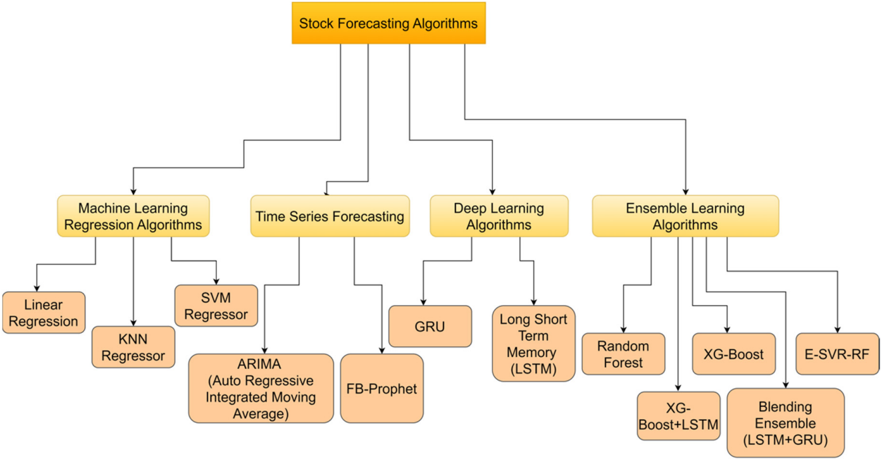
This paper reviews machine learning, deep learning, time series, and ensemble methods for stock price forecasting and implements an ensemble “Random Forest + XG-Boost + LSTM” on two Indian chemical-sector stocks. The ensemble achieved the best reported RMSE and R² among the compared models for both stocks.
Key findings
- The proposed ensemble “Random Forest + XG-Boost + LSTM” demonstrated the best performance compared with other distinct algorithms in the paper’s experimental analysis.
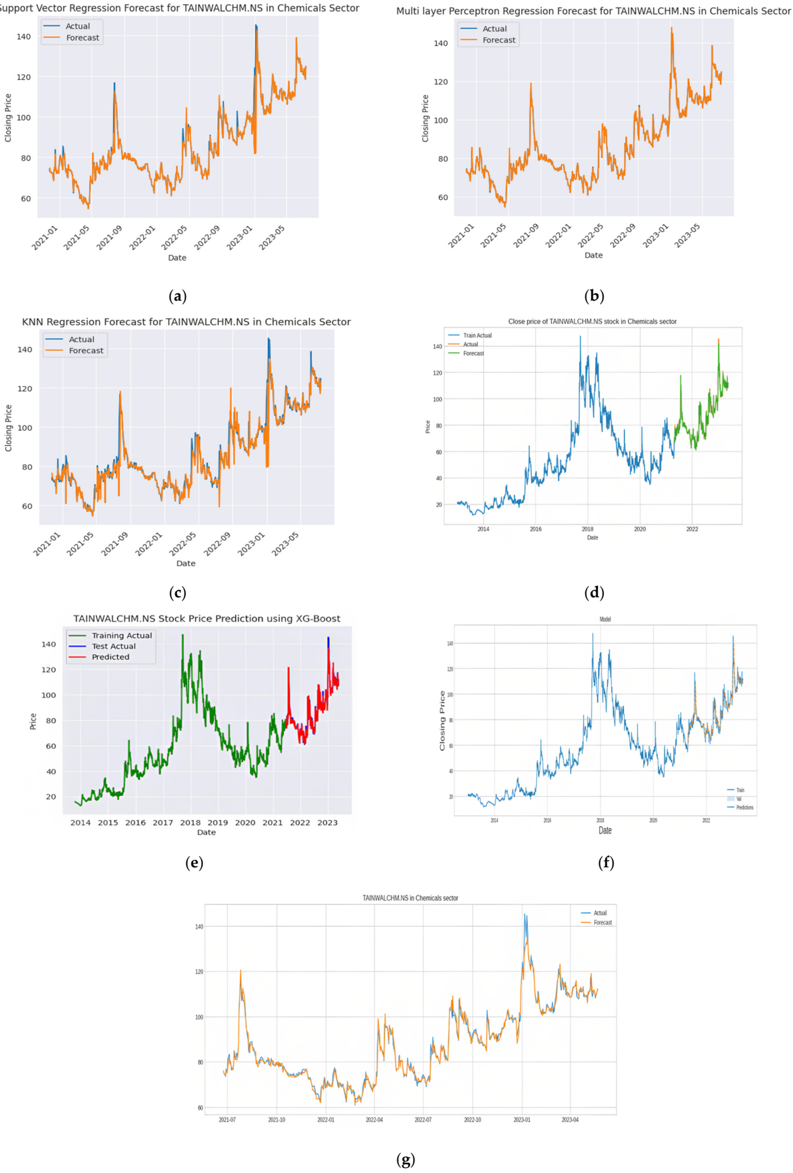
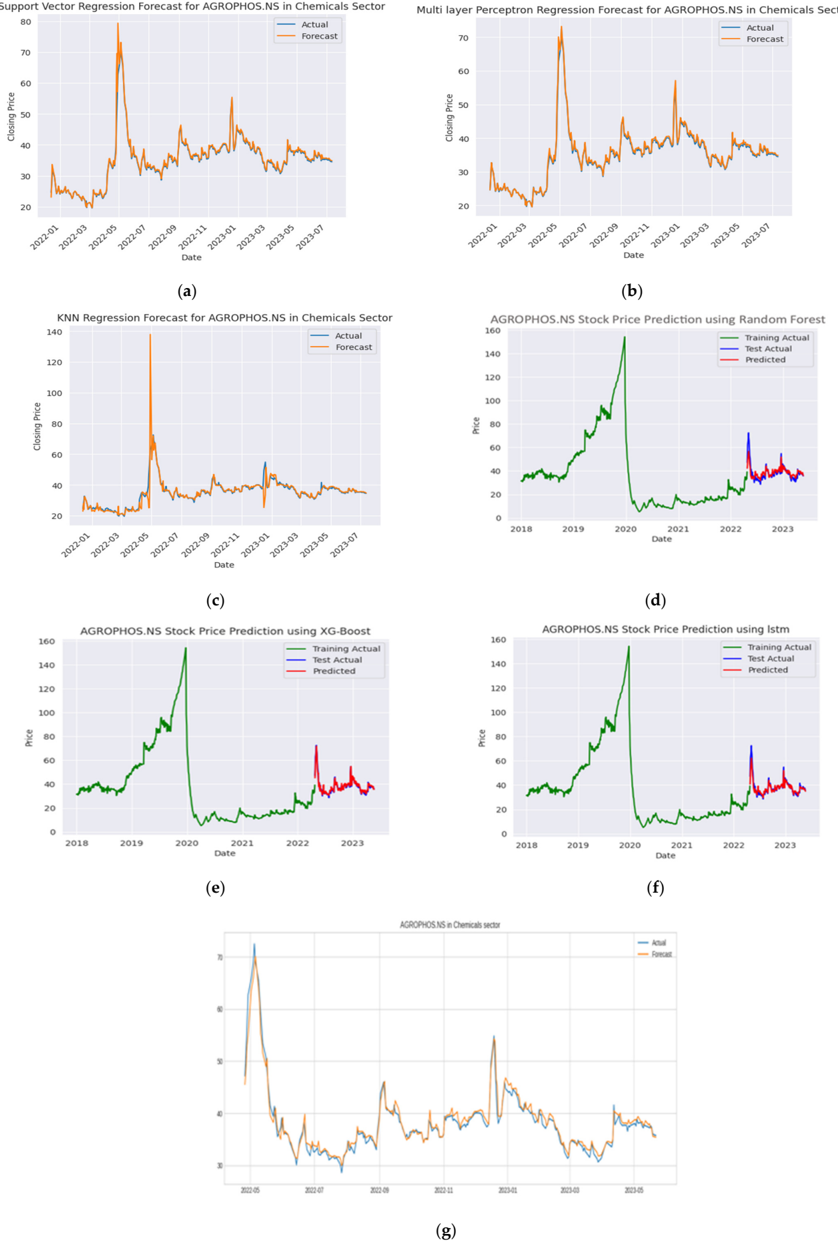
- For TAINIWALCHM, the ensemble achieved RMSE 2.0247 and R² 0.9921; for AGROPHOS, it achieved RMSE 1.2658 and R² 0.9897 (Table 2).
- The review concludes that machine learning or deep learning models alone are not sufficient, that ensemble techniques can provide superior performance, and that hyperparameter tuning is crucial for improving stock forecasts.
- The paper states there is still no universal solution to accurately predict stock price or market trend, and AI-based models can fail if not trained efficiently with fresh data.
Methods
- Design: a systematic/comprehensive review of supervised and unsupervised machine learning, ensemble, time series, and deep learning algorithms for stock price prediction and classification, plus an experimental comparative analysis.
- Data: stock data obtained from the Yahoo Finance API for Tainwala Chemicals and Plastics (TAINIWALCHM) from 2014 to 2023 and Agro Phos (AGROPHOS) from 2018 to 2023.
- Main analysis: implemented algorithms in Python and evaluated performance using RMSE and R²; the ensemble used a stacked model with Keras, TensorFlow, and sklearn, 80% training and 20% testing, MSE loss, Adam optimizer, and grid-search hyperparameter tuning.
Limitations
- The paper states that no universal solution exists for accurate stock price or trend prediction, that AI-based models can fail if not trained efficiently with fresh data, and that decisions should not rely only on AI-based price forecasting methods.
- The text makes evident that the experimental comparison is limited to two stocks, TAINIWALCHM and AGROPHOS, both described as falling under the chemical industry market sector.
- The text makes evident that the review’s comparative performance table draws on heterogeneous prior studies with different datasets, metrics, and evaluation settings, so the reported comparisons are not from a single controlled benchmark.
Model-written summary. Check it against the paper before relying on it.
Integrity signals
Registry
Cites
Statistics
Figures


Verification
Claims the paper makes
33 Valid · 11 Not valid · 17 Not checked · 26 Own results and interpretations
At least one cited source doesn’t support this claim or points to a different paper, and none confirmed it — see the verdicts below.
In the paper
“The ensemble algorithm of XG-Boost + LSTM shows the following evaluation parameter: MSE = 3.465 (Vuong et al. 2022).”
§ Forecasting Stock Market Prices Using Machine Learning and Deep Learning Models: A Systematic Review, Performance Analysis and Discussion of Implications > 13 XG-Boost + LSTM
What the sources say
- Disputedcites Vuong et al. 2022 matched to “Stock-Price Forecasting Based on XGBoost and LSTM” (2022) sourceExperimental — accuracy not yet measured
Table 6 in §3.3 Results reports an MSE of 3.465 × 10⁻⁷ for XGBoost + LSTM on the Forex dataset, not 3.465. The citing sentence omits the exponent, changing the reported value by a factor of ten million. (LLM, conf=0.95)
Checked by a reasoning model — may be wrong.
plain- Asserted: passes — The authors put it forward as true.
- Checkable: passes — It can be checked against evidence.
- Load-bearing: unclear — It is unclear whether the paper’s conclusions depend on it.
- Based: passes — The paper gives a reason why it holds.
- Disputed
The sources with a verdict support this claim; the rest weren’t checked yet, have no full text we could read, or their verdicts aren’t rated yet.
In the paper
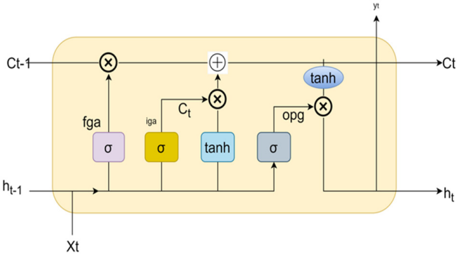
“Stock forecasting using LSTM, a unique recurrent neural network (RNN), overcomes long-term dependency (Qiu et al. 2020;Banik et al. 2022).”
§ Forecasting Stock Market Prices Using Machine Learning and Deep Learning Models: A Systematic Review, Performance Analysis and Discussion of Implications > 2. Comprehensive Summary of Theoretical Basis
What the sources say
- Supportedcites Qiu et al. 2020 matched to “Forecasting stock prices with long-short term memory neural network based on attention mechanism” (2020) source
The 'Long short-term memory neural networks (LSTM)' section describes LSTM as a form of RNN intended to avoid long-term dependence problems. The Introduction also says LSTM is suitable for stock-price time series. Page numbers are not provided in our copy. (LLM, conf=0.92)
- Not checked — no full text of the sourcecites Banik et al. 2022 matched to “LSTM based decision support system for swing trading in stock market” (2022) source
plainstates a cause- Asserted: passes — The authors put it forward as true.
- Checkable: passes — It can be checked against evidence.
- Load-bearing: unclear — It is unclear whether the paper’s conclusions depend on it.
- Based: passes — The paper gives a reason why it holds.
- Supported
Every source the paper cites for this claim was checked and supports it.
In the paper
“However, when it comes to predicting financial distress, the logistic regression model has exhibited better results in comparison to neural networks (Zizi et al. 2021).”
§ Forecasting Stock Market Prices Using Machine Learning and Deep Learning Models: A Systematic Review, Performance Analysis and Discussion of Implications > 2.3.1. Long Short-Term Memory (LSTM)
What the sources say
- Supportedcites Zizi et al. 2021 matched to “An Optimal Model of Financial Distress Prediction: A Comparative Study between Neural Networks and Logistic Regression” (2021) source
The Discussion reports that, in the authors’ comparison, logistic regression performed better than neural networks. The Conclusions likewise describe superior test-sample accuracy for logistic regression in predicting financial distress among Moroccan SMEs; the claim is supported as a report of those results, not as a universal rule. (LLM, conf=0.94)
plain- Asserted: passes — The authors put it forward as true.
- Checkable: passes — It can be checked against evidence.
- Load-bearing: unclear — It is unclear whether the paper’s conclusions depend on it.
- Based: passes — The paper gives a reason why it holds.
- Supported
Every source the paper cites for this claim was checked and supports it.
In the paper
“ARIMA can be combined with another algorithm, symmetric generalized autoregressive conditional heteroskedasticity (SGARCH), to improve forecasting performance.”
§ Forecasting Stock Market Prices Using Machine Learning and Deep Learning Models: A Systematic Review, Performance Analysis and Discussion of Implications > 2.2.1. ARIMA
What the sources say
- Supportedcites Vo and Ślepaczuk 2022 matched to “Applying Hybrid ARIMA-SGARCH in Algorithmic Investment Strategies on S&P500 Index” (2022) source
The Methodology section describes a hybrid model that combines ARIMA with GARCH to forecast the mean and variance. The Results section reports that the ARIMA–SGARCH model predicted S&P 500 returns more accurately than ARIMA alone on the study’s error metrics. (LLM, conf=0.94)
plainstates a cause- Asserted: passes — The authors put it forward as true.
- Checkable: passes — It can be checked against evidence.
- Load-bearing: unclear — It is unclear whether the paper’s conclusions depend on it.
- Based: passes — The paper gives a reason why it holds.
- Supported
The cited sources support only part of this claim — read each source’s verdict below.
In the paper
“Models with an integrated GNB algorithm will yield feature extraction and feature scaling outcomes that are superior to those already achieved using models that incorporate either the GNB algorithm or feature scaling (Setiani et al. 2020;Ampomah et al. 2021).”
§ Forecasting Stock Market Prices Using Machine Learning and Deep Learning Models: A Systematic Review, Performance Analysis and Discussion of Implications > Sr No Algorithm Name Gap Analysis Performance Evaluation 1 Linear regression
What the sources say
- Could not verifycites Setiani et al. 2020 matched to “Prediction of Banking Stock Prices Using Naïve Bayes Method” (2021) sourceExperimental — accuracy not yet measured
The Methodology section describes a Naïve Bayes classifier and a Gaussian-distribution calculation, while Figure 3 reports 57% prediction accuracy. Neither passage addresses integrated GNB with feature extraction or scaling, or compares it with models using either component alone (searched: integrated GNB, feature extraction, feature scaling, comparative performance). (LLM, conf=0.76)
- Partly supportedcites Ampomah et al. 2021 matched to “Stock Market Prediction with Gaussian Naïve Bayes Machine Learning Algorithm” (2021) sourceExperimental — accuracy not yet measured
The Conclusion reports that models combining GNB, feature scaling, and feature extraction generally outperformed models combining GNB with just one of those techniques. The cited paper measures stock-price prediction performance, not the quality of feature extraction or scaling themselves, and expressly notes an exception: GNB_LDA. (LLM, conf=0.86)
hedgedstates a cause- Asserted: passes — The authors put it forward as true.
- Checkable: passes — It can be checked against evidence.
- Load-bearing: unclear — It is unclear whether the paper’s conclusions depend on it.
- Based: passes — The paper gives a reason why it holds.
- Could not verify
7 more claims · 1 with their cited sources checked
Create a free account to see all 87 claims and to verify the 1 reference still open.
- Probably not a substantial claim. 50
- It may state two separate claims as one. 45
- The quote only partly states this claim. 2
Self-check
Percentages, sums and reported differences re-computed from the paper’s own numbers.
Each contradiction between two passages listed here was confirmed by an independent check.
Rated major: it would touch a result — a value a result rests on, reported and recomputed p-values on opposite sides of the significance level, two passages that conflict with no sign which is right, or a cited work retracted before this paper was published.
In the paper
§ Forecasting Stock Market Prices Using Machine Learning and Deep Learning Models: A Systematic Review, Performance Analysis and Discussion of Implications > 7. Conclusions
“| Random forest | 87.8839 | 0.9818 | 98.5633 | 0.9428 |”
§ Forecasting Stock Market Prices Using Machine Learning and Deep Learning Models: A Systematic Review, Performance Analysis and Discussion of Implications > 7. Conclusions
“| SVR | 4.525 | 0.9279 | 1.5074 | 0.9432 |”
Rated major: it would touch a result — a value a result rests on, reported and recomputed p-values on opposite sides of the significance level, two passages that conflict with no sign which is right, or a cited work retracted before this paper was published.
In the paper
§ Forecasting Stock Market Prices Using Machine Learning and Deep Learning Models: A Systematic Review, Performance Analysis and Discussion of Implications > 7. Conclusions
“| SVR | 4.525 | 0.9279 | 1.5074 | 0.9432 |”
§ Forecasting Stock Market Prices Using Machine Learning and Deep Learning Models: A Systematic Review, Performance Analysis and Discussion of Implications > 7. Conclusions
“| MLPR | 2.5893 | 0.9611 | 2.4764 | 0.9472 |”
Rated minor: it would not touch a result — a value no result rests on, a p-value that stays on the same side of the significance level, or a conflict that is clerical, resolved elsewhere in the paper, or outside its own findings.
In the paper
§ Forecasting Stock Market Prices Using Machine Learning and Deep Learning Models: A Systematic Review, Performance Analysis and Discussion of Implications > 2.2.2. FB Prophet Model
“where l(t) represents the linear trend, sp(t) represents seasonal patterns, v(t) represents holiday effects, and εn is the white noise error.”
§ Forecasting Stock Market Prices Using Machine Learning and Deep Learning Models: A Systematic Review, Performance Analysis and Discussion of Implications > 7 FB Prophet
“One of its advantages is that it does not consider holidays or null values.”
Rated minor: it would not touch a result — a value no result rests on, a p-value that stays on the same side of the significance level, or a conflict that is clerical, resolved elsewhere in the paper, or outside its own findings.
In the paper
§ Forecasting Stock Market Prices Using Machine Learning and Deep Learning Models: A Systematic Review, Performance Analysis and Discussion of Implications > 3. General Machine Learning Pipeline
“Training the ML model involves six steps, which are described in the following section:”
§ Forecasting Stock Market Prices Using Machine Learning and Deep Learning Models: A Systematic Review, Performance Analysis and Discussion of Implications > 3. General Machine Learning Pipeline
“Step 7: Fine-tune the hyperparameters to improve the evaluation parameters of the model.”
Rated minor: it would not touch a result — a value no result rests on, a p-value that stays on the same side of the significance level, or a conflict that is clerical, resolved elsewhere in the paper, or outside its own findings.
In the paper
§ Forecasting Stock Market Prices Using Machine Learning and Deep Learning Models: A Systematic Review, Performance Analysis and Discussion of Implications > 2. Comprehensive Summary of Theoretical Basis
“The model showed the lowest RMSE value of 186.32, a precision of 60%, and an F1-score of 66.47 (Li and Pan 2021).”
§ Forecasting Stock Market Prices Using Machine Learning and Deep Learning Models: A Systematic Review, Performance Analysis and Discussion of Implications > 13 XG-Boost + LSTM
“The blending ensemble algorithm, which consists of a modified version of RNN, i.e., LSTM and GRU, has the following evaluation parameters: MSE = 186.32,MPA = 99.65,precision = 60%, Recall = 75%, F1-Score = 66.67% (Li and Pan 2021).”
8 more findings
Create a free account to see every finding of this check.
Cited works that were retracted
Works this paper cites that were later retracted, from the retraction notices publishers deposit. Major when the notice came out before this paper was published.
A note, not an issue: for example, a cited work that was retracted only after this paper was published, which its authors could not have known.
In the paper
“In (Sharaf et al. 2022), news headlines pertaining to TSLA, AMZ, and GOOG stock were considered to obtain good-quality data to reduce spam tweets through feature selection methods.”
Cited work 10.1007/s11042-022-14216-w · retracted 2026-04-25 · notice 10.1007/s11042-026-21614-x · this paper published 2023-07-26
Citations
Cites
1 retracted
Sharaf, M. M., Hemdan, E. E., El‐Sayed, A., & El-Bahnasawy, N. A. W. (2022) · Multimedia Tools and Applications · doi:10.1007/s11042-022-14216-w · Cited by 65 · cited 1×
“In (Sharaf et al. 2022), news headlines pertaining to TSLA, AMZ, and GOOG stock were considered to obtain good-quality data to reduce spam tweets through feature selection methods.”
BackgroundRetractedPatel, J., Shah, S., Thakkar, P., & Kotecha, K. (2015) · Expert Systems with Applications · doi:10.1016/j.eswa.2014.07.040 · Cited by 1,141 · cited 1×
“Random forest, trained on multiple decision trees and Naïve Bayes, predicts stock movement based on negative or positive probability using Reliance and Infosys’ 10-year historical data (Patel et al. 2015).”
MethodSentiment analysis using deep learning architectures: a review
Yadav, A., & Vishwakarma, D. K. (2020) · Artificial Intelligence Review · doi:10.1007/s10462-019-09794-5 · Cited by 841 · cited 1×
“Social media data, company news, and trend analysis can classify investors’ stock sentiments as positive, negative, or neutral (Yadav and Vishwakarma 2019).”
BackgroundApplications of deep learning in stock market prediction: Recent progress
Jiang, W. (2021) · Expert Systems with Applications · doi:10.1016/j.eswa.2021.115537 · Cited by 714 · cited 2×
“We believe that researchers can explore the possible usage of state-of-the-art deep learning and machine learning algorithms in stock trend prediction and classification (Jiang 2021; Nikou et al. 2019).”
BackgroundEvaluating multiple classifiers for stock price direction prediction
Ballings, M., Van den Poel, D., Hespeels, N., & Gryp, R. (2015) · Expert Systems with Applications · doi:10.1016/j.eswa.2015.05.013 · Cited by 611 · cited 7×
“The performance of the SVM algorithm can be elevated by tuning parameters such as regularization, gamma, and kernel parameters (Bustos et al. 2017).”
MethodInfluentialStock Market Analysis: A Review and Taxonomy of Prediction Techniques
Shah, D., Isah, H., & Zulkernine, F. (2019) · International Journal of Financial Studies · doi:10.3390/ijfs7020026 · Cited by 465 · cited 2×
“As the stock market evolves under the influence of various factors such as geopolitical issues, equity trading, and investment, the underlying challenges also change, and so do the methodologies for addressing the new challenges (Sprenger and Welpe 2011; Shah et al. 2019).”
BackgroundNabipour, M., Nayyeri, P., Jabani, H., S., S., & Mosavi, A. (2020) · IEEE Access · doi:10.1109/access.2020.3015966 · Cited by 463 · cited 1×
“Similar feature engineering-and deep learning-based approaches are presented in (Shen and Shafiq 2020; Nabipour et al. 2020; Mohapatra et al. 2022).”
BackgroundThe evolution of stock market efficiency over time: A survey of the empirical literature
Lim, K.-P., & Brooks, R. (2011) · Journal of Economic Surveys · doi:10.1111/j.1467-6419.2009.00611.x · Cited by 410 · cited 2×
“It is said that the stock market evolves over a period of time (Lim and Brooks 2011), and hence, the approaches developed for handling specific problems will see low performance sooner or later even though their performance is found to be appreciated initially.”
BackgroundShort-term stock market price trend prediction using a comprehensive deep learning system
Shen, J., & Shafiq, M. O. (2020) · Journal of Big Data · doi:10.1186/s40537-020-00333-6 · Cited by 380 · cited 1×
“Similar feature engineering-and deep learning-based approaches are presented in (Shen and Shafiq 2020; Nabipour et al. 2020; Mohapatra et al. 2022).”
BackgroundForecasting stock prices with long-short term memory neural network based on attention mechanism
Qiu, J., Wang, B., & Zhou, C. (2020) · PLOS ONE · doi:10.1371/journal.pone.0227222 · Cited by 366
A Survey of Forex and Stock Price Prediction Using Deep Learning
Hu, Z., Zhao, Y., & Khushi, M. (2021) · Applied System Innovation · doi:10.3390/asi4010009 · Cited by 340 · cited 2×
“Hadoop architectures can also handle large volumes of stock data (Jose et al. 2019) and deep learning algorithms can predict financial markets (Hu et al. 2021).”
BackgroundStock market prediction using machine learning classifiers and social media, news
Khan, W., Ghazanfar, M. A., Azam, M. A., Karami, A., Alyoubi, K. H., & Alfakeeh, A. S. (2022) · Journal of Ambient Intelligence and Humanized Computing · doi:10.1007/s12652-020-01839-w · Cited by 336 · cited 1×
“Khan et al., in (Khan et al. 2020), used Pyspark, MLlib, linear regression, and random forest to achieve 80–98% accuracy.”
MethodA comprehensive evaluation of ensemble learning for stock-market prediction
Nti, I. K., Adekoya, A. F., & Weyori, B. A. (2020) · Journal of Big Data · doi:10.1186/s40537-020-00299-5 · Cited by 329 · cited 1×
“Most ensemble classifiers and regressors are developed by combining decision trees, support vector machines, and neural networks (Nti et al. 2020).”
BackgroundNikou, M., Mansourfar, G., & Bagherzadeh, J. (2019) · Intelligent Systems in Accounting, Finance and Management · doi:10.1002/isaf.1459 · Cited by 292 · cited 1×
“Generally, these chart patterns are identified based on the perceptions of traders.”
BackgroundKardani, N., Zhou, A., Nazem, M., & Shen, S.-L. (2021) · Journal of Rock Mechanics and Geotechnical Engineering · doi:10.1016/j.jrmge.2020.05.011 · Cited by 285 · cited 2×
“The outcomes showed that the GNB LDA predictive model (Kardani et al. 2020) performed better than all other GNB models.”
BackgroundMethodPredicting the daily return direction of the stock market using hybrid machine learning algorithms
Zhong, X., & Enke, D. (2019) · Financial Innovation · doi:10.1186/s40854-019-0138-0 · Cited by 274 · cited 1×
“…integrated moving average), FB Prophet (Facebook Prophet), LSTM (long short-term memory), GRU (gated recurrent network), as well as ensemble algorithms such as random forest and XG-Boost (extreme gradient boosting), are described (Zhong and Enke 2019; Sidra and Sen 2020; Parray et al. 2020).”
MethodDeep learning and time series-to-image encoding for financial forecasting
Barra, S., Carta, S. M., Corriga, A., Podda, A. S., & Recupero, D. R. (2020) · IEEE/CAA Journal of Automatica Sinica · doi:10.1109/jas.2020.1003132 · Cited by 267 · cited 1×
“We believe that researchers can explore the possible usage of state-of-the-art deep learning and machine learning algorithms in stock trend prediction and classification (Jiang 2021; Nikou et al. 2019).”
BackgroundStock Market Prediction on High-Frequency Data Using Generative Adversarial Nets
Zhou, X., Pan, Z., Hu, G., Tang, S., & Zhao, C. (2018) · Mathematical Problems in Engineering · doi:10.1155/2018/4907423 · Cited by 258 · cited 1×
“Another proposed method uses Ensemble LSTM with CNN on stock indexes for training adversarial networks, which can help forecast high-frequency stock and has advantages like adversarial training and reducing direction prediction loss and forecast error loss (Zhou et al. 2018).”
MethodForecasting Stock Market Movement Direction Using Sentiment Analysis and Support Vector Machine
Ren, R., Wu, D. D., & Liu, T. (2019) · IEEE Systems Journal · doi:10.1109/jsyst.2018.2794462 · Cited by 256 · cited 1×
“Ren et al. showed an increase in accuracy of up to 18.6% to 89.93% points when multimodal data were considered (Ren et al. 2019).”
BackgroundInfluentialA novel ensemble deep learning model for stock prediction based on stock prices and news
Li, Y., & Pan, Y. (2022) · International Journal of Data Science and Analytics · doi:10.1007/s41060-021-00279-9 · Cited by 247 · cited 3×
“The model showed the lowest RMSE value of 186.32, a precision of 60%, and an F1-score of 66.47 (Li and Pan 2021).”
BackgroundMethodInfluentialNovel volatility forecasting using deep learning–Long Short Term Memory Recurrent Neural Networks
Liu, Y. (2019) · Expert Systems with Applications · doi:10.1016/j.eswa.2019.04.038 · Cited by 208 · cited 1×
“(Yang 2019) implemented a model consisting of two layers of RNN.”
MethodA systematic review of stock market prediction using machine learning and statistical techniques
Kumar, D., Sarangi, P. K., & Verma, R. (2022) · Materials Today: Proceedings · doi:10.1016/j.matpr.2020.11.399 · Cited by 203 · cited 1×
“There are a significant number of review articles on stock price prediction and forecasting (Polamuri et al. 2019; Kumar et al. 2021; Soni et al. 2022).”
BackgroundStock Market Forecasting Using Deep Learning and Technical Analysis: A Systematic Review
Li, A. W., & Bastos, G. S. (2020) · IEEE Access · doi:10.1109/access.2020.3030226 · Cited by 186 · cited 3×
“Here, LSTM is chosen for prediction as it can store memory and does not have a vanishing gradient issue (Li and Bastos Similar work is presented in (Agrawal et al. 2022; Sathish Kumar et al. 2020; Umer et al. 2019).”
BackgroundMethodStock Price Forecasting with Deep Learning: A Comparative Study
Shahi, T. B., Shrestha, A., Neupane, A., & Guo, W. (2020) · Mathematics · doi:10.3390/math8091441 · Cited by 183 · cited 8×
“The analysis of financial instruments such as stocks and equities is a considerable challenge.”
BackgroundMethodInfluentialA Survey on Machine Learning for Stock Price Prediction: Algorithms and Techniques
Obthong, M., Tantisantiwong, N., Jeamwatthanachai, W., & Wills, G. B. (2020) · International Conference on Finance, Economics, Management and IT Business (FEMIB) · doi:10.5220/0009340700630071 · Cited by 181 · cited 2×
“Financial markets encompass various types of market, including stock markets, derivatives markets, bond markets, and commodity markets (Obthong et al. 2020).”
BackgroundDynamic mode decomposition for financial trading strategies
Mann, J., & Kutz, J. N. (2016) · Quantitative Finance · doi:10.1080/14697688.2016.1170194 · Cited by 172 · cited 1×
“Traders employ a wide range of trading strategies, including swing trading, day trading, position trading, and scalping (Mann and Kutz 2016).”
BackgroundStock market prediction using deep learning algorithms
Mukherjee, S., Sadhukhan, B., Sarkar, N., Roy, D., & De, S. (2023) · CAAI Transactions on Intelligence Technology · doi:10.1049/cit2.12059 · Cited by 170 · cited 2×
“It is said that the stock market evolves over a period of time (Lim and Brooks 2011), and hence, the approaches developed for handling specific problems will see low performance sooner or later even though their performance is found to be appreciated initially.”
BackgroundMethodStock Prediction Based on Technical Indicators Using Deep Learning Model
Agrawal, M., Shukla, P. K., Nair, R., Nayyar, A., & Masud, M. (2021) · Computers, materials & continua/Computers, materials & continua (Print) · doi:10.32604/cmc.2022.014637 · Cited by 166
Stock Price Prediction Using CNN and LSTM-Based Deep Learning Models
Mehtab, S., & Sen, J. (2020) · 2020 International Conference on Decision Aid Sciences and Application (DASA) · doi:10.1109/dasa51403.2020.9317207 · Cited by 159
A Random Forests Approach to Predicting Clean Energy Stock Prices
Sadorsky, P. (2021) · Journal of Risk and Financial Management · doi:10.3390/jrfm14020048 · Cited by 138 · cited 1×
“…forest can perform well on large datasets, but the possibility of the formation of large number of trees can slow down the algorithm’s performance (Salles et al. The random forest approach can also be used for various other use cases, such as predicting the direction of stocks (Sadorsky 2021).”
MethodForecasting stock index returns using ARIMA-SVM, ARIMA-ANN, and ARIMA-random forest hybrid models
Kumar, M., & Thenmozhi, M. (2014) · International Journal of Banking, Accounting and Finance · doi:10.1504/ijbaaf.2014.064307 · Cited by 135 · cited 1×
“Primary, fundamental, and technical analysis are popular approaches to understanding market trends (Manish and Thenmozhi 2014), but they possess inherent limitations due to the involvement of lagging indicators and prediction inaccuracy.”
BackgroundMachine Learning approaches in stock price prediction: A systematic review
Soni, P., Tewari, Y., & Krishnan, D. (2022) · Journal of Physics: Conference Series · doi:10.1088/1742-6596/2161/1/012065 · Cited by 132 · cited 1×
“But due to the boom in artificial intelligence and machine learning, the frequency of publications has increased considerably.”
BackgroundTime series data analysis of stock price movement using machine learning techniques
Parray, I. R., Khurana, S. S., Kumar, M., & Altalbe, A. A. (2020) · Soft Computing · doi:10.1007/s00500-020-04957-x · Cited by 124 · cited 1×
“…integrated moving average), FB Prophet (Facebook Prophet), LSTM (long short-term memory), GRU (gated recurrent network), as well as ensemble algorithms such as random forest and XG-Boost (extreme gradient boosting), are described (Zhong and Enke 2019; Sidra and Sen 2020; Parray et al. 2020).”
MethodLSTM based decision support system for swing trading in stock market
Banik, S., Sharma, N., Mangla, M., Mohanty, S. N., & S., S. (2022) · Knowledge-Based Systems · doi:10.1016/j.knosys.2021.107994 · Cited by 120 · cited 1×
“Stock forecasting using LSTM, a unique recurrent neural network (RNN), overcomes long-term dependency (Qiu et al. 2020; Banik et al. 2022).”
MethodStock Market Prediction with High Accuracy using Machine Learning Techniques
Bansal, M., Goyal, A., & Choudhary, A. (2022) · Procedia Computer Science · doi:10.1016/j.procs.2022.12.028 · Cited by 108
Stock-Price Forecasting Based on XGBoost and LSTM
Hoang Vuong, P., Tan Dat, T., Khoi Mai, T., Hoang Uyen, P., & The Bao, P. (2022) · Computer Systems Science and Engineering · doi:10.32604/csse.2022.017685 · Cited by 100 · cited 3×
“The result of its RMSE is achieved 93 (Suresh et al. 2022; Kaninde et al. 2022).”
BackgroundMethodInfluentialStock Market Prediction Using Machine Learning(ML)Algorithms
Umer, M., Awais, M., & Muzammul, M. (2019) · ADCAIJ ADVANCES IN DISTRIBUTED COMPUTING AND ARTIFICIAL INTELLIGENCE JOURNAL · doi:10.14201/adcaij20198497116 · Cited by 98 · cited 2×
“Similar work is presented in (Agrawal et al. 2022; Sathish Kumar et al. 2020; Umer et al. Based on the studies presented so far, the best stock market forecasting solution is derived from fundamental analysis and technical analysis with sentiment analysis and deep learning models.”
Background(2017) · Cited by 95
Improving random forests by neighborhood projection for effective text classification
Salles, T., Gonçalves, M., Rodrigues, V., & Rocha, L. (2018) · Information Systems · doi:10.1016/j.is.2018.05.006 · Cited by 66 · cited 1×
“Random forest can perform well on large datasets, but the possibility of the formation of large number of trees can slow down the algorithm’s performance (Salles et al. 2018).”
BackgroundA hybrid two-stage financial stock forecasting algorithm based on clustering and ensemble learning
Xu, Y., Yang, C., Peng, S., & Nojima, Y. (2020) · Applied Intelligence · doi:10.1007/s10489-020-01766-5 · Cited by 65 · cited 1×
“Similarly, (Xu et al. 2020) also used bagging ensemble learning techniques to predict Chinese stocks.”
MethodStock Market Prediction with Gaussian Naïve Bayes Machine Learning Algorithm
Ampomah, E. K., Nyame, G., Qin, Z., Addo, P. C., Gyamfi, E. O., & Gyan, M. (2021) · Informatica · doi:10.31449/inf.v45i2.3407 · Cited by 64 · cited 1×
“There are variants, such as binary logistic regression, that can improve finance ratios and investors’ ability to anticipate stock price (Smita 2021).”
BackgroundStock Market Prices Prediction using Random Forest and Extra Tree Regression
Polamurı, S. R., Srinivas, K., & Mohan, A. K. (2019) · International Journal of Recent Technology and Engineering (IJRTE) · doi:10.35940/ijrte.c4314.098319 · Cited by 61 · cited 2×
“There are a significant number of review articles on stock price prediction and forecasting (Polamuri et al. 2019; Kumar et al. 2021; Soni et al. 2022).”
BackgroundBuilding portfolios based on machine learning predictions
Kaczmarek, T., & Perez, K. (2021) · Economic Research-Ekonomska Istraživanja · doi:10.1080/1331677x.2021.1875865 · Cited by 59
Zizi, Y., Jamali-Alaoui, A., El Goumi, B., Oudgou, M., & El Moudden, A. (2021) · Risks · doi:10.3390/risks9110200 · Cited by 47 · cited 2×
“However, when it comes to predicting financial distress, the logistic regression model has exhibited better results in comparison to neural networks (Zizi et al. 2021).”
MethodResultStock price prediction using the RNN model
Zhu, Y. (2020) · Journal of Physics: Conference Series · doi:10.1088/1742-6596/1650/3/032103 · Cited by 46 · cited 1×
“But the vanishing gradient and exploding gradient problems often need to be addressed in RNN-based architectures (Li and Pan 2021; Zhu 2020).”
BackgroundCagliero, L., Fior, J., & Garza, P. (2023) · Expert Systems with Applications · doi:10.1016/j.eswa.2022.119493 · Cited by 46 · cited 2×
“But time series numerical data can be transformed into images, and patterns in the images can be identified to understand new trends occurring in the price changes (Barra et al. 2020).”
BackgroundMohapatra, S., Mukherjee, R., Roy, A., Sengupta, A., & Puniyani, A. R. (2022) · Journal of risk and financial management · doi:10.3390/jrfm15080350 · Cited by 42 · cited 1×
“Similar feature engineering-and deep learning-based approaches are presented in (Shen and Shafiq 2020; Nabipour et al. 2020; Mohapatra et al. 2022).”
BackgroundImran, K. (2018) · Asian Journal of Empirical Research · doi:10.18488/journal.1007/2018.8.7/1007.7.247.258 · Cited by 40 · cited 1×
“These methods were very well adopted before the success of deep learning models.”
MethodApplying Hybrid ARIMA-SGARCH in Algorithmic Investment Strategies on S&P500 Index
Vo, N., & Ślepaczuk, R. (2022) · Entropy · doi:10.3390/e24020158 · Cited by 39 · cited 1×
“These methods were very well adopted before the success of deep learning models.”
MethodPredicting stock market trends using random forests: A sample of the Zagreb stock exchange
Manojlovic, T., & Stajduhar, I. (2015) · 2015 38th International Convention on Information and Communication Technology, Electronics and Microelectronics (MIPRO) · doi:10.1109/mipro.2015.7160456 · Cited by 38 · cited 3×
“…also be used for various other use cases, such as predicting the direction of stocks (Sadorsky This algorithm is used in the Zagreb Stock Exchange (Manojlovi´c and Štajduhar 2015) and is compared with SVM, KNN, and logistic regression based on the evaluation parameters accuracy, precession,…”
MethodTextual Feature Extraction Using Ant Colony Optimization for Hate Speech Classification
Gite, S., Patil, S., Dharrao, D., Yadav, M., Basak, S., Rajendran, A., & Kotecha, K. (2023) · Big Data and Cognitive Computing · doi:10.3390/bdcc7010045 · Cited by 37
Self-citationShort-Term Forecasting of Stock Prices Using Long Short Term Memory
Kumar, S., & Ningombam, D. (2018) · doi:10.1109/icit.2018.00046 · Cited by 34 · cited 1×
“An algorithm like a random forest approach is also a good choice for Twitter sentiment analysis (Kumar and Ningombam 2018; Reddy et al. 2020).”
MethodAn Efficient System to Predict and Analyze Stock Data using Hadoop Techniques
Assistant Professor, S. O. C., Jose, J., Mana, S. C., Assistant Professor, S. O. C., Samhitha, B. K., & Assistant Professor, S. O. C. (2019) · International Journal of Recent Technology and Engineering (IJRTE) · doi:10.35940/ijrte.b1824.078219 · Cited by 32 · cited 2×
“For evaluating a classification model’s accuracy, recall, precision, and F-score, are commonly preferred metrics, and for regression or price forecasting models, root mean square error (RMSE) and mean absolute percentage error (MAPE) are often employed (Jose et al. 2019).”
BackgroundMethodA formal approach to candlestick pattern classification in financial time series
Hu, W., Si, Y., Fong, S. J., et al. (2019) · Applied Soft Computing · doi:10.1016/j.asoc.2019.105700 · Cited by 31
Stock Market Price Forecasting Using the Arima Model: an Application to Istanbul, Turkiye
Mashadihasanli, T. (2022) · Journal of Economic Policy Researches / İktisat Politikası Araştırmaları Dergisi · doi:10.26650/jepr1056771 · Cited by 31 · cited 2×
“Some of the classical methods, such as autoregressive moving average (ARIMA) and FB Prophet, are discussed in this subsection.”
MethodAnalysis of Financial Time Series Forecasting using Deep Learning Model
Kumar, R., Kumar, P., & Kumar, Y. (2021) · 2021 11th International Conference on Cloud Computing, Data Science & Engineering (Confluence) · doi:10.1109/confluence51648.2021.9377158 · Cited by 29 · cited 1×
“Subsequently, important features are shortlisted, and valid data are selected for stock price prediction or forecasting (Raghaven-dra et al. 2021).”
BackgroundLQ45 Stock Index Prediction using k-Nearest Neighbors Regression
Informatics Department, U. M. N., Tanuwijaya*, J., Hansun, S., & Informatics Department, U. M. N. (2019) · International Journal of Recent Technology and Engineering (IJRTE) · doi:10.35940/ijrte.c4663.098319 · Cited by 29 · cited 1×
“The separator is then discovered when the data are initially mapped to a high-dimensional feature space.”
BackgroundStock Price Prediction using LSTM
Vora, S., Shaikh, R., Bhanushali, K., & Patil, P. P. (2022) · Indian Journal of Artificial Intelligence and Neural Networking · doi:10.54105/ijainn.d1052.062422 · Cited by 29
News or Noise? The Stock Market Reaction to Different Types of Company-Specific News Events
Sprenger, T. O., & Welpe, I. M. (2011) · SSRN Electronic Journal · doi:10.2139/ssrn.1734632 · Cited by 28
Stock Price Prediction using Technical, Fundamental and News based Approach
Khairi, T. W. A., Zaki, R. M. H., & Mahmood, W. A. (2019) · doi:10.1109/sccs.2019.8852599 · Cited by 28 · cited 3×
“Programming libraries like Senti-WordNet can be used for PoS This approach has resulted in high profitability and low loss-making situations (Khairi et al. 2019).”
BackgroundMethodStock Price Prediction using Facebook Prophet
Kaninde, S., Mahajan, M., Janghale, A., & Joshi, B. (2022) · ITM Web of Conferences · doi:10.1051/itmconf/20224403060 · Cited by 27 · cited 2×
“ARIMA can be combined with another algorithm, symmetric generalized autoregressive conditional heteroskedasticity (SGARCH), to improve forecasting performance.”
BackgroundMethodPredicting Stock Price Using Sentimental Analysis Through Twitter Data
Reddy, N. N., Naresh, E., & P, V. K. B. (2020) · IEEE International Conference on Electronics, Computing and Communication Technologies (CONECCT) · doi:10.1109/conecct50063.2020.9198494 · Cited by 20 · cited 1×
“An algorithm like a random forest approach is also a good choice for Twitter sentiment analysis (Kumar and Ningombam 2018; Reddy et al. 2020).”
MethodBustos, O., Pomares, A., & Gonzalez, E. (2017) · 2017 Congreso Internacional de Innovacion y Tendencias en Ingenieria (CONIITI) · doi:10.1109/coniiti.2017.8273335 · Cited by 18 · cited 2×
“The euclidean distance calculation is given in Equation (2), (2) where P r represents the predicted value and h i represents the data value.”
BackgroundMethodStudy of Machine learning Algorithms for Stock Market Prediction
Pathak, A., & Shri Govindram Seksaria Institute of Technology and Science, I. (2020) · International Journal of Engineering Research and · doi:10.17577/ijertv9is060064 · Cited by 18 · cited 1×
“…such as predicting the direction of stocks (Sadorsky This algorithm is used in the Zagreb Stock Exchange (Manojlovi´c and Štajduhar 2015) and is compared with SVM, KNN, and logistic regression based on the evaluation parameters accuracy, precession, recall, and F-Score (Pathak and Pathak 2020).”
MethodStock Market Trend Prediction Using Support Vector Machines and Variable Selection Methods
Grigoryan, H. (2017) · Proceedings of the 2017 International Conference on Applied Mathematics, Modelling and Statistics Application (AMMSA 2017) · doi:10.2991/ammsa-17.2017.45 · Cited by 17 · cited 2×
“The comparison of SVM and its variants, such as “Peeling + SVM” and “CC + SVM”, shows that its prediction can be improved by advanced SVM methods (Grigoryan 2017).”
BackgroundMethod(2019) · EcoForum · Cited by 16
Prediction of Amazon’s Stock Price Based on ARIMA, XGBoost, and LSTM Models
Zhu, Z., & He, K. (2022) · Proceedings of Business and Economic Studies · doi:10.26689/pbes.v5i5.4432 · Cited by 15 · cited 1×
“Based on the evaluation parameters, XG-Boost outperformed ARIMA and LSTM (Zhu and He 2022).”
MethodLim, Y. X., & Tan, C. (2021) · Journal of Asian Business and Economic Studies · doi:10.1108/jabes-07-2021-0106 · Cited by 12 · cited 1×
“This research was based on historical data using time series forecasting with 10, 15, and 20 days of data (Lim and Tan 2021).”
MethodDynamic Mode Decomposition for Financial Trading Strategies
Mann, J., & Kutz, J. N. (2015) · RePEc: Research Papers in Economics · doi:10.48550/arxiv.1508.04487 · Cited by 12
Stock Market Increase and Decrease using Twitter Sentiment Analysis and ARIMA Model
Kedar, S. V. (2021) · Turkish Journal of Computer and Mathematics Education (TURCOMAT) · doi:10.17762/turcomat.v12i1s.1596 · Cited by 10 · cited 2×
“Researchers have extensively used FB Prophet in stock price forecasting (Kaninde et al. 2022; Shahi et al. 2020).”
BackgroundMethodPrediction of Banking Stock Prices Using Naïve Bayes Method
Setiani, I., Tentua, M. N., & Oyama, S. (2021) · Journal of Physics: Conference Series · doi:10.1088/1742-6596/1823/1/012059 · Cited by 8 · cited 1×
“There are variants, such as binary logistic regression, that can improve finance ratios and investors’ ability to anticipate stock price (Smita 2021).”
BackgroundLogistic Regression Model For Predicting Performance of S&P BSE30 Company Using IBM SPSS
Smita, M. (2021) · International Journal of Mathematics Trends and Technology · doi:10.14445/22315373/ijmtt-v67i7p515 · Cited by 7 · cited 2×
“There are variants, such as binary logistic regression, that can improve finance ratios and investors’ ability to anticipate stock price (Smita 2021).”
BackgroundMethodSTOCK PRICE PREDICTION USING DEEP LEARNING AND SENTIMENTAL ANALYSIS
Sathishkumar, R., Girivarman, R., Parameswaran, S., et al. (2020) · Journal of Emerging Technologies and Innovative Research · Cited by 6
Historical Analysis and Forecasting of Stock Market Using Fbprophet
Suresh, N., Priya, B., Sai Teja, M., Sai Krishna, B., & Lakshmi, G. (2022) · South Asian Journal of Engineering and Technology · doi:10.26524/sajet.2022.12.43 · Cited by 6 · cited 3×
“In this subsection, some of the popular deep learning models are discussed in relation to the finance domain.”
BackgroundMethodShort-term Stock Market Price Trend Prediction Using a Customized Deep Learning System
Shen, J. (2019) · Carleton University's Institutional Repository (MacOdrum Library, Carleton University) · doi:10.22215/etd/2019-13721 · Cited by 4
A Time Series Analysis-Based Stock Price Prediction Using Machine Learning and Deep Learning Models
Mehtab, S., & Sen, J. (2020) · arXiv · doi:10.48550/arxiv.2004.11697
Research works printed but not linked: 4
- 4. Baheti, Radhika, Gauri Shirkande, Sneha Bodake, Janhavi Deokar, and Archana K. 2021. Stock Market Analysis from Social Media and News using Machine Learning Techniques. International Journal on Data Science and Machine Learning with Applications 1: 59-67.
- 22. Gururaj, Vaishnavi, V. R. Shriya, and K. Ashwini. 2019. Stock Market Prediction using Linear Regression and Support Vector Machines. International Journal of Applied Engineering Research 14: 1931-34.
- 84. Seethalakshmi, Ramaswamy. 2018. Analayis of stock market predictor variables using linear regression. International Journal of Pure and Applied Mathematics 119: 369-78.
- 105. Venkat, Projects. 2022. Stock Market Trend Prediction Using K-Nearest Neighbor (KNN) Algorithm. Journal of Engineering Sciences 3: 32-44.
Cited by
Shaban, W. M., Ashraf, E., & Slama, A. E. (2023) · Neural Computing and Applications · doi:10.1007/s00521-023-09179-4 · Cited by 124
“These methods are ABC-ANFIS-SVM [16], DLSMP [17], CNN-BiLSTM-AM [20], PSO-LSTM [22], BiLSTM [26], CNN [27], and CKELM [28] as shown in Table 1.”
Rane, N. L., Choudhary, S., & Rane, J. (2023) · SSRN Electronic Journal · doi:10.2139/ssrn.4640316 · Cited by 142
Deep Learning in Finance: A Survey of Applications and Techniques
Mienye, E. D., Jere, N. R., Obaido, G., Mienye, I. D., & Aruleba, K. (2024) · AI · doi:10.3390/ai5040101 · Cited by 117
Deep learning for financial forecasting: A review of recent trends
Giantsidi, S., & Tarantola, C. (2025) · International Review of Economics & Finance · doi:10.1016/j.iref.2025.104719 · Cited by 118
Vuong, P. H., Phu, L. H., Nguyen, T. H. V., Duy, L. N., Bao, P. T., & Trinh, T. D. (2024) · Science Progress · doi:10.1177/00368504241236557 · Cited by 57
“1 Numerous models and predictions of stock prices have been proposed.”
Background
Metadata
- Authors
- Sonkavde, G., Dharrao, D. S., Bongale, A. M., Deokate, S. T., Doreswamy, D., & Bhat, S. K.
- Affiliations
- Symbiosis International University (IN)
- Savitribai Phule Pune University (IN)
- Department of Mechatronics, Manipal Institute of Technology, Manipal Academy of Higher Education, Manipal 576104, Karnataka, India
- Manipal Academy of Higher Education (IN)
- Corresponding author
- Dharrao, Deepak Sudhakar
- Bongale, Anupkumar M.
- ORCID
- Venue
- International Journal of Financial Studies
- Publisher
- MDPI AG
- Published
- 2023-07-26
- Volume
- 11
- Issue
- 3
- Pages
- 94
- ISSN
- 2227-7072 (ISSN-L)
- OpenAlex
- W4385363975
- Cited by
- 262
- References
- 83
- Citations by year
- 2026: 72 · 2025: 125 · 2024: 59 · 2023: 6
- FWCI
- 8.55
- Type
- journal article
- Language
- en
- Open access
- gold
- doi.org
- Licence
- Locations
- International Journal of Financial Studies (publishedVersion, cc-by)
- RePEc: Research Papers in Economics (submittedVersion)
- DOAJ (DOAJ: Directory of Open Access Journals) (submittedVersion, cc-by-sa)
- Topics
- Social Sciences › Decision Sciences › Management Science and Operations Research › Stock Market Forecasting Methods
- Social Sciences › Economics, Econometrics and Finance › Finance › Financial Markets and Investment Strategies
- Social Sciences › Business, Management and Accounting › Accounting › Financial Analysis and Corporate Governance
- Keywords
- stock price prediction, financial time series forecasting, ensemble learning, random forest, XGBoost, LSTM, financial classification, artificial intelligence in finance, portfolio optimization
About these checks
Registry, retraction, Cites and statistics results are computed, not judged, with one exception: a printed reference that no index lists is read once by a model before it counts as a citation error. Claims are extracted by a model and kept only when their quote appears verbatim in the text; each cited source is then checked, with a model’s help, for whether it says what the claim relies on. Those verdicts can be wrong — read the claim’s quote and the cited source before relying on one.
The claim verdicts this report counts are experimental: their accuracy is not yet measured.
A language model drew the claims from the paper on 2026-09-28, under version 3 of the claim definition (prompt extract-v3).
A second model labelled each claim on 2026-09-28 (model jev-1.13-20260917, definition revision gold-guideline-v0.2).
Cited sources are checked with a language model’s help (gpt-6-sol).
Statistics and arithmetic are recomputed, not judged.
Confidence bands are shown only for fields calibrated on our annotated test set. None is calibrated yet, so no band is shown.
What counts as a claim ›How we measure confidence ›How we check this ›
Are you an author, or do you see a problem with this page? Request a review
Data sources
Bibliographic data: Semantic Scholar, OpenAlex, Crossref.
Contains information from the Semantic Scholar Academic Graph Datasets, made available under the ODC Attribution License (ODC-BY 1.0).
Semantic Scholar’s data is described in: Kinney, R., et al. (2023). The Semantic Scholar Open Data Platform. arXiv:2301.10140.
