

Functional Properties of Pea (Pisum sativum, L.) Protein Isolates Modified with Chymosin
Open accessThe DOI matches its Crossref record; 50 of the 50 references it cites were found in a registry or an index.
Abstract
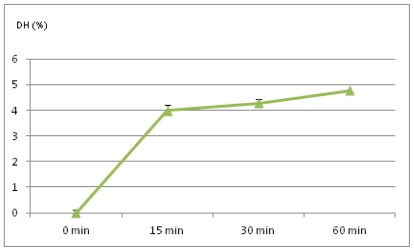
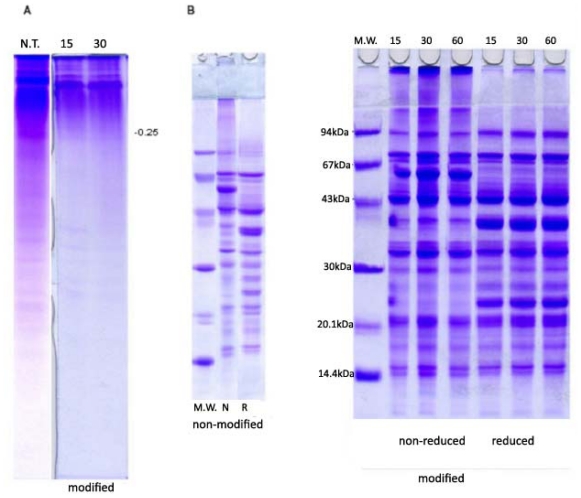
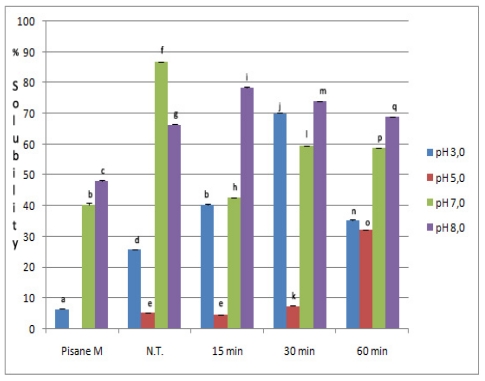
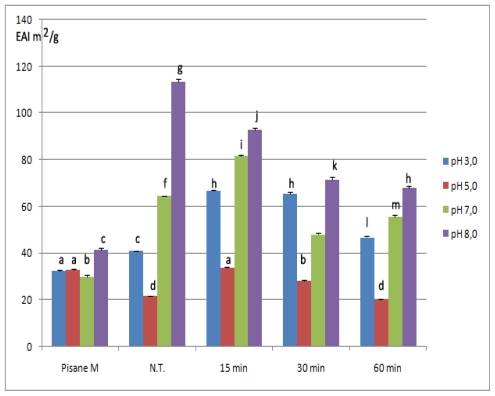
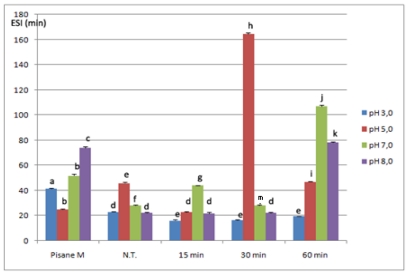
In this paper, the effects of limited hydrolysis on functional properties, as well as on protein composition of laboratory-prepared pea protein isolates, were investigated. Pea protein isolates were hydrolyzed for either 15, 30 and 60 min with recombined chymosin (Maxiren). The effect of enzymatic action on solubility, emulsifying and foaming properties at different pH values (3.0; 5.0; 7.0 and 8.0) was monitored. Chymosin can be a very useful agent for improvement of functional properties of isolates. Action of this enzyme caused a low degree of hydrolysis (3.9–4.7%), but improved significantly functional properties of pea protein isolates (PPI), especially at lower pH values (3.0–5.0). At these pH values all hydrolysates had better solubility, emulsifying activity and foaming stability, while longer-treated samples (60 min) formed more stable emulsions at higher pH values (7.0, 8.0) than initial isolates. Also, regardless of pH value, all hydrolysates showed improved foaming ability. A moderate positive correlation between solubility and emulsifying activity index (EAI) (0.74) and negative correlation between solubility and foam stability (−0.60) as well as between foam stability (FS) and EAI (−0.77) were observed. Detected enhancement in functional properties was a result of partial hydrolysis of insoluble protein complexes.
Overview
The claims and statistics of this paper haven’t been checked yet.
Free: it reads the open-access text and checks the first 5 claims that cite a source we can check. Create a free account to check every claim.
Integrity signals
Registry
Cites
Statistics
Figures
Verification
Claims the paper makes
The claims and statistics of this paper haven’t been checked yet.
Free: it reads the open-access text and checks the first 5 claims that cite a source we can check. Create a free account to check every claim.
Claims other papers make about this one
Each is checked against this paper’s own text: does it say what the citing paper says it does?
The source backs part of the claim, not all of it — or backs it for a different population, condition or comparison.
In the citing paper
“Enzymatic hydrolysis using proteases (papain, trypsin, chymosin) effectively improves solubility, emulsifying, and foaming characteristics by selectively cleaving peptide bonds [42].”
From Pea Protein Isolates: From Extraction to Functionality. (2025) · cites this paper as [42]
Experimental — accuracy not yet measured
Self-check
Percentages, sums and reported differences re-computed from the paper’s own numbers.
The self-check needs the paper’s full text.
Citations
Cites
Bradford, M. M. (1976) · Analytical Biochemistry · doi:10.1016/0003-2697(76)90527-3 · Cited by 255,302 · cited 1×
“In supernatant protein content was measured using method of Bradford [47].”
MethodDISC ELECTROPHORESIS – II METHOD AND APPLICATION TO HUMAN SERUM PROTEINS*
Davis, B. J. (1964) · Annals of the New York Academy of Sciences · doi:10.1111/j.1749-6632.1964.tb14213.x · Cited by 18,892 · cited 1×
“Protein hydrolysates were analyzed by PAGE, following the general procedure by Davis [45] using 7% (w/v) acrylamide gels.”
Method(1971) · Soil Science Society of America Journal · doi:10.2136/sssaj1971.03615995003500050003x · Cited by 6,358
Emulsifying properties of proteins: evaluation of a turbidimetric technique
Pearce, K. N., & Kinsella, J. E. (1978) · Journal of Agricultural and Food Chemistry · doi:10.1021/jf60217a041 · Cited by 2,476 · cited 1×
“Emulsifying properties were measured according to procedure of Pearce and Kinsella [48].”
MethodFling, S. P., & Gregerson, D. S. (1986) · Analytical Biochemistry · doi:10.1016/0003-2697(86)90228-9 · Cited by 934 · cited 2×
“SDS-PAGE was conducted following the procedure by Fling and Gregerson [46] using 5% (w/v) stacking and 12.”
MethodInfluentialBoye, J. I., Aksay, S., Roufik, S., Ribéreau, S., Mondor, M., Farnworth, E., & Rajamohamed, S. H. (2010) · Food Research International · doi:10.1016/j.foodres.2009.07.021 · Cited by 825 · cited 1×
“Properties of these proteins are well documented [30–34], so significant differences in amino acid composition, and structure and, consequently, different functionality of these proteins are already known [35].”
BackgroundPownall, T. L., Udenigwe, C. C., & Aluko, R. E. (2010) · Journal of Agricultural and Food Chemistry · doi:10.1021/jf904456r · Cited by 479 · cited 1×
“Proteins of different plant sources such as soy [4–7], pea bean [1,2,8,9], rice [10], peanuts [11,12] cowpea [13] were the object of limited enzymatic hydrolysis.”
BackgroundProfile and Functional Properties of Seed Proteins from Six Pea (Pisum sativum) Genotypes
Barac, M., Cabrilo, S., Pesic, M., Stanojevic, S., Zilic, S., Macej, O., & Ristic, N. (2010) · International Journal of Molecular Sciences · doi:10.3390/ijms11124973 · Cited by 368 · cited 1×
“[29] showed that pea (Pisum sativum, L.”
Self-citationOgunwolu, S. O., Henshaw, F. O., Mock, H.-P., Santros, A., & Awonorin, S. O. (2009) · Food Chemistry · doi:10.1016/j.foodchem.2009.01.011 · Cited by 318 · cited 1×
“Also, dependence between both parameters and pH had similar U-shape profile, which was in agreement with previous investigations based on PPI [41], and other plant proteins [42].”
ResultZhao, G., Liu, Y., Zhao, M., Ren, J., & Yang, B. (2011) · Food Chemistry · doi:10.1016/j.foodchem.2011.01.046 · Cited by 289 · cited 1×
“Proteins of different plant sources such as soy [4–7], pea bean [1,2,8,9], rice [10], peanuts [11,12] cowpea [13] were the object of limited enzymatic hydrolysis.”
Background
Cited by
Items 101–113 of 113
Hydrolysis of plant-based proteins
Shanmugapriya, R., Srivigneswar, S., Vignesh, S., Sunil, C. K., K., S., & Baskaran, N. (2025) · Elsevier eBooks · doi:10.1016/b978-0-443-33955-4.00017-6
Mahajan, P., & Singla, M. (2026) · Elsevier eBooks · doi:10.1016/b978-0-443-32976-0.00008-4
Ben-Harb, S. (2017) · theses.fr (ABES) · doi:10.70675/892eccefz40b0z4753z8851zf5dd6c53bdfe
Assad-Bustillos, M. (2019) · theses.fr (ABES) · doi:10.70675/14357a02zc588z4907zacc6zac6d2dd4f623 · Cited by 1
Berrazaga, I. (2018) · theses.fr (ABES) · doi:10.70675/2d3c7d63z64d1z415bz88bfzde635f1bd01d · Cited by 3
Sharma, M., Raturi, D., Singh, R., Rajpal, V. R., Mahmoudi, A., Raina, S. N., & Singh, A. (2026) · The Nucleus · doi:10.1007/s13237-026-00657-3
Uhlarik, A., Vojnov, B., Vasiljević, M., Vujić, S., Krstić, Đ., Dоliјаnоvić, Ž., & Šeremešıć, S. (2026) · Plants · doi:10.3390/plants15081226
BARAĆ, N., Rabrenović, B., Ignjatović, I. S., Lević, S., Pavlović, V. B., Žilić, S., Milovanović, D., & Barać, M. (2026) · Food Technology and Biotechnology · doi:10.17113/ftb.64.03.26.9373
“[ 23 ].”
Self-citationEnzymatic Modification of Plant Proteins
Loushigam, G. L., Singh, S. M., Badgujar, P. C., & Kuttu, N. (2026) · Springer eBooks · doi:10.1007/978-3-032-19821-1_10
Osborne Fractionation and Functional Properties of Wheatbran Protein
Krishnamoorthy, V., Krijgsheld, J., & Euverink, G. J. W. (2026) · ACS Food Science & Technology · doi:10.1021/acsfoodscitech.6c00018
Molecular properties of plant-based proteins for alternative protein
Das, A., Sau, A., Chokkakula, S., Ramalingam, P., Subhashini, S., Ravindran, B., & Prabakaran, D. S. (2026) · Advances in protein chemistry and structural biology · doi:10.1016/bs.apcsb.2026.08.012
Modi, A., Shrestha, S., Kasapis, S., Dhital, S., & Arora, A. (2026) · Comprehensive Reviews in Food Science and Food Safety · doi:10.1111/1541-4337.70648 · Cited by 1
Metadata
- Authors
- Barać, M., Čabrilo, S., Pešić, M., Stanojević, S., Pavlićević, M., Maćej, O., & Ristić, N.
- Affiliations
- University of Belgrade (RS)
- High Technical School of Vocational Studies, Nemanjina 2, Pozarevac 12000, Serbia
- Faculty of Agriculture, University of Belgrade, Nemanjina 6, Belgrade-Zemun 11000, Serbia
- Corresponding author
- Barać, Miroljub
- Venue
- International Journal of Molecular Sciences
- Publisher
- MDPI AG
- Published
- 2011-11-29
- Volume
- 12
- Issue
- 12
- Pages
- 8372-8387
- ISSN
- 1422-0067 (ISSN-L)
- PMC
- PMC3257075
- OpenAlex
- W2156006361
- Semantic Scholar
- df63a85e5b2281c818ff2828523e26eb27edc2c6
- Cited by
- 113
- References
- 49
- Citations by year
- 2026: 14 · 2025: 5 · 2024: 15 · 2023: 7 · 2022: 8 · 2021: 10 · 2020: 13 · 2019: 14 · 2018: 7 · 2017: 7 · 2016: 5 · 2015: 3 · 2014: 4 · 2013: 1
- FWCI
- 0.65
- Type
- journal article
- Language
- en
- Open access
- gold
- doi.org
- Licence
- Locations
- International Journal of Molecular Sciences (publishedVersion, cc-by)
- Europe PMC (PubMed Central) (publishedVersion, cc-by)
- PubMed Central (publishedVersion, cc-by)
- PubMed (publishedVersion)
- AgroSpace (University of Belgrade, Faculty of Agriculture) (submittedVersion, cc-by)
- DOAJ (DOAJ: Directory of Open Access Journals) (submittedVersion, cc-by-sa)
- Topics
- Life Sciences › Agricultural and Biological Sciences › Food Science › Protein Hydrolysis and Bioactive Peptides
- Life Sciences › Agricultural and Biological Sciences › Food Science › Proteins in Food Systems
- Life Sciences › Agricultural and Biological Sciences › Food Science › Food Nutrient Composition and Product Development
- Keywords
- pea protein isolate, Pisum sativum, chymosin, enzymatic hydrolysis, protein functional properties, solubility, emulsifying activity, foam stability, pH dependence, degree of hydrolysis, protein complexes
- MeSH terms
- Emulsions, Hydrogen-Ion Concentration, Hydrolysis, Plant Proteins, Protein Hydrolysates, Chymosin, Pisum sativum
About these checks
Registry, retraction, Cites and statistics results are computed, not judged, with one exception: a printed reference that no index lists is read once by a model before it counts as a citation error. Claims are extracted by a model and kept only when their quote appears verbatim in the text; each cited source is then checked, with a model’s help, for whether it says what the claim relies on. Those verdicts can be wrong — read the claim’s quote and the cited source before relying on one.
Statistics and arithmetic are recomputed, not judged.
Confidence bands are shown only for fields calibrated on our annotated test set. None is calibrated yet, so no band is shown.
What counts as a claim ›How we measure confidence ›How we check this ›
Are you an author, or do you see a problem with this page? Request a review
Data sources
Bibliographic data: Semantic Scholar, OpenAlex, Crossref.
Contains information from the Semantic Scholar Academic Graph Datasets, made available under the ODC Attribution License (ODC-BY 1.0).
Semantic Scholar’s data is described in: Kinney, R., et al. (2023). The Semantic Scholar Open Data Platform. arXiv:2301.10140.
