

A Genomic Survey of SCPP Family Genes in Fishes Provides Novel Insights into the Evolution of Fish Scales
Open accessThe DOI matches its Crossref record; 31 of the 31 references it cites were found in a registry or an index; none of the 7 sources its claims cite is checked for support yet.
Abstract
The family of secretory calcium-binding phosphoproteins (SCPPs) have been considered vital to skeletal tissue mineralization. However, most previous SCPP studies focused on phylogenetically distant animals but not on those closely related species. Here we provide novel insights into the coevolution of SCPP genes and fish scales in 10 species from Otophysi. According to their scale phenotypes, these fishes can be divided into three groups, i.e., scaled, sparsely scaled, and scaleless. We identified homologous SCPP genes in the genomes of these species and revealed an absence of some SCPP members in some genomes, suggesting an uneven evolutionary history of SCPP genes in fishes. In addition, most of these SCPP genes, with the exception of SPP1, individually form one or two gene cluster(s) on each corresponding genome. Furthermore, we constructed phylogenetic trees using maximum likelihood method to estimate their evolution. The phylogenetic topology mostly supports two subclasses in some species, such as Cyprinus carpio, Sinocyclocheilus anshuiensis, S. grahamin, and S. rhinocerous, but not in the other examined fishes. By comparing the gene structures of recently reported candidate genes, SCPP1 and SCPP5, for determining scale phenotypes, we found that the hypothesis is suitable for Astyanax mexicanus, but denied by S. anshuiensis, even though they are both sparsely scaled for cave adaptation. Thus, we conclude that, although different fish species display similar scale phenotypes, the underlying genetic changes however might be diverse. In summary, this paper accelerates the recognition of the SCPP family in teleosts for potential scale evolution.
Overview
CoChat Summary
TL;DR
This comparative genomic survey of 10 Otophysan fishes found uneven SCPP gene repertoires, lineage-specific losses, and one- or two-cluster SPARCL1-SCPP arrangements, with duplicated SPARCL1/SCPP genes in Cyprininae likely from a fourth WGD. The previously proposed SCPP1/SCPP5 scale-phenotype hypothesis fits *Astyanax mexicanus* but not *Sinocyclocheilus anshuiensis*, suggesting similar sparsely scaled phenotypes can have diverse genetic bases.
Key findings
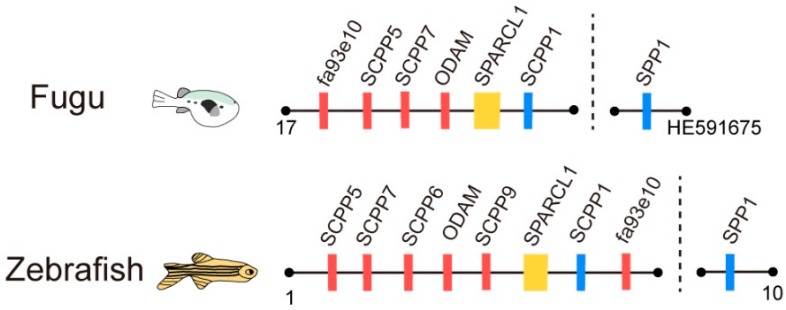
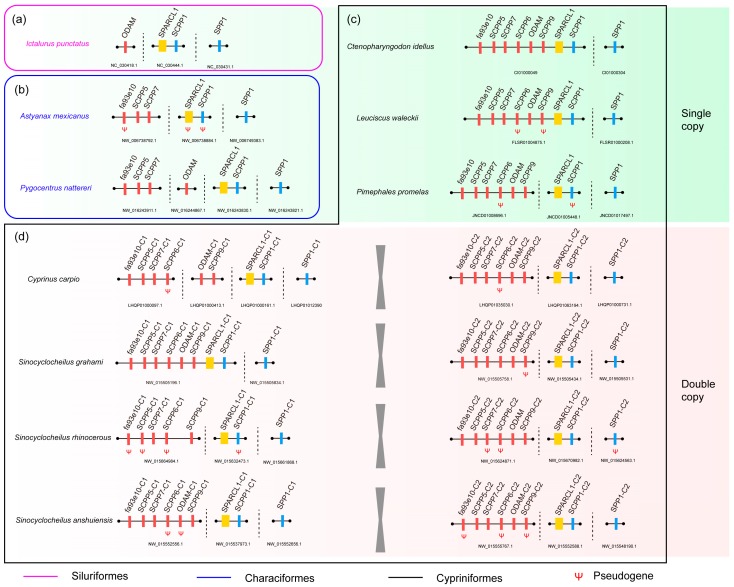
- Collected 115 nucleotide sequences: 14 SPARCL1 genes and 101 SCPP family genes from 10 species; SPP1 was always separate from the main cluster, while most other SCPPs formed one cluster in CI and LW or two clusters in IP, AM, PN, PP, CC, SG, SR, and SA.
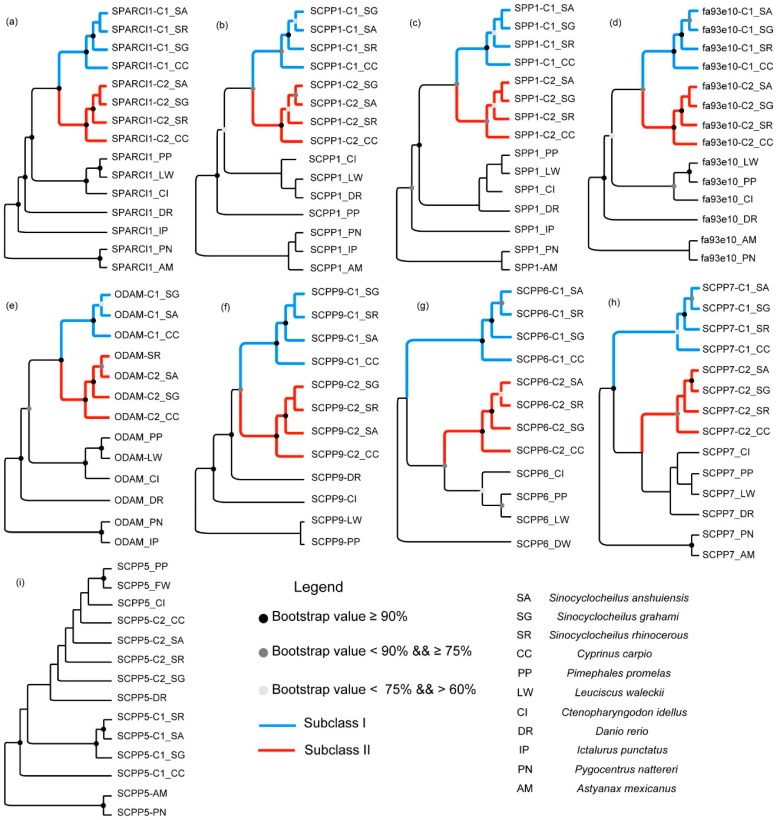
- Double copies of SPARCL1 and SCPP genes were found in CC, SG, SR, and SA, likely from the fourth Cyprininae-specific WGD; single copies were found in PP, LW, CI, IP, PN, and AM. SCPP6 existed only in Cypriniformes and was absent in Siluriformes and Characiformes.
- Possible pseudogenes were more frequent in sparsely scaled species: AM had half of the SCPPs (SPARCL1, SCPP1, and fa93e10) as possible pseudogenes; among *Sinocyclocheilus*, SG had one (SCPP9-C2), SR had seven, and SA had five.
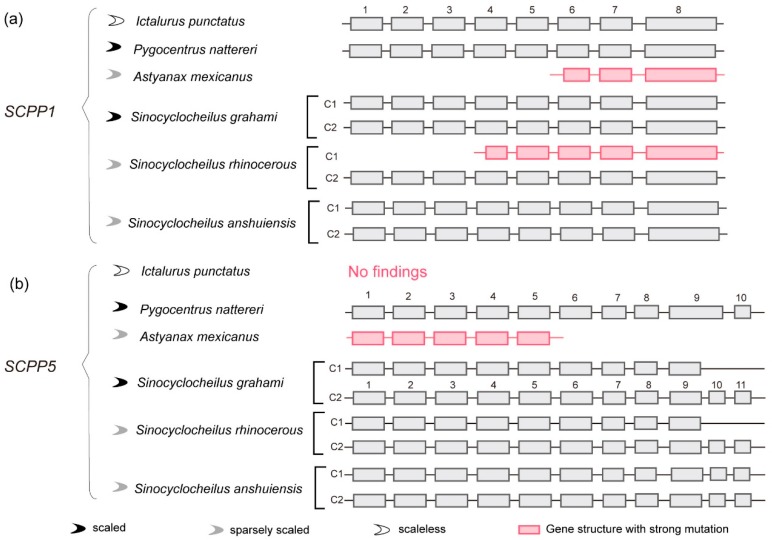
- The SCPP1/SCPP5 candidate hypothesis for scale phenotype was suitable for AM, but denied by SA: AM showed missing exons in SCPP1 and structural changes in SCPP5, SR missed some SCPP1 exons, SA had normal SCPP1 and SCPP5, and scaleless IP lacked SCPP5.
Methods
- Comparative genomic survey of 10 Otophysi species: AM, CI, CC, IP, LW, PP, PN, SA, SG, and SR; genomes were downloaded from NCBI and the grass carp official website, with protein queries from NCBI and transcriptome confirmation for SG, SR, and SA from a previous study.
- Genes were extracted using BLAST and Exonerate; alignments used MEGA 7 with Muscle; best nucleotide substitution models were selected in Jmodeltest 2.0; maximum-likelihood phylogenies were built in PhyML 3.1 with 1000 replicates; genomic mapping used TBtools; pseudogenes were inferred from missing exons, codon frameshifts, or premature stop codons.
Limitations
- Stated: the exact functions of newly identified SCPP copies remain unknown and require further experimental verification; the authors could not determine whether the extra exon in *Sinocyclocheilus* SCPP1 causes pseudogenization; transcriptome confirmation mostly supported predictions except for SCPP5.
- Evident from the text: conclusions rely on predicted gene structures and genome/transcriptome data without functional assays, and taxon sampling is limited to 10 Otophysan fishes, so lineage-specific patterns may not generalize.
Model-written summary. Check it against the paper before relying on it.
Integrity signals
Registry
Cites
Statistics
Figures
Verification
Claims the paper makes
0 Valid · 0 Not valid · 4 Not checked · 13 Own results and interpretations
None of the sources cited for this claim have been checked yet.
In the paper
“In contrast, only a single copy of SPARCL1 and SCPP genes was identified in other fishes (PP, LW, CI, IP, PN, and AM) as the same as spotted gar [8] and zebrafish [11].”
§ A Genomic Survey of SCPP Family Genes in Fishes Provides Novel Insights into the Evolution of Fish Scales > 2. Results > 2.1. Collection of SPARCL1 and SCPP Genes and Transcriptome Confirmation
What the sources say
- Not checked yetcites [8] Braasch I. Gehrke A.R. Smith J.J. Kawasaki K. Manousaki T. Pasquier J. Amores A. Desvignes T. Batzel P. Catchen J. The spotted gar genome illuminates vertebrate evolution and facilitates human-teleost comparisons Nat. Genet. 2016 48 427 437 10.1038/ng.3526 26950095 PMC4817229 source
- Not checked yetcites [11] Kawasaki K. The SCPP gene repertoire in bony vertebrates and graded differences in mineralized tissues Dev. Genes Evol. 2009 219 147 157 10.1007/s00427-009-0276-x 19255778 PMC3713409 source
plain- Asserted: passes — The authors put it forward as true.
- Checkable: passes — It can be checked against evidence.
- Load-bearing: passes — The paper’s conclusions depend on it.
- Based: passes — The paper gives a reason why it holds.
A result the paper reports from its own data — it cites no other source for it, so there is none to check. The quote shows it is in the paper.
In the paper
“In Sinocyclocheilus species (SA, SG, SR) and CC, SPARCL1 and SCPP genes were found to be doubled, with an exception of only one copy of ODAM in SR.”
§ A Genomic Survey of SCPP Family Genes in Fishes Provides Novel Insights into the Evolution of Fish Scales > 2. Results > 2.1. Collection of SPARCL1 and SCPP Genes and Transcriptome Confirmation
plain- Asserted: passes — The authors put it forward as true.
- Checkable: passes — It can be checked against evidence.
- Load-bearing: passes — The paper’s conclusions depend on it.
- Based: passes — The paper gives a reason why it holds.
A result the paper reports from its own data — it cites no other source for it, so there is none to check. The quote shows it is in the paper.
In the paper
“Interestingly, we observed more possible pseudogenes in these sparsely scaled species (AM, SR, and SA).”
§ A Genomic Survey of SCPP Family Genes in Fishes Provides Novel Insights into the Evolution of Fish Scales > 2. Results > 2.3. The Putative SPARCL1-SCPP Cluster and Pseudogenes
plainstates an association- Asserted: passes — The authors put it forward as true.
- Checkable: passes — It can be checked against evidence.
- Load-bearing: passes — The paper’s conclusions depend on it.
- Based: passes — The paper gives a reason why it holds.
A conclusion the paper draws from its own results — it cites no other source for it, so there is none to check. The quote shows it is in the paper.
In the paper
“After comparing the SCPP gene copies, we estimated that the fourth WGD in Cyprininae with a high possibility caused the duplication of SPARCL1 and SCPP genes.”
§ A Genomic Survey of SCPP Family Genes in Fishes Provides Novel Insights into the Evolution of Fish Scales > 5. Conclusions
hedgedstates a possible cause- Asserted: passes — The authors put it forward as true.
- Checkable: passes — It can be checked against evidence.
- Load-bearing: passes — The paper’s conclusions depend on it.
- Based: passes — The paper gives a reason why it holds.
- Rests on an assumption not shown here.
A conclusion the paper draws from its own results — it cites no other source for it, so there is none to check. The quote shows it is in the paper.
In the paper
“These structural changes suggest their pseudogene status.”
§ A Genomic Survey of SCPP Family Genes in Fishes Provides Novel Insights into the Evolution of Fish Scales > 2. Results > 2.4. SCPP1 and SCPP5: Gene Structure Comparison between Cavefishes and Other Fishes
hedgedstates a possible cause- Asserted: passes — The authors put it forward as true.
- Checkable: passes — It can be checked against evidence.
- Load-bearing: passes — The paper’s conclusions depend on it.
- Based: passes — The paper gives a reason why it holds.
2 more claims
Create a free account to see all 17 claims and to verify the 7 references still open.
- It may state two separate claims as one. 9
- The quote only partly states this claim. 1
- Probably not a substantial claim. 1
Claims other papers make about this one
Each is checked against this paper’s own text: does it say what the citing paper says it does?
In the citing paper
“both enam and scpp1 were described as nonfunctional in a cave-dwelling population (Lv et al. 2017)”
From SCPP Gene Repertoires in Teleosts and Evolutionary Changes in Bone, Teeth, and Scales (2026) · cites this paper as Lv et al. 2017
Self-check
Percentages, sums and reported differences re-computed from the paper’s own numbers.
Each contradiction between two passages listed here was confirmed by an independent check.
Rated minor: it would not touch a result — a value no result rests on, a p-value that stays on the same side of the significance level, or a conflict that is clerical, resolved elsewhere in the paper, or outside its own findings.
In the paper
§ A Genomic Survey of SCPP Family Genes in Fishes Provides Novel Insights into the Evolution of Fish Scales > 1. Introduction
“In vertebrates, two SCPP genes, SPP1 and ODAM, and their common ancestor, SPARACL1, are conserved in jawed vertebrates with a significant similarity in encoded amino acid sequences between tetrapods and teleosts [8,9].”
§ A Genomic Survey of SCPP Family Genes in Fishes Provides Novel Insights into the Evolution of Fish Scales > 1. Introduction
“In elephant shark, a cartilaginous fish that diverged early from the bony fish lineage, only two SCPP-related ancestral genes (i.e., SPARC and SPARCL1) were identified in its genome, suggesting earlier origins compared to SCPP genes found in bony fishes [6].”
Rated minor: it would not touch a result — a value no result rests on, a p-value that stays on the same side of the significance level, or a conflict that is clerical, resolved elsewhere in the paper, or outside its own findings.
In the paper
§ A Genomic Survey of SCPP Family Genes in Fishes Provides Novel Insights into the Evolution of Fish Scales > 2. Results > 2.4. SCPP1 and SCPP5: Gene Structure Comparison between Cavefishes and Other Fishes
“Based on the pairwise alignment of SCPP1 between them and zebrafish, we evaluated that this additional exon was generated by a crack of the original Exon 9.”
§ A Genomic Survey of SCPP Family Genes in Fishes Provides Novel Insights into the Evolution of Fish Scales > 2. Results > 2.4. SCPP1 and SCPP5: Gene Structure Comparison between Cavefishes and Other Fishes
“We temporarily regard these SCPP5s as normal genes, although we cannot determine whether this crack causes pseudogenization.”
Rated minor: it would not touch a result — a value no result rests on, a p-value that stays on the same side of the significance level, or a conflict that is clerical, resolved elsewhere in the paper, or outside its own findings.
In the paper
§ A Genomic Survey of SCPP Family Genes in Fishes Provides Novel Insights into the Evolution of Fish Scales > 3. Discussion > 3.2. Evolution of SPARCL1 and SCPP Genes during Whole Genome Duplication
“This indicates that the primary vertebrates had unevolved the SCPP family until the appearance of teleosts. Thus, SCPP genes existed in teleosts were thought to be evolved after the actinopterygian–sarcopterygian divergence [11].”
§ A Genomic Survey of SCPP Family Genes in Fishes Provides Novel Insights into the Evolution of Fish Scales > 1. Introduction
“This cluster was also confirmed in coelacanth [9], spotted gar [8], and sunfish [12].”
Citations
Cites
MEGA7: Molecular Evolutionary Genetics Analysis Version 7.0 for Bigger Datasets
Kumar, S., Stecher, G., & Tamura, K. (2016) · Molecular Biology and Evolution · doi:10.1093/molbev/msw054 · Cited by 44,059
Guindon, S., Dufayard, J.-F., Lefort, V., Anisimova, M., Hordijk, W., & Gascuel, O. (2010) · Systematic Biology · doi:10.1093/sysbio/syq010 · Cited by 18,376
jModelTest 2: more models, new heuristics and parallel computing
Darriba, D., Taboada, G. L., Doallo, R., & Posada, D. (2012) · Nature Methods · doi:10.1038/nmeth.2109 · Cited by 16,785
Posada, D., & Buckley, T. R. (2004) · Systematic Biology · doi:10.1080/10635150490522304 · Cited by 3,927
Automated generation of heuristics for biological sequence comparison
Slater, G. S. C., & Birney, E. (2005) · BMC Bioinformatics · doi:10.1186/1471-2105-6-31 · Cited by 2,933
Jaillon, O., Aury, J.-M., Brunet, F., Petit, J.-L., Stange-Thomann, N., Mauceli, E., Bouneau, L., Fischer, C., Ozouf-Costaz, C., Bernot, A., et al. (2004) · Nature · doi:10.1038/nature03025 · Cited by 1,966 · cited 2×
“Besides the above-mentioned three rounds of WGD, some fish lineages such as Acipenseridae, Catostomidae, Cobitidae, Cyprininae, and Salmonidae underwent a fourth round of WGD [20].”
BackgroundThe Atlantic salmon genome provides insights into rediploidization
Lien, S., Koop, B. F., Sandve, S. R., Miller, J. R., Kent, M. P., Nome, T., Hvidsten, T. R., Leong, J. S., Minkley, D. R., Zimin, A., et al. (2016) · Nature · doi:10.1038/nature17164 · Cited by 1,047
The medaka draft genome and insights into vertebrate genome evolution
Kasahara, M., Naruse, K., Sasaki, S., Nakatani, Y., Qu, W., Ahsan, B., Yamada, T., Nagayasu, Y., Doi, K., Kasai, Y., et al. (2007) · Nature · doi:10.1038/nature05846 · Cited by 1,038
From 2R to 3R: evidence for a fish-specific genome duplication (FSGD)
Meyer, A., & Van de Peer, Y. (2005) · BioEssays · doi:10.1002/bies.20293 · Cited by 945
Whole-genome duplication in teleost fishes and its evolutionary consequences
Glasauer, S. M. K., & Neuhauss, S. C. F. (2014) · Molecular Genetics and Genomics · doi:10.1007/s00438-014-0889-2 · Cited by 877
Cited by
SCPP Gene Repertoires in Teleosts and Evolutionary Changes in Bone, Teeth, and Scales
Kawasaki, K. (2026) · Genome Biology and Evolution · doi:10.1093/gbe/evag148
Self-citation
Metadata
- Authors
- Lv, Y., Kawasaki, K., Li, J., Li, Y., Bian, C., Huang, Y., You, X., & Shi, Q.
- Affiliations
- BGI Group (China) (CN)
- Pennsylvania State University (US)
- Corresponding author
- Shi, Qiong
- Venue
- International Journal of Molecular Sciences
- Publisher
- MDPI AG
- Published
- 2017-11-16
- Volume
- 18
- Issue
- 11
- Pages
- 2432
- ISSN
- 1422-0067 (ISSN-L)
- PMC
- PMC5713400
- OpenAlex
- W2768787133
- Cited by
- 29
- References
- 31
- Citations by year
- 2026: 3 · 2025: 2 · 2024: 4 · 2023: 4 · 2022: 6 · 2021: 3 · 2020: 5 · 2019: 1 · 2018: 1
- FWCI
- 0.56
- Type
- journal article
- Language
- en
- Open access
- gold
- doi.org
- Licence
- Locations
- International Journal of Molecular Sciences (publishedVersion, cc-by)
- Europe PMC (PubMed Central) (publishedVersion, cc-by)
- PubMed Central (publishedVersion, cc-by)
- PubMed (publishedVersion)
- Funders
- National Natural Science Foundation of China (31370047)
- Topics
- Life Sciences › Biochemistry, Genetics and Molecular Biology › Molecular Biology › Developmental Biology and Gene Regulation
- Life Sciences › Agricultural and Biological Sciences › Aquatic Science › Fish Biology and Ecology Studies
- Life Sciences › Biochemistry, Genetics and Molecular Biology › Molecular Biology › Genomics and Phylogenetic Studies
- Keywords
- fish scales, scale evolution, Otophysi, gene family evolution, gene clusters, cave adaptation, Astyanax mexicanus, Sinocyclocheilus, Cyprinus carpio, skeletal mineralization, teleosts
- MeSH terms
- Animal Scales, Animals, Calcium-Binding Proteins, Carps, Multigene Family, Phosphoproteins, Phylogeny, Genome, Evolution, Molecular, Fish Proteins
About these checks
Registry, retraction, Cites and statistics results are computed, not judged, with one exception: a printed reference that no index lists is read once by a model before it counts as a citation error. Claims are extracted by a model and kept only when their quote appears verbatim in the text; each cited source is then checked, with a model’s help, for whether it says what the claim relies on. Those verdicts can be wrong — read the claim’s quote and the cited source before relying on one.
A language model drew the claims from the paper on 2026-11-25, under version 3 of the claim definition (model deepseek-v4.1-flash, prompt extract-v3).
A second model labelled each claim on 2026-11-25 (model jev-1.13-20260917, definition revision gold-guideline-v0.2).
Statistics and arithmetic are recomputed, not judged.
Confidence bands are shown only for fields calibrated on our annotated test set. None is calibrated yet, so no band is shown.
What counts as a claim ›How we measure confidence ›How we check this ›
Are you an author, or do you see a problem with this page? Request a review
How to cite
Cite CoChat for the checks on this page, and the paper for its own findings.
- This page
- CoChat. (2026). Citation check: A Genomic Survey of SCPP Family Genes in Fishes Provides Novel Insights into the Evolution of Fish Scales. https://app.cochat.ai/papers/10.3390/ijms18112432
- The paper
- Lv, Y., Kawasaki, K., Li, J., Li, Y., Bian, C., Huang, Y., You, X., & Shi, Q. (2017). A Genomic Survey of SCPP Family Genes in Fishes Provides Novel Insights into the Evolution of Fish Scales. International Journal of Molecular Sciences. https://doi.org/10.3390/ijms18112432
Data sources
Bibliographic data: Semantic Scholar, OpenAlex, Crossref.
Contains information from the Semantic Scholar Academic Graph Datasets, made available under the ODC Attribution License (ODC-BY 1.0).
Semantic Scholar’s data is described in: Kinney, R., et al. (2023). The Semantic Scholar Open Data Platform. arXiv:2301.10140.
