

Insulin-Like Growth Factor (IGF) System in Liver Diseases
Open accessThe DOI matches its Crossref record; 182 of the 189 references it cites were found in a registry or an index, and 1 are not checked yet.
Abstract
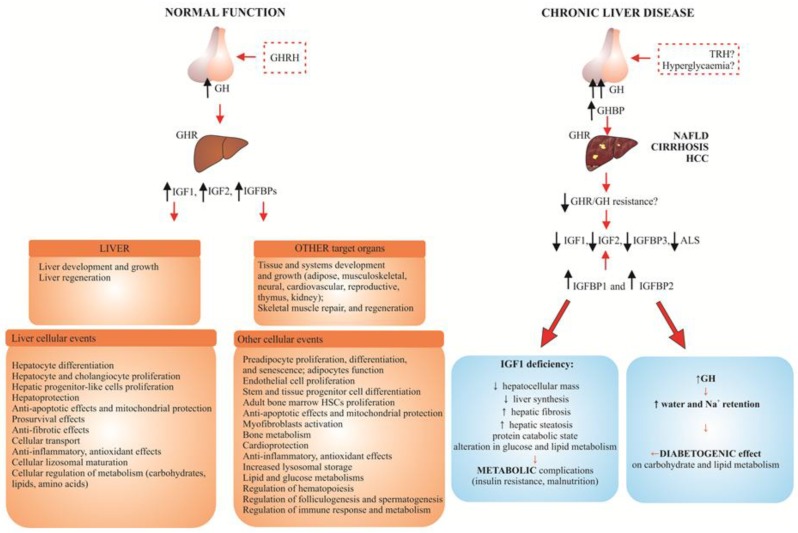
Hepatocyte differentiation, proliferation, and apoptosis are affected by growth factors produced in liver. Insulin-like growth factor 1 and 2 (IGF1 and IGF2) act in response to growth hormone (GH). Other IGF family components include at least six binding proteins (IGFBP1 to 6), manifested by both IGFs develop due to interaction through the type 1 receptor (IGF1R). The data based on animal models and/or in vitro studies suggest the role of IGF system components in cellular aspects of hepatocarcinogenesis (cell cycle progression, uncontrolled proliferation, cell survival, migration, inhibition of apoptosis, protein synthesis and cell growth), and show that systemic IGF1 administration can reduce fibrosis and ameliorate general liver function. In epidemiologic and clinicopathological studies on chronic liver disease (CLD), lowered serum levels, decreased tissue expression of IGF1, elevated production of IGF1R and variable IGF2 expression has been noted, from the start of preneoplastic alterations up to the developed hepatocellular carcinoma (HCC) stage. These changes result in well-known clinical symptoms of IGF1 deficiency. This review summarized the current data of the complex role of IGF system components in the most common CLD (nonalcoholic fatty liver disease, cirrhosis, and hepatocellular carcinoma). Better recognition and understanding of this system can contribute to discovery of new and improved versions of current preventive and therapeutic actions in CLD.
Overview
The claims and statistics of this paper haven’t been checked yet.
Free: it reads the open-access text and checks the first 5 claims that cite a source we can check. Create a free account to check every claim.
Integrity signals
Registry
Cites
Statistics
Figures
Verification
Claims the paper makes
The claims and statistics of this paper haven’t been checked yet.
Free: it reads the open-access text and checks the first 5 claims that cite a source we can check. Create a free account to check every claim.
Claims other papers make about this one
Each is checked against this paper’s own text: does it say what the citing paper says it does?
The source backs part of the claim, not all of it — or backs it for a different population, condition or comparison.
In the citing paper
“Experimental data show that low doses of IGF-1 increase bone mass in cirrhotic rats [65,69,70].”
From Bone diseases in patients with chronic liver disease (2019) · cites this paper as [70]
Experimental — accuracy not yet measured
Self-check
Percentages, sums and reported differences re-computed from the paper’s own numbers.
The self-check needs the paper’s full text.
Citations
Cites
Vernon, G., Baranova, A., & Younossi, Z. M. (2011) · Alimentary Pharmacology & Therapeutics · doi:10.1111/j.1365-2036.2011.04724.x · Cited by 3,074 · cited 2×
“NASH can progress to cirrhosis and its related complications [26,29].”
BackgroundDAUGHADAY, W. H., & ROTWEIN, P. (1989) · Endocrine Reviews · doi:10.1210/edrv-10-1-68 · Cited by 1,725 · cited 1×
“They are functionally related to insulin but have a much higher growth-promoting activity [6,7].”
BackgroundLiver Failure and Defective Hepatocyte Regeneration in Interleukin-6-Deficient Mice
Cressman, D. E., Greenbaum, L. E., DeAngelis, R. A., Ciliberto, G., Furth, E. E., Poli, V., & Taub, R. (1996) · Science · doi:10.1126/science.274.5291.1379 · Cited by 1,538 · cited 1×
“IGF1 plays role in supporting proliferation of hepatocytes and accelerating DNA synthesis [74], together with IL-6, TNF-α, HGF and TGF-α/EGF systems [75,76].”
BackgroundThe Somatomedin Hypothesis: 2001
Le Roith, D., Bondy, C., Yakar, S., Liu, J.-L., & Butler, A. (2001) · Endocrine Reviews · doi:10.1210/edrv.22.1.0419 · Cited by 1,257
The Insulin-Like Growth Factor-Binding Protein (IGFBP) Superfamily*
Hwa, V., Oh, Y., & Rosenfeld, R. G. (1999) · Endocrine Reviews · doi:10.1210/edrv.20.6.0382 · Cited by 1,079 · cited 1×
“In addition, IGFBPs’ activity is also regulated by IGFBP proteases [14,19,24,25].”
BackgroundInsulin‐like growth factors I and II
HUMBEL, R. E. (1990) · European Journal of Biochemistry · doi:10.1111/j.1432-1033.1990.tb15595.x · Cited by 999 · cited 2×
“In mammals, liver-derived endocrine IGF1 mediates the growth promoting effects of growth hormone (GH) during postnatal life, whereas IGF2 stimulates placental and fetal growth, and is less GH dependent than IGF1 [8,9].”
BackgroundMechanisms of hepatic fibrogenesis
Lee, U. E., & Friedman, S. L. (2011) · Best Practice & Research Clinical Gastroenterology · doi:10.1016/j.bpg.2011.02.005 · Cited by 923
Mechanisms of Organ Injury and Repair by Macrophages
Vannella, K. M., & Wynn, T. A. (2017) · Annual Review of Physiology · doi:10.1146/annurev-physiol-022516-034356 · Cited by 656
Liver regeneration. 2. Role of growth factors and cytokines in hepatic regeneration.
Fausto, N., Laird, A. D., & Webber, E. M. (1995) · The FASEB Journal · doi:10.1096/fasebj.9.15.8529831 · Cited by 619
From NAFLD to NASH to cirrhosis—new insights into disease mechanisms
Wree, A., Broderick, L., Canbay, A., Hoffman, H. M., & Feldstein, A. E. (2013) · Nature Reviews Gastroenterology & Hepatology · doi:10.1038/nrgastro.2013.149 · Cited by 609 · cited 2×
“%) in the absence of significant alcohol intake, is recognized as the most common cause and form of CLD, and is estimated to affect 30% of adults and 10% of children in the United States [28], with its worldwide prevalence continuously increasing, in correlation with the growing obesity epidemic [26,29,30].”
Background
Cited by
Items 201–289 of 289
Biswas, B. N., Sugimoto, M., & Hoque, M. A. (2025) · Biology · doi:10.3390/biology14040431 · Cited by 3
“…cycle, mitosis [55]; platelet degranulation [56]; platelet activation, signaling, and aggregation [57]; regulation of insulin-like growth factor transport and uptake by insulin-like growth factor binding proteins [58]; mitotic prometaphase [59]; and cell cycle checkpoints [60] (detailed Table S2).”
Kareem, R. A., Sameer, H. N., Athab, Z. H., Adil, M., Yaseen, A., & Allela, O. Q. B. (2025) · Microbial Pathogenesis · doi:10.1016/j.micpath.2025.107748 · Cited by 4
Khalaf, S. E., Abdelfattah, S. N., Khaliefa, A. K., Daoud, S. A., Abu-Sarea, E. Y., & Hasona, N. A. (2024) · Human & Experimental Toxicology · doi:10.1177/09603271241251451 · Cited by 5
Mohamed, A. A., Abd-Elsalam, S. M., El-Daly, M. M., Kamal, N., Saed, S. M., Mohamoud, S., Abed, H. A., Abdelghany, R. S., & Ahmed, S. H. (2021) · The Open Biomarkers Journal · doi:10.2174/1875318302111010001 · Cited by 3
Charalambous, C., Moon, J., Holly, J. M. P., Chaturvedi, N., Hughes, A. D., & Captur, G. (2022) · Frontiers in Cardiovascular Medicine · doi:10.3389/fcvm.2022.863988 · Cited by 4
“It influences cardiomyocytes and the cardiac action potential as described above, but IGF-II is more involved in placental and fetal growth (including cardiac development) in utero (60), is less growth hormone dependent than IGF-I (61), and is not known to influence the cardiac action potential in mature cardiomyocyte…”
BackgroundMineral disorders in patients with chronic liver disease. Part 1: epidemiology and pathophysiology
Gorbacheva, A. M., Евгеньевна, Б. Е., Lavreniuk, A., Константиновна, Е. А., Тихонов, И. Н., & Mokrysheva, N. G. (2024) · Obesity and metabolism · doi:10.14341/omet13124 · Cited by 3
Liu, Y., Xue, H., Liu, Y., Han, L., Liang, Q. Y., Ma, L., Zhao, M., & Liu, J. (2025) · Clinical and Translational Gastroenterology · doi:10.14309/ctg.0000000000000829 · Cited by 3
“Finally, IGF-1 plays a signi fi cant role in metabolic regulation, and its de fi ciency has been implicated in hepatic insulin resistance, a critical contributor to liver damage (13).”
Al-Qabandi, W., Alsaeid, M., & Dhaunsi, G. S. (2025) · Endocrine and Metabolic Science · doi:10.1016/j.endmts.2025.100249 · Cited by 3
Molecular mechanisms from the transition of MASLD-MASH-liver fibrosis to liver cancer
Zhang, C., Sui, Y., Liu, S., & Yang, M. J. (2025) · The Journal of Precision Medicine Health and Disease · doi:10.1016/j.premed.2025.100012 · Cited by 7
Basal metabolic rate shapes the development and progression of hepatocellular carcinoma
Maciak, S., Sawicka, D., Kasacka, I., Chyczewski, L., Car, H., & Konarzewski, M. (2025) · BMC Cancer · doi:10.1186/s12885-025-14491-4 · Cited by 3
Ko, Y., Song, B. G., Shin, H., Park, Y., Park, J., Park, M. K., Lee, Y. B., Yu, S. J., Sinn, D. H., Kim, Y. J., et al. (2025) · Osteoporosis International · doi:10.1007/s00198-025-07602-1 · Cited by 3
Torgersen, J., Newcomb, C. W., Carbonari, D. M., Smith, S. M., Brecker, K. L., Rajapakse, C. S., Jones, B. C., Cottrell, C., Grewal, R., Price, J. C., et al. (2025) · PLoS ONE · doi:10.1371/journal.pone.0327668 · Cited by 2
“We hypothesized that chronic HCV infection, through persistent hepatic inflammation and fibrosis, would be associated with decreased production of this growth factor, which might lead to impaired liver fat regulation and promote hepatic steatosis [46].”
Wu, H., Liu, S., Chen, S., Qin, C., Yan, W., Cao, X., Zhou, Y., & Duan, Y. (2026) · Cell Death and Disease · doi:10.1038/s41419-026-08635-y · Cited by 2
Kehar, M., Germán, A. G. A., Pandey, A., Mysore, K. R., Narang, A., Pandurangi, S., Suri, A., Whitehead, B. A., Aqul, A. A., & Duro, D. (2026) · Journal of Pediatric Gastroenterology and Nutrition · doi:10.1002/jpn3.70367 · Cited by 2
Effects and mechanisms of GSG2 in esophageal cancer progression
Geng, C., Wang, Q., Xing, P.-F., Wang, M., Tong, S.-D., & Zhou, J. (2022) · Journal of Cancer Research and Clinical Oncology · doi:10.1007/s00432-022-04260-2 · Cited by 2
Maia, M. L. P., Albuquerque, R. M., Silva, S. D. D. C., Lima, C. X., Diniz, P. H. C., & Vidigal, P. V. T. (2023) · Oncology · doi:10.1159/000535332 · Cited by 3
Quality assessment of systematic literature on uterine fibroids: a systematic review
Okesola, M. A., Okesola, J. O., Ogunlana, O. O., & Afolabi, I. S. (2024) · F1000Research · doi:10.12688/f1000research.124879.2 · Cited by 2
Mohamed, A. A., Sahin, C., Berres, M., Beetz, O., von Websky, M., Vogel, T., Vondran, F. W. R., Bruners, P., Imöhl, M., Frank, K., et al. (2024) · Clinical and Translational Radiation Oncology · doi:10.1016/j.ctro.2024.100887 · Cited by 5
The burden of cancer in metabolic dysfunction-associated steatotic liver disease
Pirvu, B.-F., Clenciu, D., Beldie, L.-A., Dica, C.-C., Burticală, M.-A., Ţenea-Cojan, T. Ş., Mitrea, A., Amzolini, A. M., Efrem, I. C., Mogoș, G. F. R., et al. (2025) · Romanian Journal of Morphology and Embryology · doi:10.47162/rjme.65.4.09 · Cited by 5
“In context of MASLD, alterations of the hepatic microenvironment support their upregulation leading to increased susceptibility of developing HCC. Elevated levels of IGF-1 activate IGF-1 receptor (IGF-1R) on hepatocytes [53].”
An Overview of Some Plant Based Products With Hepatoprotective Activity
Labhade, S., Sharma, S. K., Paliwal, S., & Desai, S. K. (2021) · Iraqi Journal of Pharmaceutical Sciences · doi:10.31351/vol30iss2pp1-15 · Cited by 2
“These huge veins further partition into vessels to provide blood to each one of the lobules((6,7)).”
BackgroundSHEHABELDIN, M. S. N. M. H. N., & MOHAMED, M. D. M. A. A. Z. H. K. (2022) · The Medical Journal of Cairo University/The Medical Journal of Cairo University · doi:10.21608/mjcu.2022.264607 · Cited by 2
The Pathogenesis of Physical Frailty and Sarcopenia
Dasarathy, S. (2019) · Springer eBooks · doi:10.1007/978-3-030-26226-6_4 · Cited by 3
Characterization of Pro-Fibrotic Signaling Pathways using Human Hepatic OrganoidsPreprint
Guan, Y., Fang, Z., Hu, A., Roberts, S., Wang, M., Ren, W., Johansson, P. K., Heilshorn, S. C., Enejder, A. M. K., & Peltz, G. (2023) · bioRxiv (Cold Spring Harbor Laboratory) · doi:10.1101/2023.04.25.538102 · Cited by 2
Александровна, П. В., & Okovityi, S. V. (2025) · Meditsinskiy sovet = Medical Council · doi:10.21518/ms2025-223 · Cited by 1
Damiano, F., Stanca, B. D. C., Giannotti, L., Stanca, E., Dinoi, A. F., & Siculella, L. (2025) · Cancers · doi:10.3390/cancers17172731 · Cited by 1
“However, emerging evidence from physiological contexts, such as skeletal muscle [38] and liver regeneration [39], suggests that IGF1 could also undergo cap-independent translation, a mechanism that may similarly be co-opted in tumors.”
Eid, J. R., Haddad, A., Hassan, M. M., Amin, H. M., Newhook, T. E., Chun, Y. S., Tzeng, C.-W. D., Vauthey, J., Cao, H. S. T., & Kaseb, A. O. (2025) · Journal of Gastrointestinal Surgery · doi:10.1016/j.gassur.2025.102275 · Cited by 1
Srimanus, K., Damrongmanee, A., Ukarapol, N., Chattipakorn, N., & Chattipakorn, S. C. (2026) · Biochimica et Biophysica Acta (BBA) - Molecular Basis of Disease · doi:10.1016/j.bbadis.2026.168218 · Cited by 2
Chai, Z., Liu, J., Liu, J., Niu, L., Xiaoqing, W., Liu, C., & Han, F. (2026) · Scientific Reports · doi:10.1038/s41598-026-49240-5 · Cited by 2
“However, not only is the expression pattern and function of IGFBP1 in tumorigenesis under debate 4,9,31 , but the association between IGFBP1 expression and cancer risk is also controversial 32 and needs further study.”
Quality assessment of systematic literature on uterine fibroids: a systematic review
Okesola, M. A., Okesola, J. O., Ogunlana, O. O., & Afolabi, I. S. (2022) · F1000Research · doi:10.12688/f1000research.124879.1 · Cited by 1
Pituitary Dysfunction in Systemic Disorders
Marques, P., & Korbonits, M. (2022) · Elsevier eBooks · doi:10.1016/b978-0-323-99899-4.00024-x · Cited by 2
Growth Impairment in Pediatric Inflammatory Bowel Disease
Huang, J. G., & Walters, T. D. (2023) · Springer eBooks · doi:10.1007/978-3-031-14744-9_12 · Cited by 1
Stem cell signaling molecules and pathways in liver regeneration
Chawla, S., & Das, A. (2023) · Elsevier eBooks · doi:10.1016/b978-0-443-18800-8.00014-9 · Cited by 1
Jauregui, D., Khogali, M. K., Xing, Y., Fan, X., Wen, K., Liu, L., Zhao, M., Geng, T., & Gong, D. (2022) · Agriculture · doi:10.3390/agriculture12030347 · Cited by 1
“Some studies have shown that IGFBP family members can bind to IGF1/2 and participate in a variety of cellular processes, including cell growth and proliferation, migration, cell survival, apoptosis inhibition, and protein synthesis by modulating the biological availability of IGF1/2 [3].”
BackgroundInfluentialTurgut, S., Acarer, D., Seyit, H., Pamuk, N., Pişkinpaşa, H., Bozkur, E., Karabulut, M., & Çakır, İ. (2022) · Hormone and Metabolic Research · doi:10.1055/a-1856-7014 · Cited by 1
Rykalo, N. A., & Romanenko, I. V. (2022) · Zaporozhye Medical Journal · doi:10.14739/2310-1210.2022.4.255267 · Cited by 1
Hong, S. E., Mun, S. J., Lee, Y. J., Yoo, T., Suh, K., Kang, K. W., Son, M. J., Kim, W. S., & Choi, M. (2024) · bioRxiv (Cold Spring Harbor Laboratory) · doi:10.1101/2024.09.20.614203 · Cited by 1
“5); for example, IGF signaling, an inhibitory signal against inflammation and fibrosis originating from the hepatocytes 46 47 , acts on endothelial cells and is downregulated in the MASH liver (Fig.”
BackgroundNatural Polymeric-Based Composites for Delivery of Growth Factors
Figueroa-Pizano, M. D., & Carvajal‐Millán, E. (2021) · Advances in material research and technology · doi:10.1007/978-3-030-70266-3_10
Maternal Hepatic Adaptations to Pregnancy
Nambiar, S. M. (2021) · Purdue e-Pubs (Purdue University System) · doi:10.25394/pgs.15044022.v1
Dause, T. J., Denninger, J. K., Smith, B. M., & Kirby, E. D. (2021) · Cited by 1
Ghannam, E., Rozaik, S. E., Agwa, R. H., Marwan, A., Mashaly, M. E.-S., Salem, M. M., zekred, A. S. E., & Saleh, A. A. G. (2022) · Research Square · doi:10.21203/rs.3.rs-1216787/v1
“Growth factors produced in the liver, including IGF-1 and IGF-2, affect hepatocytes proliferation, differentiation and apoptosis [4].”
BackgroundPromising biomarkers for liver cancer
Ravikiran, T., Anand, S., Ramachandregowda, S., & Kariyappa, A. S. (2022) · Elsevier eBooks · doi:10.1016/b978-0-323-98807-0.00019-3
Swinney, D. C. (2020) · Faculty Opinions – Post-Publication Peer Review of the Biomedical Literature · doi:10.3410/f.737198406.793576929
Ghoneem, E. A., Rozaik, S., Agwa, R. H., Marwan, A., Mashaly, M. E.-S., Saleh, A. I., zekred, A. S. E., & Saleh, A. I. (2022) · The Egyptian Journal of Hospital Medicine · doi:10.21608/ejhm.2022.241722
“Growth factors produced in the liver, including IGF-1 and IGF-2, affect hepatocytes proliferation, differentiation and apoptosis ([4]).”
BackgroundEffects of Growth Factors and Cytokines on the Liver Regeneration Phase of DILI
魏, 亚. (2022) · Advances in Clinical Medicine · doi:10.12677/acm.2022.1281130
Sepehri, A., Jahromi, G. P., Shahbazi, A., Sahraei, H., Hatef, B., Meftahi, G. H., & Negah, S. S. (2022) · Acta Histochemica · doi:10.1016/j.acthis.2022.151960
Liver Cancer: Interdisciplinary Approach
Zhang, H., Zhao, J., Yang, W., Li, Z., Gong, L., & Li, Y. (2022) · Interdisciplinary cancer research · doi:10.1007/16833_2022_96
Data from Adiposity, Adulthood Weight Change, and Risk of Incident Hepatocellular Carcinoma
Simon, T. G., Kim, M. N., Luo, X., Liu, X., Yang, W., Ma, Y., Chong, D. Q., Fuchs, C. S., Stampfer, M. J., Giovannucci, E. L., et al. (2023) · doi:10.1158/1940-6207.c.6547276.v1
Biochemical Studies on Amphiregulin protein in Hepatitis C virus patients
Ramadan, E., Sayed, I. E. T. E., Badra, G., Refat, S., & Ismaiel, A. H. A. (2023) · Egyptian Journal of Chemistry · doi:10.21608/ejchem.2023.151042.6607
Current Research Progress of Pathogenesis, Diagnosis and Treatment of Sarcopenia in Liver Cirrhosis
蔡, 剑. (2023) · Advances in Clinical Medicine · doi:10.12677/acm.2023.1371634
Resistencia a la insulina, hepatopatía grasa y su asociación con las proteínas acarreadoras de IGF
Guzmán, C., Mendoza-Domínguez, G., & Bautista-Ubaldo, M. G. (2023) · Revista Mexicana de Endocrinología Metabolismo y Nutrición · doi:10.24875/rme.22000056
Kandula, R., Jain, R. S., Kandula, S., & Reddy, B. S. (2023) · Research Journal of Pharmacy and Technology · doi:10.52711/0974-360x.2023.00687
Metabolic comorbidities, endocrine—Diabetes, polycystic ovarian syndrome, thyroid dysfunction
Yang, R., & Fan, J. (2024) · Elsevier eBooks · doi:10.1016/b978-0-323-99649-5.00004-2
IGF1R is protective in pneumococcal pneumoniaPreprint
Felten, M., Alves, L. G. T., Letsiou, E., Alfaro‐Arnedo, E., Piñeiro‐Hermida, S., López, I. P., Dietert, K., Firsching, T., Gruber, A. D., Fatykhova, D., et al. (2024) · bioRxiv (Cold Spring Harbor Laboratory) · doi:10.1101/2024.09.11.612370
Maher, S., Atta, S. A., Kamel, M. M., Hammam, O. A., & Okasha, H. (2024) · Journal of Clinical and Experimental Hepatology · doi:10.1016/j.jceh.2024.102488
Liver cancer: Advances in diagnostic research
Khan, S., Hanif, S., Syed, M. A., Irfan, M., Zahoor, A. F., Khan, I. U., Khalid, M., & Sonia, S. (2025) · Elsevier eBooks · doi:10.1016/b978-0-443-33849-6.00007-6
Asaad, A. M., & Kakey, E. (2025) · ARO-The Scientific Journal of Koya University · doi:10.14500/aro.12181 · Cited by 1
Zhan, Z., Lin, W., Yao, X., Huang, S., Lan, S., Zheng, L., Guo, Z., & Chen, B. (2025) · Frontiers in Nutrition · doi:10.3389/fnut.2025.1628726
Rajeshwar, D. S., Nalla, S. V., Dubey, I., Gautam, R. K., Bhardwaj, S., Shrivastava, R., & Kushwaha, S. (2025) · Biological Trace Element Research · doi:10.1007/s12011-025-04839-z
He, S., Yang, J., Jiang, S., Li, Y., & Han, X. (2020) · Figshare · doi:10.6084/m9.figshare.12864856
He, S., Yang, J., Jiang, S., Li, Y., & Han, X. (2020) · Figshare · doi:10.6084/m9.figshare.12864850
Zhou, X., Tan, B., Gui, W., Zhou, C., Zhao, H., Lin, X., & Li, H. (2023) · Figshare · doi:10.6084/m9.figshare.24655875
Zhang, Y., Li, J., Chu, P., Shang, R., Yin, S., & Wang, T. (2024) · Figshare · doi:10.6084/m9.figshare.26632995
Zhou, X., Tan, B., Gui, W., Zhou, C., Zhao, H., Lin, X., & Li, H. (2024) · Figshare · doi:10.6084/m9.figshare.26646535
Zhang, Y., Li, J., Chu, P., Shang, R., Yin, S., & Wang, T. (2024) · Figshare · doi:10.6084/m9.figshare.26632983
Cai, W., Ma, Y., Song, L., Cao, N., Gao, J., Zhou, S., & Tang, X. (2023) · Figshare · doi:10.6084/m9.figshare.22609934
Zhou, X., Tan, B., Gui, W., Zhou, C., Zhao, H., Lin, X., & Li, H. (2024) · Figshare · doi:10.6084/m9.figshare.26646538
Zhou, X., Tan, B., Gui, W., Zhou, C., Zhao, H., Lin, X., & Li, H. (2024) · Figshare · doi:10.6084/m9.figshare.24656143
Zhang, Y., Li, J., Chu, P., Shang, R., Yin, S., & Wang, T. (2024) · Figshare · doi:10.6084/m9.figshare.26632986
Zhang, Y., Li, J., Chu, P., Shang, R., Yin, S., & Wang, T. (2024) · Figshare · doi:10.6084/m9.figshare.26632989
Zhang, Y., Li, J., Chu, P., Shang, R., Yin, S., & Wang, T. (2024) · Figshare · doi:10.6084/m9.figshare.26632992
He, S., Yang, J., Jiang, S., Li, Y., & Han, X. (2020) · Figshare · doi:10.6084/m9.figshare.12864853
Somatostatin Effect on Growth Factors in Hepatocellular Carcinoma
Tsakou, A., Notas, G., Xidakis, C., Tsomidis, I., Kouroumalis, E., & Voumvouraki, A. (2026) · Current Issues in Molecular Biology · doi:10.3390/cimb48020134 · Cited by 1
Association of insulin and GH/IGF-1 derangements and heart failure: a narrative review
Cesaro, A., Calabrò, P., Ruvolo, A., & Fazio, S. (2026) · Exploration of Cardiology · doi:10.37349/ec.2026.101294
Vitamin D and Bone Metabolism in Non-Alcoholic, Non-Viral Liver Cirrhosis: A Pilot Study
Spasskaya, O., Максимовна, Г. А., Lavreniuk, A., Евгеньевна, Б. Е., Tikhonov, I. N., Константиновна, Е. А., Khairieva, А. V., Litvinova, E. E., Zhukov, A. Y., & Mokrysheva, N. G. (2026) · Obesity and metabolism · doi:10.14341/omet13306
Yuanze, G., Wang, F., Ganesan, K., & Chen, J. (2026) · Science China Life Sciences · doi:10.1007/s11427-025-3176-0
“…2025; Zhu et al., 2022b). mTORC2-mediated feedback phosphorylation of Akt and IGF-1R amplifies signaling robustness, while S6K-dependent inhibition of PDK1 introduces a layer of regulatory plasticity that may contribute to therapeutic resistance in BC (Adamek and Kasprzak, 2018; Park et al., 2020).”
Cho, Y. K., Park, H., Lim, T. S., Jhee, J. H., & Jhee, J. H. (2026) · Diabetes Obesity and Metabolism · doi:10.1111/dom.70792 · Cited by 1
“The liver is the primary site of circulating IGF-1 synthesis, which is tightly regulated by the growth hormone (GH) axis [12].”
Lo, T.-H., Chan, K. C., Chen, D., Deng, C., Yeh, S. T.-Y., Wu, M., Cai, Y., Xu, A., & Wong, C. (2026) · Molecular Therapy · doi:10.1016/j.ymthe.2026.05.006 · Cited by 1
“34,35 These observations raise the possibility that PLAC9 may confer additional benefit in metabolic dysfunction-associated stea-totic liver disease (MASLD).”
MagmaFlow : A desktop platform for artificial intelligence‐driven expression analysis
Buss, C. E., Li, A., Gilglioni, E. H., Bansal, M., Singh, S. P., Bakiri, L., Cardozo, A. K., & Gurzov, E. N. (2026) · FEBS Open Bio · doi:10.1002/2211-5463.70288
“TGFB1 connected inflammatory signaling to extracellular matrix remodeling [13], while IGFBP3 bridged insulin/IGF axis dysregulation to both hypoxia response and fibrotic pathways [33].”
Mesenchymal stem cells and extracellular vesicles in liver regeneration
Karnawat, K., Puthiyattil, N., Parthasarathy, R., Sekar, J. A., Elangbam, P., Roy, N., Gupta, K., Balachander, G. M., & Pai, R. R. (2026) · Elsevier eBooks · doi:10.1016/b978-0-443-45056-3.00017-0
Oh, M. J., Park, Y.-S., Mo, J.-Y., Kang, E. K., Kang, C. W., & Kim, S. (2026) · International Journal of Molecular Sciences · doi:10.3390/ijms27135851
“The insulin-like growth factor (IGF) system is associated with hepatic metabolism, cell survival, and regeneration, and altered IGF-related signaling has been reported in liver disease [8,11,12].”
Hepatokines and stellakines in liver and neurological diseases: The liver-brain axis
Park, J., Guo, F., Lee, J. E., & Cheon, S. Y. (2026) · Experimental Neurology · doi:10.1016/j.expneurol.2026.115899 · Cited by 1
Su, Y., Ren, W., Zeng, Y., Meng, J., Yao, X., & Wang, J. (2026) · Biology · doi:10.3390/biology15151225
“Insulin-like Growth Factor 1 ( IGF1 ) is a multifunctional peptide hormone primarily synthesized in the liver, regulating cellular functions via paracrine or autocrine mechanisms [9,10].”
Detection of the DGAT1 Gene Variation and Its Association with Growth Traits in Degeres Sheep
Begenova, A., Nurgulsim, K., Otepova, G., Bekenova, A., Bissengaliyev, R., Baibolin, Z. K., & Kulmagambetov, T. (2026) · Animals · doi:10.3390/ani16162583
“In our study, the IGF-1 gene was predominantly expressed in the liver, consistent with the liver being the primary site of IGF-1 synthesis in mammals and supporting its central role in growth and metabolic regulation [34].”
Insulin-like growth factor receptor signaling in physiology and disease
Dilawar, M., Malik, A., Liao, J., Shen, P., Huang, Z., Zhang, P., Wang, J., Zhang, N., Nisar, M. F., & Chen, G. (2026) · Signal Transduction and Targeted Therapy · doi:10.1038/s41392-026-02843-w · Cited by 3
Jiang, H., Zhu, J., Lei, Z., Yimamu, T., Chen, H., Li, Q., Muhetaer, A., & Abudourousuli, A. (2026) · Frontiers in Immunology · doi:10.3389/fimmu.2026.1836824
Anjos, M., Oliveira, P. S., Carvalho, D., Flores, A. E., Ramos, S. V., Ferreira, R. M., Padrão, A. I., Reis-Mendes, A., & Fonseca, H. (2026) · Biology · doi:10.3390/biology15201850
“It is also the main source of circulating insulin-like growth factor-1 [79] and, to a lesser extent in adults, of erythropoietin [80], and it produces angiotensinogen, the substrate of the renin–angiotensin system and a determinant of blood pressure regulation [81].”
Lee, S., Aulia, D., Kılıç, T., Kim, H., Jeon, H., Rahman, M. H., Yoon, S., Ogun, A. O., & Lee, S. (2026) · Animals · doi:10.3390/ani16203324
An adversarial deep neural network for identifying non-alcoholic fatty liver disease
Wang, Y., Wang, Y., Zhang, R., Di, Q., Li, G., Wang, S., Liu, C., & Na, L. (2026) · Technology and Health Care · doi:10.1177/09287329261501859
Metadata
- Authors
- Adamek, A., & Kasprzak, A.
- Affiliations
- Poznan University of Medical Sciences (PL)
- Corresponding author
- Adamek, Agnieszka
- Venue
- International Journal of Molecular Sciences
- Publisher
- MDPI AG
- Published
- 2018-04-27
- Volume
- 19
- Issue
- 5
- Pages
- 1308
- ISSN
- 1422-0067 (ISSN-L)
- PMC
- PMC5983723
- OpenAlex
- W2800431474
- Cited by
- 284
- References
- 189
- Citations by year
- 2026: 24 · 2025: 30 · 2024: 36 · 2023: 44 · 2022: 53 · 2021: 41 · 2020: 31 · 2019: 25
- FWCI
- 3.73
- Type
- journal article
- Language
- en
- Open access
- gold
- doi.org
- Licence
- Locations
- International Journal of Molecular Sciences (publishedVersion, cc-by)
- Europe PMC (PubMed Central) (publishedVersion, cc-by)
- PubMed Central (publishedVersion, cc-by)
- PubMed (publishedVersion)
- Topics
- Health Sciences › Medicine › Endocrinology, Diabetes and Metabolism › Growth Hormone and Insulin-like Growth Factors
- Health Sciences › Medicine › Hepatology › Liver physiology and pathology
- Health Sciences › Medicine › Hepatology › Liver Disease Diagnosis and Treatment
- Keywords
- insulin-like growth factor system, insulin-like growth factor I, insulin-like growth factor II, IGF binding proteins, IGF-1 receptor, chronic liver disease, non-alcoholic fatty liver disease, liver cirrhosis, hepatocellular carcinoma, hepatocarcinogenesis, liver fibrosis, growth hormone, hepatocyte proliferation, apoptosis
- MeSH terms
- Animals, Cell Line, Carcinoma, Hepatocellular, Humans, Insulin-Like Growth Factor I, Insulin-Like Growth Factor II, Liver Cirrhosis, Liver Cirrhosis, Experimental, Liver Diseases, Liver Neoplasms, Liver Neoplasms, Experimental, Models, Animal, Non-alcoholic Fatty Liver Disease
About these checks
Registry, retraction, Cites and statistics results are computed, not judged, with one exception: a printed reference that no index lists is read once by a model before it counts as a citation error. Claims are extracted by a model and kept only when their quote appears verbatim in the text; each cited source is then checked, with a model’s help, for whether it says what the claim relies on. Those verdicts can be wrong — read the claim’s quote and the cited source before relying on one.
Statistics and arithmetic are recomputed, not judged.
Confidence bands are shown only for fields calibrated on our annotated test set. None is calibrated yet, so no band is shown.
What counts as a claim ›How we measure confidence ›How we check this ›
Are you an author, or do you see a problem with this page? Request a review
Data sources
Bibliographic data: Semantic Scholar, OpenAlex, Crossref.
Contains information from the Semantic Scholar Academic Graph Datasets, made available under the ODC Attribution License (ODC-BY 1.0).
Semantic Scholar’s data is described in: Kinney, R., et al. (2023). The Semantic Scholar Open Data Platform. arXiv:2301.10140.
