

Insulin-Like Growth Factor (IGF) System in Liver Diseases
Open accessThe DOI matches its Crossref record; 182 of the 189 references it cites were found in a registry or an index, and 1 are not checked yet.
Abstract
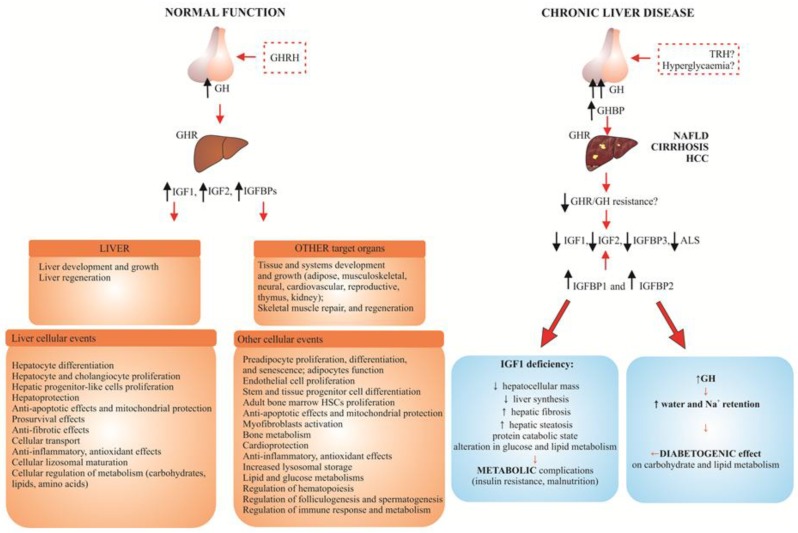
Hepatocyte differentiation, proliferation, and apoptosis are affected by growth factors produced in liver. Insulin-like growth factor 1 and 2 (IGF1 and IGF2) act in response to growth hormone (GH). Other IGF family components include at least six binding proteins (IGFBP1 to 6), manifested by both IGFs develop due to interaction through the type 1 receptor (IGF1R). The data based on animal models and/or in vitro studies suggest the role of IGF system components in cellular aspects of hepatocarcinogenesis (cell cycle progression, uncontrolled proliferation, cell survival, migration, inhibition of apoptosis, protein synthesis and cell growth), and show that systemic IGF1 administration can reduce fibrosis and ameliorate general liver function. In epidemiologic and clinicopathological studies on chronic liver disease (CLD), lowered serum levels, decreased tissue expression of IGF1, elevated production of IGF1R and variable IGF2 expression has been noted, from the start of preneoplastic alterations up to the developed hepatocellular carcinoma (HCC) stage. These changes result in well-known clinical symptoms of IGF1 deficiency. This review summarized the current data of the complex role of IGF system components in the most common CLD (nonalcoholic fatty liver disease, cirrhosis, and hepatocellular carcinoma). Better recognition and understanding of this system can contribute to discovery of new and improved versions of current preventive and therapeutic actions in CLD.
Overview
The claims and statistics of this paper haven’t been checked yet.
Free: it reads the open-access text and checks the first 5 claims that cite a source we can check. Create a free account to check every claim.
Integrity signals
Registry
Cites
Statistics
Figures
Verification
Claims the paper makes
The claims and statistics of this paper haven’t been checked yet.
Free: it reads the open-access text and checks the first 5 claims that cite a source we can check. Create a free account to check every claim.
Claims other papers make about this one
Each is checked against this paper’s own text: does it say what the citing paper says it does?
The source backs part of the claim, not all of it — or backs it for a different population, condition or comparison.
In the citing paper
“Experimental data show that low doses of IGF-1 increase bone mass in cirrhotic rats [65,69,70].”
From Bone diseases in patients with chronic liver disease (2019) · cites this paper as [70]
Experimental — accuracy not yet measured
Self-check
Percentages, sums and reported differences re-computed from the paper’s own numbers.
The self-check needs the paper’s full text.
Citations
Cites
Vernon, G., Baranova, A., & Younossi, Z. M. (2011) · Alimentary Pharmacology & Therapeutics · doi:10.1111/j.1365-2036.2011.04724.x · Cited by 3,074 · cited 2×
“NASH can progress to cirrhosis and its related complications [26,29].”
BackgroundDAUGHADAY, W. H., & ROTWEIN, P. (1989) · Endocrine Reviews · doi:10.1210/edrv-10-1-68 · Cited by 1,725 · cited 1×
“They are functionally related to insulin but have a much higher growth-promoting activity [6,7].”
BackgroundLiver Failure and Defective Hepatocyte Regeneration in Interleukin-6-Deficient Mice
Cressman, D. E., Greenbaum, L. E., DeAngelis, R. A., Ciliberto, G., Furth, E. E., Poli, V., & Taub, R. (1996) · Science · doi:10.1126/science.274.5291.1379 · Cited by 1,538 · cited 1×
“IGF1 plays role in supporting proliferation of hepatocytes and accelerating DNA synthesis [74], together with IL-6, TNF-α, HGF and TGF-α/EGF systems [75,76].”
BackgroundThe Somatomedin Hypothesis: 2001
Le Roith, D., Bondy, C., Yakar, S., Liu, J.-L., & Butler, A. (2001) · Endocrine Reviews · doi:10.1210/edrv.22.1.0419 · Cited by 1,257
The Insulin-Like Growth Factor-Binding Protein (IGFBP) Superfamily*
Hwa, V., Oh, Y., & Rosenfeld, R. G. (1999) · Endocrine Reviews · doi:10.1210/edrv.20.6.0382 · Cited by 1,079 · cited 1×
“In addition, IGFBPs’ activity is also regulated by IGFBP proteases [14,19,24,25].”
BackgroundInsulin‐like growth factors I and II
HUMBEL, R. E. (1990) · European Journal of Biochemistry · doi:10.1111/j.1432-1033.1990.tb15595.x · Cited by 999 · cited 2×
“In mammals, liver-derived endocrine IGF1 mediates the growth promoting effects of growth hormone (GH) during postnatal life, whereas IGF2 stimulates placental and fetal growth, and is less GH dependent than IGF1 [8,9].”
BackgroundMechanisms of hepatic fibrogenesis
Lee, U. E., & Friedman, S. L. (2011) · Best Practice & Research Clinical Gastroenterology · doi:10.1016/j.bpg.2011.02.005 · Cited by 923
Mechanisms of Organ Injury and Repair by Macrophages
Vannella, K. M., & Wynn, T. A. (2017) · Annual Review of Physiology · doi:10.1146/annurev-physiol-022516-034356 · Cited by 656
Liver regeneration. 2. Role of growth factors and cytokines in hepatic regeneration.
Fausto, N., Laird, A. D., & Webber, E. M. (1995) · The FASEB Journal · doi:10.1096/fasebj.9.15.8529831 · Cited by 619
From NAFLD to NASH to cirrhosis—new insights into disease mechanisms
Wree, A., Broderick, L., Canbay, A., Hoffman, H. M., & Feldstein, A. E. (2013) · Nature Reviews Gastroenterology & Hepatology · doi:10.1038/nrgastro.2013.149 · Cited by 609 · cited 2×
“%) in the absence of significant alcohol intake, is recognized as the most common cause and form of CLD, and is estimated to affect 30% of adults and 10% of children in the United States [28], with its worldwide prevalence continuously increasing, in correlation with the growing obesity epidemic [26,29,30].”
Background
Cited by
Items 101–200 of 289
Ragusa, F., Panera, N., Cardarelli, S., Scarsella, M., Bianchi, M., Biagioni, S., Giorgi, M., Alisi, A., & Massimi, M. (2021) · Cancers · doi:10.3390/cancers13092182 · Cited by 15
Interlinking of diabetes mellitus and cancer: An overview
Ahmad, I., Suhail, M., Ahmad, A., Alhosin, M., & Tabrez, S. S. M. (2023) · Cell Biochemistry and Function · doi:10.1002/cbf.3802 · Cited by 17
Berberine-loaded albumin nanoparticles reverse aflatoxin B1-induced liver hyperplasia
Khedr, S. A., Ghareeb, D. A., Fathy, S. A., & Hamdy, G. M. (2023) · BMC Pharmacology and Toxicology · doi:10.1186/s40360-023-00683-w · Cited by 14
“Mouse livers with HCC have been reported to have 20 times higher levels of IGF2, which are expressed in the cytoplasm, rough endoplasmic reticulum, and mitochondria of malignant hepatocytes [34].”
BackgroundTranscriptomic signatures of progressive and regressive liver fibrosis and portal hypertension
Petrenko, O., Königshofer, P., Brusilovskaya, K., Hofer, B., Bareiner, K., Simbrunner, B., Jühling, F., Baumert, T. F., Lupberger, J., Trauner, M., et al. (2024) · iScience · doi:10.1016/j.isci.2024.109301 · Cited by 20
“44,45 Moreover,weidentifiedthat Chek1 was involved in early regression response and persists as upregulatedthrough both weeks.”
BackgroundLong Noncoding RNA EGOT Responds to Stress Signals to Regulate Cell Inflammation and Growth
Barriocanal, M., Prior, C., Suárez, B., Unfried, J. P., Razquin, N., Hervás‐Stubbs, S., Sangro, B., Segura, V., & Fortes, P. (2021) · The Journal of Immunology · doi:10.4049/jimmunol.1900776 · Cited by 14
Saeki, C., Kanai, T., Ueda, K., Nakano, M., Oikawa, T., Torisu, Y., Saruta, M., & Tsubota, A. (2023) · Frontiers in Medicine · doi:10.3389/fmed.2023.1233928 · Cited by 16
“Second, we were unable to assess the IGF-binding protein levels, which regulate the biological activity of IGF-1 and may be associated with liver functional reserve (8, 9, 21).”
BackgroundAdiposity, Adulthood Weight Change, and Risk of Incident Hepatocellular Carcinoma
Simon, T. G., Kim, M. N., Luo, X., Liu, X., Yang, W., Ma, Y., Chong, D. Q., Fuchs, C. S., Stampfer, M. J., Giovannucci, E. L., et al. (2021) · Cancer Prevention Research · doi:10.1158/1940-6207.capr-20-0549 · Cited by 15
Chen, J., Wang, L., Zhou, Y., Zhao, S., Chen, Q., & Zheng, K. (2026) · The Journal of Prevention of Alzheimer s Disease · doi:10.1016/j.tjpad.2026.100478 · Cited by 15
“However, IGF-1 levels are significantly reduced in various chronic liver diseases [52].”
Tanaka, M., Kaji, K., Nishimura, N., Asada, S., Koizumi, A., Matsuda, T., Yorioka, N., Tsuji, Y., Fujinaga, Y., Sato, S., et al. (2023) · Biochimica et Biophysica Acta (BBA) - Molecular Cell Research · doi:10.1016/j.bbamcr.2023.119649 · Cited by 14
Hidden players in the metabolic vulnerabilities of amyotrophic lateral sclerosis
Rosina, M., Scaricamazza, S., Fenili, G., Nesci, V., Valle, C., Ferri, A., & Paronetto, M. P. (2025) · Trends in Endocrinology and Metabolism · doi:10.1016/j.tem.2025.02.004 · Cited by 16
Pituitary stalk interruption syndrome and liver changes: From clinical features to mechanisms
Wu, Z., Li, Y., & Chang, B. (2020) · World Journal of Gastroenterology · doi:10.3748/wjg.v26.i44.6909 · Cited by 17
Fu, L., Yuen, K. C. J., Tint, A. N., Hoffman, A. R., Bongso, A., & Lee, K. (2021) · Endocrine · doi:10.1007/s12020-021-02823-w · Cited by 14
Xiong, Y., Wang, Y., Yang, T., Luo, Y., Xu, S., & Li, L. (2023) · American Journal of Cardiovascular Drugs · doi:10.1007/s40256-023-00596-3 · Cited by 14
“In contrast to IGF-1, IGF-2 stimulates placental and fetal growth while being less reliant on growth hormone [54].”
BackgroundLong-Term Phenotypic and Proteomic Changes Following Vitrified Embryo Transfer in the Rabbit Model
García‐Domínguez, X., Marco‐Jiménez, F., Peñaranda, D. S., & Vicente, J. S. (2020) · Animals · doi:10.3390/ani10061043 · Cited by 15
“The role of the liver in organ growth and development is well documented [28,29].”
BackgroundSchneider, C. V., Gross, S., Balasubramani, S., Tomanová, P., Schrader, C., Fromme, M., Mandorfer, M., Güldiken, N., Schneider, K. M., Lurje, G., et al. (2025) · Clinical Gastroenterology and Hepatology · doi:10.1016/j.cgh.2025.02.030 · Cited by 14
Tseng, F., Chen, Y.-T., Chi, Y., Chen, P., & Yang, W. (2019) · Medicine · doi:10.1097/md.0000000000014862 · Cited by 14
Chen, Y., Bian, S., & Le, J. (2025) · Genes · doi:10.3390/genes16040399 · Cited by 13
“This suggests their potential role in the progression of fibrosis, but alterations in the GH/IGF axis and IGF-binding proteins are common in all chronic liver diseases [114].”
Advances on Senescence-associated secretory phenotype regulated by circular RNAs in tumors
Qiu, Y., Zhang, S., Man, C., Gong, D., Xu, Y., Fan, Y., Wang, X., & Zhang, W. (2024) · Ageing Research Reviews · doi:10.1016/j.arr.2024.102287 · Cited by 12
Metabolic alterations in spinal and bulbar muscular atrophy
Francini‐Pesenti, F., Vitturi, N., Tresso, S., & Sorarú, G. (2020) · Revue Neurologique · doi:10.1016/j.neurol.2020.03.020 · Cited by 13
Fei, F., Sun, S., Li, Q., Zhou, P., Wang, L., Zhang, R., Luo, F., Yu, M., & Wang, X. (2020) · Cancer Research · doi:10.1158/0008-5472.can-20-2818 · Cited by 11
“Besides, IGF1 is generally downregulated in HCC, while IGF2 expression is variable at different stages (11).”
BackgroundWang, A. J.-S., Allen, A., Sofman, M., Sphabmixay, P., Yıldız, E., & Griffith, L. G. (2021) · Advanced NanoBiomed Research · doi:10.1002/anbr.202100049 · Cited by 12
Jiang, Y., Wang, Y., Chen, S., Liu, Z., Yang, H., Jiao, Y., & Tang, L. (2023) · Disease Markers · doi:10.1155/2023/2970429 · Cited by 12
“reported that insulin-like growth factor II acts in response to the growth hormone (GH), thereby affecting hepatocyte differentiation, proliferation, and apoptosis [40].”
BackgroundKasper, P., Selle, J., Vohlen, C., Wilke, R., Kuiper-Makris, C., Klymenko, O., Bae‐Gartz, I., Schömig, C., Quaas, A., Schumacher, B., et al. (2022) · International Journal of Molecular Sciences · doi:10.3390/ijms23105609 · Cited by 12
“Likewise, insulin/IGF-1 signaling is associated with cellular aging processes and was identified to be among the top regulated processes in the proteomic analysis of livers after maternal obesity in the present study [18].”
BackgroundHepatocyte β‐catenin loss is compensated by Insulin‐mTORC1 activation to promote liver regeneration
Hu, S., Cao, C., Poddar, M., Delgado, E., Singh, S., Singh‐Varma, A., Stolz, D. B., Bell, A., & Monga, S. P. (2023) · Hepatology · doi:10.1002/hep.32680 · Cited by 11
“Intriguingly, mTORC1 signaling has been previously shown to inhibit WNT signaling.[31] Ectopic activation of WNT signaling can also lead to perturbations in zonal targets of β‐catenin such that zone 1 could begin to express zone 3 target genes.”
BackgroundSirotkin, A. V., Petrák, J., Alwasel, S. H., & Harrath, A. H. (2019) · Animal Reproduction Science · doi:10.1016/j.anireprosci.2019.03.018 · Cited by 11
Shahsavari, M., Mohammadabadi, M., Khezri, A., Borshch, O. O., Babenko, O., Калашник, О. М., Аfanasenko, V., & Кондратюк, В. М. (2022) · Gene Expression · doi:10.14218/ge.2022.00017 · Cited by 37
Lin, J.-C., Liu, T., Chen, Y., & Yang, P. (2023) · PubMed Central · Cited by 22
Xia, S., Qin, X., Wang, J., & Ren, H. (2023) · Stem Cell Research & Therapy · doi:10.1186/s13287-023-03605-z · Cited by 10
“With the progression of CLD, the liver’s biosynthetic function is weakened, and the synthesis of IGF-1 is restrained, leading to the rate of bone formation is inhibited [47].”
BackgroundAging disrupts hepatocyte zonation homeostasis in mice and humans
Sinha, S., Ali, Q., Zhang, T., T-Nguyen, D. H., Hanna, S., Sethiadi, J., Hissong, E. M., & Schwartz, R. E. (2025) · Hepatology · doi:10.1097/hep.0000000000001451 · Cited by 17
Kalra, S., Bhattacharya, S., & Rawal, P. (2021) · Medical Sciences · doi:10.3390/medsci9020039 · Cited by 14
Zhang, Y., Li, J., Chu, P., Shang, R., Yin, S., & Wang, T. (2023) · BMC Genomics · doi:10.1186/s12864-023-09740-4 · Cited by 10
Obesity and Liver Cancer in Japan: A Comprehensive Review
Nishikawa, H., Fukunishi, S., Asai, A., Nishiguchi, S., & Higuchi, K. (2021) · Anticancer Research · doi:10.21873/anticanres.14999 · Cited by 12
Fernández-Pereira, C., Penedo, M. A., Baltanás, T. R., Martínez, R. F., Ortolano, S., Olivares, J. M., & Agís‐Balboa, R. C. (2022) · International Journal of Molecular Sciences · doi:10.3390/ijms23179591 · Cited by 11
“However, IGFs are mainly synthesized in the liver in response to growth hormone (GH) signaling [39], and it has been proven in a rat model that IGFs are able to cross the blood–brain barrier and finally reach the brain [40].”
BackgroundAnalysis of the role of m6A and lncRNAs in prognosis and immunotherapy of hepatocellular carcinoma
Xu, Y., & Liu, R. (2022) · Heliyon · doi:10.1016/j.heliyon.2022.e10612 · Cited by 10
“High expression of IGFBP1 can inhibit the development of liver disease [54, 55], and our study also found that IGFBP1 can negatively regulate two lncRNAs.”
BackgroundSosnowska, M., Kutwin, M., Koczoń, P., Chwalibóg, A., & Sawosz, E. (2023) · Journal of Inflammation Research · doi:10.2147/jir.s415378 · Cited by 9
“Among all tested growth factors, C60(OH)40 nanofilm induced the largest quantitative change in the IGF system, which is involved in hepatocyte proliferation as a key mediator of growth hormone and participates in glucose uptake, normal insulin sensitivity, and glycogen storage.(37) The IGF system consists of insulin-l…”
BackgroundGhrelin regulating liver activity and its potential effects on liver fibrosis and Echinococcosis
Zhu, J., Zhou, T., Meng, M., Aimulajiang, K., & Wen, H. (2024) · Frontiers in Cellular and Infection Microbiology · doi:10.3389/fcimb.2023.1324134 · Cited by 12
A Unique Case of IGF-2 Induced Hypoglycemia Associated with Hepatocellular Carcinoma
Rana, P., & Kim, B. S. (2019) · Case Reports in Endocrinology · doi:10.1155/2019/4601484 · Cited by 11
“As demonstrated in murine models, TIH associated with IGF-2 is caused by the overexpression of the IGF-2 gene by the tumor, leading to an elevation of IGF-2 or its precursor pro- or big-IGF-2 [3].”
BackgroundEffect of Benzo(a)pyrene on the Expression of miR-483-3p in Hepatocyte Primary Culture and Rat Liver
Filippov, S. V., Yarushkin, A. A., Kalinina, T. S., Ovchinnikov, V. Y., Knyazev, R. A., & Gulyaeva, L. F. (2019) · Biochemistry (Moscow) · doi:10.1134/s0006297919100080 · Cited by 10
Non-Alcoholic Fatty Liver Disease, Awareness of a Diagnostic Challenge—A Clinician’s Perspective
Mărginean, C. M., Pîrșcoveanu, D. F. V., Cazacu, S. M., Popescu, M. S., Mărginean, I. C., Iacob, G. A., & Popescu, M. (2024) · Gastroenterology Insights · doi:10.3390/gastroent15040071 · Cited by 10
“Due to the extensive effects of GH on glucose metabolism, GH deficiency was commonly associated with MASLD [120].”
Regulation of Fetal Genes by Transitions among RNA-Binding Proteins during Liver Development
Suzuki, T., Adachi, S., Kikuguchi, C., Shibata, S., Nishijima, S., Kawamoto, Y., Iizuka, Y., Koseki, H., Okano, H., Natsume, T., et al. (2020) · International Journal of Molecular Sciences · doi:10.3390/ijms21239319 · Cited by 8
Gui, W., Liang, J., Lin, X., Shi, N., Zhu, Y., Tan, B., & Li, H. (2021) · Frontiers in Endocrinology · doi:10.3389/fendo.2021.654747 · Cited by 8
“There is growing evidence indicating that the IGF system plays an important role in glucose and lipid metabolism (31, 32).”
BackgroundMaruyama, T., Saito, K., Higurashi, M., Ishikawa, F., Kohno, Y., Mori, K., & Shibanuma, M. (2022) · Cancer Science · doi:10.1111/cas.15582 · Cited by 8
Wang, R., & Gao, Y. (2023) · Translational Pediatrics · doi:10.21037/tp-23-424 · Cited by 8
“IGF1 and IGF2 are functionally similar to insulin but have much higher growth-promoting effects on many cell types, including hepatocytes (18), and are thought to play a crucial role in the pathogenesis of chronic liver disease (19).”
BackgroundMushtaq, H., Zarlashat, Y., Ambreen, A., Mujahid, M., & Shafqat4, S. K. A. D. (2024) · Agrobiological Records · doi:10.47278/journal.abr/2024.004 · Cited by 11
Ali, M. E., Alsalama, S. A., Althubyani, S. A., Baazaoui, N., Ahmed, A. E., Nasser, M. E. A., & Nasr, H. A. (2024) · Veterinary World · doi:10.14202/vetworld.2024.1619-1628 · Cited by 18
“An increase in IGF-1 expression can improve liver function and fibrosis, as demonstrated by Adamek and Kasprzak [53].”
BackgroundExposure to growth hormone is associated with hepatic up-regulation of cPLA2α and COX
Piazza, V. G., Matzkin, M. E., Cicconi, N. S., Muia, N. V., Valquinta, S., Callum, G. J. M., Micucci, G. P., Freund, T., Zotta, E., González, L., et al. (2020) · Molecular and Cellular Endocrinology · doi:10.1016/j.mce.2020.110802 · Cited by 8
Hritzo, B. A., Aghdam, S. Y., Legesse, B., Kaur, A., Cao, M., Boerma, M., Chakraborty, N., Dimitrov, G. I., Gautam, A., Hammamieh, R., et al. (2021) · International Journal of Molecular Sciences · doi:10.3390/ijms22063286 · Cited by 11
“IGF-1 deficiency is also associated with liver and heart fibrosis [53,79].”
BackgroundResultThe anti-cancerous mechanism of licochalcone A on human hepatoma cell HepG2 based on the miRNA omics
Wang, J., Zhang, X., Ni, Z., Elam, E., Thakur, K., Li, K., Wang, C., Zhang, J., & Wei, Z. (2022) · Food Science and Human Wellness · doi:10.1016/j.fshw.2022.10.039 · Cited by 7
Yao, Y., Donglei, Y., Huang, Y., & Dong, M. (2020) · Clinica Chimica Acta · doi:10.1016/j.cca.2020.02.031 · Cited by 12
Paragliola, R. M., Carrozza, C., Corsello, S. M., & Salvatori, R. (2022) · Expert Review of Endocrinology & Metabolism · doi:10.1080/17446651.2022.2069558 · Cited by 8
“Liver diseases High Low/Normal Reduced IGF-I production, increased GH by absence of negative feedback; possible lack of suppression after oral glucose load; possible paradoxical GH increase after oral glucose load [30]”
BackgroundGuanjun, X., Jiesheng, C., Shi, Y., Huang, L., & Fu, J. (2022) · Growth Hormone & IGF Research · doi:10.1016/j.ghir.2022.101499 · Cited by 7
Liu, J., Zhao, X., Dai, Z., Yang, P., Chen, R., Guo, B., Lei, M., & Shi, Z. (2022) · Animals · doi:10.3390/ani12212964 · Cited by 7
“IGF1 is mainly synthesized in the liver and influences whole-body metabolism and growth [22,23].”
BackgroundSarcopenia in liver cirrhosis: perspectives from epigenetics and microbiota
Xu, J., Pan, Y.-K., Zhang, J. K., Dai, S., & Xu, L. (2023) · Frontiers in Medicine · doi:10.3389/fmed.2023.1264205 · Cited by 12
“Patients with cirrhosis have pathophysiological changes including reduced insulin-like growth factor 1 (IGF-1) level (33), oxidative stress (34, 35), and upregulation of inflammatory factors such as IL-6 (36).”
BackgroundDai, Y., Peng, Y., Lu, Z., Mao, T., Chen, K., Lu, X., Liu, K., Zhou, X., Hu, W., & Wang, H. (2024) · Toxicological Sciences · doi:10.1093/toxsci/kfae027 · Cited by 7
Oguni, K., Yamamoto, K., Nakano, Y., Soejima, Y., Suyama, A., Takase, R., Yasuda, M., Hasegawa, K., & Otsuka, F. (2024) · Frontiers in Endocrinology · doi:10.3389/fendo.2024.1381083 · Cited by 7
“Malnutrition (6), hypothyroidism (7), hepatic insuf fi ciency (8), and poorly controlled diabetes mellitus (9) have been reported to be associated with low serum IGF-I concentrations.”
BackgroundGurgul, A., Żurowski, J., Szmatoła, T., Kucharski, M., Sawicki, S., Semik‐Gurgul, E., & Oclon, E. A. (2024) · Journal of Applied Genetics · doi:10.1007/s13353-024-00915-7 · Cited by 7
Lugarà, R., Renner, S., Wolf, E., Liesegang, A., Bruckmaier, R. M., & Giller, K. (2022) · Nutrients · doi:10.3390/nu14173574 · Cited by 7
“growth hormone that has been shown to exert hepatoprotective effects by promoting tissue regeneration in the case of injury [62].”
BackgroundGiraudi, P. J., Giuricin, M., Bonazza, D., de Manzini, N., Tiribelli, C., Palmisano, S., & Rosso, N. (2020) · International Journal of Obesity · doi:10.1038/s41366-020-00687-0 · Cited by 4
“Insulin-growth factor-2 (IGF2) is the predominant circulating IGF, known predominantly as a fetal and placental growth factor and more recently shown to be a key factor in the development of steatosis that accompanies NAFLD/NASH [19, 20].”
BackgroundEvaluation of handgrip strength as a predictor of sarcopenia in patients with HCV-related cirrhosis
Salama, M. M., Bayoumy, E., Sayed, M. M., Rahman, S., Saleh, S. A. B., Zaky, A. S., & Mohamed, G. A. (2023) · Egyptian Liver Journal · doi:10.1186/s43066-023-00261-z · Cited by 8
Live-cell imaging of human liver fibrosis using hepatic micro-organoids
Guan, Y., Fang, Z., Hu, A., Roberts, S., Wang, M., Ren, W., Johansson, P. K., Heilshorn, S. C., Enejder, A., & Peltz, G. (2025) · JCI Insight · doi:10.1172/jci.insight.187099 · Cited by 6
Impact of vascular liver disease on the menstrual cycle and metabolic status in premenopausal women
Stempak-Droissart, T., Rousset‐Jablonski, C., Spritzer, P. M., Lalhou, N., Larger, É., Pichard, C., Plessier, A., & Gompel, A. (2021) · Clinics and Research in Hepatology and Gastroenterology · doi:10.1016/j.clinre.2021.101756 · Cited by 7
Santoleri, D., Lim, H., Emmett, M. J., Stoute, J., Gavin, M. J., Sostre‐Colón, J., Uehara, K., Welles, J. E., Liu, K. F., Lazar, M. A., et al. (2022) · iScience · doi:10.1016/j.isci.2022.104410 · Cited by 5
Growth Hormone Therapy in Decompensated Cirrhosis: An Open-Label, Randomized Control Trial
Kumari, S., De, A., Kalra, N., & Singh, V. (2023) · The American Journal of Gastroenterology · doi:10.14309/ajg.0000000000002300 · Cited by 8
“Current literature suggests that there is an association between HCC and IGF-2 but not IGF-1 (35 – 39).”
BackgroundJin, J., Guo, Y., Yang, L., Wang, Z., Yang, X., & Sun, S. (2019) · Oncology Reports · doi:10.3892/or.2019.7210 · Cited by 8
“Additionally, in virus‐associated liver cancer, patients also exhibit greater IGF levels than in non‐infected liver cancer patients (39).”
BackgroundGao, Y., Gong, Y., Liu, Y., Xue, Y., Zheng, K., Guo, Y., Hao, L., Peng, Q., & Shi, X. (2022) · Acta Histochemica · doi:10.1016/j.acthis.2022.151987 · Cited by 6
Liver Expression of IGF2 and Related Proteins in ZBED6 Gene-Edited Pig by RNA-Seq
Zhao, H., Wu, M., Liu, S., Tang, X., Yi, X., Li, Q., Wang, S., & Sun, X. (2020) · Animals · doi:10.3390/ani10112184 · Cited by 7
Epigenetic dysregulation of H19/IGF2 in hepatic cells exposed to toxic metal mixtures in vitro
Jo, Y., Lim, E., Park, J., Kang, K., Shin, M.-Y., Choi, J. W., Kim, S., & Lee, J. (2024) · Scientific Reports · doi:10.1038/s41598-024-80142-6 · Cited by 6
“Increased IGF2 expression has been observed in patients with liver inflammation 32,33 , a precursor to more severe liver diseases such as NAFLD and non-alcoholic steatohepatitis (NASH) 34,35 .”
Zhou, T., Li, J., Chen, J., Lu, W., Zhang, L., & Cheng, J. (2025) · General and Comparative Endocrinology · doi:10.1016/j.ygcen.2025.114717 · Cited by 5
Lok, J., Chen, C., Iannone, V., Babu, A. F., Lo, E. K. K., Vazquez-Uribe, R., Vaaben, T. H., Kettunen, M. I., Savolainen, O. I., Schwab, U., et al. (2025) · Journal of Agricultural and Food Chemistry · doi:10.1021/acs.jafc.5c01674 · Cited by 5
Tausendfreund, O., Bidlingmaier, M., Martini, S., Reif, H., Rippl, M., Schilbach, K., Schmidmaier, R., & Drey, M. (2024) · Pituitary · doi:10.1007/s11102-024-01406-y · Cited by 5
“For instance, as circulating IGF-I is mainly synthesized by the liver, diseases such as liver cirrhosis, are reported to be linked to high GH levels with low IGF-I, from early stages on [ 14 , 37–39 ].”
BackgroundWiechetek, W., Kasprzak, R., Adamek‐Urbańska, D., Gomułka, P., Wójcik, M., Bochenek, J., Bober, H., Woźniak, M., Śliwiński, J., Szczepański, A., et al. (2024) · Journal of Animal and Feed Sciences · doi:10.22358/jafs/194203/2024 · Cited by 5
“…et al., 2015) due to the expansion of new (mainly viral and bacterial) pathogens in fish farming facilities (Bigarré et al., 2017; Way et al., 2017; Adamek and Kasprzak, 2018), environmental alterations (Policar et al., 2019), accelerating climate change (FAO, 2022), or the need to reduce the use…”
Chakrabarty, J., Islam, S. M., Hossain, M. N., Naziat, A., Zahangir, M. M., & Shahjahan, M. (2025) · Journal of Applied Ichthyology · doi:10.1155/jai/5475569 · Cited by 9
Chen, Y., Pan, X., Tang, J., Liu, Z., Luo, M., & Wen, Y. (2025) · Cellular Signalling · doi:10.1016/j.cellsig.2025.112103 · Cited by 6
Serrano, G., Devriendt, N., Paepe, D., & de Rooster, H. (2021) · The Veterinary Journal · doi:10.1016/j.tvjl.2021.105716 · Cited by 5
Chen, Y., Duan, F., Liu, L., Chen, G., He, Z., Huang, H., & Wang, H. (2022) · The Journal of Steroid Biochemistry and Molecular Biology · doi:10.1016/j.jsbmb.2022.106102 · Cited by 5
Wei, X., Chen, K., Huang, C., Zhou, K., Wang, R., Wang, Y., & Xiao, Y. (2023) · PLoS ONE · doi:10.1371/journal.pone.0290384 · Cited by 5
Chen, L.-L., Li, Y., Kang, Z.-H., Zhang, X., Gu, S.-Y., Wang, N., & Shen, X. (2023) · Molecular and Cellular Endocrinology · doi:10.1016/j.mce.2023.112073 · Cited by 5
Multi-omics analysis of a fatty liver model using human hepatocyte chimeric mice
Ichikawa, A., Miki, D., Hayes, C. N., Teraoka, Y., Nakahara, H., Tateno, C., Ishida, Y., Chayama, K., & Oka, S. (2024) · Scientific Reports · doi:10.1038/s41598-024-53890-8 · Cited by 6
“Similarly, NASH symptoms have been shown to improve with administration of IGF-1, the primary downstream target of GH in the liver 31,32 .”
BackgroundHu, X., He, Y., Li, S., Jiang, Y., Yu, R., Wu, Y., Fu, X., Song, Y., Lin, C., Shi, J., et al. (2025) · Development · doi:10.1242/dev.204226 · Cited by 5
Aly, R. M., Aglan, H. A., Eldeen, G. N., Mahmoud, N. S., Aboul-Ezz, E. H. A., & Ahmed, H. H. (2022) · Journal of Genetic Engineering and Biotechnology · doi:10.1186/s43141-022-00369-6 · Cited by 5
“It has been cited that, it is responsible for glucose metabolisms, in addition to its important role in triggering insulin sensitivity and regulating glucose uptake [2, 16, 48].”
BackgroundCheng, Y., Yang, R., Zhou, Y., Wang, J., Zhang, T., Wang, S., Li, H., Jiang, W., & Zhang, X. (2022) · Aging · doi:10.18632/aging.204364 · Cited by 5
“A large number of previous studies [20, 27] have shown that IGFBP1 is released into the circulation after being synthesized in the liver.”
Transcription factor p53 regulates healthy human ovarian cells function
Sirotkin, A. V., Benčo, A., Mlynček, M., Kotwica, J., Alwasel, S. H., & Harrath, A. H. (2019) · Comptes Rendus Biologies · doi:10.1016/j.crvi.2019.08.002 · Cited by 7
“IGF-I, OT, steroid hormones (including P4), PGFs and PGE are known regulators of proliferation and apoptosis and are hormones released by healthy [9,10] and cancer [1,13–15] ovarian cells.”
BackgroundSearch for Novel Therapeutic Targets of Type 2 Diabetes Mellitus
Yadav, N. K., Mazumder, R., Rani, A., Kumar, A., & Kaur, J. (2024) · Current Drug Therapy · doi:10.2174/0115748855313087240719072514 · Cited by 5
Diagnostics of Autoimmune Hepatitis Enabled by Non‐Invasive Clinical Proteomics
Jensen, A. H., Ytting, H., Nielsen, A. B., Werge, M. P., Rashu, E. B., Hetland, L. E., Thing, M., Nabilou, P., Burisch, J. M., Junker, A. E., et al. (2025) · Alimentary Pharmacology & Therapeutics · doi:10.1111/apt.70273 · Cited by 5
“We found a downregulation of the IGF sys-tem, which is synthesised by the liver and is involved in maintaining normal insulin sensitivity and mediating growth-promoting functions of growth hormone [37].”
Eryptosis in Liver Diseases: Contribution to Anemia and Hypercoagulation
Kurmangaliyeva, S. S., Baktikulova, K., Tkachenko, A. S., Seitkhanova, B., Tryfonyuk, L., Rakhimzhanova, F. S., Yussupov, R., & Kurmangaliyev, K. B. (2025) · Medical Sciences · doi:10.3390/medsci13030125 · Cited by 12
“…one of the steps of vitamin D (cholecal-ciferol) hydroxylation (25-hydroxylation to form 25-hydroxycholecalciferol) to produce calcitriol (1,25-dihydroxycholecalciferol), a Ca 2+ -regulating hormone [6], and production of insulin-like growth factors 1 and 2 as a response to growth hormone [7].”
Emerging therapies targeting growth factors in hepatocellular carcinoma
Ruff, S. M., & Pawlik, T. M. (2024) · Expert Opinion on Pharmacotherapy · doi:10.1080/14656566.2024.2340714 · Cited by 4
Li, D., Jiang, J.-P., Chen, F.-Y., Wu, W., Fu, J., Wang, G.-H., & Li, Y.-B. (2024) · World Journal of Gastrointestinal Oncology · doi:10.4251/wjgo.v16.i8.3585 · Cited by 4
Li, J., Ren, L., Jiang, W., Sun, J., Li, J., Guo, Y., Zhu, K., Zhang, C., Kong, G., & Li, Z. (2019) · Digestive and Liver Disease · doi:10.1016/j.dld.2019.07.014 · Cited by 4
Chen, Q.-L., Yan, Q., Feng, K.-L., Xie, C., Fang, C., Wang, J.-N., Liu, L., Li, Y., & Zhong, C. (2021) · International Journal of General Medicine · doi:10.2147/ijgm.s294505 · Cited by 4
Insulin-Like Growth Factor-II and Ischemic Stroke—A Prospective Observational Study
Åberg, D., Åberg, N. D., Jood, K., Redfors, P., Blomstrand, C., Isgaard, J., Jern, C., & Svensson, J. (2021) · Life · doi:10.3390/life11060499 · Cited by 6
“IGF-I and IGF-II are mainly produced in the liver [3], but there is also production in other tissues including the CNS, most prominently in neurons [4,5].”
BackgroundThe pathophysiological mechanism between hypopituitarism and nonalcoholic fatty liver disease
Zhang, X., Tian, H., & Li, Y. (2022) · iLiver · doi:10.1016/j.iliver.2022.02.004 · Cited by 5
“In a study that investigated a spontaneous dwarf rat model, the serum AST and ALT levels and liver triglyceride levels were signi fi cantly reduced after treatment with GH and IGF1, and liver tissue in fl ammation and fi brosis were signi fi cantly improved [57].”
Sakhnova, E. E., Przhiyalkovskaya, E. G., Belaya, Z. E., & Mel'nichenko, G. A. (2021) · Problems of Endocrinology · doi:10.14341/probl12791 · Cited by 4
Non-islet-cell tumour hypoglycaemia in a cat with hepatocellular carcinoma
Guillén, A., Ressel, L., Finotello, R., German, A. J., Freeman, A., & Blackwood, L. (2019) · Journal of Feline Medicine and Surgery Open Reports · doi:10.1177/2055116919856129 · Cited by 5
Omran, M. M., Mosaad, S., Emran, T. M., El‐Taweel, F. M. A. A., & Farid, K. (2021) · Journal of Genetic Engineering and Biotechnology · doi:10.1186/s43141-021-00262-8 · Cited by 4
Ohagenyi, I., Ndofor-Foleng, H. M., Ugwu, S. O. C., & OKWELUM, N. (2022) · The Indian Journal of Animal Sciences · doi:10.56093/ijans.v92i3.122264 · Cited by 4
Anjum, A., Parvin, T., Sultana, S., Naziat, A., Ferdous, Z., Zahangir, M. M., & Shahjahan, M. (2026) · Aquaculture Nutrition · doi:10.1155/anu/2689798 · Cited by 3
“Additionally, insulin-like growth factors (IGFS; IGF-I and IGF-II) modulates GH secretion and promote cell proliferation, growth, and survival through signaling pathway mediated by the IGF receptors within the hypothalamic – pituitary – peripheral (HPP) axis [13, 14].”
Messetti, D., Mantovani, A., Morandin, R., Rolli, N., Molinaroli, E., Giachetti, G., Zoco, M., Pοlyzos, S. A., & Targher, G. (2026) · Nutrition Metabolism and Cardiovascular Diseases · doi:10.1016/j.numecd.2026.104853 · Cited by 3
Fournier, C., Karagounis, L. G., Sacco, S. M., Horcajada, M.-N., Decaens, T., Offord, E., Bouzakri, K., & Ammann, P. (2022) · The Journal of Nutritional Biochemistry · doi:10.1016/j.jnutbio.2022.108952 · Cited by 3
Fuadi, A. F., Riwanto, I., Putra, A. B., Prabowo, E., & Istiadi, H. (2022) · Bangladesh Journal of Medical Science · doi:10.3329/bjms.v21i2.58057 · Cited by 4
Fasoulopoulos, A., Varras, M. N., Varra, F., Philippou, Α., Myoteri, D., Varra, V., Kouroglou, E., Gryparis, A., Papadopetraki, Α., Vlachos, I., et al. (2025) · Molecular Medicine Reports · doi:10.3892/mmr.2025.13434 · Cited by 5
Metadata
- Authors
- Adamek, A., & Kasprzak, A.
- Affiliations
- Poznan University of Medical Sciences (PL)
- Corresponding author
- Adamek, Agnieszka
- Venue
- International Journal of Molecular Sciences
- Publisher
- MDPI AG
- Published
- 2018-04-27
- Volume
- 19
- Issue
- 5
- Pages
- 1308
- ISSN
- 1422-0067 (ISSN-L)
- PMC
- PMC5983723
- OpenAlex
- W2800431474
- Cited by
- 284
- References
- 189
- Citations by year
- 2026: 24 · 2025: 30 · 2024: 36 · 2023: 44 · 2022: 53 · 2021: 41 · 2020: 31 · 2019: 25
- FWCI
- 3.73
- Type
- journal article
- Language
- en
- Open access
- gold
- doi.org
- Licence
- Locations
- International Journal of Molecular Sciences (publishedVersion, cc-by)
- Europe PMC (PubMed Central) (publishedVersion, cc-by)
- PubMed Central (publishedVersion, cc-by)
- PubMed (publishedVersion)
- Topics
- Health Sciences › Medicine › Endocrinology, Diabetes and Metabolism › Growth Hormone and Insulin-like Growth Factors
- Health Sciences › Medicine › Hepatology › Liver physiology and pathology
- Health Sciences › Medicine › Hepatology › Liver Disease Diagnosis and Treatment
- Keywords
- insulin-like growth factor system, insulin-like growth factor I, insulin-like growth factor II, IGF binding proteins, IGF-1 receptor, chronic liver disease, non-alcoholic fatty liver disease, liver cirrhosis, hepatocellular carcinoma, hepatocarcinogenesis, liver fibrosis, growth hormone, hepatocyte proliferation, apoptosis
- MeSH terms
- Animals, Cell Line, Carcinoma, Hepatocellular, Humans, Insulin-Like Growth Factor I, Insulin-Like Growth Factor II, Liver Cirrhosis, Liver Cirrhosis, Experimental, Liver Diseases, Liver Neoplasms, Liver Neoplasms, Experimental, Models, Animal, Non-alcoholic Fatty Liver Disease
About these checks
Registry, retraction, Cites and statistics results are computed, not judged, with one exception: a printed reference that no index lists is read once by a model before it counts as a citation error. Claims are extracted by a model and kept only when their quote appears verbatim in the text; each cited source is then checked, with a model’s help, for whether it says what the claim relies on. Those verdicts can be wrong — read the claim’s quote and the cited source before relying on one.
Statistics and arithmetic are recomputed, not judged.
Confidence bands are shown only for fields calibrated on our annotated test set. None is calibrated yet, so no band is shown.
What counts as a claim ›How we measure confidence ›How we check this ›
Are you an author, or do you see a problem with this page? Request a review
Data sources
Bibliographic data: Semantic Scholar, OpenAlex, Crossref.
Contains information from the Semantic Scholar Academic Graph Datasets, made available under the ODC Attribution License (ODC-BY 1.0).
Semantic Scholar’s data is described in: Kinney, R., et al. (2023). The Semantic Scholar Open Data Platform. arXiv:2301.10140.
