

The DOI matches its Crossref record; 38 of the 38 references it cites were found in a registry or an index.
The Effect of Psyllium Husk on Intestinal Microbiota in Constipated Patients and Healthy Controls
Open accessAbstract
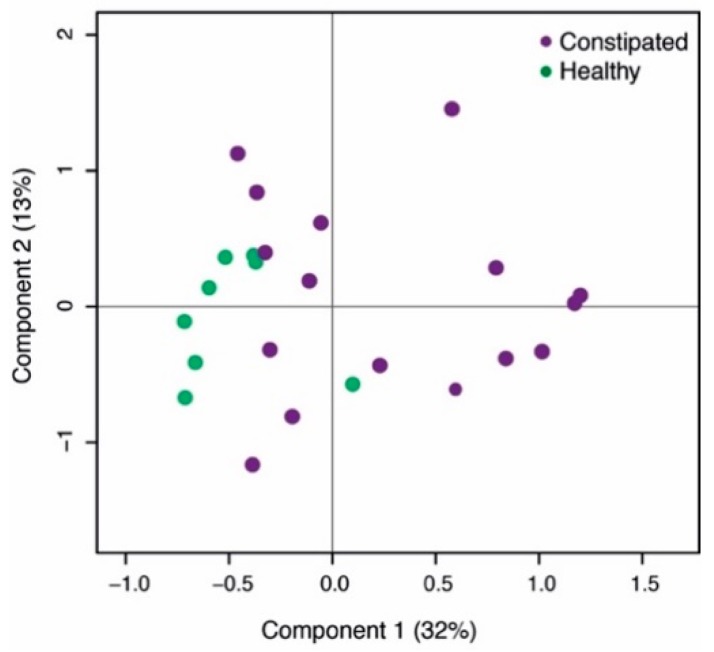
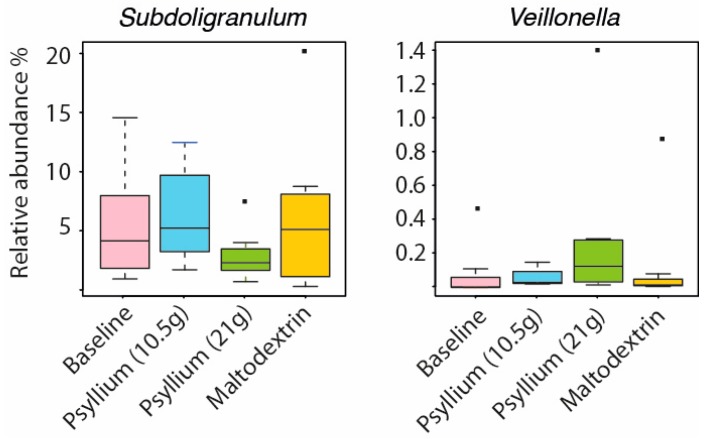
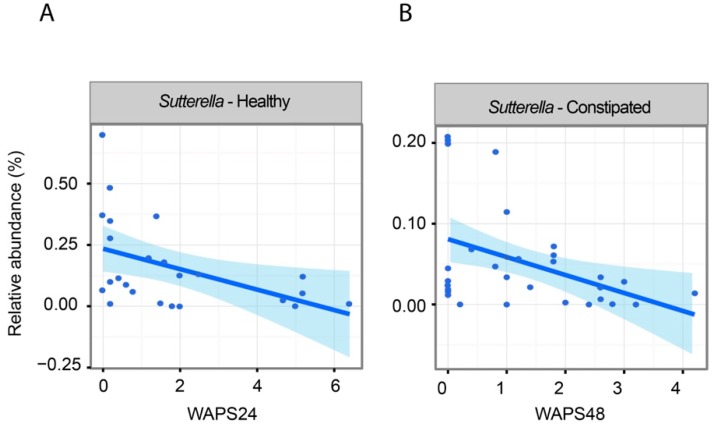
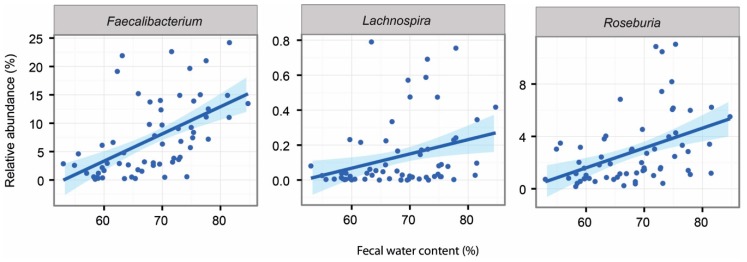
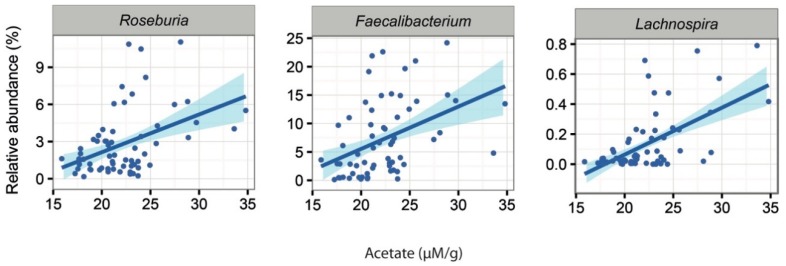
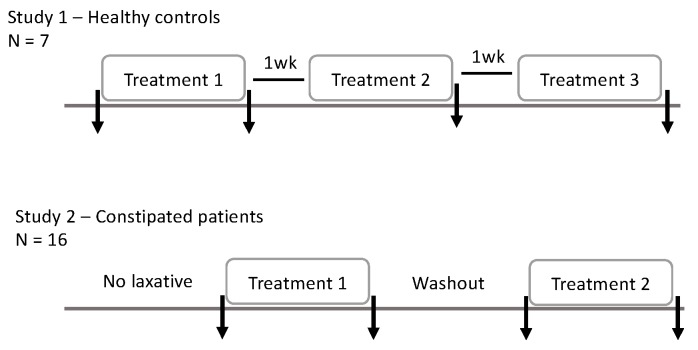
Psyllium is a widely used treatment for constipation. It traps water in the intestine increasing stool water, easing defaecation and altering the colonic environment. We aimed to assess the impact of psyllium on faecal microbiota, whose key role in gut physiology is being increasingly recognised. We performed two randomised, placebo-controlled, double-blinded trials comparing 7 days of psyllium with a placebo (maltodextrin) in 8 healthy volunteers and 16 constipated patients respectively. We measured the patients’ gastrointestnal (GI) transit, faecal water content, short-chain fatty acid (SCFA) and the stool microbiota composition. While psyllium supplement had a small but significant effect on the microbial composition of healthy adults (increasing Veillonella and decreasing Subdoligranulum), in constipated subjects there were greater effects on the microbial composition (increased Lachnospira, Faecalibacterium, Phascolarctobacterium, Veillonella and Sutterella and decreased uncultured Coriobacteria and Christensenella) and alterations in the levels of acetate and propionate. We found several taxa to be associated with altered GI transit, SCFAs and faecal water content in these patients. Significant increases in three genera known to produce butyrate, Lachnospira, Roseburia and Faecalibacterium, correlated with increased faecal water. In summary, psyllium supplementation increased stool water and this was associated with significant changes in microbiota, most marked in constipated patients.
Overview
The claims and statistics of this paper haven’t been checked yet.
Run the check — free, no account needed. It reads the open-access text and checks the sources it cites.
Integrity signals
Registry
Cites
Statistics
Figures
Verification
Claims the paper makes
The claims and statistics of this paper haven’t been checked yet.
Run the check — free, no account needed. It reads the open-access text and checks the sources it cites.
Claims other papers make about this one
Each is checked against this paper’s own text: does it say what the citing paper says it does?
In the citing paper
“Elevated levels of SCFAs are found in the stools of FC patients.”
From Role of gut microbiota in functional constipation (2021) · cites this paper as [54]
Self-check
Percentages, sums and reported differences re-computed from the paper’s own numbers.
The self-check needs the paper’s full text.
Citations
Cites
The SILVA ribosomal RNA gene database project: improved data processing and web-based tools
Quast, C., Pruesse, E., Yilmaz, P., Gerken, J., Schweer, T., Yarza, P., Peplies, J., & Glöckner, F. O. (2012) · Nucleic Acids Research · doi:10.1093/nar/gks1219 · Cited by 33,055
UPARSE: highly accurate OTU sequences from microbial amplicon reads
Edgar, R. C. (2013) · Nature Methods · doi:10.1038/nmeth.2604 · Cited by 16,770
A Direct Approach to False Discovery Rates
Storey, J. D. (2002) · Journal of the Royal Statistical Society Series B: Statistical Methodology · doi:10.1111/1467-9868.00346 · Cited by 5,603
Diversity, stability and resilience of the human gut microbiota
Lozupone, C. A., Stombaugh, J. I., Gordon, J. I., Jansson, J. K., & Knight, R. (2012) · Nature · doi:10.1038/nature11550 · Cited by 5,533
Physiological Implications of Hydrogen Sulfide: A Whiff Exploration That Blossomed
Wang, R. (2012) · Physiological Reviews · doi:10.1152/physrev.00017.2011 · Cited by 1,962
Nadkarni, M. A., Martin, F. E., Jacques, N. A., & Hunter, N. (2002) · Microbiology · doi:10.1099/00221287-148-1-257 · Cited by 1,931
Potential beneficial effects of butyrate in intestinal and extraintestinal diseases
Canani, R. B. (2011) · World Journal of Gastroenterology · doi:10.3748/wjg.v17.i12.1519 · Cited by 1,381
Salonen, A., Nikkilä, J., Jalanka, J., Immonen, O., Rajilić-Stojanović, M. D., Kekkonen, R. A., Palva, A., & de Vos, W. M. (2010) · Journal of Microbiological Methods · doi:10.1016/j.mimet.2010.02.007 · Cited by 606
Prebiotic inulin-type fructans induce specific changes in the human gut microbiota
Vandeputte, D., Falony, G., Vieira-Silva, S., Wang, J., Sailer, M., Theis, S., Verbeke, K., & Raes, J. (2017) · Gut · doi:10.1136/gutjnl-2016-313271 · Cited by 554
Action and function of Faecalibacterium prausnitzii in health and disease
Ferreira‐Halder, C. V., Faria, A. V. D. S., & Andrade, S. S. (2017) · Best Practice & Research Clinical Gastroenterology · doi:10.1016/j.bpg.2017.09.011 · Cited by 497
Cited by
Sorted by citations
The human gut bacteria Christensenellaceae are widespread, heritable, and associated with health
Waters, J. L., & Ley, R. E. (2019) · BMC Biology · doi:10.1186/s12915-019-0699-4 · Cited by 818
Mechanisms of Action of Prebiotics and Their Effects on Gastro-Intestinal Disorders in Adults
Guarino, M. P. L., Altomare, A., Emerenziani, S., Rosa, C. D., Ribolsi, M., Balestrieri, P., Iovino, P., Rocchi, G., & Cicala, M. (2020) · Nutrients · doi:10.3390/nu12041037 · Cited by 297
Desulfovibrio Bacteria Are Associated With Parkinson’s Disease
Murros, K. E., Huynh, V. A., Takala, T. M., & Saris, P. E. J. (2021) · Frontiers in Cellular and Infection Microbiology · doi:10.3389/fcimb.2021.652617 · Cited by 218
Kang, L., Li, P., Wang, D., Wang, T., Dong, H., & Qu, X. (2021) · Scientific Reports · doi:10.1038/s41598-021-84031-0 · Cited by 197
Role of gut microbiota in functional constipation
Zhang, S., Wang, R., Li, D., Zhao, L., & Zhu, L. (2021) · Gastroenterology Report · doi:10.1093/gastro/goab035 · Cited by 175
“[54] reported that the level of fecal acetate in FC patients was 2.”
Background
Metadata
- Authors
- Jalanka, J., Major, G., Murray, K., Singh, G., Nowak, A., Kurtz, C., Silos-Santiago, I., Johnston, J. M., de Vos, W. M., & Spiller, R.
- Affiliations
- Nottingham University Hospitals NHS Trust (GB)
- Synlogic (United States) (US)
- Decibel Therapeutics Inc., Boston, MA 02215, USA
- Ironwood Pharmaceuticals (United States) (US)
- Laboratory of Microbiology, Wageningen University, 6708WE Wageningen, The Netherlands
- Nottingham Digestive Diseases Centre and NIHR Nottingham Biomedical Research Centre at Nottingham University Hospitals NHS Trust, the University of Nottingham, Notts NG7 2UH, UK
- Venue
- International Journal of Molecular Sciences
- Publisher
- MDPI AG
- Published
- 2019-01-20
- Volume
- 20
- Issue
- 2
- Pages
- 433
- ISSN
- 1422-0067 (ISSN-L)
- PMC
- PMC6358997
- OpenAlex
- W2911132895
- Cited by
- 219
- References
- 38
- Citations by year
- 2026: 31 · 2025: 38 · 2024: 43 · 2023: 31 · 2022: 31 · 2021: 23 · 2020: 17 · 2019: 5
- FWCI
- 6.25
- Type
- journal article
- Language
- en
- Open access
- gold
- dx.doi.org
- Licence
- Locations
- International Journal of Molecular Sciences (publishedVersion, cc-by)
- Europe PMC (PubMed Central) (publishedVersion, other-oa)
- PubMed Central (publishedVersion, cc-by)
- PubMed (publishedVersion)
- Socio-Environmental Systems Modeling (acceptedVersion, cc-by)
- Repository@Nottingham (University of Nottingham) (submittedVersion, cc-by)
- DOAJ (DOAJ: Directory of Open Access Journals) (submittedVersion, cc-by-sa)
- Työväentutkimus Vuosikirja (submittedVersion)
- Data Archiving and Networked Services (DANS) (submittedVersion, cc-by)
- Funders
- Academy of Finland (0313471-7)
- Ironwood Pharmaceuticals Inc., Cambridge, MA, USA (-)
- Topics
- Life Sciences › Biochemistry, Genetics and Molecular Biology › Molecular Biology › Gut microbiota and health
- Health Sciences › Medicine › Gastroenterology › Gastrointestinal motility and disorders
- Health Sciences › Nursing › Nutrition and Dietetics › Microbial Metabolites in Food Biotechnology
- Keywords
- psyllium, constipation, gut microbiota, fecal microbiota composition, short-chain fatty acids, gastrointestinal transit, fecal water content, Lachnospira, Faecalibacterium, Roseburia, butyrate, Veillonella, dietary fiber supplementation
- MeSH terms
- Gastrointestinal Microbiome, Adult, Bacteria, Constipation, Double-Blind Method, Fatty Acids, Volatile, Feces, Female, Humans, Male, Middle Aged, Phylogeny, Psyllium, Case-Control Studies, Young Adult
About these checks
Registry, retraction, Cites and statistics results are computed, not judged, with one exception: a printed reference that no index lists is read once by a model before it counts as a citation error. Claims are extracted by a model and kept only when their quote appears verbatim in the text; each cited source is then checked, with a model’s help, for whether it says what the claim relies on. Those verdicts can be wrong — read the claim’s quote and the cited source before relying on one.
Statistics and arithmetic are recomputed, not judged.
Confidence bands are shown only for fields calibrated on our annotated test set. None is calibrated yet, so no band is shown.
What counts as a claim ›How we measure confidence ›How we check this ›
Are you an author, or do you see a problem with this page? Request a review
