

The DOI matches its Crossref record; 81 of the 83 references it cites were found in a registry or an index.
Omega-3 Fatty Acids and Neurodegenerative Diseases: New Evidence in Clinical Trials
Open accessPublished version of a preprint
Abstract
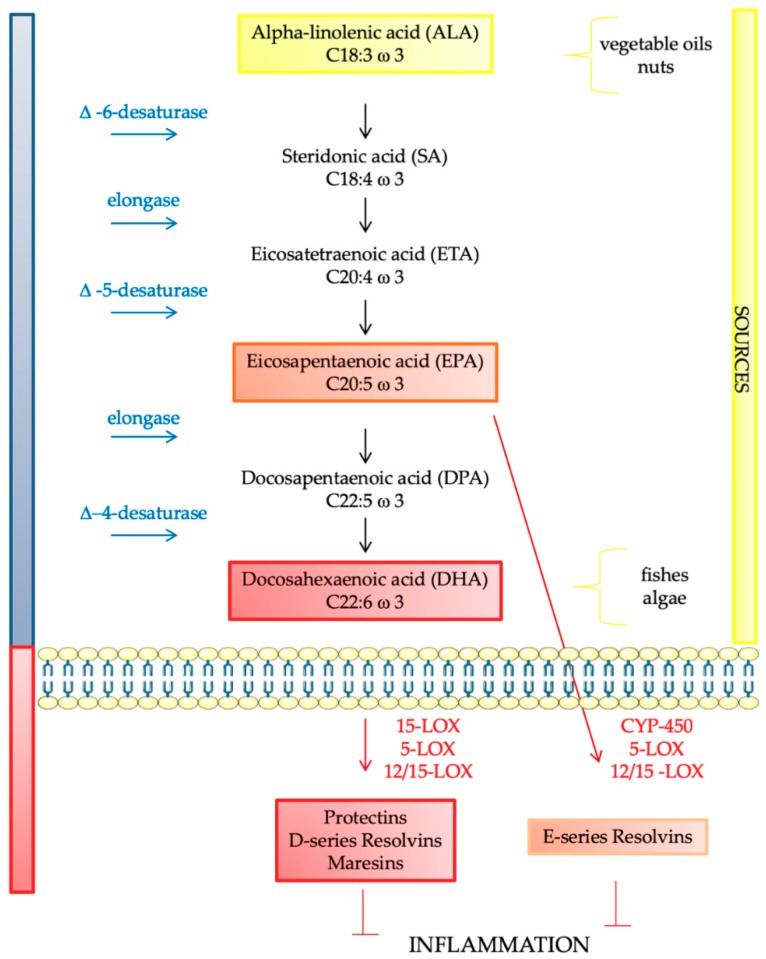
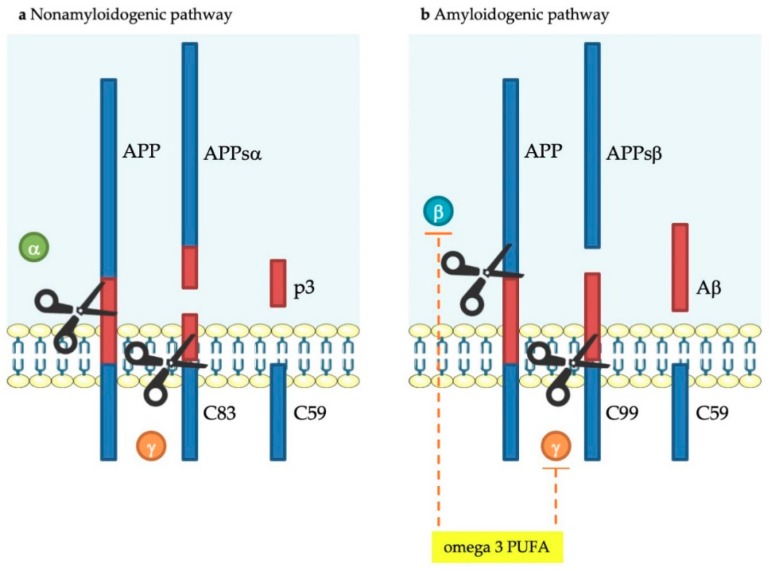
A nutritional approach could be a promising strategy to prevent or slow the progression of neurodegenerative diseases such as Parkinson’s and Alzheimer’s disease, since there is no effective therapy for these diseases so far. The beneficial effects of omega-3 fatty acids are now well established by a plethora of studies through their involvement in multiple biochemical functions, including synthesis of anti-inflammatory mediators, cell membrane fluidity, intracellular signaling, and gene expression. This systematic review will consider epidemiological studies and clinical trials that assessed the impact of supplementation or dietary intake of omega-3 polyunsaturated fatty acids on neurodegenerative diseases such as Parkinson’s and Alzheimer’s diseases. Indeed, treatment with omega-3 fatty acids, being safe and well tolerated, represents a valuable and biologically plausible tool in the management of neurodegenerative diseases in their early stages.
Overview
The claims and statistics of this paper haven’t been checked yet.
Run the check — free, no account needed. It reads the open-access text and checks the sources it cites.
Integrity signals
Registry
Cites
Statistics
Figures
Verification
Claims the paper makes
The claims and statistics of this paper haven’t been checked yet.
Run the check — free, no account needed. It reads the open-access text and checks the sources it cites.
Claims other papers make about this one
Each is checked against this paper’s own text: does it say what the citing paper says it does?
In the citing paper
“Avallone and colleagues [90] stated that the protective effects exerted by n-3 LCPUFAs are likely to be modulated by patient-related factors, some of which may have a significant genetic component and may, therefore, be unmodifiable, and furthermore, may be unpredictable via routine clinical and biochemical evaluation.”
From Role of n-3 long-chain polyunsaturated fatty acids in human nutrition and health: Review of recent studies and recommendations (2021) · cites this paper as [90]
In the citing paper
“The authors highlighted that inconsistent results are not unusual in clinical research between observational and randomized studies, particularly when investigating treatments with dietary supplements or integrators.”
From Role of n-3 long-chain polyunsaturated fatty acids in human nutrition and health: Review of recent studies and recommendations (2021) · cites this paper as [90]
In the citing paper
“Therefore, Avallone and colleagues [90] concluded n-3 LCPUFA supplementation may indeed be a valuable and biologically plausible tool in the management of neurodegenerative diseases.”
From Role of n-3 long-chain polyunsaturated fatty acids in human nutrition and health: Review of recent studies and recommendations (2021) · cites this paper as [90]
In the citing paper
“A recent systematic review on the effects of n-3 LCPUFA supplementation on cognitive function in patients with PD or AD also reported an inconsistency between the evidence from prospective observational studies and randomized trials, and the authors suggested some potential reasons for the inconsistency [90].”
From Role of n-3 long-chain polyunsaturated fatty acids in human nutrition and health: Review of recent studies and recommendations (2021) · cites this paper as [90]
Self-check
Percentages, sums and reported differences re-computed from the paper’s own numbers.
The self-check needs the paper’s full text.
Citations
Cites
The Opposing Effects of N-3 and n-6 Fatty Acids
Schmitz, G., & Ecker, J. (2008) · Progress in Lipid Research · doi:10.1016/j.plipres.2007.12.004 · Cited by 1,245
MIND diet associated with reduced incidence of Alzheimer's disease
Morris, M. C., Tangney, C. C., Wang, Y., Sacks, F. M., Bennett, D. A., & Aggarwal, N. T. (2015) · Alzheimer's & Dementia · doi:10.1016/j.jalz.2014.11.009 · Cited by 1,162
Consumption of Fish and n-3 Fatty Acids and Risk of Incident Alzheimer Disease
Morris, M. C., Evans, D. A., Bienias, J. L., Tangney, C. C., Bennett, D. A., Wilson, R. S., Aggarwal, N., & Schneider, J. (2003) · Archives of Neurology · doi:10.1001/archneur.60.7.940 · Cited by 1,135
Omega-6 fatty acids and inflammation
Innes, J. K., & Calder, P. C. (2018) · Prostaglandins Leukotrienes and Essential Fatty Acids · doi:10.1016/j.plefa.2018.03.004 · Cited by 935
Dietary fat intake and the risk of incident dementia in the Rotterdam study
Kalmijn, S., Launer, L. J., Ott, A., Witteman, J. C. M., Hofman, A., & Breteler, M. M. B. (1997) · Annals of Neurology · doi:10.1002/ana.410420514 · Cited by 895
Burdge, G. C., & Wootton, S. A. (2002) · British Journal Of Nutrition · doi:10.1079/bjn2002689 · Cited by 812
Docosahexaenoic Acid Supplementation and Cognitive Decline in Alzheimer Disease: A Randomized Trial
Quinn, J. F., Raman, R., Thomas, R. G., Yurko-Mauro, K., Nelson, E. B., Van Dyck, C., Galvin, J. E., Emond, J., Jack, C. R., Weiner, M., et al. (2010) · JAMA · doi:10.1001/jama.2010.1510 · Cited by 764
Freund-Levi, Y., Eriksdotter-Jönhagen, M., Cederholm, T., Basun, H., Faxén-Irving, G., Garlind, A., Vedin, I., Vessby, B., Wahlund, L.-O., & Palmblad, J. (2006) · Archives of Neurology · doi:10.1001/archneur.63.10.1402 · Cited by 751
Dietary patterns and risk of dementia: The Three-City cohort study
Barberger-Gateau, P., Raffaitin, C., Letenneur, L., Berr, C., Tzourio, C., Dartigues, J. F., & Alpérovitch, A. (2007) · Neurology · doi:10.1212/01.wnl.0000278116.37320.52 · Cited by 700
Schaefer, E. J., Bongard, V., Beiser, A. S., Lamon-Fava, S., Robins, S. J., Au, R., Tucker, K. L., Kyle, D. J., Wilson, P. W. F., & Wolf, P. A. (2006) · Archives of Neurology · doi:10.1001/archneur.63.11.1545 · Cited by 686
Cited by
Sorted by citations
Obesity and aging: Molecular mechanisms and therapeutic approaches
Santos, A. L., & Sinha, S. (2021) · Ageing Research Reviews · doi:10.1016/j.arr.2021.101268 · Cited by 249
Patel, A., Desai, S. S., Mane, V. K., Enman, J., Rova, U., Christakopoulos, P., & Μάτσακας, Λ. (2022) · Trends in Food Science & Technology · doi:10.1016/j.tifs.2022.01.006 · Cited by 152
Van Dael, P. (2021) · Nutrition Research and Practice · doi:10.4162/nrp.2021.15.2.137 · Cited by 138
DHA/EPA (Omega-3) and LA/GLA (Omega-6) as Bioactive Molecules in Neurodegenerative Diseases
Kousparou, C. A., Fyrilla, M., Stephanou, A., & Patrikios, I. S. (2023) · International Journal of Molecular Sciences · doi:10.3390/ijms241310717 · Cited by 134
Ferreira, I., Falcato, F., Bandarra, N., & Rauter, A. P. (2022) · Molecules · doi:10.3390/molecules27051677 · Cited by 120
Metadata
- Authors
- Avallone, R., Vitale, G., & Bertolotti, M.
- Affiliations
- University of Modena and Reggio Emilia (IT)
- Corresponding author
- Avallone, Rossella
- Venue
- International Journal of Molecular Sciences
- Publisher
- MDPI AG
- Published
- 2019-08-30
- Volume
- 20
- Issue
- 17
- Pages
- 4256
- ISSN
- 1422-0067 (ISSN-L)
- PMC
- PMC6747747
- OpenAlex
- W2963446643
- Cited by
- 218
- References
- 83
- Citations by year
- 2026: 14 · 2025: 43 · 2024: 35 · 2023: 29 · 2022: 37 · 2021: 31 · 2020: 28 · 2019: 1
- FWCI
- 3.30
- Type
- journal article
- Language
- en
- Open access
- gold
- dx.doi.org
- Licence
- Locations
- International Journal of Molecular Sciences (publishedVersion, cc-by)
- Preprints.org (acceptedVersion, cc-by)
- PubMed Central (publishedVersion, cc-by)
- PubMed (publishedVersion)
- IRIS UNIMORE (University of Modena and Reggio Emilia) (submittedVersion, cc-by)
- DOAJ (DOAJ: Directory of Open Access Journals) (submittedVersion, cc-by-sa)
- Funders
- Fondazione Cassa di Risparmio di Modena (2018.0334)
- Topics
- Health Sciences › Nursing › Nutrition and Dietetics › Fatty Acid Research and Health
- Life Sciences › Neuroscience › Cellular and Molecular Neuroscience › Alzheimer's disease research and treatments
- Health Sciences › Medicine › Psychiatry and Mental health › Dementia and Cognitive Impairment Research
- Keywords
- omega-3 fatty acids, neurodegenerative diseases, Parkinson's disease, Alzheimer's disease, dietary supplementation, polyunsaturated fatty acids, anti-inflammatory mediators, cell membrane fluidity, intracellular signaling, gene expression, disease prevention
- MeSH terms
- Clinical Trials as Topic, Humans, Fatty Acids, Omega-3, Neurodegenerative Diseases, Observational Studies as Topic
About these checks
Registry, retraction, Cites and statistics results are computed, not judged, with one exception: a printed reference that no index lists is read once by a model before it counts as a citation error. Claims are extracted by a model and kept only when their quote appears verbatim in the text; each cited source is then checked, with a model’s help, for whether it says what the claim relies on. Those verdicts can be wrong — read the claim’s quote and the cited source before relying on one.
Statistics and arithmetic are recomputed, not judged.
Confidence bands are shown only for fields calibrated on our annotated test set. None is calibrated yet, so no band is shown.
What counts as a claim ›How we measure confidence ›How we check this ›
Are you an author, or do you see a problem with this page? Request a review
