

The DOI matches its Crossref record; 192 of the 194 references it cites were found in a registry or an index.
Tryptophan Metabolism and Gut-Brain Homeostasis
Open accessAbstract
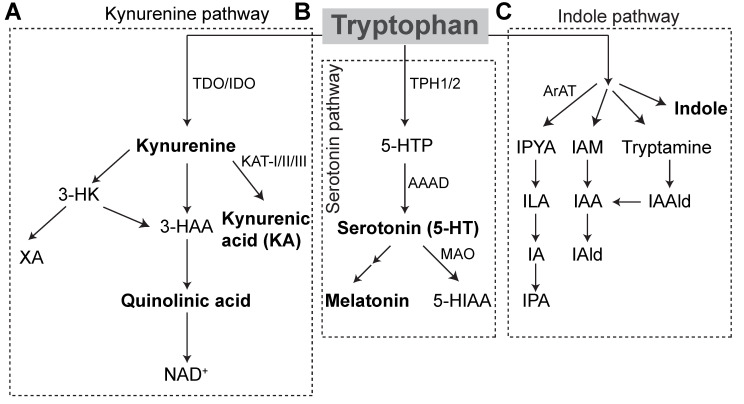
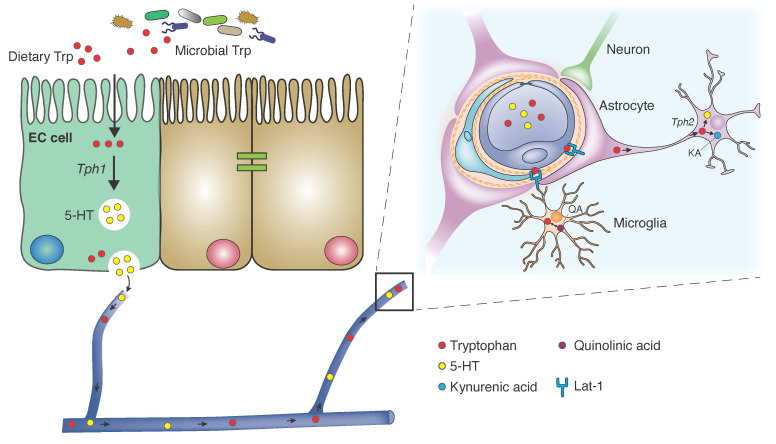
Tryptophan is an essential amino acid critical for protein synthesis in humans that has emerged as a key player in the microbiota-gut-brain axis. It is the only precursor for the neurotransmitter serotonin, which is vital for the processing of emotional regulation, hunger, sleep, and pain, as well as colonic motility and secretory activity in the gut. Tryptophan catabolites from the kynurenine degradation pathway also modulate neural activity and are active in the systemic inflammatory cascade. Additionally, tryptophan and its metabolites support the development of the central and enteric nervous systems. Accordingly, dysregulation of tryptophan metabolites plays a central role in the pathogenesis of many neurologic and psychiatric disorders. Gut microbes influence tryptophan metabolism directly and indirectly, with corresponding changes in behavior and cognition. The gut microbiome has thus garnered much attention as a therapeutic target for both neurologic and psychiatric disorders where tryptophan and its metabolites play a prominent role. In this review, we will touch upon some of these features and their involvement in health and disease.
Overview
The claims and statistics of this paper haven’t been checked yet.
Run the check — free, no account needed. It reads the open-access text and checks the sources it cites.
Integrity signals
Registry
Cites
Statistics
Figures
Verification
Claims the paper makes
The claims and statistics of this paper haven’t been checked yet.
Run the check — free, no account needed. It reads the open-access text and checks the sources it cites.
Claims other papers make about this one
Each is checked against this paper’s own text: does it say what the citing paper says it does?
In the citing paper
“these bacteria have been associated with the development of neuropsychiatric disorders, including autism spectrum disorders (205).”
From Signalling cognition: The gut microbiota and hypothalamic-pituitary-adrenal axis (2023) · cites this paper as [205]
Self-check
Percentages, sums and reported differences re-computed from the paper’s own numbers.
The self-check needs the paper’s full text.
Citations
Cites
1 retracted
Zhu, J., Wu, X., Owyang, C., & Li, Y. (2001) · The Journal of Physiology · doi:10.1111/j.1469-7793.2001.0431k.x · Cited by 226
RetractedNicotinic acetylcholine receptor α7 subunit is an essential regulator of inflammation
Wang, H., Yu, M., Ochani, M., Amella, C. A., Tanovic, M., Susarla, S., Li, J. H., Wang, H., Yang, H., Ulloa, L., et al. (2003) · Nature · doi:10.1038/nature01339 · Cited by 3,228
Gut Microbiota Regulation of Tryptophan Metabolism in Health and Disease
Agus, A., Planchais, J., & Sokol, H. (2018) · Cell Host & Microbe · doi:10.1016/j.chom.2018.05.003 · Cited by 3,180 · cited 3×
“The vast majority of TPH is absorbed in the small intestine [6].”
BackgroundInternational Union of Pharmacology classification of receptors for 5-hydroxytryptamine (Serotonin).
Hoyer, D., Clarke, D. E., Fozard, J. R., Hartig, P. R., Martin, G. R., Mylecharane, E. J., Saxena, P. R., & Humphrey, P. P. A. (1994) · Pharmacological Reviews · doi:10.1016/s0031-6997(25)06783-3 · Cited by 3,025
Metabolomics analysis reveals large effects of gut microflora on mammalian blood metabolites
Wikoff, W. R., Anfora, A. T., Liu, J., Schultz, P. G., Lesley, S. A., Peters, E. C., & Siuzdak, G. (2009) · Proceedings of the National Academy of Sciences · doi:10.1073/pnas.0812874106 · Cited by 2,677
Schizophrenia risk from complex variation of complement component 4
Sekar, A., Bialas, A. R., de Rivera, H., Davis, A., Hammond, T. R., Kamitaki, N., Tooley, K., Presumey, J., Baum, M., Van Doren, V., et al. (2016) · Nature · doi:10.1038/nature16549 · Cited by 2,394
Microbial tryptophan catabolites in health and disease
Roager, H. M., & Licht, T. R. (2018) · Nature Communications · doi:10.1038/s41467-018-05470-4 · Cited by 2,236
Gut microbiome alterations in Alzheimer’s disease
Vogt, N. M., Kerby, R. L., Dill-McFarland, K. A., Harding, S. J., Merluzzi, A. P., Johnson, S. C., Carlsson, C. M., Asthana, S., Zetterberg, H., Blennow, K., et al. (2017) · Scientific Reports · doi:10.1038/s41598-017-13601-y · Cited by 2,137
Serotonin, tryptophan metabolism and the brain-gut-microbiome axis
O’Mahony, S. M., Clarke, G., Borre, Y. E., Dinan, T. G., & Cryan, J. F. (2015) · Behavioural Brain Research · doi:10.1016/j.bbr.2014.07.027 · Cited by 2,012
Clarke, G., Grenham, S., Scully, P., Fitzgerald, P., Moloney, R. D., Shanahan, F., Dinan, T. G., & Cryan, J. F. (2013) · Molecular Psychiatry · doi:10.1038/mp.2012.77 · Cited by 1,893
Cited by
Sorted by citations
Items 401–500 of 519
Maccari, P. A., Visentin, A. P. V., Zatti, P. H., Salvador, M. M., & Branco, C. S. (2022) · Research Society and Development · doi:10.33448/rsd-v11i9.32117
Symbiotic microbes from pig gut
Jeya, K. R., Veerapagu, M., Khalifa, A. Y. Z., & Sankaranarayanan, A. (2023) · Elsevier eBooks · doi:10.1016/b978-0-323-99334-0.00032-3
Kaladan, K. V., Sivagurunathan, N., & Parsanathan, R. (2023) · Research Square · doi:10.21203/rs.3.rs-2879136/v1
Phenylketonuria in a microbial world
van der Goot, E. (2023) · University of Groningen research database (University of Groningen / Centre for Information Technology) · doi:10.33612/diss.678170132
MTHFR and LC, CFS, POTS, MCAS, SIBO, EDS: Methylating the AlphabetPreprint
Chambers, P. W. (2023) · SSRN Electronic Journal · doi:10.2139/ssrn.4495911
MTHFR and LC, CFS, POTS, MCAS, SIBO, EDS: Methylating the Alphabet
Chambers, P. W. (2023) · Medical & Clinical Research · doi:10.33140/mcr.08.08.05
Wang, C., Liu, X., Sun, Q., Zhao, F., Dai, P.-Q., Li, L.-X., & Hu, D. (2023) · Food & Function · doi:10.1039/d3fo03207h
Котиева, И. М., Франциянц, Е. М., Gulyan, M. V., Shlyk, S. V., Drobotya, N. V., Котиева, Е. М., Антонян, Б. Г., & Додохова, М. А. (2023) · Zhurnal «Patologicheskaia fiziologiia i eksperimental`naia terapiia» · doi:10.25557/0031-2991.2023.02.65-70
The Candida Covid Connection: Preexisting Candida Overgrowth and Gut Dysbiosis Drives Long CovidPreprint
Chambers, P. W. (2023) · Qeios · doi:10.32388/3bcgaw
Arjmandi, M., Poudineh, S., Sarlak, A., Eghbali, M., Barghgir, B., Poudineh, M., A, A., & A, A. (2023) · Galen Medical Journal · doi:10.31661/gmj.v12i.3072
Long Covid, the Gut, and Autoimmune Skin Diseases: A Novel Therapeutic ApproachPreprint
Chambers, P. W. (2023) · Qeios · doi:10.32388/zqy8pg
Microbiota-Gut-Brain Axis and Mental Health
Guillén, J. M. B. (2024) · British journal of healthcare and medical research · doi:10.14738/bjhmr.106.16010
Long Covid, the Gut, and Autoimmune Skin Diseases: A Novel Therapeutic ApproachPreprint
Chambers, P. W. (2024) · Qeios · doi:10.32388/zqy8pg.2
Cellular and molecular mechanisms involved in colonic disorders
Kaur, S., Singh, A., Kaur, H., Singh, J., & Bhatti, R. (2024) · Elsevier eBooks · doi:10.1016/b978-0-443-14044-0.00007-7
Feng, G., Han, C., Qin, Q., Li, W., Chen, Y., Liu, G., Lei, Y., Liu, T., Ma, K., Hou, J., et al. (2024) · SSRN Electronic Journal · doi:10.2139/ssrn.4798089
Long Covid, the Gut, and Autoimmune Skin Diseases: A Novel Therapeutic Approach
Chambers, P. W., & Chambers, S. E. (2024) · Neuroscience and Neurological Surgery · doi:10.31579/2578-8868/297
Salloum, F., Farran, M. T., Shaib, H. A., Jurjus, A. R., Sleiman, R., & Khalil, M. I. M. (2024) · Functional Foods in Health and Disease · doi:10.31989/ffhd.v14i5.1321
An, Y., Jia, Y., zhang, X., Li, X., Zhu, L., Wang, X., Ze, X., & Li, J. (2024) · Research Square · doi:10.21203/rs.3.rs-4108195/v1
Gut-Brain Axis: The role of gut microbiota in immune and neurological homeostasis
Silocchi, V. M., Awada, S. M., Machado, M. S., da Silva, A. V., Oda, J. Y., Machado, A. R. D. S. R., & Machado, A. M. (2024) · Seven Editora eBooks · doi:10.56238/sevened2024.006-022
Losada-Carrillo, M. P., Vila‐Costa, M., & Barata, C. (2024) · SSRN Electronic Journal · doi:10.2139/ssrn.4880221
Yang, S., Zhao, Y., Liu, J., Song, J., Long, Q., & Cheng, S. (2024) · Skin Research and Technology · doi:10.1111/srt.70006
RetractedThe Microbiota-Gut-Brain Axis: Tryptophan Metabolism and Potential Therapeutic Strategies
Mora-Navarro, M. A., Mora-Martínez, J. M., Patiño-Laguna, A. D. J., Barragán-Álvarez, C. P., Gonzalez-Mora, M. E., & Mora-Navarro, C. E. (2024) · IntechOpen eBooks · doi:10.5772/intechopen.113888
Villano, R., & Marzo, V. D. (2024) · Frontiers in Chemistry · doi:10.3389/fchem.2024.1436008
Tryptophan metabolism: role in modulating the function of the "brain–gut axis"
Sliusar, N. A., & Салтанова, С. Д. (2024) · Medicine Today and Tomorrow · doi:10.35339/msz.2024.93.3.sls
DISBIOSE DO TRATO GASTROINTESTINAL E DOENÇA DE ALZHEIMER
Baciuk-Souza, L., Baciuk, É. P., & Toma, M. D. A. (2024) · Intellectus Saúde · doi:10.21116/is.v1i1.954
COMPORTAMENTO ALIMENTAR E A RELAÇÃO ENTRE O INTESTINO E O CÉREBRO
Silva, L. F. E., & de Souza, C. S. H. (2024) · RECIMA21 - Revista Científica Multidisciplinar · doi:10.47820/recima21.v5i12.6076 · Cited by 1
Vitamin D, Calcium to Magnesium, and the Gut MicrobiomePreprint
Chambers, P. W. (2025) · Qeios · doi:10.32388/i7gtlb
Vitamin D, Calcium to Magnesium, and the Gut MicrobiomePreprint
Chambers, P. W. (2025) · Qeios · doi:10.32388/i7gtlb.2
Vitamin D, Calcium to Magnesium, and the Gut MicrobiomePreprint
Chambers, P. W. (2025) · Qeios · doi:10.32388/i7gtlb.3
Vitamin D, Calcium to Magnesium, and the Gut MicrobiomePreprint
Chambers, P. W. (2025) · Qeios · doi:10.32388/i7gtlb.4
Li, W., Ma, S., & Tian, Y. (2025) · Health Science Reports · doi:10.1002/hsr2.70528
Research Progress of Tryptophan-Related Metabolites in Parkinson’s Disease
徐, 利. (2025) · Advances in Clinical Medicine · doi:10.12677/acm.2025.1541318
Chen, G., Cao, L., Zhao, H., Li, T., Xiong, Z., Li, C., Jia, Y., Song, J., Liu, Y., & Liu, S. (2025) · SSRN Electronic Journal · doi:10.2139/ssrn.5252470
Rummell, L. M., Templeman, J. R., Cargo-Froom, C. L., & Shoveller, A. K. K. (2025) · Journal of Animal Science · doi:10.1093/jas/skaf180
From gut to brain: Microbial influences on neuroinflammation and microglial activity
Dave, M., Jayaraman, S., & Mukherjee, R. (2025) · Elsevier eBooks · doi:10.1016/b978-0-443-22300-6.00052-8
The impact of probiotics on cognitive function in elderly patients: a narrative review
Xiong, C., Zhai, W., Chen, X., Lan, L., & Zhang, X. (2025) · Reviews in Medical Microbiology · doi:10.1097/mrm.0000000000000436
Kowalczyk, N., Świderski, G., Zawadzka, M., Kalinowska, M., Gołębiewska, E., Pietryczuk, A., & Cudowski, A. (2025) · Journal of Molecular Structure · doi:10.1016/j.molstruc.2025.143580
Mikawa, S., ISHIMARU, Y., & Okamura, Y. (2025) · SSRN Electronic Journal · doi:10.2139/ssrn.5406545
Mikawa, S., ISHIMARU, Y., & Okamura, Y. (2025) · SSRN Electronic Journal · doi:10.2139/ssrn.5414125
Stotz, S., Moraga‐Amaro, R., Zlatopolskiy, B. D., Gemki, M., Knudsen, G. M., Neumaier, B., Soza‐Ried, C., Horacio Amaral, P., Kramer, V., & Herth, M. M. (2025) · bioRxiv (Cold Spring Harbor Laboratory) · doi:10.1101/2025.08.26.672460
Рекалов, Д. Г., Oros, M. M., Akimov, O. Y., Горошко, В. І., Kostenko, V. H., Nestulia, K. I., & Kostenko, V. О. (2025) · PAIN JOINTS SPINE · doi:10.22141/pjs.15.4.2025.488 · Cited by 1
Sun, Y., Zhang, W., Song, C., Pan, Z.-Q., Du, G.-J., Song, Z., Ren, J., Bo, L.-Y., An, J., & Wang, M. (2025) · Journal of Food Science · doi:10.1111/1750-3841.70650
Zhou, Q., Ye, M., Ye, X., Lin, L., Kong, M., Zheng, J., Li, B., Zheng, W., Liu, J., & Luo, F. (2025) · Surfaces and Interfaces · doi:10.1016/j.surfin.2025.108071
Gao, X., Jiang, P., Liu, L., Huang, Y., Tan, H., Guo, W., Xie, H., Xing, P., Wang, Q., Peng, S., et al. (2025) · Journal of Affective Disorders · doi:10.1016/j.jad.2025.120788
Douthitt, A. J., Bennett, A. H., Koustova, A., Abdelfattah, A., Horvat, D., & Geoffroy, C. G. (2025) · Brain Behavior & Immunity - Health · doi:10.1016/j.bbih.2025.101157
Chen, Y.-Z., Chen, C.-T., Shih, T., Hsu, W.-H., Lee, B., & Pan, T. (2025) · Microbiology Research · doi:10.3390/microbiolres16120261
Liu, Y., Zhao, P., Cai, Z., He, P., Wang, J., He, H., Zhu, Z., Guo, X., Ma, K., Peng, K., et al. (2024) · Figshare · doi:10.6084/m9.figshare.27022743
Wang, G., Fan, Y., Zhang, G., Cai, S., Ma, Y., Yang, L., Wang, Y., Yu, H., Qiao, S., & Zeng, X. (2024) · Figshare · doi:10.6084/m9.figshare.26695161
Wang, G., Fan, Y., Zhang, G., Cai, S., Ma, Y., Yang, L., Wang, Y., Yu, H., Qiao, S., & Zeng, X. (2024) · Figshare · doi:10.6084/m9.figshare.26695164
Chronic stress, gut dysbiosis, and cholesterol metabolism: Implications for Alzheimer's disease
Das, A., Navya, P., Chowdhury, D., Das, A., Manna, R., & Bodakhe, S. H. (2026) · Journal of Neuroimmunology · doi:10.1016/j.jneuroim.2026.578853
Epigenetic Modulation by Gut Microbiota Metabolites
Hammou, H. A., Moummou, H., Elhidar, N., Achbani, A., Belokda, W., Baz, S. E., Chatoui, H., Hassania Khalloufi, E. L., Ougjij, A. A., Zine, H., et al. (2026) · IGI Global eBooks · doi:10.4018/979-8-3373-1365-8.ch010
Yu, S., Ye, Z., Zhao, W., Yu, X., Qiu, Y., Lin, K., Lu, T., Ge, L., Sun, J., & Hua, R. (2026) · European Archives of Psychiatry and Clinical Neuroscience · doi:10.1007/s00406-025-02147-0 · Cited by 1
Wen, R., Xin, Y., Bao, S., Zhang, X., Wang, Q., Dang, Z., Zhou, Z., Wu, J., Song, D., Fu, L., et al. (2026) · npj Biofilms and Microbiomes · doi:10.1038/s41522-026-00929-5
Barrau-Martínez, B., Gonzalez-Rodriguez, A., García-Arenas, D., Campistol, J., Meavilla, S. M., Roca-Vives, R., Jáuregui, O., Ormazábal, A., Llorach, R., & Urpí-Sardà, M. (2026) · The Journal of Nutritional Biochemistry · doi:10.1016/j.jnutbio.2026.110307
Razban, V., Cristobal-Carballo, O., Morrison, S. J., & Shirali, M. (2026) · Animals · doi:10.3390/ani16040589
Amino acid disruptions in autism spectrum disorder: from etiology to therapeutic avenues
Gandam, U. K., Kumar, A. K., & Annamaneni, S. (2026) · Nutritional Neuroscience · doi:10.1080/1028415x.2026.2631555 · Cited by 1
Polyphenols and Probiotics Improve Mood Disorders by Regulating the Gut-Lung Axis
Dai, D., Hu, B., Hao, X., Xu, H., & Zhang, X. (2026) · Food Reviews International · doi:10.1080/87559129.2026.2631074
Research progresses on molecular mechanisms and analytical technologies of depression
TongTong, Y. A. N. G., Sui, H., Zhu, T., Chen, Z., Peng, K., Wang, G., & Chen, H. (2026) · Scientia Sinica Vitae · doi:10.1360/ssv-2025-0290
Cortisol and Serotonin Patterns in Epilepsy: An Observational Study
Rout, S., Pattnaik, S., Mathur, D., Mishra, B. K., Rout, T., Brahma, P. K., & Sahoo, S. K. (2026) · Al-Rafidain Journal of Medical Sciences · doi:10.54133/ajms.v10i1.2646
Li, Y., Zhang, S., Fu, T., Yuchao, F. E. N. G., & Changyuan, W. A. N. G. (2026) · Foods · doi:10.3390/foods15050902
Mikawa, S., Ishimaru, Y., & Okamura, Y. (2026) · Veterinary Sciences · doi:10.3390/vetsci13040308
Wang, H., Long, B., Cui, Y., Abulajiang, Y., Chen, B., Chen, X., Hu, X., Wang, C., Ren, M., She, R., et al. (2026) · Frontiers in Immunology · doi:10.3389/fimmu.2026.1770675
Castro, V. D. (2024) · theses.fr (ABES) · doi:10.70675/21fe1180zedcez41e6z84f6z171e779c807e
Essays on the Interplay of Body and Brain in Social Decision-Making and Self-Control
Falkenstein, M. (2023) · theses.fr (ABES) · doi:10.70675/319893e7zbe5az43b6z89c9z28dbe64f095b
Ni, S., Guan, L., Jin, Y., Liu, L., Zhu, S., Zhao, W., & Kumar, P. V. (2026) · The EPMA Journal · doi:10.1007/s13167-026-00450-x · Cited by 1
Li, H., Nianshou, Z., Yang, M. C., Hua, Y., Wei, Y., & Ji, P. (2026) · Veterinary Sciences · doi:10.3390/vetsci13050414
Huma, N. E., Davison, S., Guse, K., Walls, C., Rutschke, S., Sackett, A., Blanco-Ruiz, G., Zhang, J., Chen, C., Damián, J. P., et al. (2026) · bioRxiv (Cold Spring Harbor Laboratory) · doi:10.64898/2026.05.07.718715
Tan, A.-J., Li, T., Yang, J.-J., Li, X., Li, W.-Q., & Yu, J. (2026) · ACS Omega · doi:10.1021/acsomega.5c13612
Sochal, M., Wojtera, A., Ditmer, M., Gabryelska, A., Tarasiuk, A., Turkiewicz, S., Karuga, F. F., Fichna, J., & Białasiewicz, P. (2026) · International Journal of Molecular Sciences · doi:10.3390/ijms27125209
Gut–brain–immune crosstalk in drug-resistant epilepsy: mechanisms and therapeutic perspectives
Nagaraj, A. P., Nagaraju, P. K., & Naveen, N. R. (2026) · Journal of Holistic Integrative Pharmacy · doi:10.1016/j.jhip.2026.05.011
Choi, J. M., Cho, M. S., Jeong, B. G., Kim, J. H., & Kim, H. Y. (2026) · Korean Journal of Agricultural Science · doi:10.7744/kjoas.530209
Wang, Q., Zheng, W., Zhang, C., Lv, S., Peng, L., Chen, J., & Lu, A. (2026) · Genes & Diseases · doi:10.1016/j.gendis.2026.102315
“Enzymatic landscape” of the gut microbiome
Shatova, O. P., Zabolotneva, A. A., Makarov, V., Yudin, S. M., Roumiantsev, S. A., & Shestopalov, A. (2025) · Biological Communications · doi:10.21638/spbu03.2025.203
Tian, C., Yang, S., Zhang, X., & Yan, H. (2026) · Frontiers in Neuroscience · doi:10.3389/fnins.2026.1823961
Regulatory Effects of Functional Food Biscuits on Mouse Brain Function and Gut Microbiota
Zhang, Z., Xie, S., & 谭周进 (2026) · Molecular Nutrition & Food Research · doi:10.1002/mnfr.70545
Targeted extraction of gut-brain axis bioactives: a review
Hassan, A., Zafar, R., Awlqadr, F. H., Hassan, S. A., Ikram, A., Raza, A., Arshad, M. T., Al-Duais, M. A., Al-Aoh, H. A. N., & Laryea, E. (2026) · International Journal of Food Science & Technology · doi:10.1093/ijfood/vvag139
Zhao, H., & Wu, W. (2026) · Nutrients · doi:10.3390/nu18132185
Dai, Z., Zhang, X., Hua, Z., Wang, Y., Zhang, H., Hu, X., Du, P., & Xu, W. (2026) · The Journals of Gerontology Series A · doi:10.1093/gerona/glag171
Shu, T., Shang, X., & Zhou, Y. (2026) · Frontiers in Immunology · doi:10.3389/fimmu.2026.1871461
Light, melanin, and the microbial clock: Rewiring the gut–brain–skin axis
Clark, A. P., & Mach, N. (2026) · Frontiers in Neuroendocrinology · doi:10.1016/j.yfrne.2026.101271
Longitudinal urine metabolomics predicts high-grade brain injury in very preterm infants
Kuncewicz, T., Zasada, M., Olszewska, M., Kowalik, A., Berska, J., Bugajska, J., & Kwinta, P. (2026) · Pediatric Research · doi:10.1038/s41390-026-05289-6
Liu, H., Kuang, X., & Zheng, X. (2026) · Nutrients · doi:10.3390/nu18142364
Wu, J., Li, T., Wang, A., Li, M., Song, Y., Hu, R., Tao, Y., Qiao, C.-M., Cui, C., Zhao, W.-J., et al. (2026) · Brain Behavior and Immunity · doi:10.1016/j.bbi.2026.106924
Yang, R., He, K., Yang, Y., & Teng, L. (2026) · Biochimica et Biophysica Acta (BBA) - Molecular Basis of Disease · doi:10.1016/j.bbadis.2026.168395
Liu, L., Zhou, H.-J., Li, H.-C., Li, M.-Z., Sun, Y.-L., Zhu, J.-W., Wu, J.-L., Lu, M.-L., Yu, Y., Han, F., et al. (2026) · Frontiers in Microbiology · doi:10.3389/fmicb.2026.1850738
Das Hormonsystem – das Chamäleon unseres Körpers
Herzberg, J. (2026) · Deutsche Heilpraktiker-Zeitschrift · doi:10.1055/a-2902-7196
Qiao, X., Han, D., Bai, Y., Wang, R., Xue, X., Wang, Z. X., Jin, M. H., & Tao, R. (2026) · Pharmacological Research · doi:10.1016/j.phrs.2026.108390
Youssef, I. M., Omar, A. H., & El-Hack, M. E. A. (2026) · Elsevier eBooks · doi:10.1016/b978-0-443-45446-2.00017-x
Gao, Y., Liu, C., & He, X. (2026) · Frontiers in Cellular and Infection Microbiology · doi:10.3389/fcimb.2026.1840605
Metabolic Outputs of the Gut Microbiome: Implications for Epilepsy
Gallucci, A., Guo, X., Shukla, D., & Campbell, S. L. (2026) · Cells · doi:10.3390/cells15161492
Li, Z., Guo, Y., Ma, D., Cheng, Y., Rahman, E., Wang, Z., Chen, Q., MaoMao, Z., Chen, J., Liu, G., et al. (2026) · Food & Function · doi:10.1039/d6fo02383e
Xin, Y., Guan, S., Si, S.-M., Dong, J., Zhou, S., Liu, Y., & Xu, H. (2026) · Translational research · doi:10.1016/j.trsl.2026.08.007
Amino Acid Metabolism in Health and Disease
Su, Z., Liu, J., Deng, X., Luo, Y., Xue, H., Wang, L., Xing, L., & Wu, T. (2026) · MedComm · doi:10.1002/mco2.70930
Yu, L., Li, S., & Kim, J. E. (2026) · Nutrition Reviews · doi:10.1093/nutrit/nuag118
Deng, M., Qiu, J., Xiang, S., Pan, X., Zhao, K., Peng, Y., Duan, W., 向艺茹, Cao, Y., Mao, Z., et al. (2026) · Environmental Pollution · doi:10.1016/j.envpol.2026.129067
Serotonin neuromicrobiology: Psychobiotic modulation of the gut–brain axis for mental health
Mandloi, N., Aarzoo, Chakkaravarthi, S., Ram, H., & Singh, B. P. (2026) · Ibrain · doi:10.1002/ibra.70028
Tsutsumi, R., Tanaka, S., Funatsu, Y., Meta, Y., Izumi-Mishima, Y., Nomura, K., & Sakaue, H. (2026) · The Journal of Nutritional Biochemistry · doi:10.1016/j.jnutbio.2026.110491
Biotics in Menopausal Health: A Two-Decade Bibliometric Analysis and Narrative Review
Olawale, F., Alake, S. E., Chandrashekar, R., Kim, Y., Chowanadisai, W., (6622952), E. A. M., Smith, B. J., & Lucas, E. A. (2026) · Current Nutrition Reports · doi:10.1007/s13668-026-00798-6
Tryptophan–kynurenine pathway dysregulation and its association with inflammatory biomarkers
Gharab, K. M. K., Bik, M. A., Onmaz, D. E., Abuşoğlu, S., & Ünlü, A. (2026) · Biomeditsinskaya Khimiya · doi:10.18097/pbmce0050
Li, S., Li, X., Wang, Y., Li, K., Shen, D., Luo, L., Jin, X., Li, Y., Nagaoka, K., & Li, C. (2026) · Environment International · doi:10.1016/j.envint.2026.110519
Metadata
- Authors
- Roth, W., Zadeh, K., Vekariya, R., Ge, Y., & Mohamadzadeh, M.
- Affiliations
- University of Florida (US)
- Corresponding author
- Roth, William
- Mohamadzadeh, Mansour
- Venue
- International Journal of Molecular Sciences
- Publisher
- MDPI AG
- Published
- 2021-03-15
- Volume
- 22
- Issue
- 6
- Pages
- 2973
- ISSN
- 1422-0067 (ISSN-L)
- PMC
- PMC8000752
- OpenAlex
- W3137164735
- Cited by
- 519
- References
- 194
- Citations by year
- 2026: 102 · 2025: 150 · 2024: 139 · 2023: 72 · 2022: 46 · 2021: 10
- FWCI
- 6.30
- Type
- journal article
- Language
- en
- Open access
- gold
- doi.org
- Licence
- Locations
- International Journal of Molecular Sciences (publishedVersion, cc-by)
- PubMed Central (publishedVersion, cc-by)
- PubMed (publishedVersion)
- DOAJ (DOAJ: Directory of Open Access Journals) (submittedVersion, cc-by-sa)
- Funders
- National Institutes of Health (DK109560C, R01AI154630-01)
- Topics
- Life Sciences › Neuroscience › Biological Psychiatry › Tryptophan and brain disorders
- Life Sciences › Biochemistry, Genetics and Molecular Biology › Molecular Biology › Gut microbiota and health
- Life Sciences › Biochemistry, Genetics and Molecular Biology › Biochemistry › Amino Acid Enzymes and Metabolism
- Keywords
- tryptophan metabolism, gut-brain axis, gut microbiota, serotonin, kynurenine pathway, tryptophan catabolites, neuroinflammation, enteric nervous system, neurological disorders, mental illness, microbiota-targeted therapy
- MeSH terms
- Gastrointestinal Microbiome, Brain, Colon, Homeostasis, Humans, Hunger, Kynurenine, Pain, Serotonin, Sleep, Tryptophan, Enteric Nervous System
About these checks
Registry, retraction, Cites and statistics results are computed, not judged, with one exception: a printed reference that no index lists is read once by a model before it counts as a citation error. Claims are extracted by a model and kept only when their quote appears verbatim in the text; each cited source is then checked, with a model’s help, for whether it says what the claim relies on. Those verdicts can be wrong — read the claim’s quote and the cited source before relying on one.
Statistics and arithmetic are recomputed, not judged.
Confidence bands are shown only for fields calibrated on our annotated test set. None is calibrated yet, so no band is shown.
What counts as a claim ›How we measure confidence ›How we check this ›
Are you an author, or do you see a problem with this page? Request a review
