

The DOI matches its Crossref record; 180 of the 183 references it cites were found in a registry or an index.
Molecular Basis of Bile Acid-FXR-FGF15/19 Signaling Axis
Open accessAbstract
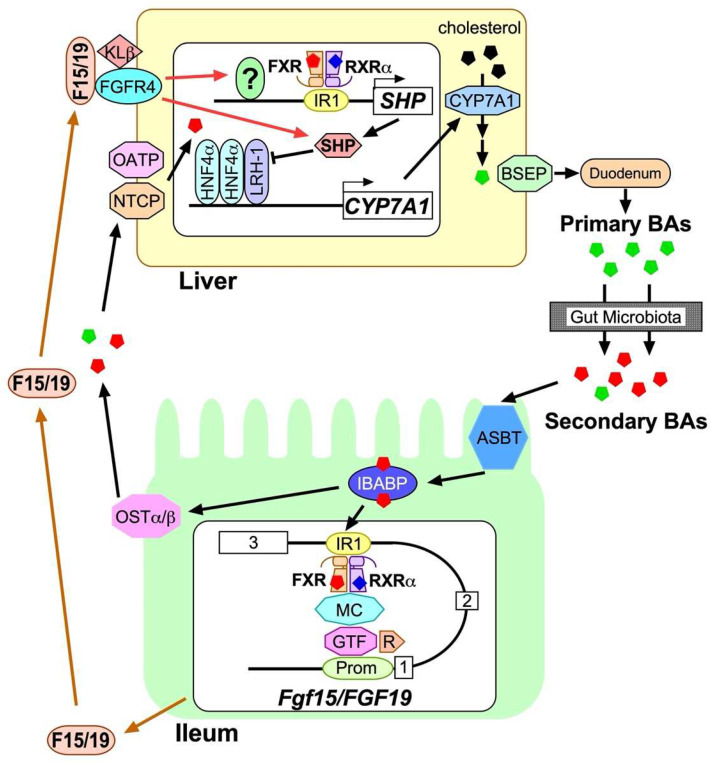
Bile acids (BAs) are a group of amphiphilic molecules consisting of a rigid steroid core attached to a hydroxyl group with a varying number, position, and orientation, and a hydrophilic side chain. While BAs act as detergents to solubilize lipophilic nutrients in the small intestine during digestion and absorption, they also act as hormones. Farnesoid X receptor (FXR) is a nuclear receptor that forms a heterodimer with retinoid X receptor α (RXRα), is activated by BAs in the enterohepatic circulation reabsorbed via transporters in the ileum and the colon, and plays a critical role in regulating gene expression involved in cholesterol, BA, and lipid metabolism in the liver. The FXR/RXRα heterodimer also exists in the distal ileum and regulates production of fibroblast growth factor (FGF) 15/FGF19, a hormone traveling via the enterohepatic circulation that activates hepatic FGF receptor 4 (FGFR4)-β-klotho receptor complex and regulates gene expression involved in cholesterol, BA, and lipid metabolism, as well as those regulating cell proliferation. Agonists for FXR and analogs for FGF15/19 are currently recognized as a promising therapeutic target for metabolic syndrome and cholestatic diseases.
Overview
The claims and statistics of this paper haven’t been checked yet.
Run the check — free, no account needed. It reads the open-access text and checks the sources it cites.
Integrity signals
Registry
Cites
Statistics
Figures
Verification
Claims the paper makes
The claims and statistics of this paper haven’t been checked yet.
Run the check — free, no account needed. It reads the open-access text and checks the sources it cites.
Claims other papers make about this one
Each is checked against this paper’s own text: does it say what the citing paper says it does?
In the citing paper
“these metabolites have emerged as important modulators of the MGB axis, functioning directly via BA receptors in the ENS and brain or indirectly via GLP-1 or the FXR-FGF15/19 axis (297, 319).”
From Signalling cognition: The gut microbiota and hypothalamic-pituitary-adrenal axis (2023) · cites this paper as [319]
Self-check
Percentages, sums and reported differences re-computed from the paper’s own numbers.
The self-check needs the paper’s full text.
Citations
Cites
Bile salt biotransformations by human intestinal bacteria
Ridlon, J. M., Kang, D.-J., & Hylemon, P. B. (2006) · Journal of Lipid Research · doi:10.1194/jlr.r500013-jlr200 · Cited by 2,829
Identification of a nuclear receptor for bile acids
Makishima, M., Okamoto, A. Y., Repa, J. J., Tu, H., Learned, R. M., Luk, A., Hull, M. V., Lustig, K. D., Mangelsdorf, D. J., & Shan, B. (1999) · Science · doi:10.1126/science.284.5418.1362 · Cited by 2,714
Self-citationSayin, S. I., Wahlström, A., Felin, J., Jäntti, S., Marschall, H.-U., Bamberg, K., Angelin, B., Hyötyläinen, T., Orešič, M., & Bäckhed, F. (2013) · Cell Metabolism · doi:10.1016/j.cmet.2013.01.003 · Cited by 2,331
Bile Acids: Natural Ligands for an Orphan Nuclear Receptor
Parks, D. J., Blanchard, S. G., Bledsoe, R. K., Chandra, G., Consler, T. G., Kliewer, S. A., Stimmel, J. B., Willson, T. M., Zavacki, A. M., Moore, D. D., et al. (1999) · Science · doi:10.1126/science.284.5418.1365 · Cited by 2,274
The Enzymes, Regulation, and Genetics of Bile Acid Synthesis
Russell, D. W. (2003) · Annual Review of Biochemistry · doi:10.1146/annurev.biochem.72.121801.161712 · Cited by 2,069
A regulatory cascade of the nuclear receptors FXR, SHP-1, and LRH-1 represses bile acid biosynthesis
Goodwin, B., Jones, S. A., Price, R. R., Watson, M. A., McKee, D. D., Moore, L. B., Galardi, C., Wilson, J. G., Lewis, M. C., Roth, M. E., et al. (2000) · Molecular Cell · doi:10.1016/s1097-2765(00)00051-4 · Cited by 1,940
Fibroblast growth factor 15 functions as an enterohepatic signal to regulate bile acid homeostasis
Inagaki, T., Choi, M., Moschetta, A., Peng, L., Cummins, C. L., McDonald, J. G., Luo, G., Jones, S. A., Goodwin, B., Richardson, J. A., et al. (2005) · Cell Metabolism · doi:10.1016/j.cmet.2005.09.001 · Cited by 1,865
Targeted Disruption of the Nuclear Receptor FXR/BAR Impairs Bile Acid and Lipid Homeostasis
Sinal, C. J., Tohkin, M., Miyata, M., Ward, J. M., Lambert, G., & Gonzalez, F. J. (2000) · Cell · doi:10.1016/s0092-8674(00)00062-3 · Cited by 1,819
Endogenous Bile Acids Are Ligands for the Nuclear Receptor FXR/BAR
Wang, H., Chen, J., Hollister, K., Sowers, L. C., & Forman, B. M. (1999) · Molecular Cell · doi:10.1016/s1097-2765(00)80348-2 · Cited by 1,636
A G Protein-coupled Receptor Responsive to Bile Acids
Kawamata, Y., Fujii, R., Hosoya, M., Harada, M., Yoshida, H., Miwa, M., Fukusumi, S., Habata, Y., Itoh, T., Shintani, Y., et al. (2003) · Journal of Biological Chemistry · doi:10.1074/jbc.m209706200 · Cited by 1,628
Cited by
Sorted by citations
Signalling cognition: The gut microbiota and hypothalamic-pituitary-adrenal axis
Rusch, J. A., Layden, B. T., & Dugas, L. R. (2023) · Frontiers in Endocrinology · doi:10.3389/fendo.2023.1130689 · Cited by 415
Zhou, S., You, H., Qiu, S., Yu, D., Bai, Y., He, J., Cao, H., Che, Q., Guo, J., & Su, Z. (2022) · Biomedicine & Pharmacotherapy · doi:10.1016/j.biopha.2022.113577 · Cited by 71
Yu, Y., Ding, Y., Wang, S., & Jiang, L. (2025) · Metabolites · doi:10.3390/metabo15060397 · Cited by 72
Sedanolide alleviates DSS-induced colitis by modulating the intestinal FXR-SMPD3 pathway in mice
Li, S., Zhuge, A., Chen, H., Han, S., Shen, J. F., Wang, K., Xia, J., He, X., Jiang, S., Wu, Y., et al. (2024) · Journal of Advanced Research · doi:10.1016/j.jare.2024.03.026 · Cited by 51
Connecting the Gut Microbiota and Neurodegenerative Diseases: the Role of Bile Acids
Wang, S., Xu, C., Liu, H., Wei, W., Zhou, X., Qian, H., Zhou, L., Zhang, H., Wu, L. M., Chen, Z., et al. (2023) · Molecular Neurobiology · doi:10.1007/s12035-023-03340-9 · Cited by 51
Metadata
- Authors
- Katafuchi, T., & Makishima, M.
- Affiliations
- Nihon University (JP)
- Corresponding author
- Katafuchi, Takeshi
- Venue
- International Journal of Molecular Sciences
- Publisher
- MDPI AG
- Published
- 2022-05-27
- Volume
- 23
- Issue
- 11
- Pages
- 6046
- ISSN
- 1422-0067 (ISSN-L)
- PMC
- PMC9181207
- OpenAlex
- W4281710331
- Cited by
- 193
- References
- 183
- Citations by year
- 2026: 69 · 2025: 52 · 2024: 38 · 2023: 25 · 2022: 9
- FWCI
- 3.81
- Type
- journal article
- Language
- en
- Open access
- gold
- doi.org
- Licence
- Locations
- International Journal of Molecular Sciences (publishedVersion, cc-by)
- PubMed Central (publishedVersion, cc-by)
- PubMed (publishedVersion)
- Funders
- Japan Society for the Promotion of Science KAKENHI (20K22746)
- Topics
- Health Sciences › Medicine › Oncology › Drug Transport and Resistance Mechanisms
- Life Sciences › Biochemistry, Genetics and Molecular Biology › Molecular Biology › Fibroblast Growth Factor Research
- Life Sciences › Biochemistry, Genetics and Molecular Biology › Biochemistry › Cholesterol and Lipid Metabolism
- Keywords
- bile acids, farnesoid X receptor, FGF receptor 4, β-Klotho, enterohepatic circulation, nuclear receptor signaling, retinoid X receptor alpha, bile acid metabolism, lipid metabolism, cholesterol metabolism, metabolic syndrome, FXR agonists
- MeSH terms
- Bile Acids and Salts, Cholesterol, Fibroblast Growth Factors, Liver, Signal Transduction, Receptors, Cytoplasmic and Nuclear
About these checks
Registry, retraction, Cites and statistics results are computed, not judged, with one exception: a printed reference that no index lists is read once by a model before it counts as a citation error. Claims are extracted by a model and kept only when their quote appears verbatim in the text; each cited source is then checked, with a model’s help, for whether it says what the claim relies on. Those verdicts can be wrong — read the claim’s quote and the cited source before relying on one.
Statistics and arithmetic are recomputed, not judged.
Confidence bands are shown only for fields calibrated on our annotated test set. None is calibrated yet, so no band is shown.
What counts as a claim ›How we measure confidence ›How we check this ›
Are you an author, or do you see a problem with this page? Request a review
