

The DOI matches its Crossref record; 49 of the 51 references it cites were found in a registry or an index; none of the 32 sources its claims cite is checked for support yet.
Predicting Food–Drug Interactions between Piperine and CYP3A4 Substrate Drugs Using PBPK Modeling
Open accessAbstract
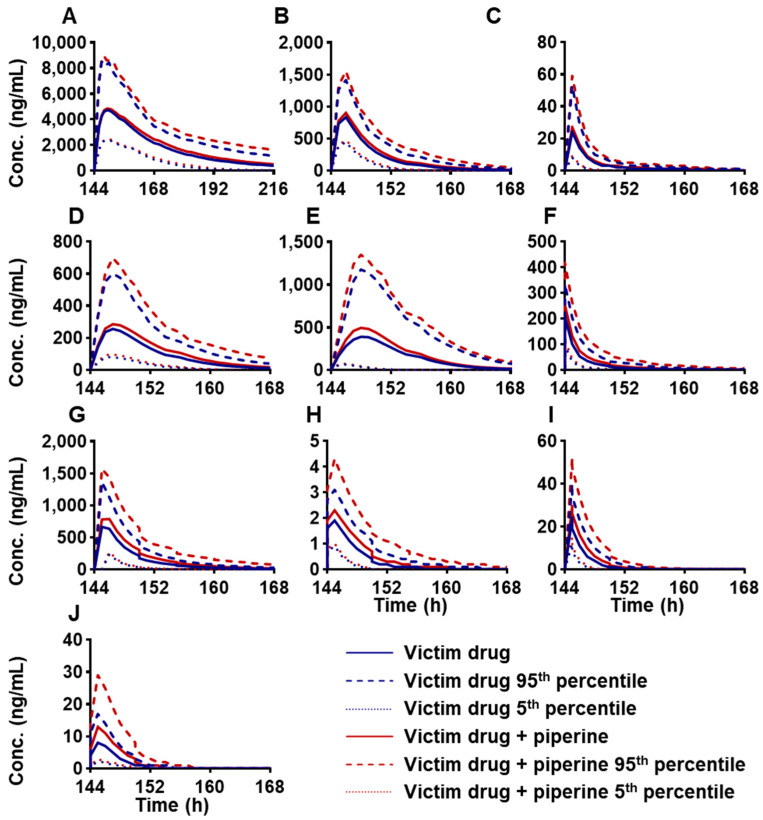
Piperine has been reported to inhibit the enzyme activity of cytochrome P450 (CYP) 3A4. The aim of this study was to develop and validate a physiologically based pharmacokinetic (PBPK) model for piperine and to predict potential food–drug interactions (FDIs) between piperine and CYP3A4 substrate drugs using these models. The PBPK model for piperine was successfully developed and validated. Using this model, FDIs with ten CYP3A4 substrate drugs were simulated. The predicted area under the curve (AUC) ratios (with and without piperine, following a 7-day intake of 20 mg/day) for six drugs were found to exceed 1.25, with significant increases in AUC observed for ritonavir (31%), nifedipine (34%), cyclosporine (35%), triazolam (36%), alfentanil (39%), and simvastatin (59%) in humans. These findings suggest that caution should be exercised when consuming amounts of black pepper equivalent to a daily intake of 20 mg piperine during treatment with CYP3A4 substrate drugs, as it may significantly alter their pharmacokinetics.
Overview
CoChat Summary
TL;DR
A PBPK model for piperine was developed and validated in Simcyp and used to simulate food–drug interactions with 10 CYP3A4 substrate drugs. After simulated 7-day intake of 20 mg/day piperine, six drugs had predicted AUC ratios ≥1.25, with the largest AUC increase for simvastatin (59%).
Key findings
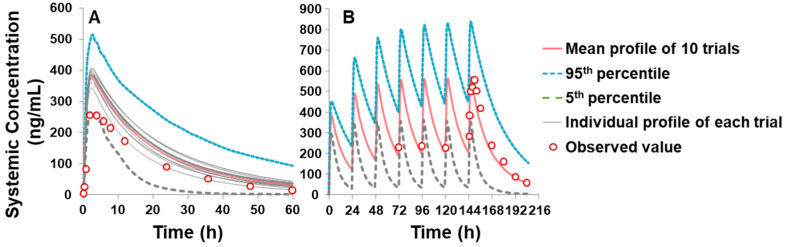
- The piperine PBPK model was validated against clinical data: predicted-to-observed fold-error was 1.3 for Cmax and 1.4 for AUClast after a single 20 mg dose, and 1.0 and 1.1 after 20 mg/day for 7 days, all within the two-fold acceptance range.
- Simulated piperine co-administration increased AUC for carbamazepine (11%), clarithromycin (17%), midazolam (20%), itraconazole (24%), ritonavir (31%), nifedipine (34%), cyclosporine (35%), triazolam (36%), alfentanil (39%), and simvastatin (59%).
- Predicted AUC ratios with versus without piperine were ≥1.25 for ritonavir (1.31), nifedipine (1.34), cyclosporine (1.35), triazolam (1.36), alfentanil (1.39), and simvastatin (1.59).
- The paper concludes caution is warranted for consuming black pepper equivalent to 20 mg/day piperine during treatment with CYP3A4 substrate drugs, especially narrow therapeutic index drugs such as alfentanil and cyclosporine.
Methods
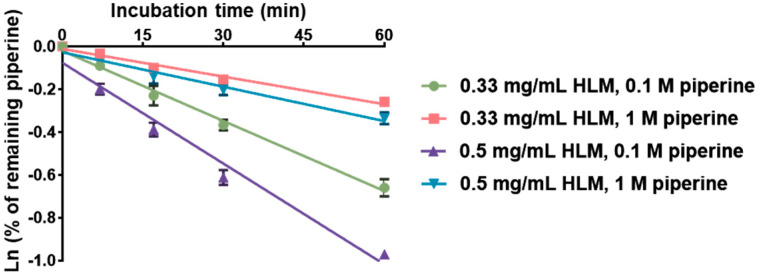
- In vitro intrinsic clearance of piperine was measured in human liver microsomes using LC-MS/MS; in-house CLint values ranged from 10.6 ± 0.9 to 34.0 ± 1.3 μL/min/mg protein across tested HLM and piperine concentrations.
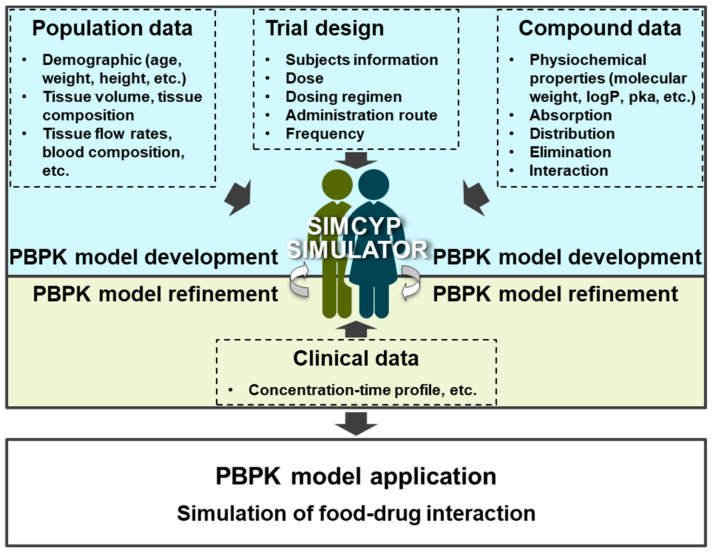
- PBPK modeling used Simcyp Version 18 with the ADAM absorption model, Rodgers and Rowland Method 2 for Vss, and whole-organ metabolic clearance with an average CLint of 24.2 μL/min/mg protein; interaction parameters included Kapp 6.74 μM, kinact 0.558 1/h, and fumic 0.863.
- The model was validated against published clinical piperine data after single-dose 20 mg and multiple-dose 20 mg/day for 7 days in Chinese healthy volunteers; simulations used a virtual population of 100 subjects (10 trials × 10 subjects), and interaction simulations used Simcyp built-in models for 10 CYP3A4 substrate drugs with or without 20 mg/day piperine for 7 days.
Limitations
- Stated: metabolic clearance was calculated using the whole-organ metabolic clearance approach due to the absence of clinical data, and the authors note PBPK models should be updated with new mechanistic insights such as enzyme or transporter inhibition or induction.
- Stated/evident: the food–drug interaction findings are simulation-based; for drugs with predicted AUC ratio ≥1.25, the paper states that a clinical interaction study should be conducted, so clinical FDI confirmation was not performed in this study.
- Evident: the paper attributes high SEMs in the interaction results to inter-individual variability and CYP3A4 polymorphism in the virtual population (CV 41% for enzyme abundance and 68% for turnover rate), and the simulations used a limited virtual population of 100 subjects and only 10 CYP3A4 substrate drugs.
Model-written summary. Check it against the paper before relying on it.
Integrity signals
Registry
Cites
Statistics
Figures
Verification
Claims the paper makes
0 Valid · 0 Not valid · 19 Not checked · 30 Own results and interpretations
A result the paper reports from its own data — it cites no other source for it, so there is none to check. The quote shows it is in the paper.
In the paper
“Piperine was found to increase the AUC of carbamazepine, clarithromycin, midazolam, itraconazole, ritonavir, nifedipine, cyclosporine, triazolam, alfentanil, and simvastatin by 11%, 17%, 20%, 24%, 31%, 34%, 35%, 36%, 39%, and 59%, respectively”
§ Predicting Food–Drug Interactions between Piperine and CYP3A4 Substrate Drugs Using PBPK Modeling > 2. Results > 2.3. PBPK Prediction for Piperine–Drug Interaction
plainstates a cause- Asserted: passes — The authors put it forward as true.
- Checkable: passes — It can be checked against evidence.
- Load-bearing: unclear — It is unclear whether the paper’s conclusions depend on it.
- Based: passes — The paper gives a reason why it holds.
A result the paper reports from its own data — it cites no other source for it, so there is none to check. The quote shows it is in the paper.
In the paper
“Piperine was found to increase the AUC of carbamazepine, clarithromycin, midazolam, itraconazole, ritonavir, nifedipine, cyclosporine, triazolam, alfentanil, and simvastatin by 11%, 17%, 20%, 24%, 31%, 34%, 35%, 36%, 39%, and 59%, respectively”
§ Predicting Food–Drug Interactions between Piperine and CYP3A4 Substrate Drugs Using PBPK Modeling > 2. Results > 2.3. PBPK Prediction for Piperine–Drug Interaction
plainstates a cause- Asserted: passes — The authors put it forward as true.
- Checkable: passes — It can be checked against evidence.
- Load-bearing: passes — The paper’s conclusions depend on it.
- Based: passes — The paper gives a reason why it holds.
A result the paper reports from its own data — it cites no other source for it, so there is none to check. The quote shows it is in the paper.
In the paper
“Piperine was found to increase the AUC of carbamazepine, clarithromycin, midazolam, itraconazole, ritonavir, nifedipine, cyclosporine, triazolam, alfentanil, and simvastatin by 11%, 17%, 20%, 24%, 31%, 34%, 35%, 36%, 39%, and 59%, respectively”
- Also stated in: § 2.3. PBPK Prediction for Piperine–Drug Interaction · plain
“The predicted AUC ratio of ritonavir, nifedipine, cyclosporine, triazolam, alfentanil, and simvastatin in the presence versus absence of piperine (following 7 consecutive days of administration) was ≥1.25, with respective ratios of 1.31, 1.34, 1.35, 1.36, 1.39, and 1.59.”
§ Predicting Food–Drug Interactions between Piperine and CYP3A4 Substrate Drugs Using PBPK Modeling > 2. Results > 2.3. PBPK Prediction for Piperine–Drug Interaction
plainstates a cause- Asserted: passes — The authors put it forward as true.
- Checkable: passes — It can be checked against evidence.
- Load-bearing: passes — The paper’s conclusions depend on it.
- Based: passes — The paper gives a reason why it holds.
- Also stated in: § 2.3. PBPK Prediction for Piperine–Drug Interaction · plain
A result the paper reports from its own data — it cites no other source for it, so there is none to check. The quote shows it is in the paper.
In the paper
“Piperine was found to increase the AUC of carbamazepine, clarithromycin, midazolam, itraconazole, ritonavir, nifedipine, cyclosporine, triazolam, alfentanil, and simvastatin by 11%, 17%, 20%, 24%, 31%, 34%, 35%, 36%, 39%, and 59%, respectively”
§ Predicting Food–Drug Interactions between Piperine and CYP3A4 Substrate Drugs Using PBPK Modeling > 2. Results > 2.3. PBPK Prediction for Piperine–Drug Interaction
plainstates a cause- Asserted: passes — The authors put it forward as true.
- Checkable: passes — It can be checked against evidence.
- Load-bearing: passes — The paper’s conclusions depend on it.
- Based: passes — The paper gives a reason why it holds.
A result the paper reports from its own data — it cites no other source for it, so there is none to check. The quote shows it is in the paper.
In the paper
“Piperine was found to increase the AUC of carbamazepine, clarithromycin, midazolam, itraconazole, ritonavir, nifedipine, cyclosporine, triazolam, alfentanil, and simvastatin by 11%, 17%, 20%, 24%, 31%, 34%, 35%, 36%, 39%, and 59%, respectively”
§ Predicting Food–Drug Interactions between Piperine and CYP3A4 Substrate Drugs Using PBPK Modeling > 2. Results > 2.3. PBPK Prediction for Piperine–Drug Interaction
plainstates a cause- Asserted: passes — The authors put it forward as true.
- Checkable: passes — It can be checked against evidence.
- Load-bearing: unclear — It is unclear whether the paper’s conclusions depend on it.
- Based: passes — The paper gives a reason why it holds.
27 more claims
Create a free account to see all 49 claims and to verify the 31 references still open.
- It may state two separate claims as one. 12
- The quote only partly states this claim. 2
- Probably not a substantial claim. 6
Citations
Cites
Influence of piperine on the pharmacokinetics of curcumin in animals and human volunteers
Shoba, G., Joy, D., Joseph, T., Majeed, M., Rajendran, R., & Srinivas, P. (1998) · Planta Medica · doi:10.1055/s-2006-957450 · Cited by 1,656
Rodgers, T., & Rowland, M. (2006) · Journal of Pharmaceutical Sciences · doi:10.1002/jps.20502 · Cited by 969
Rodgers, T., Leahy, D., & Rowland, M. (2005) · Journal of Pharmaceutical Sciences · doi:10.1002/jps.20322 · Cited by 776
Lown, K. S., Bailey, D. G., Fontana, R. J., Janardan, S. K., Adair, C. H., Fortlage, L. A., Brown, M. B., Guo, W., & Watkins, P. B. (1997) · Journal of Clinical Investigation · doi:10.1172/jci119439 · Cited by 624
Population-Based Mechanistic Prediction of Oral Drug Absorption
Jamei, M., Turner, D., Yang, J., Neuhoff, S., Polak, S., Rostami-Hodjegan, A., & Tucker, G. (2009) · The AAPS Journal · doi:10.1208/s12248-009-9099-y · Cited by 452
Piperine, a major constituent of black pepper, inhibits human P-glycoprotein and CYP3A4
Bhardwaj, R. K., Glaeser, H., Becquemont, L., Klotz, U., Gupta, S. K., & Fromm, M. F. (2002) · The Journal of Pharmacology and Experimental Therapeutics · doi:10.1124/jpet.102.034728 · Cited by 444
Piperine—The Bioactive Compound of Black Pepper: From Isolation to Medicinal Formulations
Gorgani, L., Mohammadi, M., Najafpour, G. D., & Nikzad, M. (2016) · Comprehensive Reviews in Food Science and Food Safety · doi:10.1111/1541-4337.12246 · Cited by 416
Effect of St John's Wort on Drug Metabolism by Induction of Cytochrome P450 3A4 Enzyme
Markowitz, J. S. (2003) · JAMA · doi:10.1001/jama.290.11.1500 · Cited by 403
Interaction between grapefruit juice and midazolam in humans*
Kupferschmidt, H., Ha, H. R., Ziegler, W. H., Meier, P. J., & Krähenbühl, S. (1995) · Clinical Pharmacology & Therapeutics · doi:10.1016/0009-9236(95)90068-3 · Cited by 362
Hollenberg, P. F., Edwards, D. J., He, K., Fitzsimmons, M. E., Fisher, J. M., Rahman, A., Thummel, K. E., Lown, K. S., Woster, P. M., Schmiedlin‐Ren, P., et al. (2019) · PubMed · doi:10.17615/k2j5-jx75 · Cited by 349
Disposition of intravenous and oral cyclosporine after administration with grapefruit juice*
Ducharme, M. P., Warbasse, L. H., & Edwards, D. J. (1995) · Clinical Pharmacology & Therapeutics · doi:10.1016/0009-9236(95)90032-2 · Cited by 347
(2001) · PubMed · Cited by 316
Berezhkovskiy, L. M. (2004) · Journal of Pharmaceutical Sciences · doi:10.1002/jps.20073 · Cited by 296
The impact of social determinants on cardiovascular disease
Kreatsoulas, C., & Anand, S. S. (2010) · Canadian Journal of Cardiology · doi:10.1016/s0828-282x(10)71075-8 · Cited by 275
The effects of St John's wort (Hypericum perforatum) on human cytochrome P450 activity
Wang, Z., Gorski, J. C., Hamman, M. A., Huang, S. M., Lesko, L. J., & Hall, S. D. (2001) · Clinical Pharmacology & Therapeutics · doi:10.1067/mcp.2001.118522 · Cited by 273
Volak, L. P., Ghirmai, S., Cashman, J. R., & Court, M. H. (2008) · Drug Metabolism and Disposition · doi:10.1124/dmd.108.020552 · Cited by 214
Bauer, S., Störmer, E., Johne, A., Krüger, H., Budde, K., Neumayer, H.-H., Roots, I., & Mai, I. (2003) · British Journal of Clinical Pharmacology · doi:10.1046/j.1365-2125.2003.01759.x · Cited by 187
Eagling, Profit, & Back (1999) · British Journal of Clinical Pharmacology · doi:10.1046/j.1365-2125.1999.00052.x · Cited by 181
Atal, C. K., Dubey, R. K., & Singh, J. (1985) · The Journal of Pharmacology and Experimental Therapeutics · doi:10.1016/s0022-3565(25)20081-7 · Cited by 180
Johne, A., Schmider, J., Brockmöller, J., Stadelmann, A. M., Störmer, E., Bauer, S., Scholler, G., Langheinrich, M., & Roots, I. (2002) · Journal of Clinical Psychopharmacology · doi:10.1097/00004714-200202000-00008 · Cited by 172
Abduljalil, K., Cain, T., Humphries, H., & Rostami‐Hodjegan, A. (2014) · Drug Metabolism and Disposition · doi:10.1124/dmd.114.058099 · Cited by 152
Phytochemical and pharmacological attributes of piperine: A bioactive ingredient of black pepper
Shityakov, S., Bigdelian, E., Hussein, A. A., Hussain, M. B., Tripathi, Y. C., Khan, M. U., & Shariati, M. A. (2019) · European Journal of Medicinal Chemistry · doi:10.1016/j.ejmech.2019.04.002 · Cited by 148
Gertz, M., Houston, J. B., & Galetin, A. (2011) · Drug Metabolism and Disposition · doi:10.1124/dmd.111.039248 · Cited by 139
The effect of St John’s wort extracts on CYP3A: a systematic review of prospective clinical trials
Whitten, D. L., Myers, S. P., Hawrelak, J. A., & Wohlmuth, H. (2006) · British Journal of Clinical Pharmacology · doi:10.1111/j.1365-2125.2006.02755.x · Cited by 120
Zhou, W., Johnson, T., Xu, H., Cheung, S., Bui, K., Li, J., Al-Huniti, N. H., & Zhou, D. (2016) · CPT Pharmacometrics & Systems Pharmacology · doi:10.1002/psp4.12101 · Cited by 93
Application of PBPK modelling in drug discovery and development at Pfizer
Jones, H. M., Dickins, M., Youdim, K., Gosset, J. R., Attkins, N. J., Hay, T. L., Gurrell, I. K., Logan, Y. R., Bungay, P. J., Jones, B. C., et al. (2012) · Xenobiotica · doi:10.3109/00498254.2011.627477 · Cited by 92
Khalil, F., & Läer, S. (2014) · The AAPS Journal · doi:10.1208/s12248-013-9555-6 · Cited by 74
Tubic-Grozdanis, M., Hilfinger, J. M., Amidon, G. L., Kim, J. S., Kijek, P., Staubach, P., & Langguth, P. (2008) · Pharmaceutical Research · doi:10.1007/s11095-007-9519-6 · Cited by 73
Li, G.-F., Wang, K., Chen, R., Zhao, H.-R., Yang, J., & Zheng, Q.-S. (2012) · Acta Pharmacologica Sinica · doi:10.1038/aps.2012.103 · Cited by 68
Grundy, S. M., & Stone, N. J. (2019) · JAMA Cardiology · doi:10.1001/jamacardio.2019.0777 · Cited by 68
Prospective Predictions of Human Pharmacokinetics for Eighteen Compounds
Zhang, T., Heimbach, T., Lin, W., Zhang, J., & He, H. (2015) · Journal of Pharmaceutical Sciences · doi:10.1002/jps.24373 · Cited by 56
Rasool, M. F., Khalil, F., & Läer, S. (2015) · Clinical Pharmacokinetics · doi:10.1007/s40262-015-0253-7 · Cited by 55
Soliman, M. E. S., Adewumi, A. T., Akawa, O. B., Subair, T. I., Okunlola, F. O., Akinsuku, O. E., & Khan, S. (2022) · AAPS PharmSciTech · doi:10.1208/s12249-022-02229-5 · Cited by 50
Ren, T., Wang, Q., Li, C., Yang, M., & Zuo, Z. (2017) · Xenobiotica · doi:10.1080/00498254.2017.1405293 · Cited by 48
Rasool, M. F., Ali, S., Khalid, S., Khalid, R., Majeed, A., Imran, I., Saeed, H., Usman, M., Ali, M., Alali, A. S., et al. (2021) · Scientific Reports · doi:10.1038/s41598-021-88154-2 · Cited by 44
Induction of imatinib metabolism by hypericum perforatum
Smith, P. F., Bullock, J. M., Booker, B. M., Haas, C. E., Berenson, C. S., & Jusko, W. J. (2004) · Blood · doi:10.1182/blood-2004-04-1240 · Cited by 41
Rodgers, T., & Rowland, M. (2007) · Journal of Pharmaceutical Sciences · doi:10.1002/jps.20857 · Cited by 33
Black Pepper: Overview of Health Benefits
Singletary, K. W. (2010) · Nutrition Today · doi:10.1097/nt.0b013e3181cb4539 · Cited by 31
Rezaee, M. M., Kazemi, S., Kazemi, M. T., Gharooee, S., Yazdani, E., Gharooee, H., Shiran, M. R., & Moghadamnia, A. A. (2014) · DARU Journal of Pharmaceutical Sciences · doi:10.1186/2008-2231-22-8 · Cited by 31
Ince, I., Dallmann, A., Frechen, S., Coboeken, K., Niederalt, C., Wendl, T., Block, M. S., Meyer, M. C., Eißing, T., Burghaus, R., et al. (2021) · The Journal of Clinical Pharmacology · doi:10.1002/jcph.1869 · Cited by 26
Rasool, M. F., Khalil, F., & Läer, S. (2016) · Drug Metabolism and Disposition · doi:10.1124/dmd.115.068858 · Cited by 19
Time-dependent inhibition of carbamazepine metabolism by piperine in anti-epileptic treatment
Ren, T., Yang, M., Xiao, M., Zhu, J., Xie, W., & Zuo, Z. (2019) · Life Sciences · doi:10.1016/j.lfs.2018.12.060 · Cited by 17
Khalid, S., Rasool, M. F., Imran, I., Majeed, A., Saeed, H., Rehman, A. U., Ashraf, W., Ahmad, T., Bin Jardan, Y. A., & Alqahtani, F. (2021) · Pharmaceutics · doi:10.3390/pharmaceutics13091480 · Cited by 17
Wang, X., Chen, F., Guo, N., Gu, Z., Lin, H., Xiang, X., Shi, Y., & Han, B. (2023) · Cancer Chemotherapy and Pharmacology · doi:10.1007/s00280-023-04566-z · Cited by 15
Zabela, V., Hettich, T., Schlotterbeck, G., Wimmer, L., Mihovilovic, M. D., Guillet, F., Bouaita, B., Shevchenko, B., Hamburger, M., & Oufir, M. (2018) · Journal of Chromatography B · doi:10.1016/j.jchromb.2017.11.036 · Cited by 10
Effect of Piperine on the Metabolism and Pharmacokinetics of Carbamazepine in Healthy Volunteers
Bedada, S., Appani, R., & Boga, P. (2016) · Drug Research · doi:10.1055/s-0042-118173 · Cited by 7
Ding, Z., & Wang, Z. (2014) · PubMed · Cited by 1
Li-ping, G., Xing, D., Li-ya, L., Tang, M.-H., & Wan, L. (2019) · Tianran chanwu yanjiu yu kaifa · doi:10.16333/j.1001-6880.2019.2.006 · Cited by 1
(1991) · PubMed
Research works printed but not linked: 4
- Linke, 2017, Physiologically based pharmacokinetic (PBPK) modeling to predict human internal exposure to industrial chemicals—an evaluation and case study using the simulation software GastroPlus™, Naunyn-Schmiedebergs Arch. Pharmacol., 390, S82
- (2024, March 02). FDA Public Workshop ‘Development of Best Practices in Physiologically Based Pharmacokinetic Modeling to Support Clinical Pharmacology Regulatory DecisionMaking’, Available online: https://www.fda.gov/drugs/news-events-human-drugs/development-best-practices-physiologically-based-pharmacokinetic-modeling-support-clinical.
- Fu, J.W. (2013). Preparation, Characterization and Evaluation of Compound Curcumin Encapculating in Cubic Liquid Crystalline Nanoparticles. [Ph.D. Thesis, Guangzhou University of Chinese Medicine].
- Wang, 2010, Pharmacokinetics of piperine capsules in healthy volunters, Cent. South Pharm., 8, 513
Cited by
In Silico ADME Methods Used in the Evaluation of Natural Products
Ancuceanu, R., Lascu, B. E., Drăgănescu, D., & Dinu, M. (2025) · Pharmaceutics · doi:10.3390/pharmaceutics17081002 · Cited by 83
Chou, P. J., Shannar, A., Pan, Y., Dave, P. D., Xu, J., & Kong, A. T. (2025) · Current Pharmacology Reports · doi:10.1007/s40495-025-00427-w · Cited by 36
Metabolic Insights into Drug Absorption: Unveiling Piperine's Transformative Bioenhancing Potential
Tripathi, D., Gupta, V. K., Pandey, P. K., & Rajinikanth, P. S. (2025) · Pharmaceutical Research · doi:10.1007/s11095-025-03920-5 · Cited by 24
Effect of food components on cytochrome P450 expression and activity
Sang, R., Jiang, W., Zhang, C., Yin, R., Ouyang, Z., & Wei, Y. (2025) · Human Nutrition & Metabolism · doi:10.1016/j.hnm.2025.200304 · Cited by 14
The Hidden Power of Black Pepper: Exploring Piperine’s Role in Cancer
Cinar, E. N., & Şanlıer, N. (2025) · Plant Foods for Human Nutrition · doi:10.1007/s11130-025-01374-z · Cited by 12
Metadata
- Authors
- Lin, F., Hu, Y., Zhang, Y., Zhao, L., Zhong, D., & Liu, J.
- Affiliations
- Chinese Academy of Sciences (CN)
- Corresponding author
- Liu, Jia
- Venue
- International Journal of Molecular Sciences
- Publisher
- MDPI AG
- Published
- 2024-10-11
- Volume
- 25
- Issue
- 20
- Pages
- 10955
- ISSN
- 1422-0067 (ISSN-L)
- PMC
- PMC11506926
- OpenAlex
- W4403318846
- Cited by
- 20
- References
- 51
- Citations by year
- 2026: 13 · 2025: 6 · 2024: 1
- FWCI
- 4.63
- Type
- journal article
- Language
- en
- Open access
- gold
- doi.org
- Licence
- Locations
- International Journal of Molecular Sciences (publishedVersion, cc-by)
- PubMed Central (publishedVersion, cc-by)
- PubMed (publishedVersion)
- Topics
- Life Sciences › Pharmacology, Toxicology and Pharmaceutics › Pharmacology › Piperaceae Chemical and Biological Studies
- Life Sciences › Pharmacology, Toxicology and Pharmaceutics › Pharmacology › Pharmacogenetics and Drug Metabolism
- Health Sciences › Medicine › Oncology › Drug Transport and Resistance Mechanisms
- Keywords
- piperine, food-drug interactions, CYP3A4 inhibition, cytochrome P450, black pepper, physiologically based pharmacokinetic modeling, ritonavir, nifedipine, cyclosporine, triazolam, alfentanil, simvastatin, drug-drug interactions, pharmacokinetic simulation
- MeSH terms
- Alkaloids, Humans, Models, Biological, Nifedipine, Piperidines, Triazolam, Alfentanil, Food-Drug Interactions, Area Under Curve, Simvastatin, Cytochrome P-450 CYP3A, Benzodioxoles, Polyunsaturated Alkamides, Cytochrome P-450 CYP3A Inhibitors
About these checks
Registry, retraction, Cites and statistics results are computed, not judged, with one exception: a printed reference that no index lists is read once by a model before it counts as a citation error. Claims are extracted by a model and kept only when their quote appears verbatim in the text; each cited source is then checked, with a model’s help, for whether it says what the claim relies on. Those verdicts can be wrong — read the claim’s quote and the cited source before relying on one.
A language model drew the claims from the paper on 2026-11-14, under version 3 of the claim definition (model deepseek-v4.1-flash, prompt extract-v3).
A second model labelled each claim on 2026-11-14 (model jev-1.13-20260917, definition revision gold-guideline-v0.2).
Statistics and arithmetic are recomputed, not judged.
Confidence bands are shown only for fields calibrated on our annotated test set. None is calibrated yet, so no band is shown.
What counts as a claim ›How we measure confidence ›How we check this ›
Are you an author, or do you see a problem with this page? Request a review
Data sources
Bibliographic data: Semantic Scholar, OpenAlex, Crossref.
Contains information from the Semantic Scholar Academic Graph Datasets, made available under the ODC Attribution License (ODC-BY 1.0).
Semantic Scholar’s data is described in: Kinney, R., et al. (2023). The Semantic Scholar Open Data Platform. arXiv:2301.10140.
