

Effectiveness of Extracellular Vesicle Application in Skin Aging Treatment and Regeneration: Do We Have Enough Evidence from Clinical Trials?
Open accessThe DOI matches its Crossref record; 75 of the 75 references it cites were found in a registry or an index.
Abstract
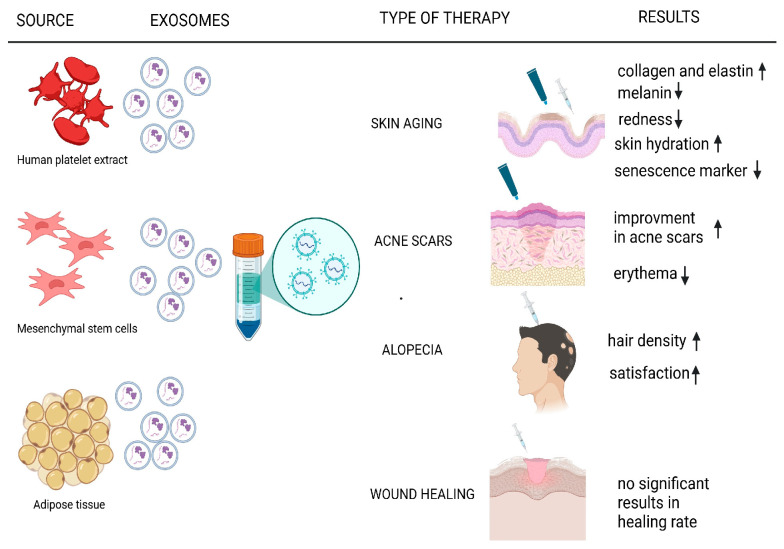
In recent years, there has been a dynamic development in therapies utilizing extracellular vesicles (EVs) including exosomes. Therefore, we have conducted an analysis of the scientific literature to verify the current state of knowledge about these therapies. A total of 12 clinical studies were analyzed, covering the use of EVs in treating skin aging, acne scars, alopecia, and wound healing. The results indicate that EVs and exosomes hold potential in regenerative skin therapies, offering innovative and non-invasive therapeutic approaches. At the same time, significant challenges related to the standardization of their production and the lack of large-scale randomized studies were identified. Thus, we also evaluated the investigated clinical trials in regard to the MISEV (Minimal Information for Studies of Extracellular Vesicles) criteria. This review provides a comprehensive overview of the contemporary applications of EVs in skin therapy and regenerative medicine, highlighting directions for further research.
Overview
The claims and statistics of this paper haven’t been checked yet.
Free: it reads the open-access text and checks the first 5 claims that cite a source we can check. Create a free account to check every claim.
Integrity signals
Registry
Cites
Statistics
Figures
Verification
Claims the paper makes
The claims and statistics of this paper haven’t been checked yet.
Free: it reads the open-access text and checks the first 5 claims that cite a source we can check. Create a free account to check every claim.
Claims other papers make about this one
Each is checked against this paper’s own text: does it say what the citing paper says it does?
The source backs part of the claim, not all of it — or backs it for a different population, condition or comparison.
In the citing paper
“There has already been evidence in the literature on plant-derived EVs that indicates their ability to deliver bioactive cargo and cargo packaged within, which can influence multiple skin health pathways simultaneously, including melanogenesis and skin extracellular matrix maintenance [9,10,21].”
From A 28-Day Pilot Study of the Effects on Facial Skin Hydration, Elasticity, and Texture of a Centella asiatica Extracellular Vesicle-Based Skin Care Formulation (2025) · cites this paper as [10]
Experimental — accuracy not yet measuredThe check wasn’t confident either way, so it gives no verdict — never disputed.
In the citing paper
“In other studies, Cica EV was shown to contain novel miRNAs and downregulate melanogenesis-related and inflammation genes, providing a plausible explanation for the pigmentation and redness reduction recorded in this clinical study [9,10,13].”
From A 28-Day Pilot Study of the Effects on Facial Skin Hydration, Elasticity, and Texture of a Centella asiatica Extracellular Vesicle-Based Skin Care Formulation (2025) · cites this paper as [10]
Experimental — accuracy not yet measured
Self-check
Percentages, sums and reported differences re-computed from the paper’s own numbers.
The self-check needs the paper’s full text.
Citations
Cites
Hallmarks of aging: An expanding universe
López-Otín, C., Blasco, M. A., Partridge, L., Serrano, M., & Kroemer, G. (2023) · Cell · doi:10.1016/j.cell.2022.11.001 · Cited by 6,549 · cited 1×
“López-Otín et al. outline the key hallmarks of aging, including genomic instability, telomere attrition, epigenetic alterations, and loss of proteostasis, while discussing emerging relevant treatment strategies [55].”
Biogenesis, Secretion, and Intercellular Interactions of Exosomes and Other Extracellular Vesicles
Colombo, M., Raposo, G., & Théry, C. (2014) · Annual Review of Cell and Developmental Biology · doi:10.1146/annurev-cellbio-101512-122326 · Cited by 6,186 · cited 1×
“Their lipid bilayer structure enables the efficient transport of bioactive molecules—proteins, RNA, microRNA, lipids, and DNA—to target cells over long distances without degradation, even in enzyme-rich environments such as blood and urine [30,31].”
Welsh, J. A., Goberdhan, D. C. I., O'Driscoll, L., Buzas, E. I., Blenkiron, C., Bussolati, B., Cai, H., Di Vizio, D., Driedonks, T. A. P., Erdbrügger, U., et al. (2024) · Journal of Extracellular Vesicles · doi:10.1002/jev2.12404 · Cited by 4,663 · cited 2×
“The term “exosome” specifically refers to those EVs that arise from the endosomal network, distinguishing them from other types of EVs arising from different cellular processes [25,27].”
InfluentialInflammaging: a new immune–metabolic viewpoint for age-related diseases
Franceschi, C., Garagnani, P., Parini, P., Giuliani, C., & Santoro, A. (2018) · Nature Reviews Endocrinology · doi:10.1038/s41574-018-0059-4 · Cited by 3,586 · cited 1×
“As a result, features of inflammaging, a chronic, low-grade inflammatory state associated with aging, become evident, along with dermal remodeling and the progression of changes leading to wrinkle formation, loss of firmness, and hyperpigmentation [13].”
Communication by Extracellular Vesicles: Where We Are and Where We Need to Go
Tkach, M., & Théry, C. (2016) · Cell · doi:10.1016/j.cell.2016.01.043 · Cited by 3,444 · cited 1×
“EVs are lipid-bilayer-enclosed particles released from all living cells [24].”
Exosomes: biogenesis, biologic function and clinical potential
Zhang, Y., Liu, Y., Liu, H., & Tang, W. H. (2019) · Cell & Bioscience · doi:10.1186/s13578-019-0282-2 · Cited by 2,119 · cited 2×
“This capacity to deliver bioactive compounds through enzyme-rich fluids makes them particularly suited for therapeutic applications, allowing them to reach tissues that are otherwise difficult to access [32,33].”
The exosome journey: from biogenesis to uptake and intracellular signalling
Gurung, S., Perocheau, D., Touramanidou, L., & Baruteau, J. (2021) · Cell Communication and Signaling · doi:10.1186/s12964-021-00730-1 · Cited by 1,791 · cited 1×
“Both exosomes [28] and EVs more generally [29] play a critical role in intercellular communication.”
The vitamin D deficiency pandemic: Approaches for diagnosis, treatment and prevention
Holick, M. F. (2017) · Reviews in Endocrine and Metabolic Disorders · doi:10.1007/s11154-017-9424-1 · Cited by 1,511 · cited 1×
“On one hand, controlled UVR exposure is essential for vitamin D synthesis, which plays a crucial role in calcium homeostasis, immune regulation, and overall skin health, among others [15].”
Zhang, Y., Bi, J., Huang, J., Tang, Y., Du, S., & Li, P. (2020) · International Journal of Nanomedicine · doi:10.2147/ijn.s264498 · Cited by 1,323 · cited 1×
“Future research should focus on optimizing exosome production and storage methods to ensure their efficacy and safety [77].”
The roles of extracellular vesicles in the immune system
Buzas, E. I. (2023) · Nature Reviews Immunology · doi:10.1038/s41577-022-00763-8 · Cited by 1,220 · cited 1×
“In this context, extracellular vesicles (EVs) playing a crucial role in cell-to-cell signaling deserve special attention [22,23].”
Cited by
Ganesan, O., Kiwanuka, H., Hamaguchi, R., & Orgill, D. P. (2025) · Frontiers in Surgery · doi:10.3389/fsurg.2025.1504563 · Cited by 26
Exosomes in aging and age-related disorders: mechanisms, therapeutic potentials, and challenges
Safaei, S., Sohrabi, S., Zahmatkesh, P., Soltani‐Zangbar, M. S., & Maleki, L. A. (2025) · Journal of Translational Medicine · doi:10.1186/s12967-025-07379-1 · Cited by 19
“In contrast, exosomes derived from youthful, healthy cells exhibit potent anti-aging properties [28].”
Park, H. S., & Shin, S. (2025) · Cosmetics · doi:10.3390/cosmetics12040135 · Cited by 11
Harnessing Regenerative Science in Aesthetic Surgery: The Biologically Driven Future
Olivas, C. G., Shauly, O., Hutchison, D. M., & Gould, D. J. (2025) · Journal of Clinical Medicine · doi:10.3390/jcm14176205 · Cited by 11
“Additionally, regulatory oversight is still evolving [84].”
Koumprentziotis, I., Kroumpouzos, E., Delavar, S., & Kroumpouzos, G. (2025) · Clinics in Dermatology · doi:10.1016/j.clindermatol.2025.07.006 · Cited by 8
Chang, T.-M., Wu, C.-C., Huang, H.-C., Lu, J.-Y., Chuang, C.-H., Kao, P.-L., Tang, W.-H., Liu, L. T.-C., Qiu, W.-Y., Percec, I., et al. (2025) · Cosmetics · doi:10.3390/cosmetics12050186 · Cited by 7
Li, D., An, T., Wang, N., Ma, F., Tuo, L., He, N., Song, H., & Liu, Q. (2025) · Extracellular Vesicle · doi:10.1016/j.vesic.2025.100088 · Cited by 9
Exosome-Based Therapeutics in Dermatology and Beyond: A Narrative Review
Pham, G. M.-T. (2026) · Biomedicines · doi:10.3390/biomedicines14020338 · Cited by 8
“In osteoarticular and peri-tendinous tissues, mesenchymal and stromal cell vesicles deliver similar paracrine cues to chondrocytes, synoviocytes, and tenocytes, helping to maintain joint integrity and guide repair after damage [2].”
Kang, H., Kim, J., Cho, Y., Go, D., Park, J., Kim, H., & Park, S. (2025) · Journal of Cosmetic Dermatology · doi:10.1111/jocd.70574 · Cited by 5
Exosomes in precision dermatology: From biomarkers to targeted therapeutics in personalized care
Moslehi, D., Nahm, W. J., Serwald, G., Bigham, Z., & Nambudiri, V. E. (2026) · Journal of the European Academy of Dermatology and Venereology · doi:10.1111/jdv.70387 · Cited by 6
“Domaszweksa-Szotek et al. 65 identified only 12 clinical studies evaluating exosome or EV therapies across dermatologic and aesthetic indications, concluding that encouraging early results must be interpreted cautiously, given small sample sizes and lack of standardized endpoints.”
New generation of clinical epigenetics analysis and diagnosis for precision medicine
Song, P., & Li, B. (2025) · Diagnostics · doi:10.3390/diagnostics15121539 · Cited by 4
Safavizadeh, N., Noormohammadi, Z., Zaefizadeh, M., & Nejati‐Koshki, K. (2025) · Journal of Cosmetic Dermatology · doi:10.1111/jocd.70351 · Cited by 4
“Recent clinical trials and research have shown that both un-modified and modified (engineered) exosomes, particularly those sourced from mesenchymal stem cells (MSCs) and fibroblasts, are efficacious in skin rejuvenation, wound healing, and enhancement of barrier function [29–31].”
Bibliometric analysis of exosomes in skin aging: Key trends and hotspots (2015–2024)
Teng, Y., Gao, Q., Gao, Q., Xu, D., Huang, Y., Zhao, X. H., Tao, X., Fan, Y., & Chen, J. (2025) · Photodiagnosis and Photodynamic Therapy · doi:10.1016/j.pdpdt.2025.105271 · Cited by 3
Xiong, S., Ji, J., Cheng, W., Pang, Q., Lin, C., & Wei, P. (2026) · Plastic and Aesthetic Research · doi:10.20517/2347-9264.2025.123 · Cited by 5
Kim, H.-R., Lee, S.-H., Bae, W. B., Shin, M.-J., Kim, S.-Y., Jung, Y. O., & Park, M. H. (2026) · Biology · doi:10.3390/biology15030249 · Cited by 2
“These vesicles present a potential natural substitute for synthetic ingredients in products aimed at anti-aging and strengthening the skin barrier [26].”
Sivalingam, A. M. (2026) · Molecular Neurobiology · doi:10.1007/s12035-026-05981-y · Cited by 2
Sore throat with acute respiratory viral infection: New possibilities of topical therapy
Vladimirova, T. Y., Martynova, A. B., & Kiunova, E. A. (2025) · Meditsinskiy sovet = Medical Council · doi:10.21518/ms2025-347 · Cited by 2
Alternative Therapies for Hair Loss: Stem Cells, Oils, and Laser Treatment
Shahla, W. A., Daou, R., & Saade, D. S. (2025) · Dermatological Reviews · doi:10.1002/der2.70050 · Cited by 1
Exosome and biotherapeutic strategies for dermatological and oncological skin complications
Tauseef, H., Wang, Y., Shahid, A., Siddiqa, A., Chao, C., & Yuan, T. (2026) · Annals of Medicine · doi:10.1080/07853890.2026.2673184 · Cited by 2
“These regulatory uncertainties are particularly evident in the divergence between cosmetic and medical uses, where exosome-containing products are already marketed and applied off-label in aesthetic practice with variable oversight and limited clinical evidence[131].”
Regulatory Frontiers in Extracellular Vesicle Therapeutics
Araldi, R. P., & Pinto, J. R. D. (2026) · IntechOpen eBooks · doi:10.5772/intechopen.1016204 · Cited by 1
Choi, B.-Y., Kim, H.-J., Kim, M. J., Roh, Y. J., Hong, J. Y., Park, K. Y., & Sul, W. J. (2026) · The Journal of Microbiology · doi:10.71150/jm.2603020 · Cited by 1
“Among these, exosome-based therapies have gained significant attention owing to their ability to facilitate intercellular communication and promote tissue regeneration (Domaszewska-Szostek et al., 2025; Lei et al., 2025).”
Exosomes in aesthetic medicine and dermatology: A review and clinical experience
Razumovskaya, E. A., Murakov, S. V., Kapuler, O. M., Kalashnikova, N. G., Михайловна, Г. А., Knyzkova, E. N., & Timofeev, A. V. (2025) · Meditsinskiy sovet = Medical Council · doi:10.21518/ms2025-347-1 · Cited by 2
Senda, F. M., & Roy, G. C. (2026) · Biomedical Engineering Advances · doi:10.1016/j.bea.2026.100213
Mysore, V. N., Arora, G., Chandrashekar, B. S., Khunger, N., Dixit, R., Arsiwala, S., Dashore, S., Shah, S., Salim, T., Vasudevan, B., et al. (2026) · Journal of Cutaneous and Aesthetic Surgery · doi:10.25259/jcas_337_2025
Dias, R. S., Guhaneshram, V., Nayak, S., Akhoon, N., Ahmed, A. M. F., Khan, S. A., Karattuthodi, M. S., & Sharma, A. (2026) · Dermatological Reviews · doi:10.1002/der2.70065
García-Delgado, N., Lapeyre, A., & Ayats, J. (2026) · Cosmetics · doi:10.3390/cosmetics13030120
He, G., Fan, R., Zhao, J., He, J., Shi, Z., Liu, P., Zhang, H., Wu, C., 贾孟, Ao, X., et al. (2026) · ACS Omega · doi:10.1021/acsomega.6c01420
Lou, G., Zhang, X., Zhao, J., Liu, C., Sun, S., Jin, M., Guo, J., Gao, Z., Xu, H., & Wang, S. (2026) · Chinese Chemical Letters · doi:10.1016/j.cclet.2026.113104
Ramdongbang, A., & Charoenkankar, S. (2026) · Stem Cell Discovery · doi:10.4236/scd.2026.161001
Green, K., Pascal, G. J., Tolaymat, L. M., Bruce, A. J., & Menapace, D. C. (2026) · BMC Plastic and Reconstructive Surgery · doi:10.1186/s44452-026-00032-w
“Reports of side effects of topical exosomes are even more scarce, with limited studies based on clinical trials reporting mild, transient symptoms at the site of application including erythema, swelling, tenderness, warmth, itching, or tingling [32].”
Dinçer, Z. Y., Zıkşahna, K., & Ihlamur, M. (2026) · The Journals of Gerontology Series A · doi:10.1093/gerona/glag183
“112 113-115 Nevertheless, issues of standardization and safety remain critical.”
Shkryl, Y., Vasyutkina, E., & Yugay, Y. (2026) · Cosmetics · doi:10.3390/cosmetics13040184
“Although PDEVs have demonstrated considerable potential as regenerative agents, bioactive nanotherapeu-tics, and delivery platforms, their translation into clinical practice remains constrained by multiple scientific, technological, and regulatory challenges [37].”
Ismail, M., & Martin, S. M. (2026) · Cureus · doi:10.7759/cureus.115688
“Research has shown that acne scars heal more quickly and that skin metrics, including moisture, suppleness, and wrinkle reduction, improve [97].”
Franceschelli, A., Procaccini, A., Subissati, D., Pallini, M., Knight, R. J., & Garo, M. L. (2026) · Biomedicines · doi:10.3390/biomedicines14102172
“Their combination with established aesthetic procedures has been proposed as a strategy to enhance skin-quality outcomes, including improvements in texture, pigmentation uniformity, erythema, and overall skin appearance [7–9].”
Acne: epidemiology, risk factors, pathogenesis, management and cutting-edge research
Li, Y., Li, G., Wang, L., Du, D., Li, J., Song, D., Li, T., Feng, P., Jiang, X., & Li, J. (2026) · Signal Transduction and Targeted Therapy · doi:10.1038/s41392-026-02964-2
“409,410 Studies have indicated that the expression of miR-124-3p is markedly downregulated in the serum exosomes of patients with severe acne, in fl uencing the pathogenesis and progression of acne by modulating the PI3K-Akt/mTOR and MAPK signaling pathways.”
Metadata
- Authors
- Domaszewska-Szostek, A., Krzyżanowska, M., Polak, A., & Puzianowska-Kuźnicka, M.
- Affiliations
- Mossakowski Medical Research Institute, Polish Academy of Sciences (PL)
- Nicolaus Copernicus University (PL)
- University of Cambridge (GB)
- Department of Human Epigenetics, Mossakowski Medical Research Institute, Polish Academy of Sciences, 02-106 Warsaw, Poland
- Corresponding author
- Domaszewska-Szostek, Anna
- Venue
- International Journal of Molecular Sciences
- Publisher
- MDPI AG
- Published
- 2025-03-06
- Volume
- 26
- Issue
- 5
- Pages
- 2354
- ISSN
- 1422-0067 (ISSN-L)
- PMC
- PMC11899913
- OpenAlex
- W4408200056
- Cited by
- 32
- References
- 74
- Citations by year
- 2026: 18 · 2025: 14
- FWCI
- 2.83
- Type
- journal article
- Language
- en
- Open access
- gold
- doi.org
- Licence
- Locations
- International Journal of Molecular Sciences (publishedVersion, cc-by)
- PubMed Central (publishedVersion, cc-by)
- PubMed (publishedVersion)
- Apollo (University of Cambridge) (submittedVersion, cc-by)
- Topics
- Life Sciences › Biochemistry, Genetics and Molecular Biology › Molecular Biology › Extracellular vesicles in disease
- Health Sciences › Medicine › Surgery › Wound Healing and Treatments
- Life Sciences › Biochemistry, Genetics and Molecular Biology › Cell Biology › Mesenchymal stem cell research
- Keywords
- extracellular vesicles, exosomes, skin aging, acne scars, hair loss, wound healing, clinical trial evidence
- MeSH terms
- Extracellular Vesicles, Animals, Clinical Trials as Topic, Humans, Regeneration, Skin, Wound Healing, Skin Aging, Regenerative Medicine
About these checks
Registry, retraction, Cites and statistics results are computed, not judged, with one exception: a printed reference that no index lists is read once by a model before it counts as a citation error. Claims are extracted by a model and kept only when their quote appears verbatim in the text; each cited source is then checked, with a model’s help, for whether it says what the claim relies on. Those verdicts can be wrong — read the claim’s quote and the cited source before relying on one.
Statistics and arithmetic are recomputed, not judged.
Confidence bands are shown only for fields calibrated on our annotated test set. None is calibrated yet, so no band is shown.
What counts as a claim ›How we measure confidence ›How we check this ›
Are you an author, or do you see a problem with this page? Request a review
Data sources
Bibliographic data: Semantic Scholar, OpenAlex, Crossref.
Contains information from the Semantic Scholar Academic Graph Datasets, made available under the ODC Attribution License (ODC-BY 1.0).
Semantic Scholar’s data is described in: Kinney, R., et al. (2023). The Semantic Scholar Open Data Platform. arXiv:2301.10140.
