

Reference Values for the Rivermead Post-Concussion Symptoms Questionnaire (RPQ) from General Population Samples in the United Kingdom, Italy, and The Netherlands
Open accessThe DOI matches its Crossref record; 49 of the 49 references it cites were found in a registry or an index.
Abstract
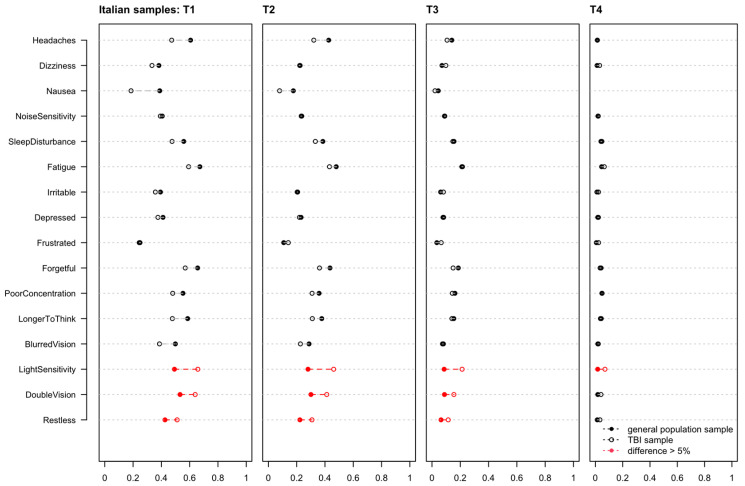
After traumatic brain injury (TBI), individuals may experience short- or long-term health burdens, often referred to as post-concussion symptoms (PCS). The Rivermead Post-Concussion Symptoms Questionnaire (RPQ) is one of the commonly used instruments to assess self-reported PCS. To date, no reference values for RPQ have been provided, although they are crucial for clinical practice when evaluating a patient’s health status relative to a comparable healthy population. Therefore, the aim of this study is to provide reference values for the United Kingdom, the Netherlands, and Italy. A total of 11,759 individuals (50.3% women) from representative general population samples participated in an online survey (4646 individuals from the UK, 3564 from the Netherlands, and 3549 from Italy). The factorial structure of the RPQ was examined using confirmatory factor analysis (CFA), and results from the general population samples were compared with those from respective TBI samples recruited within the international CENTER-TBI study using multigroup CFA. Reference values were stratified by sex, health status, age, and education using percentiles. The three-factorial model outperformed the one-factorial structure. The general population samples were largely comparable to the corresponding TBI samples, except for items such as dizziness, vision, and sensory sensitivity, which can be considered more TBI-specific. Because of the significant differences between the general population samples, we provided reference values for the total score and for the somatic, emotional, and cognitive scales for each country separately. The reference values provided can now be used in clinical practice and research. Future studies should obtain stratified reference values for other countries and languages to improve accuracy in the diagnosis and treatment of symptom burden after TBI.
Overview
The claims and statistics of this paper haven’t been checked yet.
Free: it reads the open-access text and checks the first 5 claims that cite a source we can check. Create a free account to check every claim.
Integrity signals
Registry
Cites
Statistics
Figures



Verification
Claims the paper makes
The claims and statistics of this paper haven’t been checked yet.
Free: it reads the open-access text and checks the first 5 claims that cite a source we can check. Create a free account to check every claim.
Claims other papers make about this one
Each is checked against this paper’s own text: does it say what the citing paper says it does?
The source backs part of the claim, not all of it — or backs it for a different population, condition or comparison.
In the citing paper
“Three out of 4 participants' RPQ scores decreased from clinically relevant to non-relevant levels (31) from baseline (T0) compared to after intervention (T2) and follow-up (T3).”
From Intensive exposure therapy for individuals with persistent concussion symptoms following concussion: a replicated single-case experimental design (SCED) study. (2025) · cites this paper as [31]
Experimental — accuracy not yet measuredThe cited source says what the claim attributes to it.
In the citing paper
“One participant experienced high, but not clinically relevant scores as per the guidelines (31), at T0 and their scores decreased at T2, and at T3 there was an absence of symptoms.”
Self-check
Percentages, sums and reported differences re-computed from the paper’s own numbers.
The self-check needs the paper’s full text.
Citations
Cites
Hu, L., & Bentler, P. M. (1999) · Structural Equation Modeling A Multidisciplinary Journal · doi:10.1080/10705519909540118 · Cited by 108,788
lavaan : An R Package for Structural Equation Modeling
Rosseel, Y. (2012) · Journal of Statistical Software · doi:10.18637/jss.v048.i02 · Cited by 27,955
Comparative fit indexes in structural models.
Bentler, P. M. (1990) · Psychological Bulletin · doi:10.1037/0033-2909.107.2.238 · Cited by 25,266
Significance tests and goodness of fit in the analysis of covariance structures.
Bentler, P. M., & Bonett, D. G. (1980) · Psychological Bulletin · doi:10.1037//0033-2909.88.3.588 · Cited by 19,023
Evaluating Goodness-of-Fit Indexes for Testing Measurement Invariance
Cheung, G. W., & Rensvold, R. B. (2002) · Structural Equation Modeling: A Multidisciplinary Journal · doi:10.1207/s15328007sem0902_5 · Cited by 16,280
ASSESSMENT OF COMA AND IMPAIRED CONSCIOUSNESS
Teasdale, G., & Jennett, B. (1974) · The Lancet · doi:10.1016/s0140-6736(74)91639-0 · Cited by 13,215 · cited 3×
“4 Chronic health complaints are provided for the general population samples, information on TBI severity (GCS; mild ≥ 13, moderate/severe ≤ 12) is reported for the TBI samples.”
BackgroundMethodQuality criteria were proposed for measurement properties of health status questionnaires
Terwee, C. B., Bot, S. D. M., de Boer, M. R., van der Windt, D. A. W. M., Knol, D. L., Dekker, J., Bouter, L. M., & de Vet, H. C. W. (2007) · Journal of Clinical Epidemiology · doi:10.1016/j.jclinepi.2006.03.012 · Cited by 10,764 · cited 1×
“95 indicating good to excellent internal consistency [19]), split-half reliability (odd vs.”
BackgroundFamily history of subarachnoid haemorrhage: supplemental value of scrutinizing all relatives.
Greebe, P., Bromberg, J. E., Rinkel, G. J., Algra, A., & van Gijn, J. (1997) · Journal of Neurology, Neurosurgery & Psychiatry · doi:10.1136/jnnp.62.3.273 · Cited by 4,139
psych: Procedures for Personality and Psychological Research
Revelle, W. (2017) · Cited by 3,321
Traumatic brain injury: integrated approaches to improve prevention, clinical care, and research
Maas, A. I. R., Menon, D. K., Adelson, P. D., Andelic, N., Bell, M. J., Belli, A., Bragge, P., Brazinova, A., Büki, A., Chesnut, R. M., et al. (2017) · The Lancet Neurology · doi:10.1016/s1474-4422(17)30371-x · Cited by 2,609
Self-citation
Research works printed but not linked: 2
- Brown, T.A. (2015). Confirmatory Factor Analysis for Applied Research, The Guilford Press. [2nd ed.]. Methodology in the Social Sciences.
- Steiger, J.H. Statistically Based Tests for the Number of Common Factors. Proceedings of the the Annual Meeting of the Psychometric Society, Iowa City, IA, USA.
Cited by
Zeldovich, M., Bockhop, F., Čović, A., Mueller, I., Polinder, S., Mikolić, A., van der Vlegel, M., von Steinbüchel, N., Åkerlund, C. A. I., Amrein, K., et al. (2023) · Journal of Patient-Reported Outcomes · doi:10.1186/s41687-023-00632-5 · Cited by 14
Self-citationRecovery Trajectories of Patients with Mild Traumatic Brain Injury
King, S., Winkens, I., Wijenberg, M., Schepers, J., Stapert, S. Z., Verbunt, J., Rijkeboer, M. M., van der Naalt, J., & Heugten, C. M. V. (2025) · Journal of Neurotrauma · doi:10.1089/neu.2024.0610 · Cited by 11
King, S., Stapert, S. Z., Winkens, I., van der Naalt, J., van Heugten, C. M., & Rijkeboer, M. M. (2024) · Journal of Head Trauma Rehabilitation · doi:10.1097/htr.0000000000000942 · Cited by 9
Zeldovich, M., Krol, L., Timmermann, D., Krenz, U., Arango‐Lasprilla, J. C., Gioia, G. A., Brockmann, K., Koerte, I. K., Buchheim, A., Roediger, M., et al. (2023) · Frontiers in Neurology · doi:10.3389/fneur.2023.1266828 · Cited by 9
Self-citationEggertsen, P. P., Palmfeldt, J., Pedersen, A. R., Frederiksen, O.-V., Olsen, R. K. J., & Nielsen, J. F. (2024) · Journal of the Neurological Sciences · doi:10.1016/j.jns.2024.123016 · Cited by 11
Metadata
- Authors
- Zeldovich, M., Bockhop, F., Covic, A., Cunitz, K., Polinder, S., Haagsma, J. A., von Steinbuechel, N., & on behalf of the CENTER-TBI Participants and Investigators
- Affiliations
- Universitätsmedizin Göttingen (DE)
- Institute of Medical Psychology and Medical Sociology, University Medical Center Göttingen, Waldweg 37A, 37073 Göttingen, Germany
- Erasmus MC (NL)
- Corresponding author
- Zeldovich, Marina
- Venue
- Journal of Clinical Medicine
- Publisher
- MDPI AG
- Published
- 2022-08-09
- Volume
- 11
- Issue
- 16
- Pages
- 4658
- ISSN
- 2077-0383 (ISSN-L)
- PMC
- PMC9410233
- OpenAlex
- W4293678684
- Cited by
- 36
- References
- 49
- Citations by year
- 2026: 9 · 2025: 11 · 2024: 10 · 2023: 6
- FWCI
- 4.87
- Type
- journal article
- Language
- en
- Open access
- gold
- doi.org
- Licence
- Locations
- Journal of Clinical Medicine (publishedVersion, cc-by)
- PubMed Central (publishedVersion, cc-by)
- PubMed (publishedVersion)
- EUR Research Repository (Erasmus University Rotterdam) (publishedVersion, cc-by)
- EUR Research Repository (Erasmus University Rotterdam) (submittedVersion, cc-by)
- DOAJ (DOAJ: Directory of Open Access Journals) (submittedVersion, cc-by-sa)
- GoeScholar The Publication Server of the Georg-August-Universität Göttingen (Georg-August-Universität Göttingen) (submittedVersion, cc-by)
- Funders
- the European Union 7th Framework programme (602150)
- the Hannelore Kohl Stiftung (602150)
- OneMind (602150)
- Integra LifeSciences Corporation (602150)
- Topics
- Health Sciences › Medicine › Clinical Neurology › Traumatic Brain Injury Research
- Health Sciences › Medicine › Clinical Neurology › Traumatic Brain Injury and Neurovascular Disturbances
- Health Sciences › Medicine › Clinical Neurology › Long-Term Effects of COVID-19
- Keywords
- Rivermead Post-Concussion Symptoms Questionnaire, post-concussion symptoms, traumatic brain injury, reference values, general population, percentile scores, factor structure, somatic symptoms, emotional symptoms, cognitive symptoms, dizziness, sensory sensitivity, CENTER-TBI study, cross-national comparison
About these checks
Registry, retraction, Cites and statistics results are computed, not judged, with one exception: a printed reference that no index lists is read once by a model before it counts as a citation error. Claims are extracted by a model and kept only when their quote appears verbatim in the text; each cited source is then checked, with a model’s help, for whether it says what the claim relies on. Those verdicts can be wrong — read the claim’s quote and the cited source before relying on one.
Statistics and arithmetic are recomputed, not judged.
Confidence bands are shown only for fields calibrated on our annotated test set. None is calibrated yet, so no band is shown.
What counts as a claim ›How we measure confidence ›How we check this ›
Are you an author, or do you see a problem with this page? Request a review
How to cite
Cite CoChat for the checks on this page, and the paper for its own findings.
- This page
- CoChat. (2026). Citation check: Reference Values for the Rivermead Post-Concussion Symptoms Questionnaire (RPQ) from General Population Samples in the United Kingdom, Italy, and The Netherlands. https://app.cochat.ai/papers/10.3390/jcm11164658
- The paper
- Zeldovich, M., Bockhop, F., Covic, A., Cunitz, K., Polinder, S., Haagsma, J. A., von Steinbuechel, N., & on behalf of the CENTER-TBI Participants and Investigators. (2022). Reference Values for the Rivermead Post-Concussion Symptoms Questionnaire (RPQ) from General Population Samples in the United Kingdom, Italy, and The Netherlands. Journal of Clinical Medicine. https://doi.org/10.3390/jcm11164658
Data sources
Bibliographic data: Semantic Scholar, OpenAlex, Crossref.
Contains information from the Semantic Scholar Academic Graph Datasets, made available under the ODC Attribution License (ODC-BY 1.0).
Semantic Scholar’s data is described in: Kinney, R., et al. (2023). The Semantic Scholar Open Data Platform. arXiv:2301.10140.
