

Reference Values for the Rivermead Post-Concussion Symptoms Questionnaire (RPQ) from General Population Samples in the United Kingdom, Italy, and The Netherlands
Open accessThe DOI matches its Crossref record; 49 of the 49 references it cites were found in a registry or an index.
Abstract
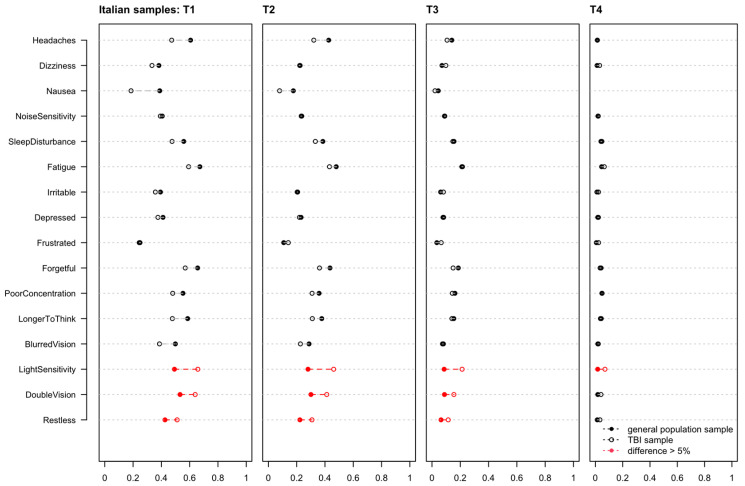
After traumatic brain injury (TBI), individuals may experience short- or long-term health burdens, often referred to as post-concussion symptoms (PCS). The Rivermead Post-Concussion Symptoms Questionnaire (RPQ) is one of the commonly used instruments to assess self-reported PCS. To date, no reference values for RPQ have been provided, although they are crucial for clinical practice when evaluating a patient’s health status relative to a comparable healthy population. Therefore, the aim of this study is to provide reference values for the United Kingdom, the Netherlands, and Italy. A total of 11,759 individuals (50.3% women) from representative general population samples participated in an online survey (4646 individuals from the UK, 3564 from the Netherlands, and 3549 from Italy). The factorial structure of the RPQ was examined using confirmatory factor analysis (CFA), and results from the general population samples were compared with those from respective TBI samples recruited within the international CENTER-TBI study using multigroup CFA. Reference values were stratified by sex, health status, age, and education using percentiles. The three-factorial model outperformed the one-factorial structure. The general population samples were largely comparable to the corresponding TBI samples, except for items such as dizziness, vision, and sensory sensitivity, which can be considered more TBI-specific. Because of the significant differences between the general population samples, we provided reference values for the total score and for the somatic, emotional, and cognitive scales for each country separately. The reference values provided can now be used in clinical practice and research. Future studies should obtain stratified reference values for other countries and languages to improve accuracy in the diagnosis and treatment of symptom burden after TBI.
Overview
The claims and statistics of this paper haven’t been checked yet.
Free: it reads the open-access text and checks the first 5 claims that cite a source we can check. Create a free account to check every claim.
Integrity signals
Registry
Cites
Statistics
Figures



Verification
Claims the paper makes
The claims and statistics of this paper haven’t been checked yet.
Free: it reads the open-access text and checks the first 5 claims that cite a source we can check. Create a free account to check every claim.
Claims other papers make about this one
Each is checked against this paper’s own text: does it say what the citing paper says it does?
The source backs part of the claim, not all of it — or backs it for a different population, condition or comparison.
In the citing paper
“Three out of 4 participants' RPQ scores decreased from clinically relevant to non-relevant levels (31) from baseline (T0) compared to after intervention (T2) and follow-up (T3).”
From Intensive exposure therapy for individuals with persistent concussion symptoms following concussion: a replicated single-case experimental design (SCED) study. (2025) · cites this paper as [31]
Experimental — accuracy not yet measuredThe cited source says what the claim attributes to it.
In the citing paper
“One participant experienced high, but not clinically relevant scores as per the guidelines (31), at T0 and their scores decreased at T2, and at T3 there was an absence of symptoms.”
Self-check
Percentages, sums and reported differences re-computed from the paper’s own numbers.
The self-check needs the paper’s full text.
Citations
Cites
Hu, L., & Bentler, P. M. (1999) · Structural Equation Modeling A Multidisciplinary Journal · doi:10.1080/10705519909540118 · Cited by 108,788 · cited 2×
“95) [33,34], the root mean square error of approximation (RMSEA; excellent fit at 0.”
Backgroundlavaan : An R Package for Structural Equation Modeling
Rosseel, Y. (2012) · Journal of Statistical Software · doi:10.18637/jss.v048.i02 · Cited by 27,955 · cited 1×
“[43] and packages table1 [44] for descriptive analyses, psych [45] for psychometric properties, and lavaan [46] for the CFA and MI testing.”
MethodComparative fit indexes in structural models.
Bentler, P. M. (1990) · Psychological Bulletin · doi:10.1037/0033-2909.107.2.238 · Cited by 25,266 · cited 1×
“95) [32,33], the Tucker–Lewis index (TLI; ≥0.”
Significance tests and goodness of fit in the analysis of covariance structures.
Bentler, P. M., & Bonett, D. G. (1980) · Psychological Bulletin · doi:10.1037//0033-2909.88.3.588 · Cited by 19,023 · cited 1×
“95) [33,34], the root mean square error of approximation (RMSEA; excellent fit at 0.”
BackgroundEvaluating Goodness-of-Fit Indexes for Testing Measurement Invariance
Cheung, G. W., & Rensvold, R. B. (2002) · Structural Equation Modeling: A Multidisciplinary Journal · doi:10.1207/s15328007sem0902_5 · Cited by 16,280 · cited 1×
“01 [41], models were considered equivalent.”
ASSESSMENT OF COMA AND IMPAIRED CONSCIOUSNESS
Teasdale, G., & Jennett, B. (1974) · The Lancet · doi:10.1016/s0140-6736(74)91639-0 · Cited by 13,215 · cited 3×
“4 Chronic health complaints are provided for the general population samples, information on TBI severity (GCS; mild ≥ 13, moderate/severe ≤ 12) is reported for the TBI samples.”
BackgroundMethodQuality criteria were proposed for measurement properties of health status questionnaires
Terwee, C. B., Bot, S. D. M., de Boer, M. R., van der Windt, D. A. W. M., Knol, D. L., Dekker, J., Bouter, L. M., & de Vet, H. C. W. (2007) · Journal of Clinical Epidemiology · doi:10.1016/j.jclinepi.2006.03.012 · Cited by 10,764 · cited 1×
“95 indicating good to excellent internal consistency [19]), split-half reliability (odd vs.”
BackgroundFamily history of subarachnoid haemorrhage: supplemental value of scrutinizing all relatives.
Greebe, P., Bromberg, J. E., Rinkel, G. J., Algra, A., & van Gijn, J. (1997) · Journal of Neurology, Neurosurgery & Psychiatry · doi:10.1136/jnnp.62.3.273 · Cited by 4,139
psych: Procedures for Personality and Psychological Research
Revelle, W. (2017) · Cited by 3,321
Traumatic brain injury: integrated approaches to improve prevention, clinical care, and research
Maas, A. I. R., Menon, D. K., Adelson, P. D., Andelic, N., Bell, M. J., Belli, A., Bragge, P., Brazinova, A., Büki, A., Chesnut, R. M., et al. (2017) · The Lancet Neurology · doi:10.1016/s1474-4422(17)30371-x · Cited by 2,609 · cited 3×
“Even after mild traumatic brain injury (scores of 13–15 on the Glasgow Coma Scale; GCS [4]), which accounts for the majority of all TBI cases [2], individuals do not fully recover to their premorbid level of functioning and report being bothered by a range of health problems [5].”
BackgroundSelf-citationWright, K. B. (2006) · Journal of Computer-Mediated Communication · doi:10.1111/j.1083-6101.2005.tb00259.x · Cited by 2,550 · cited 1×
“First, participants were recruited exclusively through Internet platforms via online surveys which are often associated with (self-)selection and response bias [58].”
BackgroundPosition statement: definition of traumatic brain injury
Menon, D. K., Schwab, K., Wright, D. W., & Maas, A. I. (2010) · Archives of Physical Medicine and Rehabilitation · doi:10.1016/j.apmr.2010.05.017 · Cited by 1,678 · cited 2×
“Introduction Traumatic brain injury (TBI) is defined as a change in brain functioning caused by an external force [1].”
BackgroundXia, Y., & Yang, Y. (2019) · Behavior Research Methods · doi:10.3758/s13428-018-1055-2 · Cited by 1,596
King, N. S., Crawford, S., Wenden, F. J., Moss, N. E. G., & Wade, D. T. (1995) · Journal of Neurology · doi:10.1007/bf00868811 · Cited by 1,460 · cited 5×
“Among the most frequently used PROMs for self-reported PCS is the Rivermead Post-Concussion Symptoms Questionnaire (RPQ) [7].”
BackgroundMethodInfluentialUtility of confirmatory factor analysis in test validation research.
Cole, D. A. (1987) · Journal of Consulting and Clinical Psychology · doi:10.1037//0022-006x.55.4.584 · Cited by 1,088 · cited 1×
“The goodness-of-fit of estimated models was evaluated with the help of multiple indices (cut-off criteria shown in brackets): χ2 and degrees of freedom (df ), as well as the ratio χ2/d f (≤2) [31], the comparative fit index (CFI; ≥0.”
MethodWu, H., & Estabrook, R. (2016) · Psychometrika · doi:10.1007/s11336-016-9506-0 · Cited by 523 · cited 1×
“For this purpose, we followed the framework originally proposed by Wu and Estabrook (2016) [38] and updated by Svetina, Rutkowski, and Rutkowski (2020) [39].”
MethodMaas, A. I. R., Menon, D. K., Steyerberg, E. W., Citerio, G., Lecky, F., Manley, G. T., Hill, S., Legrand, V., & Sorgner, A. (2015) · Neurosurgery · doi:10.1227/neu.0000000000000575 · Cited by 509 · cited 1×
“Informed Consent Informed consent was obtained according to the respective local and national requirements for all patients recruited in the core dataset of CENTER-TBI and documented in the e-CRF [17].”
MethodSteyerberg, E. W., Wiegers, E., Sewalt, C., Buki, A., Citerio, G., De Keyser, V., Ercole, A., Kunzmann, K., Lanyon, L., Lecky, F., et al. (2019) · The Lancet Neurology · doi:10.1016/s1474-4422(19)30232-7 · Cited by 496 · cited 1×
“Further study details can be found elsewhere [15].”
BackgroundRecommendations for the Use of Common Outcome Measures in Traumatic Brain Injury Research
Wilde, E. A., Whiteneck, G. G., Bogner, J., Bushnik, T., Cifu, D. X., Dikmen, S., French, L., Giacino, J. T., Hart, T., Malec, J. F., et al. (2010) · Archives of Physical Medicine and Rehabilitation · doi:10.1016/j.apmr.2010.06.033 · Cited by 461 · cited 1×
“The RPQ was suggested in the Common Data Elements (CDE) recommendations for assessing symptom burden following TBI in adults [10,11].”
MethodNelson, L. D., Temkin, N. R., Dikmen, S., Barber, J., Giacino, J. T., Yuh, E., Levin, H. S., McCrea, M. A., Stein, M. B., Mukherjee, P., et al. (2019) · JAMA Neurology · doi:10.1001/jamaneurol.2019.1313 · Cited by 451 · cited 1×
“Even after mild traumatic brain injury (scores of 13–15 on the Glasgow Coma Scale; GCS [4]), which accounts for the majority of all TBI cases [2], individuals do not fully recover to their premorbid level of functioning and report being bothered by a range of health problems [5].”
BackgroundExamination of "Postconcussion-Like" Symptoms in a Healthy Sample
Iverson, G. L., & Lange, R. T. (2003) · Applied Neuropsychology · doi:10.1207/s15324826an1003_02 · Cited by 431
Svetina, D., Rutkowski, L., & Rutkowski, D. (2020) · Structural Equation Modeling: A Multidisciplinary Journal · doi:10.1080/10705511.2019.1602776 · Cited by 425 · cited 1×
“For this purpose, we followed the framework originally proposed by Wu and Estabrook (2016) [38] and updated by Svetina, Rutkowski, and Rutkowski (2020) [39].”
MethodA Multidimensional Approach to Post-concussion Symptoms in Mild Traumatic Brain Injury
Polinder, S., Cnossen, M. C., Real, R. G. L., Covic, A., Gorbunova, A., Voormolen, D. C., Master, C. L., Haagsma, J. A., Diaz-Arrastia, R., & von Steinbuechel, N. (2018) · Frontiers in Neurology · doi:10.3389/fneur.2018.01113 · Cited by 376 · cited 1×
“This questionnaire has been translated into a wide range of languages [12] and is broadly applied in PCS assessment [13].”
Self-citationConstruct validity and reliability of the Rivermead Post-Concussion Symptoms Questionnaire
Eyres, S., Carey, A., Gilworth, G., Neumann, V., & Tennant, A. (2005) · Clinical Rehabilitation · doi:10.1191/0269215505cr905oa · Cited by 335
Smith-Seemiller, L., Fow, N. R., Kant, R., & Franzen, M. D. (2003) · Brain Injury · doi:10.1080/0269905021000030823 · Cited by 302 · cited 3×
“(2003) [21] Dutch English Italian Dutch English Italian χ2 7042.”
BackgroundHirschfeld, G. H. F., & von Brachel, R. (2020) · ScholarWorks@UMassAmherst (University of Massachusetts Amherst) · doi:10.7275/qazy-2946 · Cited by 279
The Rivermead Post Concussion Symptoms Questionnaire: A confirmatory factor analysis
Potter, S., Leigh, E., Wade, D., & Fleminger, S. (2006) · Journal of Neurology · doi:10.1007/s00415-006-0275-z · Cited by 265
Sigurdardottir, S., Andelic, N., Roe, C., Jerstad, T., & Schanke, A.-K. (2009) · Brain Injury · doi:10.1080/02699050902926309 · Cited by 217 · cited 1×
“PCS typically emerge after mild to moderate TBI [7], but also individuals after a severe TBI frequently report comparable short- or long-lasting deficits termed post-concussion-like (PC-like) symptoms [8,9].”
BackgroundDean, P. J. A., O’Neill, D., & Sterr, A. (2012) · Brain Injury · doi:10.3109/02699052.2011.635354 · Cited by 153 · cited 1×
“Some studies have shown that the occurrence of PCS is less TBI-specific [53,54] and more related to the premorbid health status of the affected individuals than to TBI [55,56].”
BackgroundWANG, Y., CHAN, R., & DENG, Y. (2006) · Archives of Clinical Neuropsychology · doi:10.1016/j.acn.2006.03.006 · Cited by 135
Base rate of post-concussion symptoms among normal people and its neuropsychological correlates
Chan, R. C. (2001) · Clinical Rehabilitation · doi:10.1191/026921501675253420 · Cited by 125 · cited 1×
“Given that most of the differences in symptoms between the language samples did not exceed the permissible cut-off value, that most of the symptoms characterized by the significant differences were specifically relevant to TBI and rarely occur in the healthy general population [47,48], and that thresholds and intercep…”
BackgroundHealth status, not head injury, predicts concussion symptoms after minor injury
McLean, S. A., Kirsch, N. L., Tan-Schriner, C. U., Sen, A., Frederiksen, S., Harris, R. E., Maixner, W. D., & Maio, R. F. (2009) · The American Journal of Emergency Medicine · doi:10.1016/j.ajem.2008.01.054 · Cited by 104 · cited 1×
“Some studies have shown that the occurrence of PCS is less TBI-specific [53,54] and more related to the premorbid health status of the affected individuals than to TBI [55,56].”
BackgroundGarden, N., & Sullivan, K. A. (2010) · Applied Neuropsychology · doi:10.1080/09084280903297495 · Cited by 97 · cited 4×
“, chronic pains [21], depression [51], stroke and multiple sclerosis [57], etc.”
BackgroundMethodInfluentialVoormolen, D. C., Cnossen, M. C., Polinder, S., Gravesteijn, B. Y., von Steinbüchel, N., Real, R. G. L., & Haagsma, J. A. (2019) · Brain Injury · doi:10.1080/02699052.2019.1607557 · Cited by 95 · cited 6×
“(2019) [14] found a high prevalence of PC-like symptoms in the general population samples from the United Kingdom, The Netherlands, and Italy.”
BackgroundSelf-citationUlrichsen, K. M., Kaufmann, T., Dørum, E. S., Kolskår, K. K., Richard, G., Alnæs, D., Arneberg, T. J., Westlye, L. T., & Nordvik, J. E. (2016) · Frontiers in Psychology · doi:10.3389/fpsyg.2016.00912 · Cited by 86 · cited 1×
“, chronic pains [21], depression [51], stroke and multiple sclerosis [57], etc.”
BackgroundHerrmann, N., Rapoport, M. J., Rajaram, R. D., Chan, F., Kiss, A., Ma, A. K., Feinstein, A., MCCullagh, S., & Lanctot, K. L. (2009) · Journal of Neuropsychiatry · doi:10.1176/appi.neuropsych.21.2.181 · Cited by 74
Internal construct validity of the Rivermead Post-Concussion Symptoms Questionnaire
Lannsjö, M., Borg, J., Björklund, G., af Geijerstam, L., & Lundgren-Nilsson, Å. (2011) · Journal of Rehabilitation Medicine · doi:10.2340/16501977-0875 · Cited by 73
van der Vlegel, M., Polinder, S., Toet, H., Panneman, M. J. M., & Haagsma, J. A. (2021) · Journal of Clinical Medicine · doi:10.3390/jcm10040806 · Cited by 55 · cited 1×
“Some studies have shown that the occurrence of PCS is less TBI-specific [53,54] and more related to the premorbid health status of the affected individuals than to TBI [55,56].”
BackgroundSelf-citationFinch, W. H., & French, B. F. (2018) · Structural Equation Modeling: A Multidisciplinary Journal · doi:10.1080/10705511.2018.1431781 · Cited by 52 · cited 1×
“10) [35,36] including 90% confidence interval (CI90%), and the standardized root mean square residual (SRMR; <0.”
Backgroundvon Steinbüchel, N., Rauen, K., Krenz, U., Wu, Y.-J., Čović, A., Plass, A. M., Cunitz, K., Mueller, I., Bockhop, F., Polinder, S., et al. (2021) · Journal of Clinical Medicine · doi:10.3390/jcm10132863 · Cited by 46 · cited 3×
“…Properties of the RPQ in General Population Samples Investigation of the comparability of psychometric characteristics of the RPQ in general population samples with the results obtained from the TBI samples followed the approach described in the study by von Steinbuechel et al. (2021) [16].”
MethodSelf-citationBase Rates of Post-concussive Symptoms in a Nonconcussed Multicultural Sample
Zakzanis, K. K., & Yeung, E. K. L. (2011) · Archives of Clinical Neuropsychology · doi:10.1093/arclin/acr021 · Cited by 42 · cited 1×
“Given that most of the differences in symptoms between the language samples did not exceed the permissible cut-off value, that most of the symptoms characterized by the significant differences were specifically relevant to TBI and rarely occur in the healthy general population [47,48], and that thresholds and intercep…”
BackgroundZeldovich, M., Wu, Y.-J., Gorbunova, A., Mikolić, A., Polinder, S., Plass, A. M., Čović, A., Asendorf, T., Anđelić, N., Voormolen, D. C., et al. (2020) · Journal of Clinical Medicine · doi:10.3390/jcm9061931 · Cited by 39 · cited 1×
“PCS typically emerge after mild to moderate TBI [7], but also individuals after a severe TBI frequently report comparable short- or long-lasting deficits termed post-concussion-like (PC-like) symptoms [8,9].”
BackgroundSelf-citationUntangling chronic pain and post-concussion symptoms: the significance of depression
Snell, D. L., Martin, R., Macleod, A. D., Surgenor, L. J., Siegert, R. J., Jean, C. H.-S. E., Melzer, T. R., Hooper, G. J., & Anderson, T. (2018) · Brain Injury · doi:10.1080/02699052.2018.1432894 · Cited by 38 · cited 1×
“Some studies have shown that the occurrence of PCS is less TBI-specific [53,54] and more related to the premorbid health status of the affected individuals than to TBI [55,56].”
Backgroundvon Steinbüchel, N., Rauen, K., Bockhop, F., Čović, A., Krenz, U., Plass, A. M., Cunitz, K., Polinder, S., Wilson, L., Steyerberg, E. W., et al. (2021) · Journal of Clinical Medicine · doi:10.3390/jcm10112396 · Cited by 35 · cited 3×
“Factorial Structure of the RPQ in the General Population Samples Comparable to the results obtained from the respective TBI samples [16], the original one-factor structure could not be replicated for any of the general population samples.”
BackgroundMethodResultSelf-citationCharacteristics and Concerns of Caregivers of Adults With Traumatic Brain Injury
Powell, J. M., Wise, E. K., Brockway, J. A., Fraser, R., Temkin, N. R., & Bell, K. R. (2016) · Journal of Head Trauma Rehabilitation · doi:10.1097/htr.0000000000000219 · Cited by 34
Thomas, M., Skilbeck, C. E., Cannan, P., & Slatyer, M. (2017) · Brain Impairment · doi:10.1017/brimp.2017.26 · Cited by 27
Gorbunova, A., Zeldovich, M., Voormolen, D. C., Krenz, U., Polinder, S., Haagsma, J. A., Hagmayer, Y., Čović, A., Real, R. G. L., Asendorf, T., et al. (2020) · Journal of Clinical Medicine · doi:10.3390/jcm9072100 · Cited by 27 · cited 1×
“These points as well as the legitimacy of data use, have been discussed in more detail elsewhere [59].”
BackgroundSelf-citationAgtarap, S., Kramer, M. D., Campbell‐Sills, L., Yuh, E. L., Mukherjee, P., Manley, G. T., McCrea, M., DIKMEN, S. S., Giacino, J. T., Stein, M. B., et al. (2020) · Assessment · doi:10.1177/1073191120913941 · Cited by 25
Rivera, D., Greving, S., Arango‐Lasprilla, J. C., von Steinbüchel, N., Zeldovich, M., & Center-Tbi Participants And Investigators (2022) · Journal of Clinical Medicine · doi:10.3390/jcm11144090 · Cited by 22 · cited 2×
“Therefore, in addition to the reference values based on the original RPQ total score, we derived reference values for the three scales covering somatic, emotional, and cognitive symptoms which showed a good fit in previous studies [28,29].”
BackgroundMethodSelf-citation
Research works printed but not linked: 2
- Brown T.A. Confirmatory Factor Analysis for Applied Research 2nd ed. Methodology in the Social Sciences The Guilford Press New York, NY, USA London, UK 2015 978-1-4625-1779-4
- Steiger J.H. Statistically Based Tests for the Number of Common Factors Proceedings of the the Annual Meeting of the Psychometric Society Iowa City, IA, USA 1980
Cited by
Zeldovich, M., Bockhop, F., Čović, A., Mueller, I., Polinder, S., Mikolić, A., van der Vlegel, M., von Steinbüchel, N., Åkerlund, C. A. I., Amrein, K., et al. (2023) · Journal of Patient-Reported Outcomes · doi:10.1186/s41687-023-00632-5 · Cited by 14
Self-citationRecovery Trajectories of Patients with Mild Traumatic Brain Injury
King, S., Winkens, I., Wijenberg, M., Schepers, J., Stapert, S. Z., Verbunt, J., Rijkeboer, M. M., van der Naalt, J., & Heugten, C. M. V. (2025) · Journal of Neurotrauma · doi:10.1089/neu.2024.0610 · Cited by 11
King, S., Stapert, S. Z., Winkens, I., van der Naalt, J., van Heugten, C. M., & Rijkeboer, M. M. (2024) · Journal of Head Trauma Rehabilitation · doi:10.1097/htr.0000000000000942 · Cited by 9
Zeldovich, M., Krol, L., Timmermann, D., Krenz, U., Arango‐Lasprilla, J. C., Gioia, G. A., Brockmann, K., Koerte, I. K., Buchheim, A., Roediger, M., et al. (2023) · Frontiers in Neurology · doi:10.3389/fneur.2023.1266828 · Cited by 9
Self-citationEggertsen, P. P., Palmfeldt, J., Pedersen, A. R., Frederiksen, O.-V., Olsen, R. K. J., & Nielsen, J. F. (2024) · Journal of the Neurological Sciences · doi:10.1016/j.jns.2024.123016 · Cited by 11
Metadata
- Authors
- Zeldovich, M., Bockhop, F., Covic, A., Cunitz, K., Polinder, S., Haagsma, J. A., von Steinbuechel, N., & on behalf of the CENTER-TBI Participants and Investigators
- Affiliations
- Universitätsmedizin Göttingen (DE)
- Institute of Medical Psychology and Medical Sociology, University Medical Center Göttingen, Waldweg 37A, 37073 Göttingen, Germany
- Erasmus MC (NL)
- Corresponding author
- Zeldovich, Marina
- Venue
- Journal of Clinical Medicine
- Publisher
- MDPI AG
- Published
- 2022-08-09
- Volume
- 11
- Issue
- 16
- Pages
- 4658
- ISSN
- 2077-0383 (ISSN-L)
- PMC
- PMC9410233
- OpenAlex
- W4293678684
- Cited by
- 36
- References
- 49
- Citations by year
- 2026: 9 · 2025: 11 · 2024: 10 · 2023: 6
- FWCI
- 4.87
- Type
- journal article
- Language
- en
- Open access
- gold
- doi.org
- Licence
- Locations
- Journal of Clinical Medicine (publishedVersion, cc-by)
- PubMed Central (publishedVersion, cc-by)
- PubMed (publishedVersion)
- EUR Research Repository (Erasmus University Rotterdam) (publishedVersion, cc-by)
- EUR Research Repository (Erasmus University Rotterdam) (submittedVersion, cc-by)
- DOAJ (DOAJ: Directory of Open Access Journals) (submittedVersion, cc-by-sa)
- GoeScholar The Publication Server of the Georg-August-Universität Göttingen (Georg-August-Universität Göttingen) (submittedVersion, cc-by)
- Funders
- the European Union 7th Framework programme (602150)
- the Hannelore Kohl Stiftung (602150)
- OneMind (602150)
- Integra LifeSciences Corporation (602150)
- Topics
- Health Sciences › Medicine › Clinical Neurology › Traumatic Brain Injury Research
- Health Sciences › Medicine › Clinical Neurology › Traumatic Brain Injury and Neurovascular Disturbances
- Health Sciences › Medicine › Clinical Neurology › Long-Term Effects of COVID-19
- Keywords
- Rivermead Post-Concussion Symptoms Questionnaire, post-concussion symptoms, traumatic brain injury, reference values, general population, percentile scores, factor structure, somatic symptoms, emotional symptoms, cognitive symptoms, dizziness, sensory sensitivity, CENTER-TBI study, cross-national comparison
About these checks
Registry, retraction, Cites and statistics results are computed, not judged, with one exception: a printed reference that no index lists is read once by a model before it counts as a citation error. Claims are extracted by a model and kept only when their quote appears verbatim in the text; each cited source is then checked, with a model’s help, for whether it says what the claim relies on. Those verdicts can be wrong — read the claim’s quote and the cited source before relying on one.
Statistics and arithmetic are recomputed, not judged.
Confidence bands are shown only for fields calibrated on our annotated test set. None is calibrated yet, so no band is shown.
What counts as a claim ›How we measure confidence ›How we check this ›
Are you an author, or do you see a problem with this page? Request a review
Data sources
Bibliographic data: Semantic Scholar, OpenAlex, Crossref.
Contains information from the Semantic Scholar Academic Graph Datasets, made available under the ODC Attribution License (ODC-BY 1.0).
Semantic Scholar’s data is described in: Kinney, R., et al. (2023). The Semantic Scholar Open Data Platform. arXiv:2301.10140.
