

The DOI matches its Crossref record; 36 of the 36 references it cites were found in a registry or an index; none of the 27 sources its claims cite is checked for support yet.
Iron Deficiency and Anemia in Male and Female Adolescent Athletes Who Engage in Ball Games
Open accessAbstract
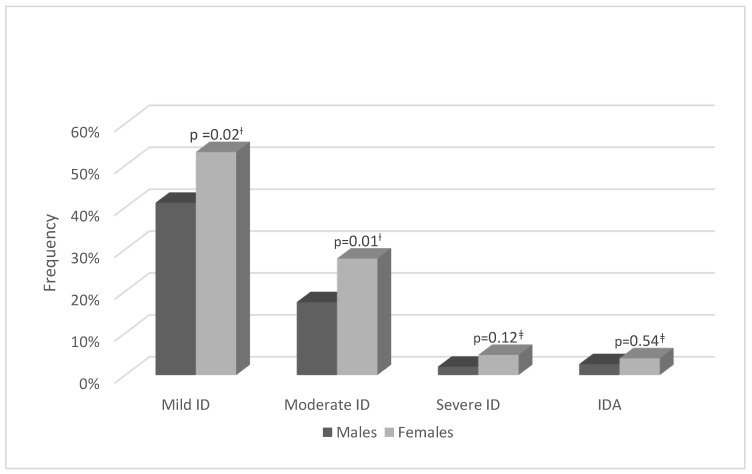
The aim of this study was to assess the prevalence of iron deficiency (ID) and iron deficiency anemia (IDA) among male adolescent athletes who participate in non-calorie-restricting sports, and to compare the results with female athletes of the same age and sports. Data of the hemoglobin concentration (Hb) and serum ferritin (sFer) levels of male (n = 350) and female (n = 126) basketball and football players, aged 11–18, from two sport medicine centers in Israel were gathered and analyzed. Mild ID was defined as sFer ≤ 30 µg/L, moderate as sFer ≤ 20 µg/L, and severe as sFer ≤ 10 µg/L. IDA was defined as sFer ≤ 20 µg/L and Hb < 13 g/dL for males and sFer ≤ 20 µg/L and Hb < 12 g/dL for females. The prevalence of mild ID was 41.1% and 53.2%, moderate was 17.4% and 27.8%, and severe was 2% and 4.8% in males and females, respectively. The prevalence of IDA was 2.6% in males and 4% in females. Mild and moderate ID was significantly higher among females. In conclusion, non-anemic ID, which is known to be common among female athletes, especially in sports requiring leanness, is also highly prevalent among adolescent males playing ball games. Therefore, screening for hemoglobin and sFer is recommended for young athletes of both genders and in all sports.
Overview
CoChat Summary
TL;DR
This cross-sectional study of 476 Israeli adolescent basketball and football players found that non-anemic iron deficiency is highly prevalent in male athletes (41.1%), a group not typically screened, with mild and moderate ID significantly higher in females. The authors recommend annual blood count and serum ferritin screening for adolescent athletes of both genders and all sports.
Key findings
- Mild ID (sFer ≤ 30 µg/L) prevalence was 41.1% (n = 144) in males and 53.2% (n = 67) in females; moderate ID (sFer ≤ 20 µg/L) was 17.4% (n = 61) and 27.8% (n = 35); severe ID (sFer ≤ 10 µg/L) was 2% (n = 7) and 4.8% (n = 6), respectively.
- IDA (sFer ≤ 20 µg/L plus Hb < 13 g/dL for males, < 12 g/dL for females) prevalence was 2.6% (n = 9) in males and 4% (n = 5) in females.
- Mild and moderate ID were significantly higher among females; severe ID and IDA were also higher in females but not statistically significant. No difference was found between basketball and football players in either gender.
- Sub-analysis by age showed significant gender differences in mild and moderate ID only in the 15–18 age group; no significant gender differences in IDA in either age group. Anemia (Hb < 13 g/dL) prevalence among male athletes was 10.4%, higher than the 4% reported for the general worldwide population.
Methods
- Cross-sectional design using blood count and ferritin data from medical files of two Israeli sport medicine centers (Shaare Zedek Medical Center, Jerusalem; Wingate Institute) collected between 2017 and 2020.
- 350 male athletes (mean age 14.5 ± 1.7; 164 football, 186 basketball) and 126 female athletes (mean age 14.8 ± 1.2; 29 football, 97 basketball), aged 11–18, all training at least five times weekly for at least 90 min per session in a competitive league; athletes without sFer data were excluded.
- ID defined as sFer ≤ 30 µg/L (mild < 30, moderate < 20, severe < 10); anemia as Hb < 13 g/dL (males) or < 12 g/dL (females); IDA as sFer ≤ 20 µg/L plus the respective Hb cutoff. Prevalence with 95% CI estimated; χ² and Fisher's exact tests for categorical comparisons, two-sample t tests for quantitative variables (SPSS v.27.0).
Limitations
- Stated by the authors: cross-sectional design with no non-athlete control group; 60% of female and 5% of male athletes at the Wingate Institute received nutritional guidance including iron supplementation, possibly affecting results (especially in females); no dietary/eating-habit questionnaire data could be included; blood analyses were performed in several laboratories according to the athlete's HMO.
- Evident from the text: the female sample was heavily skewed toward basketball (97 BB vs. 29 FB), limiting sport-specific comparisons in that group; the authors also note there is no consensus on the sFer cutoff for ID (values from 10–50 µg/L in the literature), which complicates comparison across studies.
Model-written summary. Check it against the paper before relying on it.
Integrity signals
Registry
Cites
Statistics
Figures
Verification
Claims the paper makes
0 Valid · 0 Not valid · 11 Not checked · 25 Own results and interpretations
A result the paper reports from its own data — it cites no other source for it, so there is none to check. The quote shows it is in the paper.
In the paper
“IDA (sFer ≤ 20 µg/L and Hb < 13 g/dL) was 2.6% (n = 9).”
- Also stated in: § Abstract · plain
“The prevalence of IDA was 2.6% in males and 4% in females.”
§ Iron Deficiency and Anemia in Male and Female Adolescent Athletes Who Engage in Ball Games > 3. Results > 3.1. Blood Count and Iron Status among Adolescent Athletes
plainn = 9- Asserted: passes — The authors put it forward as true.
- Checkable: passes — It can be checked against evidence.
- Load-bearing: unclear — It is unclear whether the paper’s conclusions depend on it.
- Based: passes — The paper gives a reason why it holds.
- Rests on an assumption not shown here.
- Also stated in: § Abstract · plain
A result the paper reports from its own data — it cites no other source for it, so there is none to check. The quote shows it is in the paper.
In the paper
“The prevalence of anemia (Hb < 13 g/dL) among male adolescent athletes in this study was 10.4%, a higher prevalence than the reported value in the normal worldwide population—4% [1].”
§ Iron Deficiency and Anemia in Male and Female Adolescent Athletes Who Engage in Ball Games > 4. Discussion
plain- Asserted: passes — The authors put it forward as true.
- Checkable: passes — It can be checked against evidence.
- Load-bearing: passes — The paper’s conclusions depend on it.
- Based: passes — The paper gives a reason why it holds.
A result the paper reports from its own data — it cites no other source for it, so there is none to check. The quote shows it is in the paper.
In the paper
“No difference was found in the prevalence of ID and IDA between BB players and FB players in either gender.”
§ Iron Deficiency and Anemia in Male and Female Adolescent Athletes Who Engage in Ball Games > 3. Results > 3.1. Blood Count and Iron Status among Adolescent Athletes
plain- Asserted: passes — The authors put it forward as true.
- Checkable: passes — It can be checked against evidence.
- Load-bearing: unclear — It is unclear whether the paper’s conclusions depend on it.
- Based: passes — The paper gives a reason why it holds.
A result the paper reports from its own data — it cites no other source for it, so there is none to check. The quote shows it is in the paper.
In the paper
“However, in the older age group, there were statistically significant differences in the prevalence of mild and moderate ID in female athletes.”
§ Iron Deficiency and Anemia in Male and Female Adolescent Athletes Who Engage in Ball Games > 3. Results > 3.3. Sub-Analysis according to Age Groups
plain- Asserted: passes — The authors put it forward as true.
- Checkable: passes — It can be checked against evidence.
- Load-bearing: unclear — It is unclear whether the paper’s conclusions depend on it.
- Based: passes — The paper gives a reason why it holds.
A result the paper reports from its own data — it cites no other source for it, so there is none to check. The quote shows it is in the paper.
In the paper
“IDA (sFer ≤ 20 µg/L and Hb < 12 g/dL) prevalence was 4% (n = 5).”
- Also stated in: § Abstract · plain
“The prevalence of IDA was 2.6% in males and 4% in females.”
§ Iron Deficiency and Anemia in Male and Female Adolescent Athletes Who Engage in Ball Games > 3. Results > 3.1. Blood Count and Iron Status among Adolescent Athletes
plainn = 5- Asserted: passes — The authors put it forward as true.
- Checkable: passes — It can be checked against evidence.
- Load-bearing: unclear — It is unclear whether the paper’s conclusions depend on it.
- Based: passes — The paper gives a reason why it holds.
- Rests on an assumption not shown here.
- Also stated in: § Abstract · plain
20 more claims
Create a free account to see all 36 claims and to verify the 27 references still open.
- It may state two separate claims as one. 7
- Probably not a substantial claim. 5
- The quote only partly states this claim. 1
Citations
Cites
Camaschella, C. (2015) · New England Journal of Medicine · doi:10.1056/nejmra1401038 · Cited by 1,678
Lopez, A., Cacoub, P., Macdougall, I. C., & Peyrin-Biroulet, L. (2016) · The Lancet · doi:10.1016/s0140-6736(15)60865-0 · Cited by 1,492
Haas, J. D., & Brownlie, T. (2001) · The Journal of Nutrition · doi:10.1093/jn/131.2.676s · Cited by 1,186
Recommendations to Prevent and Control Iron Deficiency in the United States: (547762006-001)
(1998) · PsycEXTRA Dataset · doi:10.1037/e547762006-001 · Cited by 815
(1998) · PubMed · Cited by 440
Iron considerations for the athlete: a narrative review
Sim, M., Garvican-Lewis, L. A., Cox, G. R., Govus, A., McKay, A. K. A., Stellingwerff, T., & Peeling, P. (2019) · European Journal of Applied Physiology · doi:10.1007/s00421-019-04157-y · Cited by 274
Iron deficiency in sports-definition, influence on performance and therapy
Clénin, G., Cordes, M., Huber, A., Schumacher, Y. O., Noack, P., Scales, J., & Kriemler, S. (2015) · Swiss Medical Weekly · doi:10.4414/smw.2015.14196 · Cited by 170
Youth Athlete Development and Nutrition
Desbrow, B. (2021) · Sports Medicine · doi:10.1007/s40279-021-01534-6 · Cited by 159
Pasricha, S.-R., Low, M., Thompson, J., Farrell, A., & De-Regil, L.-M. (2014) · The Journal of Nutrition · doi:10.3945/jn.113.189589 · Cited by 158
Iron deficiency without anemia – a clinical challenge
Soppi, E. T. (2018) · Clinical Case Reports · doi:10.1002/ccr3.1529 · Cited by 142
Iron Status and the Acute Post-Exercise Hepcidin Response in Athletes
Peeling, P., Sim, M., Badenhorst, C. E., Dawson, B., Govus, A. D., Abbiss, C. R., Swinkels, D. W., & Trinder, D. (2014) · PLoS ONE · doi:10.1371/journal.pone.0093002 · Cited by 138
Burden, R. J., Morton, K., Richards, T., Whyte, G. P., & Pedlar, C. R. (2015) · British Journal of Sports Medicine · doi:10.1136/bjsports-2014-093624 · Cited by 125
Iron balance and iron supplementation for the female athlete: A practical approach
Pedlar, C. R., Brugnara, C., Bruinvels, G., & Burden, R. (2018) · European Journal of Sport Science · doi:10.1080/17461391.2017.1416178 · Cited by 111 · cited 4×
“In females, there is a higher prevalence of ID and IDA compared with males, mainly due to iron loss in menstruation [1,13,23].”
BackgroundInfluentialIron supplementation improves energetic efficiency in iron-depleted female rowers
DELLAVALLE, D. M., & HAAS, J. D. (2014) · Medicine & Science in Sports & Exercise · doi:10.1249/mss.0000000000000208 · Cited by 93
Iron Supplementation for Female Athletes: Effects on Iron Status and Performance Outcomes
DellaValle, D. M. (2013) · Current Sports Medicine Reports · doi:10.1249/jsr.0b013e31829a6f6b · Cited by 92
Does Iron Supplementation Improve Performance in Iron-Deficient Nonanemic Athletes?
Rubeor, A., Goojha, C., Manning, J., & White, J. (2018) · Sports Health: A Multidisciplinary Approach · doi:10.1177/1941738118777488 · Cited by 81
DellaValle, D. M., & Haas, J. D. (2011) · International Journal of Sport Nutrition and Exercise Metabolism · doi:10.1123/ijsnem.21.6.501 · Cited by 79
Iron Deficiency and Anemia among Collegiate Athletes: A Retrospective Chart Review
Parks, R. B., Hetzel, S., & Brooks, M. A. (2017) · Medicine & Science in Sports & Exercise · doi:10.1249/mss.0000000000001259 · Cited by 76
Prevalence of iron depletion and anemia in top-level basketball players
Dubnov, G., & Constantini, N. W. (2004) · International Journal of Sport Nutrition and Exercise Metabolism · doi:10.1123/ijsnem.14.1.30 · Cited by 68
Self-citationMerkel, D. G., Moran, D. S., Yanovich, R., Evans, R. K., Finestone, A. S., Constantini, N., & Israeli, E. (2008) · Medicine & Science in Sports & Exercise · doi:10.1249/mss.0b013e318189560c · Cited by 67
Self-citationIncidence of Iron Deficiency and Iron Deficient Anemia in Elite Runners and Triathletes
Coates, A., Mountjoy, M., & Burr, J. (2017) · Clinical Journal of Sport Medicine · doi:10.1097/jsm.0000000000000390 · Cited by 65
Arthur-Cameselle, J., Sossin, K., & Quatromoni, P. (2017) · Eating Disorders · doi:10.1080/10640266.2016.1258940 · Cited by 59
Prevalence of Iron Deficiency in Swedish Adolescents
Hallberg, L., Hulten, L., Lindstedt, G., Lundberg, P.-A., Mark, A., Purens, J., Svanberg, B., & Swolin, B. (1993) · Pediatric Research · doi:10.1203/00006450-199311000-00023 · Cited by 53
Factors influencing the post-exercise hepcidin-25 response in elite athletes
Peeling, P., McKay, A. K. A., Pyne, D. B., Guelfi, K. J., McCormick, R. H., Laarakkers, C. M., Swinkels, D. W., Garvican-Lewis, L. A., Ross, M. L. R., Sharma, A. P., et al. (2017) · European Journal of Applied Physiology · doi:10.1007/s00421-017-3611-3 · Cited by 49
High Prevalence of Iron Deficiency and Anemia in Female Military Recruits
Dubnov‐Raz, G., Foldes, A. J., Mann, G., Magazanik, A., Siderer, M., & Constantini, N. (2006) · Military Medicine · doi:10.7205/milmed.171.9.866 · Cited by 44
Self-citationIron status of highly active adolescents: Evidence of depleted iron stores in gymnasts
Constantini, N. W., Eliakim, A., Zigel, L., Yaaron, M., & Falk, B. (2000) · International Journal of Sport Nutrition and Exercise Metabolism · doi:10.1123/ijsnem.10.1.62 · Cited by 42
Self-citationDeveloping a Food Exchange System for Meal Planning in Vegan Children and Adolescents
Menal-Puey, S., Martínez-Biarge, M., & Marques-Lopes, I. (2018) · Nutrients · doi:10.3390/nu11010043 · Cited by 39
Screening blood tests in members of the Israeli National Olympic team.
Eliakim, A., Nemet, D., & Constantini, N. (2002) · PubMed · Cited by 34
Self-citationIron deficiency in adolescent female athletes–is iron status affected by regular sporting activity?
Sandström, G., Börjesson, M., & Rödjer, S. (2012) · Clinical Journal of Sport Medicine · doi:10.1097/jsm.0b013e3182639522 · Cited by 33
Prevalence of iron deficiency and anemia among strenuously trained adolescents
Merkel, D. G., Huerta, M., Grotto, I., Blum, D., Tal, O., Rachmilewitz, E. A., Fibach, E., Epstein, Y., & Shpilberg, O. (2005) · Journal of Adolescent Health · doi:10.1016/j.jadohealth.2004.08.029 · Cited by 31
Shoemaker, M. E., Gillen, Z. M., McKay, B. D., Koehler, K., & Cramer, J. T. (2020) · Journal of the American College of Nutrition · doi:10.1080/07315724.2019.1621229 · Cited by 29
Iron Deficiency in Athletes: An Update
Rowland, T. (2012) · American Journal of Lifestyle Medicine · doi:10.1177/1559827611431541 · Cited by 28
Athletes’ anaemia. A review of possible causes and guidelines on investigation
Watts, E. (1989) · British Journal of Sports Medicine · doi:10.1136/bjsm.23.2.81 · Cited by 10
Adolescent Anemia Screening During Ambulatory Pediatric Visits in the United States
Sekhar, D. L., Murray-Kolb, L. E., Wang, L., Kunselman, A. R., & Paul, I. M. (2015) · Journal of Community Health · doi:10.1007/s10900-014-9939-2 · Cited by 9
Toivo, K., Kannus, P., Kokko, S. P., Alanko, L., Heinonen, O. J., Korpelainen, R., Savonen, K. P., Selänne, H., Vasankari, T. J., Kannas, L. K., et al. (2020) · BMJ Open Sport & Exercise Medicine · doi:10.1136/bmjsem-2020-000804 · Cited by 7
Increased Level of Serum Hepcidin in Female Adolescent Athletes
Sandström, G., Rödjer, S., Jacobsson, S., Nelson, D., & Börjesson, M. (2018) · Clinical Journal of Sport Medicine · doi:10.1097/jsm.0000000000000423 · Cited by 5
Research works printed but not linked: 1
- Harrison, T., and Kasper, D. (2015). Harrison’s Principles of Internal Medicine, McGraw-Hill Medical Publ. Division.
Cited by
Qasrawi, R., Badrasawi, M., Al-Halawa, D. A., Polo, S. V., Khader, R. A., Taweel, H., Alwafa, R. A., Zahdeh, R., Hahn, A., & Schuchardt, J. P. (2024) · European Journal of Nutrition · doi:10.1007/s00394-024-03360-8 · Cited by 20
Nutritional Modulation of Hepcidin in the Treatment of Various Anemic States
D’Andrea, P., Giampieri, F., & Battino, M. A. (2023) · Nutrients · doi:10.3390/nu15245081 · Cited by 18
Feng, Z., Wang, Y., Fu, Z., Liao, J., Liu, H., & Zhou, M. (2024) · Nutrients · doi:10.3390/nu16101417 · Cited by 17
Budiman, I. A., & Ockta, Y. (2024) · Jurnal Penelitian Pendidikan IPA · doi:10.29303/jppipa.v10i8.9103 · Cited by 12
Nabeyama, T., Suzuki, Y., Saito, H., Yamamoto, K., Sakane, M., Sasaki, Y., Shindo, H., Takita, M., & Kami, M. (2023) · Journal of the International Society of Sports Nutrition · doi:10.1080/15502783.2023.2284948 · Cited by 11
Metadata
- Authors
- Nicotra, D., Arieli, R., Redlich, N., Navot-Mintzer, D., & Constantini, N. W.
- Affiliations
- Hebrew University of Jerusalem (IL)
- Shaare Zedek Medical Center (IL)
- The Ribstein Center for Sports Medicine and Research, Wingate Institute, Netanya 42902, Israel
- Corresponding author
- Nicotra, Daniela
- Venue
- Journal of Clinical Medicine
- Publisher
- MDPI AG
- Published
- 2023-01-27
- Volume
- 12
- Issue
- 3
- Pages
- 970
- ISSN
- 2077-0383 (ISSN-L)
- PMC
- PMC9918288
- OpenAlex
- W4318485867
- Semantic Scholar
- 89eabfe56a2046bd5b9f479672834c6480c2d035
- Cited by
- 26
- References
- 36
- Citations by year
- 2026: 10 · 2025: 4 · 2024: 7 · 2023: 5
- FWCI
- 4.87
- Type
- journal article
- Language
- en
- Open access
- gold
- doi.org
- Licence
- Locations
- Journal of Clinical Medicine (publishedVersion, cc-by)
- PubMed Central (publishedVersion, cc-by)
- PubMed (publishedVersion)
- Topics
- Health Sciences › Medicine › Hematology › Iron Metabolism and Disorders
- Health Sciences › Medicine › Cardiology and Cardiovascular Medicine › Cardiovascular Effects of Exercise
- Health Sciences › Medicine › Hematology › Erythropoietin and Anemia Treatment
- Keywords
- iron deficiency, iron deficiency anemia, youth athletes, sex differences, serum ferritin, hemoglobin, basketball, football, ball games, prevalence, screening
About these checks
Registry, retraction, Cites and statistics results are computed, not judged, with one exception: a printed reference that no index lists is read once by a model before it counts as a citation error. Claims are extracted by a model and kept only when their quote appears verbatim in the text; each cited source is then checked, with a model’s help, for whether it says what the claim relies on. Those verdicts can be wrong — read the claim’s quote and the cited source before relying on one.
A language model drew the claims from the paper on 2026-11-14, under version 3 of the claim definition (model deepseek-v4.1-flash, prompt extract-v3).
A second model labelled each claim on 2026-11-14 (model jev-1.13-20260917, definition revision gold-guideline-v0.2).
Statistics and arithmetic are recomputed, not judged.
Confidence bands are shown only for fields calibrated on our annotated test set. None is calibrated yet, so no band is shown.
What counts as a claim ›How we measure confidence ›How we check this ›
Are you an author, or do you see a problem with this page? Request a review
Data sources
Bibliographic data: Semantic Scholar, OpenAlex, Crossref.
Contains information from the Semantic Scholar Academic Graph Datasets, made available under the ODC Attribution License (ODC-BY 1.0).
Semantic Scholar’s data is described in: Kinney, R., et al. (2023). The Semantic Scholar Open Data Platform. arXiv:2301.10140.
