

Explainable Deep Learning Models in Medical Image Analysis
Open accessThe DOI matches its Crossref record; 76 of the 77 references it cites were found in a registry or an index, and 1 are not checked yet.
Abstract
Deep learning methods have been very effective for a variety of medical diagnostic tasks and have even outperformed human experts on some of those. However, the black-box nature of the algorithms has restricted their clinical use. Recent explainability studies aim to show the features that influence the decision of a model the most. The majority of literature reviews of this area have focused on taxonomy, ethics, and the need for explanations. A review of the current applications of explainable deep learning for different medical imaging tasks is presented here. The various approaches, challenges for clinical deployment, and the areas requiring further research are discussed here from a practical standpoint of a deep learning researcher designing a system for the clinical end-users.
Overview
The claims and statistics of this paper haven’t been checked yet.
Free: it reads the open-access text and checks the first 5 claims that cite a source we can check. Create a free account to check every claim.
Integrity signals
Registry
Cites
Statistics
Figures
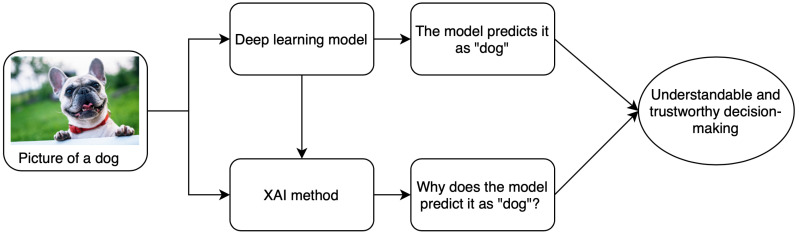
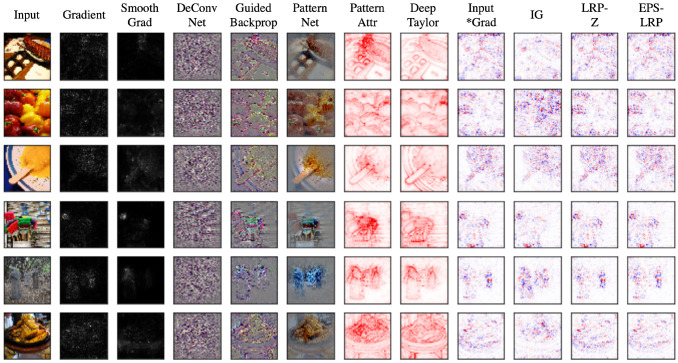

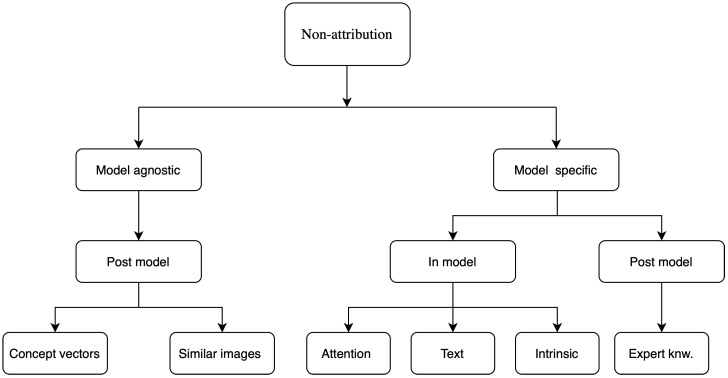
Verification
Claims the paper makes
The claims and statistics of this paper haven’t been checked yet.
Free: it reads the open-access text and checks the first 5 claims that cite a source we can check. Create a free account to check every claim.
Self-check
Percentages, sums and reported differences re-computed from the paper’s own numbers.
The self-check needs the paper’s full text.
Citations
Cites
Vaswani, A., Shazeer, N., Parmar, N., Uszkoreit, J., Jones, L., Gomez, A. N., Kaiser, L., & Polosukhin, I. (2017) · arXiv · doi:10.48550/arxiv.1706.03762 · Cited by 120,404
ImageNet classification with deep convolutional neural networks
Krizhevsky, A., Sutskever, I., & Hinton, G. E. (2017) · Communications of the ACM · doi:10.1145/3065386 · Cited by 112,155
U-Net: Convolutional Networks for Biomedical Image Segmentation
Ronneberger, O., Fischer, P., & Brox, T. (2015) · Lecture notes in computer science · doi:10.1007/978-3-319-24574-4_28 · Cited by 99,404
ImageNet: A large-scale hierarchical image database
Deng, J., Dong, W., Socher, R., Li, L.-J., Li, K., & Fei-Fei, L. (2009) · 2009 IEEE Conference on Computer Vision and Pattern Recognition · doi:10.1109/cvpr.2009.5206848 · Cited by 65,333
Going deeper with convolutions
Szegedy, C., Liu, W., Jia, Y., Sermanet, P., Reed, S., Anguelov, D., Erhan, D., Vanhoucke, V., & Rabinovich, A. (2015) · 2015 IEEE Conference on Computer Vision and Pattern Recognition (CVPR) · doi:10.1109/cvpr.2015.7298594 · Cited by 48,562
(2008) · Journal of Machine Learning Research · Cited by 33,051
Grad-CAM: Visual Explanations from Deep Networks via Gradient-Based Localization
Selvaraju, R. R., Cogswell, M., Das, A., Vedantam, R., Parikh, D., & Batra, D. (2017) · 2017 IEEE International Conference on Computer Vision (ICCV) · doi:10.1109/iccv.2017.74 · Cited by 24,513
Visualizing and understanding convolutional networks
Zeiler, M. D., & Fergus, R. (2014) · Lecture Notes in Computer Science · doi:10.1007/978-3-319-10590-1_53 · Cited by 15,839
Wold, S., Esbensen, K., & Geladi, P. (1987) · Chemometrics and Intelligent Laboratory Systems · doi:10.1016/0169-7439(87)80084-9 · Cited by 11,606
Arrieta, A. B., Díaz-Rodríguez, N., Del Ser, J., Bennetot, A., Tabik, S., Barbado, A., García, S., Gil-López, S., Molina, D., Benjamins, R., et al. (2019) · arXiv · doi:10.48550/arxiv.1910.10045 · Cited by 11,321
Barredo Arrieta, A., Díaz-Rodríguez, N., Del Ser, J., Bennetot, A., Tabik, S., Barbado, A., Garcia, S., Gil-Lopez, S., Molina, D., Benjamins, R., et al. (2020) · Information Fusion · doi:10.1016/j.inffus.2019.12.012 · Cited by 10,423 · cited 2×
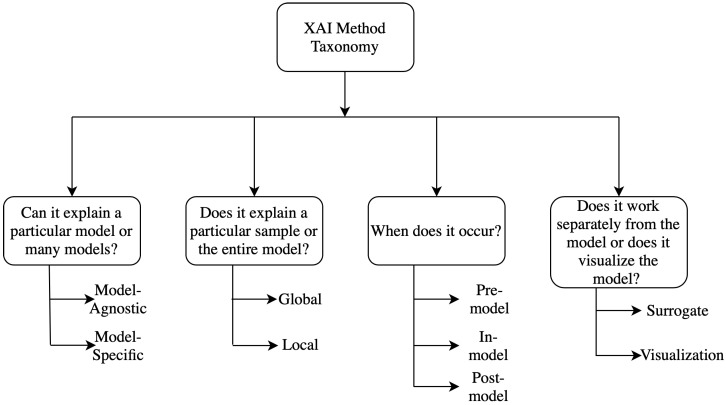
“Different kinds of taxonomies and classification methods are discussed briefly here and a detailed analysis of the taxonomies can be found in [8,9] and a flow chart for them is shown in 1.”
BackgroundGrad-CAM: Visual Explanations from Deep Networks via Gradient-Based Localization
Selvaraju, R. R., Cogswell, M., Das, A., Vedantam, R., Parikh, D., & Batra, D. (2020) · International Journal of Computer Vision · doi:10.1007/s11263-019-01228-7 · Cited by 6,909
SqueezeNet: AlexNet-level accuracy with 50x fewer parameters and <0.5MB model size
Iandola, F. N., Han, S., Moskewicz, M. W., Ashraf, K., Dally, W. J., & Keutzer, K. (2016) · arXiv · doi:10.48550/arxiv.1602.07360 · Cited by 6,201
How transferable are features in deep neural networks?
Yosinski, J., Clune, J., Bengio, Y., & Lipson, H. (2014) · arXiv · doi:10.48550/arxiv.1411.1792 · Cited by 6,061
Deep Inside Convolutional Networks: Visualising Image Classification Models and Saliency Maps
Simonyan, K., Vedaldi, A., & Zisserman, A. (2013) · arXiv · doi:10.48550/arxiv.1312.6034 · Cited by 5,370
On Pixel-Wise Explanations for Non-Linear Classifier Decisions by Layer-Wise Relevance Propagation
Bach, S., Binder, A., Montavon, G., Klauschen, F., Müller, K.-R., & Samek, W. (2015) · PLOS ONE · doi:10.1371/journal.pone.0130140 · Cited by 4,524
Axiomatic attribution for deep networks
Sundararajan, M., Taly, A., & Yan, Q. (2017) · arXiv · doi:10.48550/arxiv.1703.01365 · Cited by 4,087
A survey of decision tree classifier methodology
Safavian, S. R., & Landgrebe, D. (1991) · IEEE Transactions on Systems, Man, and Cybernetics · doi:10.1109/21.97458 · Cited by 3,808
Striving for Simplicity: The All Convolutional Net
Springenberg, J. T., Dosovitskiy, A., Brox, T., & Riedmiller, M. (2014) · arXiv · doi:10.48550/arxiv.1412.6806 · Cited by 3,447
Wang, L., Lin, Z. Q., & Wong, A. (2020) · Scientific Reports · doi:10.1038/s41598-020-76550-z · Cited by 3,113
Learning Important Features Through Propagating Activation Differences
Shrikumar, A., Greenside, P., & Kundaje, A. (2017) · arXiv · doi:10.48550/arxiv.1704.02685 · Cited by 2,761
Explainable machine-learning predictions for the prevention of hypoxaemia during surgery
Lundberg, S. M., Nair, B., Vavilala, M. S., Horibe, M., Eisses, M. J., Adams, T., Liston, D. E., Low, D. K.-W., Newman, S.-F., Kim, J., et al. (2018) · Nature Biomedical Engineering · doi:10.1038/s41551-018-0304-0 · Cited by 1,967
SmoothGrad: removing noise by adding noise
Smilkov, D., Thorat, N., Kim, B., Viégas, F., & Wattenberg, M. (2017) · arXiv · doi:10.48550/arxiv.1706.03825 · Cited by 1,467
GNNExplainer: Generating Explanations for Graph Neural Networks.
Ying, R., Bourgeois, D., You, J., Žitnik, M., & Leskovec, J. (2019) · PubMed · Cited by 1,448
Explaining nonlinear classification decisions with deep taylor decomposition
Montavon, G., Lapuschkin, S., Binder, A., Samek, W., & Müller, K.-R. (2017) · Pattern Recognition · doi:10.1016/j.patcog.2016.11.008 · Cited by 1,357
Kim, B., Wattenberg, M., Gilmer, J., Cai, C., Wexler, J., Viegas, F., & Sayres, R. (2017) · arXiv · doi:10.48550/arxiv.1711.11279 · Cited by 1,240
Jo, T., Nho, K., & Saykin, A. J. (2019) · Frontiers in Aging Neuroscience · doi:10.3389/fnagi.2019.00220 · Cited by 724
Analysis of regression in game theory approach
Lipovetsky, S., & Conklin, M. (2001) · Applied Stochastic Models in Business and Industry · doi:10.1002/asmb.446 · Cited by 650
What do we need to build explainable AI systems for the medical domain?
Holzinger, A., Biemann, C., Pattichis, C. S., & Kell, D. B. (2017) · arXiv · doi:10.48550/arxiv.1712.09923 · Cited by 636
Inceptionism: Going Deeper into Neural Networks
Mordvintsev, A., Olah, C., & Tyka, M. (2015) · Cited by 574
Kaur, H., Nori, H., Jenkins, S., Caruana, R., Wallach, H., & Wortman Vaughan, J. (2020) · Proceedings of the 2020 CHI Conference on Human Factors in Computing Systems · doi:10.1145/3313831.3376219 · Cited by 564
Yu-Jen Chen, Y.-J., Hua, K.-L., Hsu, C.-H., Cheng, W.-H., & Hidayati, S. C. (2015) · OncoTargets and Therapy · doi:10.2147/ott.s80733 · Cited by 542
Interpretability of machine learning-based prediction models in healthcare
Stiglic, G., Kocbek, P., Fijacko, N., Zitnik, M., Verbert, K., & Cilar, L. (2020) · WIREs Data Mining and Knowledge Discovery · doi:10.1002/widm.1379 · Cited by 541 · cited 2×
“Different kinds of taxonomies and classification methods are discussed briefly here and a detailed analysis of the taxonomies can be found in [8,9] and a flow chart for them is shown in 1.”
BackgroundNot Just a Black Box: Learning Important Features Through Propagating Activation Differences
Shrikumar, A., Greenside, P., Shcherbina, A., & Kundaje, A. B. (2016) · arXiv (Cornell University) · doi:10.48550/arxiv.1605.01713 · Cited by 496
Arbabshirani, M. R., Fornwalt, B. K., Mongelluzzo, G. J., Suever, J. D., Geise, B. D., Patel, A. A., & Moore, G. J. (2018) · npj Digital Medicine · doi:10.1038/s41746-017-0015-z · Cited by 443
Sayres, R., Taly, A., Rahimy, E., Blumer, K., Coz, D., Hammel, N., Krause, J., Narayanaswamy, A., Rastegar, Z., Wu, D., et al. (2019) · Ophthalmology · doi:10.1016/j.ophtha.2018.11.016 · Cited by 418
iNNvestigate neural networks!Preprint
Alber, M., Lapuschkin, S., Seegerer, P., Hägele, M., Schütt, K. T., Montavon, G., Samek, W., Müller, K., Dähne, S., & Kindermans, P.-J. (2018) · arXiv (Cornell University) · doi:10.48550/arxiv.1808.04260 · Cited by 400
Towards better understanding of gradient-based attribution methods for Deep Neural Networks
Ancona, M., Ceolini, E., Öztireli, C., & Groß, M. H. (2017) · Zurich Open Repository and Archive (University of Zurich) · doi:10.3929/ethz-b-000249929 · Cited by 368
MDNet: A Semantically and Visually Interpretable Medical Image Diagnosis Network
Zhang, Z., Xie, Y., Xing, F., McGough, M., & Yang, L. (2017) · 2017 IEEE Conference on Computer Vision and Pattern Recognition (CVPR) · doi:10.1109/cvpr.2017.378 · Cited by 354 · cited 2×
“ges DeepDreams [46] Custom CNN Segmentation of tumor from liver CT imaging GSInquire, GBP, activation maps [47] COVIDNet CNN COVID-19 detection X-ray images Attention Mapping between image to reports [53] CNN & LSTM Bladder cancer Tissue images U-Net with shape attention stream [54] U-net based Cardiac volume esti…”
MethodOne Explanation Does Not Fit All: A Toolkit and Taxonomy of AI Explainability Techniques
Arya, V., Bellamy, R. K. E., Chen, P.-Y., Dhurandhar, A., Hind, M., Hoffman, S. C., Houde, S., Liao, Q. V., Luss, R., Mojsilović, A., et al. (2019) · arXiv · doi:10.48550/arxiv.1909.03012 · Cited by 268 · cited 1×
“Several taxonomies have been proposed in the literature to classify different explainability methods[9, 10].”
BackgroundLearning how to explain neural networks: PatternNet and PatternAttribution
Kindermans, P.-J., Schütt, K. T., Alber, M., Müller, K. R., Erhan, D., Kim, B., & Dähne, S. (2017) · arXiv (Cornell University) · doi:10.48550/arxiv.1705.05598 · Cited by 264
SAUNet: Shape Attentive U-Net for Interpretable Medical Image Segmentation
Sun, J., Darbehani, F., Zaidi, M., & Wang, B. (2020) · Lecture notes in computer science · doi:10.1007/978-3-030-59719-1_77 · Cited by 207
Ophthalmic diagnosis using deep learning with fundus images – A critical review
Sengupta, S., Singh, A., Leopold, H. A., Gulati, T., & Lakshminarayanan, V. (2020) · Artificial Intelligence in Medicine · doi:10.1016/j.artmed.2019.101758 · Cited by 201
Self-citationWickstrøm, K., Kampffmeyer, M., & Jenssen, R. (2020) · Medical Image Analysis · doi:10.1016/j.media.2019.101619 · Cited by 185
Breast Mass Classification from Mammograms using Deep Convolutional Neural Networks
Lévy, D., & Jain, A. (2016) · arXiv (Cornell University) · doi:10.48550/arxiv.1612.00542 · Cited by 166
Pereira, S., Meier, R., Alves, V., Reyes, M., & Silva, C. A. (2018) · Lecture notes in computer science · doi:10.1007/978-3-030-02628-8_12 · Cited by 164
A unified view of gradient-based attribution methods for Deep Neural NetworksPreprint
Ancona, M., Ceolini, E., Öztireli, C., & Groß, M. H. (2017) · arXiv (Cornell University) · doi:10.3929/ethz-b-000237705 · Cited by 153
Explaining Models by Propagating Shapley Values of Local Components
Chen, H., Lundberg, S., & Lee, S. (2020) · Studies in computational intelligence · doi:10.1007/978-3-030-53352-6_24 · Cited by 151
Regression Concept Vectors for Bidirectional Explanations in Histopathology
Graziani, M., Andrearczyk, V., & Müller, H. (2018) · Lecture notes in computer science · doi:10.1007/978-3-030-02628-8_14 · Cited by 112
Lin, Z. Q., Shafiee, M. J., Bochkarev, S., Jules, M. S., Wang, X. Y., & Wong, A. K. C. (2019) · arXiv (Cornell University) · doi:10.48550/arxiv.1910.07387 · Cited by 108
Interpretable Predictions of Clinical Outcomes with An Attention-based Recurrent Neural Network
Sha, Y., & Wang, M. D. (2017) · ACM International Conference on Bioinformatics, Computational Biology, and Health Informatics (ACM-BCB) · doi:10.1145/3107411.3107445 · Cited by 104
Deep Neural Network or Dermatologist?
Young, K. C., Booth, G., Simpson, B., Dutton, R., & Shrapnel, S. (2019) · Lecture notes in computer science · doi:10.1007/978-3-030-33850-3_6 · Cited by 99
Confident texture-based laryngeal tissue classification for early stage diagnosis support
Moccia, S., Momi, E. D., Guarnaschelli, M., Savazzi, M., Laborai, A., Guastini, L., Peretti, G., & Mattos, L. S. (2017) · Journal of medical imaging · doi:10.1117/1.jmi.4.3.034502 · Cited by 90
Explainable Anatomical Shape Analysis Through Deep Hierarchical Generative Models
Biffi, C., Cerrolaza, J. J., Tarroni, G., Bai, W., de Marvao, A., Oktay, O., Ledig, C., Folgoc, L. L., Kamnitsas, K., Doumou, G., et al. (2020) · IEEE Transactions on Medical Imaging · doi:10.1109/tmi.2020.2964499 · Cited by 79
Papanastasopoulos, Z., Samala, R. K., Chan, H., Hadjiiski, L. M., Paramagul, C., Helvie, M. A., & Neal, C. H. (2020) · SPIE Medical Imaging: Computer-Aided Diagnosis · doi:10.1117/12.2549298 · Cited by 78
Eitel, F., Ritter, K., & Initiative, A. D. N. (2019) · Lecture notes in computer science · doi:10.1007/978-3-030-33850-3_1 · Cited by 75
Visualizing Convolutional Neural Networks to Improve Decision Support for Skin Lesion Classification
Molle, P. V., Strooper, M. D., Verbelen, T., Vankeirsbilck, B., Simoens, P., & Dhoedt, B. (2018) · Lecture notes in computer science · doi:10.1007/978-3-030-02628-8_13 · Cited by 73
MDNet: A Semantically and Visually Interpretable Medical Image Diagnosis NetworkPreprint
Zhang, Z., Xie, Y., Xing, F., et al. (2017) · arXiv (Cornell University) · doi:10.48550/arxiv.1707.02485 · Cited by 64
Uncertainty-aware organ classification for surgical data science applications in laparoscopy
Moccia, S., Wirkert, S. J., Kenngott, H., Vemuri, A. S., Apitz, M., Mayer, B., De Momi, E., Mattos, L. S., & Maier-Hein, L. (2018) · IEEE Transactions on Biomedical Engineering · doi:10.1109/tbme.2018.2813015 · Cited by 56
Towards Complementary Explanations Using Deep Neural Networks
Silva, W., Fernandes, K., Cardoso, M. J., & Cardoso, J. S. (2018) · Lecture notes in computer science · doi:10.1007/978-3-030-02628-8_15 · Cited by 53
Codella, N. C. F., Lin, C.-C., Halpern, A., Hind, M., Feris, R., & Smith, J. R. (2018) · Lecture Notes in Computer Science · doi:10.1007/978-3-030-02628-8_11 · Cited by 52
Agreement among ophthalmologists in marking the optic disc and optic cup in fundus images
Almazroa, A. A., Alodhayb, S., Osman, E., Ramadan, E., Hummadi, M., Dlaim, M., Alkatee, M., Raahemifar, K., & Lakshminarayanan, V. (2016) · International Ophthalmology · doi:10.1007/s10792-016-0329-x · Cited by 49
Self-citationLee, H., Kim, S. T., & Ro, Y. M. (2019) · Lecture notes in computer science · doi:10.1007/978-3-030-33850-3_3 · Cited by 46
Towards Interpretability of Segmentation Networks by Analyzing DeepDreams
Couteaux, V., Nempont, O., Pizaine, G., & Isabelle Bloch, A. (2019) · Lecture notes in computer science · doi:10.1007/978-3-030-33850-3_7 · Cited by 42
Glaucoma diagnosis using transfer learning methods
Singh, A., Sengupta, S., & Lakshminarayanan, V. (2019) · SPIE Applications of Machine Learning · doi:10.1117/12.2529429 · Cited by 39
Self-citationYang, H.-L., Kim, J. J., Kim, J. H., Kang, Y. K., Park, D. H., Park, H. S., Kim, H. K., & Kim, M.-S. (2019) · PLoS ONE · doi:10.1371/journal.pone.0215076 · Cited by 38
Eslami, T., Raiker, J. S., & Saeed, F. (2021) · Elsevier eBooks · doi:10.1016/b978-0-12-822822-7.00004-1 · Cited by 35
Interpretation of deep learning using attributions: application to ophthalmic diagnosis
Singh, A., Rasheed, M. A., Zelek, J., & Lakshminarayanan, V. (2020) · SPIE Applications of Machine Learning · doi:10.1117/12.2568631 · Cited by 32
Self-citationMeyes, R., de Puiseau, C. W., Posada-Moreno, A. F., & Meisen, T. (2020) · arXiv (Cornell University) · doi:10.48550/arxiv.2004.01254 · Cited by 29
Adler, T. J., Ardizzone, L., Vemuri, A., Ayala, L. A., Gröhl, J., Kirchner, T., Wirkert, S., Kruse, J., Rother, C., Köthe, U., et al. (2019) · International Journal of Computer Assisted Radiology and Surgery · doi:10.1007/s11548-019-01939-9 · Cited by 28
UBS: A Dimension-Agnostic Metric for Concept Vector Interpretability Applied to Radiomics
Yèche, H., Harrison, J., & Berthier, T. (2019) · Lecture notes in computer science · doi:10.1007/978-3-030-33850-3_2 · Cited by 28
Guideline-Based Additive Explanation for Computer-Aided Diagnosis of Lung Nodules
Zhu, P., & Ogino, M. (2019) · Lecture notes in computer science · doi:10.1007/978-3-030-33850-3_5 · Cited by 26
Incorporating Task-Specific Structural Knowledge into CNNs for Brain Midline Shift Detection
Pisov, M., Goncharov, M., Kurochkina, N., Morozov, S. P., Gombolevskiy, V. А., Chernina, V., Vladzymyrskyy, A. V., Zamyatina, K., Chesnokova, A., Pronin, I., et al. (2019) · Lecture notes in computer science · doi:10.1007/978-3-030-33850-3_4 · Cited by 24
SAUNet: Shape Attentive U-Net for Interpretable Medical Image SegmentationPreprint
Sun, J., Darbehani, F., Zaidi, M., et al. (2020) · arXiv (Cornell University) · doi:10.48550/arxiv.2001.07645 · Cited by 21
Explainable 3D convolutional neural network using GMM encoding
Stano, M., Benešová, W., & Marták, L. S. (2020) · International Conference on Machine Vision · doi:10.1117/12.2557314 · Cited by 10
Classification of brain lesions from MRI images using a novel neural network
Bamba, U., Pandey, D., & Lakshminarayanan, V. (2020) · doi:10.1117/12.2543960 · Cited by 6
Self-citationLin, Z. Q., Shafiee, M. J., Bochkarev, S., Jules, M. S., Wang, X., & Wong, A. K. C. (2019) · arXiv (Cornell University) · Cited by 3
Research works printed but not linked: 2
- El-Baz, A.S. (2020). Recent Advances in Deep Learning Applications for Retinal Diagnosis using OCT. State of the Art in Neural Networks, Elsevier. in press.
- Goodfellow, I.J., Shlens, J., and Szegedy, C. (2014). Explaining and harnessing adversarial examples. arXiv.
Cited by
Transformers in medical imaging: A survey
Shamshad, F., Khan, S., Zamir, S. W., Khan, M. H., Hayat, M., Khan, F. S., & Fu, H. (2023) · Medical Image Analysis · doi:10.1016/j.media.2023.102802 · Cited by 1,296
Explainable artificial intelligence: a comprehensive review
Minh, D., Wang, H. X., Li, Y. F., & Nguyen, T. N. (2022) · Artificial Intelligence Review · doi:10.1007/s10462-021-10088-y · Cited by 983
Loh, H. W., Ooi, C. P., Seoni, S., Barua, P. D., Molinari, F., & Acharya, U. R. (2022) · Computer Methods and Programs in Biomedicine · doi:10.1016/j.cmpb.2022.107161 · Cited by 734
Interpretable deep learning: interpretation, interpretability, trustworthiness, and beyond
Li, X., Xiong, H., Li, X., Wu, X., Zhang, X., Liu, J., Bian, J., & Dou, D. (2022) · Knowledge and Information Systems · doi:10.1007/s10115-022-01756-8 · Cited by 497
Advances in medical image analysis with vision Transformers: A comprehensive review
Azad, R., Kazerouni, A., Heidari, M., Aghdam, E. K., Molaei, A., Jia, Y., Jose, A., Roy, R., & Merhof, D. (2024) · Medical Image Analysis · doi:10.1016/j.media.2023.103000 · Cited by 485
Metadata
- Authors
- Singh, A., Sengupta, S., & Lakshminarayanan, V.
- Affiliations
- University of Waterloo (CA)
- Corresponding author
- Singh, Amitojdeep
- Venue
- Journal of Imaging
- Publisher
- MDPI AG
- Published
- 2020-06-20
- Volume
- 6
- Issue
- 6
- Pages
- 52
- ISSN
- 2313-433X (ISSN-L)
- PMC
- PMC8321083
- OpenAlex
- W3031116957
- Semantic Scholar
- af6af40155860ac2fd36680e63686473803b5f52
- Cited by
- 718
- References
- 75
- Citations by year
- 2026: 82 · 2025: 135 · 2024: 132 · 2023: 154 · 2022: 130 · 2021: 77 · 2020: 8
- FWCI
- 3.17
- Type
- journal article
- Language
- en
- Open access
- gold
- dx.doi.org
- Licence
- Locations
- Journal of Imaging (publishedVersion, cc-by)
- PubMed Central (publishedVersion, cc-by)
- PubMed (publishedVersion)
- arXiv (Cornell University) (submittedVersion)
- DOAJ (DOAJ: Directory of Open Access Journals) (submittedVersion, cc-by-sa)
- arXiv (Cornell University) (cc-by)
- Funders
- Nvidia
- Compute Canada
- Natural Sciences and Engineering Research Council of Canada
- Topics
- Physical Sciences › Computer Science › Artificial Intelligence › Explainable Artificial Intelligence (XAI)
- Health Sciences › Medicine › Health Informatics › Artificial Intelligence in Healthcare and Education
- Health Sciences › Medicine › Radiology, Nuclear Medicine and Imaging › Radiomics and Machine Learning in Medical Imaging
- Keywords
- explainable deep learning, medical image analysis, model interpretability, black-box models, clinical deployment, feature importance, diagnosis
About these checks
Registry, retraction, Cites and statistics results are computed, not judged, with one exception: a printed reference that no index lists is read once by a model before it counts as a citation error. Claims are extracted by a model and kept only when their quote appears verbatim in the text; each cited source is then checked, with a model’s help, for whether it says what the claim relies on. Those verdicts can be wrong — read the claim’s quote and the cited source before relying on one.
Statistics and arithmetic are recomputed, not judged.
Confidence bands are shown only for fields calibrated on our annotated test set. None is calibrated yet, so no band is shown.
What counts as a claim ›How we measure confidence ›How we check this ›
Are you an author, or do you see a problem with this page? Request a review
Data sources
Bibliographic data: Semantic Scholar, OpenAlex, Crossref.
Contains information from the Semantic Scholar Academic Graph Datasets, made available under the ODC Attribution License (ODC-BY 1.0).
Semantic Scholar’s data is described in: Kinney, R., et al. (2023). The Semantic Scholar Open Data Platform. arXiv:2301.10140.
