

Significant Differences in Intestinal Microbial Communities in Aquatic Animals from an Aquaculture Area
Open accessThe DOI matches its Crossref record; 41 of the 41 references it cites were found in a registry or an index.
Abstract
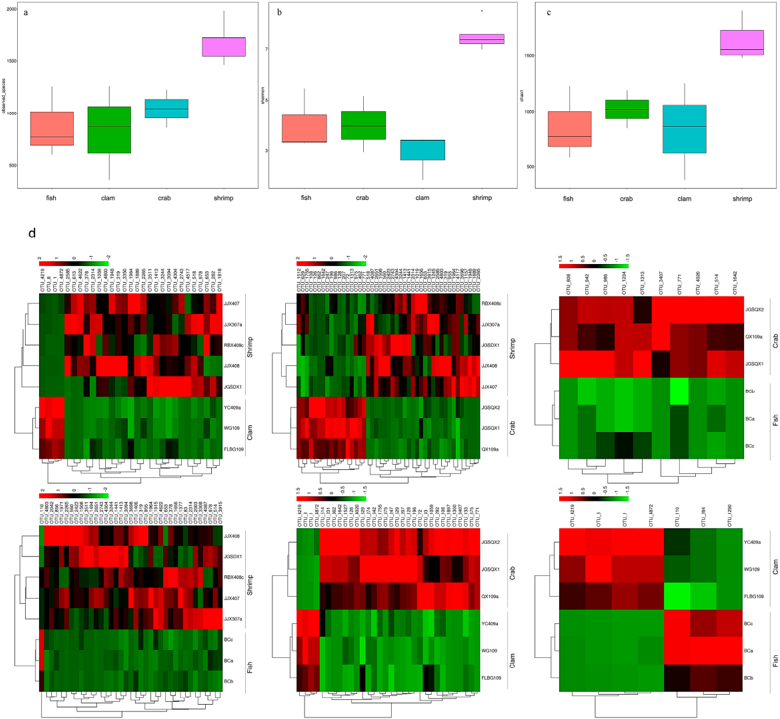
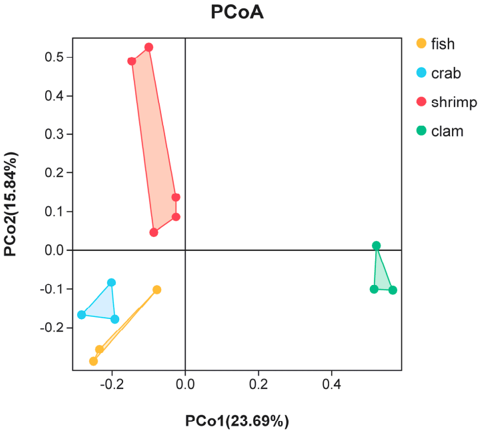
While much attention has been given to the role of animal intestinal microbes, few studies have focused on microbial communities and associated functions in cultured aquatic animals. In this study, high–throughput sequencing was used to analyze intestinal microbial communities and functions in fish, shrimp, crab and razor clams. Alpha diversity analyses showed significant differences in intestinal microbial diversity amongst these aquatic animals, and that shrimp intestines harbored the highest diversity and species numbers. T–test analyses (p < 0.05) showed significant differences in dominant microbial operational taxonomic units (OTUs) between all aquatic animals. Predominant intestinal bacteria included; Gammaproteobacteria, Fusobacteria, Mollicutes, Spirochaetia, Cyanobacteria, Bacteroidia and Bacilli. Similarly, anaerobic bacteria were highly diverse in animal intestines and included; Vibrio, Photobacterium, Cetobacterium, Propionigenium, Candidatus Hepatoplasma, Paraclostridium, and Lactobacillus. Principal co–ordinate analysis indicated that the distribution characteristics of intestinal microbes varied with animal species; in particular, we observed a high variability among shrimp intestinal samples. This variability indicated these genera had suitability for the different intestinal environment. Function prediction analysis indicated significant differences amongst different animals in the major functional groups, and that microbial functional profiles were strongly shaped by the intestinal environment. Thus, this study provides an important reference for future studies investigating crosstalk between aquatic animal hosts and their intestinal microbiota.
Overview
The claims and statistics of this paper haven’t been checked yet.
Free: it reads the open-access text and checks the first 5 claims that cite a source we can check. Create a free account to check every claim.
Integrity signals
Registry
Cites
Statistics
Figures



Verification
Claims the paper makes
The claims and statistics of this paper haven’t been checked yet.
Free: it reads the open-access text and checks the first 5 claims that cite a source we can check. Create a free account to check every claim.
Claims other papers make about this one
Each is checked against this paper’s own text: does it say what the citing paper says it does?
The source backs part of the claim, not all of it — or backs it for a different population, condition or comparison.
In the citing paper
“However, other factors can also be involved in the modulation of the microbiota such as host selection pressure and genetic background (Li et al., 2012; Sun and Xu, 2021).”
From The Active Microbiota of the Eggs and the Nauplii of the Pacific Blue Shrimp Litopenaeus stylirostris Partially Shaped by a Potential Vertical Transmission (2022) · cites this paper as Sun and Xu, 2021
Experimental — accuracy not yet measured
Self-check
Percentages, sums and reported differences re-computed from the paper’s own numbers.
The self-check needs the paper’s full text.
Citations
Cites
The gut microbiota shapes intestinal immune responses during health and disease
Round, J. L., & Mazmanian, S. K. (2009) · Nature Reviews Immunology · doi:10.1038/nri2515 · Cited by 5,029
Functional interactions between the gut microbiota and host metabolism
Tremaroli, V., & Bäckhed, F. (2012) · Nature · doi:10.1038/nature11552 · Cited by 4,387
Evolution of mammals and their gut microbes
Ley, R. E., Hamady, M., Lozupone, C., Turnbaugh, P. J., Ramey, R. R., Bircher, J. S., Schlegel, M. L., Tucker, T. A., Schrenzel, M. D., Knight, R., et al. (2008) · Science · doi:10.1126/science.1155725 · Cited by 3,747 · cited 1×
“Contributing to these factors is the host genetic background, which determines host nutritional levels, potentially affecting intestinal microbiome diversity [10,19].”
BackgroundDecoupling function and taxonomy in the global ocean microbiome
Louca, S., Parfrey, L. W., & Doebeli, M. (2016) · Science · doi:10.1126/science.aaf4507 · Cited by 3,510
Probiotic Bacteria as Biological Control Agents in Aquaculture
Verschuere, L., Rombaut, G., Sorgeloos, P., & Verstraete, W. (2000) · Microbiology and Molecular Biology Reviews · doi:10.1128/mmbr.64.4.655-671.2000 · Cited by 2,283
The role of the gut microbiota in nutrition and health
Flint, H. J., Scott, K. P., Louis, P., & Duncan, S. H. (2012) · Nature Reviews Gastroenterology & Hepatology · doi:10.1038/nrgastro.2012.156 · Cited by 2,182
The role of probiotics in aquaculture
BALCAZAR, J., BLAS, I., RUIZZARZUELA, I., CUNNINGHAM, D., VENDRELL, D., & MUZQUIZ, J. (2006) · Veterinary Microbiology · doi:10.1016/j.vetmic.2006.01.009 · Cited by 1,341
Benson, A. K., Kelly, S. A., Legge, R., Ma, F., Low, S. J., Kim, J., Zhang, M., Oh, P. L., Nehrenberg, D., Hua, K., et al. (2010) · Proceedings of the National Academy of Sciences · doi:10.1073/pnas.1007028107 · Cited by 1,314
The use of probiotics in aquaculture
Gatesoupe, F. J. (1999) · Aquaculture · doi:10.1016/s0044-8486(99)00187-8 · Cited by 1,220
Evidence for a core gut microbiota in the zebrafish
Roeselers, G., Mittge, E. K., Stephens, W. Z., Parichy, D. M., Cavanaugh, C. M., Guillemin, K., & Rawls, J. F. (2011) · The ISME Journal · doi:10.1038/ismej.2011.38 · Cited by 1,138
Role of gastrointestinal microbiota in fish
Nayak, S. K. (2010) · Aquaculture Research · doi:10.1111/j.1365-2109.2010.02546.x · Cited by 1,073 · cited 1×
“It has been reported that intestinal microbes play important roles in nutritional metabolic processes [3,4].”
BackgroundLinks between diet, gut microbiota composition and gut metabolism
Flint, H. J., Duncan, S. H., Scott, K. P., & Louis, P. (2015) · Proceedings of the Nutrition Society · doi:10.1017/s0029665114001463 · Cited by 1,020
Gnotobiotic zebrafish reveal evolutionarily conserved responses to the gut microbiota
Rawls, J. F., Samuel, B. S., & Gordon, J. I. (2004) · Proceedings of the National Academy of Sciences · doi:10.1073/pnas.0400706101 · Cited by 979
Vibrio harveyi: a significant pathogen of marine vertebrates and invertebrates
Austin, B., & Zhang, X.-H. (2006) · Letters in Applied Microbiology · doi:10.1111/j.1472-765x.2006.01989.x · Cited by 797
Llewellyn, M. S., Boutin, S., Hoseinifar, S. H., & Derome, N. (2014) · Frontiers in Microbiology · doi:10.3389/fmicb.2014.00207 · Cited by 745
Intestinal Microbial Diversity during Early-Life Colonization Shapes Long-Term IgE Levels
Cahenzli, J., Köller, Y., Wyss, M., Geuking, M. B., & McCoy, K. D. (2013) · Cell Host & Microbe · doi:10.1016/j.chom.2013.10.004 · Cited by 611 · cited 1×
“Studies have shown that intestinal microbial communities with different structures and compositions, directly affect host nutritional metabolism and sensitivity to pathogenic bacterial infections [7,8].”
BackgroundLiu, H., Guo, X., Gooneratne, R., Lai, R., Zeng, C., Zhan, F., & Wang, W. (2016) · Scientific Reports · doi:10.1038/srep24340 · Cited by 524
Tsuchiya, C., Sakata, T., & Sugita, H. (2007) · Letters in Applied Microbiology · doi:10.1111/j.1472-765x.2007.02258.x · Cited by 520
The role of microorganisms in aquaculture ponds
Moriarty, D. J. W. (1997) · Aquaculture · doi:10.1016/s0044-8486(96)01487-1 · Cited by 497
Bacterial Interactions in Early Life Stages of Marine Cold Water Fish
Hansen, G. H., & Olafsen, J. A. (1999) · Microbial Ecology · doi:10.1007/s002489900158 · Cited by 488
Characterization of the gut microbiota of three commercially valuable warmwater fish species
Larsen, A. M., Mohammed, H. H., & Arias, C. R. (2014) · Journal of Applied Microbiology · doi:10.1111/jam.12475 · Cited by 438
Regulation of life span by the gut microbiota in the short-lived African turquoise killifish
Smith, P., Willemsen, D., Popkes, M., Metge, F., Gandiwa, E., Reichard, M., & Valenzano, D. R. (2017) · eLife · doi:10.7554/elife.27014 · Cited by 423 · cited 1×
“Propionate is involved in regulatory functions in intestinal physiology and immune systems [28].”
BackgroundInteractions between fish larvae and bacteria in marine aquaculture
Olafsen, J. A. (2001) · Aquaculture · doi:10.1016/s0044-8486(01)00702-5 · Cited by 414
Zorriehzahra, M. J., Delshad, S. T., Adel, M., Tiwari, R., Karthik, K., Dhama, K., & Lazado, C. C. (2016) · Veterinary Quarterly · doi:10.1080/01652176.2016.1172132 · Cited by 380
The bacterial microflora of fish, revised
Austin, B. (2006) · The Scientific World JOURNAL · doi:10.1100/tsw.2006.181 · Cited by 346 · cited 1×
“Several studies have shown that intestinal microbial composition in such animals, contribute to vitamin synthesis, growth and development, material metabolism, and is related to intestinal development, immune responses and host resistance to disease [5,6].”
BackgroundRungrassamee, W., Klanchui, A., Maibunkaew, S., Chaiyapechara, S., Jiravanichpaisal, P., & Karoonuthaisiri, N. (2014) · PLoS ONE · doi:10.1371/journal.pone.0091853 · Cited by 284
Intestinal microbiota composition in fishes is influenced by host ecology and environment
WONG, S., & RAWLS, J. F. (2012) · Molecular Ecology · doi:10.1111/j.1365-294x.2012.05646.x · Cited by 276
Rungrassamee, W., Klanchui, A., Maibunkaew, S., & Karoonuthaisiri, N. (2016) · Journal of Invertebrate Pathology · doi:10.1016/j.jip.2015.11.004 · Cited by 222 · cited 1×
“Several members of the Vibrio genus are considered primary disease pathogens, causing death in aquaculture animals, and seriously endangering aquaculture systems [29,30].”
BackgroundAbid, A., Davies, S. J., Waines, P., Emery, M., Castex, M., Gioacchini, G., Carnevali, O., Bickerdike, R., Romero, J., & Merrifield, D. L. (2013) · Fish & Shellfish Immunology · doi:10.1016/j.fsi.2013.09.039 · Cited by 210
Lantibiotics produced by lactic acid bacteria: structure, function and applications
Twomey, D., Ross, R. P., Ryan, M., Meaney, B., & Hill, C. (2002) · Antonie van Leeuwenhoek · doi:10.1023/a:1020660321724 · Cited by 180
Host‐specificity of environmentally transmitted Mycoplasma ‐like isopod symbionts
Fraune, S., & Zimmer, M. (2008) · Environmental Microbiology · doi:10.1111/j.1462-2920.2008.01672.x · Cited by 137
Bacterial Community Associated with the Intestinal Tract of P. monodon in Commercial Farms
Chaiyapechara, S., Rungrassamee, W., Suriyachay, I., Kuncharin, Y., Klanchui, A., Karoonuthaisiri, N., & Jiravanichpaisal, P. (2011) · Microbial Ecology · doi:10.1007/s00248-011-9936-2 · Cited by 136
Alonso-Fernández, S., Castro, M. C., Berdasco, M., García-de-la-Banda, I., Moreno-Ventas, X., & Hernández-de-Rojas, A. (2018) · Probiotics and Antimicrobial Proteins · doi:10.1007/s12602-018-9439-2 · Cited by 135
Schink, B., & Pfennig, N. (1982) · Archives of Microbiology · doi:10.1007/bf00415003 · Cited by 134
Sun, F., Wang, Y., Wang, C., Zhang, L., Tu, K., & Zheng, Z. (2019) · Aquaculture · doi:10.1016/j.aquaculture.2019.04.026 · Cited by 115
Self-citationPrice, C. E., Zeyniyev, A., Kuipers, O. P., & Kok, J. (2012) · FEMS Microbiology Reviews · doi:10.1111/j.1574-6976.2011.00323.x · Cited by 66
Microbial community ecology: Function over phylogeny
Gibbons, S. M. (2017) · Nature Ecology & Evolution · doi:10.1038/s41559-016-0032 · Cited by 61
Lactic acid bacteria: genetics, metabolism and applications
Siezen, R. J., Kok, J., Abee, T., & Schaafsma, G. (2002) · Springer eBooks · doi:10.1007/978-94-017-2029-8_1 · Cited by 57
Wang, C.-Z., Lin, G.-R., Yan, T., Zheng, Z.-P., Chen, B., & Sun, F.-L. (2014) · Fisheries Science · doi:10.1007/s12562-014-0765-3 · Cited by 55
Self-citationHamid, A., Sakata, T., & Kakimoto, D. (1979) · NIPPON SUISAN GAKKAISHI · doi:10.2331/suisan.45.99 · Cited by 41
Sun, F., Wang, C., Chen, L., Weng, G., & Zheng, Z. (2019) · Applied Microbiology and Biotechnology · doi:10.1007/s00253-019-10236-z · Cited by 41
Self-citation
Cited by
Yang, H., Wu, J., Du, H., Zhang, H., Li, J., & Wei, Q. (2022) · Frontiers in Microbiology · doi:10.3389/fmicb.2021.828409 · Cited by 39
Sun, F., Yang, H., Zhang, X., Tan, F., & Shi, Q. (2022) · Ecological Indicators · doi:10.1016/j.ecolind.2022.109569 · Cited by 38
Self-citationFeng, W., Feng, W., Ge, J., Li, J., Su, S., Jia, R., Yu, J., Xu, P., & Tang, Y. (2021) · Comparative Biochemistry and Physiology Part D Genomics and Proteomics · doi:10.1016/j.cbd.2021.100924 · Cited by 40
Jiang, H., Li, R., Zhao, M., Peng, X., Sun, M., Liu, C., Liu, G., & Xue, H. (2024) · Aquatic Toxicology · doi:10.1016/j.aquatox.2024.106844 · Cited by 31
Giraud, C., Callac, N., Boulo, V., Lam, J.-S., Pham, D., Selmaoui-Folcher, N., & Wabete, N. (2022) · Frontiers in Microbiology · doi:10.3389/fmicb.2022.886752 · Cited by 26
Metadata
- Authors
- Sun, F., & Xu, Z.
- Affiliations
- Chinese Academy of Sciences (CN)
- Corresponding author
- Xu, Zhantang
- ORCID
- Sun, Fulin
- Venue
- Journal of Marine Science and Engineering
- Publisher
- MDPI AG
- Published
- 2021-01-20
- Volume
- 9
- Issue
- 2
- Pages
- 104
- ISSN
- 2077-1312 (ISSN-L)
- OpenAlex
- W3123503854
- Cited by
- 35
- References
- 41
- Citations by year
- 2026: 5 · 2025: 6 · 2024: 6 · 2023: 9 · 2022: 7 · 2021: 2
- FWCI
- 2.24
- Type
- journal article
- Language
- en
- Open access
- gold
- doi.org
- Licence
- Locations
- Journal of Marine Science and Engineering (publishedVersion, cc-by)
- DOAJ (DOAJ: Directory of Open Access Journals) (submittedVersion, cc-by-sa)
- Funders
- Guangdong Science and Technology Department (2017A020216008)
- Key deployment project of Marine Science Research Center of Chinese Academy of Sciences (COMS2019J10)
- Topics
- Life Sciences › Immunology and Microbiology › Immunology › Aquaculture disease management and microbiota
- Life Sciences › Biochemistry, Genetics and Molecular Biology › Molecular Biology › Gut microbiota and health
- Physical Sciences › Environmental Science › Ecology › Microbial Community Ecology and Physiology
- Keywords
- gut microbiota, aquatic animals, fish, shrimp, crabs, razor clam, microbial diversity, anaerobic bacteria, Vibrio, host-microbe interactions, aquaculture, microbial functional profiles
About these checks
Registry, retraction, Cites and statistics results are computed, not judged, with one exception: a printed reference that no index lists is read once by a model before it counts as a citation error. Claims are extracted by a model and kept only when their quote appears verbatim in the text; each cited source is then checked, with a model’s help, for whether it says what the claim relies on. Those verdicts can be wrong — read the claim’s quote and the cited source before relying on one.
Statistics and arithmetic are recomputed, not judged.
Confidence bands are shown only for fields calibrated on our annotated test set. None is calibrated yet, so no band is shown.
What counts as a claim ›How we measure confidence ›How we check this ›
Are you an author, or do you see a problem with this page? Request a review
Data sources
Bibliographic data: Semantic Scholar, OpenAlex, Crossref.
Contains information from the Semantic Scholar Academic Graph Datasets, made available under the ODC Attribution License (ODC-BY 1.0).
Semantic Scholar’s data is described in: Kinney, R., et al. (2023). The Semantic Scholar Open Data Platform. arXiv:2301.10140.
