

The CWI Pathway: Regulation of the Transcriptional Adaptive Response to Cell Wall Stress in Yeast
Open accessThe DOI matches its Crossref record; 95 of the 96 references it cites were found in a registry or an index.
Abstract
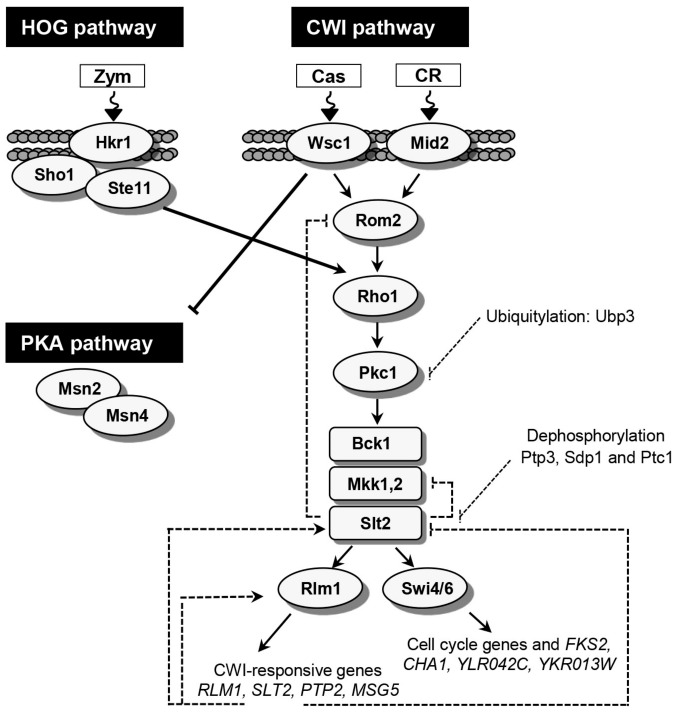
Fungi are surrounded by an essential structure, the cell wall, which not only confers cell shape but also protects cells from environmental stress. As a consequence, yeast cells growing under cell wall damage conditions elicit rescue mechanisms to provide maintenance of cellular integrity and fungal survival. Through transcriptional reprogramming, yeast modulate the expression of genes important for cell wall biogenesis and remodeling, metabolism and energy generation, morphogenesis, signal transduction and stress. The yeast cell wall integrity (CWI) pathway, which is very well conserved in other fungi, is the key pathway for the regulation of this adaptive response. In this review, we summarize the current knowledge of the yeast transcriptional program elicited to counterbalance cell wall stress situations, the role of the CWI pathway in the regulation of this program and the importance of the transcriptional input received by other pathways. Modulation of this adaptive response through the CWI pathway by positive and negative transcriptional feedbacks is also discussed. Since all these regulatory mechanisms are well conserved in pathogenic fungi, improving our knowledge about them will have an impact in the developing of new antifungal therapies.
Overview
The claims and statistics of this paper haven’t been checked yet.
Free: it reads the open-access text and checks the first 5 claims that cite a source we can check. Create a free account to check every claim.
Integrity signals
Registry
Cites
Statistics
Figures
Verification
Claims the paper makes
The claims and statistics of this paper haven’t been checked yet.
Free: it reads the open-access text and checks the first 5 claims that cite a source we can check. Create a free account to check every claim.
Claims other papers make about this one
Each is checked against this paper’s own text: does it say what the citing paper says it does?
The source backs part of the claim, not all of it — or backs it for a different population, condition or comparison.
In the citing paper
“Among these are the cell wall integrity/protein kinase C pathway, the Ca2+/calcineurin pathway, a second MAPK cascade, the HOG pathway, and the pH-sensing PacC pathway (461–463).”
From Aspergillus fumigatus and Aspergillosis in 2019 (2019) · cites this paper as [463]
Experimental — accuracy not yet measured
Self-check
Percentages, sums and reported differences re-computed from the paper’s own numbers.
The self-check needs the paper’s full text.
Citations
Cites
Engineering stability in gene networks by autoregulation
Becskei, A., & Serrano, L. (2000) · Nature · doi:10.1038/35014651 · Cited by 1,520 · cited 1×
“In contrast to negative autoregulation, which speed up transcriptional gene circuits [81], positive autoregulation that occurs when a transcription factor enhance its own production rate amplifies gene expression and slow down the kinetics of gene expression [82].”
BackgroundThe Fungal Cell Wall: Structure, Biosynthesis, and Function
Gow, N. A. R., Latge, J.-P., & Munro, C. A. (2017) · Microbiology Spectrum · doi:10.1128/microbiolspec.funk-0035-2016 · Cited by 1,423 · cited 3×
“α-1,3-glucan plays an important role in the organization of the cell wall of Schizosaccharomyces pombe and many human pathogens but is absent from the Candida and Saccharomyces cell walls [12,14].”
BackgroundThe cell wall: a carbohydrate armour for the fungal cell
Latgé, J. (2007) · Molecular Microbiology · doi:10.1111/j.1365-2958.2007.05872.x · Cited by 987 · cited 1×
“In contrast, galactomannan and β-1,3/1,4-glucan are present in Aspergillus but not in yeast [18].”
BackgroundRoberts, C. J., Nelson, B., Marton, M. J., Stoughton, R., Meyer, M. R., Bennett, H. A., He, Y. D., Dai, H., Walker, W. L., Hughes, T. R., et al. (2000) · Science · doi:10.1126/science.287.5454.873 · Cited by 855 · cited 1×
“As described above, expression of RLM1 and SLT2 is induced by cell wall stress in an Rlm1-dependent manner [30,40,63,83].”
BackgroundCell Wall Assembly in Saccharomyces cerevisiae
Lesage, G., & Bussey, H. (2006) · Microbiology and Molecular Biology Reviews · doi:10.1128/mmbr.00038-05 · Cited by 849 · cited 3×
“In accordance, the transcription of many cell wall genes varies during the cell cycle and particularly at G1 for isotropic cell wall synthesis [15].”
BackgroundLevin, D. E. (2011) · Genetics · doi:10.1534/genetics.111.128264 · Cited by 831 · cited 3×
“Therefore, treatments with cell wall perturbing agents that directly induce cell wall stress by interfering cell wall construction or mutational loss of proteins necessary for cell wall biogenesis elicit a rescue mechanism known as “compensatory salvage response” that provides compensatory synthesis of cell wall mater…”
BackgroundCell wall construction in Saccharomyces cerevisiae
Klis, F. M., Boorsma, A., & De Groot, P. W. J. (2006) · Yeast · doi:10.1002/yea.1349 · Cited by 759 · cited 1×
“In particular, the cell wall structure needs to be remodeled under those stress conditions with a direct impact on cell wall integrity [28].”
BackgroundArchitecture of the Yeast Cell Wall
Kollár, R., Reinhold, B. B., Petráková, E., Yeh, H. J. C., Ashwell, G., Drgonová, J., Kapteyn, J. C., Klis, F. M., & Cabib, E. (1997) · Journal of Biological Chemistry · doi:10.1074/jbc.272.28.17762 · Cited by 644
Growth factor-induced MAPK network topology shapes Erk response determining PC-12 cell fate
Santos, S. D. M., Verveer, P. J., & Bastiaens, P. I. H. (2007) · Nature Cell Biology · doi:10.1038/ncb1543 · Cited by 609 · cited 1×
“Triggering sustained or transient cellular responses through MAPK signaling pathways requires precise regulatory mechanisms that define different dynamics which determine different outputs [71].”
BackgroundFungal Cell Wall Organization and Biosynthesis
Free, S. J. (2013) · Advances in Genetics · doi:10.1016/b978-0-12-407677-8.00002-6 · Cited by 576 · cited 2×
“α-1,3-glucan plays an important role in the organization of the cell wall of Schizosaccharomyces pombe and many human pathogens but is absent from the Candida and Saccharomyces cell walls [12,14].”
Background
Cited by
Items 101–153 of 153
Kalebina, T. S., Kulakovskaya, E. V., Rekstina, V. V., Trilisenko, L. V., Ziganshin, R., Marmiy, N. V., Есипов, Д. С., & Kulakovskaya, T. V. (2023) · Biochemistry (Moscow) · doi:10.1134/s0006297923010133 · Cited by 5
“Cell wall (CW) in yeast is responsible for direct contact of yeast cells with environment and plays an important role in adaptation of these microorganisms to various carbon sources, development and aging, stress response [1-4], regulation of morphogenesis [5] and adhesion [6].”
BackgroundXiujuan, Y., Zhang, S., Yu, Z., Sun, L., Sohail, M. A., Ye, Z., Zhou, L., & Qi, X. (2023) · Journal of Fungi · doi:10.3390/jof9060606 · Cited by 3
“The stress response to external stress in fungi is usually controlled by MAPK signaling pathways [15,62].”
BackgroundDai, M., Liu, X., Goldman, G. H., Lü, L., & Zhang, S. (2024) · mSphere · doi:10.1128/msphere.00057-24 · Cited by 3
“The cell wall integrity (CWI) signaling pathway regulates the shape and biosynthesis of the cell wall (32).”
BackgroundAdvances in single-cell protein production by methylotrophic Pichia pastoris
Yuan, J., Dong, C., Rong, Y., Li, Y., & Wu, X. (2025) · Chinese Science Bulletin (Chinese Version) · doi:10.1360/csb-2025-5384 · Cited by 2
Santos, M. D. S. M., Mueller, L. P., Batistote, M., & Cardoso, C. A. L. (2022) · Revista de Biologia Neotropical / Journal of Neotropical Biology · doi:10.5216/rbn.v19i2.74455 · Cited by 2
Spiridon-Bodi, M., Ros-Carrero, C., Igual, J. C., & Gomar‐Alba, M. (2025) · Cell Communication and Signaling · doi:10.1186/s12964-025-02027-z · Cited by 2
“When phosphorylated, Slt2 translocates to the nucleus and activates the transcription factor Rlm1 [56, 57], which, in turn, activates the transcriptional response of genes related to cell wall biosynthesis [52, 58].”
Vélez, V., Carrasquillo-Carrión, K., Santini-González, J., Ramos-Valerio, Y. A., Vázquez-Quiñones, L. E., Roche-Lima, A., Rodríguez-Medina, J. R., & Parés-Matos, E. I. (2019) · Computational Biology and Chemistry · doi:10.1016/j.compbiolchem.2019.01.001 · Cited by 3
Regulation of Plant Infection Processes by MAP Kinase Pathways in Ascomycetous Pathogens
Wang, Z., Zhang, X., Jiang, C., & Xu, J. (2022) · The mycota · doi:10.1007/978-3-031-16503-0_8 · Cited by 2
Maltose accumulation-induced cell death in Saccharomyces cerevisiae
Zhang, X., Nijland, J. G., & Driessen, A. J. M. (2024) · FEMS Yeast Research · doi:10.1093/femsyr/foae012 · Cited by 2
“…FKS2 (also known as GSC2 , 3.66 ± 0.50), and FKS3 (2.81 ± 0.44), genes involved in cell wall stress CRH1 (2.04 ± 0.16) and CHS3 (2.33 ± 0.23) (Sanz et al. 2017 ), genes involved in cell cycle pr ogr ession SMI1 (also known as KNR4 , 0.41 ± 0.08) (Martin-Yken et al. 2002 ), genes involved in…”
BackgroundInfluentialYang, C., Huang, L., Huang, K., Seah, S. Y. K., & Peng, B. (2025) · Journal of Food Science · doi:10.1111/1750-3841.70248 · Cited by 1
Li, P. S., Wu, W., He, C., Tan, B., Tang, S., & Yu, L. (2025) · Journal of Fungi · doi:10.3390/jof11100709 · Cited by 2
“RLM1 is responsible for mediating the majority of the transcriptional output of the CWI pathway [36].”
Herzog, S., Sedlacek, T. N., Roth, K. D. R., Reuning, M., Brandt, U., & Fleißner, A. (2025) · PLoS Genetics · doi:10.1371/journal.pgen.1011891 · Cited by 1
“While the role of the cell wall integrity pathway in the transcriptional regulation of chitin synthase genes is well established in yeast and filamentous fungi, its role in posttranscriptional regulation is still poorly understood [14,37,38].”
Song, J., Raza, A., Chen, H., Li, G., Huang, B., & Wang, Z. (2025) · Applied and Environmental Microbiology · doi:10.1128/aem.01468-25 · Cited by 1
“This is consistent with previous studies, which showed that heat stress responses usually include the activation of MAPK signaling (41– 44).”
Ahn, E., Kazem‐Rostami, M., Park, S., Ashby, R. D., Ngo, H. L., & Meinhardt, L. W. (2026) · Journal of Fungi · doi:10.3390/jof12010033 · Cited by 2
“This hyper-elongation phenotype may also reflect an aberrant activation of the cell wall integrity signaling pathway, where fungi induce compensatory chitin synthesis and polarized growth in response to cell wall stress [45,46].”
Tan, C.-Y., Lin, H.-Y., Chen, T.-T., Shih, Y.-T., & Chung, Y. (2026) · International Journal of Food Microbiology · doi:10.1016/j.ijfoodmicro.2026.111778 · Cited by 1
Stack-Couture, S., Marsiglio-Librais, G. N., Lung, B., Genereaux, J. L., Halder, V., Dumeaux, V., Shapiro, R. S., & Lajoie, P. (2026) · Journal of Cell Science · doi:10.1242/jcs.264610 · Cited by 2
“The CWI is a stress pathway responsible for resolving cell wall damage (Sanz et al., 2017).”
Vepštaitė‐Monstavičė, I., Lukša, J., & Servienė, E. (2021) · Zemdirbyste-Agriculture · doi:10.13080/z-a.2021.108.040 · Cited by 1
“Through the transcriptional reprogramming, yeasts modulate the expression of genes important for the cell wall biogenesis, metabolism, energy generation, signal transduction and stress (Sanz et al., 2017).”
BackgroundJiménez‐Gutiérrez, E., Fernández‐Acero, T., Alonso‐Rodríguez, E., Molina, M., & Martín, H. (2022) · International Journal of Molecular Sciences · doi:10.3390/ijms231911034 · Cited by 1
“The phosphorylated and thus activated Slt2 MAPK, in turn, activates the transcription factor Rlm1, which modulates the expression of genes involved in the cell wall compensatory mechanism [5], and the SBF complex formed by Swi4 and Swi6, which regulates genes participating in cell cycle control [6] and a small set of…”
BackgroundКалебина, Т. С., Kulakovskaya, E. V., Rekstina, V. V., Trilisenko, L. V., Ziganshin, R., Marmiy, N. V., Есипов, Д. С., & Kulakovskaya, T. V. (2023) · Biochemistry (Moscow) · doi:10.31857/s0320972523010098 · Cited by 1
Structure and Development of Ascomata
Bhunjun, C. S., Phukhamsakda, C., & Hyde, K. D. (2021) · Elsevier eBooks · doi:10.1016/b978-0-12-819990-9.00063-9 · Cited by 2
Special Issue: Yeast Cell Signaling Pathways (Volume 1)
Teixeira, V. (2023) · International Journal of Molecular Sciences · doi:10.3390/ijms24054929 · Cited by 1
“As part of one of the mitogen-activated protein kinase (MAPK) pathways, it comprises a three-tiered protein kinase cascade composed of the MAKKK Bck1, the MAPKKs Mkk1 and Mkk2, and the MAPK Slt2 s [1].”
BackgroundMechanisms of weak acid and sugar tolerance in Saccharomyces cerevisiae
Zhang, X. (2023) · University of Groningen research database (University of Groningen / Centre for Information Technology) · doi:10.33612/diss.642668219 · Cited by 1
Genetic and chemical perturbation of 1,3-β-glucan synthesis to compromise yeast cell wall integrity
Kubo, K., & Ohya, Y. (2018) · PLANT MORPHOLOGY · doi:10.5685/plmorphol.30.59
“…離などが起きるのに対して,細胞壁合成が停止したFks1 の温度感受性変異株ではなぜか芽の成長だけでなく染色体 分離もおこらずに,細胞周期がG2期で停止した(Suzuki et al. 2004).この時に注目した細胞周期進行のマーカーは植 物細胞で言えば微小管形成中心に当たるSpindle pole body (SPB)である.許容温度である25℃でFks1の温度感受性変 異株を培養しタイムラプスで観察すると,出芽してから120 分くらいで複製されたSPBは分離を始め(図1A),スピンド ルが形成される.核分裂が起こり,最終的には240分で細…”
Regulation of Endoplasmic Reticulum Stress in Saccharomyces cerevisiae
Chadwick, S. R. (2020) · Scholarship@Western (Western University)
Impact of high sugar content on metabolism and physiology of indigenous yeasts
Tondini, F. (2018) · Adelaide Research & Scholarship (AR&S) (University of Adelaide)
Herzog, S. (2020) · Digitale Bibliothek Braunschweig (Verbundzentrale Göttingen (VZG)) · doi:10.24355/dbbs.084-202006111128-0
Deletion of YLR358C Contributes to Reduce Cell Wall Integrity in Saccharomyces CerevisiaePreprint
Zhang, Y., Li, M., Wang, H., Deng, J., Liu, J., Zhang, L., & Lyu, L. (2022) · Research Square · doi:10.21203/rs.3.rs-1235133/v1
Ohno, N. (2020) · Elsevier eBooks · doi:10.1016/b978-0-12-819475-1.00010-9
Johnston, M. (2019) · Faculty Opinions – Post-Publication Peer Review of the Biomedical Literature · doi:10.3410/f.736768431.793568641
Pál, S. E. (2022) · SZTE Repository of Dissertations (University of Szeged) · doi:10.14232/phd.11334
Kondo, T., Hosokawa, Y., Ozawa, R., & Kasahara, S. (2024) · PLoS ONE · doi:10.1371/journal.pone.0314016
Zhang, F., Tang, Y., Zhou, H., Li, K., West, J. A., Griffin, J. L., Lilley, K. S., & Zhang, N. (2025) · International Journal of Molecular Sciences · doi:10.3390/ijms26083534
“The cell wall integrity (CWI) pathway, together with the HOG (high-osmolarity glycerol) and the calcium–calcineurin pathways, is responsible for transcriptional regulation of cell wall synthesis during growth and cell wall remodeling in response to cell wall stress conditions [5,6].”
Hernández‐Cabello, L., Rojas-Torres, N., Godoy, L., González, C., Concha, Y., Plaza, V., Castillo, L., Mora-Montes, H. M., & Ganga, M. A. (2025) · Microorganisms · doi:10.3390/microorganisms13071489
“CWI is the most studied, and it is activated by a set of plasma membrane-spanning sensors through activation of the cell surface sensor proteins Wsc1-3 and Mtl1 in the face of a stress factor [14].”
Exploring Copper’s Role in Metabolic Modulation of Lachancea thermotolerans in Winemaking Conditions
Simonin, S., Sizzano, F., Bianconi, V., Monnard, C., Schnée, S., Bourdin, G., Alfonso, E., & Bach, B. (2026) · Fermentation · doi:10.3390/fermentation12090406 · Cited by 3
Gao, L., Meng, J., Dai, W., Zhang, Z., Dong, H., Yuan, Q., Zhang, W., Liu, S., & Wu, X. (2024) · Figshare · doi:10.6084/m9.figshare.24586284
Gao, L., Meng, J., Dai, W., Zhang, Z., Dong, H., Yuan, Q., Zhang, W., Liu, S., & Wu, X. (2023) · Figshare · doi:10.6084/m9.figshare.24586159
Märker, R. (2019) · Dokumentenrepositorium der RUB (Ruhr University Bochum) · doi:10.13154/294-6786 · Cited by 1
Gao, L., Meng, J., Dai, W., Zhang, Z., Dong, H., Yuan, Q., Zhang, W., Liu, S., & Wu, X. (2024) · Figshare · doi:10.6084/m9.figshare.26641528
CRISPRi/a for investigating yeast tolerance to inhibitors in lignocellulosic hydrolysates
Lenitz Etxaburu, I. (2023) · Chalmers Research (Chalmers University of Technology) · Cited by 2
Smith, J. R., Naidoo-Blassoples, R. K., & Bauer, F. F. (2026) · FEMS Yeast Research · doi:10.1093/femsyr/foaf075
“Second, adaptive cell wall remodelling or stress responses, rather than static biochemical composition, could determine susceptibility (Levin 2005 , Bermejo et al. 2008 , Sanz et al. 2018 ).”
Pavón‐Vergés, M., García, R., Rodríguez-Peña, J. M., Sanz, A. F., & Arroyo, J. (2026) · The FASEB Journal · doi:10.1096/fj.202504656rr · Cited by 1
Self-citationAdaptively evolved chitin overproduction in Saccharomyces cerevisiae
Nguyen, A., Penttilä, M. E., Frey, A. D., & Jouhten, P. (2026) · Metabolic Engineering · doi:10.1016/j.ymben.2026.102499
The Yeast Envelope: The Sugar Walls of a Castle
Donker, E. I. M., & Zerbib, D. (2026) · Springer eBooks · doi:10.1007/978-3-319-26779-1_264-1
Liu, X., Li, X. R., Yang, S., & Peng, L. (2026) · Postharvest Biology and Technology · doi:10.1016/j.postharvbio.2026.114566
Yammine, M., Picavet, A., Poilpré, E., Flament, S., Bray, F., Mouly, I., & Rolando, C. H. (2026) · ACS Omega · doi:10.1021/acsomega.6c02870
García, R., Rodríguez-Peña, J. M., Mangas‐Losada, A., Díez-Muñiz, S., Petryk, Y., de Aldana, C. R. V., & Arroyo, J. (2026) · Scientific Reports · doi:10.1038/s41598-026-62018-z
Self-citationThe Pho3 Acid Phosphatase of Saccharomyces cerevisiae Cell Wall Hydrolyzes Inorganic Polyphosphates
Tomashevsky, A., Kulakovskaya, T. V., Drozdov, N. A., & Калебина, Т. С. (2026) · Microbiology · doi:10.1134/s0026261726600242
“The yeast cell wall plays an important role in adaptation to environmental conditions, stress response (Sanz et al., 2017; Liu and Levin, 2018; Molon et al., 2018), morphogenesis (Davì et al., 2019), and adhesion (Willaert, 2018).”
Fernández‐Calleja, L., Villar, C. J., & Lombó, F. (2026) · Rhizosphere · doi:10.1016/j.rhisph.2026.101480
Deculty, C., Flamant, P., Moyrand, F., Commère, P., Novault, S., Gil, M., Elj, R., Matondo, M., Janbon, G., & Mouyna, I. (2026) · mBio · doi:10.1128/mbio.02302-26
“This pathway is required for adaptation to cell wall stress (26) and intersects with several signaling pathways represented among the mutants identified in our screen.”
Zhu, L., Li, X., Hu, Q., Wei, L., Li, Y., Li, X., & Yang, J. (2026) · Mycology: An International Journal on Fungal Biology · doi:10.1080/21501203.2026.2750747
Reich, M., Czajka, K. M., Hourtovenko, C., Kinkar, E., Saleh, M. T., Michael, P., Saunders, D., Appanna, V. D., & Tharmalingam, S. (2026) · Journal of Fungi · doi:10.3390/jof12110833
Metadata
- Authors
- Sanz, A., García, R., Rodríguez-Peña, J., & Arroyo, J.
- Affiliations
- Universidad Complutense de Madrid (ES)
- Corresponding author
- Arroyo, Javier
- Venue
- Journal of Fungi
- Publisher
- MDPI AG
- Published
- 2017-12-21
- Volume
- 4
- Issue
- 1
- Pages
- 1
- ISSN
- 2309-608X (ISSN-L)
- PMC
- PMC5872304
- OpenAlex
- W2783112343
- Cited by
- 149
- References
- 96
- Citations by year
- 2026: 14 · 2025: 19 · 2024: 19 · 2023: 16 · 2022: 19 · 2021: 22 · 2020: 16 · 2019: 19 · 2018: 5
- FWCI
- 1.02
- Type
- journal article
- Language
- en
- Open access
- gold
- doi.org
- Licence
- Locations
- Journal of Fungi (publishedVersion, cc-by)
- Europe PMC (PubMed Central) (publishedVersion, cc-by)
- PubMed Central (publishedVersion, cc-by)
- PubMed (publishedVersion)
- Library Open Repository (Universidad Complutense Madrid) (submittedVersion, cc-by)
- LA Referencia (Red Federada de Repositorios Institucionales de Publicaciones Científicas) (submittedVersion, other-oa)
- DOAJ (DOAJ: Directory of Open Access Journals) (submittedVersion, cc-by-sa)
- Funders
- MINECO (BIO2013-48136-P, BIO2016-79289-P)
- Topics
- Life Sciences › Biochemistry, Genetics and Molecular Biology › Molecular Biology › Fungal and yeast genetics research
- Health Sciences › Medicine › Infectious Diseases › Antifungal resistance and susceptibility
- Life Sciences › Biochemistry, Genetics and Molecular Biology › Genetics › Bacterial Genetics and Biotechnology
- Keywords
- cell wall integrity pathway, cell wall stress, transcriptional regulation, adaptive response, Saccharomyces cerevisiae, transcriptional feedback loop, cell wall biosynthesis, cell wall remodeling, fungal pathogens, antifungal drug targets, stress response
About these checks
Registry, retraction, Cites and statistics results are computed, not judged, with one exception: a printed reference that no index lists is read once by a model before it counts as a citation error. Claims are extracted by a model and kept only when their quote appears verbatim in the text; each cited source is then checked, with a model’s help, for whether it says what the claim relies on. Those verdicts can be wrong — read the claim’s quote and the cited source before relying on one.
Statistics and arithmetic are recomputed, not judged.
Confidence bands are shown only for fields calibrated on our annotated test set. None is calibrated yet, so no band is shown.
What counts as a claim ›How we measure confidence ›How we check this ›
Are you an author, or do you see a problem with this page? Request a review
Data sources
Bibliographic data: Semantic Scholar, OpenAlex, Crossref.
Contains information from the Semantic Scholar Academic Graph Datasets, made available under the ODC Attribution License (ODC-BY 1.0).
Semantic Scholar’s data is described in: Kinney, R., et al. (2023). The Semantic Scholar Open Data Platform. arXiv:2301.10140.
