

Recent Insights into the Paradoxical Effect of Echinocandins
Open accessThe DOI matches its Crossref record; 67 of the 67 references it cites were found in a registry or an index.
Abstract
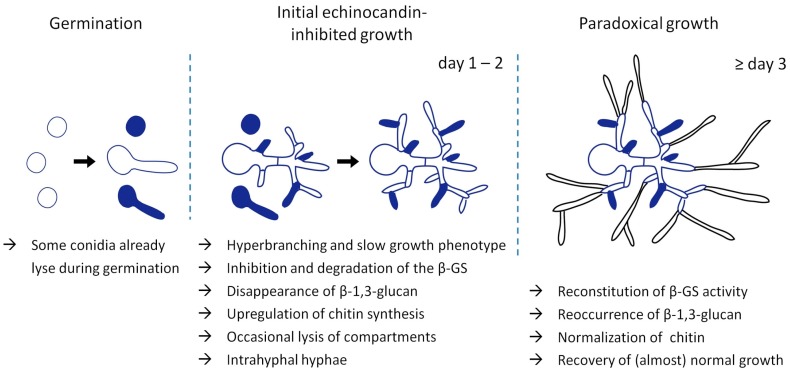
Echinocandin antifungals represent one of the most important drug classes for the treatment of invasive fungal infections. The mode of action of the echinocandins relies on inhibition of the β-1,3-glucan synthase, an enzyme essentially required for the synthesis of the major fungal cell wall carbohydrate β-1,3-glucan. Depending on the species, echinocandins may exert fungicidal or fungistatic activity. Apparently independent of this differential activity, a surprising in vitro phenomenon called the “paradoxical effect” can be observed. The paradoxical effect is characterized by the ability of certain fungal isolates to reconstitute growth in the presence of higher echinocandin concentrations, while being fully susceptible at lower concentrations. The nature of the paradoxical effect is not fully understood and has been the focus of multiple studies in the last two decades. Here we concisely review the current literature and propose an updated model for the paradoxical effect, taking into account recent advances in the field.
Overview
The claims and statistics of this paper haven’t been checked yet.
Free: it reads the open-access text and checks the first 5 claims that cite a source we can check. Create a free account to check every claim.
Integrity signals
Registry
Cites
Statistics
Figures
Verification
Claims the paper makes
The claims and statistics of this paper haven’t been checked yet.
Free: it reads the open-access text and checks the first 5 claims that cite a source we can check. Create a free account to check every claim.
Claims other papers make about this one
Each is checked against this paper’s own text: does it say what the citing paper says it does?
The cited source says what the claim attributes to it.
In the citing paper
“This paradoxical growth also seems to exist in vivo (623–625).”
From Aspergillus fumigatus and Aspergillosis in 2019 (2019) · cites this paper as [625]
Self-check
Percentages, sums and reported differences re-computed from the paper’s own numbers.
The self-check needs the paper’s full text.
Citations
Cites
Pappas, P. G., Kauffman, C. A., Andes, D. R., Clancy, C. J., Marr, K. A., Ostrosky-Zeichner, L., Reboli, A. C., Schuster, M. G., Vazquez, J. A., Walsh, T. J., et al. (2016) · Clinical Infectious Diseases · doi:10.1093/cid/civ933 · Cited by 4,200
Pappas, P. G., Kauffman, C. A., Andes, D. R., Clancy, C. J., Marr, K. A., Ostrosky-Zeichner, L., Reboli, A. C., Schuster, M. G., Vazquez, J. A., Walsh, T. J., et al. (2016) · Clinical Infectious Diseases · doi:10.1093/cid/civ1194 · Cited by 1,298
Micafungin versus Caspofungin for Treatment of Candidemia and Other Forms of Invasive Candidiasis
Pappas, P. G., Rotstein, C. M. F., Betts, R. F., Nucci, M., Talwar, D., De Waele, J. J., Vazquez, J. A., Dupont, B. F., Horn, D. L., Ostrosky-Zeichner, L., et al. (2007) · Clinical Infectious Diseases · doi:10.1086/520980 · Cited by 638
Fungal Cell Wall Organization and Biosynthesis
Free, S. J. (2013) · Advances in Genetics · doi:10.1016/b978-0-12-407677-8.00002-6 · Cited by 576 · cited 1×
“Depending on the fungal species, approximately one-third to four-fifths of the cell wall consists of β-1,3-glucan and its rearrangement derivatives [5].”
BackgroundStimulation of Chitin Synthesis Rescues Candida albicans from Echinocandins
Walker, L. A., Munro, C. A., de Bruijn, I., Lenardon, M. D., McKinnon, A., & Gow, N. A. R. (2008) · PLoS Pathogens · doi:10.1371/journal.ppat.1000040 · Cited by 445 · cited 1×
“albicans the cell wall integrity (CWI), the high osmolarity glycerol (HOG), and the calcineurin signaling pathways mutually stimulate the chitin synthases Chs2 and Chs8 to overcome echinocandin-induced stress [59].”
BackgroundDifferential Expression and Function of Two Homologous Subunits of Yeast 1,3-β-D-Glucan Synthase
Mazur, P., Morin, N., Baginsky, W., el-Sherbeini, M., Clemas, J. A., Nielsen, J. B., & Foor, F. (1995) · Molecular and Cellular Biology · doi:10.1128/mcb.15.10.5671 · Cited by 424
Echinocandin Antifungal Drugs in Fungal Infections: A Comparison
Chen, S. C.-A., Slavin, M. A., & Sorrell, T. C. (2011) · Drugs · doi:10.2165/11585270-000000000-00000 · Cited by 371
Douglas, C. M., D'Ippolito, J. A., Shei, G. J., Meinz, M., Onishi, J., Marrinan, J. A., Li, W., Abruzzo, G. K., Flattery, A., Bartizal, K., et al. (1997) · Antimicrobial Agents and Chemotherapy · doi:10.1128/aac.41.11.2471 · Cited by 344
Garcia-Effron, G., Lee, S., Park, S., Cleary, J. D., & Perlin, D. S. (2009) · Antimicrobial Agents and Chemotherapy · doi:10.1128/aac.00443-09 · Cited by 323
Garcia-Effron, G., Park, S., & Perlin, D. S. (2009) · Antimicrobial Agents and Chemotherapy · doi:10.1128/aac.01162-08 · Cited by 256
Cited by
Aspergillus fumigatus and Aspergillosis in 2019
Latgé, J.-P., & Chamilos, G. (2019) · Clinical Microbiology Reviews · doi:10.1128/cmr.00140-18 · Cited by 1,400
Drug resistance and tolerance in fungi.
Berman, J., & Krysan, D. J. (2020) · Nature Reviews Microbiology · doi:10.1038/s41579-019-0322-2 · Cited by 642
Aspergillus fumigatus and aspergillosis: From basics to clinics
Arastehfar, A., Carvalho, A., Houbraken, J., Lombardi, L., Garcia-Rubio, R., Jenks, J. D., Rivero-Menendez, O., Aljohani, R., Jacobsen, I. D., Berman, J., et al. (2021) · Studies in Mycology · doi:10.1016/j.simyco.2021.100115 · Cited by 241
Ghassemi, N., Poulhazan, A., Deligey, F., Mentink-Vigier, F., Marcotte, I., & Wang, T. (2022) · Chemical Reviews · doi:10.1021/acs.chemrev.1c00669 · Cited by 188
A molecular vision of fungal cell wall organization by functional genomics and solid-state NMR
Chakraborty, A., Fernando, L. D., Fang, W., Dickwella Widanage, M. C., Wei, P., Jin, C., Fontaine, T., Latgé, J.-P., & Wang, T. (2021) · Nature Communications · doi:10.1038/s41467-021-26749-z · Cited by 158
Metadata
- Authors
- Wagener, J., & Loiko, V.
- Affiliations
- University of Würzburg (DE)
- Max-von-Pettenkofer-Institut für Hygiene und Medizinische Mikrobiologie (DE)
- Corresponding author
- Wagener, Johannes
- ORCID
- Wagener, Johannes
- Venue
- Journal of Fungi
- Publisher
- MDPI AG
- Published
- 2017-12-28
- Volume
- 4
- Issue
- 1
- Pages
- 5
- ISSN
- 2309-608X (ISSN-L)
- PMC
- PMC5872308
- OpenAlex
- W2779926281
- Cited by
- 73
- References
- 67
- Citations by year
- 2026: 4 · 2025: 7 · 2024: 6 · 2023: 14 · 2022: 8 · 2021: 12 · 2020: 12 · 2019: 8 · 2018: 2
- FWCI
- 0.92
- Type
- journal article
- Language
- en
- Open access
- gold
- doi.org
- Licence
- Locations
- Journal of Fungi (publishedVersion, cc-by)
- Europe PMC (PubMed Central) (publishedVersion, cc-by)
- PubMed Central (publishedVersion, cc-by)
- PubMed (publishedVersion)
- DOAJ (DOAJ: Directory of Open Access Journals) (submittedVersion, cc-by-sa)
- Open access LMU (Ludwid Maxmilian's Universitat Munchen) (submittedVersion, cc-by)
- Online Publication Service of Würzburg University (Würzburg University) (submittedVersion, cc-by)
- Topics
- Health Sciences › Medicine › Infectious Diseases › Antifungal resistance and susceptibility
- Life Sciences › Biochemistry, Genetics and Molecular Biology › Molecular Biology › Fungal and yeast genetics research
- Health Sciences › Medicine › Infectious Diseases › Fungal Infections and Studies
- Keywords
- echinocandins, paradoxical effects, beta-1,3-glucan synthase, β-1,3-glucan, fungal cell wall, invasive fungal infections, antifungal resistance
About these checks
Registry, retraction, Cites and statistics results are computed, not judged, with one exception: a printed reference that no index lists is read once by a model before it counts as a citation error. Claims are extracted by a model and kept only when their quote appears verbatim in the text; each cited source is then checked, with a model’s help, for whether it says what the claim relies on. Those verdicts can be wrong — read the claim’s quote and the cited source before relying on one.
Statistics and arithmetic are recomputed, not judged.
Confidence bands are shown only for fields calibrated on our annotated test set. None is calibrated yet, so no band is shown.
What counts as a claim ›How we measure confidence ›How we check this ›
Are you an author, or do you see a problem with this page? Request a review
How to cite
Cite CoChat for the checks on this page, and the paper for its own findings.
- This page
- CoChat. (2026). Citation check: Recent Insights into the Paradoxical Effect of Echinocandins. https://app.cochat.ai/papers/10.3390/jof4010005
- The paper
- Wagener, J., & Loiko, V. (2017). Recent Insights into the Paradoxical Effect of Echinocandins. Journal of Fungi. https://doi.org/10.3390/jof4010005
Data sources
Bibliographic data: Semantic Scholar, OpenAlex, Crossref.
Contains information from the Semantic Scholar Academic Graph Datasets, made available under the ODC Attribution License (ODC-BY 1.0).
Semantic Scholar’s data is described in: Kinney, R., et al. (2023). The Semantic Scholar Open Data Platform. arXiv:2301.10140.
