

Recent Insights into the Paradoxical Effect of Echinocandins
Open accessThe DOI matches its Crossref record; 67 of the 67 references it cites were found in a registry or an index.
Abstract
Echinocandin antifungals represent one of the most important drug classes for the treatment of invasive fungal infections. The mode of action of the echinocandins relies on inhibition of the β-1,3-glucan synthase, an enzyme essentially required for the synthesis of the major fungal cell wall carbohydrate β-1,3-glucan. Depending on the species, echinocandins may exert fungicidal or fungistatic activity. Apparently independent of this differential activity, a surprising in vitro phenomenon called the “paradoxical effect” can be observed. The paradoxical effect is characterized by the ability of certain fungal isolates to reconstitute growth in the presence of higher echinocandin concentrations, while being fully susceptible at lower concentrations. The nature of the paradoxical effect is not fully understood and has been the focus of multiple studies in the last two decades. Here we concisely review the current literature and propose an updated model for the paradoxical effect, taking into account recent advances in the field.
Overview
The claims and statistics of this paper haven’t been checked yet.
Free: it reads the open-access text and checks the first 5 claims that cite a source we can check. Create a free account to check every claim.
Integrity signals
Registry
Cites
Statistics
Figures
Verification
Claims the paper makes
The claims and statistics of this paper haven’t been checked yet.
Free: it reads the open-access text and checks the first 5 claims that cite a source we can check. Create a free account to check every claim.
Claims other papers make about this one
Each is checked against this paper’s own text: does it say what the citing paper says it does?
The cited source says what the claim attributes to it.
In the citing paper
“This paradoxical growth also seems to exist in vivo (623–625).”
From Aspergillus fumigatus and Aspergillosis in 2019 (2019) · cites this paper as [625]
Self-check
Percentages, sums and reported differences re-computed from the paper’s own numbers.
The self-check needs the paper’s full text.
Citations
Cites
Pappas, P. G., Kauffman, C. A., Andes, D. R., Clancy, C. J., Marr, K. A., Ostrosky-Zeichner, L., Reboli, A. C., Schuster, M. G., Vazquez, J. A., Walsh, T. J., et al. (2016) · Clinical Infectious Diseases · doi:10.1093/cid/civ933 · Cited by 4,200
Pappas, P. G., Kauffman, C. A., Andes, D. R., Clancy, C. J., Marr, K. A., Ostrosky-Zeichner, L., Reboli, A. C., Schuster, M. G., Vazquez, J. A., Walsh, T. J., et al. (2016) · Clinical Infectious Diseases · doi:10.1093/cid/civ1194 · Cited by 1,298
Micafungin versus Caspofungin for Treatment of Candidemia and Other Forms of Invasive Candidiasis
Pappas, P. G., Rotstein, C. M. F., Betts, R. F., Nucci, M., Talwar, D., De Waele, J. J., Vazquez, J. A., Dupont, B. F., Horn, D. L., Ostrosky-Zeichner, L., et al. (2007) · Clinical Infectious Diseases · doi:10.1086/520980 · Cited by 638
Fungal Cell Wall Organization and Biosynthesis
Free, S. J. (2013) · Advances in Genetics · doi:10.1016/b978-0-12-407677-8.00002-6 · Cited by 576 · cited 1×
“Depending on the fungal species, approximately one-third to four-fifths of the cell wall consists of β-1,3-glucan and its rearrangement derivatives [5].”
BackgroundStimulation of Chitin Synthesis Rescues Candida albicans from Echinocandins
Walker, L. A., Munro, C. A., de Bruijn, I., Lenardon, M. D., McKinnon, A., & Gow, N. A. R. (2008) · PLoS Pathogens · doi:10.1371/journal.ppat.1000040 · Cited by 445 · cited 1×
“albicans the cell wall integrity (CWI), the high osmolarity glycerol (HOG), and the calcineurin signaling pathways mutually stimulate the chitin synthases Chs2 and Chs8 to overcome echinocandin-induced stress [59].”
BackgroundDifferential Expression and Function of Two Homologous Subunits of Yeast 1,3-β-D-Glucan Synthase
Mazur, P., Morin, N., Baginsky, W., el-Sherbeini, M., Clemas, J. A., Nielsen, J. B., & Foor, F. (1995) · Molecular and Cellular Biology · doi:10.1128/mcb.15.10.5671 · Cited by 424
Echinocandin Antifungal Drugs in Fungal Infections: A Comparison
Chen, S. C.-A., Slavin, M. A., & Sorrell, T. C. (2011) · Drugs · doi:10.2165/11585270-000000000-00000 · Cited by 371
Douglas, C. M., D'Ippolito, J. A., Shei, G. J., Meinz, M., Onishi, J., Marrinan, J. A., Li, W., Abruzzo, G. K., Flattery, A., Bartizal, K., et al. (1997) · Antimicrobial Agents and Chemotherapy · doi:10.1128/aac.41.11.2471 · Cited by 344
Garcia-Effron, G., Lee, S., Park, S., Cleary, J. D., & Perlin, D. S. (2009) · Antimicrobial Agents and Chemotherapy · doi:10.1128/aac.00443-09 · Cited by 323
Garcia-Effron, G., Park, S., & Perlin, D. S. (2009) · Antimicrobial Agents and Chemotherapy · doi:10.1128/aac.01162-08 · Cited by 256
Mousset, S., Buchheidt, D., Heinz, W., Ruhnke, M., Cornely, O. A., Egerer, G., Krüger, W., Link, H., Neumann, S., Ostermann, H., et al. (2014) · Annals of Hematology · doi:10.1007/s00277-013-1867-1 · Cited by 255 · cited 1×
“The frequency of echinocandin resistance is generally low, thereby making echinocandins a first choice for empiric therapy of invasive candidiasis [15,16].”
BackgroundStevens, D. A., Espiritu, M., & Parmar, R. (2004) · Antimicrobial Agents and Chemotherapy · doi:10.1128/aac.48.9.3407-3411.2004 · Cited by 217 · cited 4×
“Since RPMI 1640 and SAAMF are both buffered to physiologic conditions, the differences do not solely depend on the pH [18].”
BackgroundInfluentialBetts, R. F., Nucci, M., Talwar, D., Gareca, M., Queiroz‐Telles, F., Bedimo, R. J., Herbrecht, R., Ruiz‐Palacios, G., Young, J. H., Baddley, J. W., et al. (2009) · Clinical Infectious Diseases · doi:10.1086/598933 · Cited by 214
Wiederhold, N. P., Kontoyiannis, D. P., Chi, J., Prince, R. A., Tam, V. H., & Lewis, R. E. (2004) · The Journal of Infectious Diseases · doi:10.1086/424465 · Cited by 207
Thompson, J. R., Douglas, C. M., Li, W., Jue, C. K., Pramanik, B., Yuan, X., Rude, T. H., Toffaletti, D. L., Perfect, J. R., & Kurtz, M. (1999) · Journal of Bacteriology · doi:10.1128/jb.181.2.444-453.1999 · Cited by 196
Stevens, D. A., Ichinomiya, M., Koshi, Y., & Horiuchi, H. (2006) · Antimicrobial Agents and Chemotherapy · doi:10.1128/aac.00563-06 · Cited by 193
Petraitiene, R., Petraitis, V., Groll, A. H., Sein, T., Schaufele, R. L., Francesconi, A., Bacher, J., Avila, N. A., & Walsh, T. J. (2002) · Antimicrobial Agents and Chemotherapy · doi:10.1128/aac.46.1.12-23.2002 · Cited by 182
Chamilos, G., Lewis, R. E., Albert, N., & Kontoyiannis, D. P. (2007) · Antimicrobial Agents and Chemotherapy · doi:10.1128/aac.00095-07 · Cited by 171 · cited 3×
“[21] 60/0/40 (n = 20) 0/0/0 (n = 10) 40/70/20 (n = 10) 90/0/0 (n = 10)”
BackgroundFortwendel, J. R., Juvvadi, P. R., Pinchai, N., Perfect, B. Z., Alspaugh, J. A., Perfect, J. R., & Steinbach, W. J. (2009) · Antimicrobial Agents and Chemotherapy · doi:10.1128/aac.01154-08 · Cited by 161 · cited 2×
“The increase in total chitin synthase activity in the presence of caspofungin has been shown to be calcineurin-dependent [57].”
BackgroundCaspofungin Kills Candida albicans by Causing both Cellular Apoptosis and Necrosis
Hao, B., Cheng, S., Clancy, C. J., & Nguyen, M. H. (2013) · Antimicrobial Agents and Chemotherapy · doi:10.1128/aac.01366-12 · Cited by 157
Fortwendel, J. R., Juvvadi, P. R., Perfect, B. Z., Rogg, L. E., Perfect, J. R., & Steinbach, W. J. (2010) · Antimicrobial Agents and Chemotherapy · doi:10.1128/aac.00854-09 · Cited by 153 · cited 1×
“Of 11 clinical isolates six showed paradoxical growth with caspofungin, two with micafungin, and five with anidulafungin [20,26].”
BackgroundKatiyar, S. K., Alastruey-Izquierdo, A., Healey, K. R., Johnson, M. E., Perlin, D. S., & Edlind, T. D. (2012) · Antimicrobial Agents and Chemotherapy · doi:10.1128/aac.00813-12 · Cited by 148
Heat Shock Protein 90 Is Required for Conidiation and Cell Wall Integrity in Aspergillus fumigatus
Lamoth, F., Juvvadi, P. R., Fortwendel, J. R., & Steinbach, W. J. (2012) · Eukaryotic Cell · doi:10.1128/ec.00032-12 · Cited by 136
Aimanianda, V., Simenel, C., Garnaud, C., Clavaud, C., Tada, R., Barbin, L., Mouyna, I., Heddergott, C., Popolo, L., Ohya, Y., et al. (2017) · mBio · doi:10.1128/mbio.00619-17 · Cited by 135 · cited 1×
“Specialized enzymes may subsequently rearrange the β-1,3-glucan polymers, such as by forming β-1,6-glucan linkages [4], which significantly contribute to the rigidity and dynamics of the cell wall.”
BackgroundAntifungal Pharmacokinetics and Pharmacodynamics
Lepak, A. J., & Andes, D. R. (2015) · Cold Spring Harbor Perspectives in Medicine · doi:10.1101/cshperspect.a019653 · Cited by 134
Dichtl, K., Helmschrott, C., Dirr, F., & Wagener, J. (2012) · Molecular Microbiology · doi:10.1111/j.1365-2958.2011.07946.x · Cited by 133
Self-citationFeldmesser, M., Kress, Y., Mednick, A., & Casadevall, A. (2000) · The Journal of Infectious Diseases · doi:10.1086/317614 · Cited by 130
Preclinical Evaluation of the Stability, Safety, and Efficacy of CD101, a Novel Echinocandin
Ong, V., Hough, G., Schlosser, M., Bartizal, K., Balkovec, J. M., James, K. D., & Krishnan, B. R. (2016) · Antimicrobial Agents and Chemotherapy · doi:10.1128/aac.00701-16 · Cited by 126
Chiou, C. C., Mavrogiorgos, N., Tillem, E., Hector, R., & Walsh, T. J. (2001) · Antimicrobial Agents and Chemotherapy · doi:10.1128/aac.45.12.3310-3321.2001 · Cited by 117 · cited 1×
“It has been shown for multiple fungal species that inhibition of chitin synthesis strengthens the fungicidal activity of echinocandins [23,65,66].”
BackgroundMelo, A. S., Colombo, A. L., & Arthington-Skaggs, B. A. (2007) · Antimicrobial Agents and Chemotherapy · doi:10.1128/aac.00676-07 · Cited by 117 · cited 2×
“Another factor that was repeatedly reported to affect the occurrence of a paradoxical effect is sessile growth within a biofilm as compared to conventional growth as planktonic cells [25,30,31].”
BackgroundStudies of the paradoxical effect of caspofungin at high drug concentrations
Stevens, D. A., White, T. C., Perlin, D. S., & Selitrennikoff, C. P. (2005) · Diagnostic Microbiology and Infectious Disease · doi:10.1016/j.diagmicrobio.2004.10.006 · Cited by 113 · cited 1×
“Many initial hypotheses to explain the paradoxical effect could be excluded: It has been demonstrated that paradoxical growth is not a result of resistance-associated mutations in the β-GS, upregulation of β-GS activity, inactivation, precipitation or degradation of the drug, or selection of a resistant subpopulation…”
BackgroundPfaller, M. A., Messer, S. A., Rhomberg, P. R., Jones, R. N., & Castanheira, M. (2016) · Journal of Antimicrobial Chemotherapy · doi:10.1093/jac/dkw214 · Cited by 103
Dichtl, K., Samantaray, S., Aimanianda, V., Zhu, Z., Prévost, M., Latgé, J., Ebel, F., & Wagener, J. (2015) · Molecular Microbiology · doi:10.1111/mmi.12877 · Cited by 100 · cited 2×
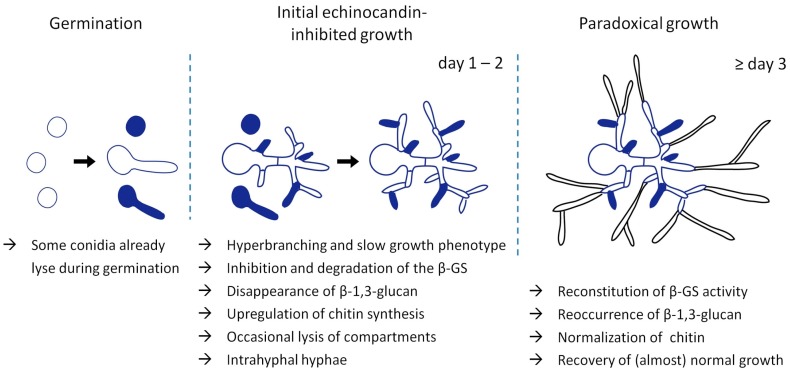
“Importantly, the paradoxically growing hyphae show a rather normal morphology and emerge from an initially growth-inhibited, β-1,3-glucan-depleted, chitin-rich and hyperbranched mycelium that shows frequent hyphal lysis phenomena [14,34] (Figure 1).”
BackgroundSelf-citationAssessment of the Paradoxical Effect of Caspofungin in Therapy of Candidiasis
Clemons, K. V., Espiritu, M., Parmar, R., & Stevens, D. A. (2006) · Antimicrobial Agents and Chemotherapy · doi:10.1128/aac.50.4.1293-1297.2006 · Cited by 99 · cited 1×
“Similar, the results of experimental studies in animal models that explored the potential benefit of high-dose echinocandin therapy against Candida species did not confirm the clinical relevance of the phenomenon [46,47].”
ResultRueda, C., Cuenca-Estrella, M., & Zaragoza, O. (2014) · Antimicrobial Agents and Chemotherapy · doi:10.1128/aac.00946-13 · Cited by 98 · cited 1×
“Many initial hypotheses to explain the paradoxical effect could be excluded: It has been demonstrated that paradoxical growth is not a result of resistance-associated mutations in the β-GS, upregulation of β-GS activity, inactivation, precipitation or degradation of the drug, or selection of a resistant subpopulation…”
BackgroundBizerra, F. C., Melo, A. S. A., Katchburian, E., Freymüller, E., Straus, A. H., Takahashi, H. K., & Colombo, A. L. (2011) · Antimicrobial Agents and Chemotherapy · doi:10.1128/aac.00633-10 · Cited by 91
Ferreira, J. A. G., Carr, J. H., Starling, C. E. F., de Resende, M. A., & Donlan, R. M. (2009) · Antimicrobial Agents and Chemotherapy · doi:10.1128/aac.00316-09 · Cited by 84 · cited 1×
“Another factor that was repeatedly reported to affect the occurrence of a paradoxical effect is sessile growth within a biofilm as compared to conventional growth as planktonic cells [25,30,31].”
BackgroundCD101: a novel long-acting echinocandin
Zhao, Y., Perez, W. B., Jiménez‐Ortigosa, C., Hough, G., Locke, J. B., Ong, V., Bartizal, K., & Perlin, D. S. (2016) · Cellular Microbiology · doi:10.1111/cmi.12640 · Cited by 81
Fleischhacker, M., Radecke, C., Schulz, B., & Ruhnke, M. (2008) · European Journal of Clinical Microbiology & Infectious Diseases · doi:10.1007/s10096-007-0411-4 · Cited by 78 · cited 4×
“, 90% showed paradoxical growth with caspofungin, 63% with micafungin, but none with anidulafungin [22].”
BackgroundInfluentialAntachopoulos, C., Meletiadis, J., Sein, T., Roilides, E., & Walsh, T. J. (2008) · Antimicrobial Agents and Chemotherapy · doi:10.1128/aac.00699-07 · Cited by 76 · cited 4×
“Of 11 clinical isolates six showed paradoxical growth with caspofungin, two with micafungin, and five with anidulafungin [20,26].”
BackgroundMethodResultInfluentialTopological and Mutational Analysis of Saccharomyces cerevisiae Fks1
Johnson, M. E., & Edlind, T. D. (2012) · Eukaryotic Cell · doi:10.1128/ec.00082-12 · Cited by 70 · cited 1×
“The β-GS is a multi-pass membrane protein that is located in the plasma membrane [1].”
BackgroundHall, G. S., Myles, C., Pratt, K. J., & Washington, J. A. (1988) · Antimicrobial Agents and Chemotherapy · doi:10.1128/aac.32.9.1331 · Cited by 67 · cited 1×
“Hall and colleagues reported for the nonclinical echinocandin cilofungin that many isolates of Candida albicans and Candida tropicalis continued to grow in concentrations above that of partial inhibition [17].”
BackgroundCharacterization of the 1,3- -glucan synthase of Aspergillus fumigatus
Beauvais, A., Drake, R., Ng, K., Diaquin, M., & Latge, J. P. (1993) · Journal of General Microbiology · doi:10.1099/00221287-139-12-3071 · Cited by 66 · cited 1×
“It is assumed that the enzyme synthesizes a linear β-1,3-glucan polymer using UDP-glucose monomers as a substrate [2,3].”
BackgroundShields, R. K., Nguyen, M. H., Du, C., Press, E., Cheng, S., & Clancy, C. J. (2011) · Antimicrobial Agents and Chemotherapy · doi:10.1128/aac.00999-10 · Cited by 65 · cited 5×
“[23] 60/13/23 (n = 30) 0/0/0 (n = 34) 4/0/0 (n = 23)”
BackgroundInfluentialStevens, D. A. (2000) · Antimicrobial Agents and Chemotherapy · doi:10.1128/aac.44.9.2547-2548.2000 · Cited by 64 · cited 1×
“It has been shown for multiple fungal species that inhibition of chitin synthesis strengthens the fungicidal activity of echinocandins [23,65,66].”
BackgroundLamoth, F., Juvvadi, P. R., Gehrke, C., Asfaw, Y. G., & Steinbach, W. J. (2014) · The Journal of Infectious Diseases · doi:10.1093/infdis/jit530 · Cited by 62 · cited 1×
“Similar to the cnaA and crzA mutants, inhibition of Hsp90 function results in increased caspofungin susceptibility and abolishes paradoxical growth [62,63].”
BackgroundSemisynthetic echinocandins affect cell wall deposition of Pneumocystis carinii in vitro and in vivo
Bartlett, M. S., Current, W. L., Goheen, M. P., Boylan, C. J., Lee, C. H., Shaw, M. M., Queener, S. F., & Smith, J. W. (1996) · Antimicrobial Agents and Chemotherapy · doi:10.1128/aac.40.8.1811 · Cited by 58
Moreno-Velásquez, S. D., Seidel, C., Juvvadi, P. R., Steinbach, W. J., & Read, N. D. (2017) · Antimicrobial Agents and Chemotherapy · doi:10.1128/aac.00710-17 · Cited by 57 · cited 1×
“As soon as paradoxical growth begins, the β-GS showed renewed localization at the hyphal tips [64].”
BackgroundLewis, R. E., Albert, N. D., & Kontoyiannis, D. P. (2008) · Journal of Antimicrobial Chemotherapy · doi:10.1093/jac/dkn069 · Cited by 56 · cited 2×
“However, these results should be considered with some caution because they are solely based on measuring the metabolic activity of Aspergillus mycelium [27].”
BackgroundResultLoiko, V., & Wagener, J. (2017) · Antimicrobial Agents and Chemotherapy · doi:10.1128/aac.01690-16 · Cited by 51 · cited 6×
“fumigatus besides inhibition of the β-GS at very high concentrations [34].”
BackgroundSelf-citationPharmacokinetics of the Novel Echinocandin CD101 in Multiple Animal Species
Ong, V., James, K. D., Smith, S., & Krishnan, B. R. (2017) · Antimicrobial Agents and Chemotherapy · doi:10.1128/aac.01626-16 · Cited by 51
Frost, D. J., Brandt, K., Capobianco, J., & Goldman, R. (1994) · Microbiology · doi:10.1099/13500872-140-9-2239 · Cited by 49 · cited 1×
“It is assumed that the enzyme synthesizes a linear β-1,3-glucan polymer using UDP-glucose monomers as a substrate [2,3].”
BackgroundEchinocandin Resistance in Candida Species: a Review of Recent Developments
Wiederhold, N. P. (2016) · Current Infectious Disease Reports · doi:10.1007/s11908-016-0549-2 · Cited by 49
Paradoxical echinocandin activity: a limited in vitro phenomenon?
Wiederhold, N. P. (2009) · Medical Mycology · doi:10.1080/13693780802428542 · Cited by 48
SAFDAR, A. Y. E. S. H. A., Rodriguez, G., Rolston, K. V. I., O'Brien, S. M., Khouri, I. F., Shpall, E. J., Keating, M. J., Kantarjian, H. M., Champlin, R. E., RAAD, I. I., et al. (2007) · Bone Marrow Transplantation · doi:10.1038/sj.bmt.1705559 · Cited by 45
Potential Microbiological Effects of Higher Dosing of Echinocandins
Steinbach, W. J., Lamoth, F., & Juvvadi, P. R. (2015) · Clinical Infectious Diseases · doi:10.1093/cid/civ725 · Cited by 41
Elefanti, A., Mouton, J. W., Krompa, K., Al-Saigh, R., Verweij, P. E., Zerva, L., & Meletiadis, J. (2013) · Antimicrobial Agents and Chemotherapy · doi:10.1128/aac.01573-12 · Cited by 27 · cited 1×
“fumigatus and other Aspergillus species [28].”
Moretti, S., Bozza, S., D'Angelo, C., Casagrande, A., Della Fazia, M. A., Pitzurra, L., Romani, L., & Aversa, F. (2012) · Antimicrobial Agents and Chemotherapy · doi:10.1128/aac.05198-11 · Cited by 24
Walraven, C. J., Bernardo, S. M., Wiederhold, N. P., & Lee, S. A. (2014) · Medical Mycology · doi:10.1093/mmy/myt007 · Cited by 23 · cited 2×
“Another factor that was repeatedly reported to affect the occurrence of a paradoxical effect is sessile growth within a biofilm as compared to conventional growth as planktonic cells [25,30,31].”
BackgroundBayegan, S., Majoros, L., Kardos, G., Kemény-Beke, A., Miszti, C., Kovacs, R., & Gesztelyi, R. (2010) · The Journal of Microbiology · doi:10.1007/s12275-010-9221-y · Cited by 21 · cited 1×
“tropicalis isolate treated with caspofungin [51].”
Safety of high-dose micafungin for patients with hematological diseases
Yamazaki, S., Nakamura, F., Yoshimi, A., Ichikawa, M., Nannya, Y., & Kurokawa, M. (2014) · Leukemia & lymphoma/Leukemia and lymphoma · doi:10.3109/10428194.2014.885514 · Cited by 21
Mariné, M., Pastor, F. J., Sahand, I. H., Pontón, J., Quindós, G., & Guarro, J. (2009) · Antimicrobial Agents and Chemotherapy · doi:10.1128/aac.00980-09 · Cited by 20 · cited 1×
“Similar, the results of experimental studies in animal models that explored the potential benefit of high-dose echinocandin therapy against Candida species did not confirm the clinical relevance of the phenomenon [46,47].”
ResultMarcos-Zambrano, L. J., Escribano, P., Sánchez‐Carrillo, C., Bouza, E., & Guinea, J. (2016) · Antimicrobial Agents and Chemotherapy · doi:10.1128/aac.01584-16 · Cited by 20 · cited 5×
“[24] 10/<1/11 (n = 291) 0/2/3 (n = 62) 62/38/48 (n = 50) 6/1/1 (n = 164)”
BackgroundMethodInfluentialShields, R. K., Nguyen, M. H., Press, E. G., & Clancy, C. J. (2011) · Antimicrobial Agents and Chemotherapy · doi:10.1128/aac.00095-11 · Cited by 18 · cited 1×
“Interestingly, the intermittent exposure not only suppressed paradoxical growth but additionally increased the fungicidal activity of caspofungin when compared to unaltered or renewed drug exposure [32,33].”
BackgroundThe Postantifungal and Paradoxical Effects of Echinocandins Against Candida spp.
Moriyama, B., Henning, S. A., Penzak, S. R., & Walsh, T. J. (2012) · Future Microbiology · doi:10.2217/fmb.12.31 · Cited by 15 · cited 1×
“Interestingly, the intermittent exposure not only suppressed paradoxical growth but additionally increased the fungicidal activity of caspofungin when compared to unaltered or renewed drug exposure [32,33].”
BackgroundSafdar, A., Rodriguez, G. H., Zuniga, J., Akhrass, F. A., & Pande, A. (2013) · Journal of Pharmacy Practice · doi:10.1177/0897190013515927 · Cited by 14
Influence of Serum and Albumin on Echinocandin In Vitro Potency and Pharmacodynamics
Nasar, A., Ryan, L., Frei, C. R., Cota, J. M., & Wiederhold, N. P. (2013) · Current Fungal Infection Reports · doi:10.1007/s12281-013-0136-z · Cited by 11 · cited 1×
“) of echinocandins is controversial and was summarized and discussed elsewhere [29].”
Background
Cited by
Aspergillus fumigatus and Aspergillosis in 2019
Latgé, J.-P., & Chamilos, G. (2019) · Clinical Microbiology Reviews · doi:10.1128/cmr.00140-18 · Cited by 1,400
Drug resistance and tolerance in fungi.
Berman, J., & Krysan, D. J. (2020) · Nature Reviews Microbiology · doi:10.1038/s41579-019-0322-2 · Cited by 642
Aspergillus fumigatus and aspergillosis: From basics to clinics
Arastehfar, A., Carvalho, A., Houbraken, J., Lombardi, L., Garcia-Rubio, R., Jenks, J. D., Rivero-Menendez, O., Aljohani, R., Jacobsen, I. D., Berman, J., et al. (2021) · Studies in Mycology · doi:10.1016/j.simyco.2021.100115 · Cited by 241
Ghassemi, N., Poulhazan, A., Deligey, F., Mentink-Vigier, F., Marcotte, I., & Wang, T. (2022) · Chemical Reviews · doi:10.1021/acs.chemrev.1c00669 · Cited by 188
A molecular vision of fungal cell wall organization by functional genomics and solid-state NMR
Chakraborty, A., Fernando, L. D., Fang, W., Dickwella Widanage, M. C., Wei, P., Jin, C., Fontaine, T., Latgé, J.-P., & Wang, T. (2021) · Nature Communications · doi:10.1038/s41467-021-26749-z · Cited by 158
Metadata
- Authors
- Wagener, J., & Loiko, V.
- Affiliations
- University of Würzburg (DE)
- Max-von-Pettenkofer-Institut für Hygiene und Medizinische Mikrobiologie (DE)
- Corresponding author
- Wagener, Johannes
- ORCID
- Wagener, Johannes
- Venue
- Journal of Fungi
- Publisher
- MDPI AG
- Published
- 2017-12-28
- Volume
- 4
- Issue
- 1
- Pages
- 5
- ISSN
- 2309-608X (ISSN-L)
- PMC
- PMC5872308
- OpenAlex
- W2779926281
- Cited by
- 73
- References
- 67
- Citations by year
- 2026: 4 · 2025: 7 · 2024: 6 · 2023: 14 · 2022: 8 · 2021: 12 · 2020: 12 · 2019: 8 · 2018: 2
- FWCI
- 0.92
- Type
- journal article
- Language
- en
- Open access
- gold
- doi.org
- Licence
- Locations
- Journal of Fungi (publishedVersion, cc-by)
- Europe PMC (PubMed Central) (publishedVersion, cc-by)
- PubMed Central (publishedVersion, cc-by)
- PubMed (publishedVersion)
- DOAJ (DOAJ: Directory of Open Access Journals) (submittedVersion, cc-by-sa)
- Open access LMU (Ludwid Maxmilian's Universitat Munchen) (submittedVersion, cc-by)
- Online Publication Service of Würzburg University (Würzburg University) (submittedVersion, cc-by)
- Topics
- Health Sciences › Medicine › Infectious Diseases › Antifungal resistance and susceptibility
- Life Sciences › Biochemistry, Genetics and Molecular Biology › Molecular Biology › Fungal and yeast genetics research
- Health Sciences › Medicine › Infectious Diseases › Fungal Infections and Studies
- Keywords
- echinocandins, paradoxical effects, beta-1,3-glucan synthase, β-1,3-glucan, fungal cell wall, invasive fungal infections, antifungal resistance
About these checks
Registry, retraction, Cites and statistics results are computed, not judged, with one exception: a printed reference that no index lists is read once by a model before it counts as a citation error. Claims are extracted by a model and kept only when their quote appears verbatim in the text; each cited source is then checked, with a model’s help, for whether it says what the claim relies on. Those verdicts can be wrong — read the claim’s quote and the cited source before relying on one.
Statistics and arithmetic are recomputed, not judged.
Confidence bands are shown only for fields calibrated on our annotated test set. None is calibrated yet, so no band is shown.
What counts as a claim ›How we measure confidence ›How we check this ›
Are you an author, or do you see a problem with this page? Request a review
Data sources
Bibliographic data: Semantic Scholar, OpenAlex, Crossref.
Contains information from the Semantic Scholar Academic Graph Datasets, made available under the ODC Attribution License (ODC-BY 1.0).
Semantic Scholar’s data is described in: Kinney, R., et al. (2023). The Semantic Scholar Open Data Platform. arXiv:2301.10140.
